
BIOMECHANIC S CONCEPTS BIOMECHANICS Study of Biological Systems
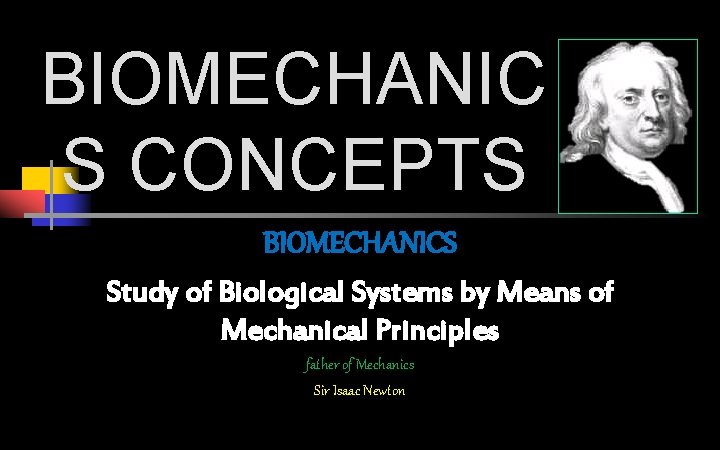
BIOMECHANIC S CONCEPTS BIOMECHANICS Study of Biological Systems by Means of Mechanical Principles father of Mechanics Sir Isaac Newton

BIOMECHANICS Biology Skeletal system Muscular system Physics Nervous system Mechanics Kinetics 15 -Feb-22 P. Ratan (MPT, Ortho & Sports) Kinematics 2

HUMAN MOVEMENT ANALYSIS BIOMECHANICS KINETICS KINESIOLOGY KINEMATICS Linear Angular Position Velocity Acceleration Force Torque 15 -Feb-22 P. Ratan (MPT, Ortho & Sports) FUNCTIONAL 3

Basic types of Motion n Linear n n Rectilinear Curvilinear Angular or rotational Combined or general 15 -Feb-22 P. Ratan (MPT, Ortho & Sports) 4
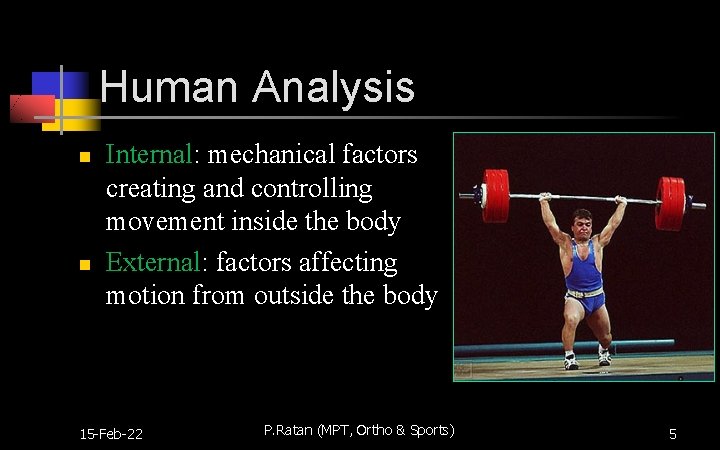
Human Analysis n n Internal: mechanical factors creating and controlling movement inside the body External: factors affecting motion from outside the body 15 -Feb-22 P. Ratan (MPT, Ortho & Sports) 5
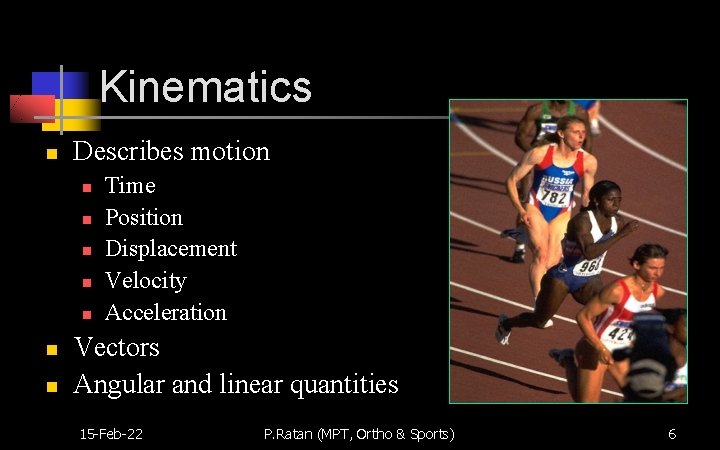
Kinematics n Describes motion n n n Time Position Displacement Velocity Acceleration Vectors Angular and linear quantities 15 -Feb-22 P. Ratan (MPT, Ortho & Sports) 6
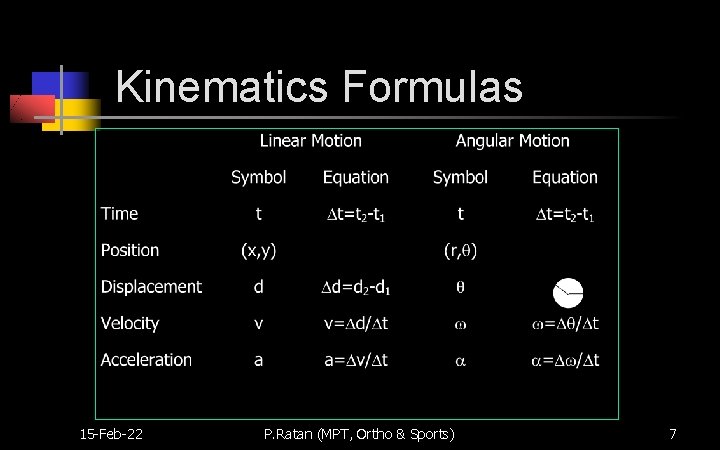
Kinematics Formulas 15 -Feb-22 P. Ratan (MPT, Ortho & Sports) 7
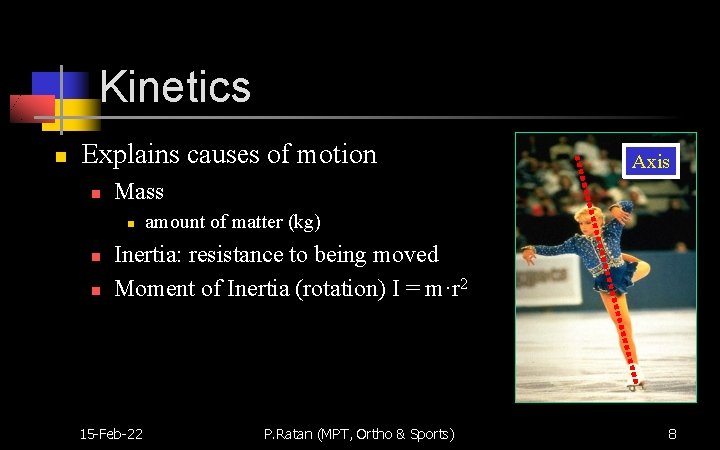
Kinetics n Explains causes of motion n Mass n n n Axis amount of matter (kg) Inertia: resistance to being moved Moment of Inertia (rotation) I = m·r 2 15 -Feb-22 P. Ratan (MPT, Ortho & Sports) 8
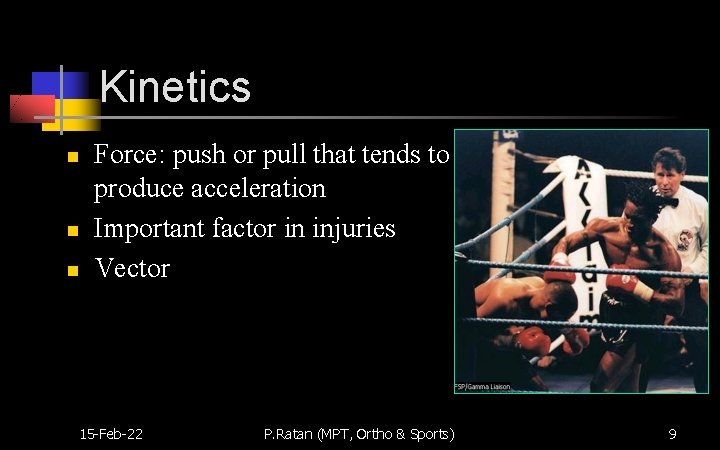
Kinetics n n n Force: push or pull that tends to produce acceleration Important factor in injuries Vector 15 -Feb-22 P. Ratan (MPT, Ortho & Sports) 9
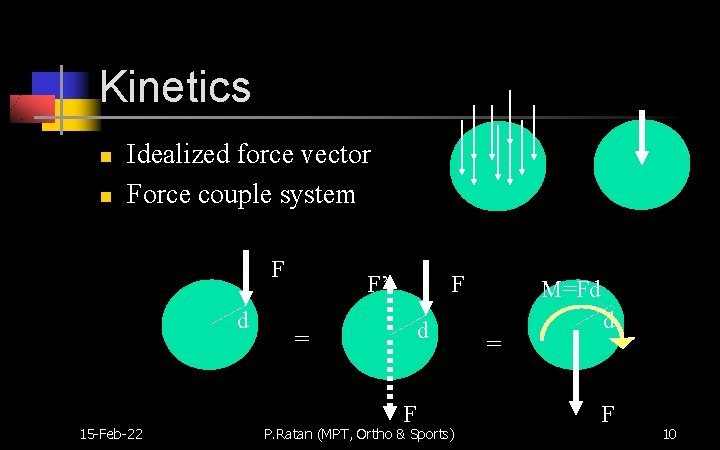
Kinetics n n Idealized force vector Force couple system F d 15 -Feb-22 F’ F d = F P. Ratan (MPT, Ortho & Sports) M=Fd = d F 10
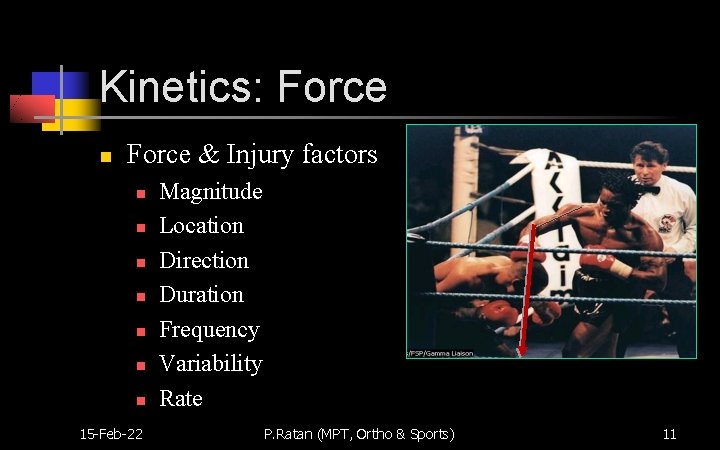
Kinetics: Force n Force & Injury factors n n n n 15 -Feb-22 Magnitude Location Direction Duration Frequency Variability Rate P. Ratan (MPT, Ortho & Sports) 11
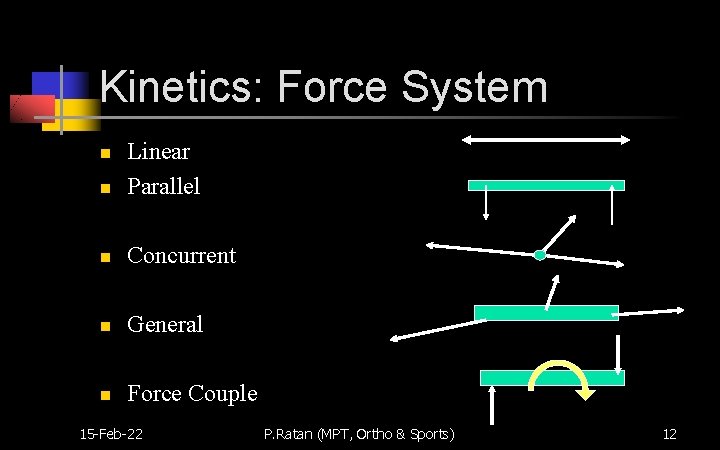
Kinetics: Force System n Linear Parallel n Concurrent n General n Force Couple n 15 -Feb-22 P. Ratan (MPT, Ortho & Sports) 12
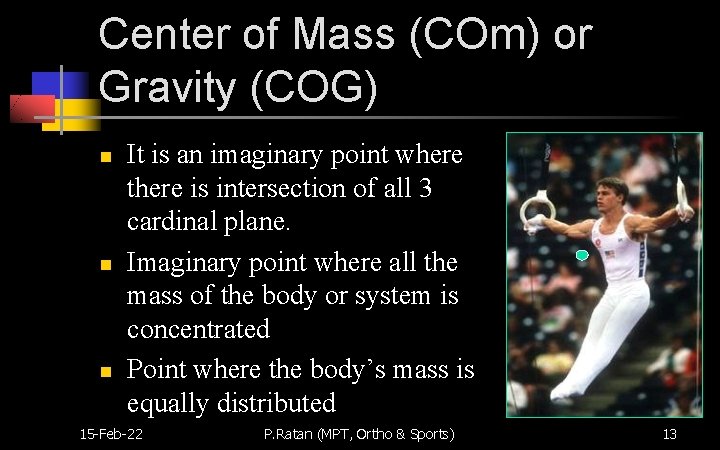
Center of Mass (COm) or Gravity (COG) n n n It is an imaginary point where there is intersection of all 3 cardinal plane. Imaginary point where all the mass of the body or system is concentrated Point where the body’s mass is equally distributed 15 -Feb-22 P. Ratan (MPT, Ortho & Sports) 13
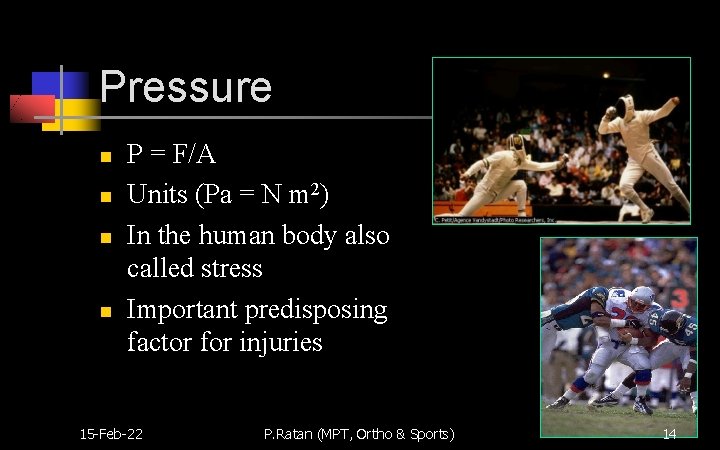
Pressure n n P = F/A Units (Pa = N m 2) In the human body also called stress Important predisposing factor for injuries 15 -Feb-22 P. Ratan (MPT, Ortho & Sports) 14

Moments of Force (Torque) n n Effect of a force that tends to cause rotation about an axis M = F ·d (Nm) n n If F and d are Force through axis 15 -Feb-22 P. Ratan (MPT, Ortho & Sports) 15
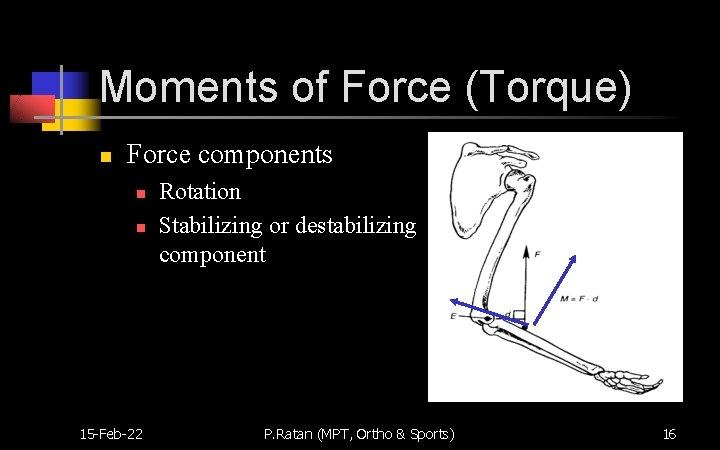
Moments of Force (Torque) n Force components n n 15 -Feb-22 Rotation Stabilizing or destabilizing component P. Ratan (MPT, Ortho & Sports) 16
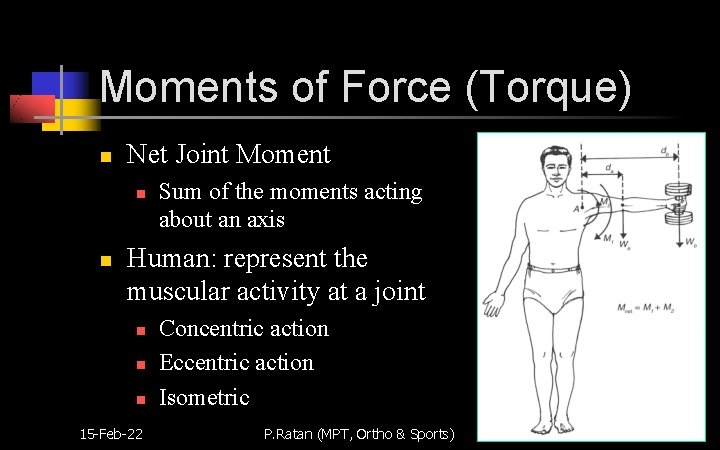
Moments of Force (Torque) n Net Joint Moment n n Sum of the moments acting about an axis Human: represent the muscular activity at a joint n n n 15 -Feb-22 Concentric action Eccentric action Isometric P. Ratan (MPT, Ortho & Sports) 17
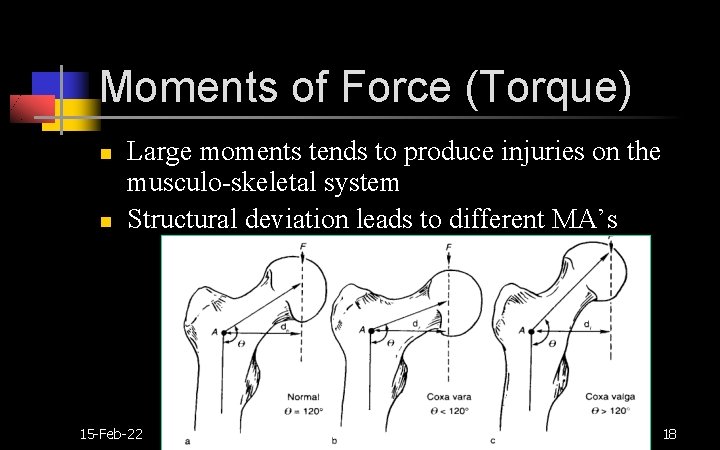
Moments of Force (Torque) n n Large moments tends to produce injuries on the musculo-skeletal system Structural deviation leads to different MA’s 15 -Feb-22 P. Ratan (MPT, Ortho & Sports) 18
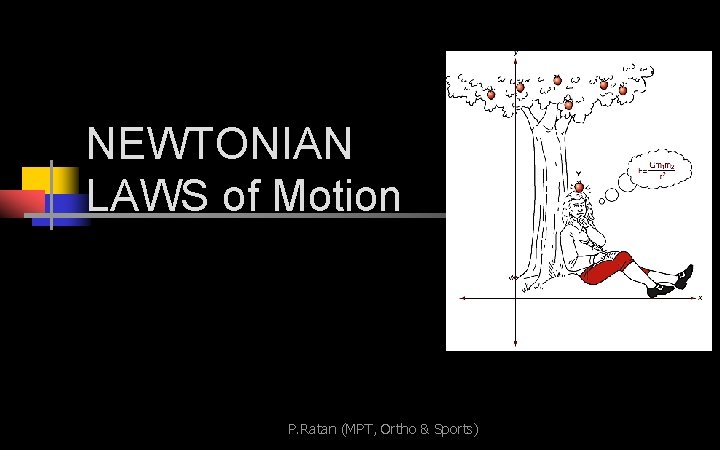
NEWTONIAN LAWS of Motion P. Ratan (MPT, Ortho & Sports)
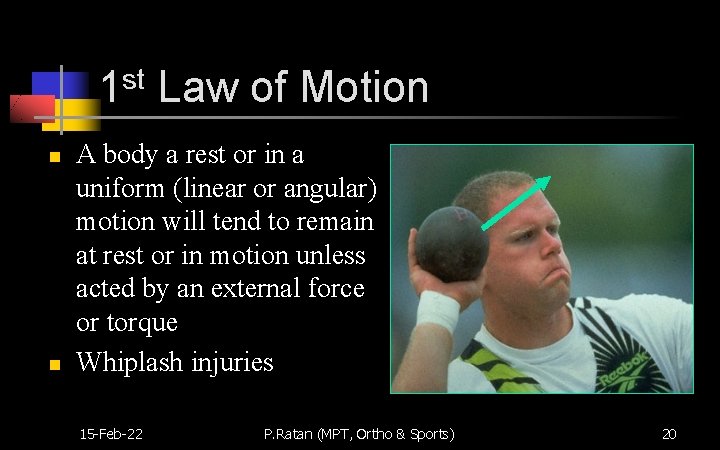
1 st Law of Motion n n A body a rest or in a uniform (linear or angular) motion will tend to remain at rest or in motion unless acted by an external force or torque Whiplash injuries 15 -Feb-22 P. Ratan (MPT, Ortho & Sports) 20
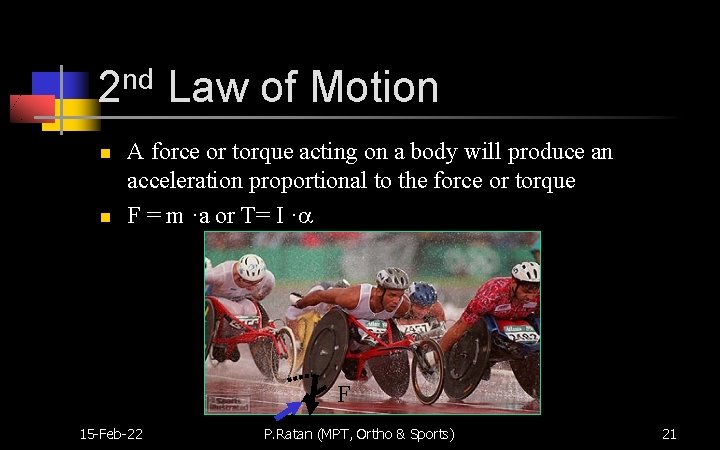
2 nd Law of Motion n n A force or torque acting on a body will produce an acceleration proportional to the force or torque F = m ·a or T= I · F 15 -Feb-22 P. Ratan (MPT, Ortho & Sports) 21
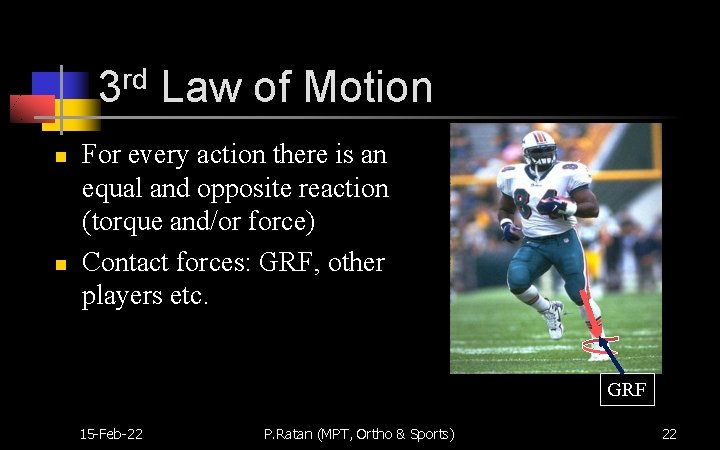
3 rd Law of Motion n n For every action there is an equal and opposite reaction (torque and/or force) Contact forces: GRF, other players etc. GRF 15 -Feb-22 P. Ratan (MPT, Ortho & Sports) 22
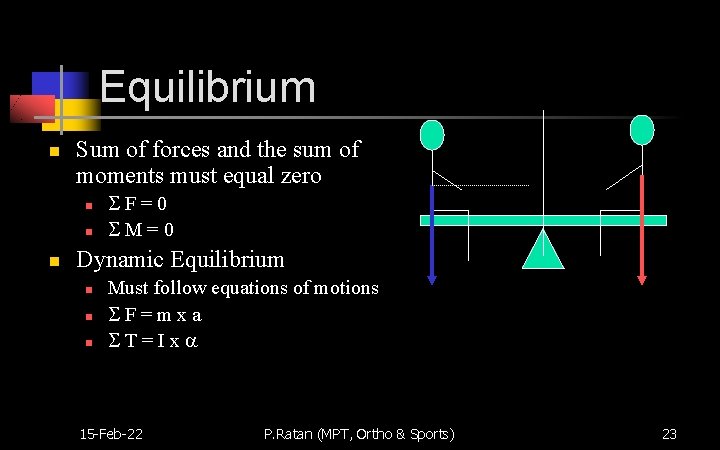
Equilibrium n Sum of forces and the sum of moments must equal zero n n n F=0 M=0 Dynamic Equilibrium n n n Must follow equations of motions F=mxa T=Ix 15 -Feb-22 P. Ratan (MPT, Ortho & Sports) 23
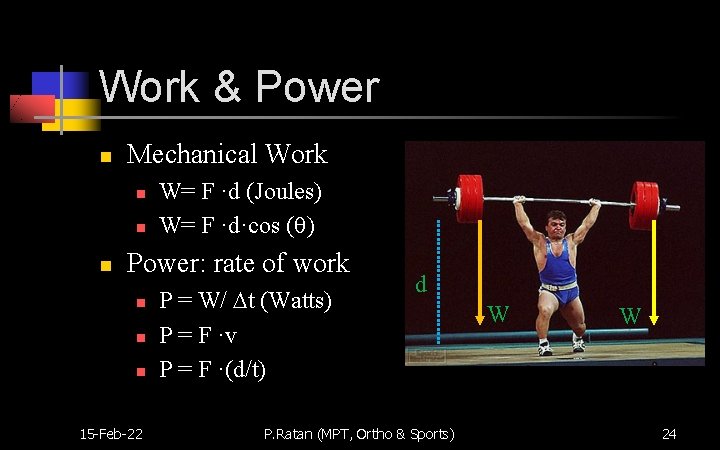
Work & Power n Mechanical Work n n n W= F ·d (Joules) W= F ·d·cos ( ) Power: rate of work n n n 15 -Feb-22 P = W/ t (Watts) P = F ·v P = F ·(d/t) d P. Ratan (MPT, Ortho & Sports) W W 24
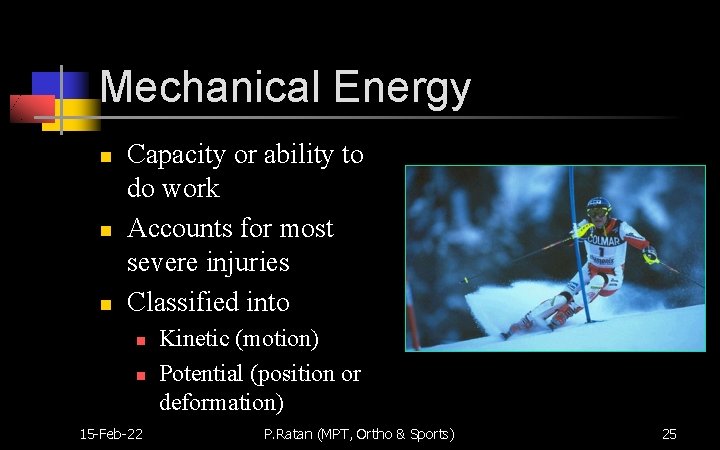
Mechanical Energy n n n Capacity or ability to do work Accounts for most severe injuries Classified into n n 15 -Feb-22 Kinetic (motion) Potential (position or deformation) P. Ratan (MPT, Ortho & Sports) 25
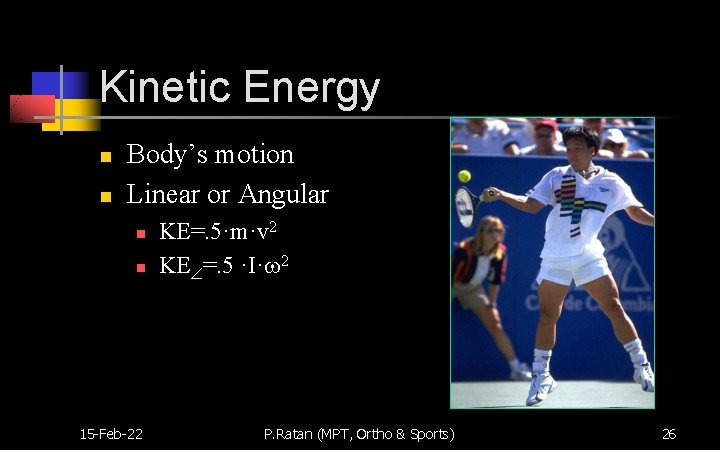
Kinetic Energy n n Body’s motion Linear or Angular n n 15 -Feb-22 KE=. 5·m·v 2 KE =. 5 ·I· 2 P. Ratan (MPT, Ortho & Sports) 26
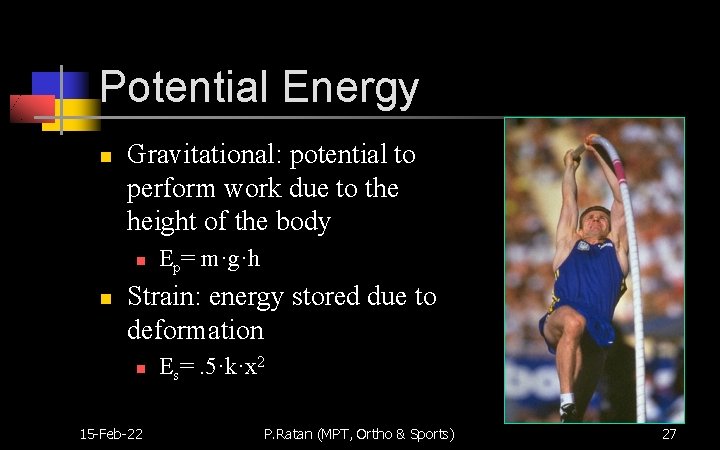
Potential Energy n Gravitational: potential to perform work due to the height of the body n n Ep= m·g·h Strain: energy stored due to deformation n 15 -Feb-22 Es=. 5·k·x 2 P. Ratan (MPT, Ortho & Sports) 27
Total Mechanical Energy n n Body segment’s: rigid (nodeformable), no strain energy in the system TME = Sum of KE, KE , PE TME = (. 5·m ·v 2)+(. 5 ·I · 2)+(m ·g ·h ) 15 -Feb-22 P. Ratan (MPT, Ortho & Sports) 28
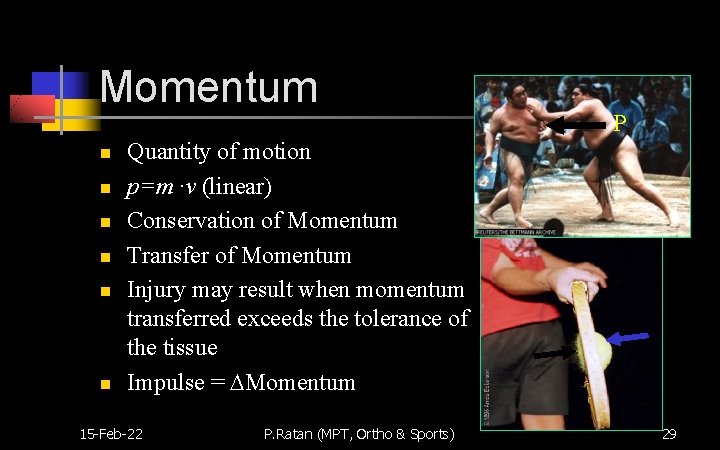
Momentum n n n P Quantity of motion p=m ·v (linear) Conservation of Momentum Transfer of Momentum Injury may result when momentum transferred exceeds the tolerance of the tissue Impulse = Momentum 15 -Feb-22 P. Ratan (MPT, Ortho & Sports) 29
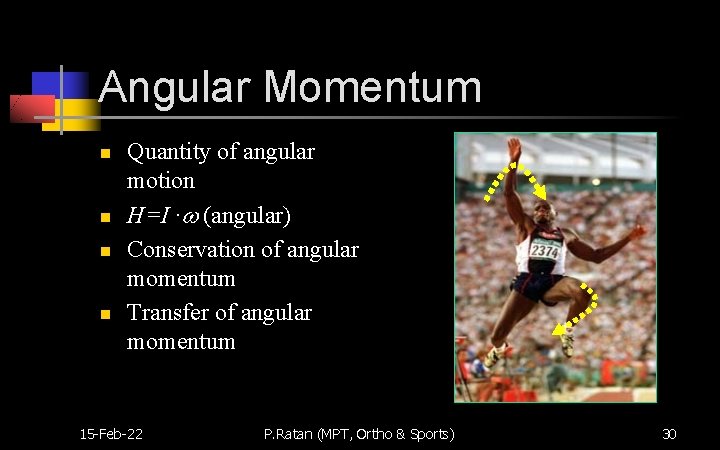
Angular Momentum n n Quantity of angular motion H=I · (angular) Conservation of angular momentum Transfer of angular momentum 15 -Feb-22 P. Ratan (MPT, Ortho & Sports) 30
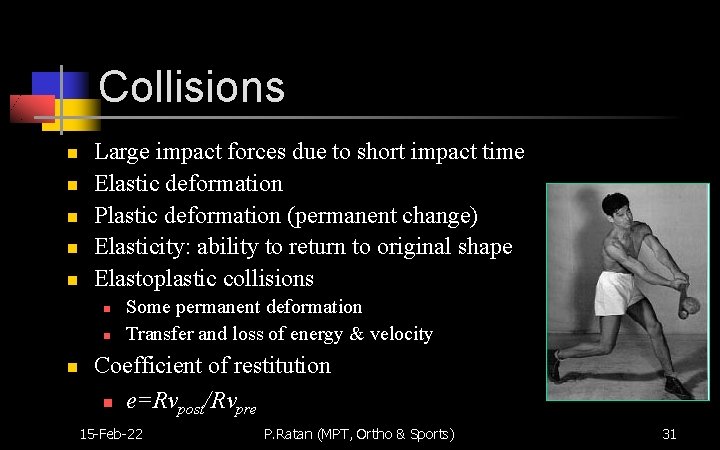
Collisions n n n Large impact forces due to short impact time Elastic deformation Plastic deformation (permanent change) Elasticity: ability to return to original shape Elastoplastic collisions n n n Some permanent deformation Transfer and loss of energy & velocity Coefficient of restitution n e=Rvpost/Rvpre 15 -Feb-22 P. Ratan (MPT, Ortho & Sports) 31
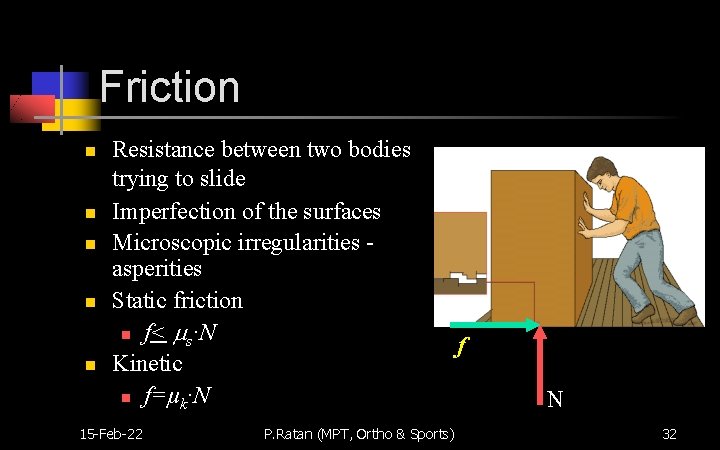
Friction n n Resistance between two bodies trying to slide Imperfection of the surfaces Microscopic irregularities asperities Static friction n f< s·N Kinetic n f=µk·N 15 -Feb-22 P. Ratan (MPT, Ortho & Sports) f N 32
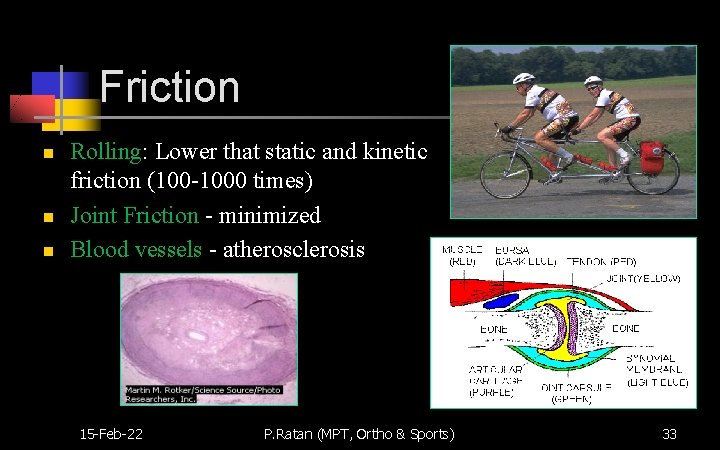
Friction n Rolling: Lower that static and kinetic friction (100 -1000 times) Joint Friction - minimized Blood vessels - atherosclerosis 15 -Feb-22 P. Ratan (MPT, Ortho & Sports) 33
FLUID MECHANICS Branch of Mechanics Dealing with the Properties & Behaviors of Gases & Fluids
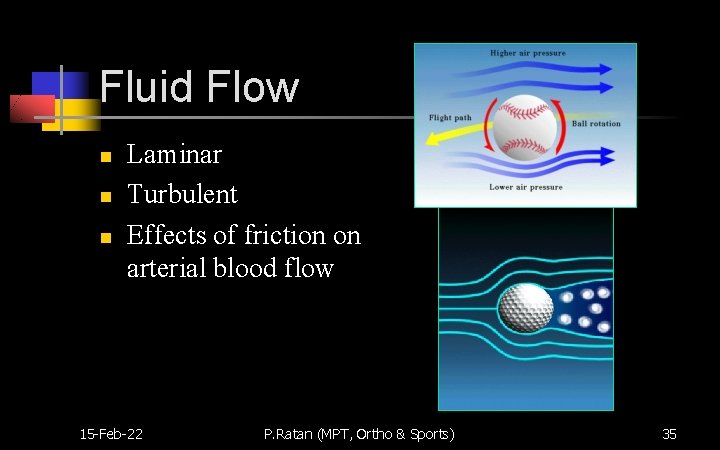
Fluid Flow n n n Laminar Turbulent Effects of friction on arterial blood flow 15 -Feb-22 P. Ratan (MPT, Ortho & Sports) 35

Fluid Forces n n Buoyancy Drag n n n n Surface Pressure Wave Lift Magnus forces Viscosity Biological tissue must have a fluid component 15 -Feb-22 P. Ratan (MPT, Ortho & Sports) 36
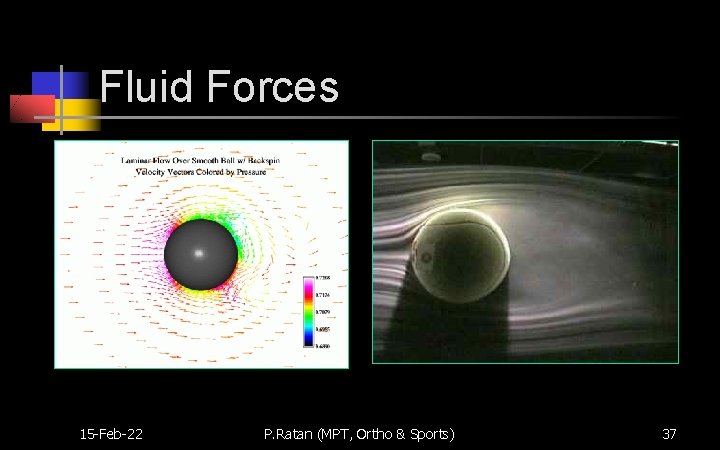
Fluid Forces 15 -Feb-22 P. Ratan (MPT, Ortho & Sports) 37
- Slides: 37