
Biomarkers Physiological Laboratory Markers of Drug Effect Janet
Biomarkers: Physiological & Laboratory Markers of Drug Effect Janet Woodcock, M. D. Deputy Commissioner and Chief Medical Officer Food and Drug Administration February 1, 2007
Definitions n n Markers of drug effect or response (laboratory, physiological, or other) are a subset of the general class of biomarkers Other biomarkers may include diagnostic, prognostic or physiologic status information not linked to drug response
Biomarker Definition n “A characteristic that is objectively measured and evaluated as an indicator of normal biologic processes, pathogenic processes, or pharmacologic responses to a therapeutic intervention” BIOMARKERS DEFINITIONS WORKING GROUP: BIOMARKERS AND SURROGATE ENDPOINTS: PREFERRED DEFINITIONS AND CONCEPTUAL FRAMEWORK. CLIN PHARMACOL THER 2001; 69: 89 -95. n FDA Pharmacogenomics Guidance further defines possible, probable and known valid biomarker categories depending on available scientific information on the marker
Clinical Endpoint Definition n n “A characteristic or variable that reflects how a patient feels, functions or survives” (Note that, except for survival, assessing these involves some sort of intermediary measurement) Clinical endpoints are usually acceptable for evidence of efficacy for regulatory purposes In contrast, many types of biomarkers are used for safety assessment
Surrogate Endpoint Definition n A biomarker intended to substitute for a clinical endpoint. A surrogate endpoint is expected to predict clinical benefit (or harm, or lack of benefit) based on epidemiologic, therapeutic, pathophysiologic or other scientific evidence
SURROGATE ENDPOINT A surrogate endpoint of a clinical trial is a laboratory measurement or a physical sign used as a substitute for a clinically meaningful endpoint that measures directly how a patient feels, functions or survives. Changes induced by a therapy on a surrogate endpoint are expected to reflect changes in a clinically meaningful endpoint. Robert J. Temple
SURROGATE MARKER Use of this term is discouraged because it suggests that the substitution is for a marker rather than for a clinical endpoint BIOMARKERS DEFINITIONS WORKING GROUP: BIOMARKERS AND SURROGATE ENDPOINTS: PREFERRED DEFINITIONS AND CONCEPTUAL FRAMEWORK. CLIN PHARMACOL THER 2001; 69: 89 -95.
Why Are Biomarkers Important? n n Diagnosis is the foundation of therapy Biomarkers are quantitative measures that allow us to diagnose and assess the disease process and monitor response to treatment Biomarkers are also crucial to efficient medical product development As a consequence of scientific, economic and regulatory factors, biomarker development has lagged significantly behind therapeutic development
Use of Biomarkers in Early Drug Development and Decision Making n n Evaluate activity in animal models Bridge animal and human pharmacology via proo -of-mechanism or other observations Evaluate safety in animal models, e. g. , toxicogenomics Evaluate human safety early in development
Use of Biomarkers in Later Drug Development and Decision Making n Evaluate dose-response and optimal regimen for desired pharmacologic effect n Use safety markers to determine dose-response for toxicity n Determine role (if any) of differences in metabolism on above Rolan. Br J Phamacol 44: 219, 1997
Use of Surrogate Endpoints in Late Drug Development n n n Efficacy: Use to assess whether drug has clinically significant efficacy Surrogate endpoints may be used to support “accelerated approval” of a drug if the surrogate is deemed reasonably likely to predict a clinical endpoint of interest A few surrogate endpoints (e. g. , blood pressure) are acceptable for full approval
Use of Biomarkers in Clinical Practice n Disease and disease subtype diagnosis n Prognostic determination n Selection of appropriate therapy n n Maximize efficacy Minimize toxicity n Selection of correct dose n Monitoring outcomes (good and bad)
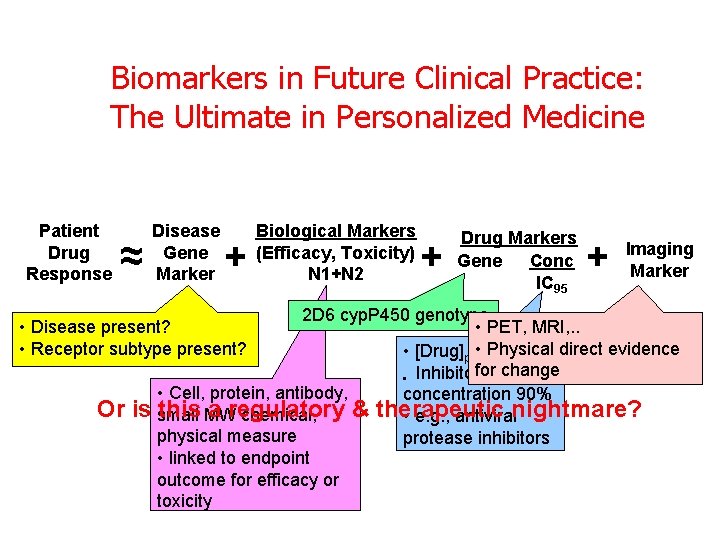
Biomarkers in Future Clinical Practice: The Ultimate in Personalized Medicine Patient Drug Response ≈ Disease Gene Marker + + Drug Markers Gene Conc IC 95 + Imaging Marker 2 D 6 cyp. P 450 genotype • PET, MRI, . . • Physical direct evidence • [Drug]plasma(free) for change • Inhibitory • Cell, protein, antibody, concentration 90% is small this MW a regulatory & therapeutic chemical, • e. g. , antiviralnightmare? physical measure protease inhibitors • linked to endpoint outcome for efficacy or toxicity • Disease present? • Receptor subtype present? Or Biological Markers (Efficacy, Toxicity) N 1+N 2
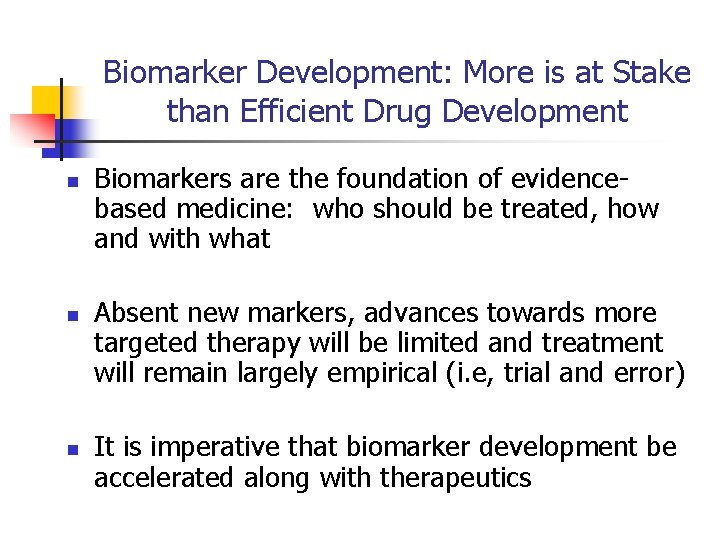
Biomarker Development: More is at Stake than Efficient Drug Development n n n Biomarkers are the foundation of evidencebased medicine: who should be treated, how and with what Absent new markers, advances towards more targeted therapy will be limited and treatment will remain largely empirical (i. e, trial and error) It is imperative that biomarker development be accelerated along with therapeutics
Problem: Classic Thinking about Biomarkers Inhibits New Biomarker Development n n Development of biomarkers “confounded” with the surrogate endpoint issue Near impossibility of “validating” new surrogates has created a significant barrier I will present the classic view first (slides courtesy of Dr. Art Atkinson) and then a proposal for a new framework Note: classic view not “wrong” as much as limiting
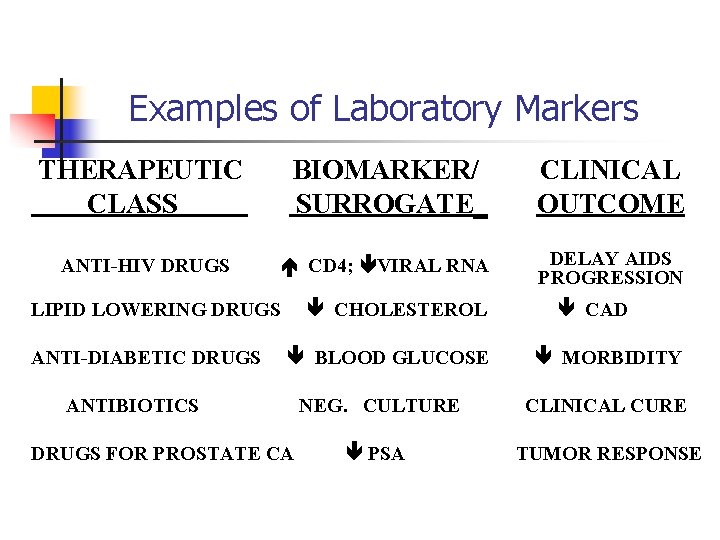
Examples of Laboratory Markers THERAPEUTIC CLASS BIOMARKER/ SURROGATE_ CLINICAL OUTCOME ANTI-HIV DRUGS CD 4; VIRAL RNA DELAY AIDS PROGRESSION CHOLESTEROL LIPID LOWERING DRUGS ANTI-DIABETIC DRUGS BLOOD GLUCOSE ANTIBIOTICS DRUGS FOR PROSTATE CA CAD MORBIDITY NEG. CULTURE CLINICAL CURE PSA TUMOR RESPONSE
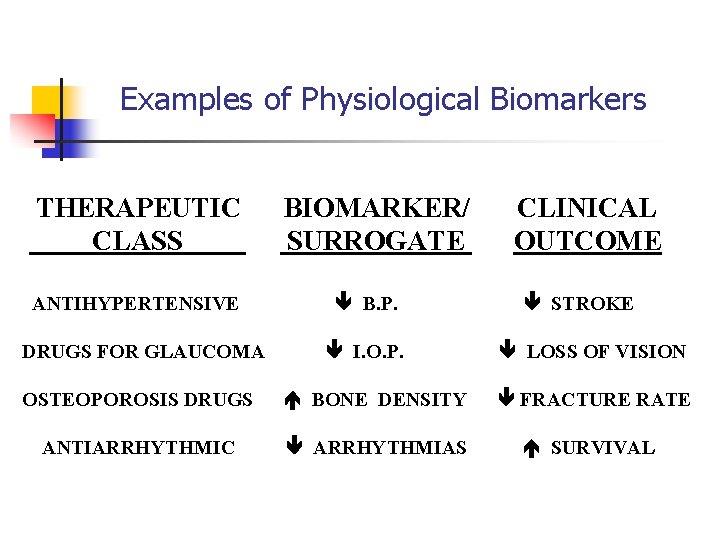
Examples of Physiological Biomarkers THERAPEUTIC CLASS ANTIHYPERTENSIVE DRUGS FOR GLAUCOMA BIOMARKER/ SURROGATE B. P. I. O. P. CLINICAL OUTCOME STROKE LOSS OF VISION OSTEOPOROSIS DRUGS BONE DENSITY FRACTURE RATE ANTIARRHYTHMIC ARRHYTHMIAS SURVIVAL

The Most Widely Used Surrogate Endpoint* BLOOD LEVELS USED AS A SURROGATE FOR CLINICAL EFFICACY AND TOXICITY IN THE EVALUATION OF GENERIC DRUGS * Comment by Carl Peck: CDDS WORKSHOP, Mc. Lean, VA, May 13, 1998
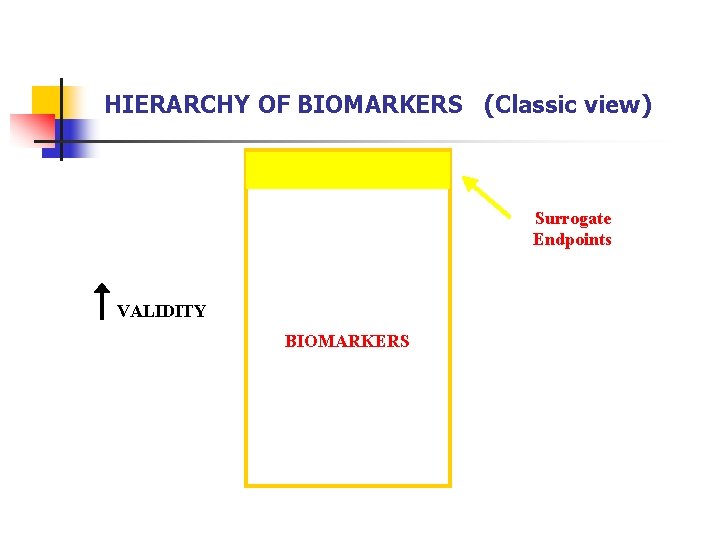
HIERARCHY OF BIOMARKERS (Classic view) Surrogate Endpoints VALIDITY BIOMARKERS

HIERARCHY OF BIOMARKERS* (Classic view) TYPE 0: NATURAL HISTORY MARKER (Prognosis) TYPE I: BIOLOGICAL ACTIVITY MARKER (Responds to therapy) TYPE II: SINGLE OR MULTIPLE MARKER(S) OF THERAPEUTIC EFFICACY (Surrogate endpoint, accounts fully for clinical efficacy) * Mildvan D, et al. : Clin Infect Dis 1997; 24: 764 -74.
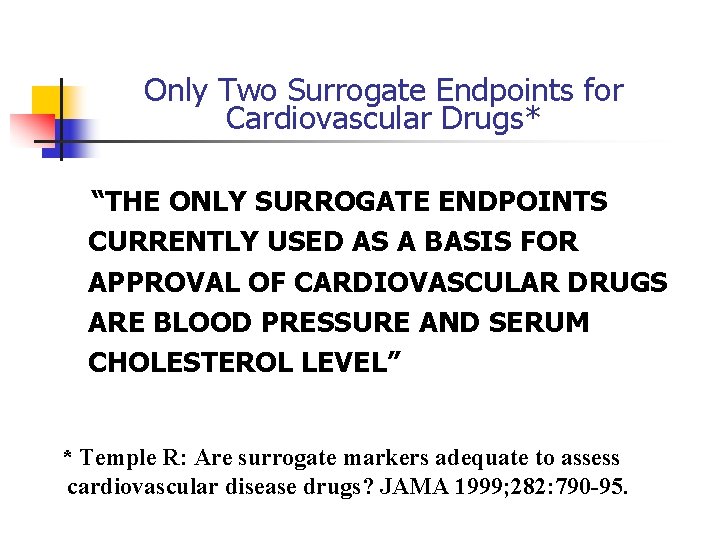
Only Two Surrogate Endpoints for Cardiovascular Drugs* “THE ONLY SURROGATE ENDPOINTS CURRENTLY USED AS A BASIS FOR APPROVAL OF CARDIOVASCULAR DRUGS ARE BLOOD PRESSURE AND SERUM CHOLESTEROL LEVEL” * Temple R: Are surrogate markers adequate to assess cardiovascular disease drugs? JAMA 1999; 282: 790 -95.
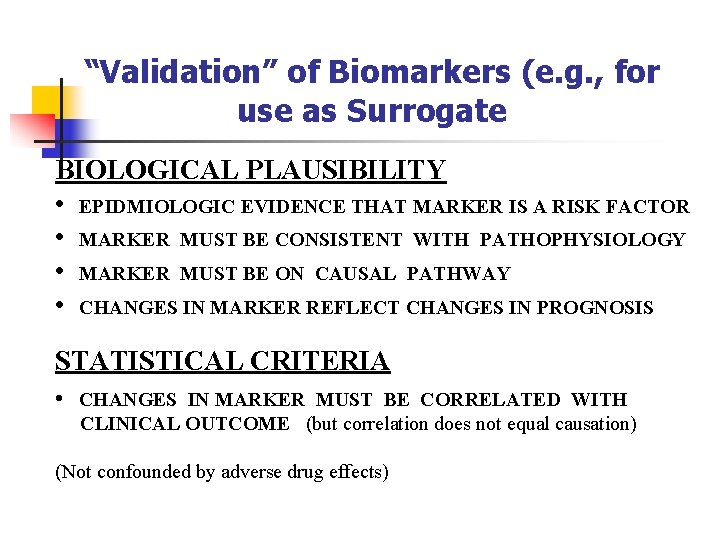
“Validation” of Biomarkers (e. g. , for use as Surrogate BIOLOGICAL PLAUSIBILITY • EPIDMIOLOGIC EVIDENCE THAT MARKER IS A RISK FACTOR • MARKER MUST BE CONSISTENT WITH PATHOPHYSIOLOGY • MARKER MUST BE ON CAUSAL PATHWAY • CHANGES IN MARKER REFLECT CHANGES IN PROGNOSIS STATISTICAL CRITERIA • CHANGES IN MARKER MUST BE CORRELATED WITH CLINICAL OUTCOME (but correlation does not equal causation) (Not confounded by adverse drug effects)
ADDITIONAL SUPPORT FOR BIOMARKER as SURROGATE* SUCCESS IN CLINICAL TRIALS • EFFECT ON SURROGATE HAS PREDICTED OUTCOME WITH OTHER DRUGS OF SAME PHARMACOLOGIC CLASS • EFFECT ON SURROGATE HAS PREDICTED OUTCOME FOR DRUGS IN SEVERAL PHARMACOLOGIC CLASSES OTHER BENEFIT/RISK CONSIDERATIONS • SERIOUS OR LIFE-THREATENING ILLNESS WITH NO ALTERNATIVE THERAPY • • • LARGE SAFETY DATA BASE SHORT-TERM USE DIFFICULTY IN STUDYING CLINICAL ENDPOINT * Temple R: JAMA 1999; 282: 790 -5.

Problems with Current Biomarker Conceptual Framework n n n Overemphasis on “surrogacy” as single objective of biomarker development Difficulty in achieving surrogate “validation” frustrates progress New science and technology will contribute numerous candidate biomarkers—require path forward
Fate of Most Candidate Biomarkers n n n Discovered in academic laboratory Clinical series results published Further small academic series published Some uptake in academic centers in clinical care Assay may be commercialized as laboratory service
Fate of Most Candidate Biomarkers n Small number may be developed into commercially available laboratory tests n Fewer may become integrated into clinical care n Evidence base for use often remains slim/controversial n Not adopted for regulatory use because of absence of needed evidence
Limitations of Current Conceptual and Developmental Framework n n n Practical business and conceptual models for biomarker development are lacking Consequence: no rigorous pursuit of evidence to develop marker or to assemble data for regulatory approval Exploration of clinical relevance is generally ad hoc
Urgent Need to Overcome Current Obstacles n n n New opportunities to link biomarker development to the drug development process to spur assessment of new markers Requires clear regulatory framework for the technical evaluation that is required Need to identify new business models
Future of Drug Development and Biomarker Development Tightly Linked n n n Biomarkers represent bridge between mechanistic understanding of preclinical development and empirical clinical evaluation Regulatory system has been focused on empirical testing: skewing overall clinical evaluation towards “all empirical” Mechanistic clinical evaluation lacking
Pursuit of Surrogacy § Surrogate EP supposed to “completely correlate with the clinical endpoint” § This is not possible and has led to serious (but I would argue, misplaced) disillusionment with the use of biomarkers § Flemming TR, De. Mets DL: Surrogate endpoints in clinical trials: are we being misled? Ann Intern Med 1996; 125: 605 -13
Limitation of Current Conceptual Framework for Development of Surrogate Endpoints n n Current model for surrogacy based largely on cardiovascular and HIV experiences in the 1990’s CAST outcome: n n Surrogate: suppression of VBP’s Mortality increased in treatment arms Temple. “A regulatory authority’s opinion about surrogate endpoints”. Clinical Measurement in Drug Evaluation. Wiley and Sons. 1995
Surrogate Endpoint Development n n n HIV epidemic spurred the use of new surrogate endpoints for antiretroviral therapy Rigorous statistical criteria for assessing correlation of candidate surrogate with clinical outcome were published* No surrogate EP has ever met these criteria *Prentice. Stat in Med 8: 431, 1989
Surrogate Endpoint Development n HIV RNA copy number is now used as early drug development tool, surrogate endpoint in trials, and for clinical monitoring of antiviral therapy n Lack of complete correlation with clinical outcomes has not compromised utility n Successful development of antiretrovirals and control of HIV infection
Fundamental Problems with the Current Conceptual Framework for Surrogate Endpoints n There is no “gold standard” clinical outcome measurement – concept of “ultimate” clinical outcome is flawed n Survival: data show that desirability of longer survival dependent on quality of life, in many individuals’ estimation. n Generalizability of any single outcome measure (e. g. , mortality) can be limited by trial parameters (e. g. , who was entered) n Confusion between desirability of prolonged observation (for safety and long term outcomes) and use of surrogate
Fundamental Problems with Current Conceptual Framework for Surrogate Endpoint Development n n n Patient outcomes are multidimensional—a single outcome measure (whether clinical or surrogate endpoint) can miss domains of interest. Very difficult to capture both benefit and harm within a single measure—very unlikely for a biomarker. The concept of “ultimate clinical outcome” includes parameters such as duration of observation that are important dimensions. However, knowledge about these dimensions could be acquired outside of the biomarker measurement
Additional Problems with Surrogate Endpoint Framework n n n Per-patient view of outcomes very different from population mean view of outcomes. For example, “ultimate” benefit in survival of 8% over placebo not meaningful to you if you are not in the 8% who actually respond Newer (and older, e. g. , metabolizing enzymes) biomarkers provide information at the individual level
Towards the Robust Use of Biomarkers in Drug Development n n Implement new biomarker use throughout preclinical and clinical development “Qualify” biomarker for intended use: less focus on surrogacy Goal is understanding mechanistic bases for individual response to therapy to increase informativeness of development process Achieve more predictable drug development and therapeutic outcomes
Towards Robust Use of Biomarkers in Drug Development n n n Biomarkers must be studied in order to be “qualified” for an intended use Add-on costs in clinical trials have been a significant barrier, as have trial organization issues Requires government-academic-industry collaboration and focus
Towards the Robust Use of Biomarkers in Drug Development n n n FDA’s Critical Path Initiative: proposal to use consortia to qualify biomarkers through resource sharing Currently such consortia are being set up in areas such as animal safety testing and overall biomarker development Clinical safety biomarkers of great interest
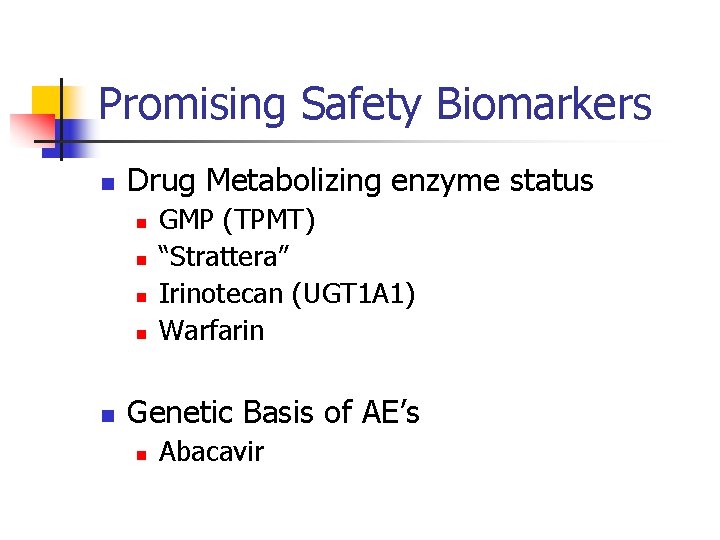
Promising Safety Biomarkers n Drug Metabolizing enzyme status n n n GMP (TPMT) “Strattera” Irinotecan (UGT 1 A 1) Warfarin Genetic Basis of AE’s n Abacavir
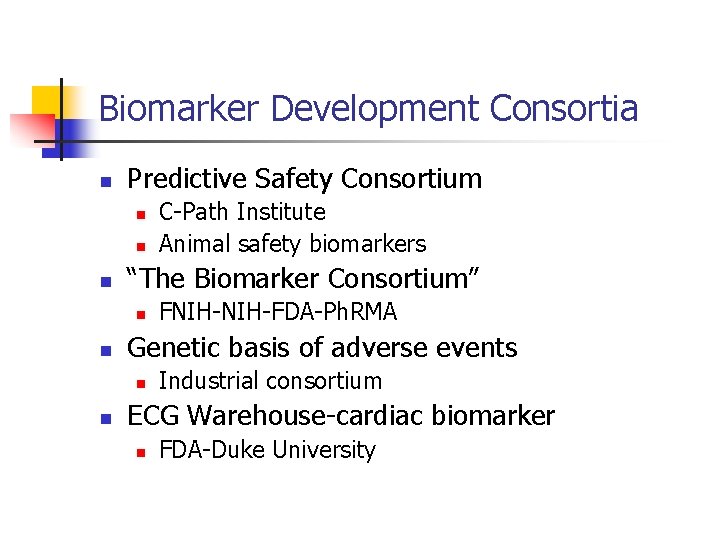
Biomarker Development Consortia n Predictive Safety Consortium n n n “The Biomarker Consortium” n n FNIH-FDA-Ph. RMA Genetic basis of adverse events n n C-Path Institute Animal safety biomarkers Industrial consortium ECG Warehouse-cardiac biomarker n FDA-Duke University
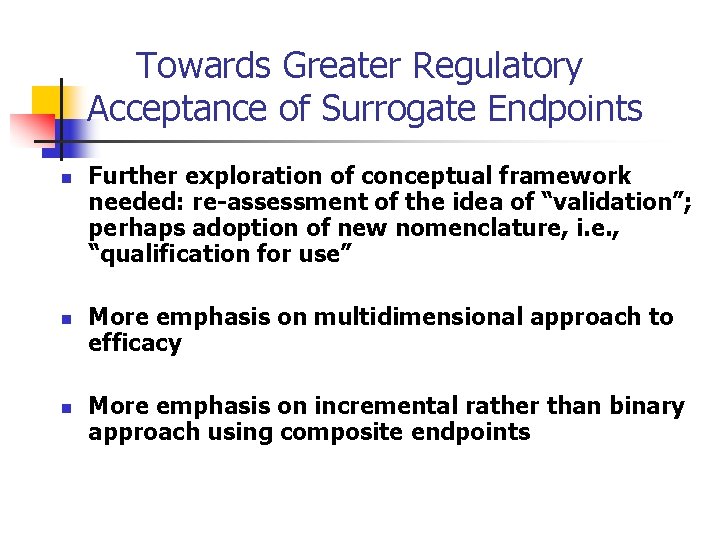
Towards Greater Regulatory Acceptance of Surrogate Endpoints n n n Further exploration of conceptual framework needed: re-assessment of the idea of “validation”; perhaps adoption of new nomenclature, i. e. , “qualification for use” More emphasis on multidimensional approach to efficacy More emphasis on incremental rather than binary approach using composite endpoints
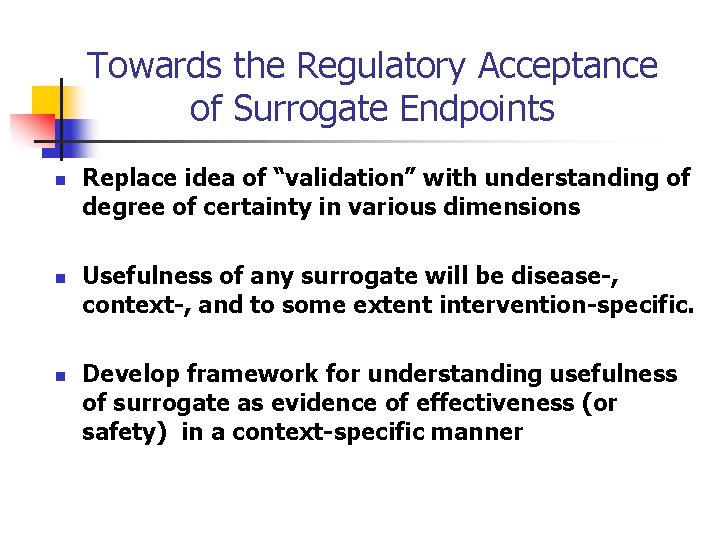
Towards the Regulatory Acceptance of Surrogate Endpoints n n n Replace idea of “validation” with understanding of degree of certainty in various dimensions Usefulness of any surrogate will be disease-, context-, and to some extent intervention-specific. Develop framework for understanding usefulness of surrogate as evidence of effectiveness (or safety) in a context-specific manner
Summary n n Important public health need for development of additional biomarkers to target and monitor therapy This requires use in clinical trials during drug development Business model/regulatory path for such markers is not clear to industry Clarification and stimulus required
Summary n n n Definitions for biomarkers, clinical outcomes and surrogate endpoints have been developed Further development of the model needed in order to increase use and utility of markers in drug development Single measurements will rarely capture all dimensions of clinical outcomes
Summary n n A multidimensional and continuous model needs to replace the current single dimension, binary model of clinical effect Outcomes happen to people, not populations. In order to target therapy, individual outcomes, (e. g. responder analyses, individual AEs etc. ) will need to be correlated with biomarker status
Summary n n FDA is developing these concepts as part of its “Critical Path” Initiative. Development will include process for refining general framework as well as individual projects on biomarker and surrogate endpoint development
- Slides: 47