
BIOLPHYS 438 Logistics Ch 4 Fluids in the
BIOL/PHYS 438 ● Logistics ● Ch. 4: “Fluids in the Body” wrapup Flow in Pipes ● Viscosity, Reynolds number & Turbulence ● Blood Circulation: Aortas to Capillaries Transport of Dissolved Gases

Logistics Assignment 1: login, update, Email anytime! Assignment 2: due Today Assignment 3: due Thursday 15 Feb Assignment 4: Thu 15 Feb → Tue after Break Spring Break: 17 -25 Feb: work on Project too!

Viscosity • • Units: poiseuille (Pl): 1 Pl = 1 Pa • s = 1 kg • m-1 • s-1 = 10 poise = 103 c. P (centipoise). (H 2 O @ 20ºC: ≈ 1 c. P)
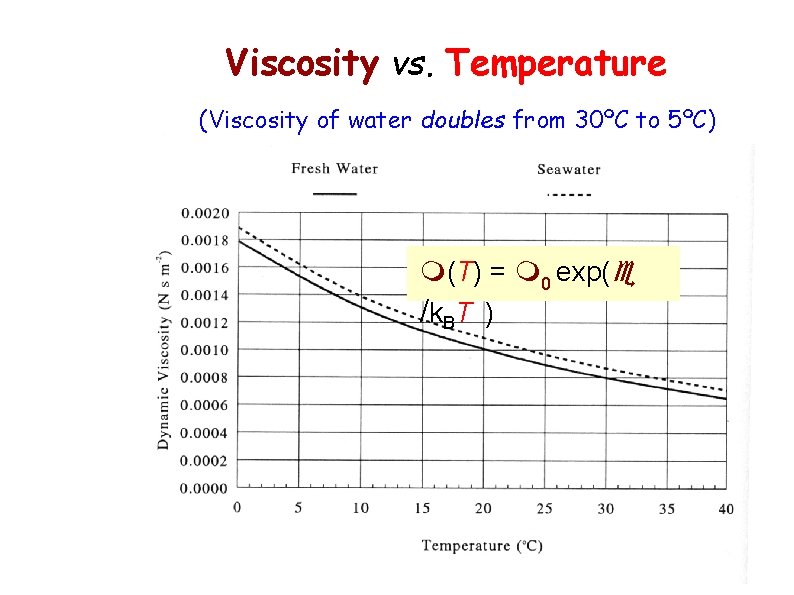
Viscosity vs. Temperature (Viscosity of water doubles from 30ºC to 5ºC) (T) = 0 exp( /k. BT )

Reynolds Number (Re) The Reynolds number is the ratio of dynamic pressure ru 2 to shearing stress u/L : Re = u L / n where u = velocity of fluid flow (or velocity of object through fluid), L = characteristic length (e. g. diameter of pipe or that of object moving through fluid) and n = kinematic viscosity of fluid: n ≡ /r Flow through a pipe is turbulent for Re > 2300.
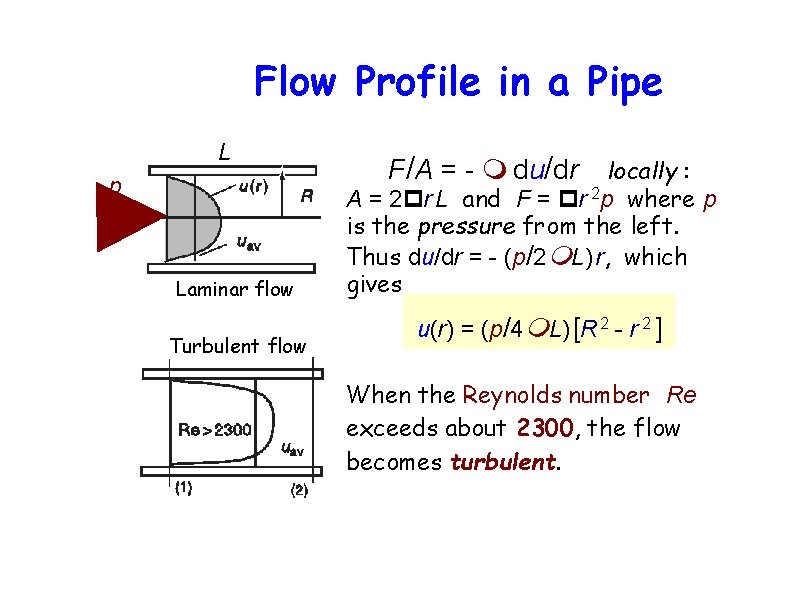
Flow Profile in a Pipe L p Laminar flow Turbulent flow F/A = - du/dr locally : A = 2 pr L and F = pr 2 p where p is the pressure from the left. Thus du/dr = - (p/2 m. L) r, which gives u(r) = (p/4 m. L) [R 2 - r 2 ] When the Reynolds number Re exceeds about 2300, the flow becomes turbulent.
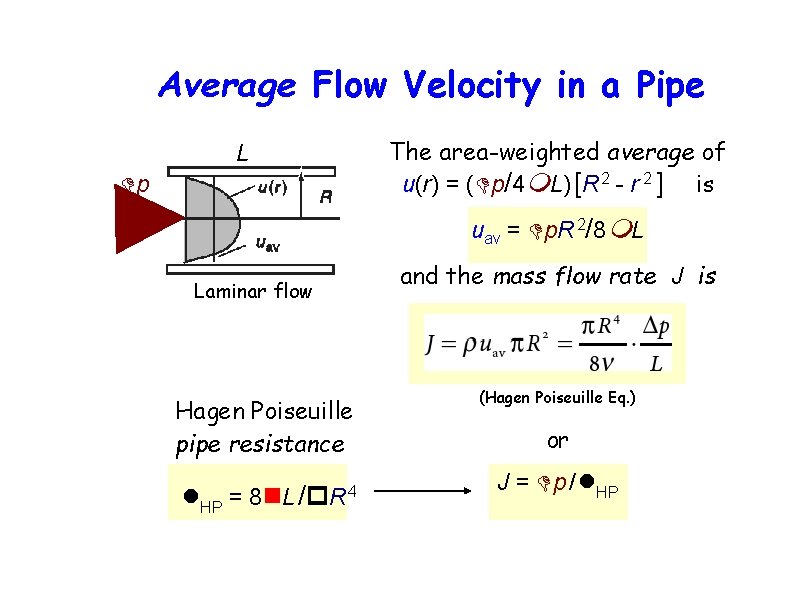
Average Flow Velocity in a Pipe The area-weighted average of u(r) = (Dp/4 m. L) [R 2 - r 2 ] is L Dp uav = Dp. R 2/8 m. L and the mass flow rate J is Laminar flow Hagen Poiseuille pipe resistance l. HP = 8 n. L /p R 4 (Hagen Poiseuille Eq. ) or J = Dp / l. HP
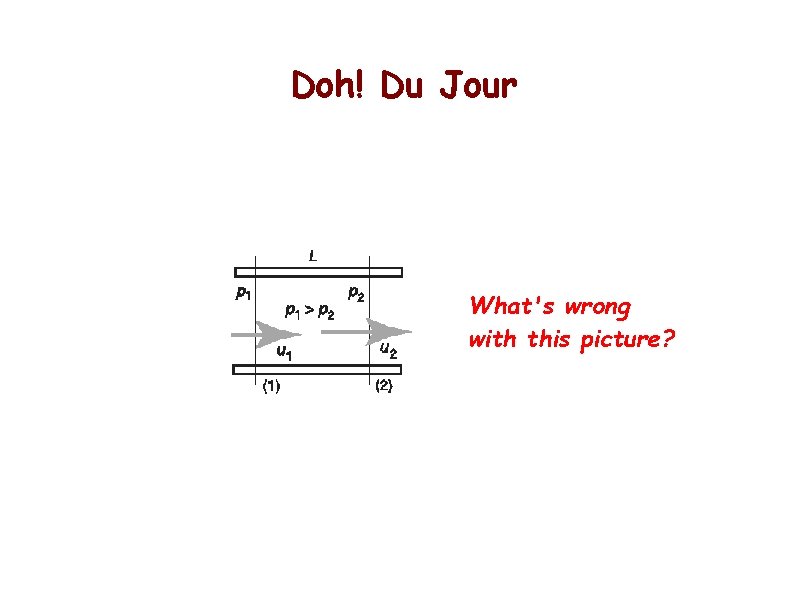
Doh! Du Jour What's wrong with this picture?

Principle of Continuity
![Laminar vs. Turbulent Flow Photo by Friedrich Ahlborn [1918] r lamina turbulent](http://slidetodoc.com/presentation_image_h2/a90cf305908b9b0172c1e99b59feba3b/image-10.jpg "Laminar vs. Turbulent Flow Photo by Friedrich Ahlborn [1918] r lamina turbulent")
Laminar vs. Turbulent Flow Photo by Friedrich Ahlborn [1918] r lamina turbulent
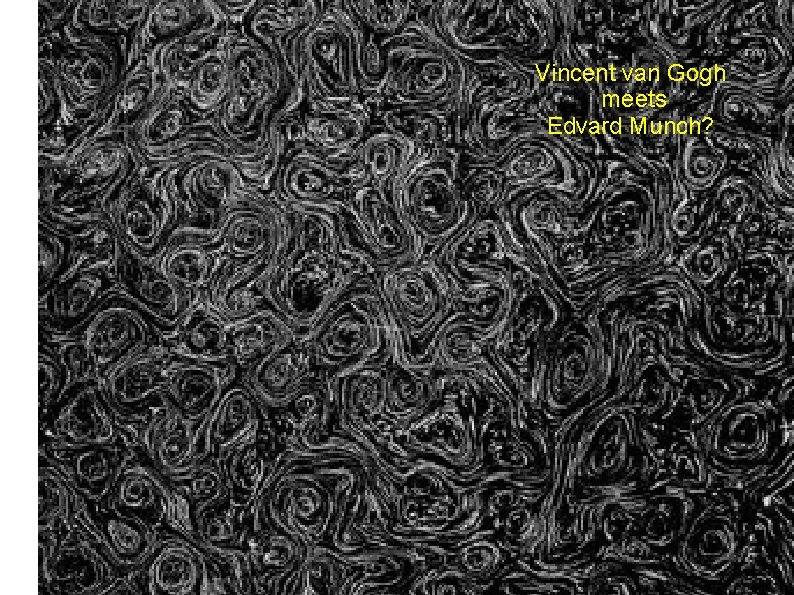
Vincent van Gogh meets Edvard Munch?
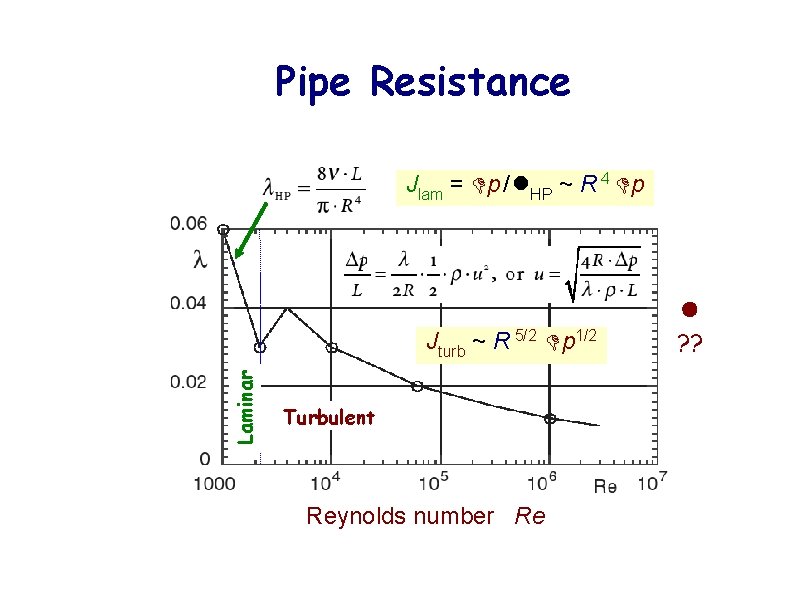
Pipe Resistance Jlam = Dp / l. HP ~ R 4 Dp Laminar Jturb ~ R 5/2 Dp 1/2 Turbulent Reynolds number Re l ? ?
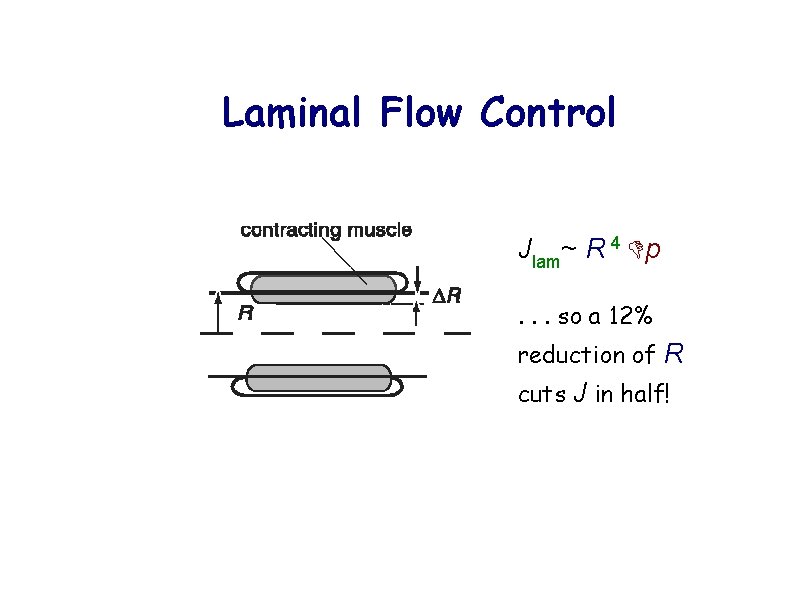
Laminal Flow Control Jlam~ R 4 Dp. . . so a 12% reduction of R cuts J in half!
![The Aorta Raorta [m] ≥ 1. 2 • 10 -4 M 3/4 Aaorta [m](http://slidetodoc.com/presentation_image_h2/a90cf305908b9b0172c1e99b59feba3b/image-14.jpg "The Aorta Raorta [m] ≥ 1. 2 • 10 -4 M 3/4 Aaorta [m")
The Aorta Raorta [m] ≥ 1. 2 • 10 -4 M 3/4 Aaorta [m 2 ] ≥ 4. 5 • 10 -8 M 3/2 uaorta [m/s] ≤ 31. 6 M -3/4
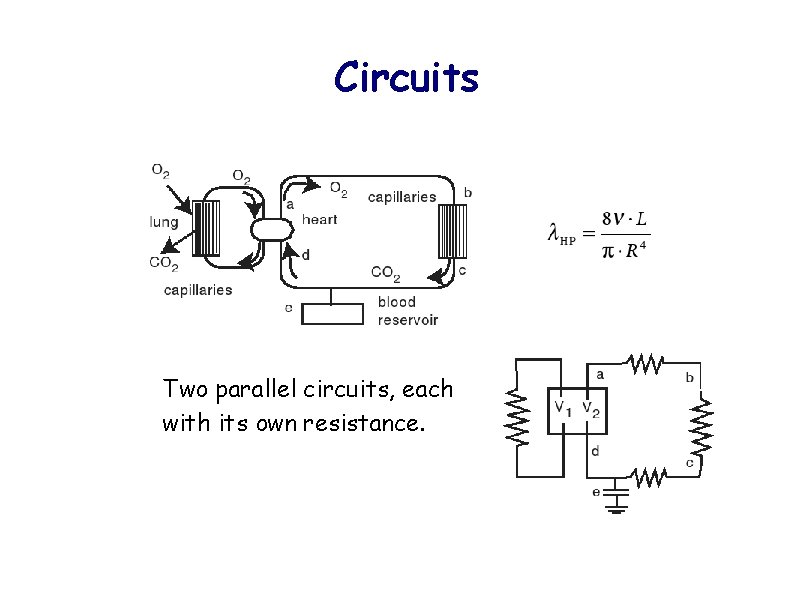
Circuits Two parallel circuits, each with its own resistance.
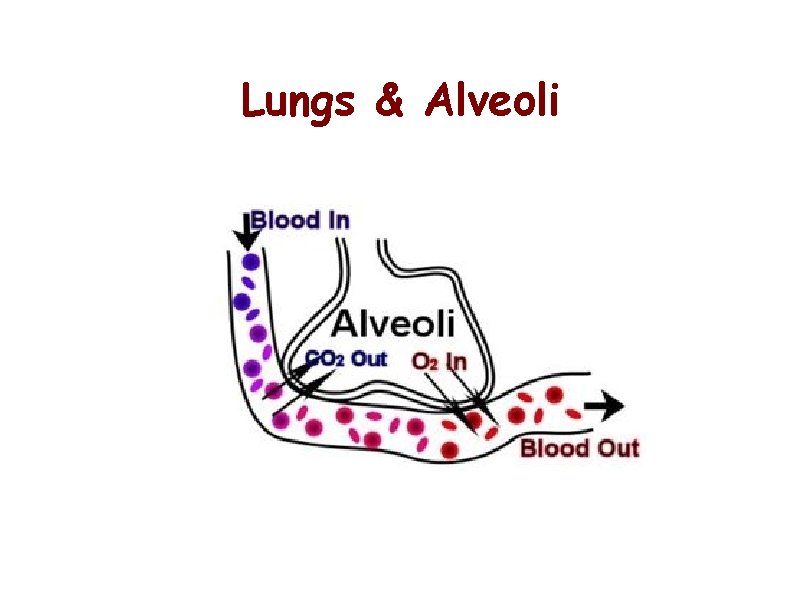
Lungs & Alveoli
![Hæmoglobin m = - ds/d. N is like a potential energy [J]: oxygen molecules](http://slidetodoc.com/presentation_image_h2/a90cf305908b9b0172c1e99b59feba3b/image-17.jpg "Hæmoglobin m = - ds/d. N is like a potential energy [J]: oxygen molecules")
Hæmoglobin m = - ds/d. N is like a potential energy [J]: oxygen molecules tend to move “downhill” from high m to low m. For concentrations of solutes in water we have m. IG = log(n /n. Q) where n. Q is a constant. In thermal equilibrium, we require mtot = m. IG + mext = constant, where mext is the binding energy of an O 2 molecule to hæmoglobin (Hb). The stronger the binding, the more “downhill”! The density n is proportional to the partial pressure p. Oxygen occupies all 4 Hb sites for p > 10 k. Pa (~0. 1 atm) and is released when p < 2 k. Pa (~0. 02 atm). What happens when CO 2 competes with O 2 for Hb sites?
![Aorta to Capillaries and Back Ncap ≈ 2. 83 • 108 M [kg] ucap](http://slidetodoc.com/presentation_image_h2/a90cf305908b9b0172c1e99b59feba3b/image-18.jpg "Aorta to Capillaries and Back Ncap ≈ 2. 83 • 108 M [kg] ucap")
Aorta to Capillaries and Back Ncap ≈ 2. 83 • 108 M [kg] ucap [m/s]≈ 8 • 10 -5 M -1/4
![Heart Specs Pheart [W] ≈ 1. 95 • 10 -2 b M ¾ =](http://slidetodoc.com/presentation_image_h2/a90cf305908b9b0172c1e99b59feba3b/image-19.jpg "Heart Specs Pheart [W] ≈ 1. 95 • 10 -2 b M ¾ =")
Heart Specs Pheart [W] ≈ 1. 95 • 10 -2 b M ¾ = fheart ∆Vheart ∆pheart ∆Vheart~ M and ∆pheart is independent of M so fheart ~ M -¼ [man: ~ 1 Hz; mouse: ~ 9. 2 Hz]
- Slides: 19