
Biology Unit C Cycling of Matter in Living
Biology Unit C – Cycling of Matter in Living Systems
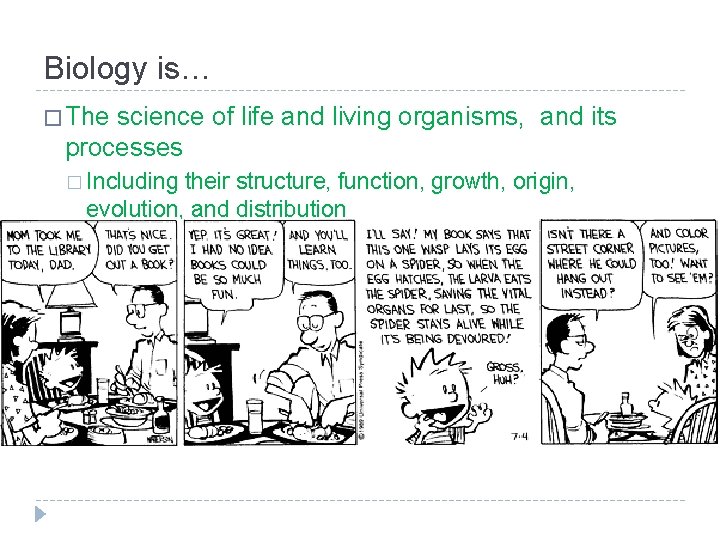
Biology is… � The science of life and living organisms, and its processes � Including their structure, function, growth, origin, evolution, and distribution
All living things share five characteristics: 1) 2) 3) 4) 5) A need for energy Produce waste Respond adapt to their environment Reproduce Grow
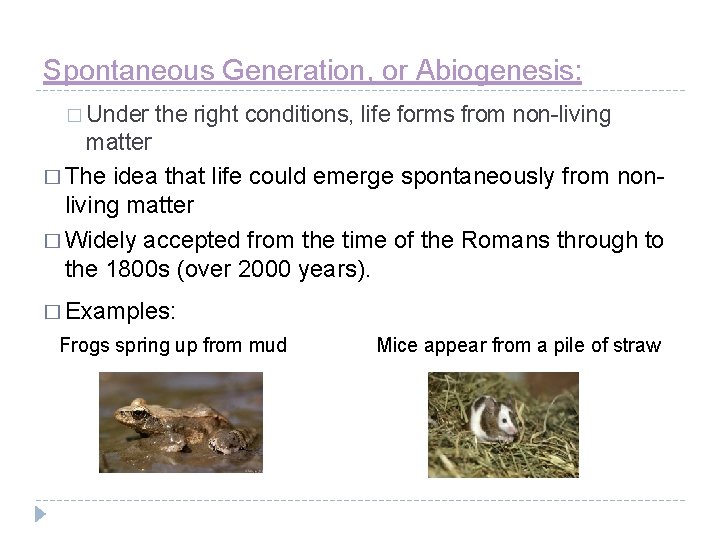
Spontaneous Generation, or Abiogenesis: � Under the right conditions, life forms from non-living matter � The idea that life could emerge spontaneously from nonliving matter � Widely accepted from the time of the Romans through to the 1800 s (over 2000 years). � Examples: Frogs spring up from mud Mice appear from a pile of straw
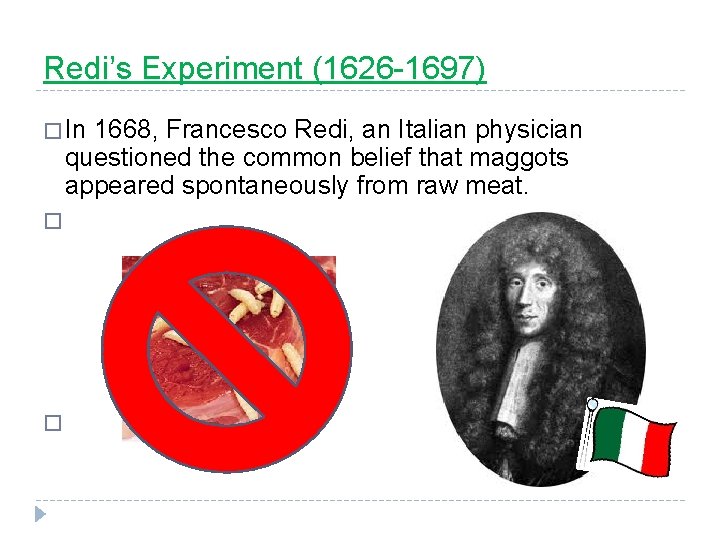
Redi’s Experiment (1626 -1697) � In 1668, Francesco Redi, an Italian physician questioned the common belief that maggots appeared spontaneously from raw meat. � Instead, he believed that flies laid their eggs in the meat. He set up three experiments. One flask had meat and opened to the air, the next flask had meat and was covered by gauze and the third flask had meat and was sealed. The only flask to produce maggots was the one opened to the air. � Despite the evidence, the idea of spontaneous generation continued to thrive.
Redi’s Experiment (1626 -1697) �Redi believed that flies laid their eggs in the meat. He set up three experiments… 1 st flask - meat and was opened to the air 2 nd flask - meat and was covered by gauze 3 rd flask - meat and was sealed. �The only flask to produce maggots was the one opened to the air.

Redi’s Experiment (1626 -1697)
Despite Redi`s evidence that disputed the spontaneous generation theory, his ideas remained unpopular in the scientific community vs.
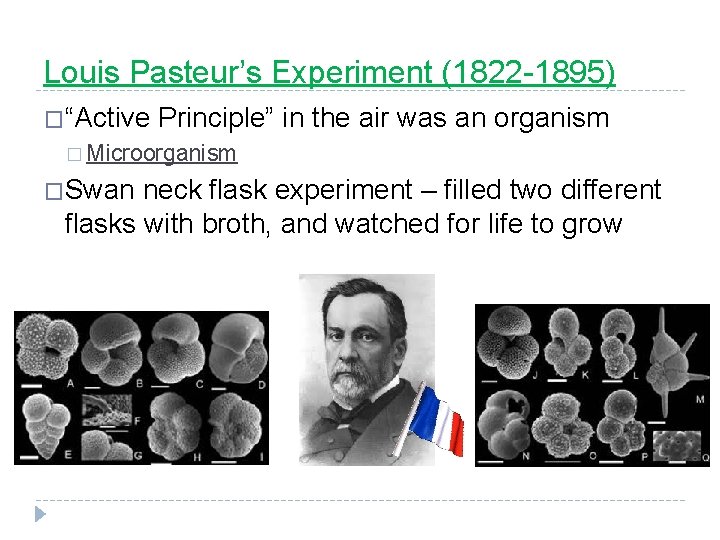
Louis Pasteur’s Experiment (1822 -1895) �“Active Principle” in the air was an organism � Microorganism �Swan neck flask experiment – filled two different flasks with broth, and watched for life to grow
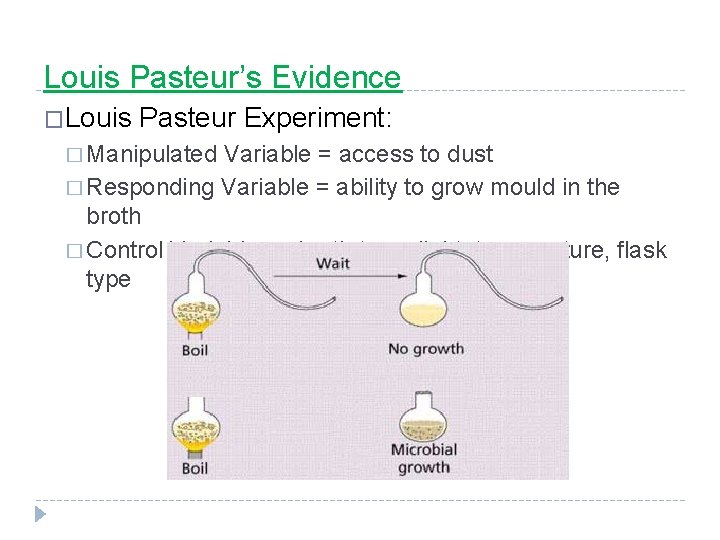
Louis Pasteur’s Evidence �Louis Pasteur Experiment: � Manipulated Variable = access to dust � Responding Variable = ability to grow mould in the broth � Control Variables = broth type, light, temperature, flask type
� Pasteur provided strong evidence that spontaneous generation did not occur, but also that microorganisms are found in the air… related his findings to disease http: //www. youtube. com/watch? v=JHZw. Mxm. LHnk&feature=related
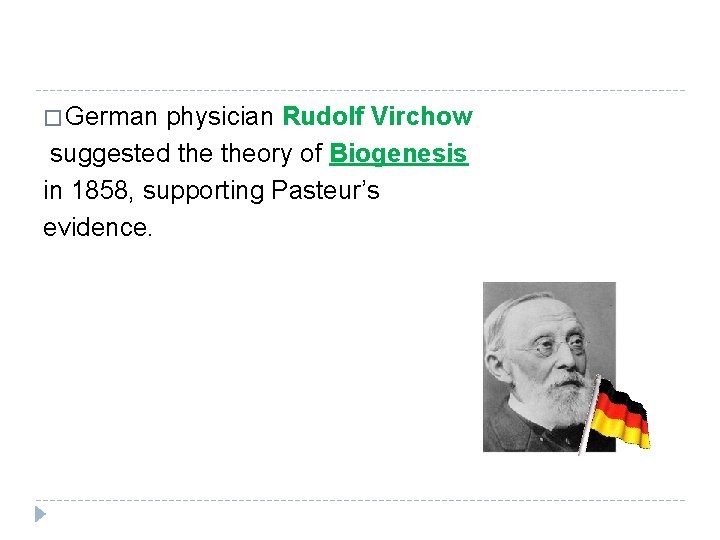
� German physician Rudolf Virchow suggested theory of Biogenesis in 1858, supporting Pasteur’s evidence.

Biogenesis � The theory that living organisms can only arise from other living organisms. � Life comes from life (1858)
Inquiry Questions – Think, Pair, Share! � Why � To do we live? what extent are cells the building blocks of life? � How does a single-celled-organism carry out life functions � How did the cell theory disprove spontaneous generation, and revolutionize life sciences?
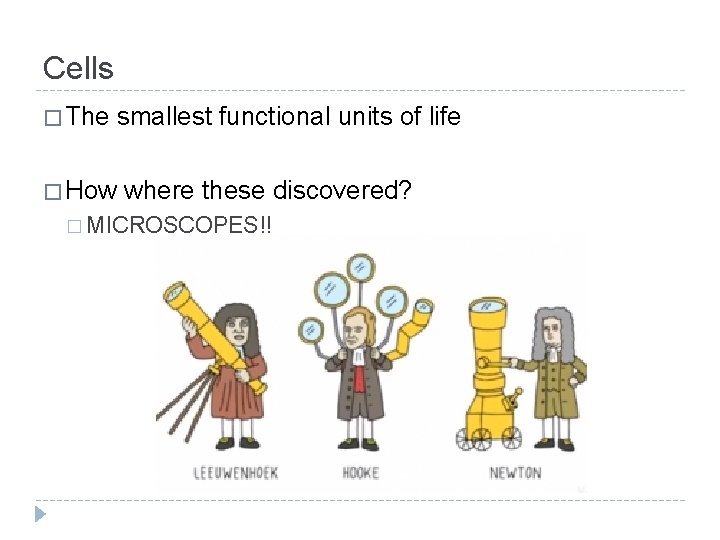
Cells � The smallest functional units of life � How where these discovered? � MICROSCOPES!!
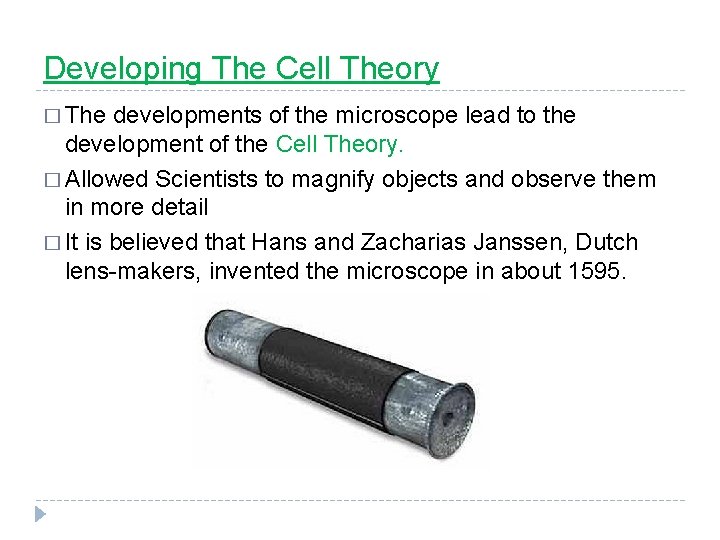
Developing The Cell Theory � The developments of the microscope lead to the development of the Cell Theory. � Allowed Scientists to magnify objects and observe them in more detail � It is believed that Hans and Zacharias Janssen, Dutch lens-makers, invented the microscope in about 1595.
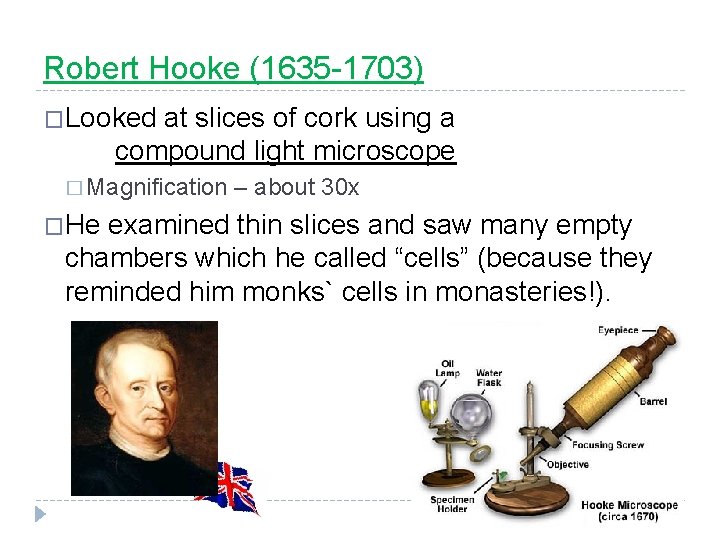
Robert Hooke (1635 -1703) �Looked at slices of cork using a compound light microscope � Magnification �He – about 30 x examined thin slices and saw many empty chambers which he called “cells” (because they reminded him monks` cells in monasteries!).
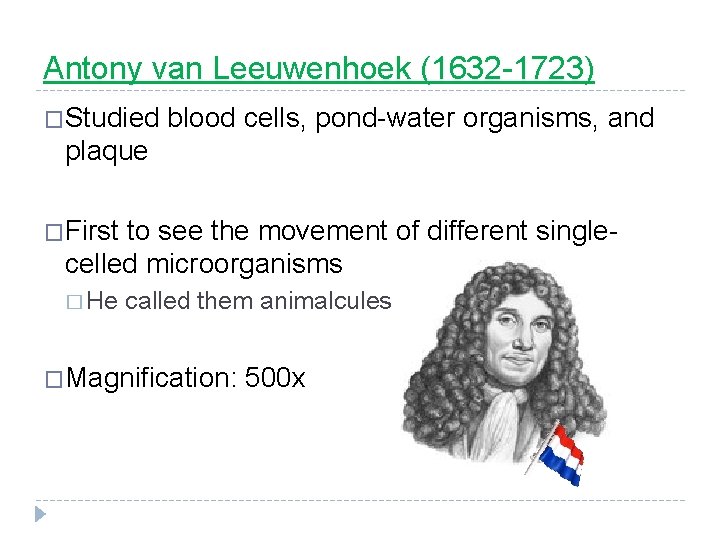
Antony van Leeuwenhoek (1632 -1723) �Studied blood cells, pond-water organisms, and plaque �First to see the movement of different singlecelled microorganisms � He called them animalcules �Magnification: 500 x
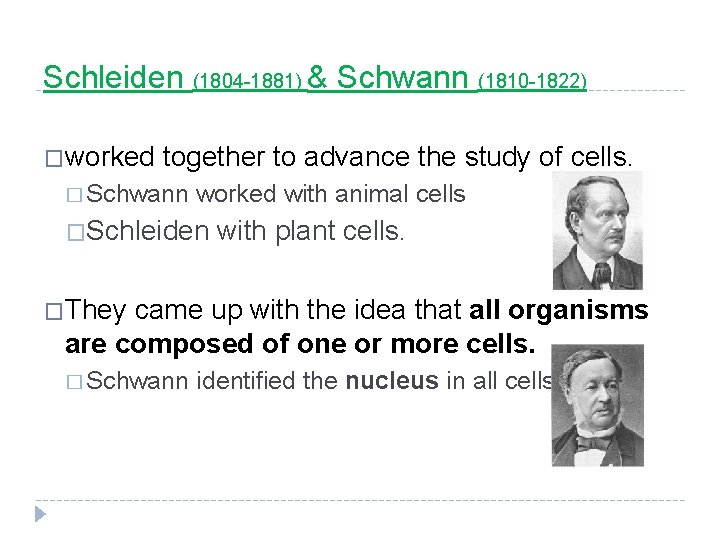
Schleiden (1804 -1881) & Schwann (1810 -1822) �worked together to advance the study of cells. � Schwann worked with animal cells �Schleiden with plant cells. �They came up with the idea that all organisms are composed of one or more cells. � Schwann identified the nucleus in all cells.
Back to Rudolf Virchow �He believed cells came from pre-existing cells = Cells from Cells (…Biogenesis) This disputed Schwann and Schleiden who thought cells formed from crystallization of non-living tissue or by budding from the surface of other cells
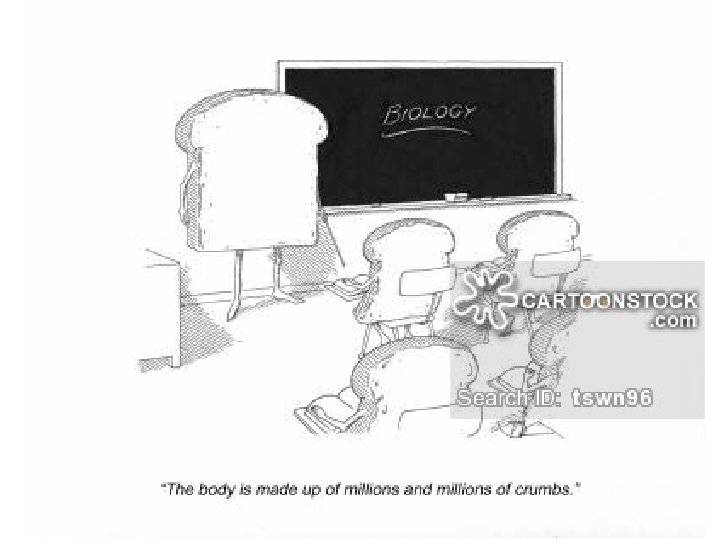
The Cell Theory Thanks to the accumulated work of many scientists, the Cell Theory was formulated, which states: 1. 2. 3. All organisms are composed of one or more cells The cell is the smallest functional unit of life All cells are produced from other cells 1) All organisms are composed of one or more cells 2) The cell is the smallest functional unit of life 3) All cells are produced from other cells
Think, Pair, Share! � Why do you think there were so many heated debates around the development of the cell theory? � Can you describe a time when collaboration worked well for you? Where there ever any disagreements that led to a false assumption (like cells spontaneously crystalizing into existence)?
� Read pages 247 -252 for review � Complete questions #5 -7 pg. 252 � https: //www. youtube. com/watch? v=WNBy. Rgh. R 6 sw
Exit Slip � Rate your understanding of today's topic on a scale of 1 -10. What can you do to improve your understanding? � If you could invent one “science gizmo” what would it be? Do you think your invention would lead to any discoveries that would change our understanding of science? � Have you ever used a microscope before?
- Slides: 26