
Biology Topic 1 Cell Biology 1 Cell structure
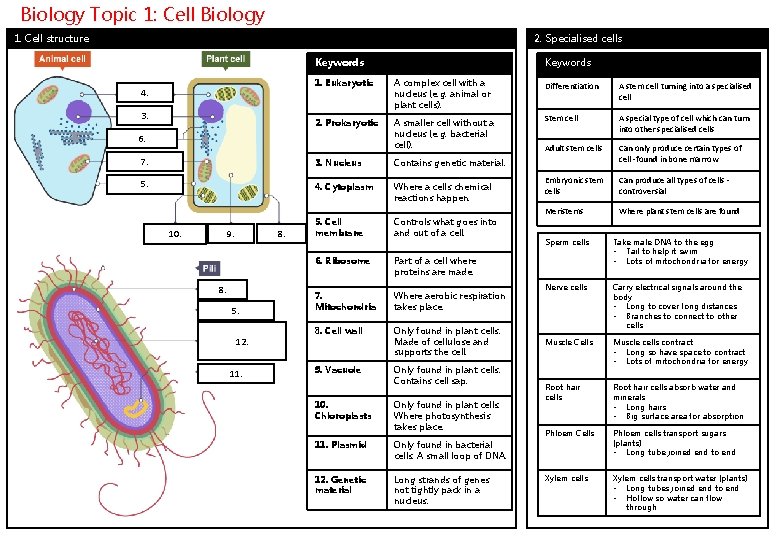
Biology Topic 1: Cell Biology 1. Cell structure 2. Specialised cells Keywords 4. 3. 1. Eukaryotic A complex cell with a nucleus (e. g. animal or plant cells). Differentiation A stem cell turning into a specialised cell 2. Prokaryotic A smaller cell without a nucleus (e. g. bacterial cell). Stem cell A special type of cell which can turn into other specialised cells Adult stem cells Can only produce certain types of cell -found in bone marrow Embryonic stem cells Can produce all types of cells controversial Meristems Where plant stem cells are found 6. 7. 3. Nucleus Contains genetic material. 5. 4. Cytoplasm Where a cells chemical reactions happen. 5. Cell membrane Controls what goes into and out of a cell. 6. Ribosome Part of a cell where proteins are made. 7. Mitochondria Where aerobic respiration takes place. 8. Cell wall Only found in plant cells. Made of cellulose and supports the cell. 8. 9. 10. 8. 5. 12. 11. 9. Vacuole Only found in plant cells. Contains cell sap. 10. Chloroplasts Only found in plant cells. Where photosynthesis takes place. 11. Plasmid Only found in bacterial cells. A small loop of DNA. 12. Genetic material Long strands of genes not tightly pack in a nucleus. Sperm cells Take male DNA to the egg • Tail to help it swim • Lots of mitochondria for energy Nerve cells Carry electrical signals around the body • Long to cover long distances • Branches to connect to other cells Muscle Cells Muscle cells contract • Long so have space to contract • Lots of mitochondria for energy Root hair cells absorb water and minerals • Long hairs • Big surface area for absorption Phloem Cells Phloem cells transport sugars (plants) • Long tube joined end to end Xylem cells transport water (plants) • Long tubes joined end to end • Hollow so water can flow through
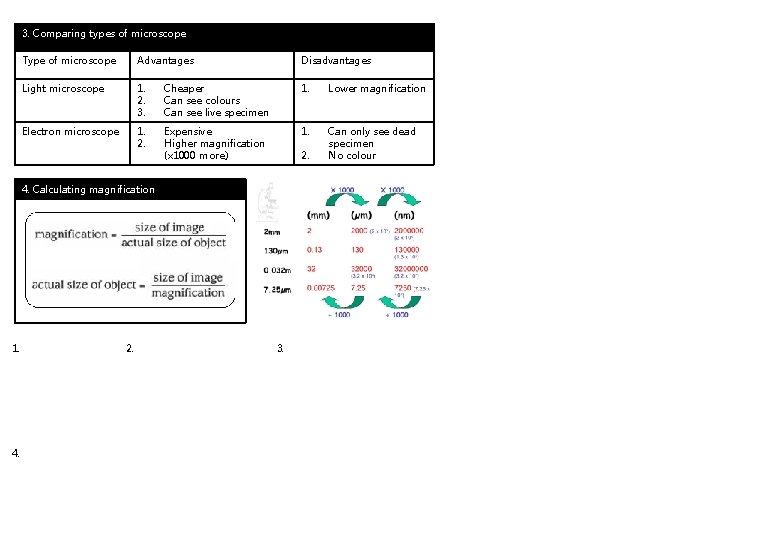
3. Comparing types of microscope Type of microscope Advantages Disadvantages Light microscope 1. 2. 3. Cheaper Can see colours Can see live specimen 1. Lower magnification Electron microscope 1. 2. Expensive Higher magnification (x 1000 more) 1. Can only see dead specimen No colour 2. 4. Calculating magnification 1. 4. 2. 3.
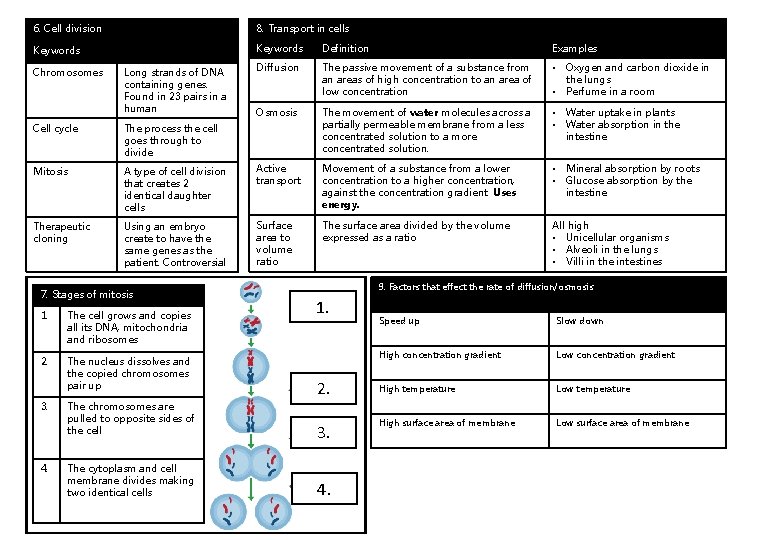
6. Cell division 8. Transport in cells Keywords Definition Examples Diffusion The passive movement of a substance from an areas of high concentration to an area of low concentration • Oxygen and carbon dioxide in the lungs • Perfume in a room Osmosis The movement of water molecules across a partially permeable membrane from a less concentrated solution to a more concentrated solution. • Water uptake in plants • Water absorption in the intestine Chromosomes Long strands of DNA containing genes. Found in 23 pairs in a human Cell cycle The process the cell goes through to divide Mitosis A type of cell division that creates 2 identical daughter cells Active transport Movement of a substance from a lower concentration to a higher concentration, against the concentration gradient. Uses energy. • Mineral absorption by roots • Glucose absorption by the intestine Therapeutic cloning Using an embryo create to have the same genes as the patient. Controversial Surface area to volume ratio The surface area divided by the volume expressed as a ratio All high • Unicellular organisms • Alveoli in the lungs • Villi in the intestines 7. Stages of mitosis 1. The cell grows and copies all its DNA, mitochondria and ribosomes 2. The nucleus dissolves and the copied chromosomes pair up 3. 4. The chromosomes are pulled to opposite sides of the cell The cytoplasm and cell membrane divides making two identical cells 9. Factors that effect the rate of diffusion/osmosis 1. 2. 3. 4. Speed up Slow down High concentration gradient Low concentration gradient High temperature Low temperature High surface area of membrane Low surface area of membrane
- Slides: 3