
Biology Tissues Organs and Systems What is Biology
Biology Tissues, Organs, and Systems
What is Biology is a natural science concerned with the study of life and living organisms Bio- living ology- study of Therefore- the study of living things
The Microscopes work by expanding a small-scale field of view. Microscopes allow us to examine life forms, both plant and animal, and understand their function. 1590’s-Zaccharias Janssen and his son Hans were first to develop the compound microscope. Electron Microscopes are scientific instruments that use a beam of highly energetic electrons to examine objects on a very fine scale. Magnification on a microscope refers to the amount or degree to which the object observed is enlarged.
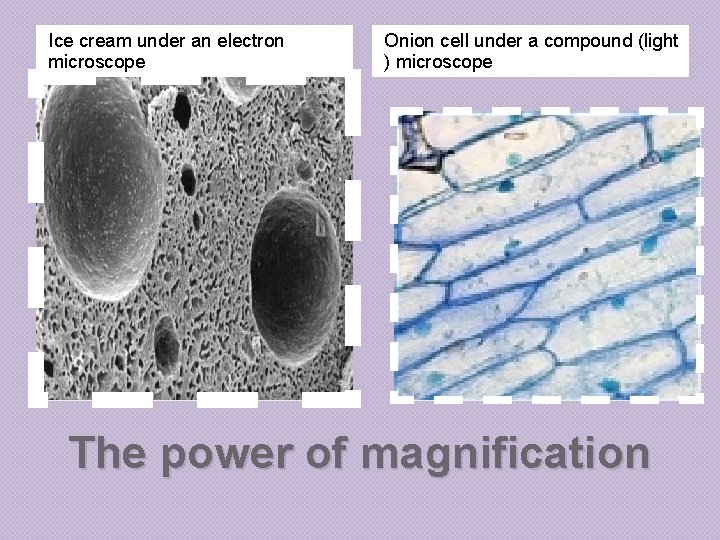
Ice cream under an electron microscope Onion cell under a compound (light ) microscope The power of magnification
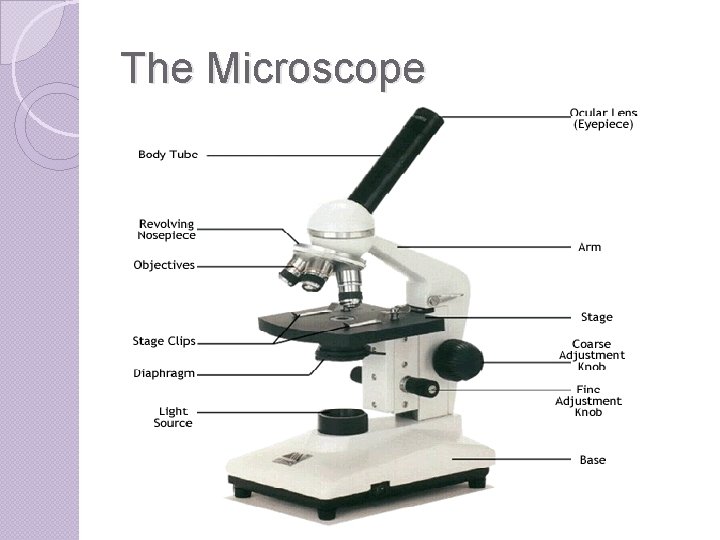
The Microscope
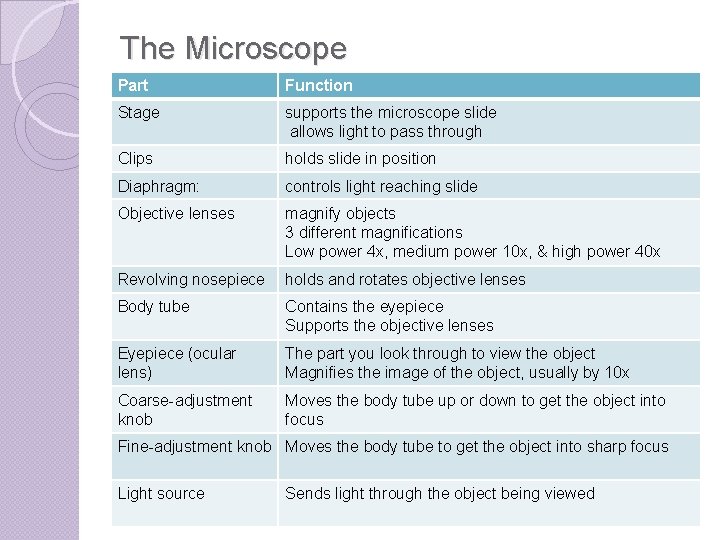
The Microscope Part Function Stage supports the microscope slide allows light to pass through Clips holds slide in position Diaphragm: controls light reaching slide Objective lenses magnify objects 3 different magnifications Low power 4 x, medium power 10 x, & high power 40 x Revolving nosepiece holds and rotates objective lenses Body tube Contains the eyepiece Supports the objective lenses Eyepiece (ocular lens) The part you look through to view the object Magnifies the image of the object, usually by 10 x Coarse-adjustment knob Moves the body tube up or down to get the object into focus Fine-adjustment knob Moves the body tube to get the object into sharp focus Light source Sends light through the object being viewed
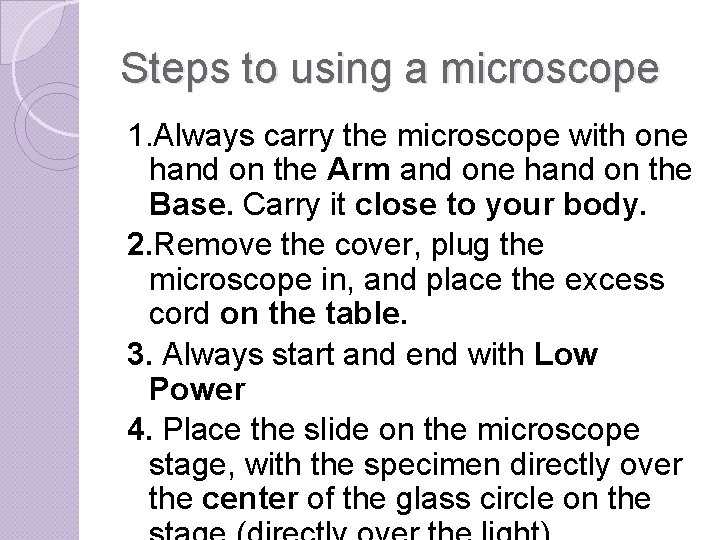
Steps to using a microscope 1. Always carry the microscope with one hand on the Arm and one hand on the Base. Carry it close to your body. 2. Remove the cover, plug the microscope in, and place the excess cord on the table. 3. Always start and end with Low Power 4. Place the slide on the microscope stage, with the specimen directly over the center of the glass circle on the
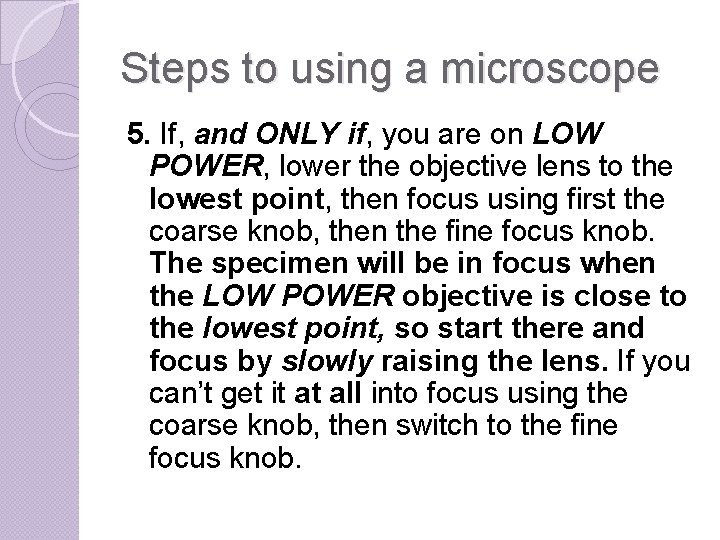
Steps to using a microscope 5. If, and ONLY if, you are on LOW POWER, lower the objective lens to the lowest point, then focus using first the coarse knob, then the fine focus knob. The specimen will be in focus when the LOW POWER objective is close to the lowest point, so start there and focus by slowly raising the lens. If you can’t get it at all into focus using the coarse knob, then switch to the fine focus knob.
Steps to using a microscope 6. Adjust the Diaphragm as you look through the Eyepiece, and you will see that MORE detail is visible when you allow in LESS light! Too much light will give the specimen a washed-out appearance. TRY IT OUT!! 7. Once you have found the specimen on Low Power center the specimen in your field of view, then, without changing the focus knobs, switch it to High Power. 8. Once you have it on High Power remember that you only use the fine focus knob!
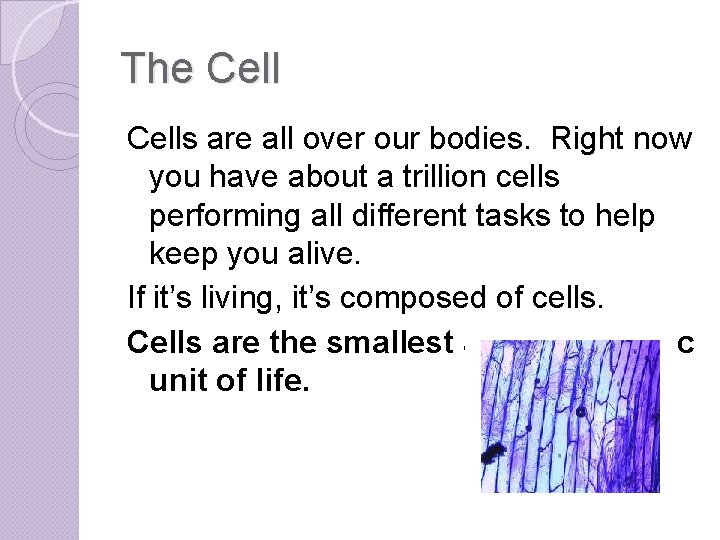
The Cells are all over our bodies. Right now you have about a trillion cells performing all different tasks to help keep you alive. If it’s living, it’s composed of cells. Cells are the smallest and most basic unit of life.
Cell Theory �All living things are composed of one or more cells �The cell is the basic unit of life �All cells come from pre-existing cells
Cell Structures Cells are made up of many different organelles that each have a particular structure and function within the cell. Animal and plant cells have a different structure. Animals cells have some different organelles compared to plant cells.
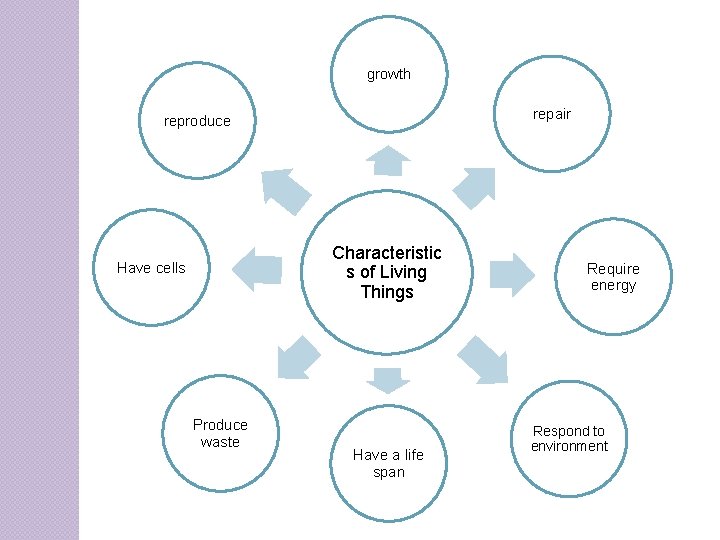
growth repair reproduce Characteristic s of Living Things Have cells Produce waste Have a life span Require energy Respond to environment
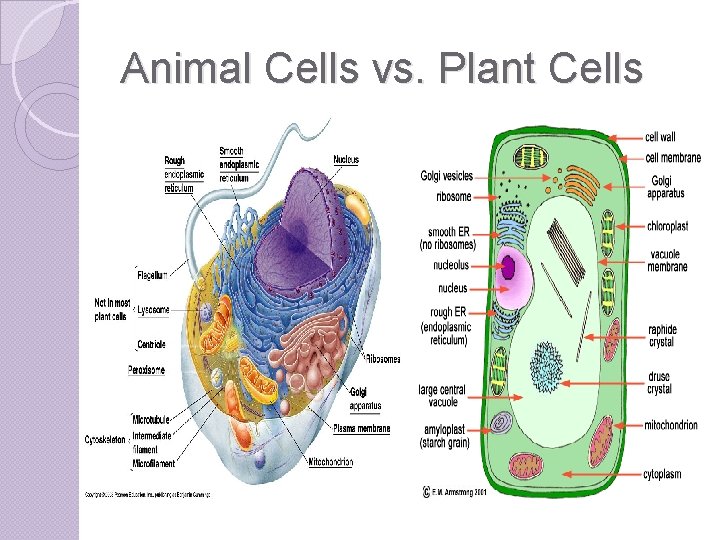
Animal Cells vs. Plant Cells
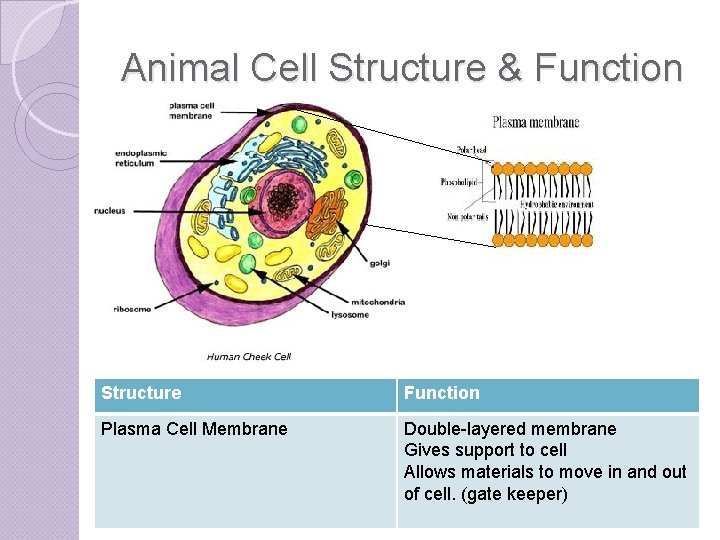
Animal Cell Structure & Function Structure Function Plasma Cell Membrane Double-layered membrane Gives support to cell Allows materials to move in and out of cell. (gate keeper)
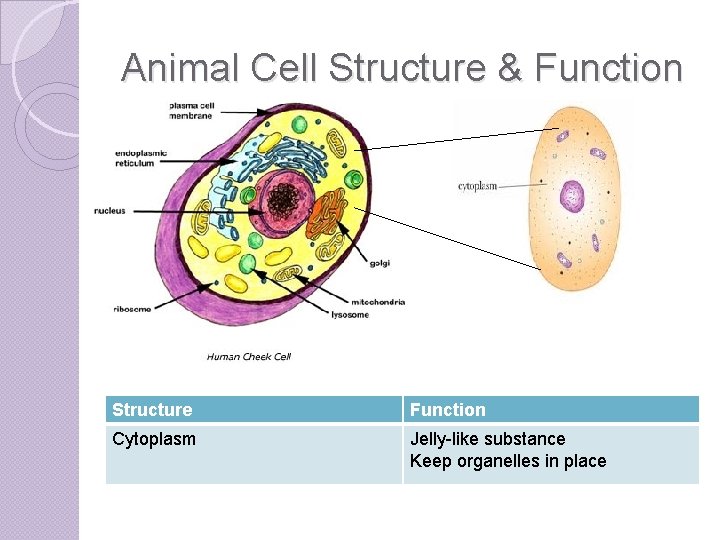
Animal Cell Structure & Function Structure Function Cytoplasm Jelly-like substance Keep organelles in place
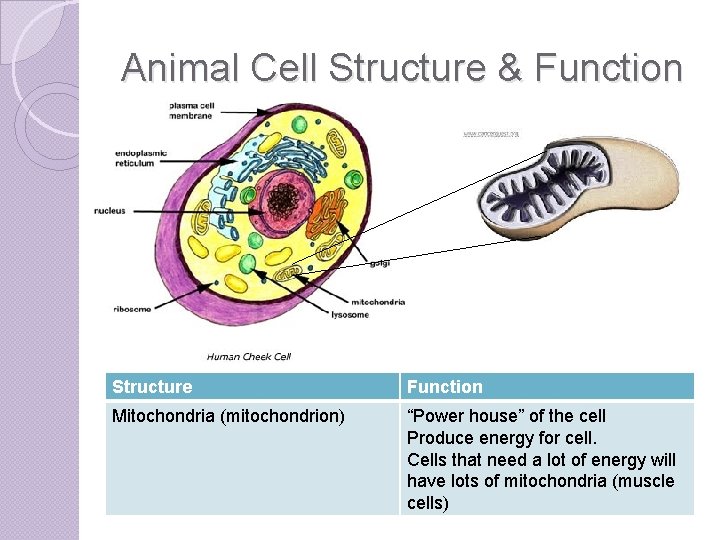
Animal Cell Structure & Function Structure Function Mitochondria (mitochondrion) “Power house” of the cell Produce energy for cell. Cells that need a lot of energy will have lots of mitochondria (muscle cells)
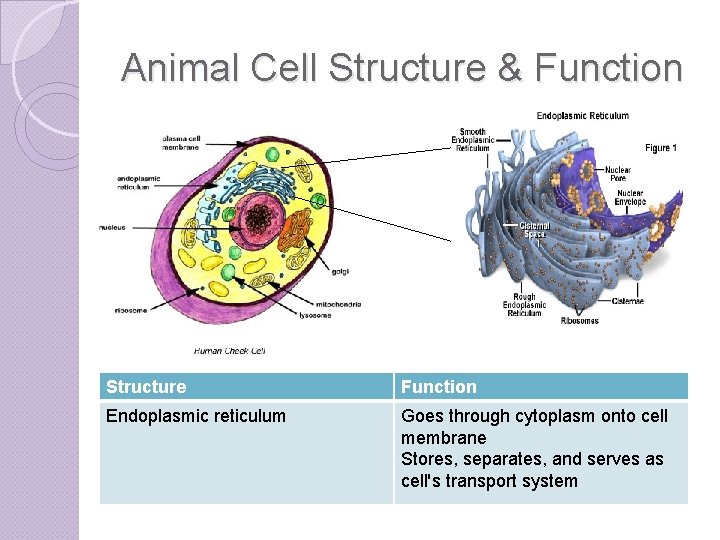
Animal Cell Structure & Function Structure Function Endoplasmic reticulum Goes through cytoplasm onto cell membrane Stores, separates, and serves as cell's transport system
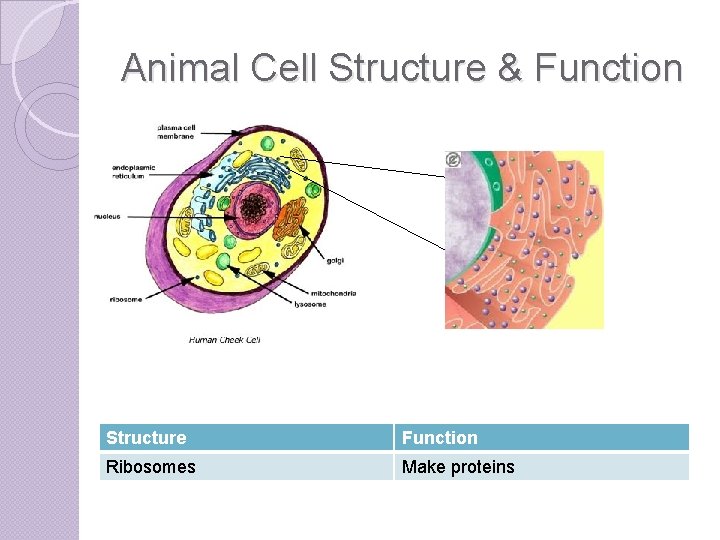
Animal Cell Structure & Function Structure Function Ribosomes Make proteins
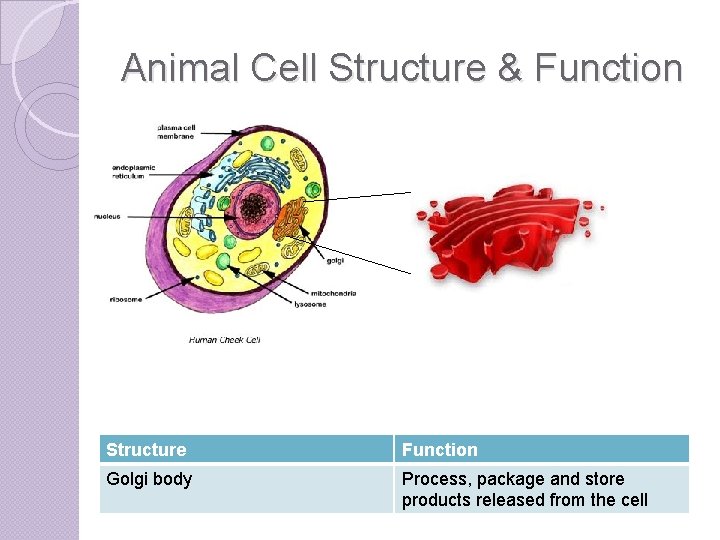
Animal Cell Structure & Function Structure Function Golgi body Process, package and store products released from the cell
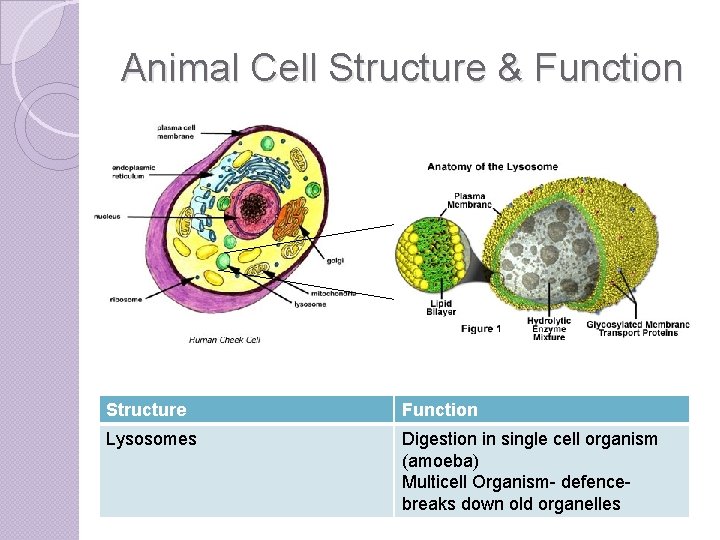
Animal Cell Structure & Function Structure Function Lysosomes Digestion in single cell organism (amoeba) Multicell Organism- defencebreaks down old organelles
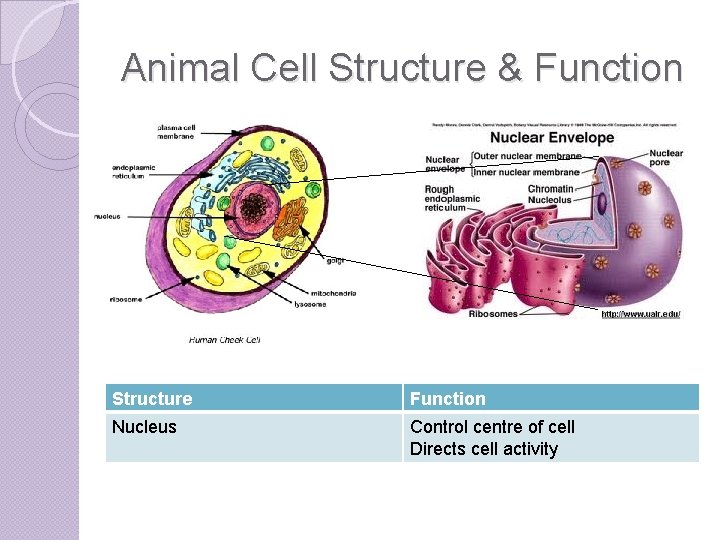
Animal Cell Structure & Function Structure Function Nucleus Control centre of cell Directs cell activity
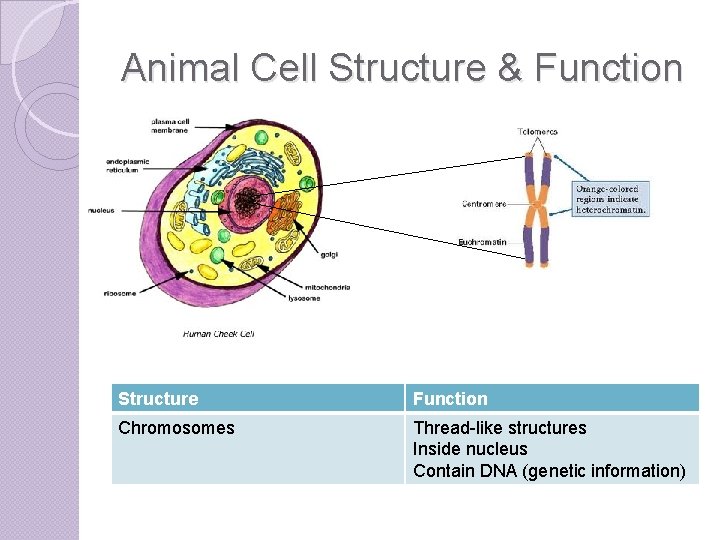
Animal Cell Structure & Function Structure Function Chromosomes Thread-like structures Inside nucleus Contain DNA (genetic information)
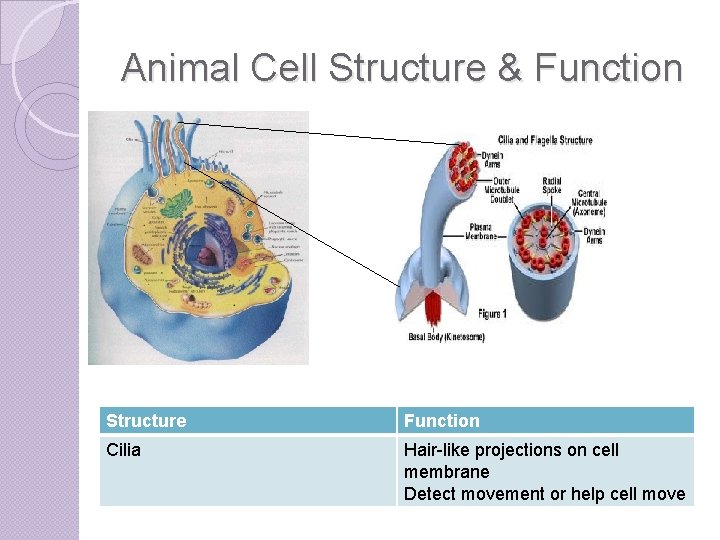
Animal Cell Structure & Function Structure Function Cilia Hair-like projections on cell membrane Detect movement or help cell move
Preparing for a lab Part of biology labs is knowing how to draw scientific drawings. �Use a blank piece of paper �Place the drawing in the centre of the page �Look at the specimen, note details and sizes before you draw. �Use a sharp pencil NO PENS �Your drawing should be large enough to show detail �Never shade or colour your diagram. If something is darker you must stipple (make many tiny dots)
Preparing for a lab � Labels should be printed in ink. should usually be placed in a neat vertical column to the right of the drawing � Pointers for labels should be fine, straight, horizontal unbroken lines drawn with a pencil and a ruler. Pointers should never cross each other and arrowheads should not be used. � Drawings need to have a title, name and date. � At the bottom of the page should be the power of the microscope, magnification of the drawing and the actual size of the object drawn. Calculations for these need to be shown � Put a title with your name and date.
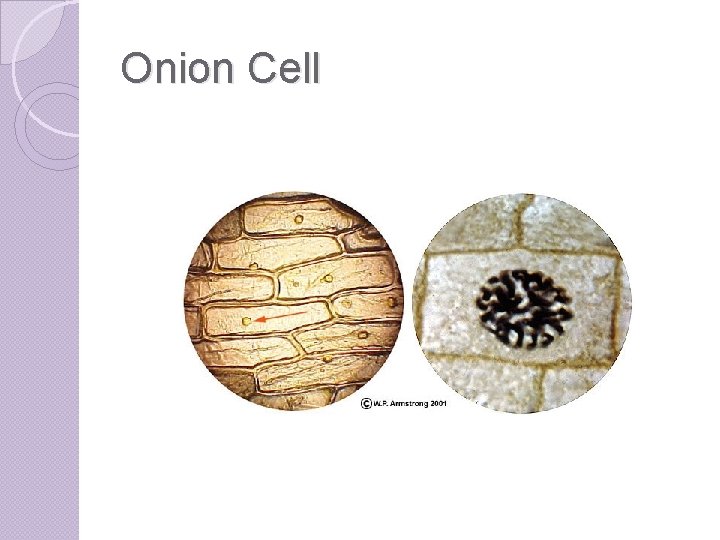
Onion Cell
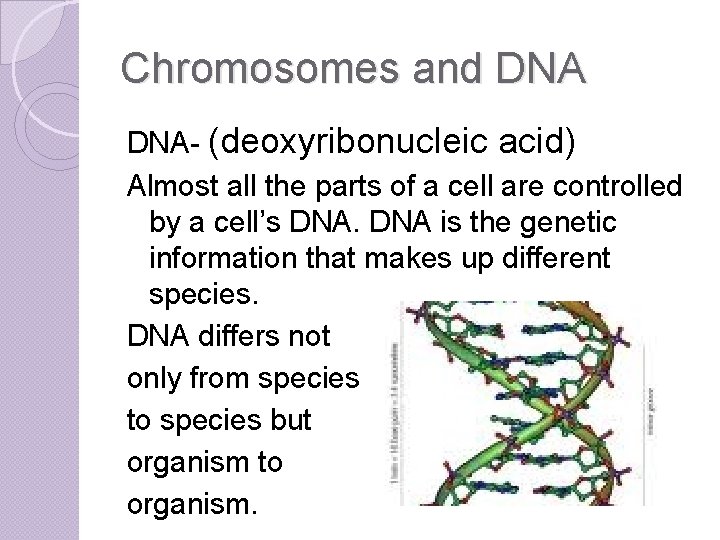
Chromosomes and DNA- (deoxyribonucleic acid) Almost all the parts of a cell are controlled by a cell’s DNA is the genetic information that makes up different species. DNA differs not only from species to species but organism to organism.
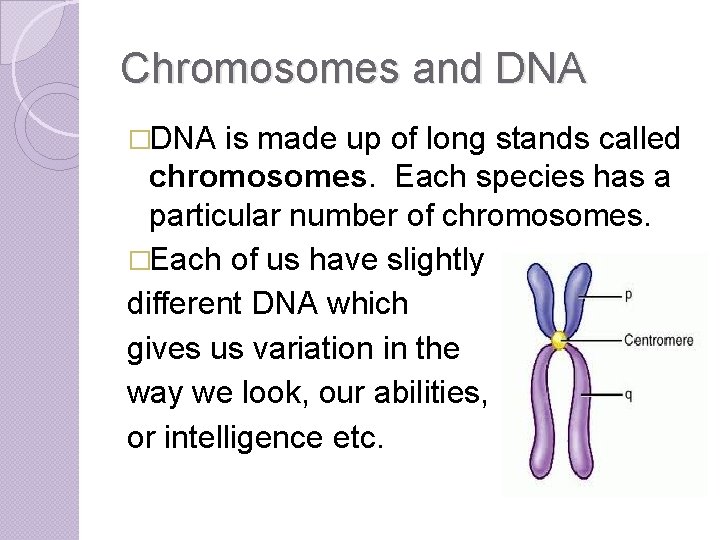
Chromosomes and DNA �DNA is made up of long stands called chromosomes. Each species has a particular number of chromosomes. �Each of us have slightly different DNA which gives us variation in the way we look, our abilities, or intelligence etc.
Cell Division Growth In order for a multicellular organism to grow it must increase the number of cells through cell division. Cells cannot simply grow bigger and bigger for a number of reasons. 1. If they become damaged it would be impossible to replace them 2. Nutrients would have a hard time getting to all the organelles that need them 3. Waste removal would take way to long
Cell Division Repair In order to heal broken bones or scrapes cells need to be able to repair themselves. They do this by replacing old or damaged cells in that area. If you get a cut on your knee the cells that are damaged in that area will be replaced with new cells. The good cells round the injured area begin to reproduce quickly in order to repair the injured area that is cut on your knee.
Cell Division Reproduction Axsexual reproduction- one parent needed to reproduce. DNA divides in half and will have exactly the same DNA Sexual reproduction- two parents needed to reproduce. (sperm and egg cells) DNA from both parents.
Chromosomes and DNA �In humans or sexual reproducing species the offspring will carry on some of the genetic information from each parent. �In sexual reproducing species each parent will give a sex chromosome. �Males have XY chromosomes �Females have XX chromosomes
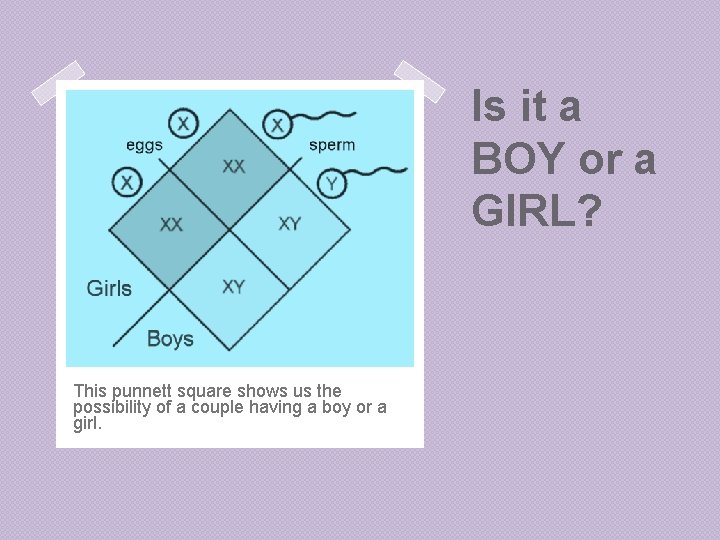
Is it a BOY or a GIRL? This punnett square shows us the possibility of a couple having a boy or a girl.
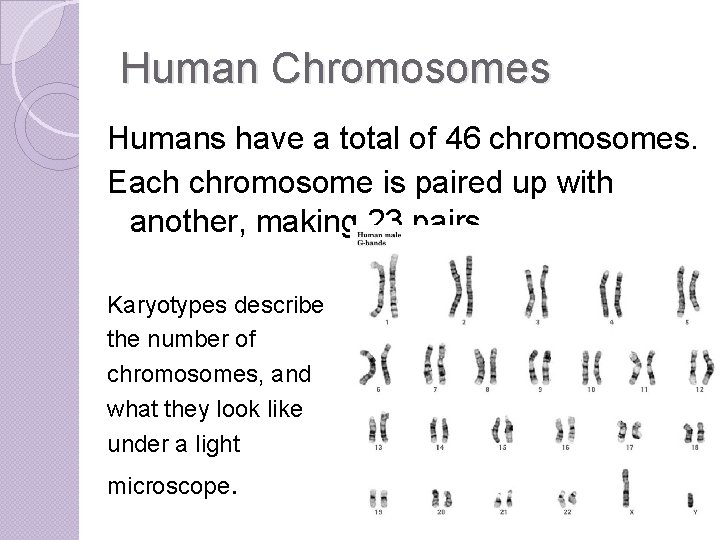
Human Chromosomes Humans have a total of 46 chromosomes. Each chromosome is paired up with another, making 23 pairs. Karyotypes describe the number of chromosomes, and what they look like under a light microscope.
Human Chromosomes �A karyotype is an organized profile of a person's chromosomes. In a karyotype, chromosomes are arranged and numbered by size, from largest to smallest. This arrangement helps scientists quickly identify chromosomal alterations that may result in a genetic disorder. �To make a karyotype, scientists take a picture of someone's chromosomes, cut them out and match them up using size, banding pattern and centromere position as guides. http: //learn. genetics. utah. edu/content/begin/trai ts/karyotype/
Genetic mutation DNA is copied in to each and every single cell in our bodies. In some instances there is a change in the genetic information which causes a mutation in each cell of the body. We can use karyotyping to see these different types of mutations.
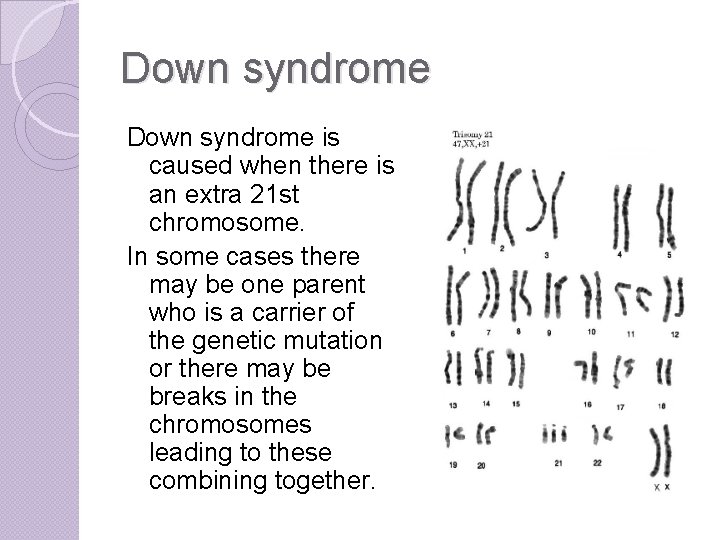
Down syndrome is caused when there is an extra 21 st chromosome. In some cases there may be one parent who is a carrier of the genetic mutation or there may be breaks in the chromosomes leading to these combining together.
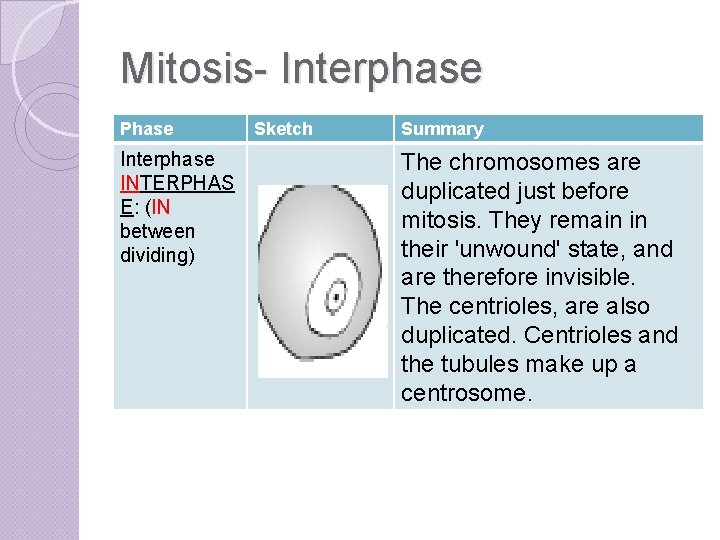
Mitosis- Interphase Phase Interphase INTERPHAS E: (IN between dividing) Sketch Summary The chromosomes are duplicated just before mitosis. They remain in their 'unwound' state, and are therefore invisible. The centrioles, are also duplicated. Centrioles and the tubules make up a centrosome.
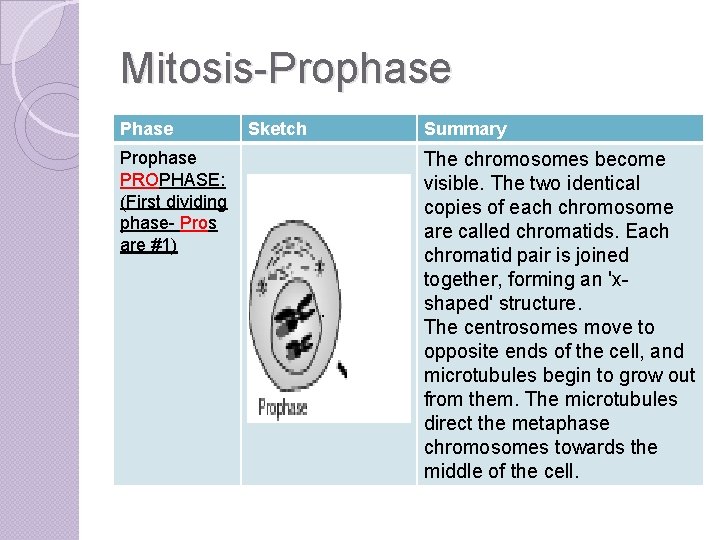
Mitosis-Prophase PROPHASE: (First dividing phase- Pros are #1) Sketch Summary The chromosomes become visible. The two identical copies of each chromosome are called chromatids. Each chromatid pair is joined together, forming an 'xshaped' structure. The centrosomes move to opposite ends of the cell, and microtubules begin to grow out from them. The microtubules direct the metaphase chromosomes towards the middle of the cell.
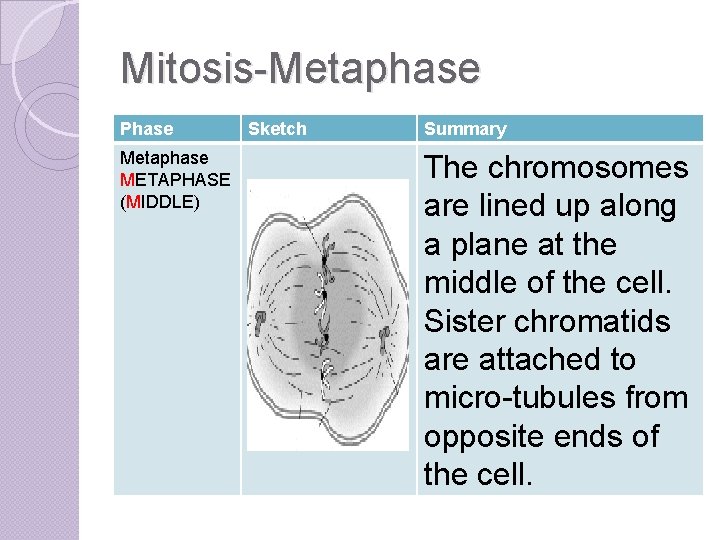
Mitosis-Metaphase Phase Metaphase METAPHASE (MIDDLE) Sketch Summary The chromosomes are lined up along a plane at the middle of the cell. Sister chromatids are attached to micro-tubules from opposite ends of the cell.
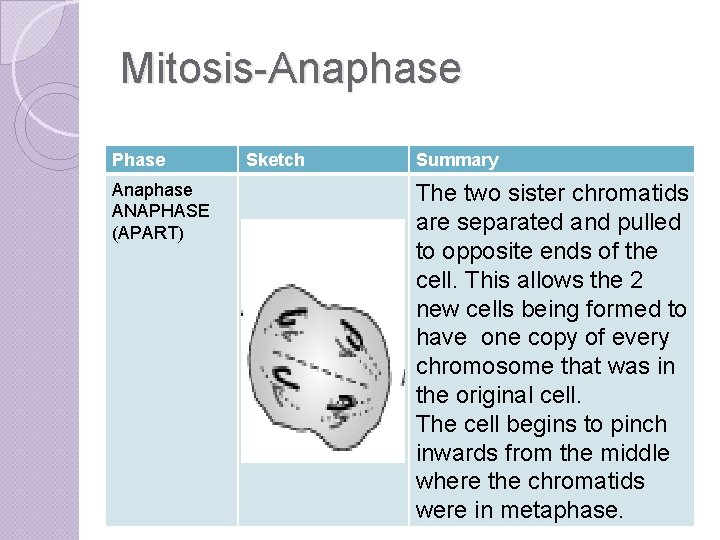
Mitosis-Anaphase Phase Anaphase ANAPHASE (APART) Sketch Summary The two sister chromatids are separated and pulled to opposite ends of the cell. This allows the 2 new cells being formed to have one copy of every chromosome that was in the original cell. The cell begins to pinch inwards from the middle where the chromatids were in metaphase.
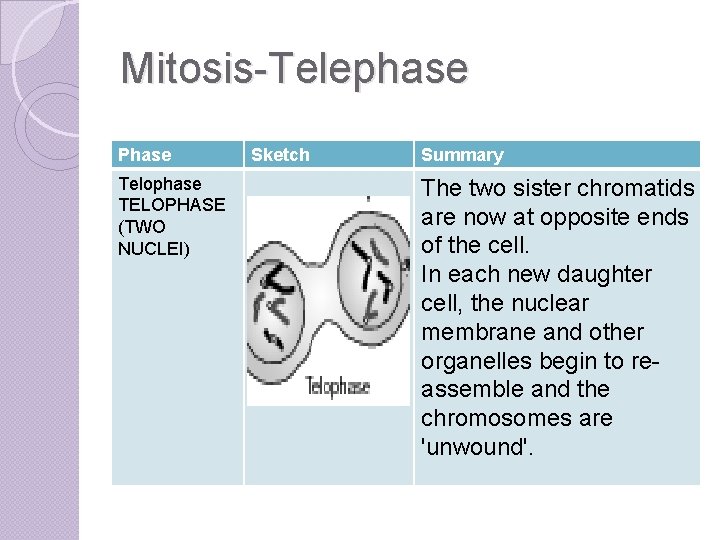
Mitosis-Telephase Phase Telophase TELOPHASE (TWO NUCLEI) Sketch Summary The two sister chromatids are now at opposite ends of the cell. In each new daughter cell, the nuclear membrane and other organelles begin to reassemble and the chromosomes are 'unwound'.
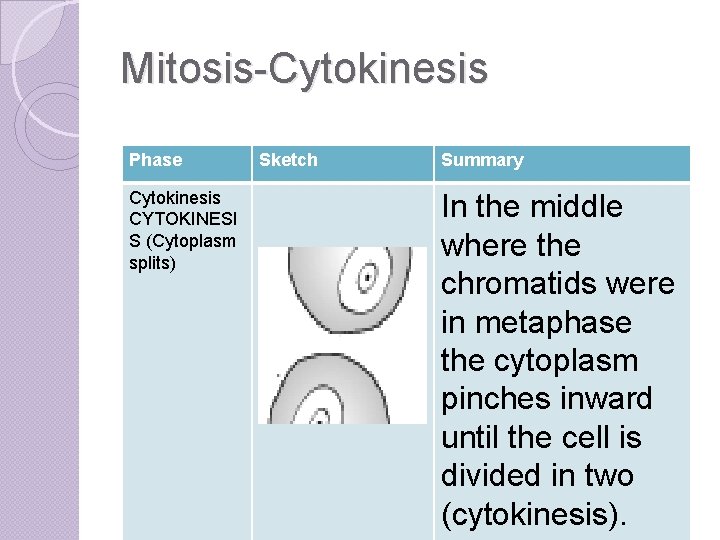
Mitosis-Cytokinesis Phase Cytokinesis CYTOKINESI S (Cytoplasm splits) Sketch Summary In the middle where the chromatids were in metaphase the cytoplasm pinches inward until the cell is divided in two (cytokinesis).
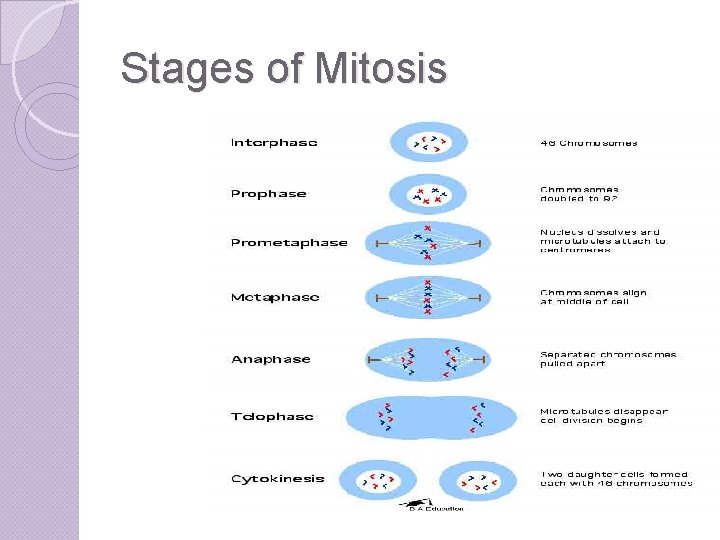
Stages of Mitosis
Mitosis http: //www. aboutkidshealth. ca/howthebodyworks/Stages-of. Mitosis. aspx? article. ID=10173&category. ID=XG-nh 2 -01 a
- Slides: 46