
Biology the Study of Life What does it
Biology: the Study of Life What does it mean to be living?
Characteristics of all living things n n Highly organized Contains many complex chemicals Made up of one or more cells Use energy n n n Have a life span Respond to environmental change Grow Reproduce Change over time
n All living things are able to carry out a complete set of activities common to all organisms
Nutrition n Taking materials from the environment and converting them into a usable form of energy
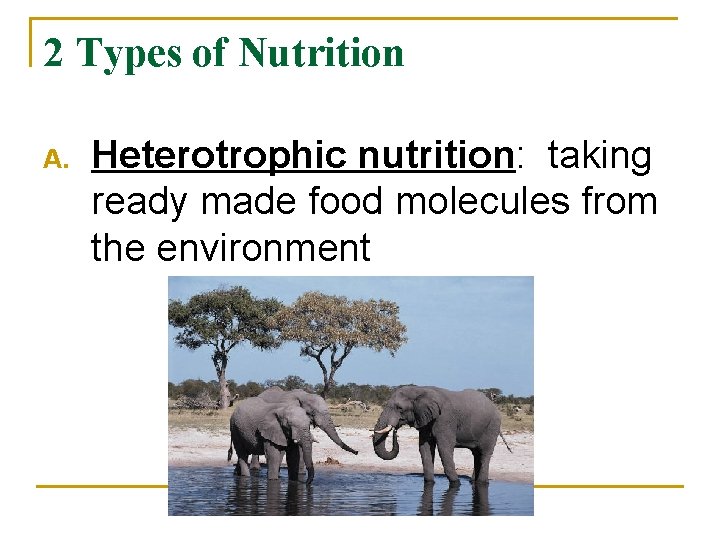
2 Types of Nutrition A. Heterotrophic nutrition: taking ready made food molecules from the environment
Nutrition 1. ingestion: taking food in 2. digestion: breaking down food 3. egestion: the elimination of undigested food
Nutrition B. Autotrophic nutrition: taking simple inorganic molecules from the environment and converting them into food
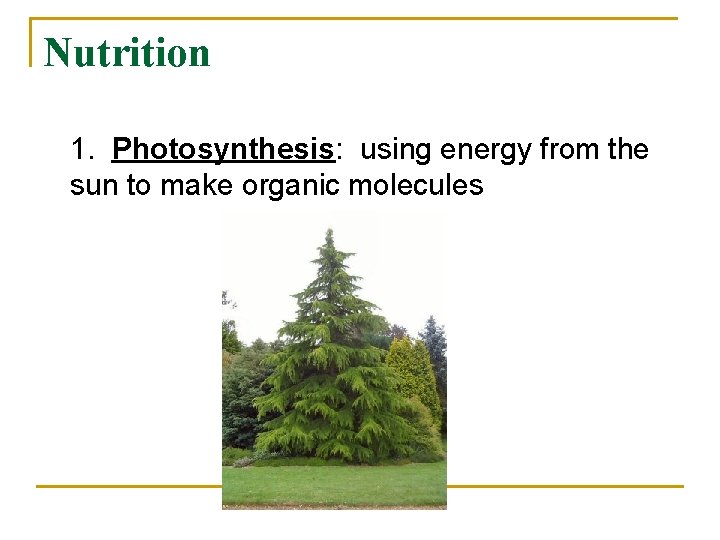
Nutrition 1. Photosynthesis: using energy from the sun to make organic molecules
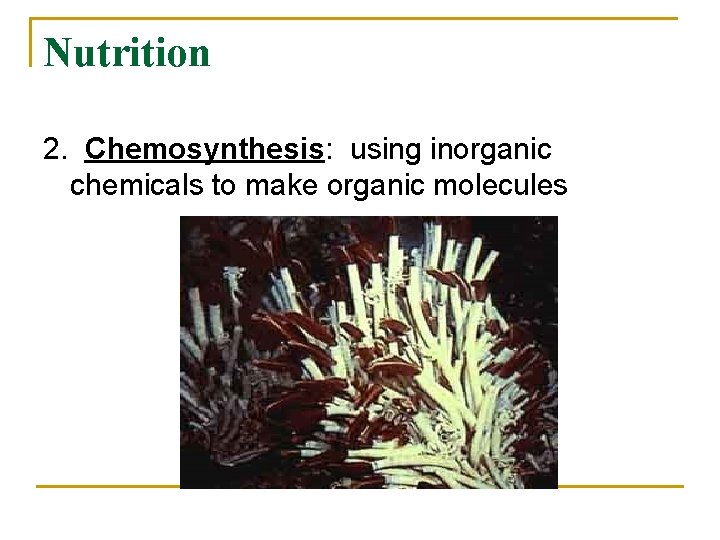
Nutrition 2. Chemosynthesis: using inorganic chemicals to make organic molecules
Excretion n the elimination of cellular wastes (wastes that result from chemical reactions that occur within the cells)
Synthesis n The formation of large, complex molecules from smaller, simpler ones n http: //www. brookscole. com/chemistry_d/templates/student_resources/shared_re sources/animations/protein_synthesis. html
Synthesis n n Produces materials that can become part of the structure of an organism The organism can repair or replace worn out parts The organism can grow The incorporation of materials into the body of an organism is called assimilation
Transport n n n The process by which molecules move into or out of the cell, and are distributed around the cell Involves absorption – moving the material into the cell Involves circulation – moving the materials around the cells
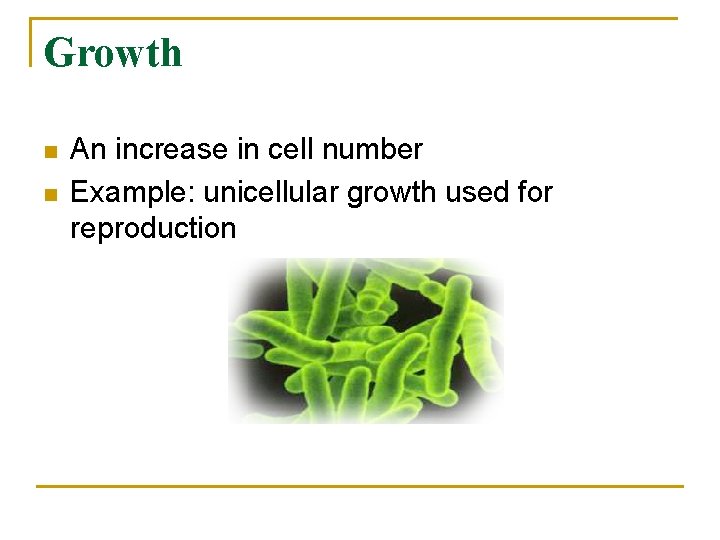
Growth n n An increase in cell number Example: unicellular growth used for reproduction
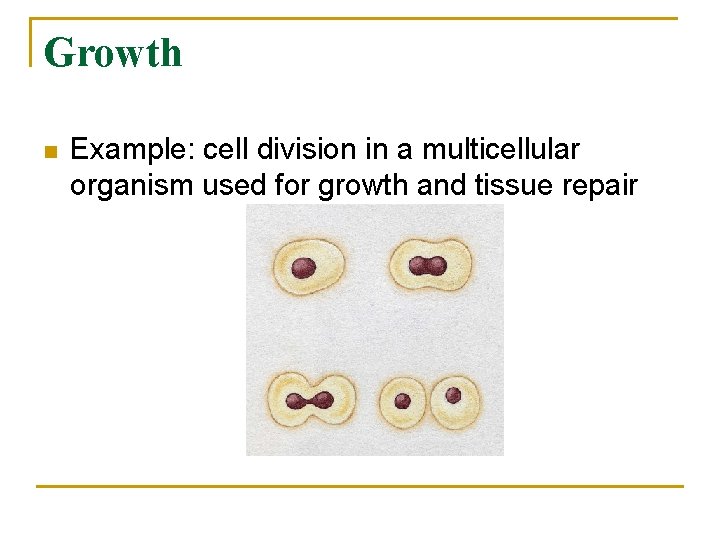
Growth n Example: cell division in a multicellular organism used for growth and tissue repair
Respiration n n The set of chemical reactions which release the energy stored in food Anaerobic respiration – does NOT require oxygen Aerobic respiration – requires oxygen Both types of respiration produce the energy molecule ATP (adenosine triphosphate)
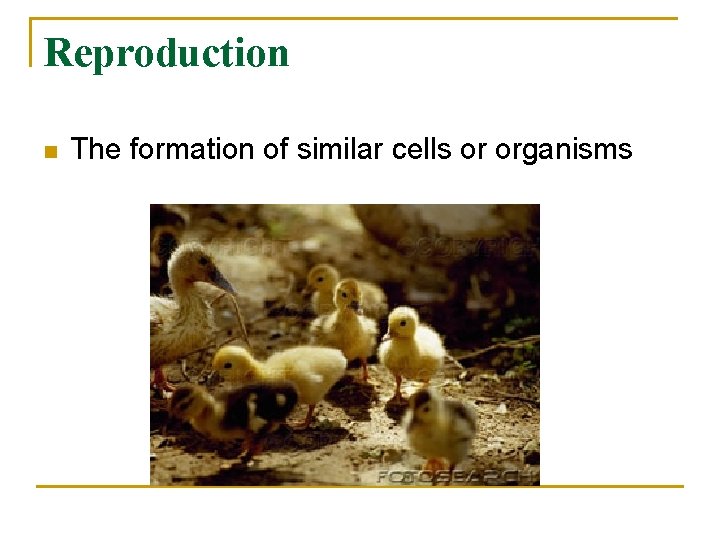
Reproduction n The formation of similar cells or organisms
Metabolism n n The sum of ALL chemical reactions that occur within the cell(s) of an organims Includes processes that build complex substances from simple ones q n SYNTHESIS Includes processes that break down complex substances into simple ones q HYDROLYSIS (DIGESTION)
Regulation n Detecting changes in the external and internal environment and responding to them n The goal of regulation if maintaining a stable internal environment called homeostasis http: //www. uclan. ac. uk/ldu/resources/multimedia/showcase/07 l owbloodglucose. html
Homeostasis n Maintaining a constant, stable environment within an organism in a constantly changing environment
- Slides: 20