
Biology Revision CHAPTER 5 Coordination and Control Part
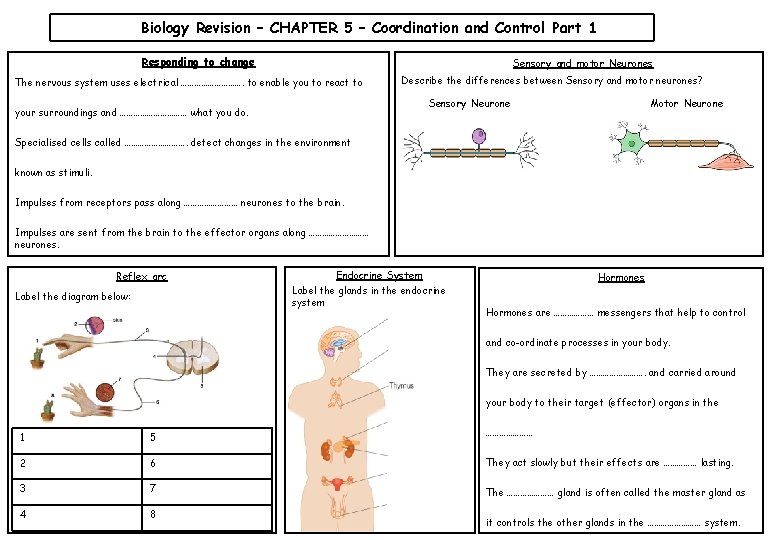
Biology Revision – CHAPTER 5 – Coordination and Control Part 1 Responding to change Sensory and motor Neurones The nervous system uses electrical ……………. to enable you to react to Describe the differences between Sensory and motor neurones? Sensory Neurone your surroundings and …………… what you do. Motor Neurone Specialised cells called ……………. detect changes in the environment known as stimuli. Impulses from receptors pass along ………… neurones to the brain. Impulses are sent from the brain to the effector organs along …………… neurones. Reflex arc Label the diagram below: Endocrine System Label the glands in the endocrine system Hormones are ……………… messengers that help to control and co-ordinate processes in your body. They are secreted by …………. and carried around your body to their target (effector) organs in the ………………… 1 5 2 6 They act slowly but their effects are …………… lasting. 3 7 The ………………… gland is often called the master gland as 4 8 it controls the other glands in the ………… system.
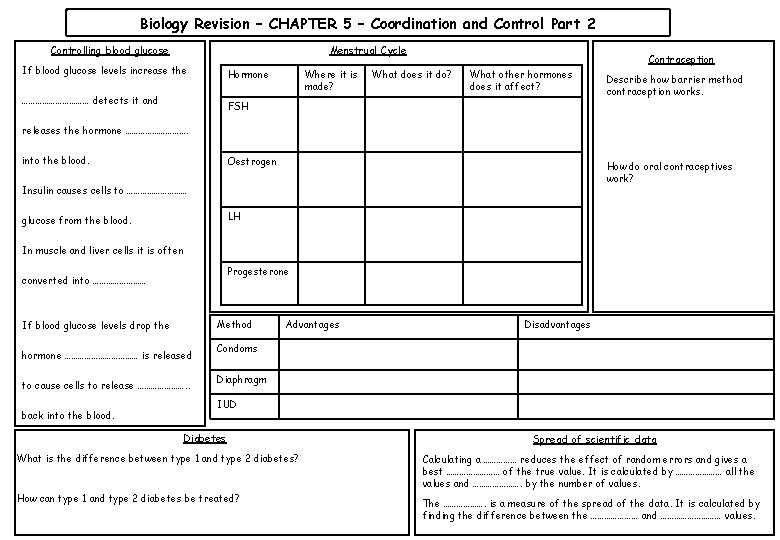
Biology Revision – CHAPTER 5 – Coordination and Control Part 2 Menstrual Cycle Controlling blood glucose If blood glucose levels increase the Hormone …………… detects it and Where it is made? Contraception What does it do? What other hormones does it affect? Describe how barrier method contraception works. FSH releases the hormone ……………. into the blood. Oestrogen How do oral contraceptives work? Insulin causes cells to …………… LH glucose from the blood. In muscle and liver cells it is often Progesterone converted into ………… Method If blood glucose levels drop the hormone ……………… is released to cause cells to release …………………. . back into the blood. Advantages Disadvantages Condoms Diaphragm IUD Diabetes What is the difference between type 1 and type 2 diabetes? How can type 1 and type 2 diabetes be treated? Spread of scientific data Calculating a …………… reduces the effect of random errors and gives a best ………… of the true value. It is calculated by ………………… all the values and …………………. by the number of values. The ………………. is a measure of the spread of the data. It is calculated by finding the difference between the ………………… and …………… values.
- Slides: 2