
Biology Principles of Biology I Syllabus Basics and
Biology : Principles of Biology I • Syllabus Basics and Important Notes
Chapter 1 Biology: Exploring Life
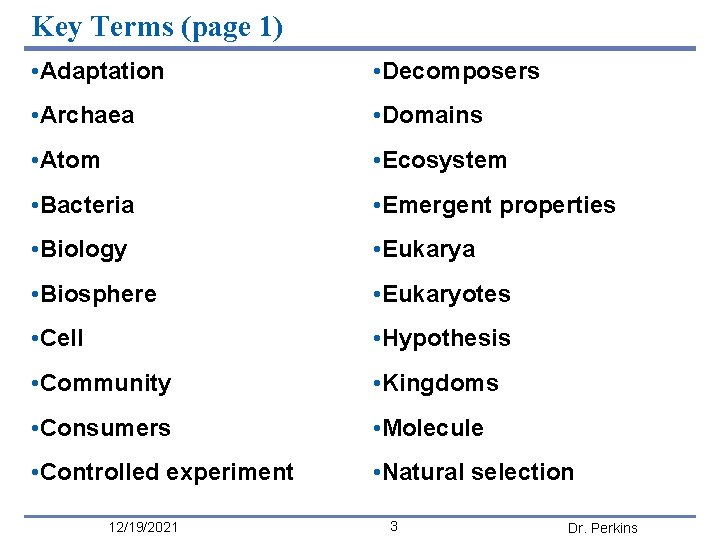
Key Terms (page 1) • Adaptation • Decomposers • Archaea • Domains • Atom • Ecosystem • Bacteria • Emergent properties • Biology • Eukarya • Biosphere • Eukaryotes • Cell • Hypothesis • Community • Kingdoms • Consumers • Molecule • Controlled experiment • Natural selection 12/19/2021 3 Dr. Perkins
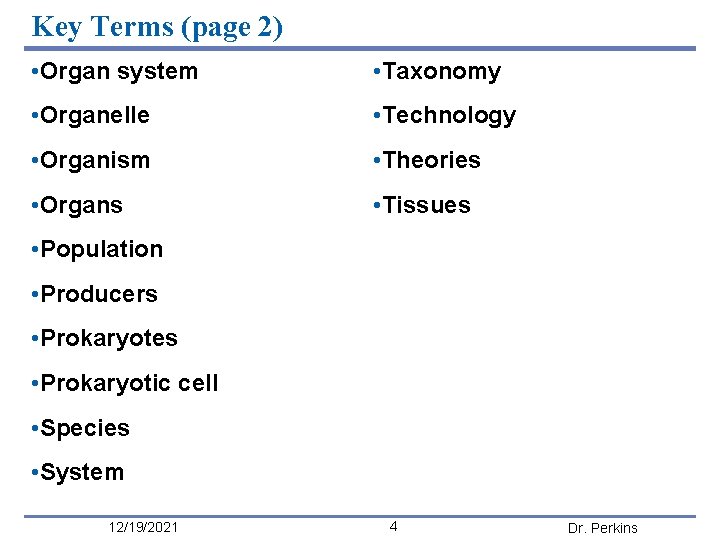
Key Terms (page 2) • Organ system • Taxonomy • Organelle • Technology • Organism • Theories • Organs • Tissues • Population • Producers • Prokaryotes • Prokaryotic cell • Species • System 12/19/2021 4 Dr. Perkins
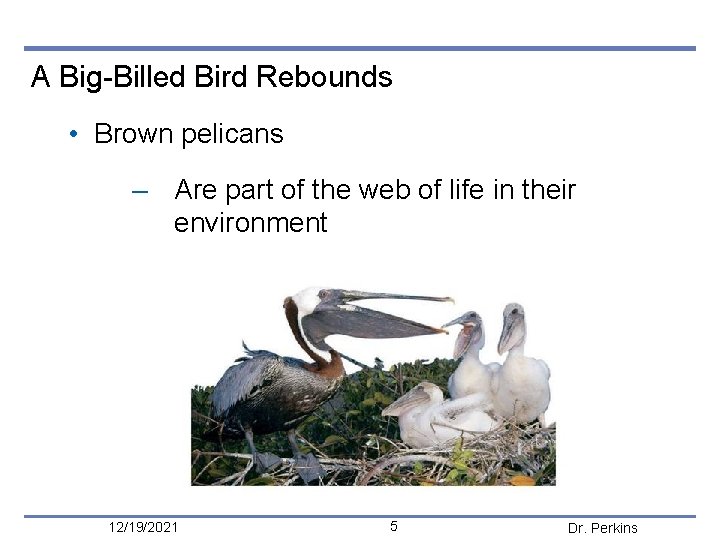
A Big-Billed Bird Rebounds • Brown pelicans – Are part of the web of life in their environment 12/19/2021 5 Dr. Perkins
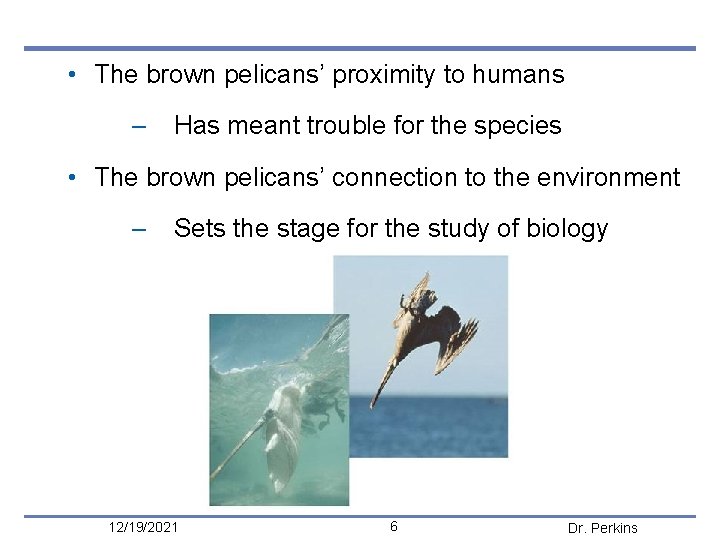
• The brown pelicans’ proximity to humans – Has meant trouble for the species • The brown pelicans’ connection to the environment – Sets the stage for the study of biology 12/19/2021 6 Dr. Perkins
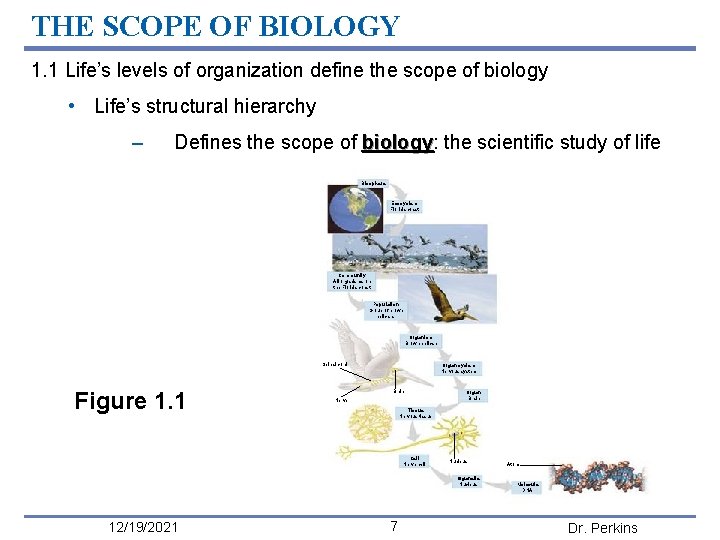
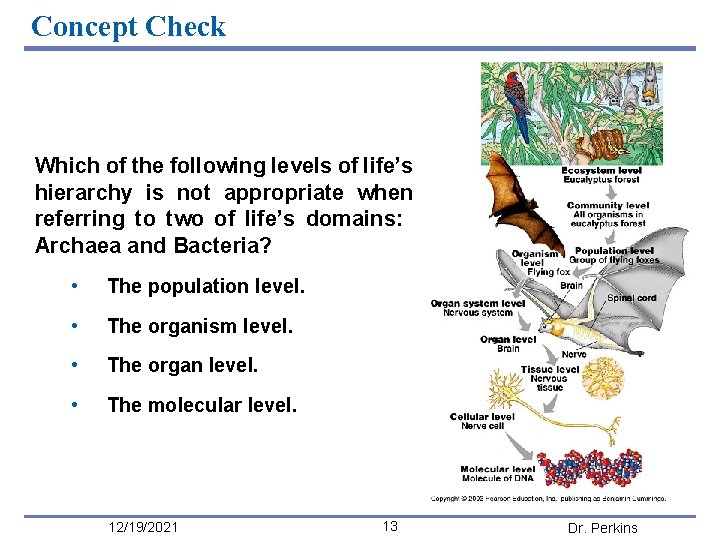
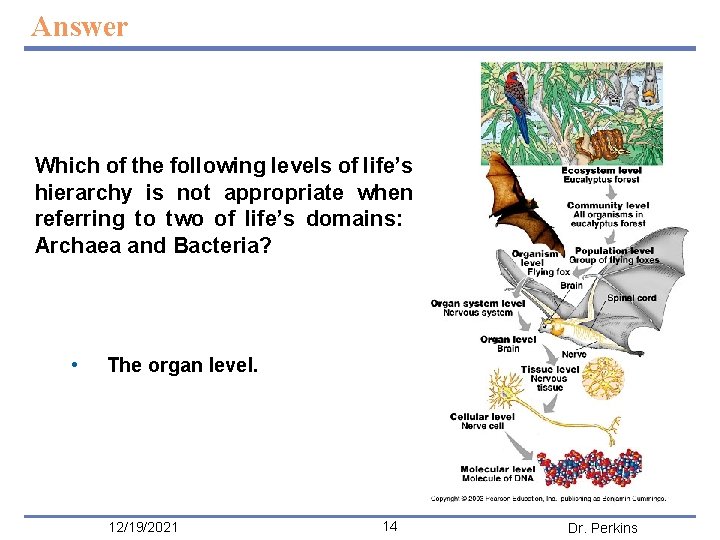
THE SCOPE OF BIOLOGY 1. 1 Life’s levels of organization define the scope of biology • Life’s structural hierarchy – Defines the scope of biology: biology the scientific study of life Biosphere Ecosystem Florida coast Community All organisms on the Florida coast Population Group of brown pelicans Organism Brown pelican Spinal cord Figure 1. 1 Organ system Nervous system Brain Nerve Organ Brain Tissue Nervous tissue Cell Nerve cell Nucleus Organelle Nucleus 12/19/2021 7 Atom Molecule DNA Dr. Perkins
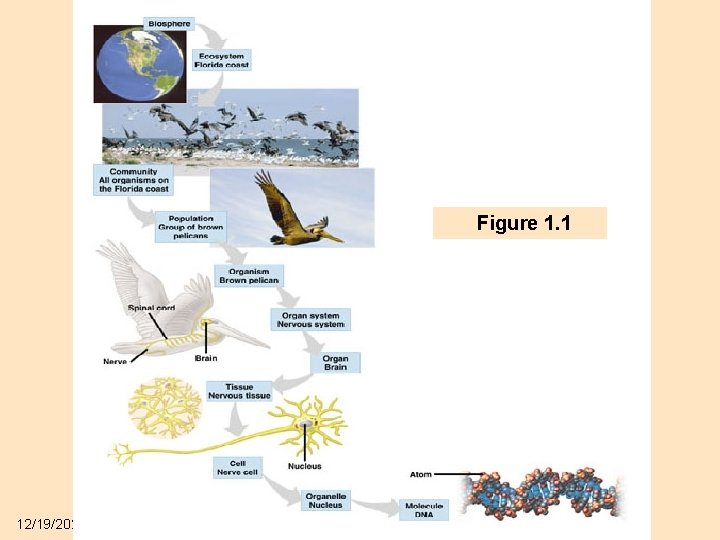
Figure 1. 1 12/19/2021 8
Question • Which of the following levels of biological organization includes all others in the list: cell, molecule, organ, tissue? • Organ 12/19/2021 9
• An ecosystem consists of all the organisms living in a par ticular area – As well as the nonliving environmental components • All the living organisms in an ecosystem – Make up a community 12/19/2021 10 Dr. Perkins
• A population – Consists of a localized group of individuals of a species • An individual living entity – Is an organism 12/19/2021 11 Dr. Perkins
• The hierarchy continues downward with v Organ systems v Organs v Tissues v Cells v Organelles v Molecules 12/19/2021 12 Dr. Perkins
Concept Check Which of the following levels of life’s hierarchy is not appropriate when referring to two of life’s domains: Archaea and Bacteria? • The population level. • The organism level. • The organ level. • The molecular level. 12/19/2021 13 Dr. Perkins
Answer Which of the following levels of life’s hierarchy is not appropriate when referring to two of life’s domains: Archaea and Bacteria? • The organ level. 12/19/2021 14 Dr. Perkins
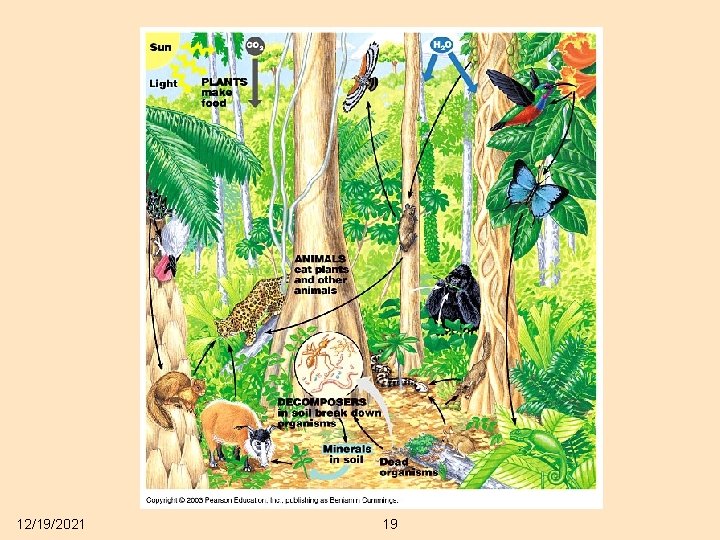
1. 2 Living organisms and their environments form interconnecting webs • Ecosystems are characterized by the cycling of chemical nutrients from the atmosphere and soil – To producers to consumers to decomposers and back to the environment which contains both living and nonliving components 12/19/2021 15 Dr. Perkins
Environment 1. ENVIRONMENT natural world: the natural world, within which people, animals, and plants live. It is regarded by many as being at risk from the harmful influences of industrialized societies. Microsoft® Encarta® Reference Library 2004. © 1993 -2003 Microsoft Corporation. All rights reserved. 12/19/2021 16 Dr. Perkins
1. 2 Living organisms and their environments form interconnecting webs • Two major processes are at work in an ecosystem: 1. The recycling of chemical nutrients 2. The flow of energy 12/19/2021 17 Dr. Perkins
Question • Explain how the photosynthesis of plants functions in both the cycling of chemical nutrients and the flow of energy in an ecosystem. • Photosynthesis use light energy to convert carbon dioxide and water to make energy rich compounds/food, making it the pathway for nutrients and energy for most organisms. It is the basis of the entire food chain for all living organisms. 12/19/2021 18
12/19/2021 19
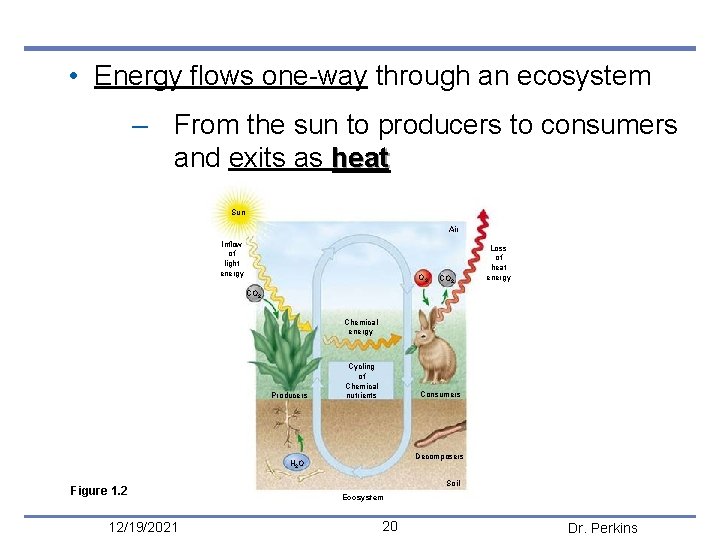
• Energy flows one-way through an ecosystem – From the sun to producers to consumers and exits as heat Sun Air Inflow of light energy O 2 CO 2 Loss of heat energy CO 2 Chemical energy Producers Cycling of Chemical nutrients Consumers Decomposers H 2 O Figure 1. 2 12/19/2021 Soil Ecosystem 20 Dr. Perkins
Question • Explain why cells are considered the basic unit of life • They are the lowest level in hierarchy of biological organization at which properties of life actually appear. 12/19/2021 21
1. 3 Cells are the structural and functional units of life • A cell v Is the basic unit of life that can perform all functions necessary for life including: 1. Regulate its internal environment 2. Take in and use energy 3. Respond to its local environment 4. Develop and maintain its complex organization 5. Divide to form new cells 12/19/2021 22 Dr. Perkins
• New proper ties emerge – from the complex organization of a system, such as a cell Ø An important theme of biology is the emergent property: v Life is dependent on the organizational levels of a cell – or “the whole is greater than sum of its parts. ” v System: the combination of the parts that from a more complex organization, regardless if it is a cell or a community. 12/19/2021 23 Dr. Perkins
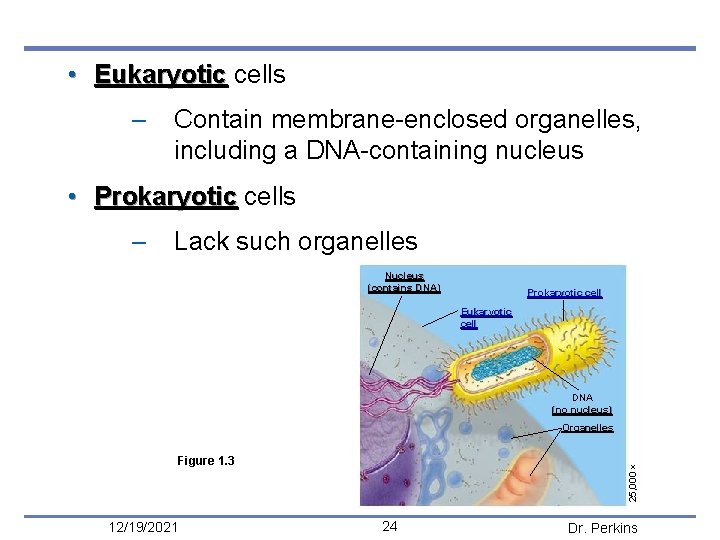
• Eukaryotic cells – Contain membrane-enclosed organelles, including a DNA-containing nucleus • Prokaryotic cells – Lack such organelles Nucleus (contains DNA) Prokar yotic cell Eukar yotic cell DNA (no nucleus) Organelles 12/19/2021 25, 000 Figure 1. 3 24 Dr. Perkins
Question • What is the chemical basis of all life’s kinship? • DNA is the genetic material 12/19/2021 25
EVOLUTION, UNITY, AND DIVERSITY 1. 4 The unity of life: All forms of life have common features • DNA is the genetic information – For constructing the molecules that make up cells and organisms 12/19/2021 26 Dr. Perkins
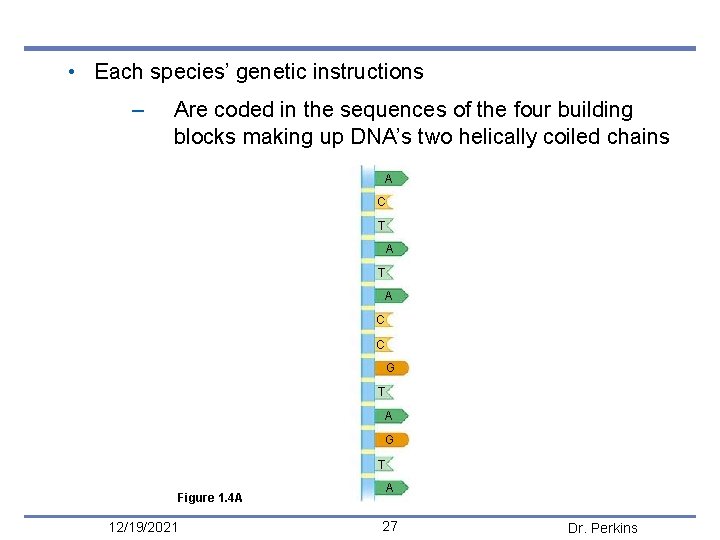
• Each species’ genetic instructions – Are coded in the sequences of the four building blocks making up DNA’s two helically coiled chains A C T A C C G T A G T Figure 1. 4 A 12/19/2021 A 27 Dr. Perkins
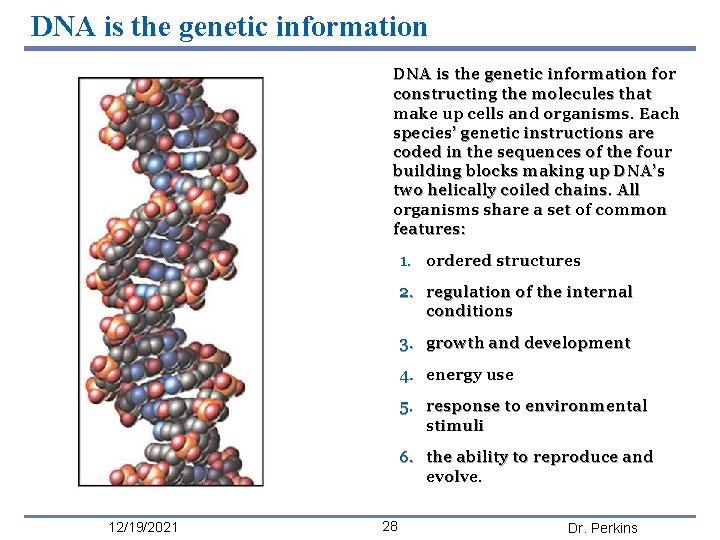
DNA is the genetic information for constructing the molecules that make up cells and organisms. Each species’ genetic instructions are coded in the sequences of the four building blocks making up DNA’s two helically coiled chains. All organisms share a set of common features: 1. ordered structures 2. regulation of the internal conditions 3. growth and development 4. energy use 5. response to environmental stimuli 6. the ability to reproduce and evolve. 12/19/2021 28 Dr. Perkins
Question • List the 6 basic characteristics of life. 1. 2. 3. 4. 5. 3. 12/19/2021 Ordered structures Regulation of internal conditions Growth and development Energy use Response to environmental stimuli The ability to reproduce and evolve 29
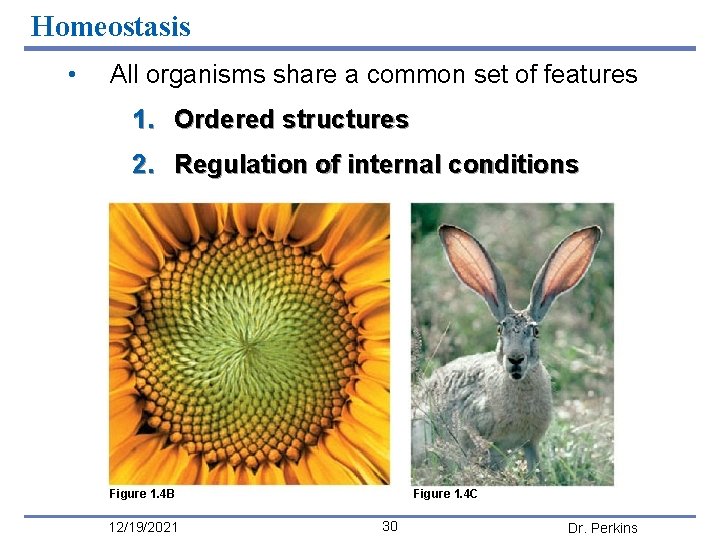
Homeostasis • All organisms share a common set of features 1. Ordered structures 2. Regulation of internal conditions Figure 1. 4 B 12/19/2021 Figure 1. 4 C 30 Dr. Perkins
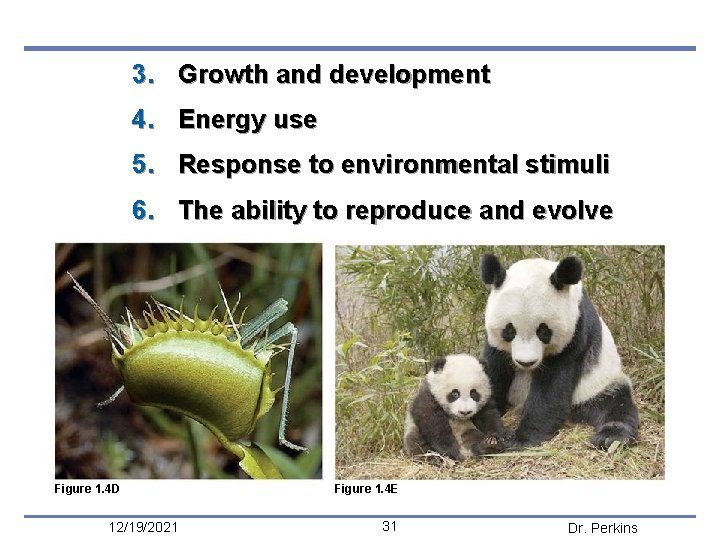
3. Growth and development 4. Energy use 5. Response to environmental stimuli 6. The ability to reproduce and evolve Figure 1. 4 D 12/19/2021 Figure 1. 4 E 31 Dr. Perkins
Question • List the three domains and the five kingdoms. • Give examples of each. • Eukaryote, Bacteria, Achaea • Animalia, Plantae, Fungi, Monera, Protista • Any animal, any plant, yeast and mushrooms, E. coli, algae and amoeba 12/19/2021 32
1. 5 The diversity of life can be arranged into three domains • Organisms are grouped (classified) into: – the prokaryotic 2 domains: • Bacteria and Archaea – the eukaryotic domain • 12/19/2021 Eukarya 33 Dr. Perkins
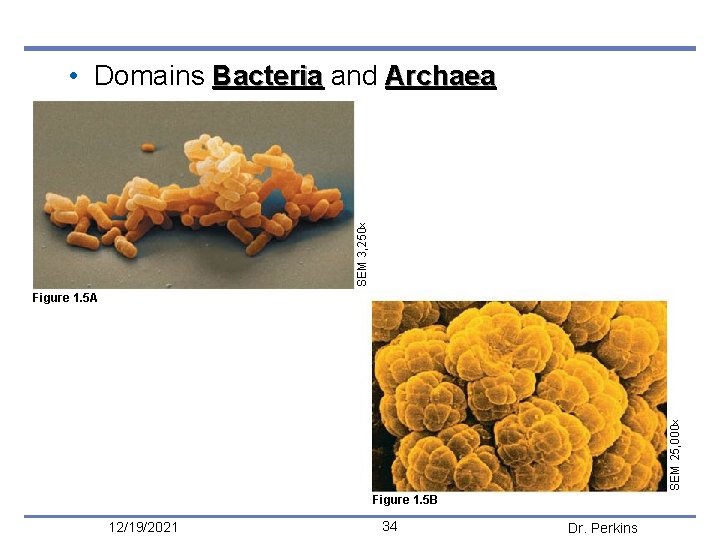
SEM 3, 250 • Domains Bacteria and Archaea SEM 25, 000 Figure 1. 5 A Figure 1. 5 B 12/19/2021 34 Dr. Perkins
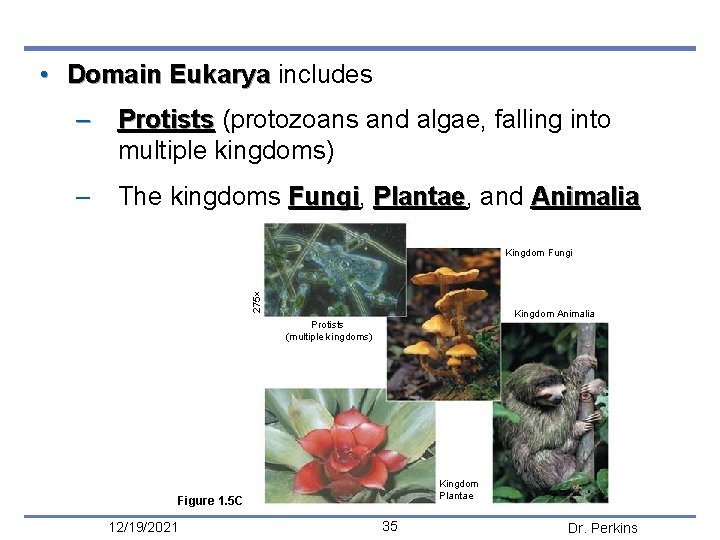
• Domain Eukarya includes – Protists (protozoans and algae, falling into multiple kingdoms) The kingdoms Fungi, Fungi Plantae, Plantae and Animalia Kingdom Fungi 275 – Kingdom Animalia Protists (multiple kingdoms) Kingdom Plantae Figure 1. 5 C 12/19/2021 35 Dr. Perkins
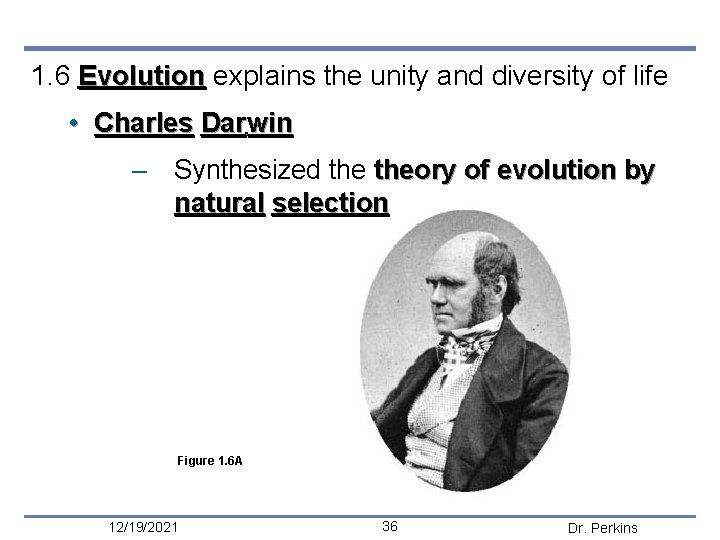
1. 6 Evolution explains the unity and diversity of life • Charles Dar win – Synthesized theory of evolution by natural selection Figure 1. 6 A 12/19/2021 36 Dr. Perkins
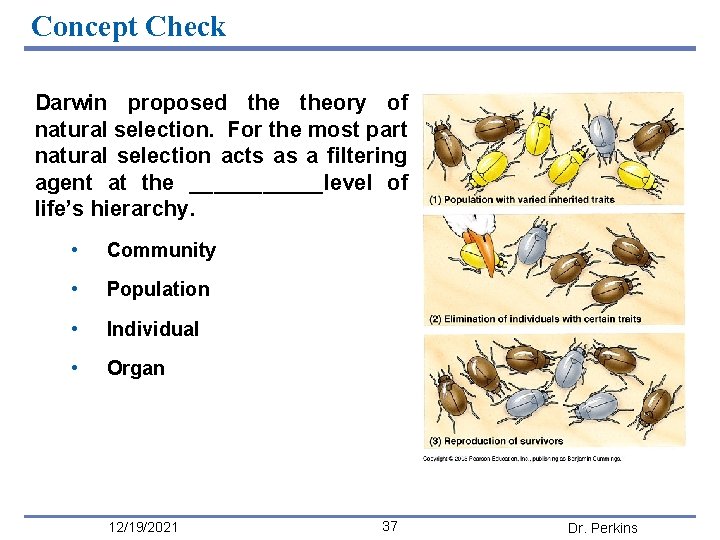
Concept Check Darwin proposed theory of natural selection. For the most part natural selection acts as a filtering agent at the ______level of life’s hierarchy. • Community • Population • Individual • Organ 12/19/2021 37 Dr. Perkins
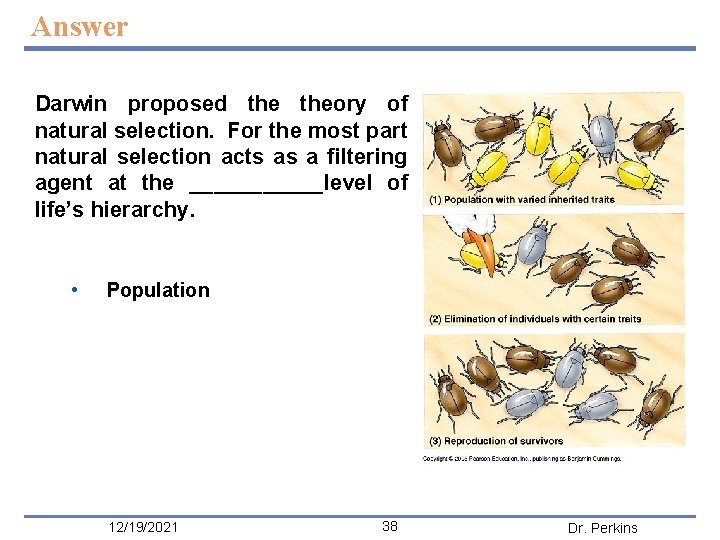
Answer Darwin proposed theory of natural selection. For the most part natural selection acts as a filtering agent at the ______level of life’s hierarchy. • Population 12/19/2021 38 Dr. Perkins
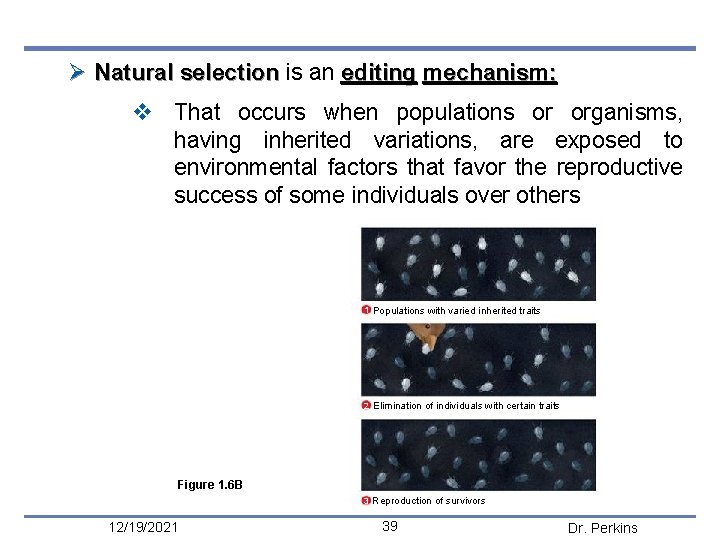
Ø Natural selection is an editing mechanism: v That occurs when populations or organisms, having inherited variations, are exposed to environmental factors that favor the reproductive success of some individuals over others 1 Populations with varied inherited traits 2 Elimination of individuals with certain traits Figure 1. 6 B 3 Reproduction of survivors 12/19/2021 39 Dr. Perkins
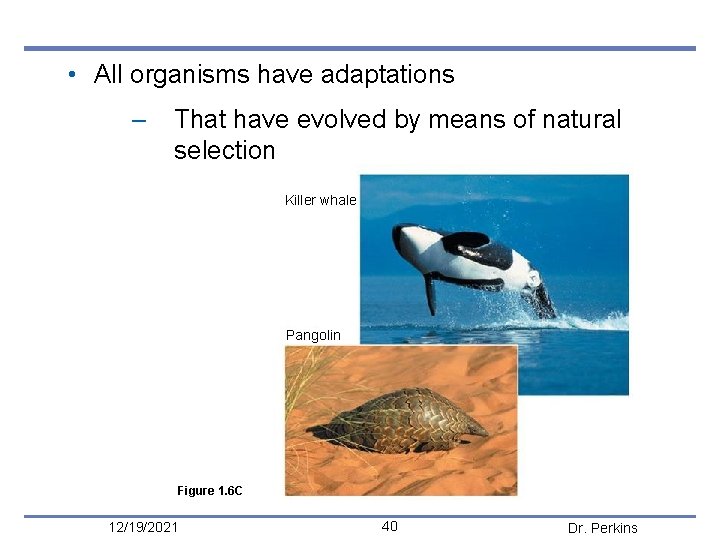
• All organisms have adaptations – That have evolved by means of natural selection Killer whale Pangolin Figure 1. 6 C 12/19/2021 40 Dr. Perkins
Question • How does natural selection allow a population to adapt to its environment? • On average, those organisms with heritable traits best suited for their local environment produce the largest number of offspring that survive and reproduce. This increases the frequency of these traits in the population. 12/19/2021 41
THE PROCESS OF SCIENCE 1. 7 Scientists use two main approaches to learn about nature • Science – Is a way of knowing – Seeks natural causes for natural phenomena 12/19/2021 42 Dr. Perkins
1. Discovery Science • In discovery science v Scientists describe some aspect of the world and use inductive reasoning to draw general conclusions v Inductive: LOGIC reaching a conclusion based on observation: generalizing to produce a universal claim or principle from observed instances 12/19/2021 43 Dr. Perkins
2. Hypothesis-Based Science • In hypothesis-based science v Scientists attempt to explain obser vations by testing hypotheses 12/19/2021 44 Dr. Perkins
1. 8 With hypothesis-based science, we pose and test hypotheses • Hypothesis-based science involves: v Obser vations, questions, hypotheses as tentative answers to questions and v Deductions leading to predictions, predictions and then tests of predictions to see if a hypothesis is falsifiable 12/19/2021 45 Dr. Perkins
Question • What is the difference between discovery science and hypothesis-based science? • In the first, scientists make observations and describe objects and phenomena (inductive reasoning); in the second, they propose hypotheses, make deductions, and test predictions. 12/19/2021 46
Hypothesis §Theory needing investigation: investigation a tentative explanation for a phenomenon, used as a basis for further investigation The hypothesis of the big bang is one way to explain the beginning of the universe. 12/19/2021 47 Dr. Perkins
Hypothesis - defined w A conjecture advanced for heuristic purposes, cast in a form that is amenable to confirmation or refutation by conducting of definable experiments and the critical assembly of empiric data; not to be confused with assumption, postulation, or unfocused speculation. w Heuristic: LOGIC procedure for getting solution: a helpful procedure for arriving at a solution but not necessarily a proof 12/19/2021 48 Dr. Perkins
Deduction • Conclusion drawn: a conclusion drawn from available information. • Drawing a conclusion: the process of drawing a conclusion from available information. • LOGIC logical conclusion: a conclusion reached by applying the rules of logic to a premise. • LOGIC reasoning: the forming of conclusions by applying the rules of logic to a premise 12/19/2021 49 Dr. Perkins
A Case Study from Ever yday Life • Deductive reasoning is used in testing hypotheses as follows – If a hypothesis is correct, and we test it, then we can expect a par ticular outcome 12/19/2021 50 Dr. Perkins
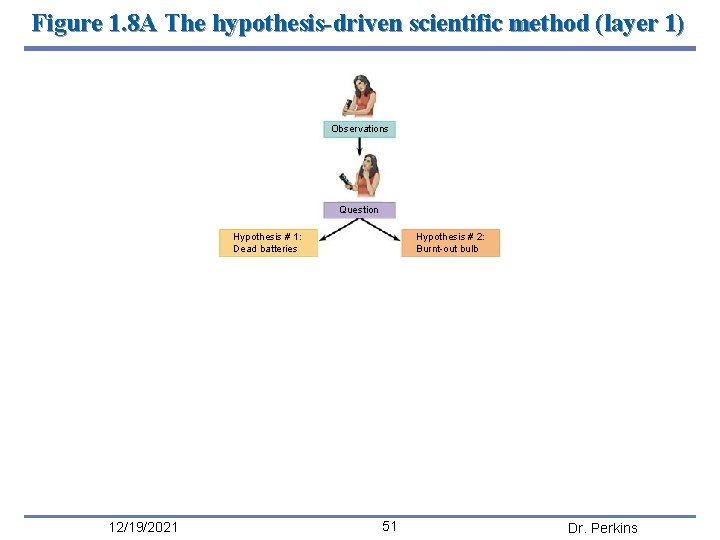
Figure 1. 8 A The hypothesis-driven scientific method (layer 1) Observations Question Hypothesis # 1: Dead batteries Hypothesis # 2: Burnt-out bulb Prediction: Replacing batteries will fix problem Prediction: Replacing bulb will fix problem Test prediction Test falsifies hypothesis 12/19/2021 Test does not falsify hypothesis 51 Dr. Perkins
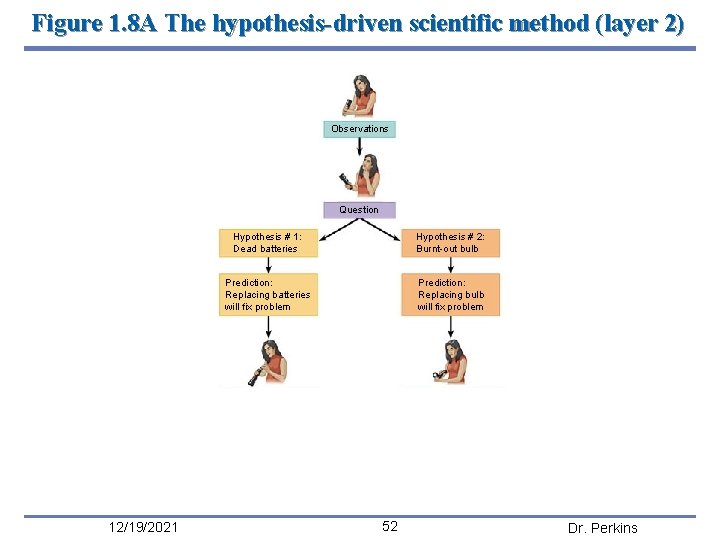
Figure 1. 8 A The hypothesis-driven scientific method (layer 2) Observations Question Hypothesis # 1: Dead batteries Hypothesis # 2: Burnt-out bulb Prediction: Replacing batteries will fix problem Prediction: Replacing bulb will fix problem Test prediction Test falsifies hypothesis 12/19/2021 Test does not falsify hypothesis 52 Dr. Perkins
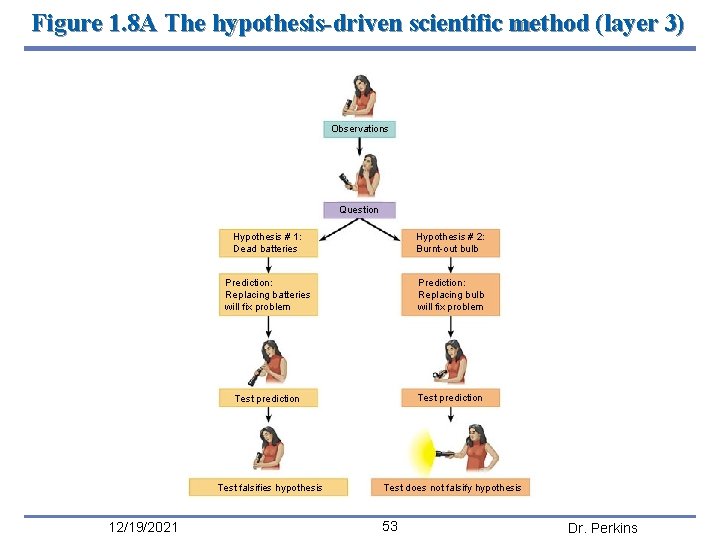
Figure 1. 8 A The hypothesis-driven scientific method (layer 3) Observations Question Hypothesis # 1: Dead batteries Hypothesis # 2: Burnt-out bulb Prediction: Replacing batteries will fix problem Prediction: Replacing bulb will fix problem Test prediction Test falsifies hypothesis 12/19/2021 Test does not falsify hypothesis 53 Dr. Perkins
Five Steps of the scientific method 1. Observation come from others or results of earlier tests 2. Questions are asked about unclear aspects of the observations: How? Why? When? 3. Hypotheses are tentative explanation of a phenomenon phrased in such a way as to be testable. 4. Predictions are logical, testable outcomes of the hypotheses developed by the use of deductive reasoning. Predictions take the form of if (statement of hypotheses) is true, then (predictions). 5. Tests of prediction are performed to determine if the predictions are supported (fail to falsify) or falsified. 12/19/2021 54 Dr. Perkins
Two important qualities of the hypotheses-based science 1. A hypothesis must be testable. 2. A hypothesis must be falsifiable. A hypothesis becomes credible when repeated attempts to disprove it fail. 12/19/2021 55 Dr. Perkins
Controls • Controlled experiment, one that is designed to compare an experimental group with a control group. • Ideally, the experimental and control groups differ only in the one factor the experiment is designed to test. • Without the control group, one could not rule out certain test areas as the cause of the difference. • This experimental design should leave only one factor to account for the difference in the two groups. 12/19/2021 56 Dr. Perkins
Question • What two required features of an hypothesis? • It must be testable and falsifiable 12/19/2021 57
Question • Why is it difficult to draw a conclusion from an experiment that is not controlled? • Without a control you don’t know if the experimental outcome is due to the variable you are trying to test or due to some other variable. 12/19/2021 58
BIOLOGY AND EVERYDAY LIFE CONNECTION 1. 8 Biology is connected to our lives in many ways: v Biology in the news has an enormous impact on our every day lives. Some examples of biology in the news are endangered species, genetically modified crops, global warming, pollution, cloning, nutrition, emerging diseases, and medical advances. v Technology is the practical application of scientific knowledge and discovery. Scientists speak of discovery while engineers speak of inventions. Scientists and engineers benefit from the work and success of each other. 12/19/2021 59 Dr. Perkins
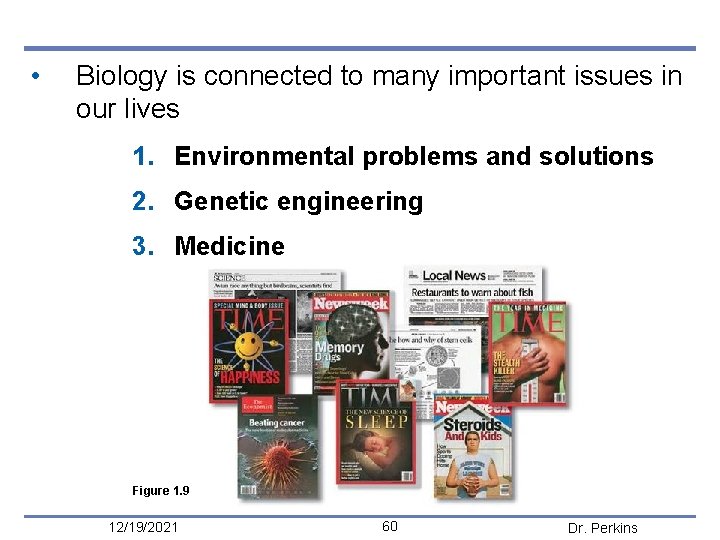
• Biology is connected to many impor tant issues in our lives 1. Environmental problems and solutions 2. Genetic engineering 3. Medicine Figure 1. 9 12/19/2021 60 Dr. Perkins
• Many technological advances – Stem from scientific research • The science-technology-society relationship – Is an impor tant aspect of a biology course 12/19/2021 61 Dr. Perkins
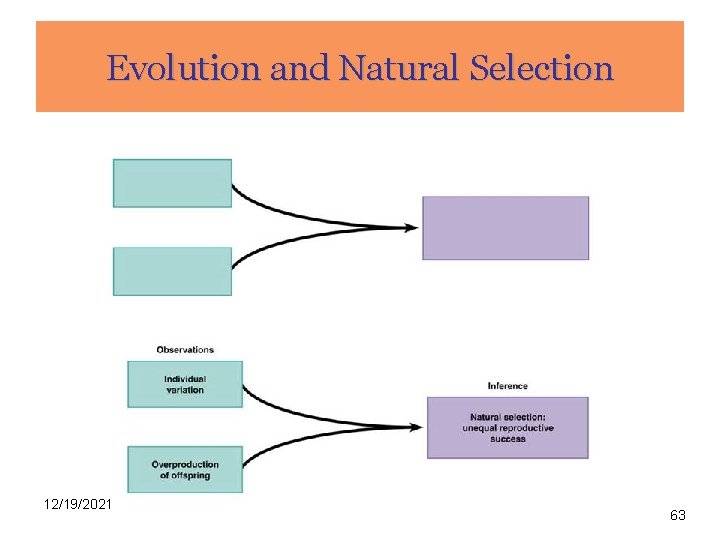
Evolution and Natural Selection • Evolution explains the unity and diversity of life. Charles Darwin synthesized theory of evolution by natural selection. Natural selection is an editing mechanism that occurs when populations of organisms having inherited variations are exposed to environmental factors that favor the reproductive success of some individuals over others. All organisms have adaptations that have evolved by means of natural selection. 12/19/2021 62
Evolution and Natural Selection 12/19/2021 63
- Slides: 63