
Biology of Cultured Fish Developed by the Harbor

Biology of Cultured Fish Developed by the Harbor Branch ACTED staff

Fish Anatomy
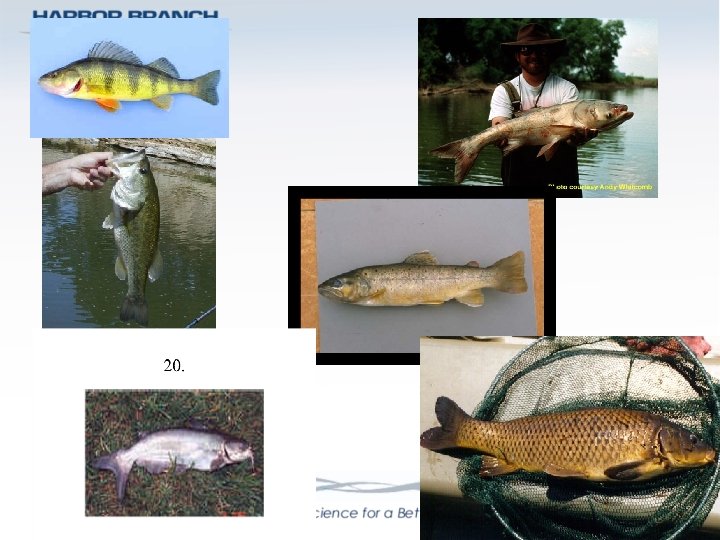
Work with a partner and list differences amongst fish on the next slide.
Name the parts of the fish on the following slide.

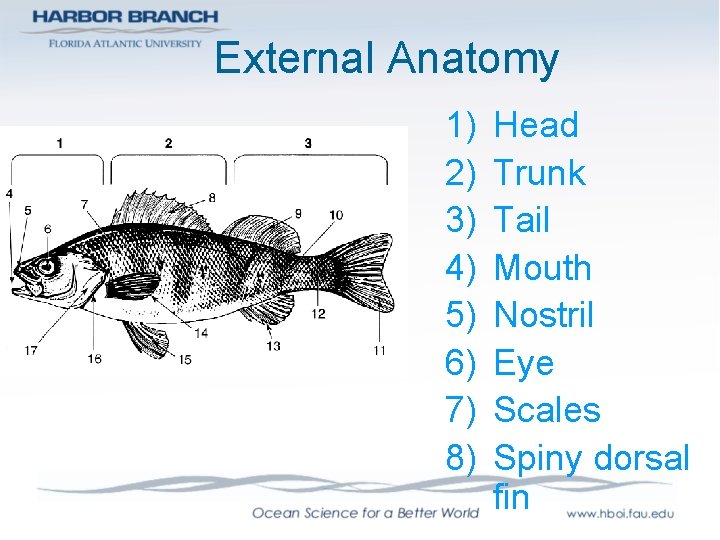
External Anatomy 1) 2) 3) 4) 5) 6) 7) 8) Head Trunk Tail Mouth Nostril Eye Scales Spiny dorsal fin

External Anatomy 9) Soft dorsal fin 10) Lateral line 11) Caudal fin 12) Peduncle 13) Anal fin 14) Pelvic fin 15) Pectoral fin
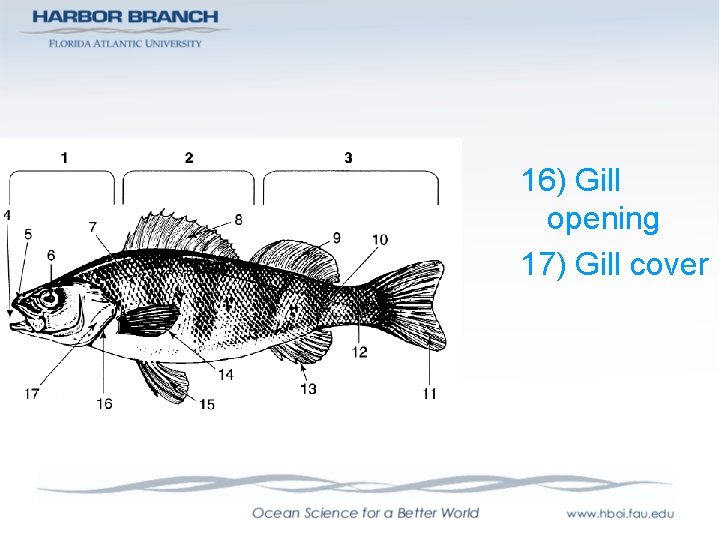
16) Gill opening 17) Gill cover
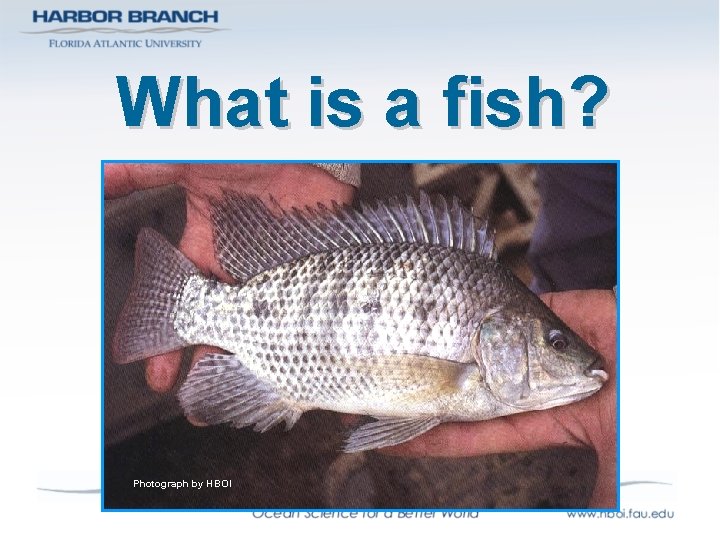
What is a fish? Photograph by HBOI
Anatomy & Physiology • Lives in water? • Carnivore, Omnivore, Herbivore • Vertebrate • Poikilotherm “cold blooded” • Fins • Gills • Senses • Lateral line • Scales • Slime (mucus) • Swim bladder “buoyancy compensator” • External or Internal Reproduction
Freshwater Fish Less than 1% of the Earth is freshwater • 40% of fish are freshwater • less than 5000 m deep • species are a result of evolutionary isolation and ecological adaptation • No global species • Two species are circumpolar
Marine Fish Earth is 71% saltwater • 60% of fish are marine • Less evolutionary variable and ecologically isolated • The oceans provide much bigger space • Many have large ranges • 7000 m deep • 130 global species Tuna distribution in southern oceans
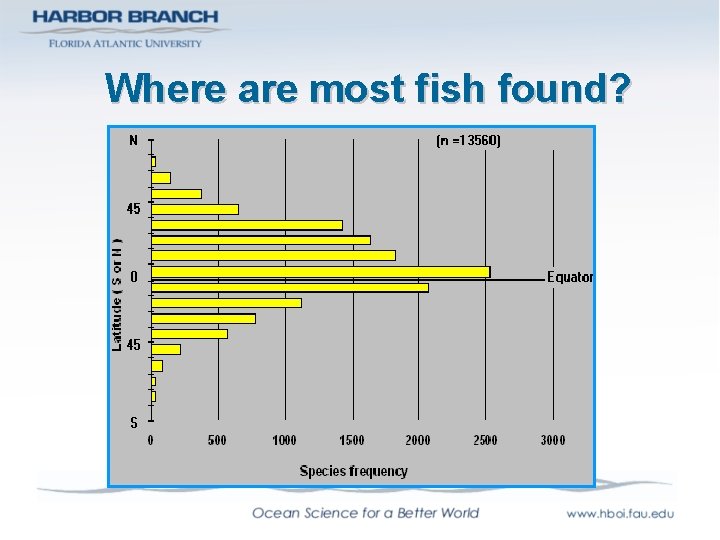
Where are most fish found?
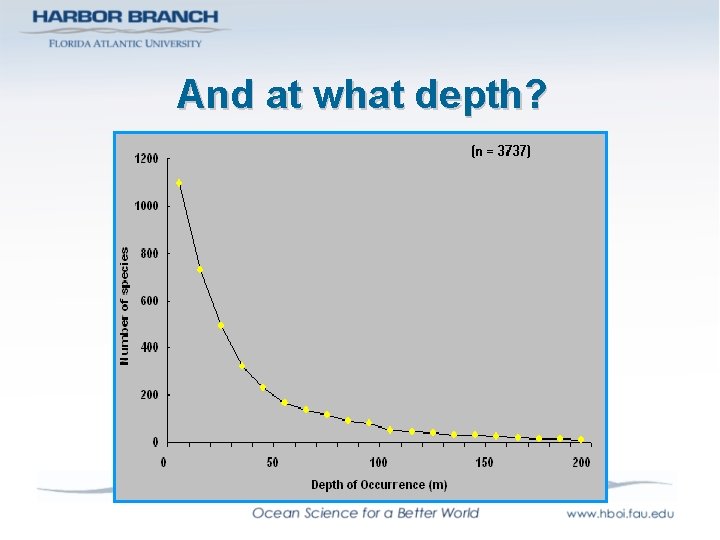
And at what depth?
Ichthyology “the study of fishes” • 25, 000 living species • 53, 000 scientific names • 200 new species each year
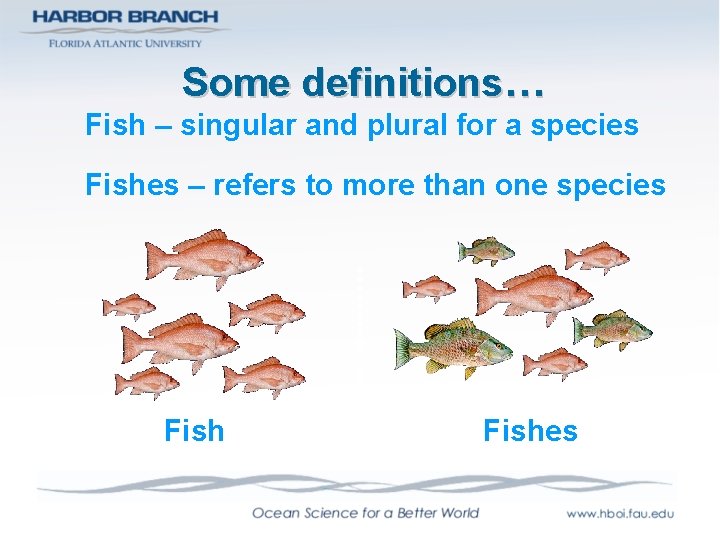
Some definitions… Fish – singular and plural for a species Fishes – refers to more than one species Fishes
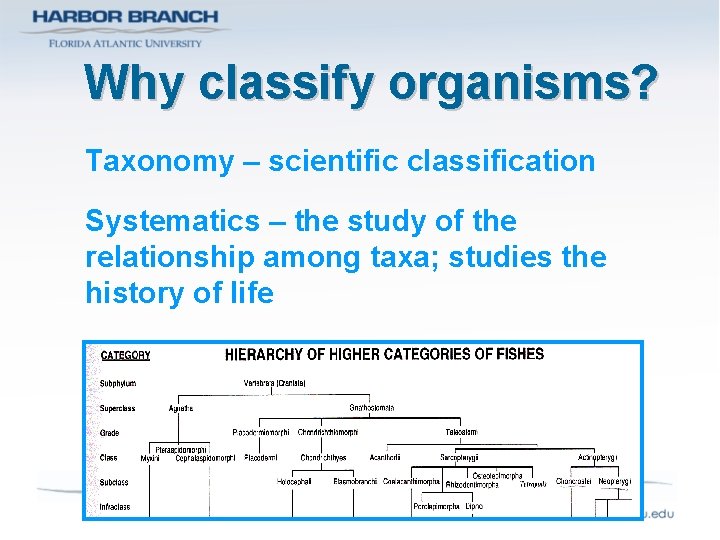
Why classify organisms? Taxonomy – scientific classification Systematics – the study of the relationship among taxa; studies the history of life
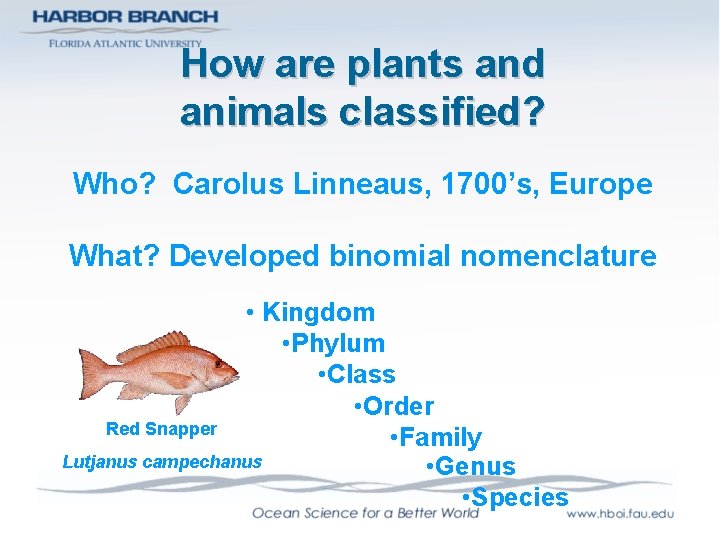
How are plants and animals classified? Who? Carolus Linneaus, 1700’s, Europe What? Developed binomial nomenclature • Kingdom • Phylum • Class • Order Red Snapper • Family Lutjanus campechanus • Genus • Species
How would an aquaculturist classify fish? • Temperature • Salinity • Reproduction
Temperature Cold (trout, salmon) Temp: below 15 C Cool (catfish, striped bass) Temp: 15 – 25 C Warm (tilapia) Temp: above 25 C
Salinity Freshwater (< 1 ppt) Brackish water (1 -15 ppt) Saltwater (15 -36 ppt) Euryhaline – adapts to different salinities Stenohaline – cannot adapt to different salinities
Osmoregulation • Aquatic species may be classified in terms of their salinity tolerance as either: • • • saltwater species brackish water species freshwater species • Salinity requirements may differ for a given species at different stages in its life cycle. • Species adapted to a narrow range of salinities are described as stenohaline. • Species which are able to tolerate a wide range of salinities are described as euryhaline.
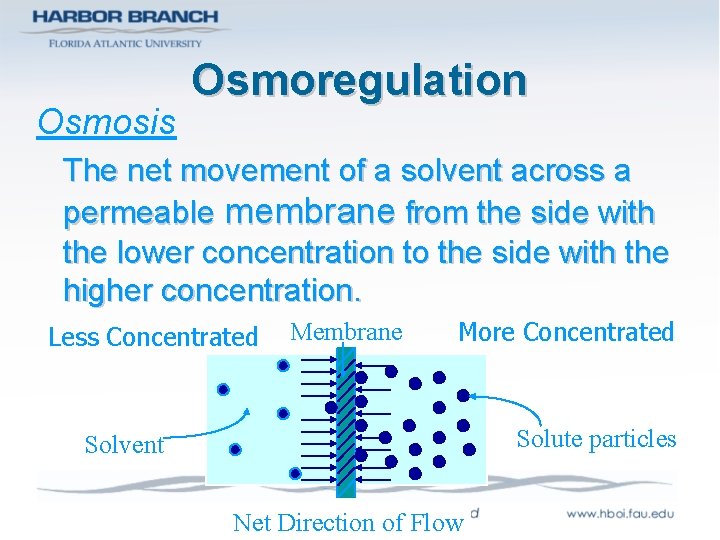
Osmosis Osmoregulation The net movement of a solvent across a permeable membrane from the side with the lower concentration to the side with the higher concentration. Less Concentrated Membrane More Concentrated Solute particles Solvent Net Direction of Flow
Osmoregulation • For fish we can think of the body fluids as one solution, the surrounding water as the other solution, and the parts of the body separating the two solutions as the membrane. • In most organisms the gills are the primary membranes where osmosis occurs.
Osmoregulation: Marine Fish • The body fluids of saltwater species are hypotonic (dilute) relative to the surrounding water, so these species tend to lose water to the environment. • Osmoregulation in saltwater species requires intake of water and excretion of excess salts.
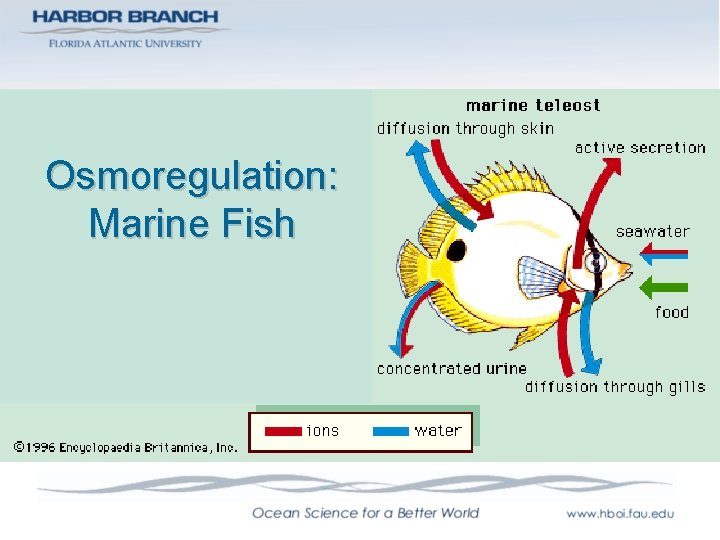
Osmoregulation: Marine Fish
Osmoregulation: Freshwater Fish • The ionic composition of the body fluids of freshwater species is hypertonic (more concentrated) to the surrounding water, so these species tend to accumulate water from the environment. • Osmoregulation in freshwater species involves excretion of water and active uptake and retention of salts.
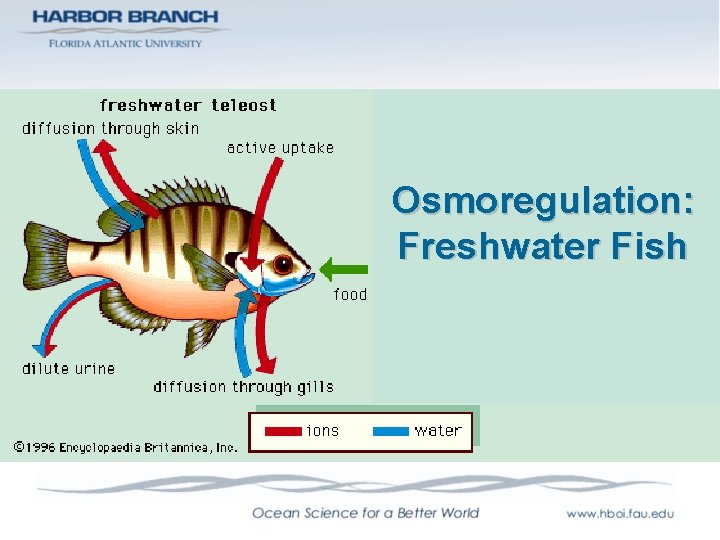
Osmoregulation: Freshwater Fish
- Slides: 32