
Biology lecture Two Cell structure and function Professor
Biology: lecture Two Cell structure and function Professor: Zied Jezawi
2
3
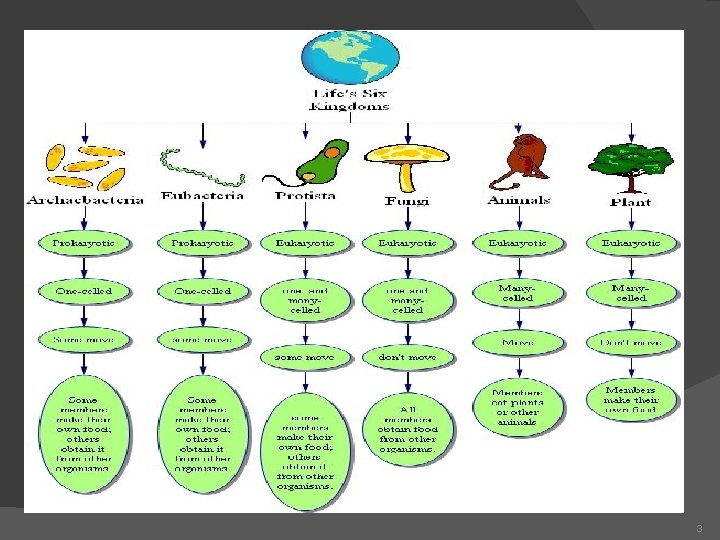
Two different types of cells exist • Prokaryotic are so named because they lack a membrane bounded nucleus. They are divided into two types, based on DNA and RNA. • Bacteria • Archaea • Eukaryotic cell which has a nucleus. • Animal cells, plant cells and those of fungi and many protists. 4
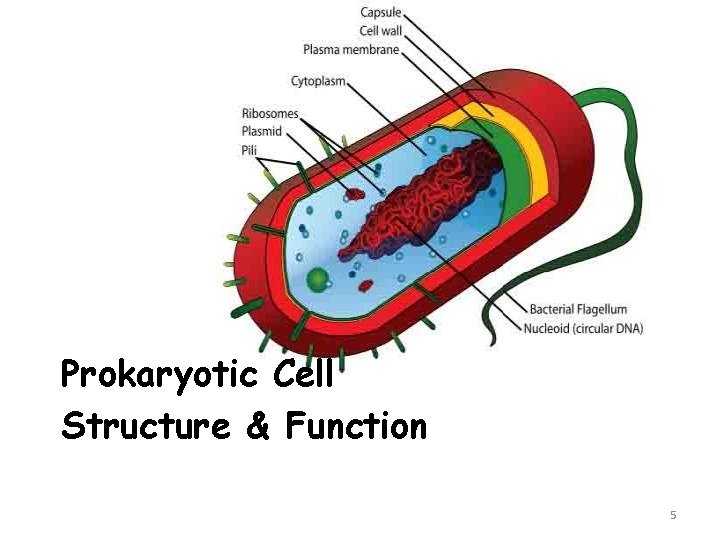
Prokaryotic Cell Structure & Function 5
• Capsule - Found in some bacterial cells, this additional outer covering protects the cell when it is engulfed by other organisms • Cell Wall - Outer covering of most cells that protects the bacterial cell and gives it shape. 6
Cytoplasm - A gel-like substance composed mainly of water that also contains enzymes, salts, cell components. Cell Membrane or Plasma Membrane - Surrounds the cell's cytoplasm and regulates the flow of substances in and out of the cell. 7
• Flagella - Long, whip-like protrusion that aids in cellular locomotion. • Ribosomes - Cell structures responsible for protein production. • Plasmids - Gene carrying, circular DNA structures that are not involved in reproduction. • Nucleiod Region - Area of the cytoplasm that contains the single bacterial DNA molecule. 8
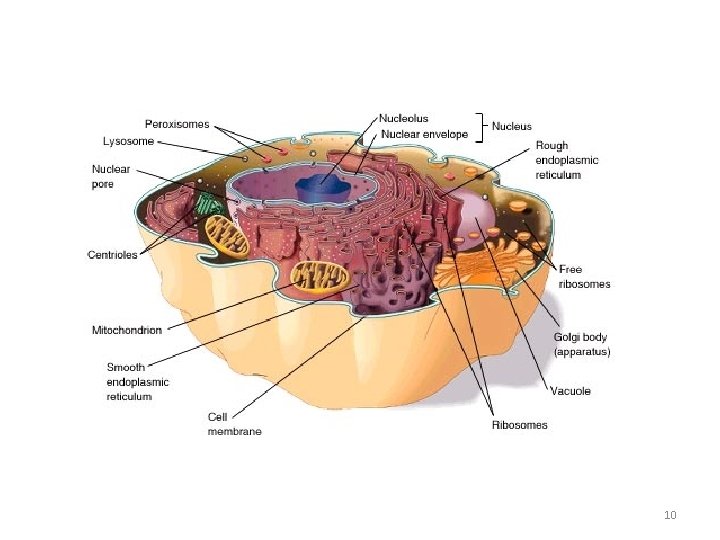
Structure of Eukaryotic Cell • Eukaryotic cells have compartments called organelles. • Each membranous organelle has a specific structure and function. 9
10
The Nucleus and Ribosomes • The chromosomes are the carriers of genetic information and that the nucleus is the command center of the cell. 11
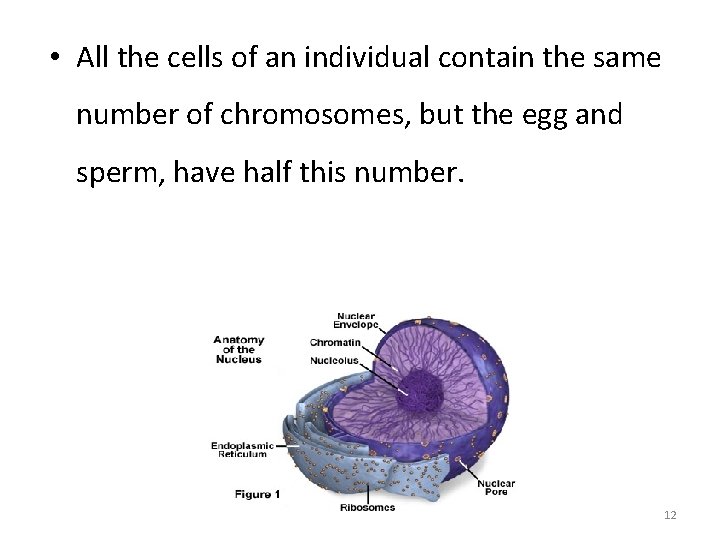
• All the cells of an individual contain the same number of chromosomes, but the egg and sperm, have half this number. 12
• Three types of RNA are produced in the nucleolus. (r. RNA) (m. RNA) (t. RNA) 13
The nucleus is separated from the cytoplasm by a double membrane known as the nuclear envelope. The nuclear envelope has nuclear pores. 14
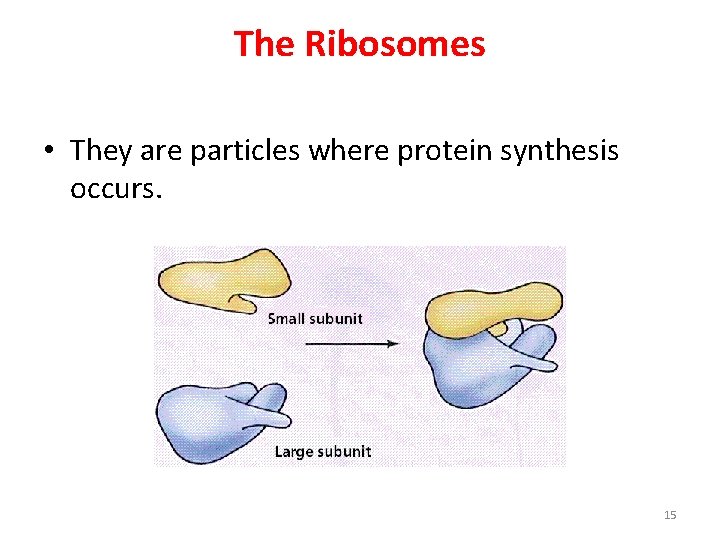
The Ribosomes • They are particles where protein synthesis occurs. 15
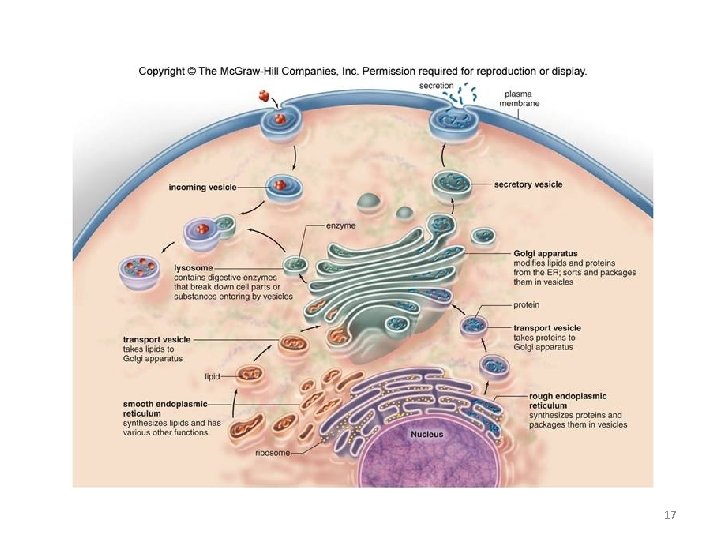
The Endomembrane System The nuclear envelope endoplasmic reticulum Golgi apparatus 16
17
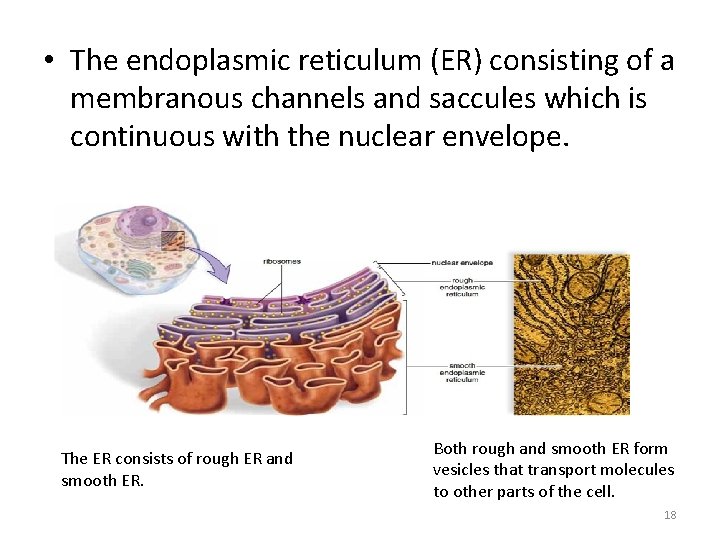
• The endoplasmic reticulum (ER) consisting of a membranous channels and saccules which is continuous with the nuclear envelope. The ER consists of rough ER and smooth ER. Both rough and smooth ER form vesicles that transport molecules to other parts of the cell. 18
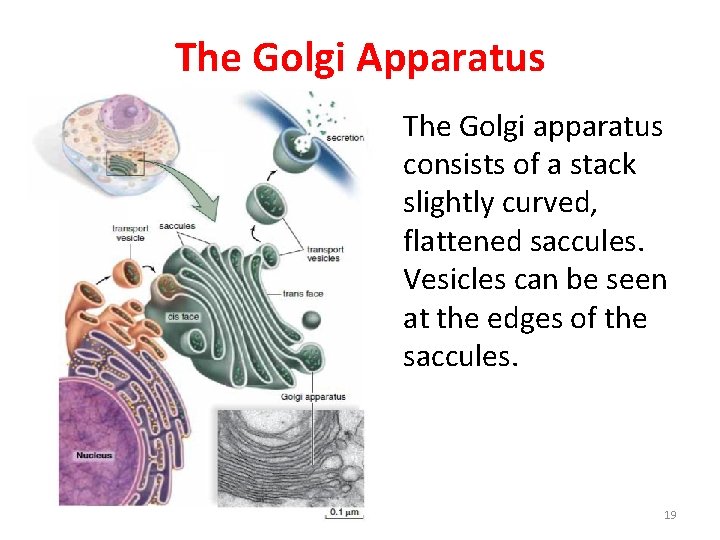
The Golgi Apparatus The Golgi apparatus consists of a stack slightly curved, flattened saccules. Vesicles can be seen at the edges of the saccules. 19
• The Golgi apparatus sorts the modified molecules and packages them into vesicles that depart from the outer face. In animal cells, some of these vesicles are lysosomes. 20
Lysosomes • They are membrane bounded vesicles produced by the Golgi apparatus. • They have a very low p. H and store powerful hydrolytic digestive enzymes in an inactive state. 21
• Lysosomes assist in digesting material taken into the cell • They destroy non- functional organelles. 22
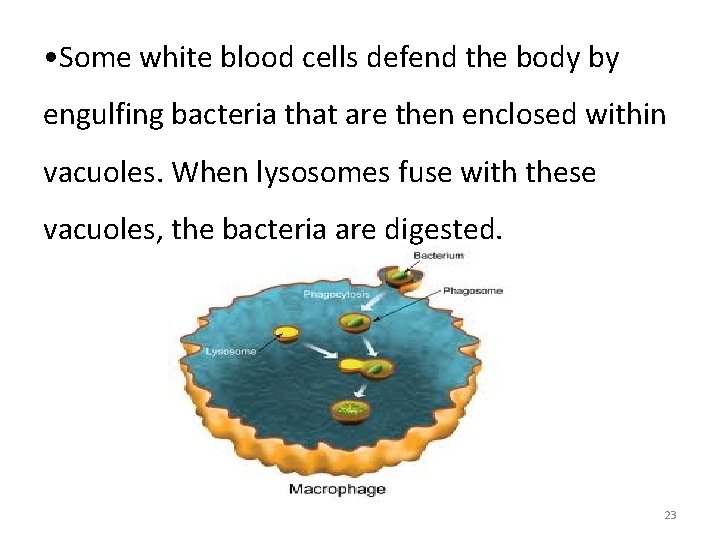
• Some white blood cells defend the body by engulfing bacteria that are then enclosed within vacuoles. When lysosomes fuse with these vacuoles, the bacteria are digested. 23
Vacuoles are membranous sacs, but vacuoles are larger than vesicles. • The contractile vacuoles of some cells get rid of excess water others digestive vacuoles for breaking down nutrients. • Few animal cells contain vacuoles. 24
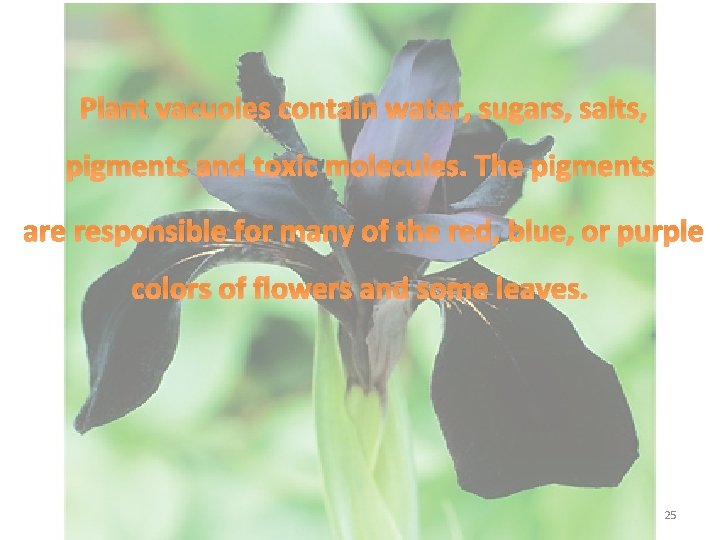
Plant vacuoles contain water, sugars, salts, pigments and toxic molecules. The pigments are responsible for many of the red, blue, or purple colors of flowers and some leaves. 25

The toxic substances help protect a land plant from herbivorous animals. 26
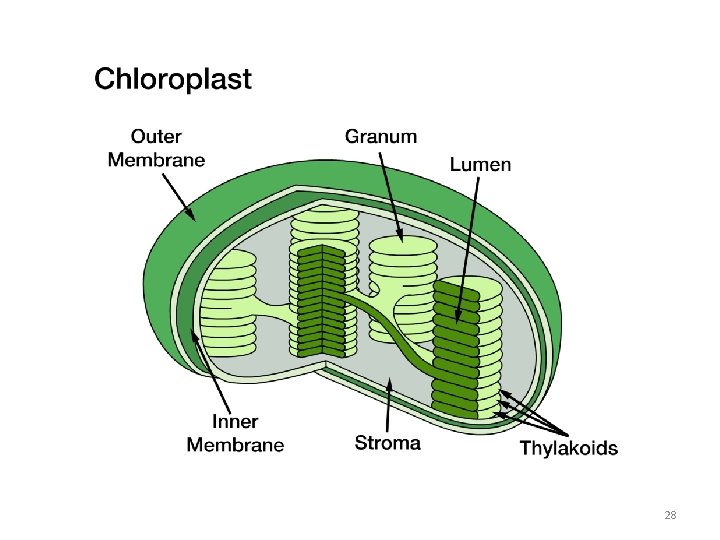
Chloroplasts have a three membrane system. The semi-fluid stroma, which contains enzymes and thylakoids, –Disk like sacs formed from a third chloroplast membrane. –A stack of thylakoids is a granum 27
28
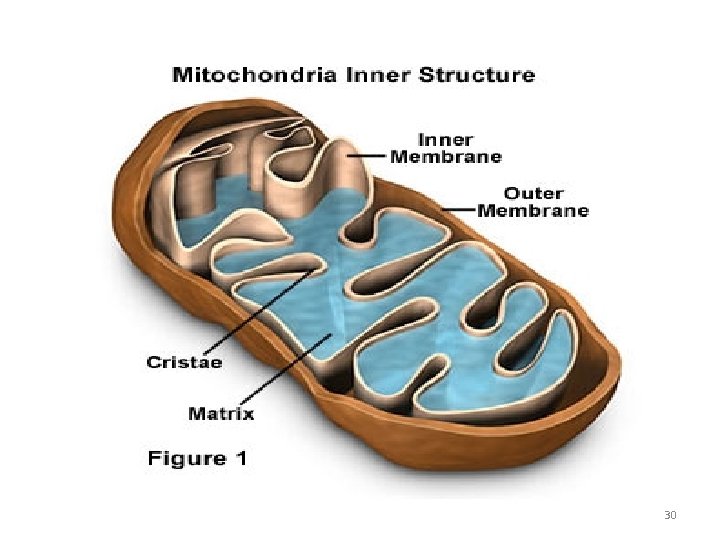
Mitochondria • Nearly all eukaryotic cells, and certainly all plant and algal cells in addition to animal cells, contain mitochondria. • The number of mitochondria can vary in cells depending on their activities. Some cells, such as liver cells, may have as many as 1, 000 mitochondria. 29
30
Mitochondria have two membranes, the outer membrane and the inner membrane. • The inner membrane is highly convoluted into cristae that project into the matrix. These cristae increase the surface area of the inner membrane so much that in a liver cell they account for about one third the total membrane in the cell. 31
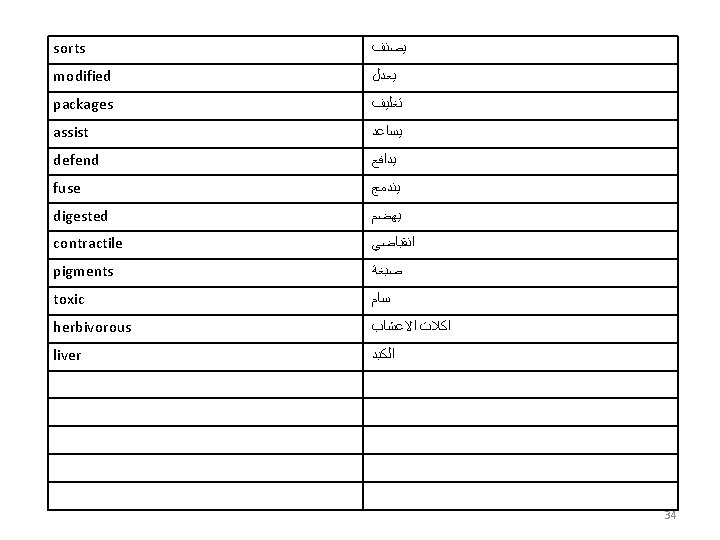
Appendix of Terminology word meaning structure ﺗﺮﻛﻴﺐ function ﻭﻇﻴﻔﺔ kingdom ﻣﻤﻠﻜﺔ exist ﻣﻮﺟﻮﺩ divided ﻣﻘﺴﻢ fungi ﻓﻄﺮﻳﺎﺕ protists ﻃﻼﺋﻌﻴﺎﺕ Prokaryotic ﺍﻟﻨﻮﺍﺓ ﺑﺪﺍﺋﻴﺔ Eukaryotic ﺍﻟﻨﻮﺍﺓ ﺣﻘﻴﻘﻴﺔ additional ﺇﺿﺎﻓﻲ protects ﻳﺤﻤﻲ engulfed ﻳﺒﺘﻠﻊ organisms ﻛﺎﺋﻦ 32

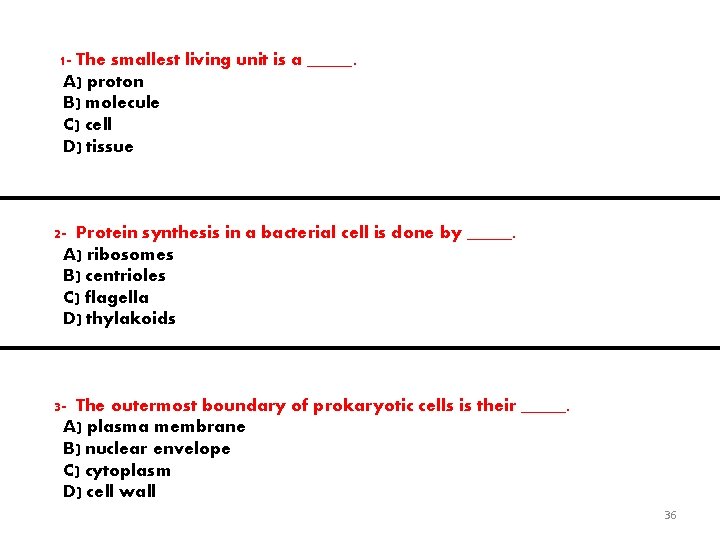
1 - The smallest living unit is a _____. A) proton B) molecule C) cell D) tissue 2 - Protein synthesis in a bacterial cell is done by _____. A) ribosomes B) centrioles C) flagella D) thylakoids 3 - The outermost boundary of prokaryotic cells is their _____. A) plasma membrane B) nuclear envelope C) cytoplasm D) cell wall 36
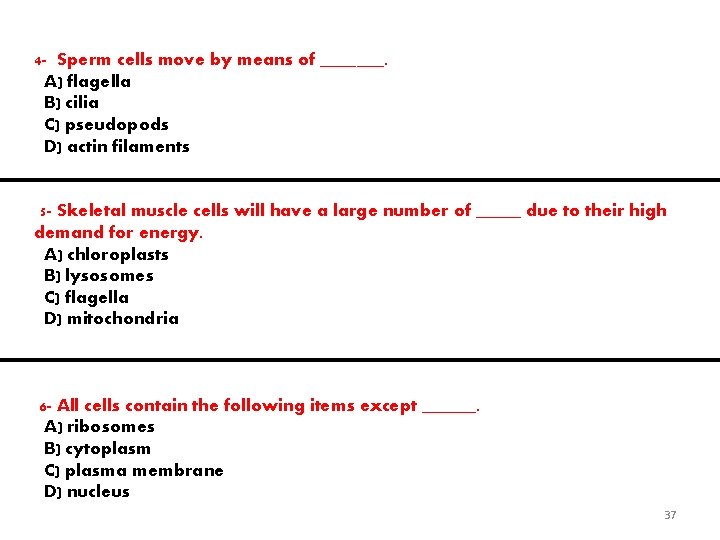
4 - Sperm cells move by means of _______. A) flagella B) cilia C) pseudopods D) actin filaments 5 - Skeletal muscle cells will have a large number of _____ due to their high demand for energy. A) chloroplasts B) lysosomes C) flagella D) mitochondria 6 - All cells contain the following items except ______. A) ribosomes B) cytoplasm C) plasma membrane D) nucleus 37
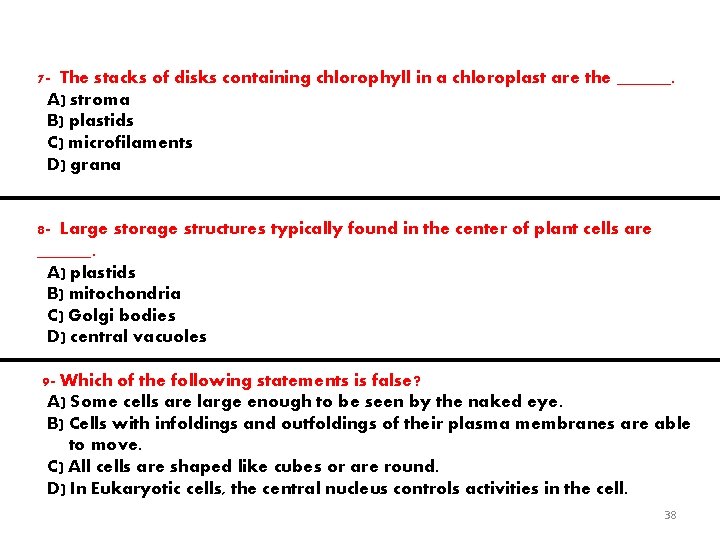
7 - The stacks of disks containing chlorophyll in a chloroplast are the ______. A) stroma B) plastids C) microfilaments D) grana 8 - Large storage structures typically found in the center of plant cells are ______. A) plastids B) mitochondria C) Golgi bodies D) central vacuoles 9 - Which of the following statements is false? A) Some cells are large enough to be seen by the naked eye. B) Cells with infoldings and outfoldings of their plasma membranes are able to move. C) All cells are shaped like cubes or are round. D) In Eukaryotic cells, the central nucleus controls activities in the cell. 38
10 - Cells of more complex organisms are different from bacterial cells in which of the following ways? A) The presence of cytoplasm B) The presence of a plasma membrane C) The variety of organelles and their complexity. D) The presence of DNA. 11 - Which of these organelles contain digestive enzymes? A) Mitochondria B) Ribosomes C) Lysosomes D) Golgi bodies 12 - Synthesis of lipids occurs in which major organelle? A) Chloroplasts B) Mitochondrian C) Smooth endoplasmic reticulum D) Rough endoplasmic reticulum 39
13 - The description "9+2 array" in cells refers to _______. A) microfilaments B) spindles C) vacuoles D) microtubules 14 - When a cell grows, which of the following occurs? A) They increase in size only. B) They will develop multiple nuclei. C) They will increase the volume faster than the surface area of the cell. D) They will lose their nuclear membranes. 15 - Skeletal muscle cells will have a large number of _____ due to their high demand for energy. A) chloroplasts B) lysosomes C) flagella D) mitochondria 40
16 - The large surface area needed for the participants in cellular respiration is provided by the _____ of the mitochondria. A) stroma B) thylakoids C) cristae D) matrix 17 - Which of the following will NOT be found in abundance in an insulinproducing pancreas cell? A) Rough endoplasmic reticulum B) Golgi apparatus C) Chloroplasts D) Ribosomes 18 - Debris that is trapped in mucus is moved away from the lungs toward the throat by _____. A) flagella B) cilia C) pseudopods D) actin filaments 41
19 - The _____ participates in ribosome synthesis and is found in the nucleus. A) plasma membrane B) smooth endoplasmic reticulum C) Golgi apparatus D) nucleolus 20 - The endosymbiotic hypothesis attempts to explain _____. A) the origin of chloroplasts and mitochondria B) how cells reproduce C) how photosynthesis occurs D) the differences between plant and animal cells 42

Thank You 43
- Slides: 43