
Biology Homeostasis Key Concepts Key Words Reflex actions
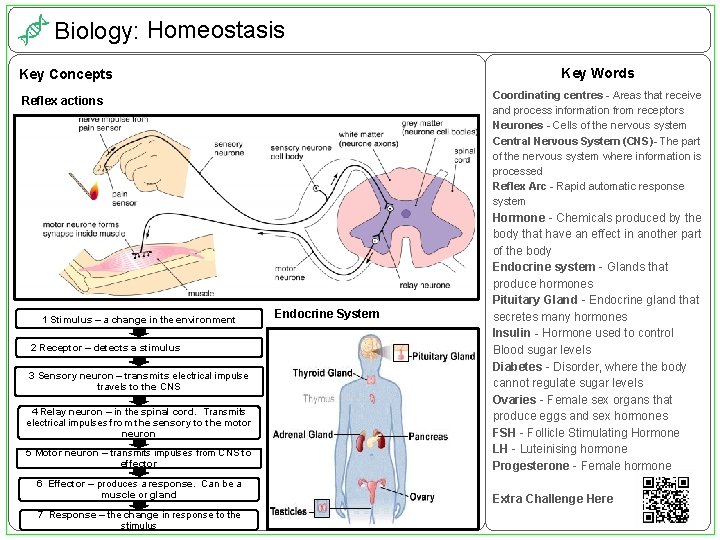
Biology: Homeostasis Key Concepts Key Words Reflex actions Coordinating centres - Areas that receive and process information from receptors Neurones - Cells of the nervous system Central Nervous System (CNS)- The part of the nervous system where information is processed Reflex Arc - Rapid automatic response system 1 Stimulus – a change in the environment 2 Receptor – detects a stimulus 3 Sensory neuron – transmits electrical impulse travels to the CNS 4 Relay neuron – in the spinal cord. Transmits electrical impulses from the sensory to the motor neuron 5 Motor neuron – transmits impulses from CNS to effector 6 Effector – produces a response. Can be a muscle or gland 7 Response – the change in response to the stimulus Endocrine System Hormone - Chemicals produced by the body that have an effect in another part of the body Endocrine system - Glands that produce hormones Pituitary Gland - Endocrine gland that secretes many hormones Insulin - Hormone used to control Blood sugar levels Diabetes - Disorder, where the body cannot regulate sugar levels Ovaries - Female sex organs that produce eggs and sex hormones FSH - Follicle Stimulating Hormone LH - Luteinising hormone Progesterone - Female hormone Extra Challenge Here
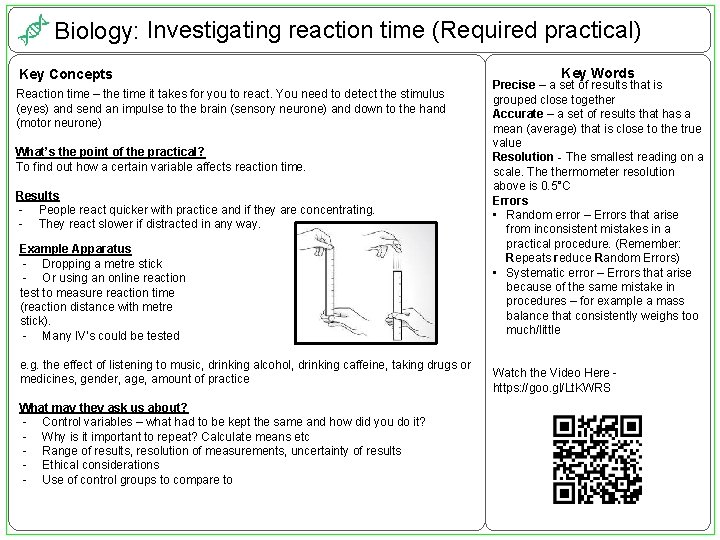
Biology: Investigating reaction time (Required practical) Key Concepts Reaction time – the time it takes for you to react. You need to detect the stimulus (eyes) and send an impulse to the brain (sensory neurone) and down to the hand (motor neurone) What’s the point of the practical? To find out how a certain variable affects reaction time. Results - People react quicker with practice and if they are concentrating. - They react slower if distracted in any way. Example Apparatus - Dropping a metre stick - Or using an online reaction test to measure reaction time (reaction distance with metre stick). - Many IV’s could be tested e. g. the effect of listening to music, drinking alcohol, drinking caffeine, taking drugs or medicines, gender, age, amount of practice What may they ask us about? - Control variables – what had to be kept the same and how did you do it? - Why is it important to repeat? Calculate means etc - Range of results, resolution of measurements, uncertainty of results - Ethical considerations - Use of control groups to compare to Key Words Precise – a set of results that is grouped close together Accurate – a set of results that has a mean (average) that is close to the true value Resolution - The smallest reading on a scale. The thermometer resolution above is 0. 5°C Errors • Random error – Errors that arise from inconsistent mistakes in a practical procedure. (Remember: Repeats reduce Random Errors) • Systematic error – Errors that arise because of the same mistake in procedures – for example a mass balance that consistently weighs too much/little Watch the Video Here https: //goo. gl/Lt. KWRS
- Slides: 2