
Biology Final Review Chromosomes Chromosomes are DNA its
Biology Final Review
Chromosomes • Chromosomes are DNA & its associated proteins. Ø We have 46 chromosomes or 23 pairs of chromosomes. • In a prokaryotic cell, it is the main ring of DNA.
Autosomes vs. Sex Chromosomes • Autosomes are any chromosomes that are not directly involved in determining the sex of an individual. Ø We have 22 pairs. • Sex chromosomes contain genes that will determine the sex of the individual. Ø We have one pair. Ø Females are XX. Ø Males are XY.
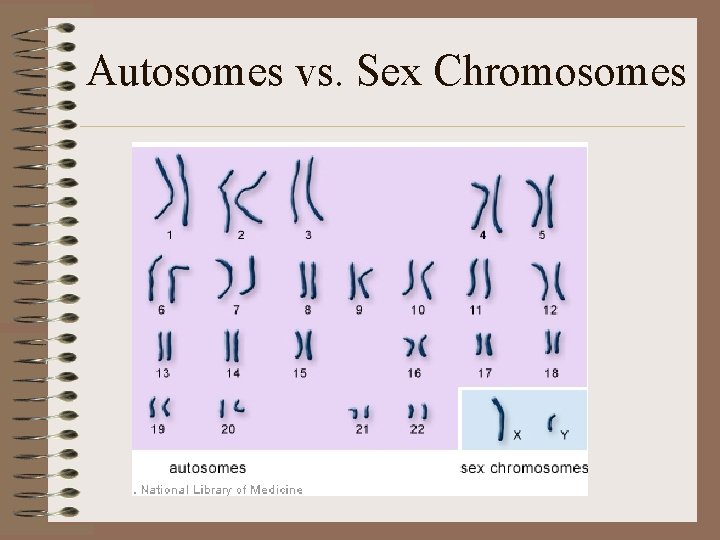
Autosomes vs. Sex Chromosomes

Gametes • Gametes are an organism’s reproductive cells. Ø Female’s gametes are eggs or ova. Ø Male’s gametes are sperm.
Haploid vs. Diploid • Haploid refers to a cell (gamete) that contains only 1 set of chromosomes. Ø It is represented by “n. ” • Diploid refers to a somatic or body cell that contains 2 sets of chromosomes. Ø It is represented by “ 2 n. ”
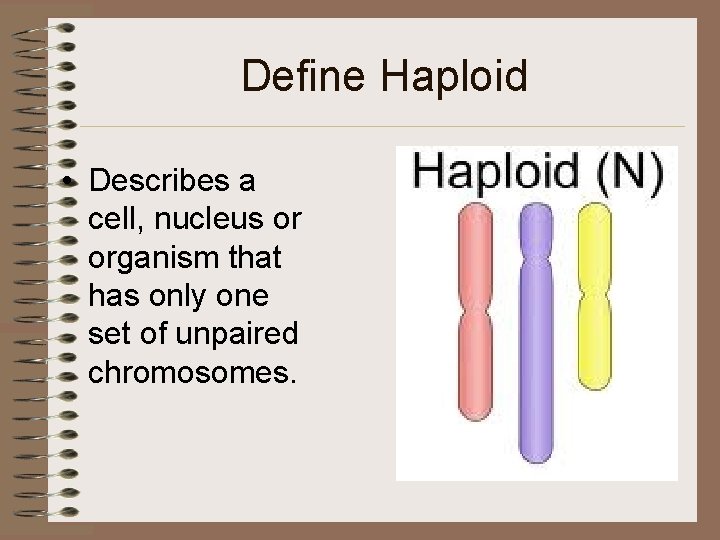
Define Haploid • Describes a cell, nucleus or organism that has only one set of unpaired chromosomes.
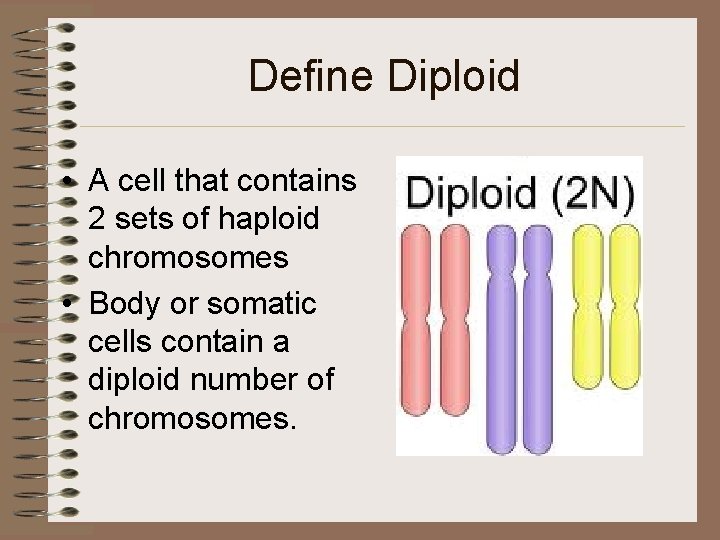
Define Diploid • A cell that contains 2 sets of haploid chromosomes • Body or somatic cells contain a diploid number of chromosomes.
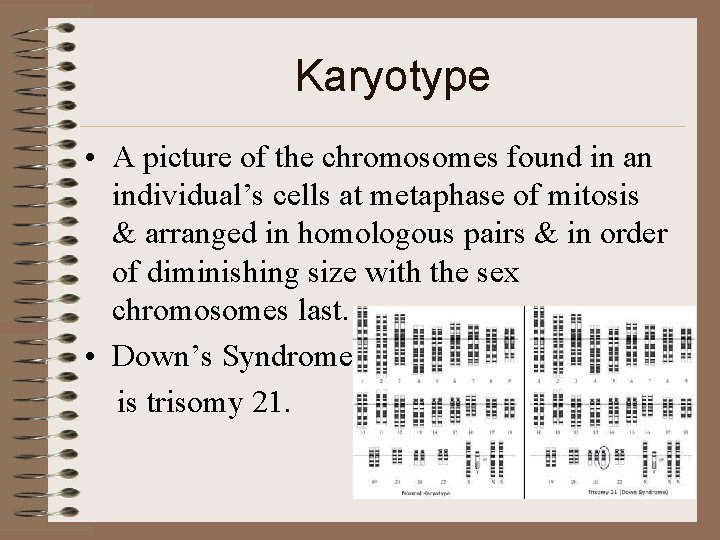
Karyotype • A picture of the chromosomes found in an individual’s cells at metaphase of mitosis & arranged in homologous pairs & in order of diminishing size with the sex chromosomes last. • Down’s Syndrome is trisomy 21.
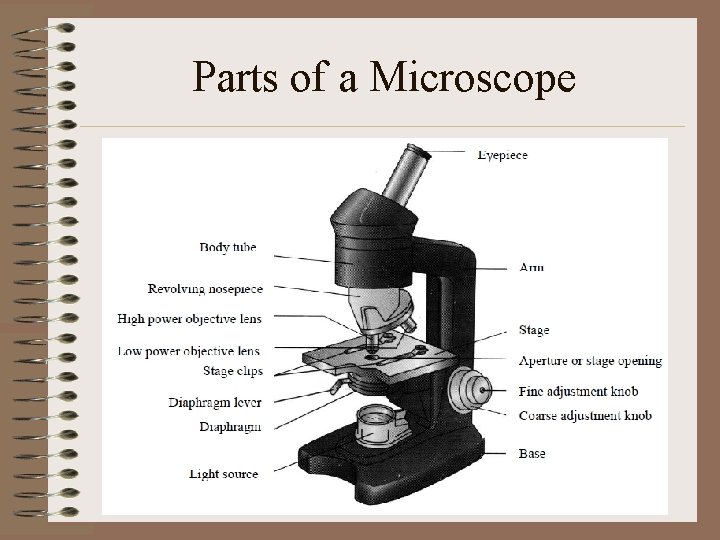
Parts of a Microscope
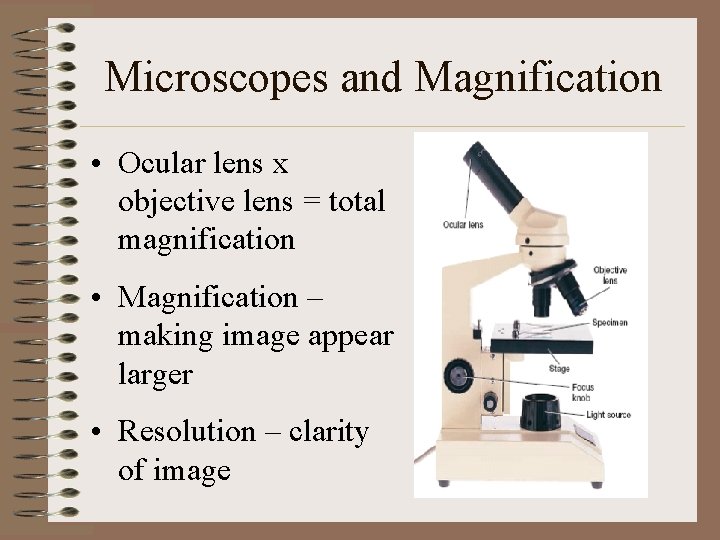
Microscopes and Magnification • Ocular lens x objective lens = total magnification • Magnification – making image appear larger • Resolution – clarity of image
Cell Theory • All living things are made of cells. • Cells are the basic units of structure and function in organisms. • All cells come from existing cells.
Prokaryote vs. Eukaryote • Prokaryote Ø Ø Ø No nucleus No membrane bound organelles Circular DNA Relatively small Reproduce quickly (20 min. ) § Examples: Bacteria
Prokaryote vs. Eukaryote • Eukaryote Ø Ø Ø Nucleus Many membrane bound organelles Linear DNA Relatively large Reproduce slowly (24+ hours) § Examples: Plants, animals, fungi & protists
Cell Parts & Functions • Cell membrane Ø Controls what enters & leaves a cell; separates & protects the cell from the environment. • Nucleus Ø Contains the DNA in eukaryotic cells; controls cellular activities. • Vacuole Ø Membrane bound sac that stores water, may also contain ions, nutrients & waste.
Cell Parts & Functions • Chloroplast Ø Organelle that uses light energy to make carbohydrates from CO 2 & H 2 O. • Cytoplasm Ø Region of the cell within the membrane that includes the fluid, the cytoskeleton and all of the organelles except the nucleus. • DNA Ø Material that contains the information that determines hereditary characteristics.
Cell Parts & Functions • Ribosomes Ø Organelle composed of RNA & protein; site of protein synthesis. • Mitochondrion Ø Cell organelle surrounded by 2 membranes & is the site of cellular respiration, which produces ATP. • Cell Wall Ø Rigid structure that surrounds the cell membrane & provides support to the cell.
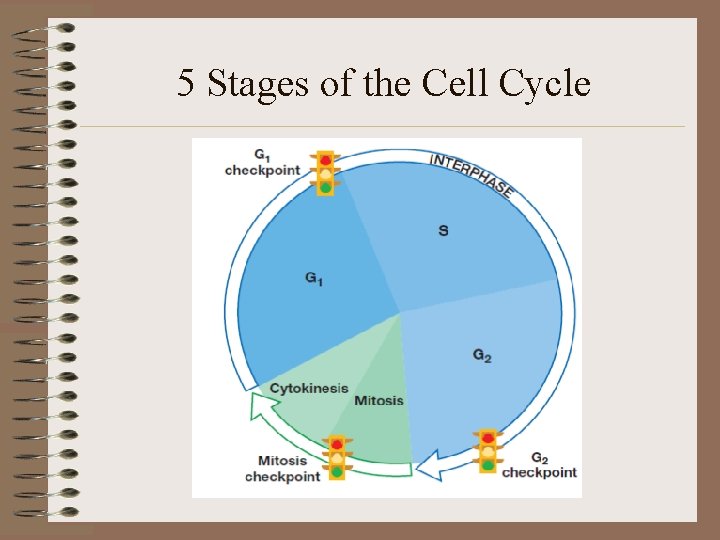
5 Stages of the Cell Cycle
5 Stages of the Cell Cycle • The first 3 stages are collectively called interphase. (90% of a cell’s life is spent here. ) 1. First growth (G 1) phase Ø Cell grows rapidly & carries out routine functions. (Major portion of a cell’s life is spent here. )
5 Stages of the Cell Cycle 2. Synthesis (S) phase Ø Cell’s DNA is copied. Ø Each chromosome consists of 2 chromatids attached at the centromere. 3. Second growth (G 2) phase Ø Preparations are made for the nucleus to divide. Ø Microtubules are rearranged. Ø Organelles are manufactured or reproduced.
5 Stages of the Cell Cycle 4. Mitosis Ø The nucleus of a cell divides into 2 nuclei each with the same # and kinds of chromosomes as the original cell. 5. Cytokinesis Ø The cytoplasm divides and 2 new cells are formed.
3 Checkpoints • A checkpoint is an inspection point at which feedback signals from the cell can trigger the next phase of the cell cycle or delay it. 1. Cell Growth (G 1) checkpoint at the end of the G 1 phase § Makes the decision of whether or not a cell will divide.
3 Checkpoints 2. DNA synthesis (G 2) checkpoint at the end of the G 2 phase § DNA replication is checked by DNA repair enzymes. 3. Mitosis checkpoint at the end of mitosis § Triggers the exit from mitosis
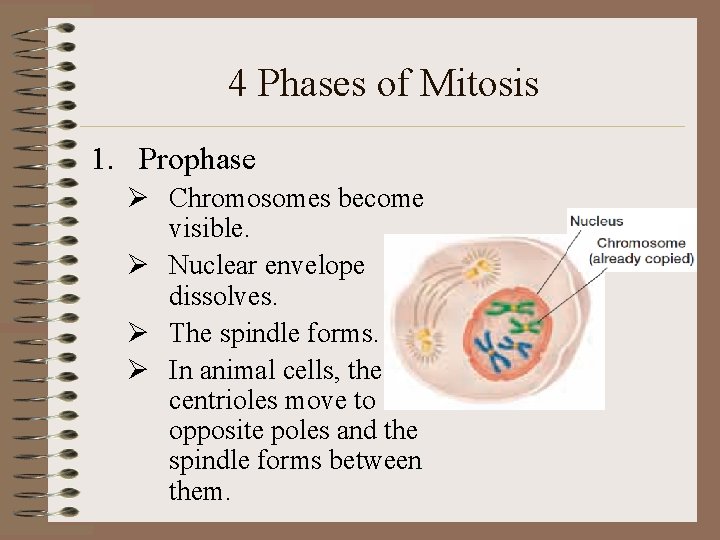
4 Phases of Mitosis 1. Prophase Ø Chromosomes become visible. Ø Nuclear envelope dissolves. Ø The spindle forms. Ø In animal cells, the centrioles move to opposite poles and the spindle forms between them.
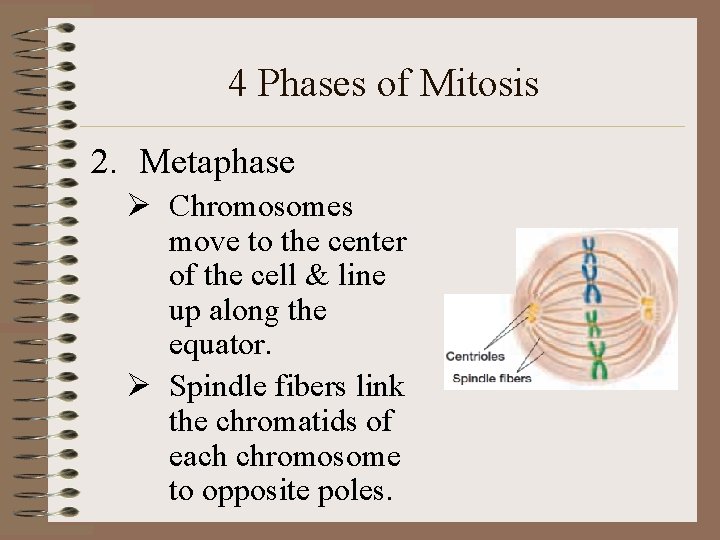
4 Phases of Mitosis 2. Metaphase Ø Chromosomes move to the center of the cell & line up along the equator. Ø Spindle fibers link the chromatids of each chromosome to opposite poles.
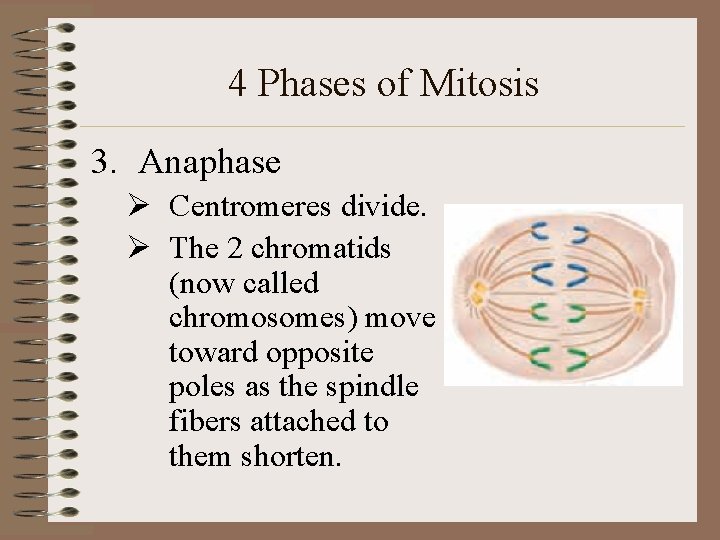
4 Phases of Mitosis 3. Anaphase Ø Centromeres divide. Ø The 2 chromatids (now called chromosomes) move toward opposite poles as the spindle fibers attached to them shorten.
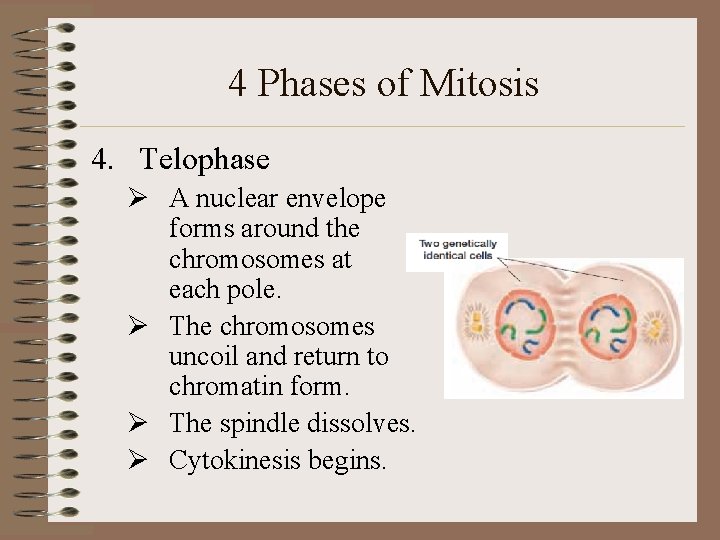
4 Phases of Mitosis 4. Telophase Ø A nuclear envelope forms around the chromosomes at each pole. Ø The chromosomes uncoil and return to chromatin form. Ø The spindle dissolves. Ø Cytokinesis begins.
Cytokinesis • • Division of the cytoplasm of a cell Follows the division of the cell’s nucleus by mitosis or meiosis Cytokinesis in animal cells occurs when a belt of protein threads pinches the cell membrane in half. Cytokinesis in plant cells occurs when vesicles from the Golgi apparatus fuse to form a cell plate.
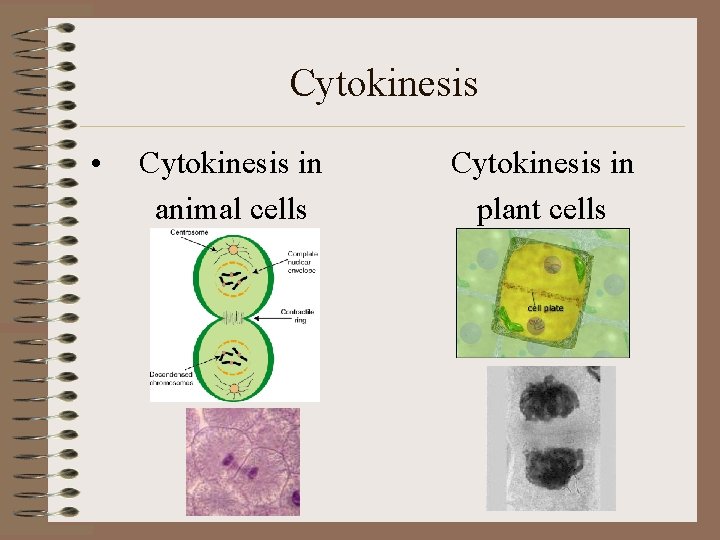
Cytokinesis • Cytokinesis in animal cells Cytokinesis in plant cells
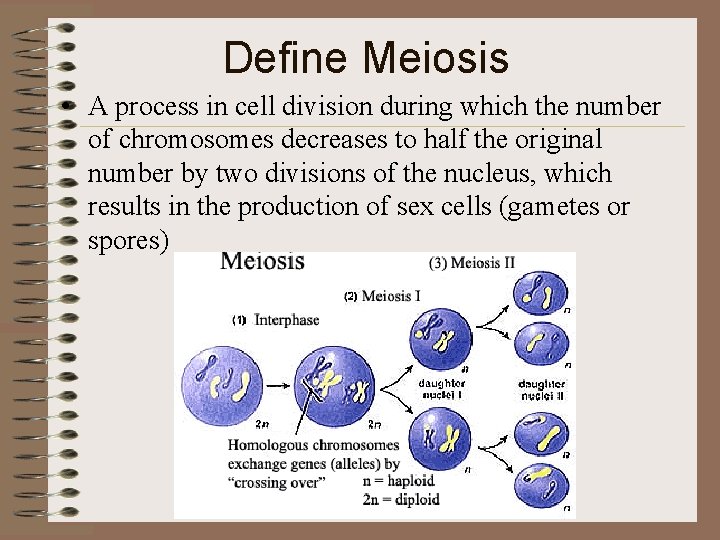
Define Meiosis • A process in cell division during which the number of chromosomes decreases to half the original number by two divisions of the nucleus, which results in the production of sex cells (gametes or spores)
What are the 4 things that give rise to variation within a species? • Independent assortment • Crossing-over • Random fertilization • Mutations
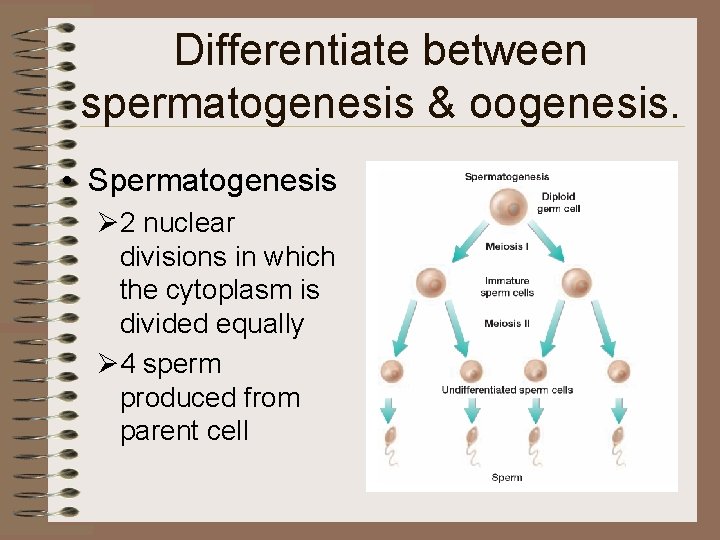
Differentiate between spermatogenesis & oogenesis. • Spermatogenesis Ø 2 nuclear divisions in which the cytoplasm is divided equally Ø 4 sperm produced from parent cell
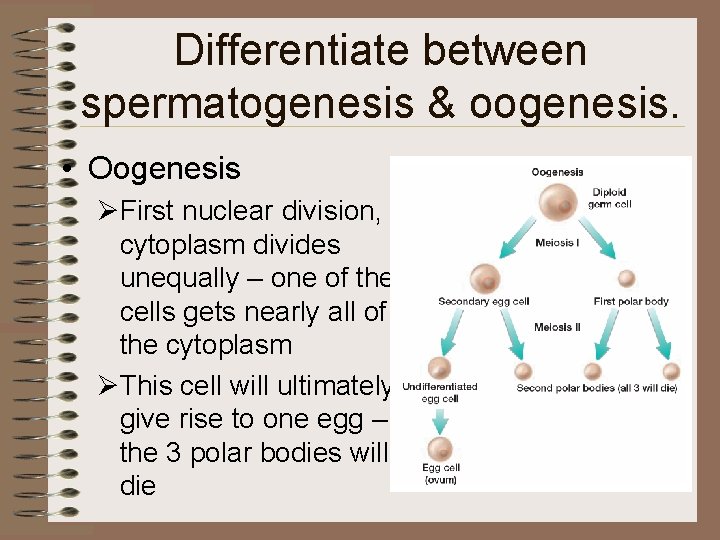
Differentiate between spermatogenesis & oogenesis. • Oogenesis ØFirst nuclear division, cytoplasm divides unequally – one of the cells gets nearly all of the cytoplasm ØThis cell will ultimately give rise to one egg – the 3 polar bodies will die
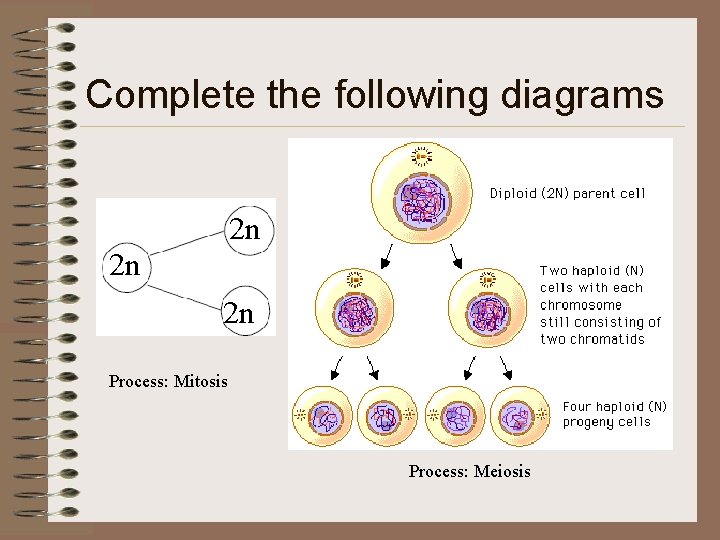
Complete the following diagrams 2 n 2 n 2 n Process: Mitosis Process: Meiosis
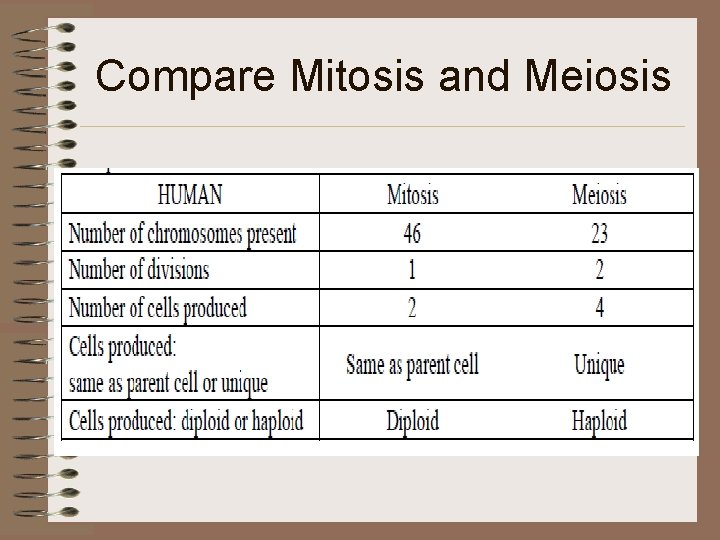
Compare Mitosis and Meiosis
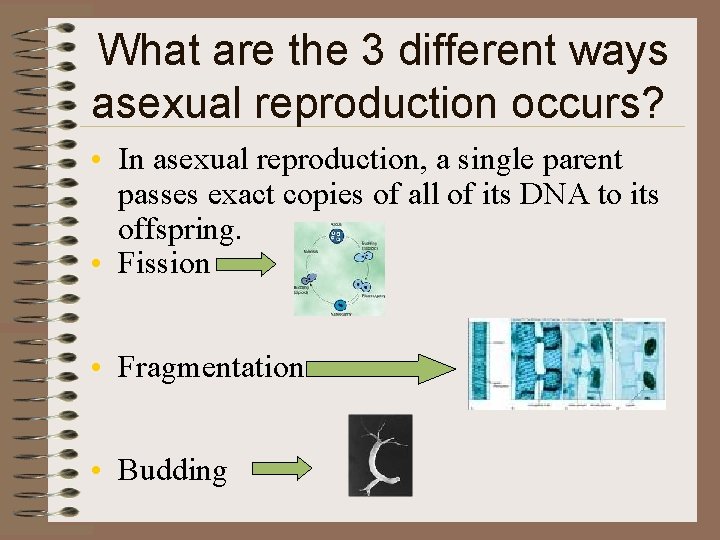
What are the 3 different ways asexual reproduction occurs? • In asexual reproduction, a single parent passes exact copies of all of its DNA to its offspring. • Fission • Fragmentation • Budding
Nondisjunction • One or more chromosomes fail to separate properly during meiosis. • One gamete ends up receiving both chromosomes and the other gamete receives none. • Trisomy occurs when the gamete w/ both chromosomes fuses w/ a normal gamete, resulting in an offspring w/ 3 copies of a chromosome instead of 2.
Diffusion vs. Osmosis • Diffusion Ø The movement of particles from regions of higher concentration to regions of lower concentration. Ø Ex: perfume spreading across a room. • Osmosis Ø The diffusion of water from an area of high concentration to an area of low concentration across a membrane. Ø Ex: Getting thirstier when you drink salt water.
Passive vs. Active Transport • Passive Transport Ø Does not require energy. Ø Movement down the concentration gradient. Ø Examples: § Diffusion § Osmosis § Facilitated diffusion
Passive vs. Active Transport • Active Transport Ø Requires energy. Ø Movement against the concentration gradient. Ø Examples: § Sodium-potassium pump § Endocytosis ü Phagocytosis ü Pinocytosis § Exocytosis
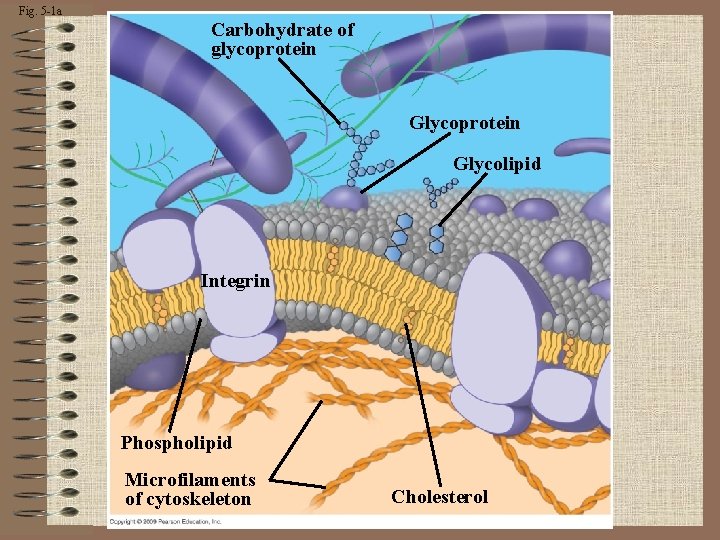
Fig. 5 -1 a Carbohydrate of glycoprotein Glycolipid Integrin Phospholipid Microfilaments of cytoskeleton Cholesterol
ATP • The energy “currency” of the cell. • An organic molecule that acts as the main energy source for cell processes • Composed of a nitrogen base, a sugar & 3 phosphate groups. • The energy is stored in the phosphate bonds. • Powers metabolism.
Photosynthesis • Process by which plants, algae & some bacteria use sunlight, CO 2 & H 2 O to produce carbohydrates & O 2. • Takes place in the chloroplast • Main pigment is chlorophyll. • Reactants are CO 2 and H 2 O • End products are glucose & O 2
Photosynthesis • Stage 1 Ø Consists of the absorption of light energy which excites the electrons in chlorophyll. Ø The electrons enter the ETC (electron transport chain). Ø Water is split to produce O 2, H+, and the electrons to replace those lost by the chlorophyll molecules.
Photosynthesis • Stage 2 Ø The conversion of light energy into chemical energy that is temporarily stored in ATP and NADPH. Ø The energy from ATP and NADPH will be used to power the third stage.
Photosynthesis • Stage 3 Ø CO 2 fixation occurs Ø Inorganic CO 2 is fixed into organic compounds (sugars).
Cellular Respiration • Process by which cells produce energy from carbohydrates; O 2 combines w/ glucose to form H 2 O & CO 2. • Takes place in the mitochondrion. • Reactants are glucose and oxygen. • Products are carbon dioxide & water.
Aerobic Respiration vs. Anaerobic Respiration • Aerobic Respiration Ø Requires oxygen. Ø Produces much more ATP (38 net ATP) • Anaerobic Respiration Ø Does not require oxygen. Ø Regenerates NAD+ so that gylcolysis can continue. Ø (2 net ATP from glycolysis)
Aerobic Respiration • Stage 1 – Glycolysis takes place in the cytoplasm. Ø Does not require oxygen. Ø Glucose is broken down to 2 pyruvate molecules Ø Produces 2 net ATP and 2 NADH • Stage 2 – Bridge reaction carries pyruvates into the mitochondrion. Ø 2 CO 2 and 2 NADH are produced
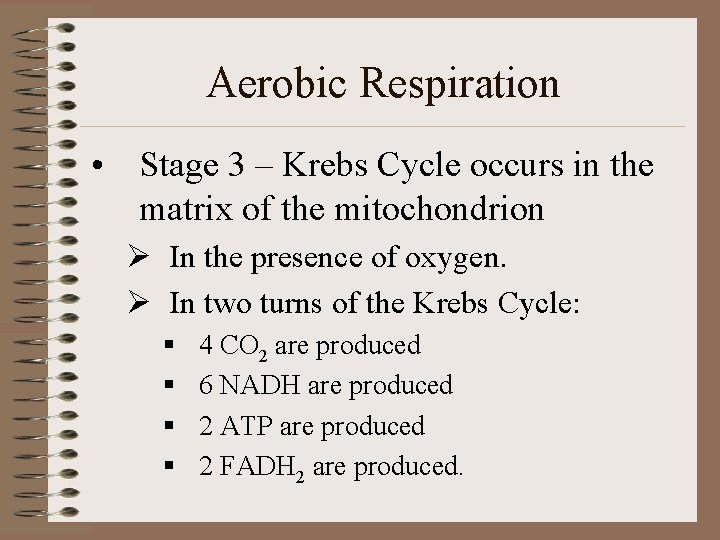
Aerobic Respiration • Stage 3 – Krebs Cycle occurs in the matrix of the mitochondrion Ø In the presence of oxygen. Ø In two turns of the Krebs Cycle: § § 4 CO 2 are produced 6 NADH are produced 2 ATP are produced 2 FADH 2 are produced.
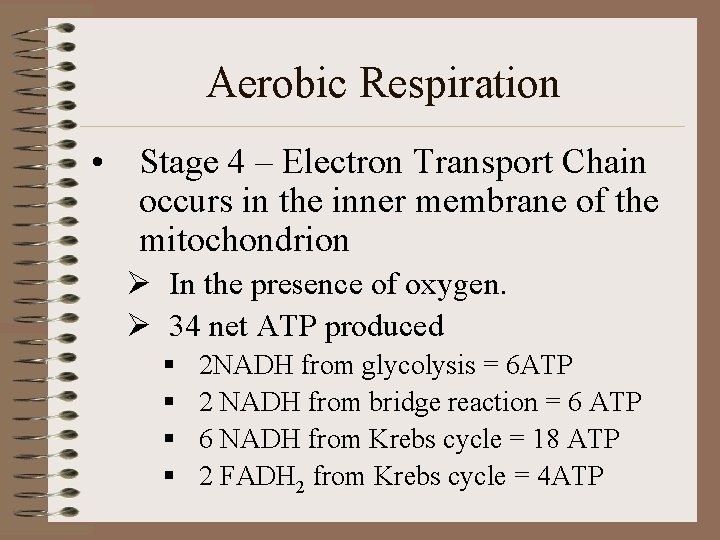
Aerobic Respiration • Stage 4 – Electron Transport Chain occurs in the inner membrane of the mitochondrion Ø In the presence of oxygen. Ø 34 net ATP produced § § 2 NADH from glycolysis = 6 ATP 2 NADH from bridge reaction = 6 ATP 6 NADH from Krebs cycle = 18 ATP 2 FADH 2 from Krebs cycle = 4 ATP
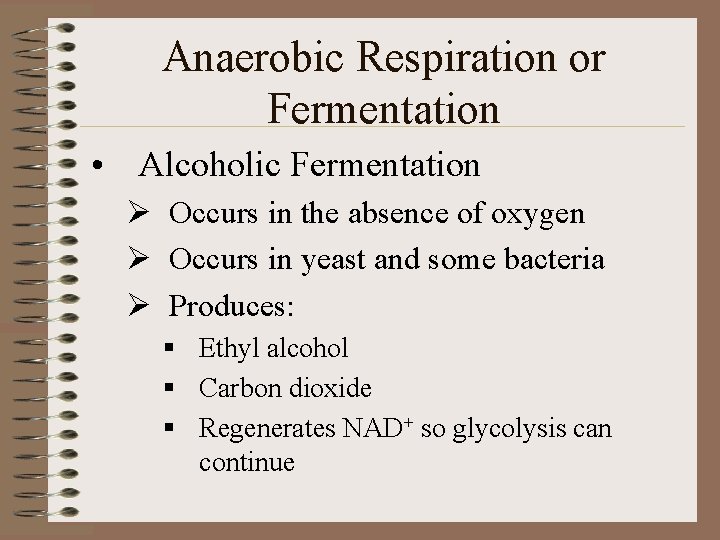
Anaerobic Respiration or Fermentation • Alcoholic Fermentation Ø Occurs in the absence of oxygen Ø Occurs in yeast and some bacteria Ø Produces: § Ethyl alcohol § Carbon dioxide § Regenerates NAD+ so glycolysis can continue
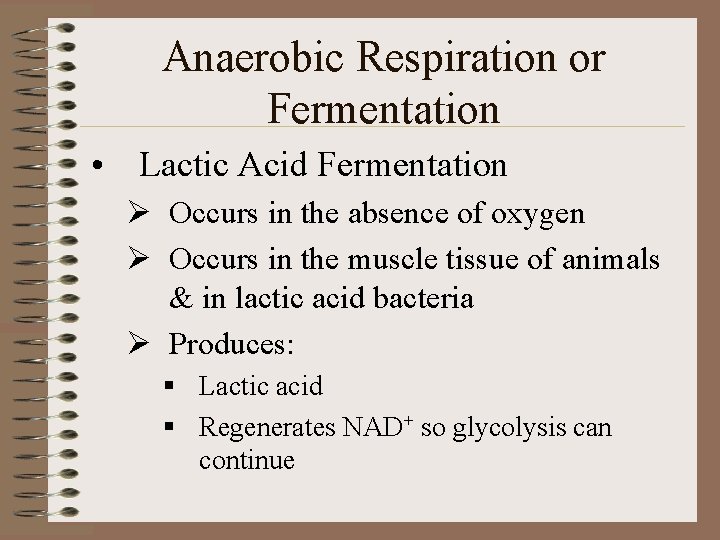
Anaerobic Respiration or Fermentation • Lactic Acid Fermentation Ø Occurs in the absence of oxygen Ø Occurs in the muscle tissue of animals & in lactic acid bacteria Ø Produces: § Lactic acid § Regenerates NAD+ so glycolysis can continue
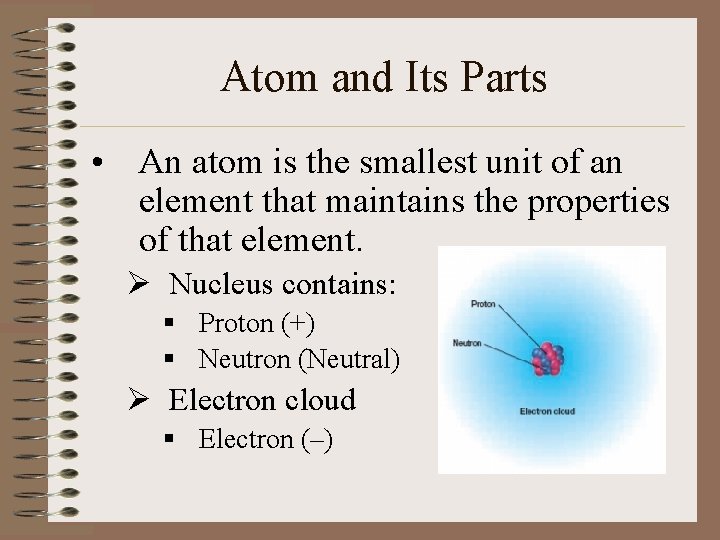
Atom and Its Parts • An atom is the smallest unit of an element that maintains the properties of that element. Ø Nucleus contains: § Proton (+) § Neutron (Neutral) Ø Electron cloud § Electron (–)
Covalent vs. Ionic Bonds • Covalent Bond Ø Bond formed when atoms share pairs of electrons. • Ionic Bond Ø Bond formed by the attraction between oppositely charged ions.
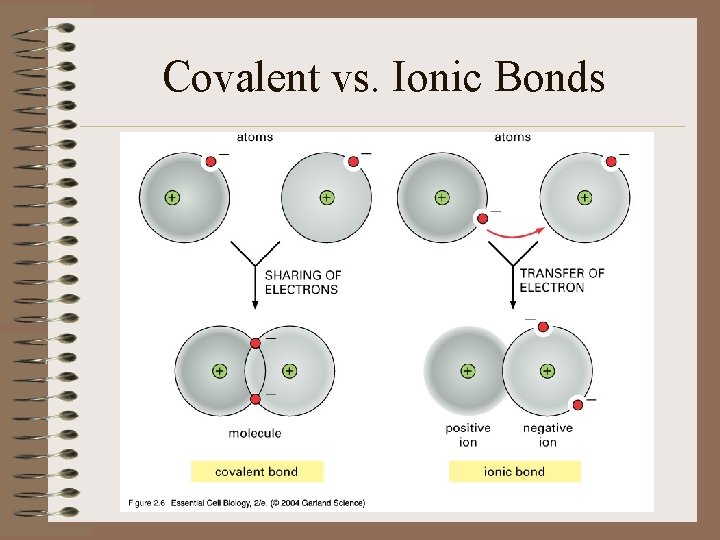
Covalent vs. Ionic Bonds
Molecules and Polar Molecules • Molecule Ø A group of atoms held together by covalent bonds. • Polar Molecule Ø Shares its electrons unequally and therefore has partially positive and negative ends, or poles. Ø Water is a polar molecule.
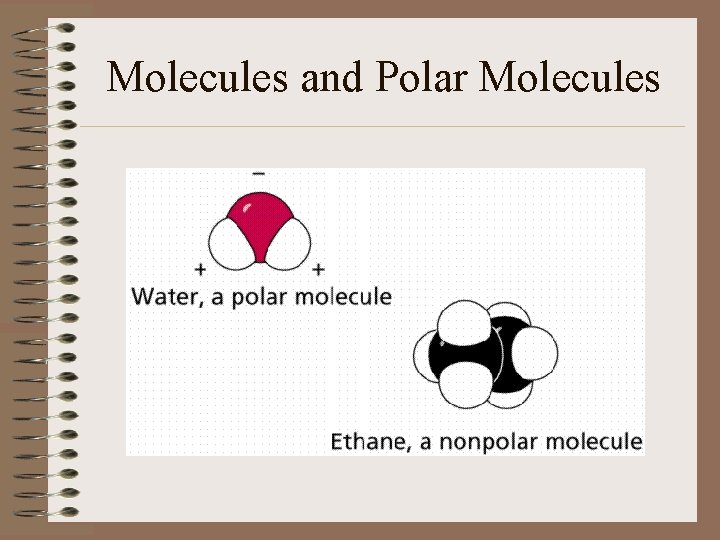
Molecules and Polar Molecules
Solvents • Solvent Ø A substance, usually a liquid, capable of dissolving another substance. • Universal Solvent Ø Water.
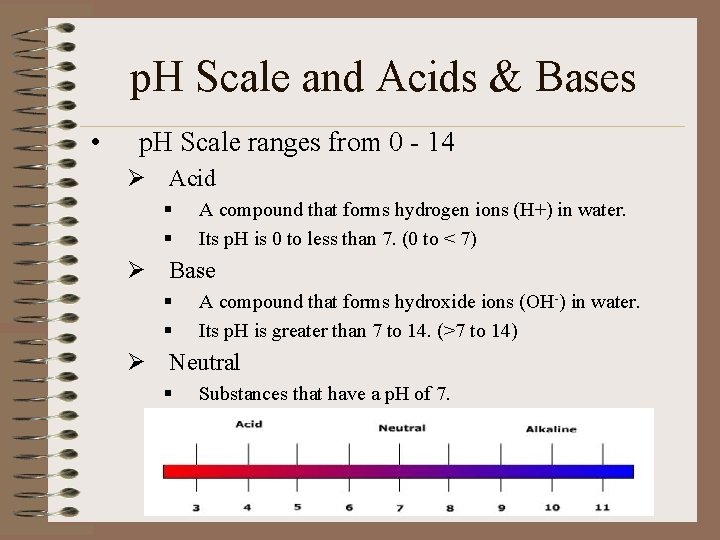
p. H Scale and Acids & Bases • p. H Scale ranges from 0 - 14 Ø Acid § § A compound that forms hydrogen ions (H+) in water. Its p. H is 0 to less than 7. (0 to < 7) Ø Base § § A compound that forms hydroxide ions (OH-) in water. Its p. H is greater than 7 to 14. (>7 to 14) Ø Neutral § Substances that have a p. H of 7.
Organic Macromolecules • Organic macromolecules: Ø Contain carbon atoms that are covalently bonded to other elements – typically hydrogen, oxygen and other carbon atoms. Ø 4 principal classes of organic compounds found in living things are: § § Carbohydrates Lipids Proteins Nucleic acids
Organic Macromolecules • Carbohydrates – organic compounds made of carbon, hydrogen and oxygen in a 1: 2: 1 ratio. Ø Monomers are monosaccharides. § Ex: Glucose and fructose Ø Polymers are polysaccharides. § Ex: Starches, potatoes, paper, crab shells Ø Functions § § § Stores energy. Makes up cell walls in plants and fungi. Makes up exoskeleton in some animals.
Organic Macromolecules • Lipids are nonpolar molecules that are insoluble in water & include fats, phospholipids, steroids and waxes. Ø Monomers are glycerol & fatty acids Ø Polymer examples § Butter & oil § All membranes § Cholesterol and Steroids Ø Functions § Stores energy § Makes up cell membranes § Acts as chemical messengers
Organic Macromolecules • Proteins Ø Monomers are amino acids Ø Polymer examples § § Hemoglobin and antibodies Muscle, hair and nails Ø Functions § § § Hemoglobin carries oxygen and antibodies help defend against infection. Make up tissues that support body structures and provide movement Speed up chemical reactions (enzymes)
Organic Macromolecules • Nucleic acids Ø Monomers are nucleotides Ø Polymer examples § DNA § RNA Ø Functions § Controls cellular activities § Stores hereditary information § Plays key role in the manufacture of proteins

Catalyst vs. Enzyme • Catalyst Ø Speeds up chemical reactions by lowering the activation energy. • Enzyme Ø Specialized protein that acts as an organic catalyst.
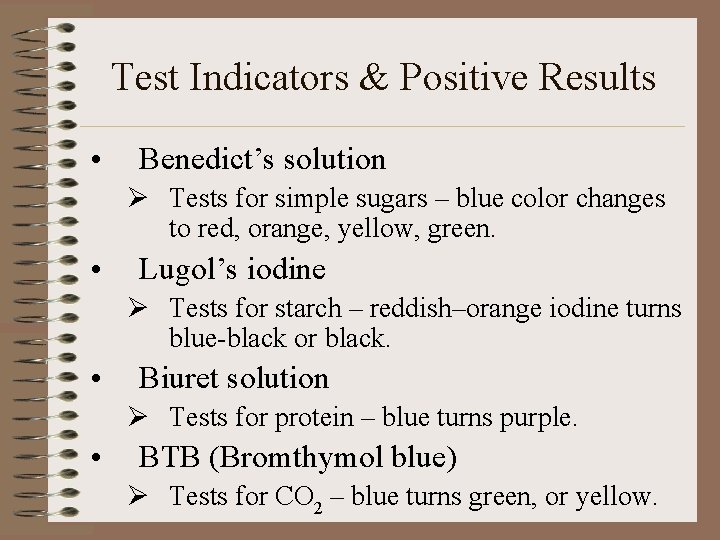
Test Indicators & Positive Results • Benedict’s solution Ø Tests for simple sugars – blue color changes to red, orange, yellow, green. • Lugol’s iodine Ø Tests for starch – reddish–orange iodine turns blue-black or black. • Biuret solution Ø Tests for protein – blue turns purple. • BTB (Bromthymol blue) Ø Tests for CO 2 – blue turns green, or yellow.
- Slides: 67