
BIOLOGY CONCEPTS CONNECTIONS Fourth Edition Neil A Campbell
BIOLOGY CONCEPTS & CONNECTIONS Fourth Edition Neil A. Campbell • Jane B. Reece • Lawrence G. Mitchell • Martha R. Taylor CHAPTER 15 Tracing Evolutionary History SSHS AP Biology From Power. Point® Lectures for Biology: Concepts & Connections Copyright © 2003 Pearson Education, Inc. publishing as Benjamin Cummings
Are Birds Really Dinosaurs with Feathers? • Did birds evolve from dinosaurs? • Evolutionary biologists investigate this question by looking at the fossil record Copyright © 2003 Pearson Education, Inc. publishing as Benjamin Cummings
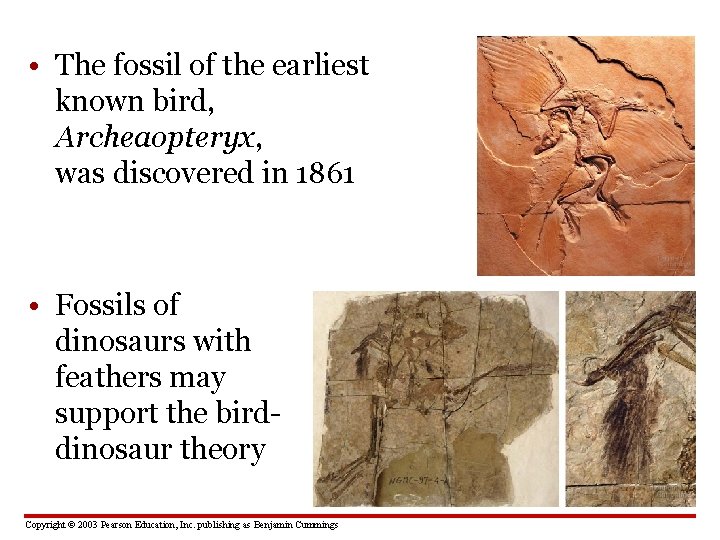
• The fossil of the earliest known bird, Archeaopteryx, was discovered in 1861 • Fossils of dinosaurs with feathers may support the birddinosaur theory Copyright © 2003 Pearson Education, Inc. publishing as Benjamin Cummings
EARTH HISTORY AND MACROEVOLUTION 15. 1 The fossil record chronicles macroevolution • Macroevolution consists of the major changes in the history of life – The fossil record chronicles these changes, which have helped to devise the geologic time scale Copyright © 2003 Pearson Education, Inc. publishing as Benjamin Cummings
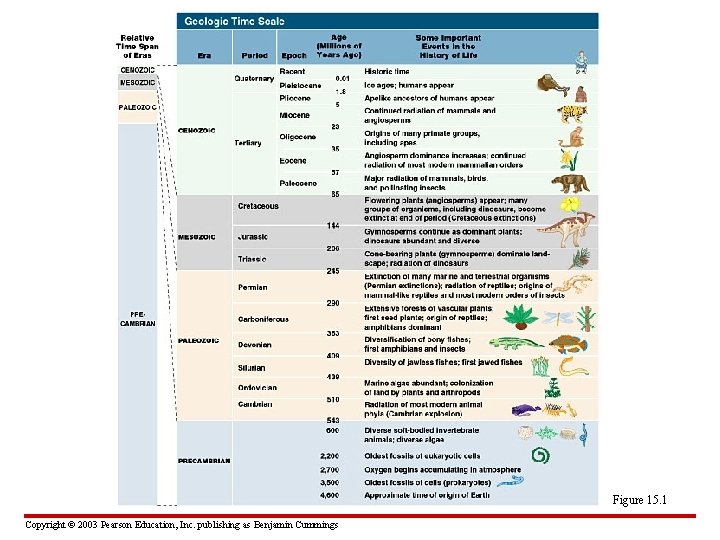
Figure 15. 1 Copyright © 2003 Pearson Education, Inc. publishing as Benjamin Cummings
15. 2 The actual ages of rocks and fossils mark geologic time • The sequence of fossils in rock strata indicates the relative ages of different species • Radiometric dating can gauge the actual ages of fossils Copyright © 2003 Pearson Education, Inc. publishing as Benjamin Cummings
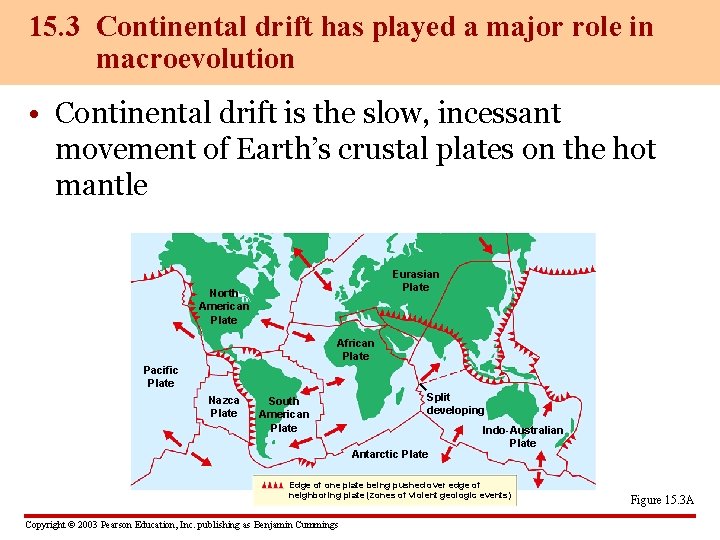
15. 3 Continental drift has played a major role in macroevolution • Continental drift is the slow, incessant movement of Earth’s crustal plates on the hot mantle Eurasian Plate North American Plate African Plate Pacific Plate Nazca Plate South American Plate Split developing Antarctic Plate Indo-Australian Plate Edge of one plate being pushed over edge of neighboring plate (zones of violent geologic events) Copyright © 2003 Pearson Education, Inc. publishing as Benjamin Cummings Figure 15. 3 A
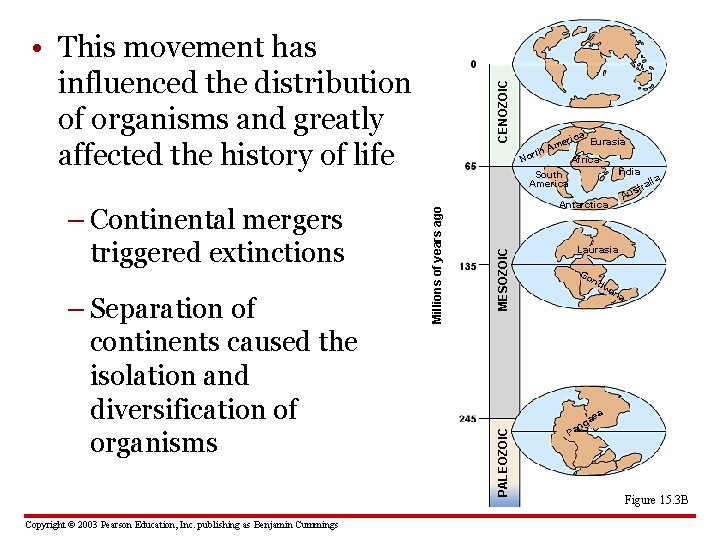
Copyright © 2003 Pearson Education, Inc. publishing as Benjamin Cummings Africa India South America a ali str Au Antarctica MESOZOIC Laurasia Go nd wa na a PALEOZOIC – Separation of continents caused the isolation and diversification of organisms a eric Eurasia m th A Nor Millions of years ago – Continental mergers triggered extinctions CENOZOIC • This movement has influenced the distribution of organisms and greatly affected the history of life e ga an P Figure 15. 3 B
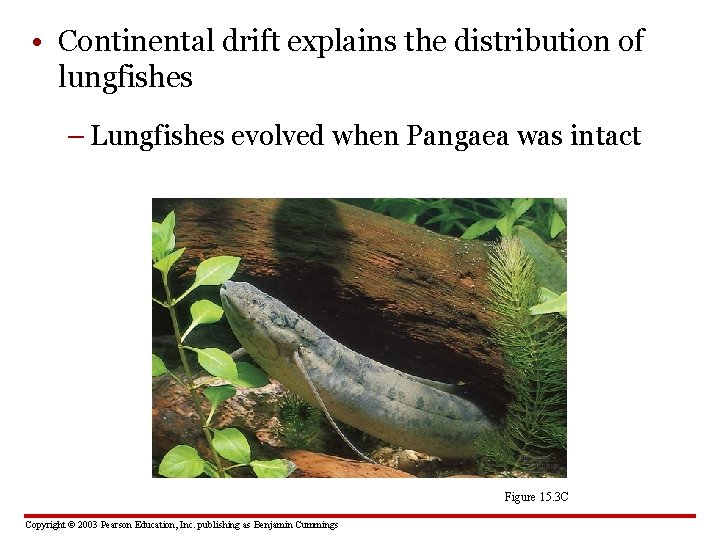
• Continental drift explains the distribution of lungfishes – Lungfishes evolved when Pangaea was intact Figure 15. 3 C Copyright © 2003 Pearson Education, Inc. publishing as Benjamin Cummings
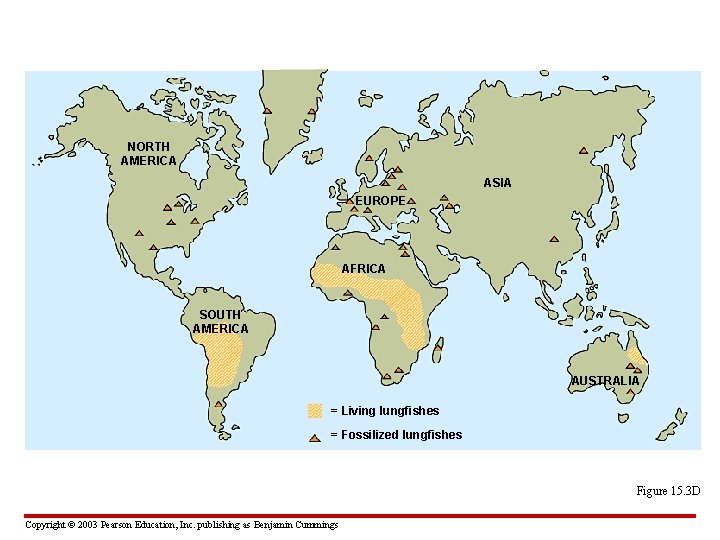
NORTH AMERICA ASIA EUROPE AFRICA SOUTH AMERICA AUSTRALIA = Living lungfishes = Fossilized lungfishes Figure 15. 3 D Copyright © 2003 Pearson Education, Inc. publishing as Benjamin Cummings
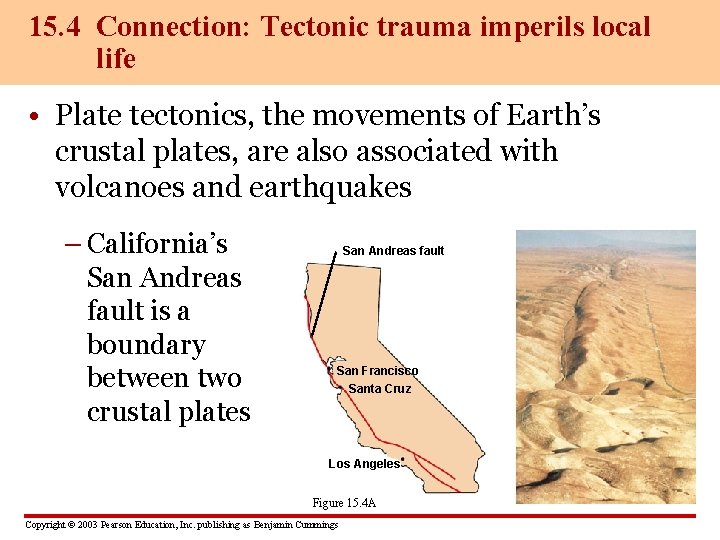
15. 4 Connection: Tectonic trauma imperils local life • Plate tectonics, the movements of Earth’s crustal plates, are also associated with volcanoes and earthquakes – California’s San Andreas fault is a boundary between two crustal plates San Andreas fault San Francisco Santa Cruz Los Angeles Figure 15. 4 A Copyright © 2003 Pearson Education, Inc. publishing as Benjamin Cummings
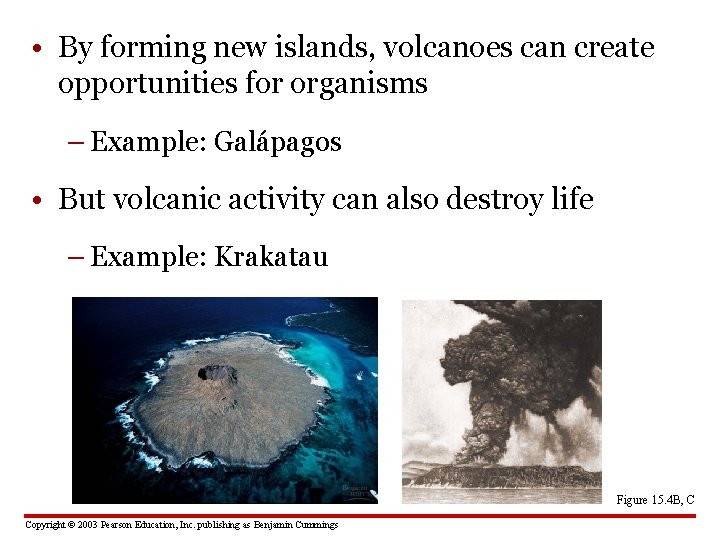
• By forming new islands, volcanoes can create opportunities for organisms – Example: Galápagos • But volcanic activity can also destroy life – Example: Krakatau Figure 15. 4 B, C Copyright © 2003 Pearson Education, Inc. publishing as Benjamin Cummings
15. 5 Mass extinctions were followed by diversification of life-forms • At the end of the Cretaceous period, many lifeforms disappeared, including the dinosaurs – These mass extinctions may have been a result of an asteroid impact or volcanic activity Copyright © 2003 Pearson Education, Inc. publishing as Benjamin Cummings
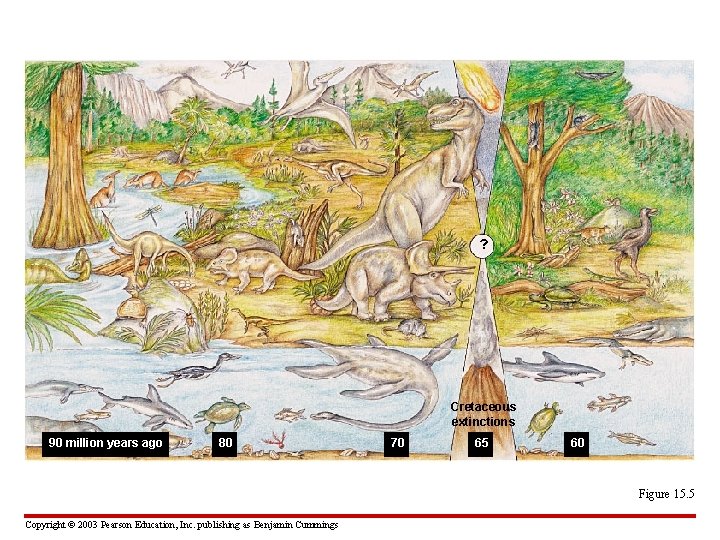
? Cretaceous extinctions 90 million years ago 80 70 65 60 Figure 15. 5 Copyright © 2003 Pearson Education, Inc. publishing as Benjamin Cummings
• Every mass extinction reduced the diversity of life – But each was followed by a rebound in diversity – Mammals filled the void left by the dinosaurs Copyright © 2003 Pearson Education, Inc. publishing as Benjamin Cummings
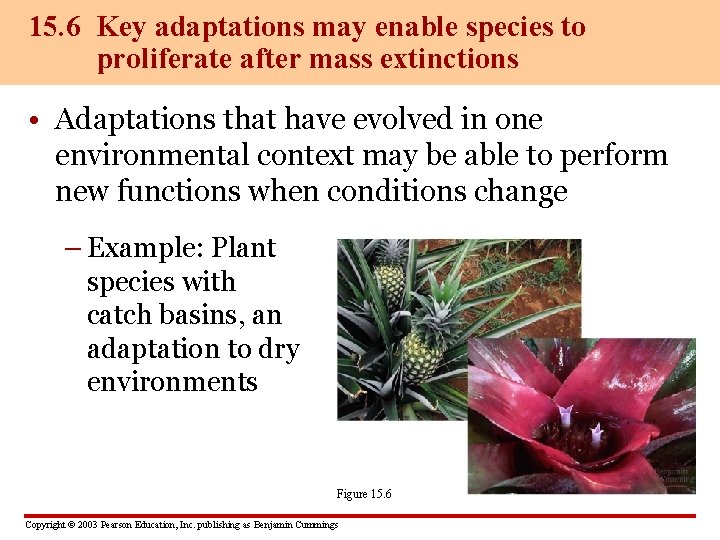
15. 6 Key adaptations may enable species to proliferate after mass extinctions • Adaptations that have evolved in one environmental context may be able to perform new functions when conditions change – Example: Plant species with catch basins, an adaptation to dry environments Figure 15. 6 Copyright © 2003 Pearson Education, Inc. publishing as Benjamin Cummings
15. 7 “Evo-devo: ” Genes that control development play a major role in evolution • “Evo-devo” is a field that combines evolutionary and developmental biology • Major adaptations may arise rapidly if mutations occur in genes that control an organism’s early development Copyright © 2003 Pearson Education, Inc. publishing as Benjamin Cummings
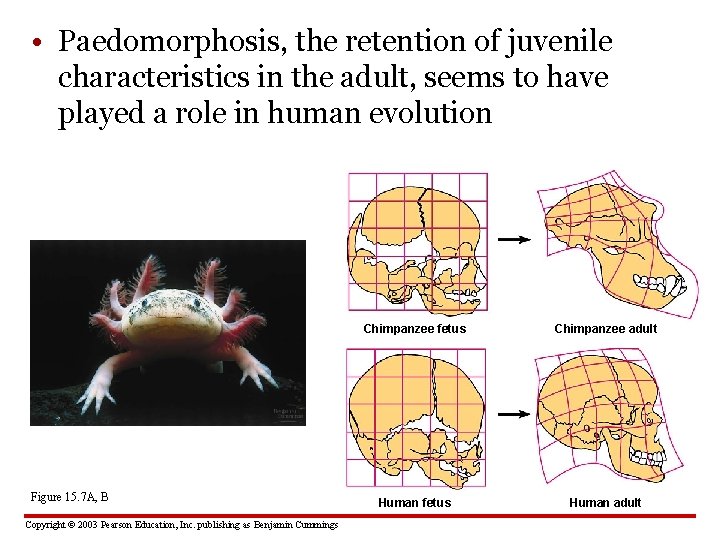
• Paedomorphosis, the retention of juvenile characteristics in the adult, seems to have played a role in human evolution Figure 15. 7 A, B Copyright © 2003 Pearson Education, Inc. publishing as Benjamin Cummings Chimpanzee fetus Chimpanzee adult Human fetus Human adult
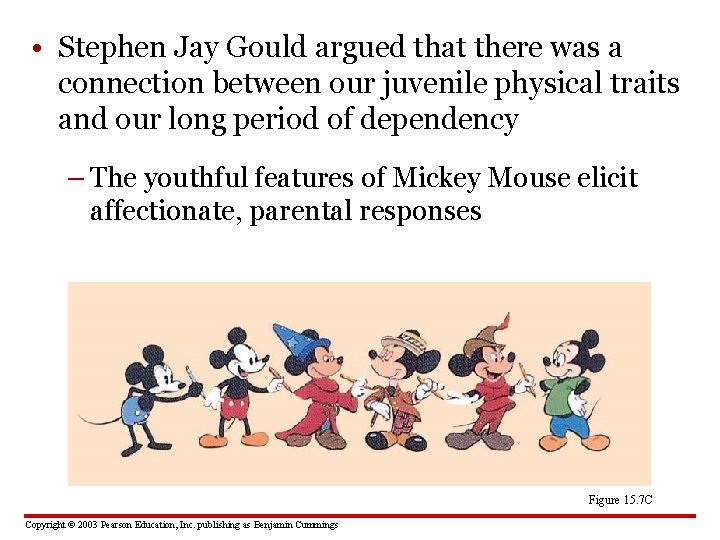
• Stephen Jay Gould argued that there was a connection between our juvenile physical traits and our long period of dependency – The youthful features of Mickey Mouse elicit affectionate, parental responses Figure 15. 7 C Copyright © 2003 Pearson Education, Inc. publishing as Benjamin Cummings
15. 8 Evolutionary trends do not mean that evolution is directed toward a goal • Evolutionary trends may reflect unequal speciation or survival of species on a branching evolutionary tree Copyright © 2003 Pearson Education, Inc. publishing as Benjamin Cummings
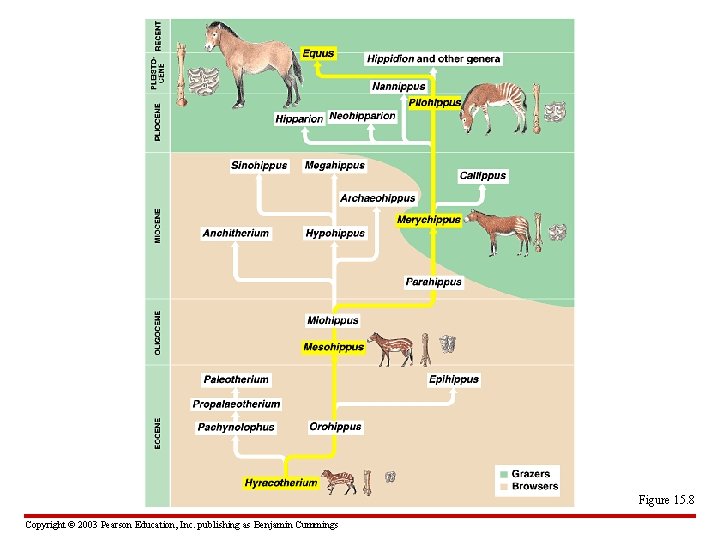
Figure 15. 8 Copyright © 2003 Pearson Education, Inc. publishing as Benjamin Cummings
15. 9 Phylogenetic trees strive to represent evolutionary history • Phylogeny is the evolutionary history of a group of organisms Copyright © 2003 Pearson Education, Inc. publishing as Benjamin Cummings
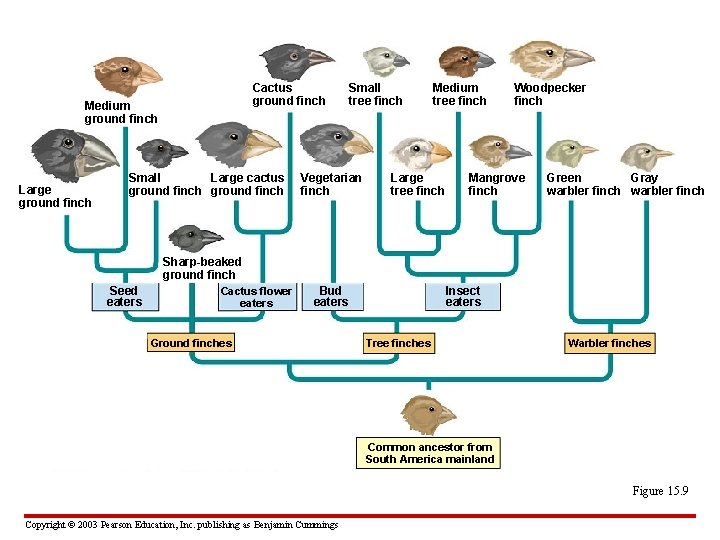
Cactus ground finch Medium ground finch Large ground finch Small Large cactus ground finch Small tree finch Vegetarian finch Medium tree finch Large tree finch Woodpecker finch Mangrove finch Green Gray warbler finch Sharp-beaked ground finch Seed eaters Cactus flower eaters Bud eaters Ground finches Insect eaters Tree finches Warbler finches Common ancestor from South America mainland Figure 15. 9 Copyright © 2003 Pearson Education, Inc. publishing as Benjamin Cummings
SYSTEMATICS AND PHYLOGENETIC BIOLOGY 15. 10 Systematists classify organisms by phylogeny • Reconstructing phylogeny is part of systematics – the study of biological diversity and classification • Taxonomists assign a two-part name to each species – The first name, the genus, covers a group of related species – The second name refers to a species within a genus Copyright © 2003 Pearson Education, Inc. publishing as Benjamin Cummings
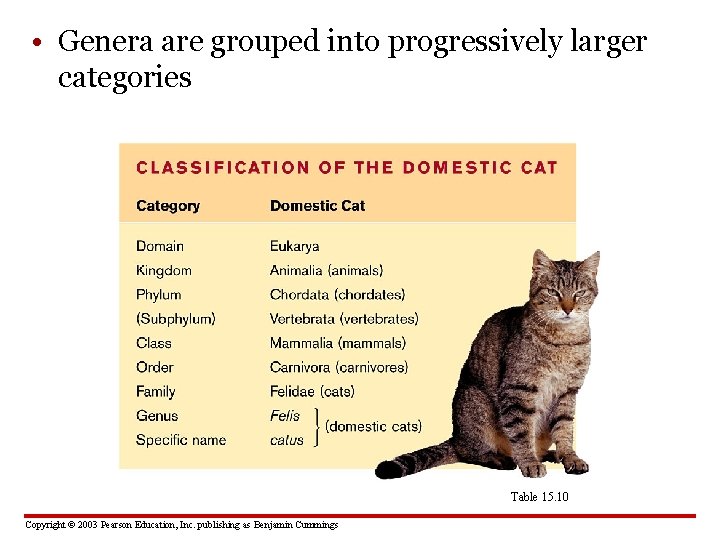
• Genera are grouped into progressively larger categories Table 15. 10 Copyright © 2003 Pearson Education, Inc. publishing as Benjamin Cummings
• Taxonomists often debate the particular placement of organisms in categories as they strive to make their categories reflect evolutionary relationships Copyright © 2003 Pearson Education, Inc. publishing as Benjamin Cummings
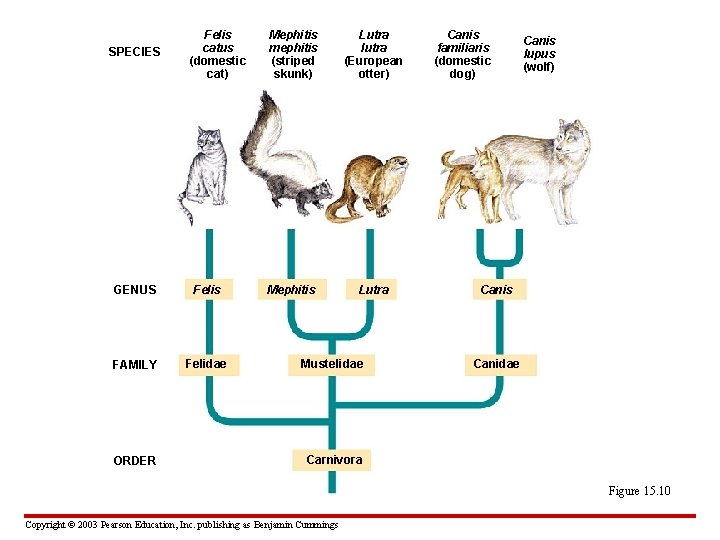
Felis catus (domestic cat) Mephitis mephitis (striped skunk) Lutra lutra (European otter) GENUS Felis Mephitis Lutra FAMILY Felidae SPECIES ORDER Mustelidae Canis familiaris (domestic dog) Canis lupus (wolf) Canis Canidae Carnivora Figure 15. 10 Copyright © 2003 Pearson Education, Inc. publishing as Benjamin Cummings
15. 11 Homology indicates common ancestry, but analogy does not • Homologous structures are evidence that organisms have evolved from a common ancestor • In contrast, analogous similarities are evidence that organisms from different evolutionary lineages have undergone convergent evolution – Their resemblances have resulted from living in similar environments Copyright © 2003 Pearson Education, Inc. publishing as Benjamin Cummings
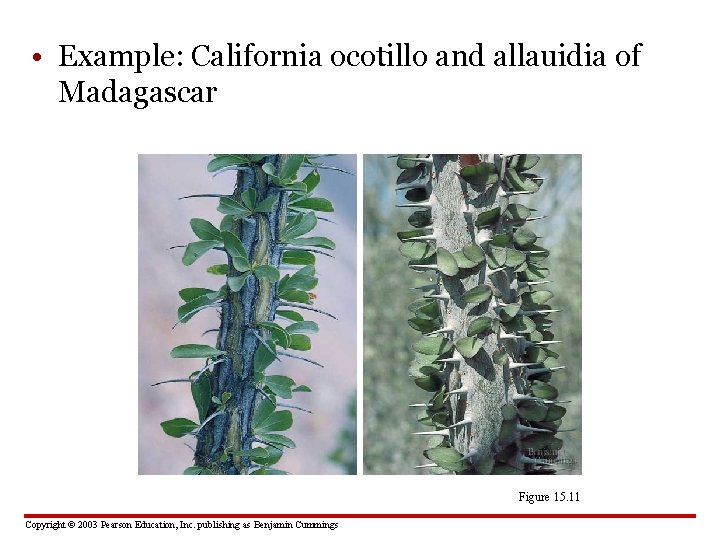
• Example: California ocotillo and allauidia of Madagascar Figure 15. 11 Copyright © 2003 Pearson Education, Inc. publishing as Benjamin Cummings
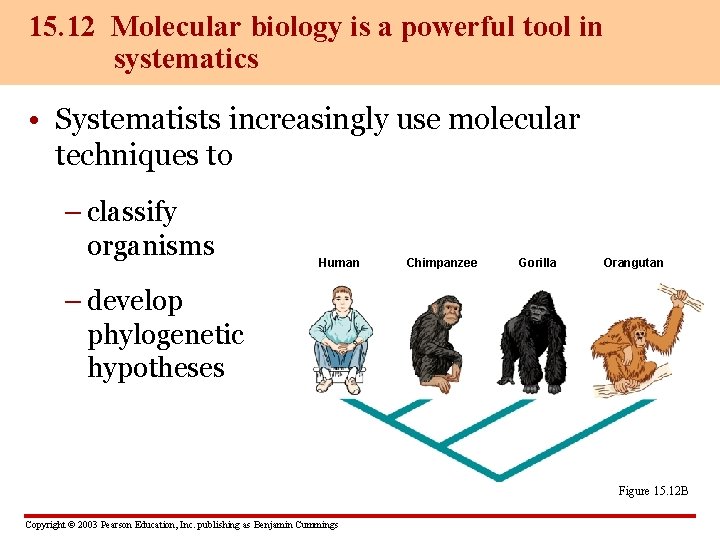
15. 12 Molecular biology is a powerful tool in systematics • Systematists increasingly use molecular techniques to – classify organisms Human Chimpanzee Gorilla Orangutan – develop phylogenetic hypotheses Figure 15. 12 B Copyright © 2003 Pearson Education, Inc. publishing as Benjamin Cummings
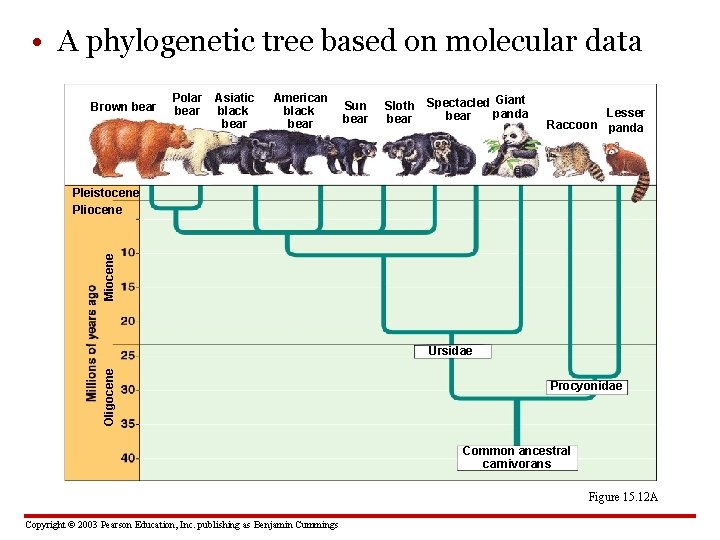
• A phylogenetic tree based on molecular data Brown bear Polar bear Asiatic black bear American black bear Sun bear Sloth bear Spectacled Giant panda bear Lesser Raccoon panda Miocene Pleistocene Pliocene Oligocene Ursidae Procyonidae Common ancestral carnivorans Figure 15. 12 A Copyright © 2003 Pearson Education, Inc. publishing as Benjamin Cummings
15. 13 Systematists attempt to make classification consistent with phylogeny • Homologous features are used to compare organisms • Cladistic analysis attempts to define monophyletic taxa Copyright © 2003 Pearson Education, Inc. publishing as Benjamin Cummings
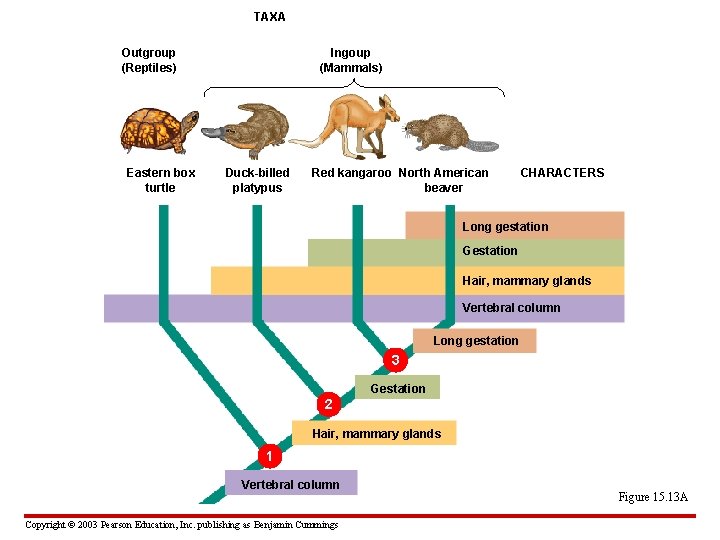
TAXA Outgroup (Reptiles) Eastern box turtle Ingoup (Mammals) Duck-billed platypus Red kangaroo North American beaver CHARACTERS Long gestation Gestation Hair, mammary glands Vertebral column Long gestation 3 Gestation 2 Hair, mammary glands 1 Vertebral column Copyright © 2003 Pearson Education, Inc. publishing as Benjamin Cummings Figure 15. 13 A
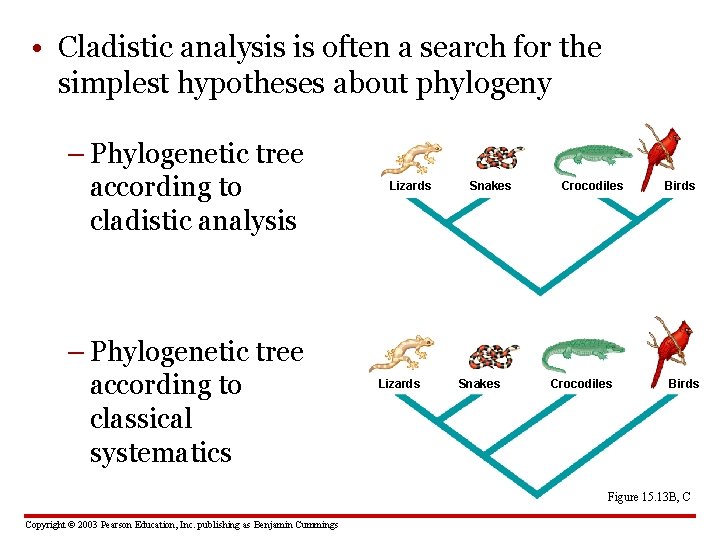
• Cladistic analysis is often a search for the simplest hypotheses about phylogeny – Phylogenetic tree according to cladistic analysis – Phylogenetic tree according to classical systematics Lizards Snakes Crocodiles Birds Figure 15. 13 B, C Copyright © 2003 Pearson Education, Inc. publishing as Benjamin Cummings
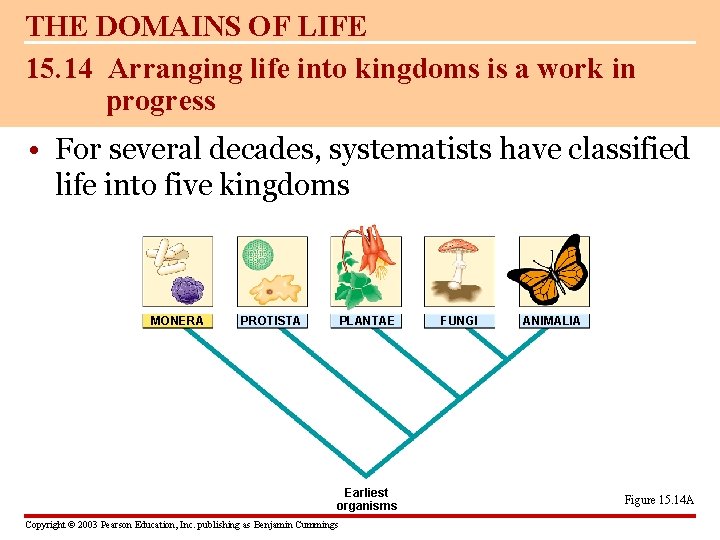
THE DOMAINS OF LIFE 15. 14 Arranging life into kingdoms is a work in progress • For several decades, systematists have classified life into five kingdoms MONERA PROTISTA PLANTAE Earliest organisms Copyright © 2003 Pearson Education, Inc. publishing as Benjamin Cummings FUNGI ANIMALIA Figure 15. 14 A
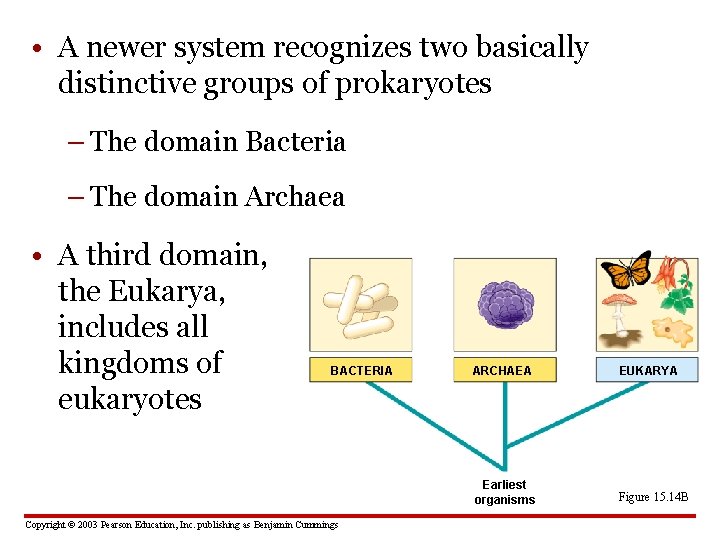
• A newer system recognizes two basically distinctive groups of prokaryotes – The domain Bacteria – The domain Archaea • A third domain, the Eukarya, includes all kingdoms of eukaryotes BACTERIA Copyright © 2003 Pearson Education, Inc. publishing as Benjamin Cummings ARCHAEA EUKARYA Earliest organisms Figure 15. 14 B
- Slides: 36