
BIOLOGY CONCEPTS CONNECTIONS Fourth Edition Neil A Campbell
BIOLOGY CONCEPTS & CONNECTIONS Fourth Edition Neil A. Campbell • Jane B. Reece • Lawrence G. Mitchell • Martha R. Taylor CHAPTER 4 A Tour of the Cell Modules 4. 6 – 4. 14 From Power. Point® Lectures for Biology: Concepts & Connections Copyright © 2003 Pearson Education, Inc. publishing as Benjamin Cummings
ORGANELLES OF THE ENDOMEMBRANE SYSTEM 4. 6 The nucleus is the cell’s genetic control center • The largest organelle is usually the nucleus • The nucleus is separated from the cytoplasm by the nuclear envelope • The nucleus is the cellular control center – It contains the DNA that directs the cell’s activities Copyright © 2003 Pearson Education, Inc. publishing as Benjamin Cummings
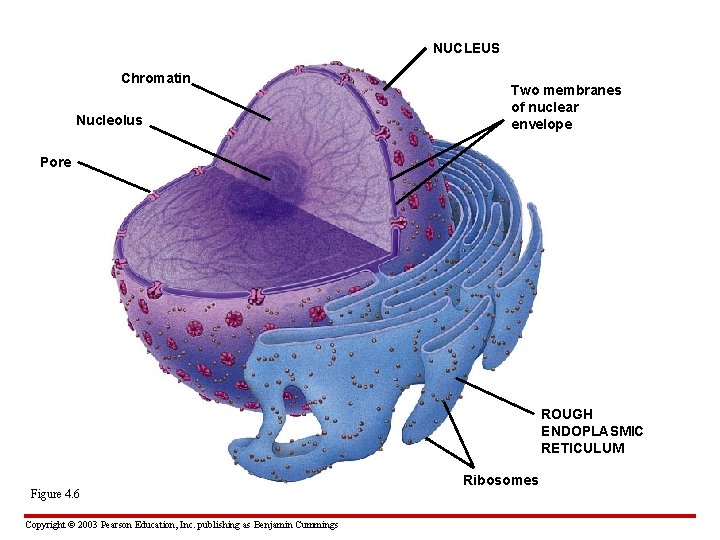
NUCLEUS Chromatin Nucleolus Two membranes of nuclear envelope Pore ROUGH ENDOPLASMIC RETICULUM Figure 4. 6 Copyright © 2003 Pearson Education, Inc. publishing as Benjamin Cummings Ribosomes
4. 7 Overview: Many cell organelles are related through the endomembrane system • The endomembrane system is a collection of membranous organelles – These organelles manufacture and distribute cell products – The endomembrane system divides the cell into compartments – Endoplasmic reticulum (ER) is part of the endomembrane system Copyright © 2003 Pearson Education, Inc. publishing as Benjamin Cummings
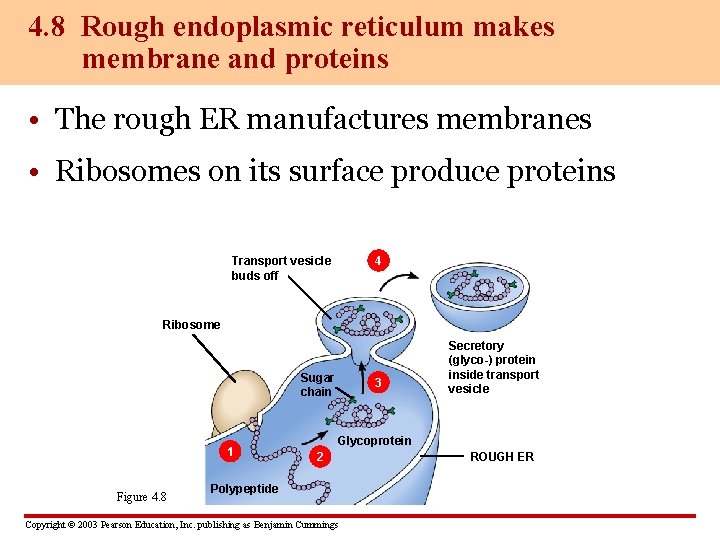
4. 8 Rough endoplasmic reticulum makes membrane and proteins • The rough ER manufactures membranes • Ribosomes on its surface produce proteins 4 Transport vesicle buds off Ribosome Sugar chain 1 Figure 4. 8 3 Secretory (glyco-) protein inside transport vesicle Glycoprotein 2 Polypeptide Copyright © 2003 Pearson Education, Inc. publishing as Benjamin Cummings ROUGH ER
4. 9 Smooth endoplasmic reticulum has a variety of functions • Smooth ER synthesizes lipids • In some cells, it regulates carbohydrate metabolism and breaks down toxins and drugs Copyright © 2003 Pearson Education, Inc. publishing as Benjamin Cummings
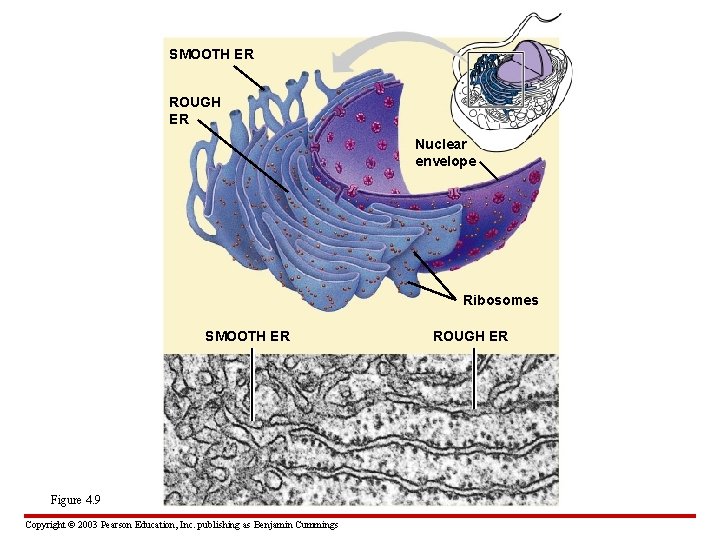
SMOOTH ER ROUGH ER Nuclear envelope Ribosomes SMOOTH ER Figure 4. 9 Copyright © 2003 Pearson Education, Inc. publishing as Benjamin Cummings ROUGH ER
4. 10 The Golgi apparatus finishes, sorts, and ships cell products • The Golgi apparatus consists of stacks of membranous sacs – These receive and modify ER products, then send them on to other organelles or to the cell membrane Copyright © 2003 Pearson Education, Inc. publishing as Benjamin Cummings
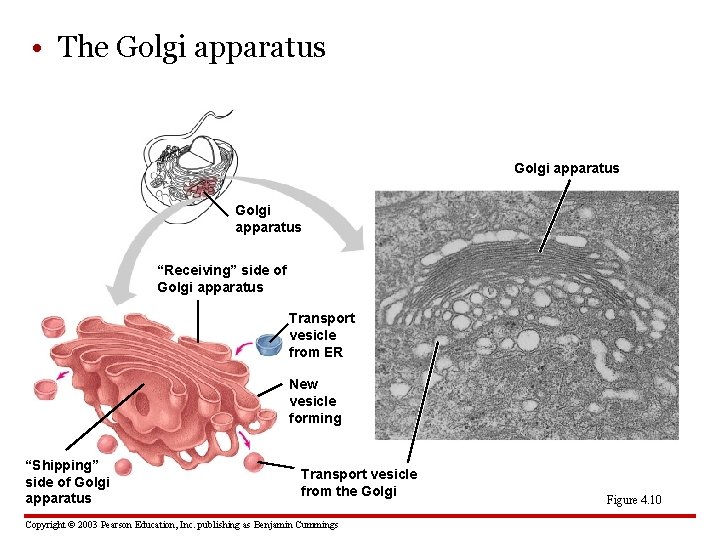
• The Golgi apparatus “Receiving” side of Golgi apparatus Transport vesicle from ER New vesicle forming “Shipping” side of Golgi apparatus Transport vesicle from the Golgi Copyright © 2003 Pearson Education, Inc. publishing as Benjamin Cummings Figure 4. 10
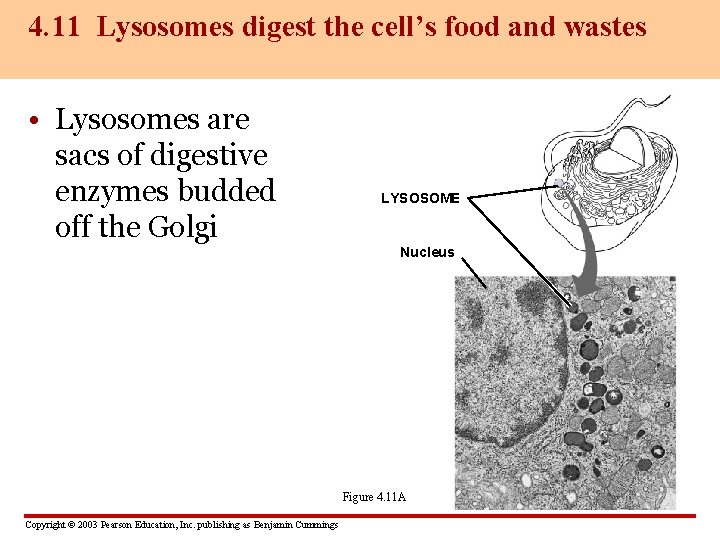
4. 11 Lysosomes digest the cell’s food and wastes • Lysosomes are sacs of digestive enzymes budded off the Golgi LYSOSOME Nucleus Figure 4. 11 A Copyright © 2003 Pearson Education, Inc. publishing as Benjamin Cummings
• Lysosomal enzymes – digest food – destroy bacteria – recycle damaged organelles – function in embryonic development in animals Copyright © 2003 Pearson Education, Inc. publishing as Benjamin Cummings
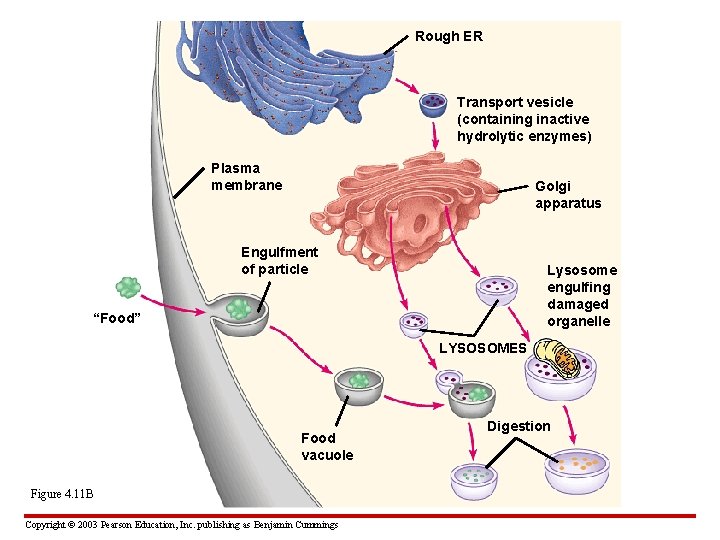
Rough ER Transport vesicle (containing inactive hydrolytic enzymes) Plasma membrane Golgi apparatus Engulfment of particle Lysosome engulfing damaged organelle “Food” LYSOSOMES Food vacuole Figure 4. 11 B Copyright © 2003 Pearson Education, Inc. publishing as Benjamin Cummings Digestion
4. 12 Connection: Abnormal lysosomes can cause fatal diseases • Lysosomal storage diseases are hereditary – They interfere with other cellular functions – Examples: Pompe’s disease, Tay-Sachs disease Copyright © 2003 Pearson Education, Inc. publishing as Benjamin Cummings
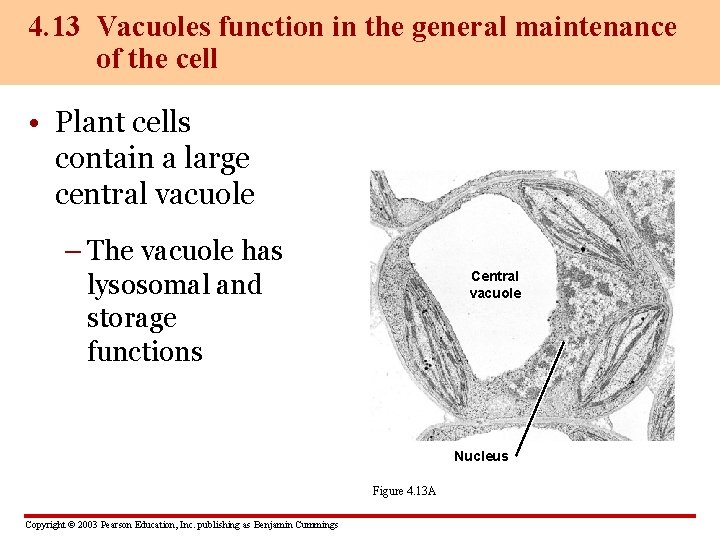
4. 13 Vacuoles function in the general maintenance of the cell • Plant cells contain a large central vacuole – The vacuole has lysosomal and storage functions Central vacuole Nucleus Figure 4. 13 A Copyright © 2003 Pearson Education, Inc. publishing as Benjamin Cummings
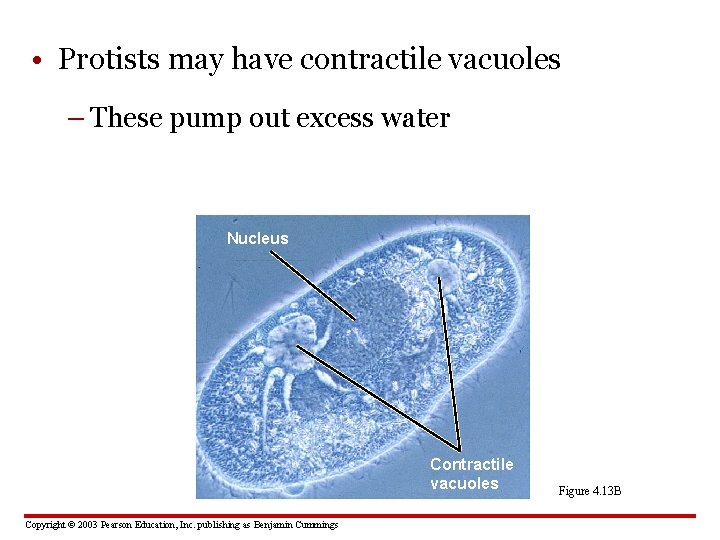
• Protists may have contractile vacuoles – These pump out excess water Nucleus Contractile vacuoles Copyright © 2003 Pearson Education, Inc. publishing as Benjamin Cummings Figure 4. 13 B
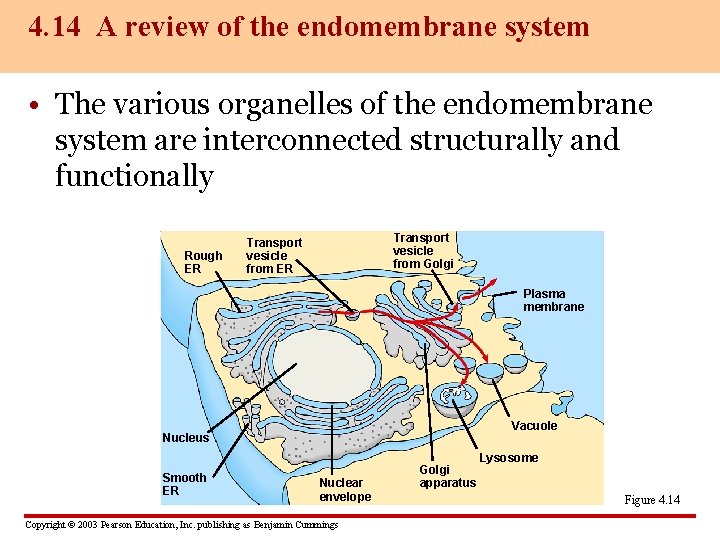
4. 14 A review of the endomembrane system • The various organelles of the endomembrane system are interconnected structurally and functionally Rough ER Transport vesicle from Golgi Transport vesicle from ER Plasma membrane Vacuole Nucleus Smooth ER Nuclear envelope Copyright © 2003 Pearson Education, Inc. publishing as Benjamin Cummings Golgi apparatus Lysosome Figure 4. 14
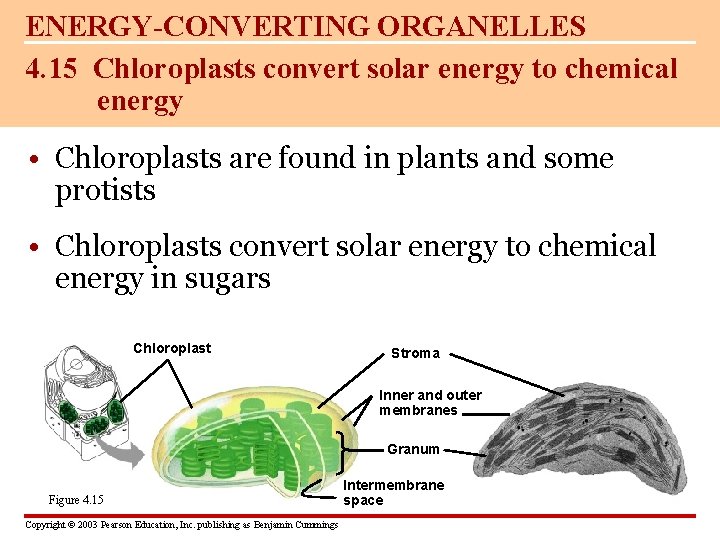
ENERGY-CONVERTING ORGANELLES 4. 15 Chloroplasts convert solar energy to chemical energy • Chloroplasts are found in plants and some protists • Chloroplasts convert solar energy to chemical energy in sugars Chloroplast Stroma Inner and outer membranes Granum Figure 4. 15 Copyright © 2003 Pearson Education, Inc. publishing as Benjamin Cummings Intermembrane space
4. 16 Mitochondria harvest chemical energy from food • Mitochondria carry out cellular respiration – This process uses the chemical energy in food to make ATP for cellular work Copyright © 2003 Pearson Education, Inc. publishing as Benjamin Cummings
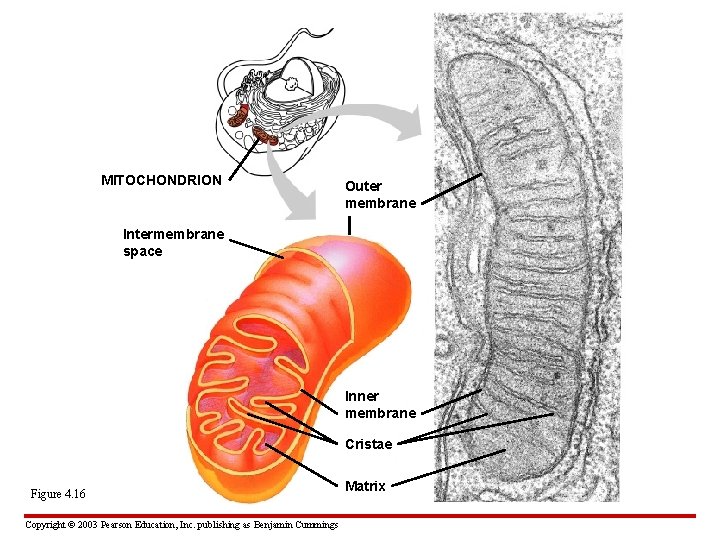
MITOCHONDRION Outer membrane Intermembrane space Inner membrane Cristae Figure 4. 16 Copyright © 2003 Pearson Education, Inc. publishing as Benjamin Cummings Matrix
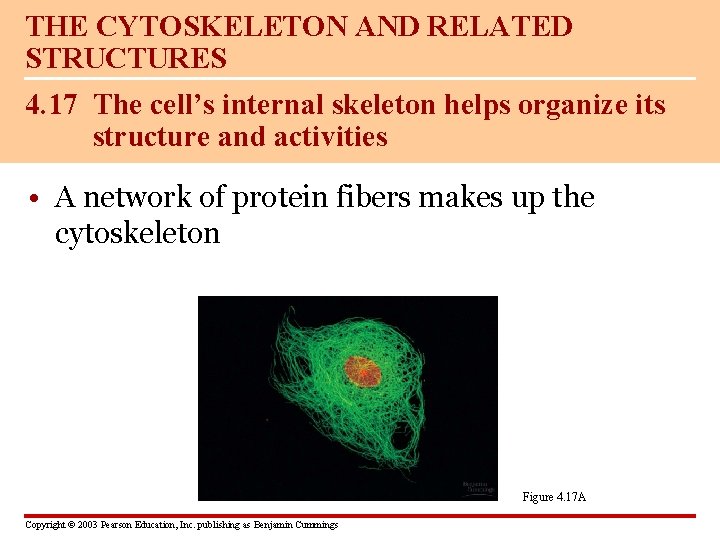
THE CYTOSKELETON AND RELATED STRUCTURES 4. 17 The cell’s internal skeleton helps organize its structure and activities • A network of protein fibers makes up the cytoskeleton Figure 4. 17 A Copyright © 2003 Pearson Education, Inc. publishing as Benjamin Cummings
• Microfilaments of actin enable cells to change shape and move • Intermediate filaments reinforce the cell and anchor certain organelles • Microtubules – give the cell rigidity – provide anchors for organelles – act as tracks for organelle movement Copyright © 2003 Pearson Education, Inc. publishing as Benjamin Cummings
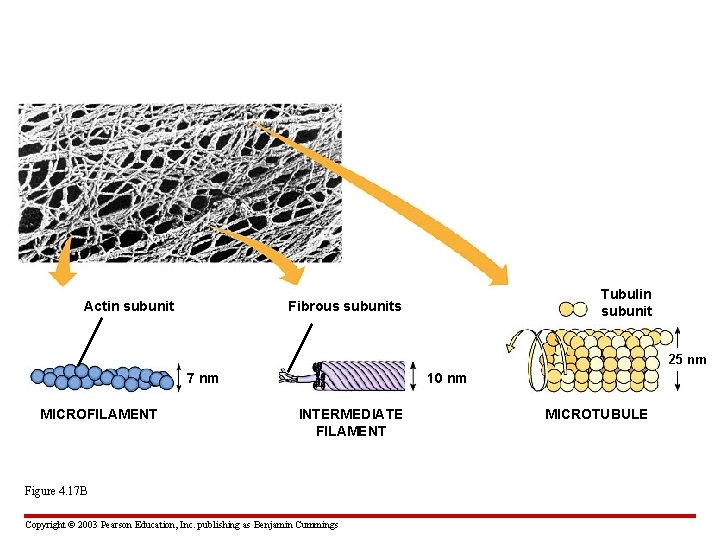
Actin subunit Tubulin subunit Fibrous subunits 25 nm 7 nm MICROFILAMENT 10 nm INTERMEDIATE FILAMENT Figure 4. 17 B Copyright © 2003 Pearson Education, Inc. publishing as Benjamin Cummings MICROTUBULE
4. 18 Cilia and flagella move when microtubules bend • Eukaryotic cilia and flagella are locomotor appendages that protrude from certain cells • A cilia or flagellum is composed of a core of microtubules wrapped in an extension of the plasma membrane Copyright © 2003 Pearson Education, Inc. publishing as Benjamin Cummings
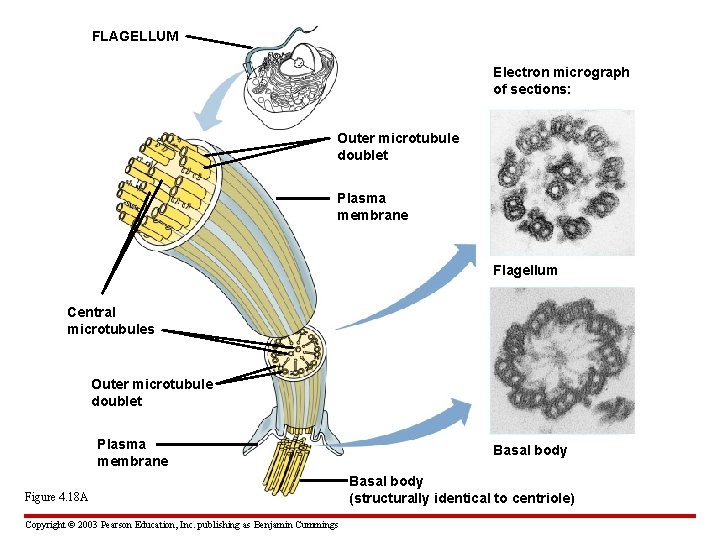
FLAGELLUM Electron micrograph of sections: Outer microtubule doublet Plasma membrane Flagellum Central microtubules Outer microtubule doublet Plasma membrane Figure 4. 18 A Copyright © 2003 Pearson Education, Inc. publishing as Benjamin Cummings Basal body (structurally identical to centriole)
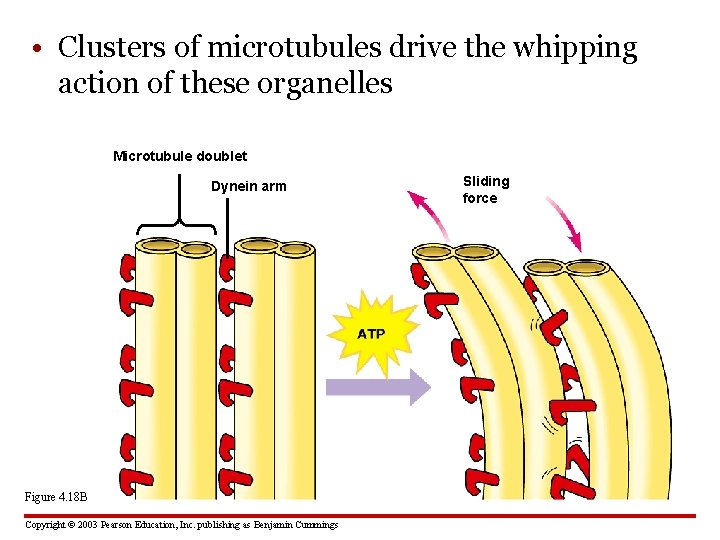
• Clusters of microtubules drive the whipping action of these organelles Microtubule doublet Dynein arm Figure 4. 18 B Copyright © 2003 Pearson Education, Inc. publishing as Benjamin Cummings Sliding force

EUKARYOTIC CELL SURFACES AND JUNCTIONS 4. 19 Cell surfaces protect, support, and join cells • Cells interact with their environments and each other via their surfaces • Plant cells are supported by rigid cell walls made largely of cellulose – They connect by plasmodesmata, channels that allow them to share water, food, and chemical messages Copyright © 2003 Pearson Education, Inc. publishing as Benjamin Cummings
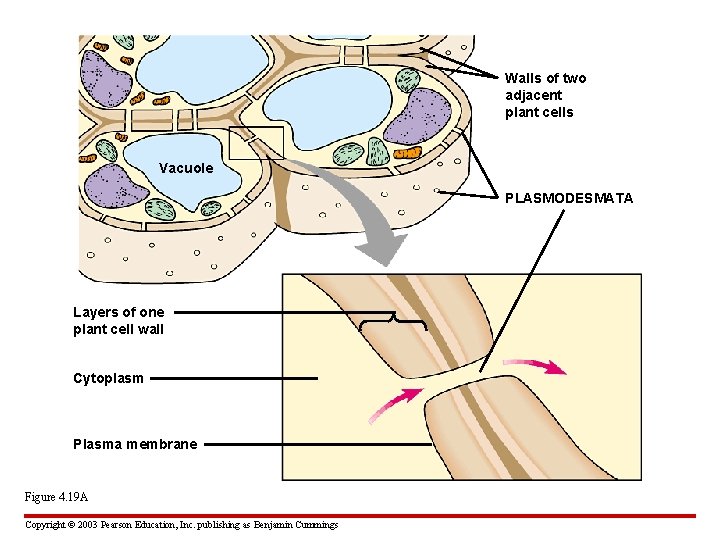
Walls of two adjacent plant cells Vacuole PLASMODESMATA Layers of one plant cell wall Cytoplasm Plasma membrane Figure 4. 19 A Copyright © 2003 Pearson Education, Inc. publishing as Benjamin Cummings
• Animal cells are embedded in an extracellular matrix – It is a sticky layer of glycoproteins – It binds cells together in tissues – It can also have protective and supportive functions Copyright © 2003 Pearson Education, Inc. publishing as Benjamin Cummings
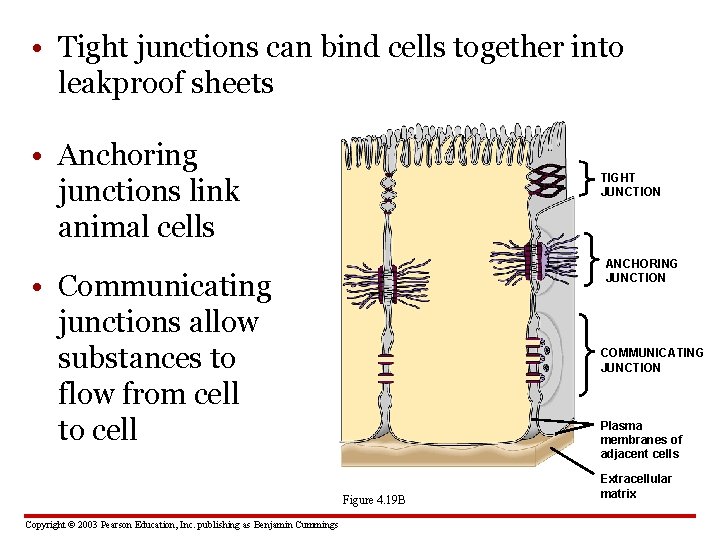
• Tight junctions can bind cells together into leakproof sheets • Anchoring junctions link animal cells TIGHT JUNCTION ANCHORING JUNCTION • Communicating junctions allow substances to flow from cell to cell COMMUNICATING JUNCTION Plasma membranes of adjacent cells Figure 4. 19 B Copyright © 2003 Pearson Education, Inc. publishing as Benjamin Cummings Extracellular matrix
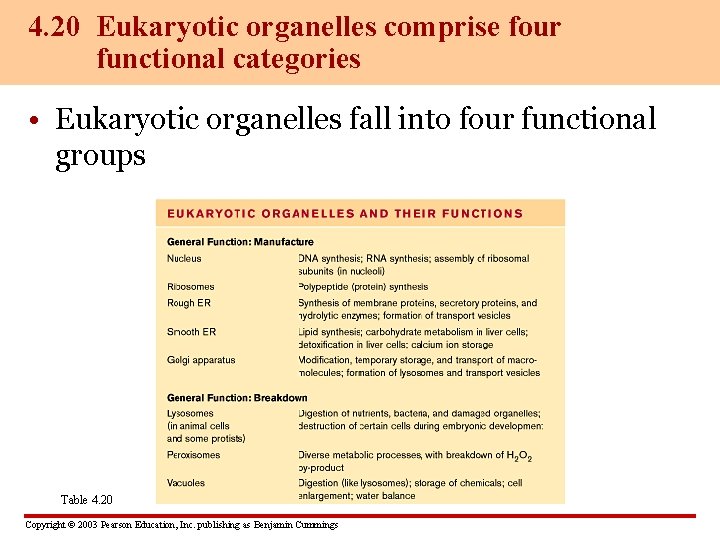
4. 20 Eukaryotic organelles comprise four functional categories • Eukaryotic organelles fall into four functional groups Table 4. 20 Copyright © 2003 Pearson Education, Inc. publishing as Benjamin Cummings
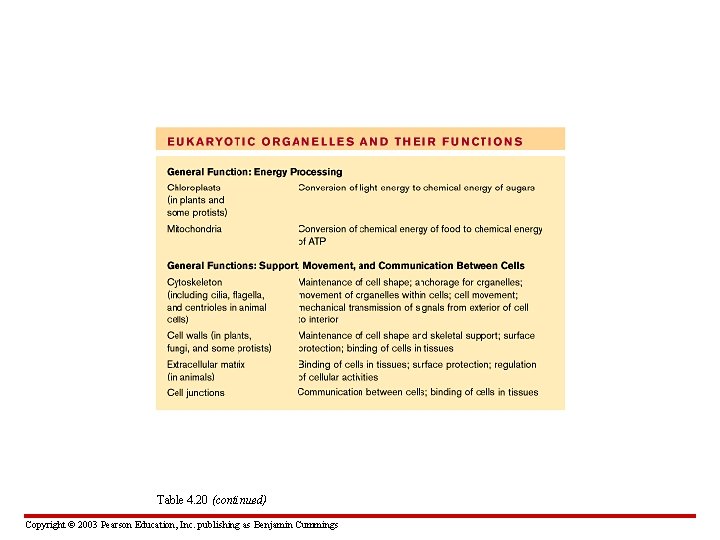
Table 4. 20 (continued) Copyright © 2003 Pearson Education, Inc. publishing as Benjamin Cummings
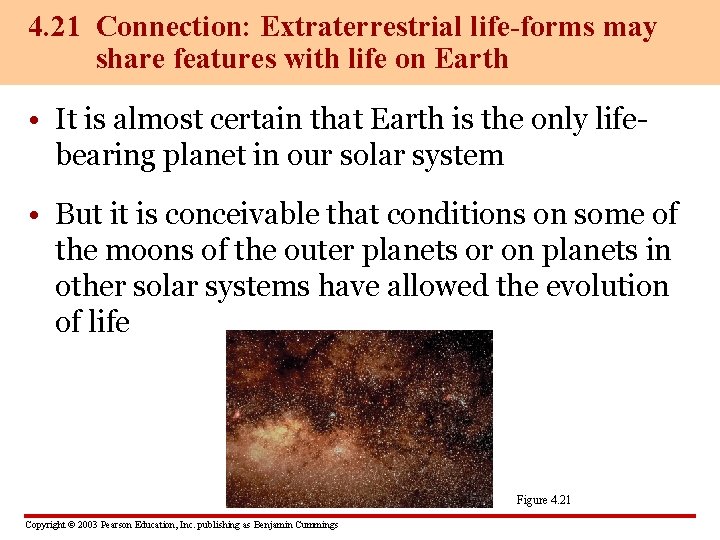
4. 21 Connection: Extraterrestrial life-forms may share features with life on Earth • It is almost certain that Earth is the only lifebearing planet in our solar system • But it is conceivable that conditions on some of the moons of the outer planets or on planets in other solar systems have allowed the evolution of life Figure 4. 21 Copyright © 2003 Pearson Education, Inc. publishing as Benjamin Cummings
- Slides: 32