
Biology CHAPTER 8 SECTION 1 PRINCIPLES OF GENETICSA
Biology CHAPTER 8 SECTION 1 PRINCIPLES OF GENETICS--A
Objectives Describe Explain Mendel’s experiments and results the principles of genetics Mendel discovered

Definitions Heredity: passing traits (characteristics) from parent to offspring Genetics: study of heredity
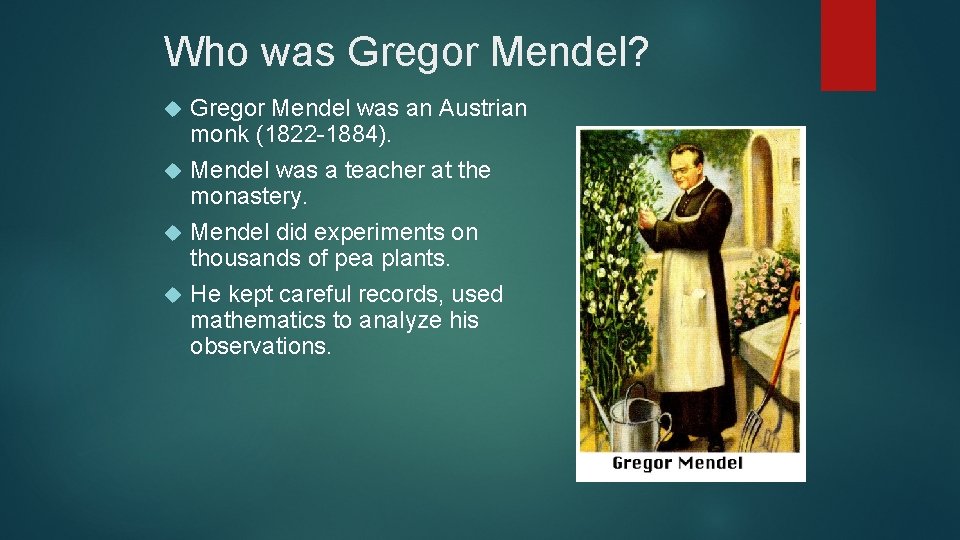
Who was Gregor Mendel? Gregor Mendel was an Austrian monk (1822 -1884). Mendel was a teacher at the monastery. Mendel did experiments on thousands of pea plants. He kept careful records, used mathematics to analyze his observations.

Heredity is the passing of traits from parents to offspring. Mendel experimented with heredity of certain traits found in peas. Mendel studied each trait separately and discovered patterns in the way traits are inherited in peas. Mendel’s work has become the basis of genetics, the study of heredity.
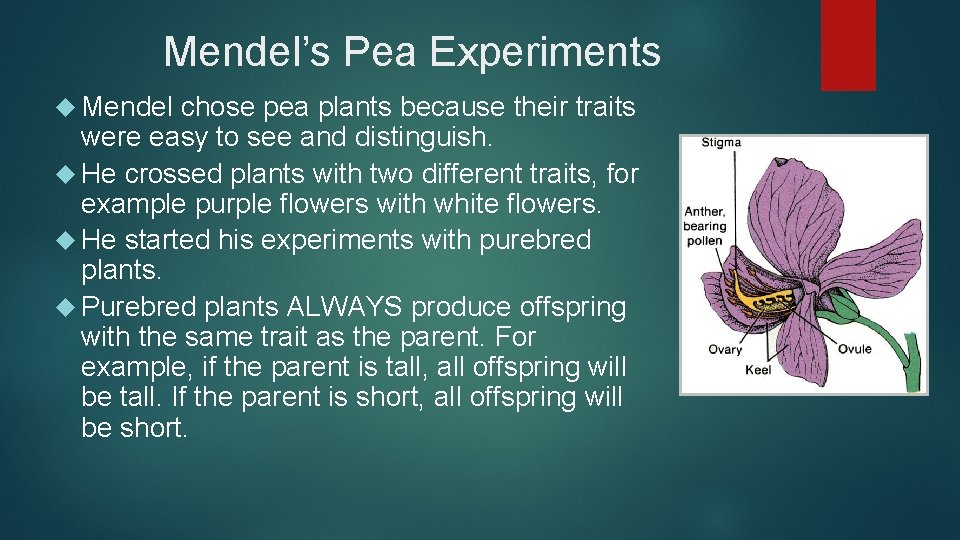
Mendel’s Pea Experiments Mendel chose pea plants because their traits were easy to see and distinguish. He crossed plants with two different traits, for example purple flowers with white flowers. He started his experiments with purebred plants. Purebred plants ALWAYS produce offspring with the same trait as the parent. For example, if the parent is tall, all offspring will be tall. If the parent is short, all offspring will be short.

Some Pea Traits that Mendel Studied
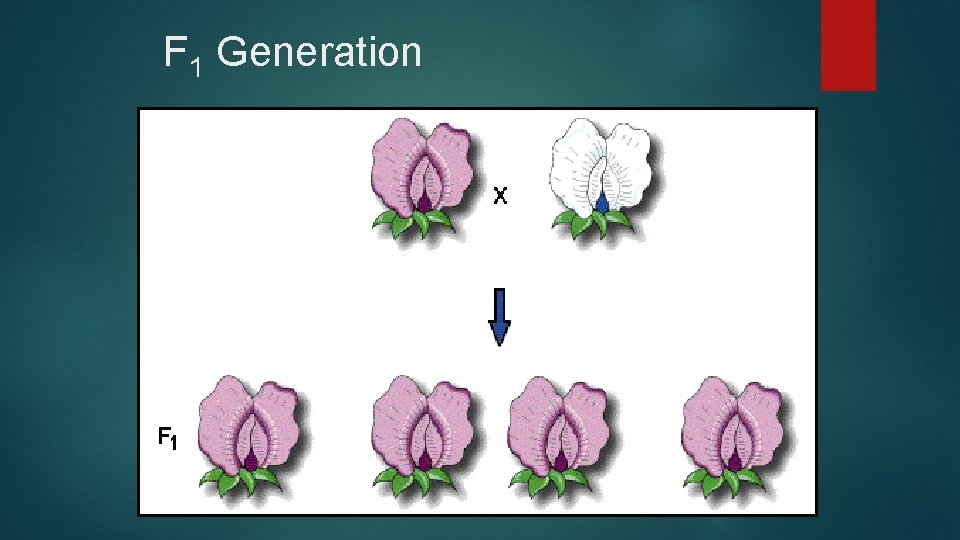
F 1 Generation P generation. He called the offspring from the parents the F generation. 1 Mendel called the parent plants the When Mendel crossed pure pea plants with purple flowers with pure pea plants with white flowers, all the F 1 generation had purple flowers

F 2 Generation When he crossed the F 1 generation peas with one another, only some of the offspring had purple flowers. These formed the F 2 generation. Mendel found that in the F 2 generation, ¾ of the plants had purple flowers and ¼ of them had white flowers.
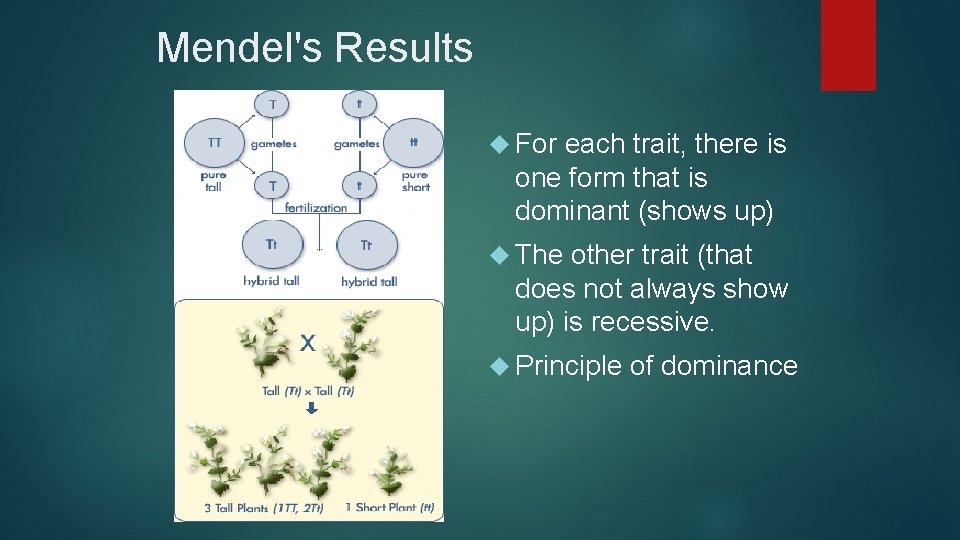
Mendel's Results For each trait, there is one form that is dominant (shows up) The other trait (that does not always show up) is recessive. Principle of dominance
Mendel's Results Each parent must have a pair of factors that controls the trait The factors (genes) separate during gamete formation This separation is called segregation More complex crosses: Mendel discovered that the gene for flower color wasn't linked to that of tallness, etc Law of independent assortment: genes for different traits segregate independently during gamete formation
Modern Terminology Gene: rough equivalent to Mendel's “factors” Allele: each possible expression of a gene Genotype: the actual gene combination for a trait Phenotype: the expression of the genes, or what the organism “looks like” Homozygous: Heterozygous: having the same alleles having two different alleles

Practice We use two letters to represent the genotype. A capital letter represents the dominant form of a gene (allele) and a lowercase letter is the abbreviation for the recessive form of the gene (allele). • Example below: P=dominant purple and p= recessive white • The phenotype for this flower is violet while its genotype (if homozygous) is PP. The phenotype for this flower is white while its genotype is pp (to be white the flower must have two of the recessive copies of the allele).
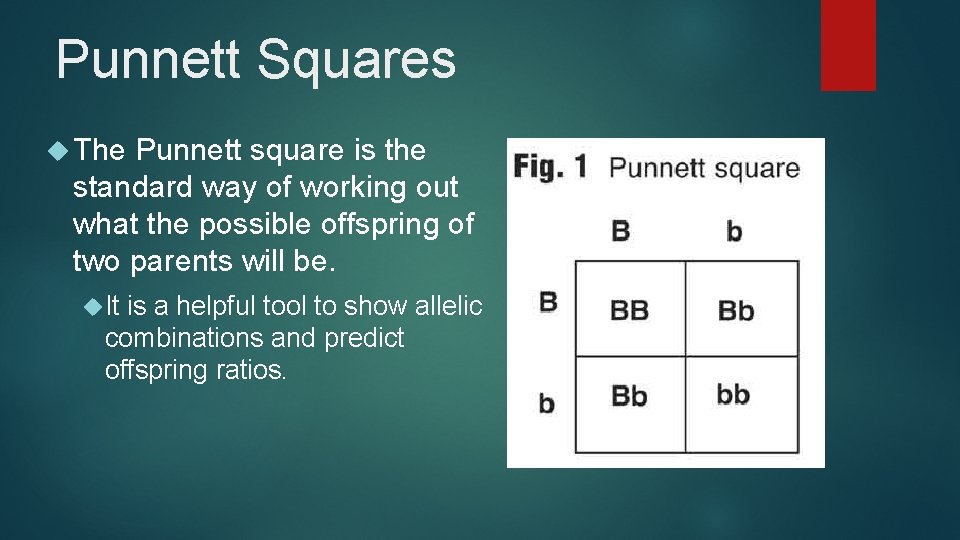
Punnett Squares The Punnett square is the standard way of working out what the possible offspring of two parents will be. It is a helpful tool to show allelic combinations and predict offspring ratios.
Before we go further lets review how to set up a Punnett Square… We begin by constructing a grid of two sets of perpendicular lines.
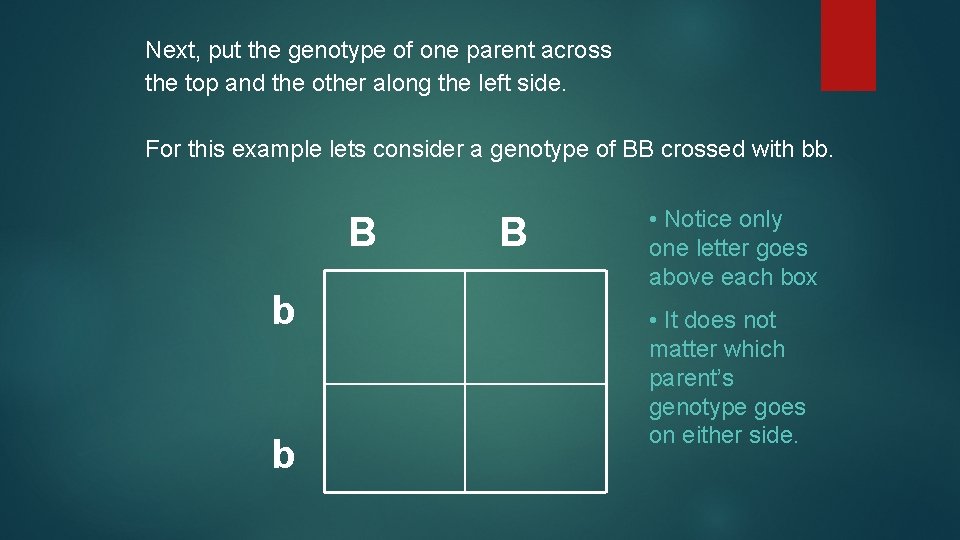
Next, put the genotype of one parent across the top and the other along the left side. For this example lets consider a genotype of BB crossed with bb. B b b B • Notice only one letter goes above each box • It does not matter which parent’s genotype goes on either side.
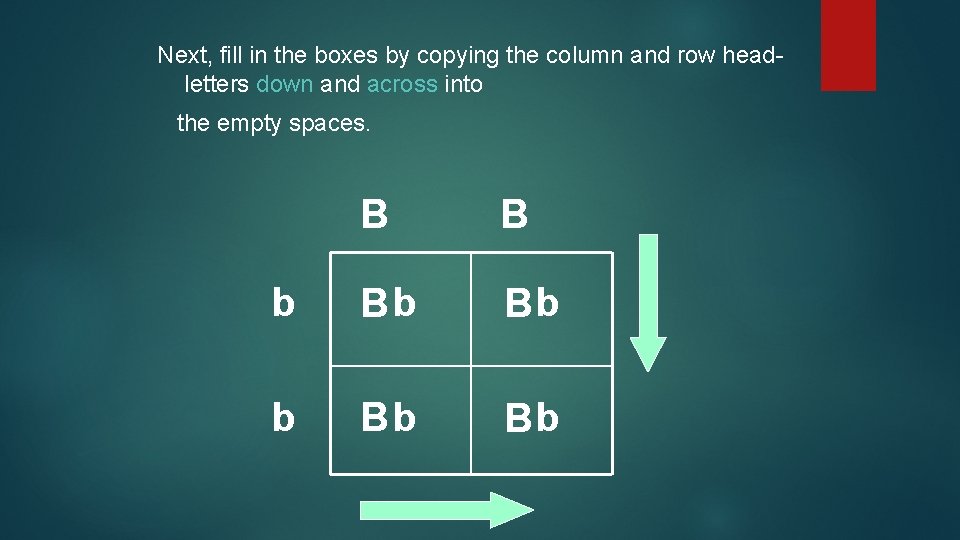
Next, fill in the boxes by copying the column and row headletters down and across into the empty spaces. B B b Bb Bb
Punnett Squares Now that we have learned the basics of genetics lets walk through some examples using Punnett Squares.
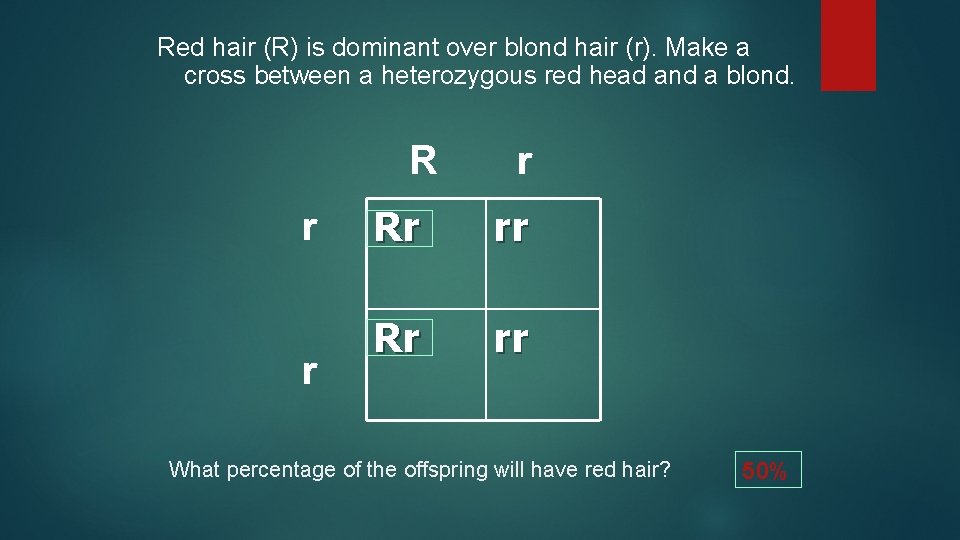
Red hair (R) is dominant over blond hair (r). Make a cross between a heterozygous red head and a blond. R r r r Rr rr What percentage of the offspring will have red hair? 50%
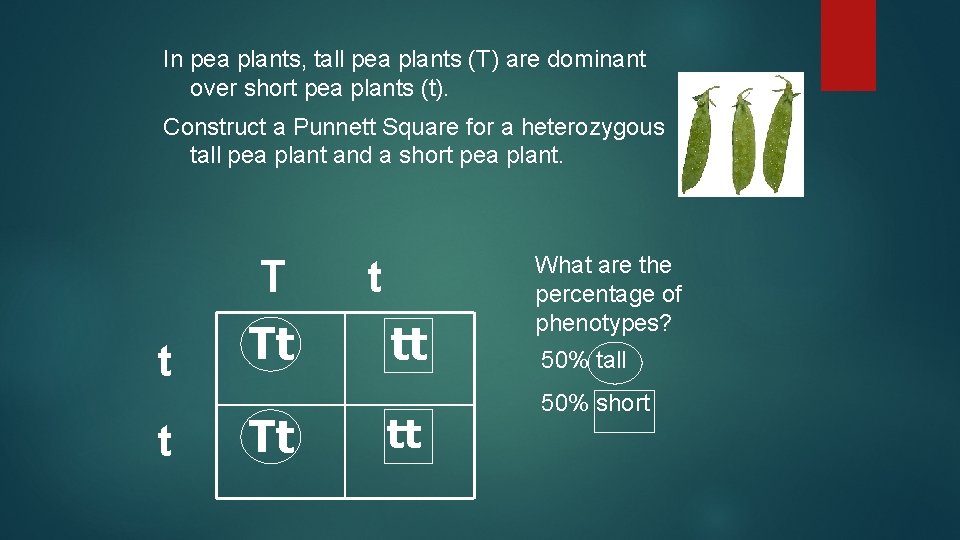
In pea plants, tall pea plants (T) are dominant over short pea plants (t). Construct a Punnett Square for a heterozygous tall pea plant and a short pea plant. T t t Tt Tt t tt tt What are the percentage of phenotypes? 50% tall 50% short
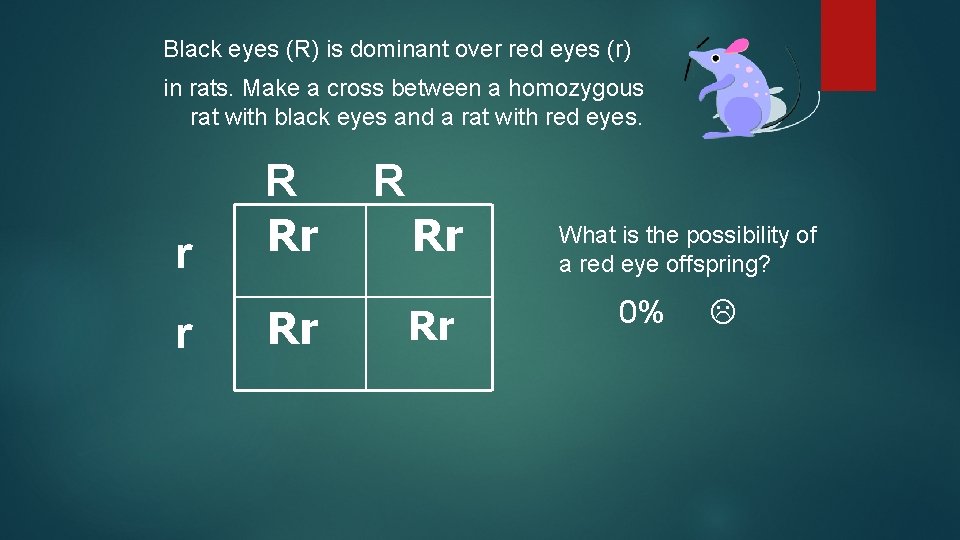
Black eyes (R) is dominant over red eyes (r) in rats. Make a cross between a homozygous rat with black eyes and a rat with red eyes. r r R Rr Rr What is the possibility of a red eye offspring? 0%
Dihybrid crosses We can predict the result of looking at 2 different traits. Assuming the traits are on different chromosomes: Determine the possible gametes the parents will form. Each Put gamete will have one allele for each trait the gametes on a Punnett square, the same as for monohybrid crosses
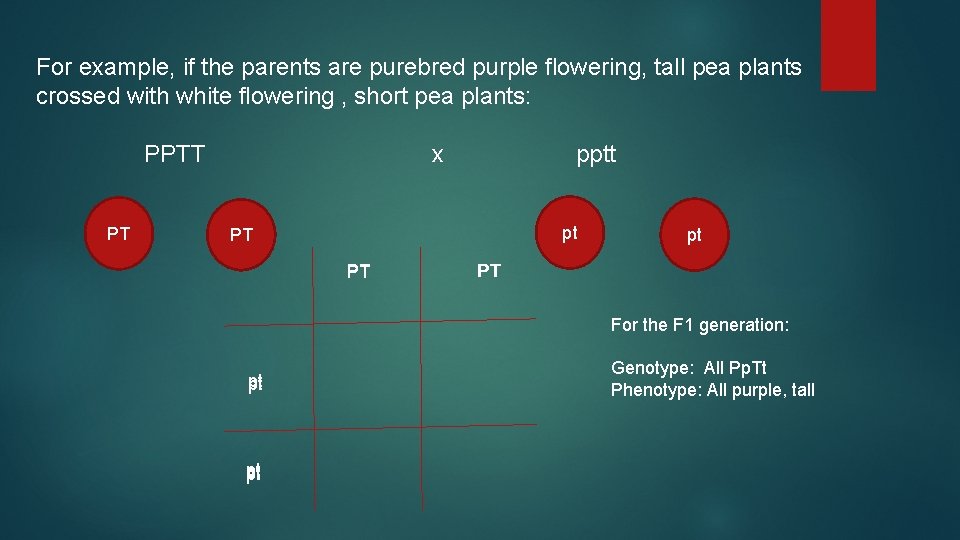
For example, if the parents are purebred purple flowering, tall pea plants crossed with white flowering , short pea plants: PPTT PT x pptt pt PT PT pt PT For the F 1 generation: pt pt pt Genotype: All Pp. Tt Phenotype: All purple, tall

F 2 Generation! Let’s do that one on the white board!
References http: //www. athro. com/evo/gen/punnett. html http: //www. kidshealth. org/kid/talk/qa/what_is_gene. html http: //brookings. k 12. sd. us/biology/ch%2011%20 genetics/punnettpractice. p pt#1 http: //www. usoe. k 12. ut. us/CURR/Science/sciber 00/7 th/genetics/sciber/pun nett. htm http: //www. biotechnologyonline. gov. au/images/contentpages/karyotype. jpg
- Slides: 25