
BIOLOGY Chapter 27 INRODUCTION TO ANIMAL DIVERSITY Power
BIOLOGY Chapter 27 INRODUCTION TO ANIMAL DIVERSITY Power. Point Image Slideshow
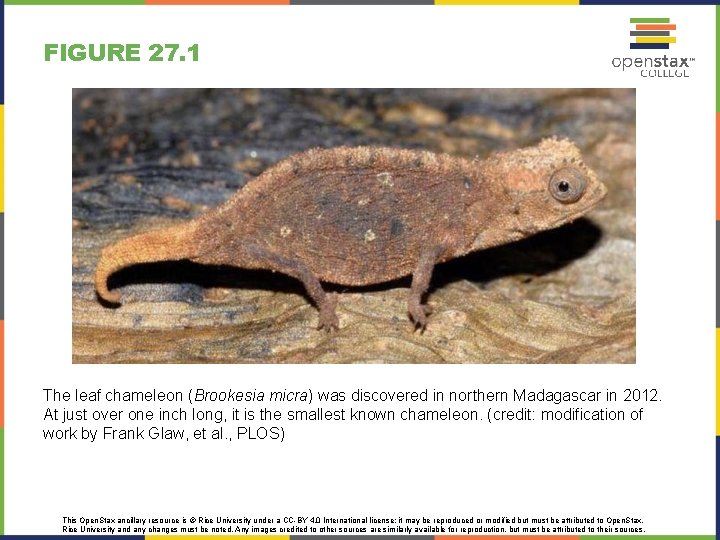
FIGURE 27. 1 The leaf chameleon (Brookesia micra) was discovered in northern Madagascar in 2012. At just over one inch long, it is the smallest known chameleon. (credit: modification of work by Frank Glaw, et al. , PLOS) This Open. Stax ancillary resource is © Rice University under a CC-BY 4. 0 International license; it may be reproduced or modified but must be attributed to Open. Stax, Rice University and any changes must be noted. Any images credited to other sources are similarly available for reproduction, but must be attributed to their sources.
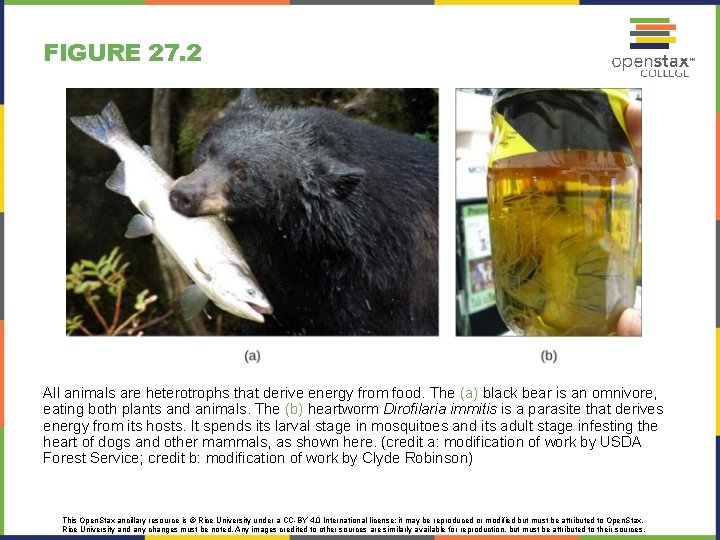
FIGURE 27. 2 All animals are heterotrophs that derive energy from food. The (a) black bear is an omnivore, eating both plants and animals. The (b) heartworm Dirofilaria immitis is a parasite that derives energy from its hosts. It spends its larval stage in mosquitoes and its adult stage infesting the heart of dogs and other mammals, as shown here. (credit a: modification of work by USDA Forest Service; credit b: modification of work by Clyde Robinson) This Open. Stax ancillary resource is © Rice University under a CC-BY 4. 0 International license; it may be reproduced or modified but must be attributed to Open. Stax, Rice University and any changes must be noted. Any images credited to other sources are similarly available for reproduction, but must be attributed to their sources.
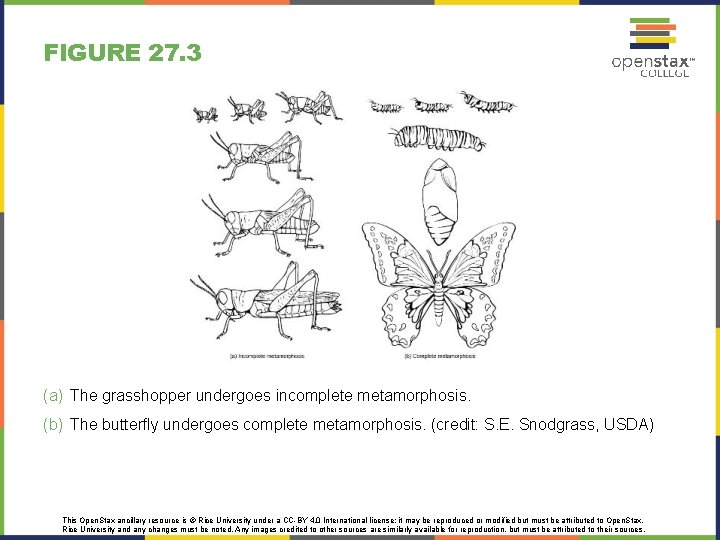
FIGURE 27. 3 (a) The grasshopper undergoes incomplete metamorphosis. (b) The butterfly undergoes complete metamorphosis. (credit: S. E. Snodgrass, USDA) This Open. Stax ancillary resource is © Rice University under a CC-BY 4. 0 International license; it may be reproduced or modified but must be attributed to Open. Stax, Rice University and any changes must be noted. Any images credited to other sources are similarly available for reproduction, but must be attributed to their sources.
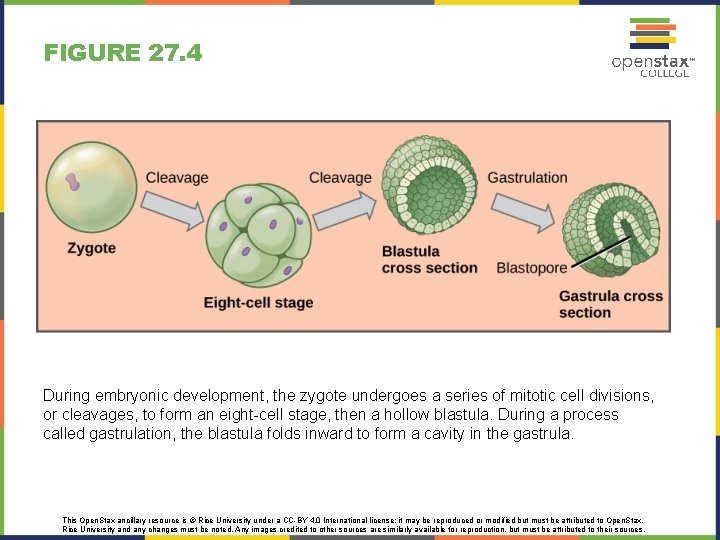
FIGURE 27. 4 During embryonic development, the zygote undergoes a series of mitotic cell divisions, or cleavages, to form an eight-cell stage, then a hollow blastula. During a process called gastrulation, the blastula folds inward to form a cavity in the gastrula. This Open. Stax ancillary resource is © Rice University under a CC-BY 4. 0 International license; it may be reproduced or modified but must be attributed to Open. Stax, Rice University and any changes must be noted. Any images credited to other sources are similarly available for reproduction, but must be attributed to their sources.
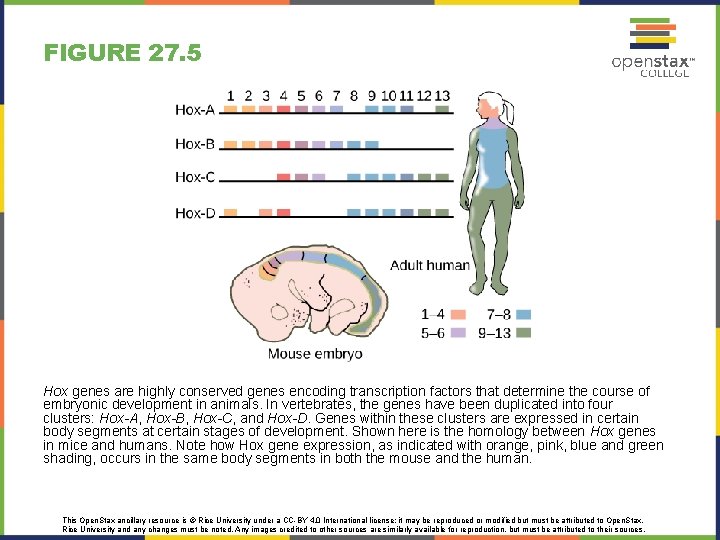
FIGURE 27. 5 Hox genes are highly conserved genes encoding transcription factors that determine the course of embryonic development in animals. In vertebrates, the genes have been duplicated into four clusters: Hox-A, Hox-B, Hox-C, and Hox-D. Genes within these clusters are expressed in certain body segments at certain stages of development. Shown here is the homology between Hox genes in mice and humans. Note how Hox gene expression, as indicated with orange, pink, blue and green shading, occurs in the same body segments in both the mouse and the human. This Open. Stax ancillary resource is © Rice University under a CC-BY 4. 0 International license; it may be reproduced or modified but must be attributed to Open. Stax, Rice University and any changes must be noted. Any images credited to other sources are similarly available for reproduction, but must be attributed to their sources.
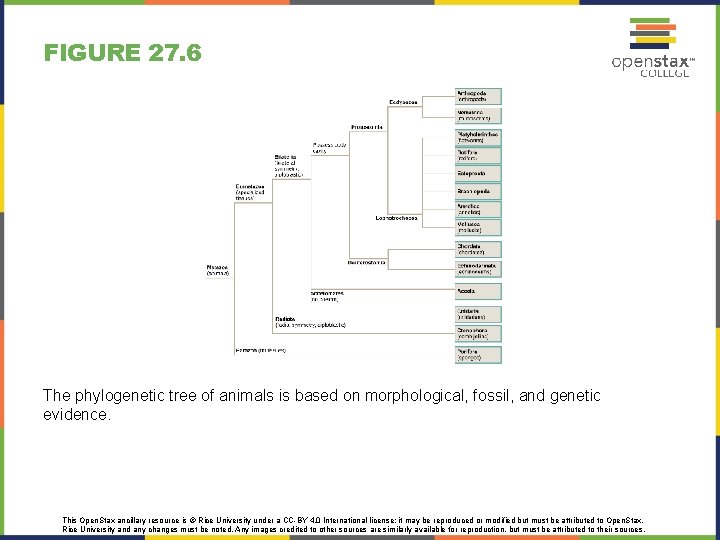
FIGURE 27. 6 The phylogenetic tree of animals is based on morphological, fossil, and genetic evidence. This Open. Stax ancillary resource is © Rice University under a CC-BY 4. 0 International license; it may be reproduced or modified but must be attributed to Open. Stax, Rice University and any changes must be noted. Any images credited to other sources are similarly available for reproduction, but must be attributed to their sources.
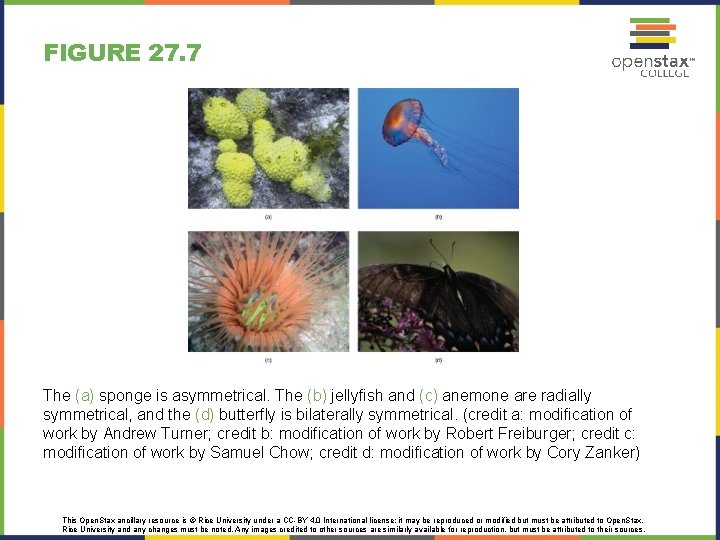
FIGURE 27. 7 The (a) sponge is asymmetrical. The (b) jellyfish and (c) anemone are radially symmetrical, and the (d) butterfly is bilaterally symmetrical. (credit a: modification of work by Andrew Turner; credit b: modification of work by Robert Freiburger; credit c: modification of work by Samuel Chow; credit d: modification of work by Cory Zanker) This Open. Stax ancillary resource is © Rice University under a CC-BY 4. 0 International license; it may be reproduced or modified but must be attributed to Open. Stax, Rice University and any changes must be noted. Any images credited to other sources are similarly available for reproduction, but must be attributed to their sources.

FIGURE 27. 8 The bilaterally symmetrical human body can be divided into planes. This Open. Stax ancillary resource is © Rice University under a CC-BY 4. 0 International license; it may be reproduced or modified but must be attributed to Open. Stax, Rice University and any changes must be noted. Any images credited to other sources are similarly available for reproduction, but must be attributed to their sources.
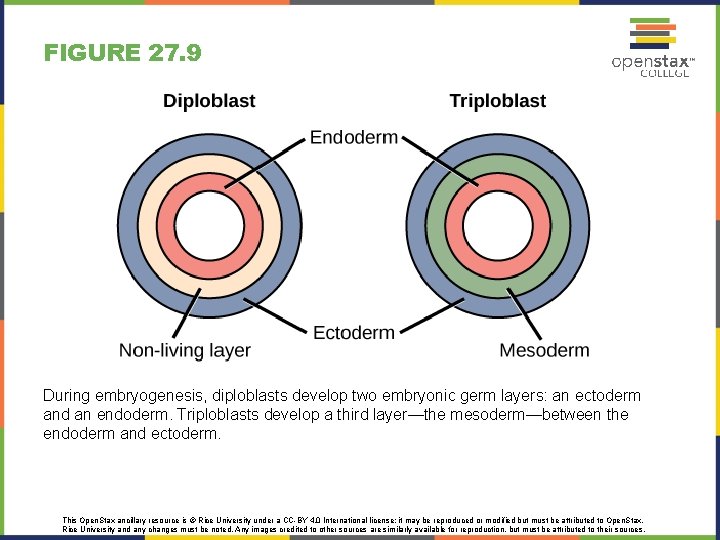
FIGURE 27. 9 During embryogenesis, diploblasts develop two embryonic germ layers: an ectoderm and an endoderm. Triploblasts develop a third layer—the mesoderm—between the endoderm and ectoderm. This Open. Stax ancillary resource is © Rice University under a CC-BY 4. 0 International license; it may be reproduced or modified but must be attributed to Open. Stax, Rice University and any changes must be noted. Any images credited to other sources are similarly available for reproduction, but must be attributed to their sources.
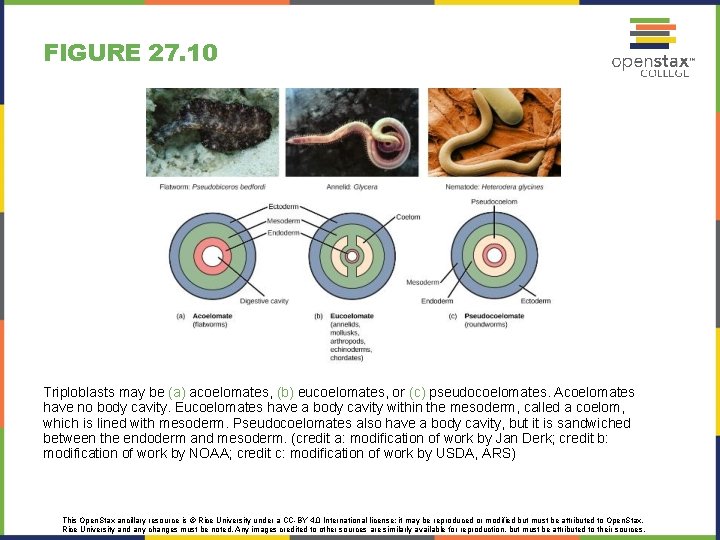
FIGURE 27. 10 Triploblasts may be (a) acoelomates, (b) eucoelomates, or (c) pseudocoelomates. Acoelomates have no body cavity. Eucoelomates have a body cavity within the mesoderm, called a coelom, which is lined with mesoderm. Pseudocoelomates also have a body cavity, but it is sandwiched between the endoderm and mesoderm. (credit a: modification of work by Jan Derk; credit b: modification of work by NOAA; credit c: modification of work by USDA, ARS) This Open. Stax ancillary resource is © Rice University under a CC-BY 4. 0 International license; it may be reproduced or modified but must be attributed to Open. Stax, Rice University and any changes must be noted. Any images credited to other sources are similarly available for reproduction, but must be attributed to their sources.
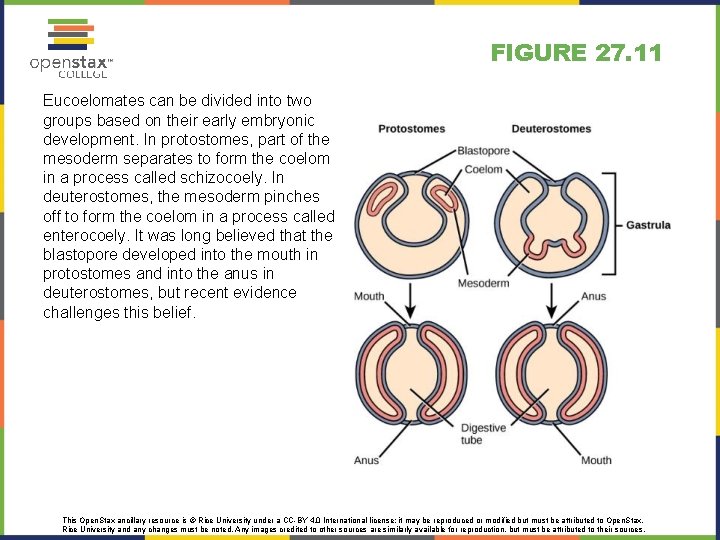
FIGURE 27. 11 Eucoelomates can be divided into two groups based on their early embryonic development. In protostomes, part of the mesoderm separates to form the coelom in a process called schizocoely. In deuterostomes, the mesoderm pinches off to form the coelom in a process called enterocoely. It was long believed that the blastopore developed into the mouth in protostomes and into the anus in deuterostomes, but recent evidence challenges this belief. This Open. Stax ancillary resource is © Rice University under a CC-BY 4. 0 International license; it may be reproduced or modified but must be attributed to Open. Stax, Rice University and any changes must be noted. Any images credited to other sources are similarly available for reproduction, but must be attributed to their sources.
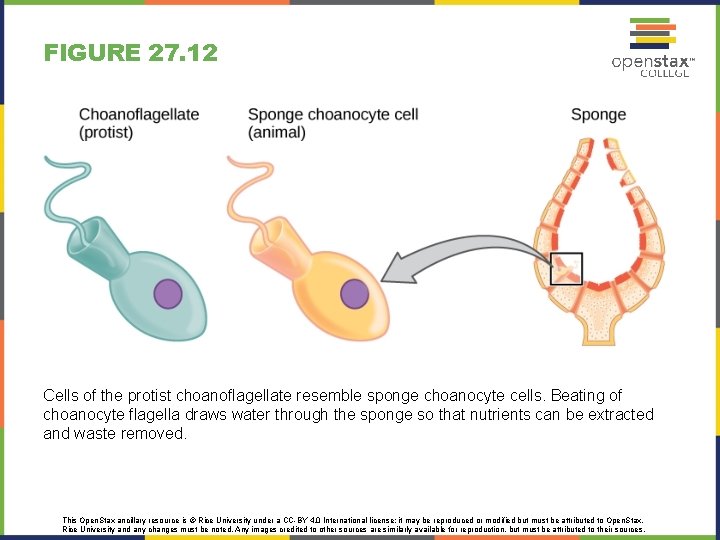
FIGURE 27. 12 Cells of the protist choanoflagellate resemble sponge choanocyte cells. Beating of choanocyte flagella draws water through the sponge so that nutrients can be extracted and waste removed. This Open. Stax ancillary resource is © Rice University under a CC-BY 4. 0 International license; it may be reproduced or modified but must be attributed to Open. Stax, Rice University and any changes must be noted. Any images credited to other sources are similarly available for reproduction, but must be attributed to their sources.
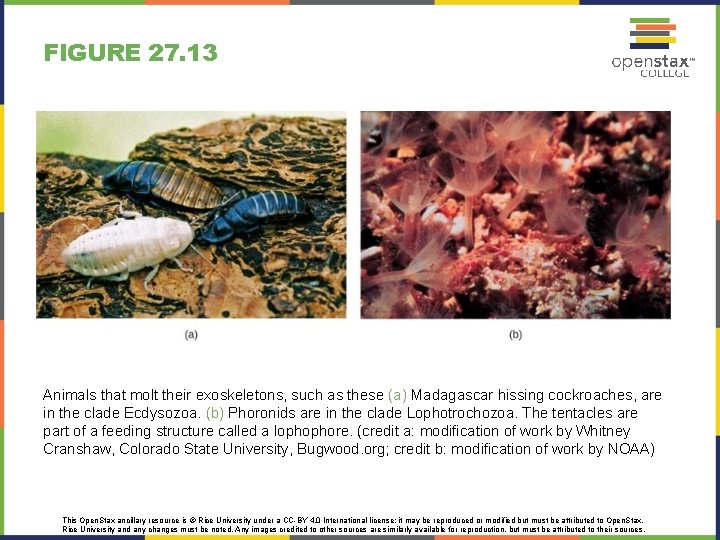
FIGURE 27. 13 Animals that molt their exoskeletons, such as these (a) Madagascar hissing cockroaches, are in the clade Ecdysozoa. (b) Phoronids are in the clade Lophotrochozoa. The tentacles are part of a feeding structure called a lophophore. (credit a: modification of work by Whitney Cranshaw, Colorado State University, Bugwood. org; credit b: modification of work by NOAA) This Open. Stax ancillary resource is © Rice University under a CC-BY 4. 0 International license; it may be reproduced or modified but must be attributed to Open. Stax, Rice University and any changes must be noted. Any images credited to other sources are similarly available for reproduction, but must be attributed to their sources.
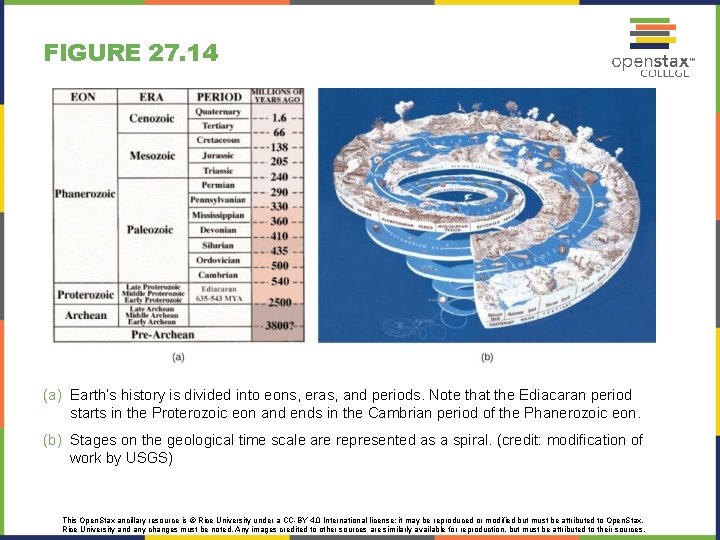
FIGURE 27. 14 (a) Earth’s history is divided into eons, eras, and periods. Note that the Ediacaran period starts in the Proterozoic eon and ends in the Cambrian period of the Phanerozoic eon. (b) Stages on the geological time scale are represented as a spiral. (credit: modification of work by USGS) This Open. Stax ancillary resource is © Rice University under a CC-BY 4. 0 International license; it may be reproduced or modified but must be attributed to Open. Stax, Rice University and any changes must be noted. Any images credited to other sources are similarly available for reproduction, but must be attributed to their sources.
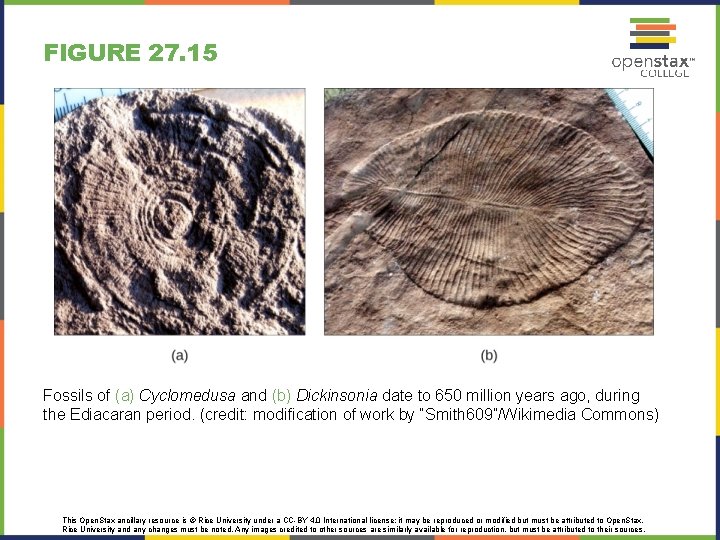
FIGURE 27. 15 Fossils of (a) Cyclomedusa and (b) Dickinsonia date to 650 million years ago, during the Ediacaran period. (credit: modification of work by “Smith 609”/Wikimedia Commons) This Open. Stax ancillary resource is © Rice University under a CC-BY 4. 0 International license; it may be reproduced or modified but must be attributed to Open. Stax, Rice University and any changes must be noted. Any images credited to other sources are similarly available for reproduction, but must be attributed to their sources.
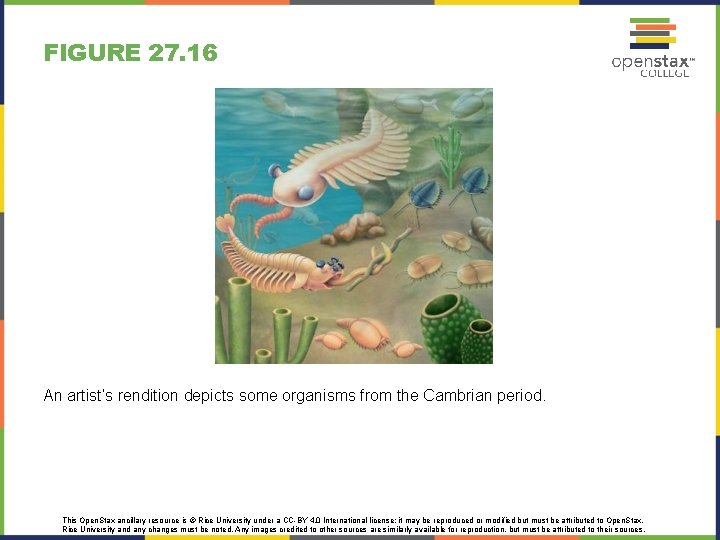
FIGURE 27. 16 An artist’s rendition depicts some organisms from the Cambrian period. This Open. Stax ancillary resource is © Rice University under a CC-BY 4. 0 International license; it may be reproduced or modified but must be attributed to Open. Stax, Rice University and any changes must be noted. Any images credited to other sources are similarly available for reproduction, but must be attributed to their sources.
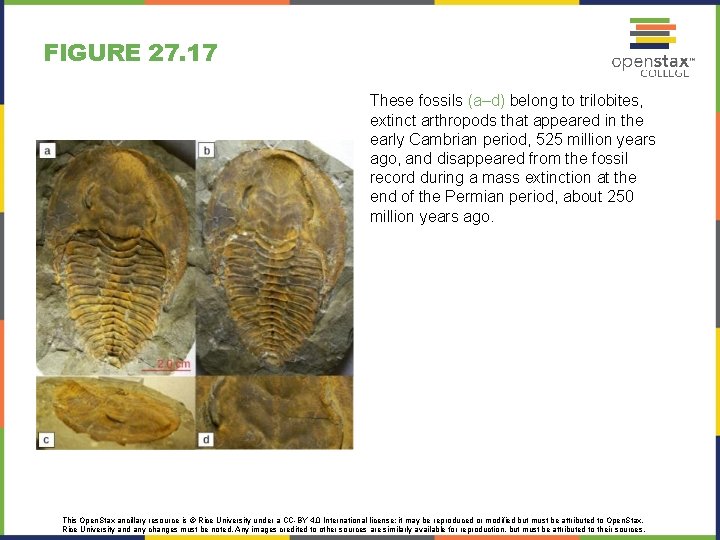
FIGURE 27. 17 These fossils (a–d) belong to trilobites, extinct arthropods that appeared in the early Cambrian period, 525 million years ago, and disappeared from the fossil record during a mass extinction at the end of the Permian period, about 250 million years ago. This Open. Stax ancillary resource is © Rice University under a CC-BY 4. 0 International license; it may be reproduced or modified but must be attributed to Open. Stax, Rice University and any changes must be noted. Any images credited to other sources are similarly available for reproduction, but must be attributed to their sources.
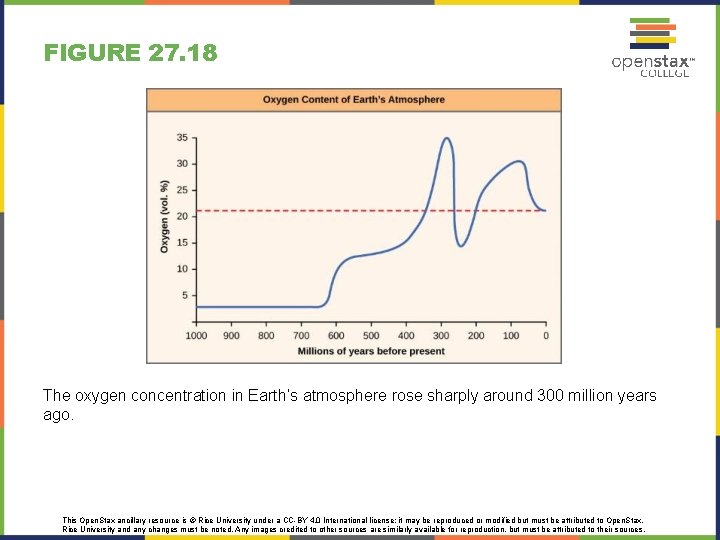
FIGURE 27. 18 The oxygen concentration in Earth’s atmosphere rose sharply around 300 million years ago. This Open. Stax ancillary resource is © Rice University under a CC-BY 4. 0 International license; it may be reproduced or modified but must be attributed to Open. Stax, Rice University and any changes must be noted. Any images credited to other sources are similarly available for reproduction, but must be attributed to their sources.
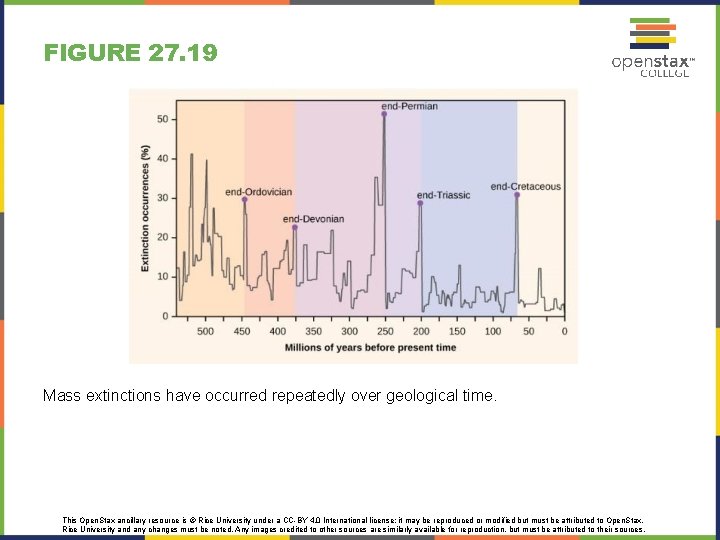
FIGURE 27. 19 Mass extinctions have occurred repeatedly over geological time. This Open. Stax ancillary resource is © Rice University under a CC-BY 4. 0 International license; it may be reproduced or modified but must be attributed to Open. Stax, Rice University and any changes must be noted. Any images credited to other sources are similarly available for reproduction, but must be attributed to their sources.
- Slides: 20