
Biology Chapter 2 Tools of the Trade Observations
Biology Chapter 2 Tools of the Trade

Observations in Biology Because we are often concerned with observing how things work, and often how cells work, a microscope is a commonly used tool in biology. A light microscope uses convex lenses to magnify an image. An electron microscope uses a beam of electrons to take an image of an object.
Light Microscopes The first compound light microscope was made in 1595 by Zacharias (or maybe his father Hans) Janssen in Holland. It magnified 3 x to 9 x. Robert Hooke improved how microscopes work, and in 1660, after looking at plant bark, coined the word 'cell' for the little units there. Anton van Leeuwenhoek used a simple (one lens) but very good microscope to describe little organisms he saw in pond water in the late 1600 s.
Observation methods See http: //nobelprize. org/educational_games/physic s/microscopes/powerline/index. html

Resolution Resolving power is the ability to tell that two things very close together are two things (that they are separate objects). Generally, the more you try to magnify, the less resolution you have. Another example of the resolving power of various instruments: http: //www. ncbi. nlm. nih. gov/books/bv. fcgi? rid= mboc 4. figgrp. 1717
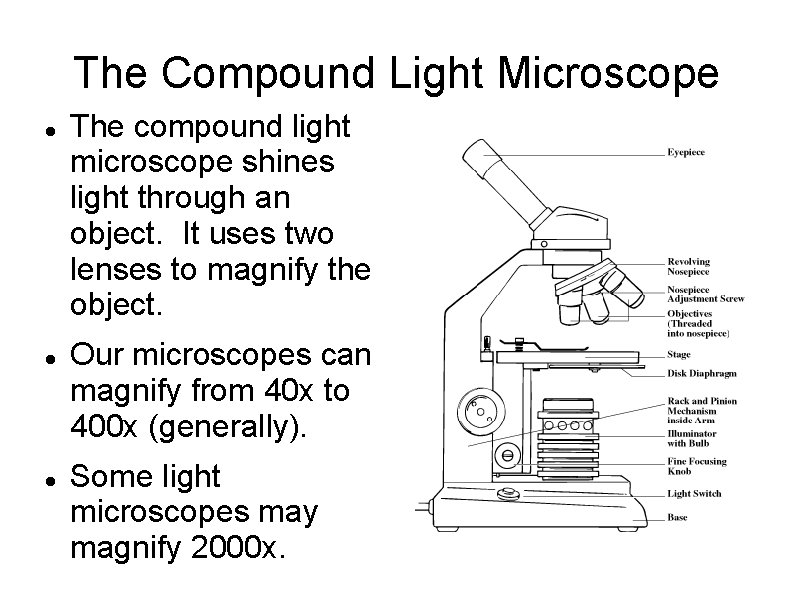
The Compound Light Microscope The compound light microscope shines light through an object. It uses two lenses to magnify the object. Our microscopes can magnify from 40 x to 400 x (generally). Some light microscopes may magnify 2000 x.
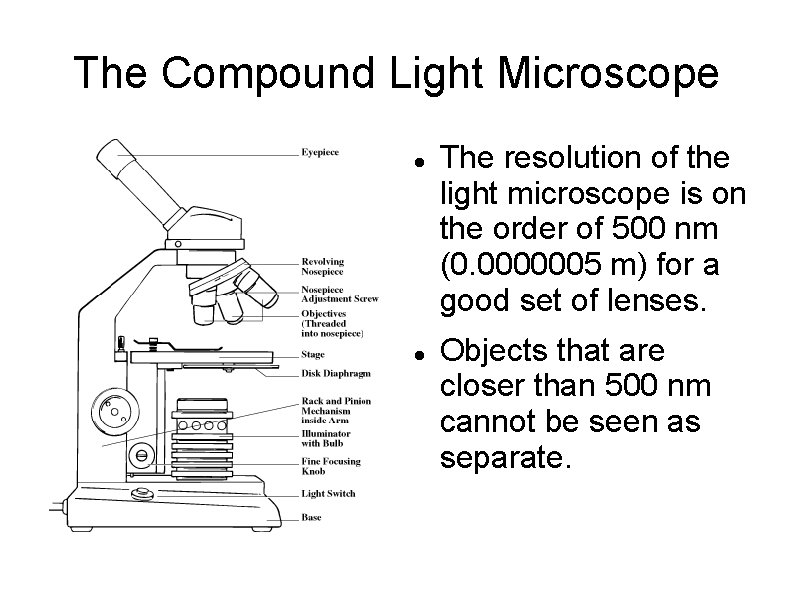
The Compound Light Microscope The resolution of the light microscope is on the order of 500 nm (0. 0000005 m) for a good set of lenses. Objects that are closer than 500 nm cannot be seen as separate.
Magnification depends on the lenses you use. The microscope has an eyepiece lens, which is usually 10 x, and three other objective lenses (4 x, 10 x and 40 x usually). Total magnification is the eyepiece x the objective lens power. An excellent web page: http: //www. southwestschools. org/jsfaculty/Micro scopes/Magnification. html
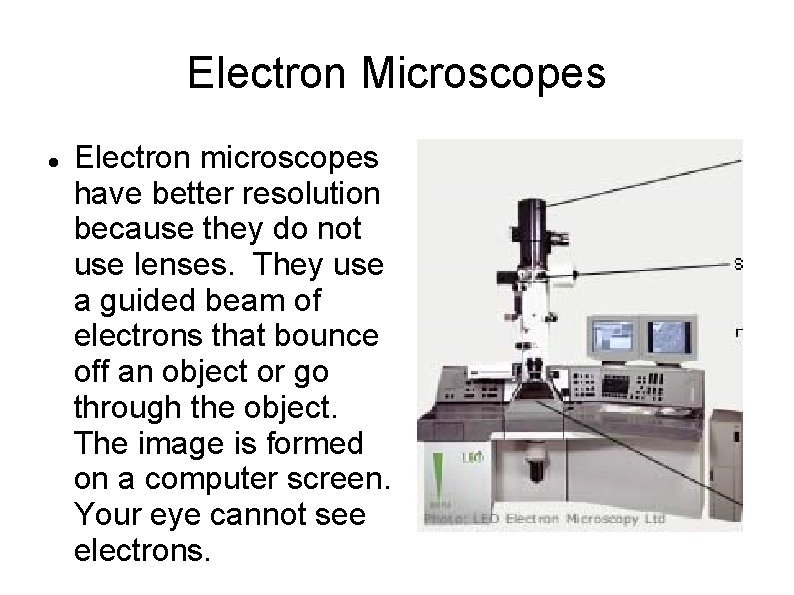
Electron Microscopes Electron microscopes have better resolution because they do not use lenses. They use a guided beam of electrons that bounce off an object or go through the object. The image is formed on a computer screen. Your eye cannot see electrons.
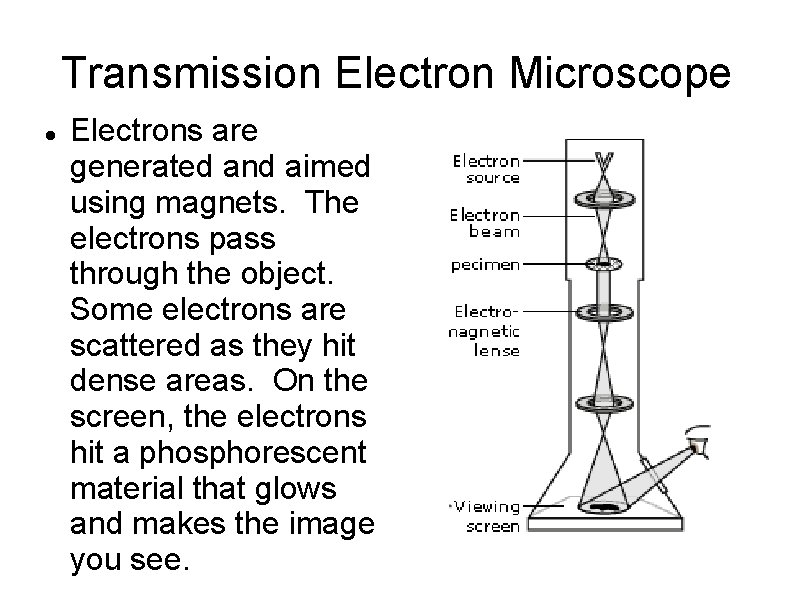
Transmission Electron Microscope Electrons are generated and aimed using magnets. The electrons pass through the object. Some electrons are scattered as they hit dense areas. On the screen, the electrons hit a phosphorescent material that glows and makes the image you see.
Transmission Electron Microscope The object that the electrons are passed through must be very thin. Often biological samples are embedded in plastic, then sliced very thin to use as samples. Other objects may be frozen, then sliced.
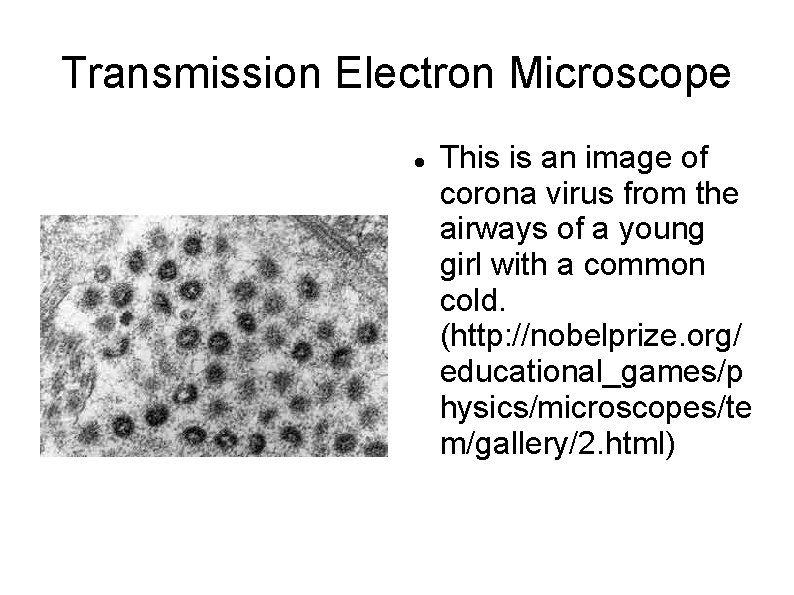
Transmission Electron Microscope This is an image of corona virus from the airways of a young girl with a common cold. (http: //nobelprize. org/ educational_games/p hysics/microscopes/te m/gallery/2. html)
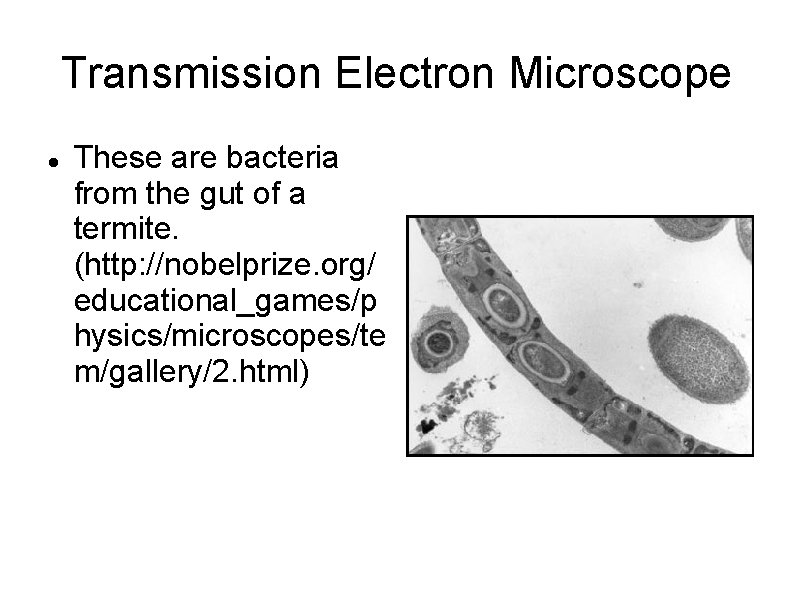
Transmission Electron Microscope These are bacteria from the gut of a termite. (http: //nobelprize. org/ educational_games/p hysics/microscopes/te m/gallery/2. html)
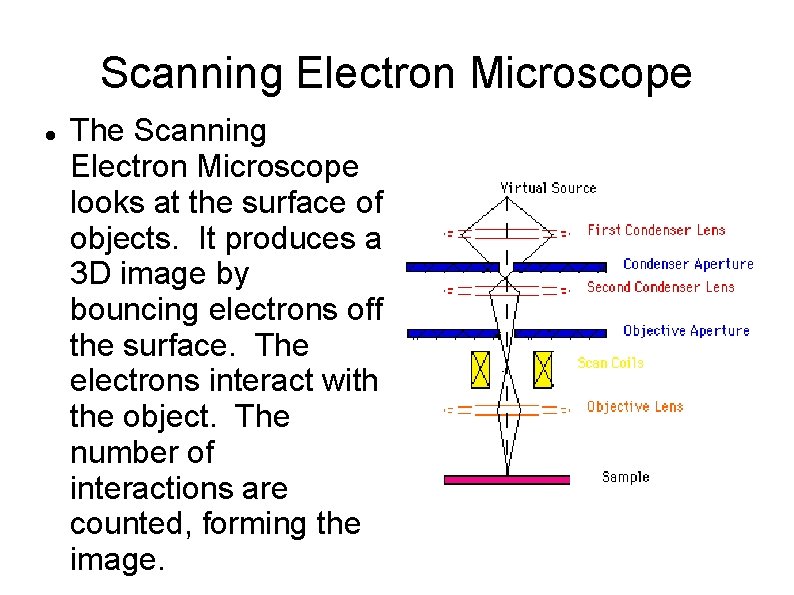
Scanning Electron Microscope The Scanning Electron Microscope looks at the surface of objects. It produces a 3 D image by bouncing electrons off the surface. The electrons interact with the object. The number of interactions are counted, forming the image.
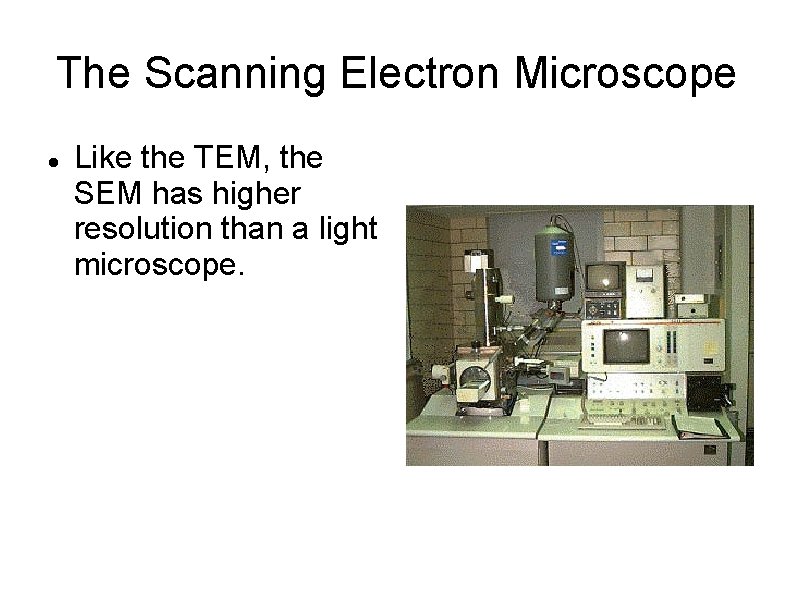
The Scanning Electron Microscope Like the TEM, the SEM has higher resolution than a light microscope.
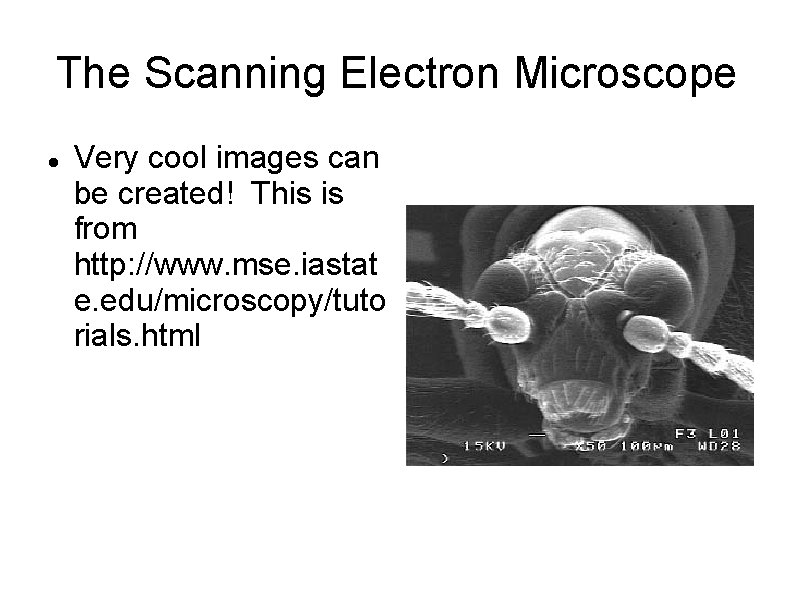
The Scanning Electron Microscope Very cool images can be created! This is from http: //www. mse. iastat e. edu/microscopy/tuto rials. html
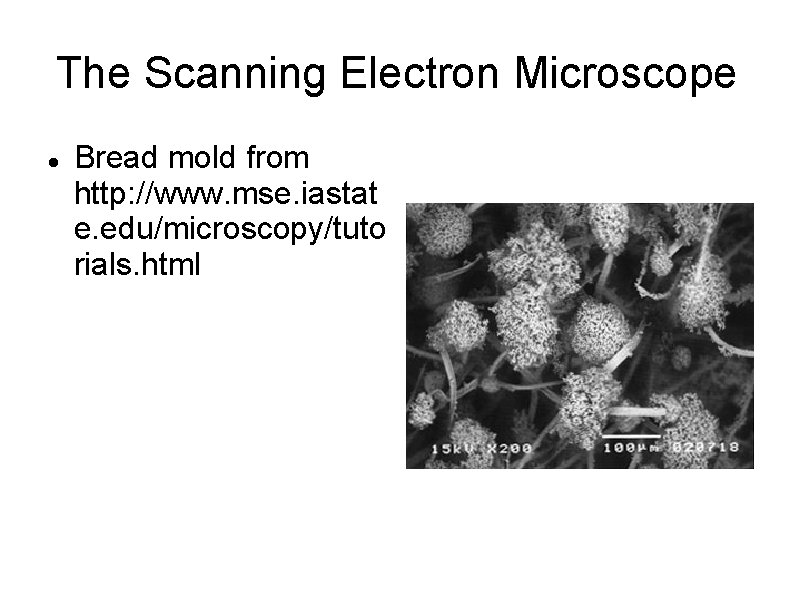
The Scanning Electron Microscope Bread mold from http: //www. mse. iastat e. edu/microscopy/tuto rials. html
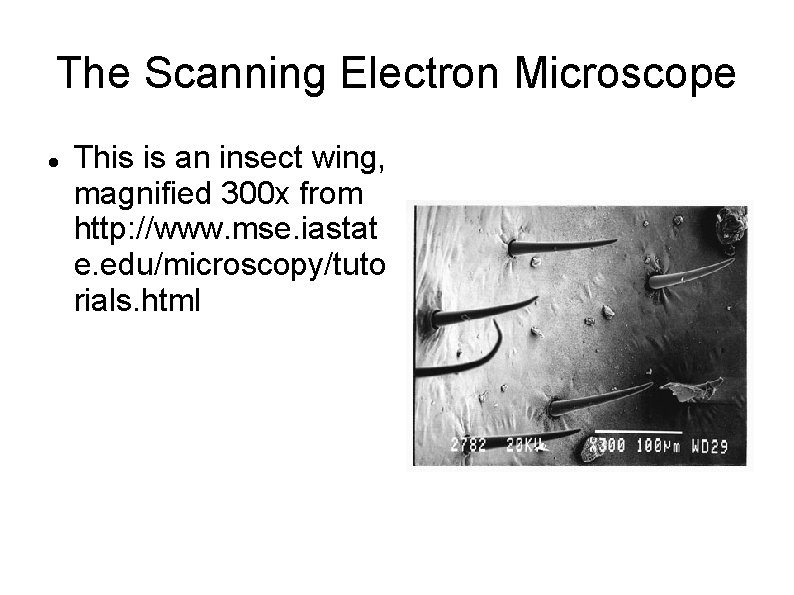
The Scanning Electron Microscope This is an insect wing, magnified 300 x from http: //www. mse. iastat e. edu/microscopy/tuto rials. html
Tools No matter which tool we use, we make observations in the form of both qualitative (non -numerical) and quantitative (measured numbers) data. The system we use in measurement is the metric system (SI).
- Slides: 19