
Biology Chapter 12 4 l What is a
Biology Chapter 12. 4
l What is a mutation? l A change (mistake) in the replication of genetic material. l The daughter cell is different from the parent

Gene Mutation l Most replication errors are corrected by the cell’s built in spell check system. l However, some do escape detection
Gene Mutation l Deletion – Leaving out one nucleotide in the sequence, shifts the reading of the sequence to the left, creating a totally different set of amino acids
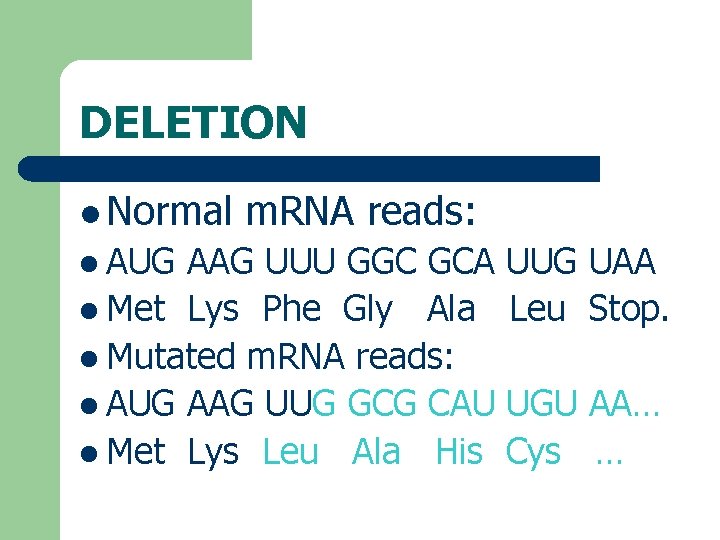
DELETION l Normal l AUG m. RNA reads: AAG UUU GGC GCA UUG l Met Lys Phe Gly Ala Leu l Mutated m. RNA reads: l AUG AAG UUG GCG CAU UGU l Met Lys Leu Ala His Cys UAA Stop. AA… …
Gene Mutation l Insertion – Mutation in which an extra nucleotide is added to the chain during replication, shifts reading to the right, creating a totally different set of amino acids
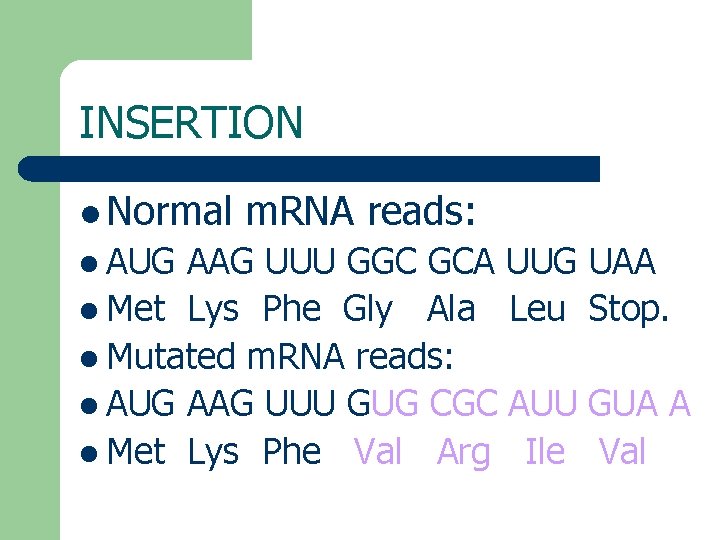
INSERTION l Normal l AUG m. RNA reads: AAG UUU GGC GCA UUG l Met Lys Phe Gly Ala Leu l Mutated m. RNA reads: l AUG AAG UUU GUG CGC AUU l Met Lys Phe Val Arg Ile UAA Stop. GUA A Val
Gene Mutation l Point Mutation – A base substitution occurs. One nucleotide is replaced with a different one
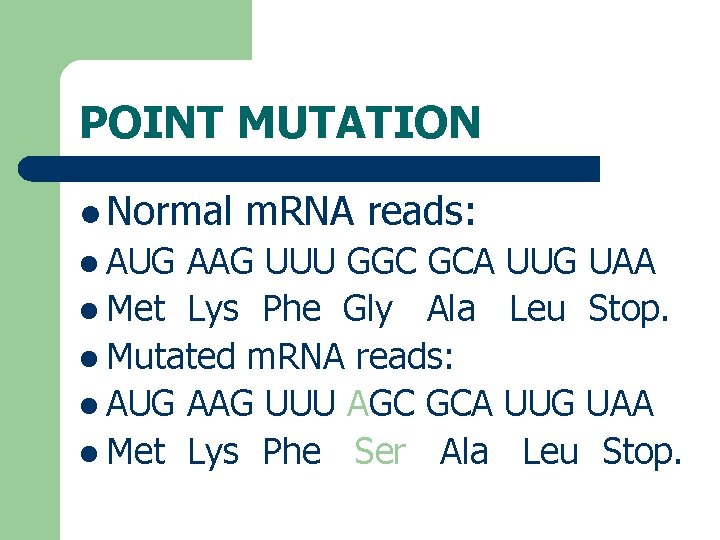
POINT MUTATION l Normal l AUG m. RNA reads: AAG UUU GGC GCA UUG UAA l Met Lys Phe Gly Ala Leu Stop. l Mutated m. RNA reads: l AUG AAG UUU AGC GCA UUG UAA l Met Lys Phe Ser Ala Leu Stop.
Gene Mutation l These mutations arise spontaneously during DNA replication. l External agents may cause mutations, called mutagens.
Chromosome Mutations l Changes may occur in chromosomes as well as in genes. l Chromosome mutations can have serious effects on the distribution of genes to gametes during meiosis.
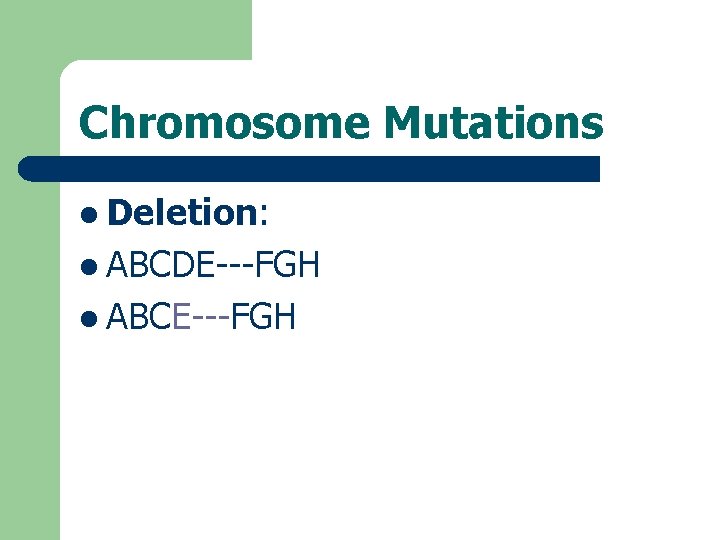
Chromosome Mutations l Deletion: l ABCDE---FGH l ABCE---FGH
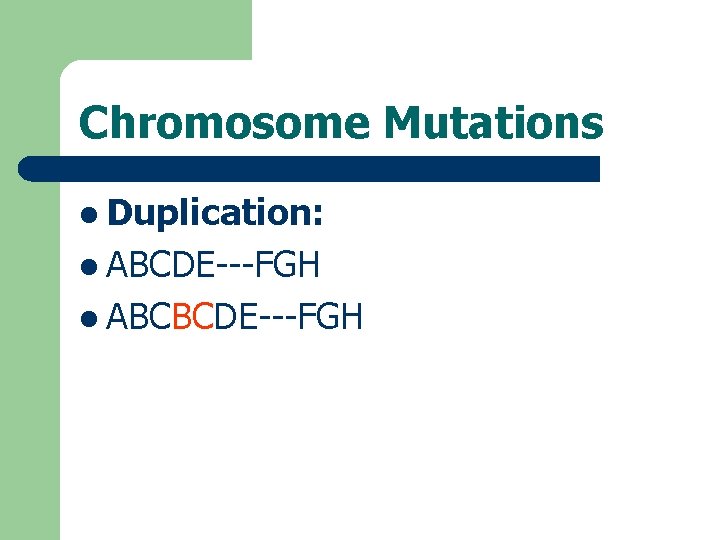
Chromosome Mutations l Duplication: l ABCDE---FGH l ABCBCDE---FGH
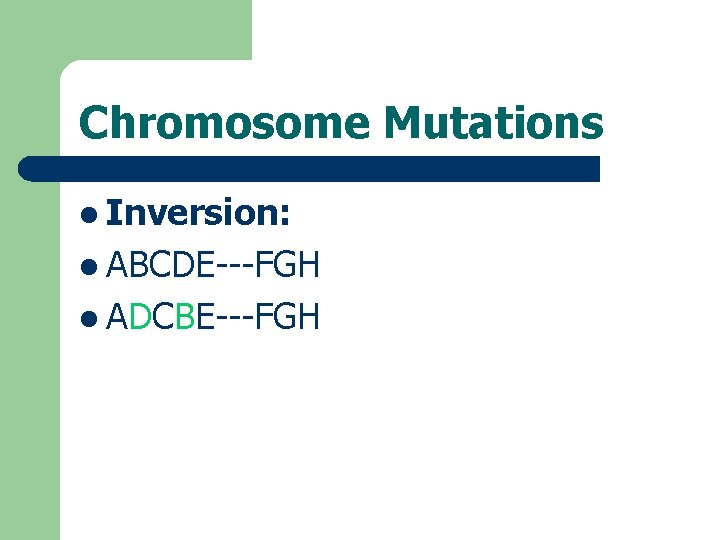
Chromosome Mutations l Inversion: l ABCDE---FGH l ADCBE---FGH
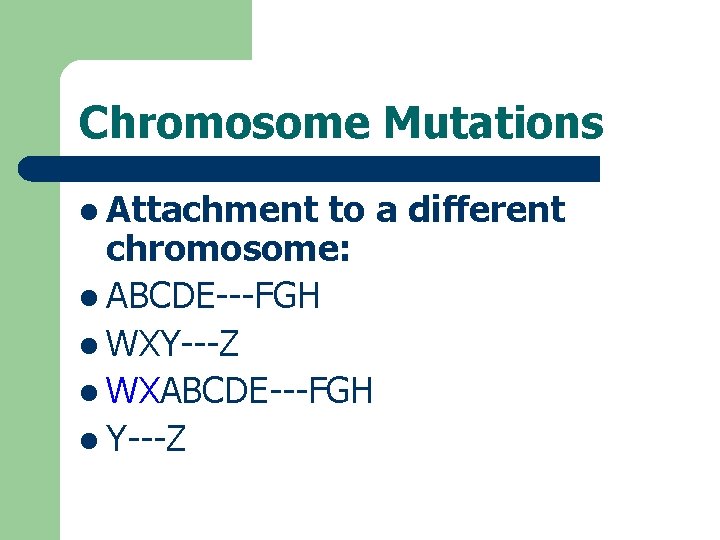
Chromosome Mutations l Attachment to a different chromosome: l ABCDE---FGH l WXY---Z l WXABCDE---FGH l Y---Z
Other causes of genetic variation During meiosis, homologous pairs fail to separate. l This would cause the offspring to have an extra chromosome. l During meiosis, part of one chromatid breaks of and joins to the other (see pg 264. ) l
CANCER Abnormal cells, go through cell cycle very fast, creating new cells like it. l They reproduce in an uncontrolled way, crowding out healthy cells and destroying tissues and possibly organs. l It can spread to other parts of the body l
Causes of Cancer Genes that control the cell cycle mutate, called an oncogene. l Mutations may be inherited or caused by a carcinogen, a cancer causing agent in the environment. l Tobacco smoke, radiation and other chemicals. l
Causes of Cancer l Viruses may also cause cancer. l Their presence disrupts normal cell processes. l They can also carry oncogenes into the host cell.
Technology Scientists can transfer a gene artificially from a donor organism to a bacteria. l The DNA of the bacterium is called recombinant DNA. l The bacteria will transcribe and translate the foreign gene and produce the protein it is coding for. l
Technology l Small, circular pieces of DNA, called plasmids, are where the foreign DNA is placed.
Technology l To obtain a foreign gene, m. RNA from a cell is isolated and DNA is produced (called reverse transcription). This single stranded DNA is converted to a double strand this double strand is the desired gene.
Technology l In use today – goats that produce a human blood clot dissolving factor. l Plants that are disease resistant. l Plants that are larger than normal.
- Slides: 23