
Biology Chapter 1 The Nature of Science 81814
Biology Chapter 1: The Nature of Science 8/18/14 Chap 1 ES Nature of Science 1 1/5/2022
Objectives 1. List the steps used in a scientific method. This means I can: • Define, identify, and compare & contrast the following: observation (both qualitative & quantitative), inference hypothesis, independent variable, constant, data, conclusion, controlled experiment, control group, experimental group. 3. Identify basic SI units for mass, weight, length, volume, density, temperature, time. 4. Convert between SI units; example I can convert from kg to mg…. 5. Differentiate between a scientific theory & a scientific law, and between science & technology. In addition, I can identify a given example as science vs. technology. Chap 1 ES Nature of Science 1/5/2022 2

Science vs. Technology 1. Science: Study & investigation of natural world, to gain knowledge & to explain/understand 2. Technology: Application (USE) of science to help (or harm) Chap 1 ES Nature of Science 1/5/2022 http: //netsains. net/wp- 3
Observation vs. Inference What’s the difference? Observation: 1. Using one of the 5 senses to make understand the world around you. Sight, touch, hearing, smell, taste (NOT in science class!) B. FACTS!!! Example: There is one TV in the room. A. 2. Types of observations: A. Qualitative: Description based on observations or “relative” comparison; color, “larger”, felt “warmer” B. Quantitative: Measured & numerical; 23 grams, 37 o. C 3. Recorded as DATA in an experiment. A. Data = RECORDED DATA Chap 1 ES Nature of Science 1/5/2022 4
Inference 1. 2. 3. 4. 5. 6. Logical interpretation/explanation. Using reasoning to make sense of what you are observing BASED on observations Example: You entered the classroom and a new adult was by my desk. You might infer that I am sick or that the person is a substitute teacher. Clues You Are Making an Inference; I think. . , Like…, Because… Used in writing the CONCLUSION of a lab report.
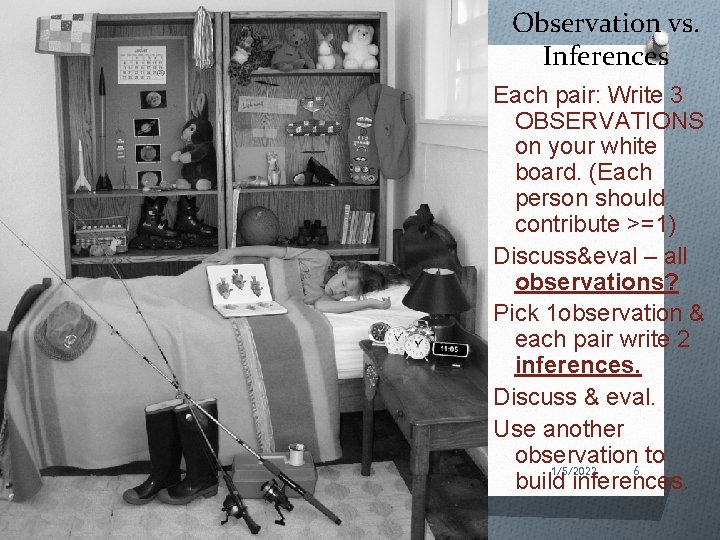
Observation vs. Inferences Chap 1 ES Nature of Science Each pair: Write 3 OBSERVATIONS on your white board. (Each person should contribute >=1) Discuss&eval – all observations? Pick 1 observation & each pair write 2 inferences. Discuss & eval. Use another observation to 1/5/2022 6 build inferences.
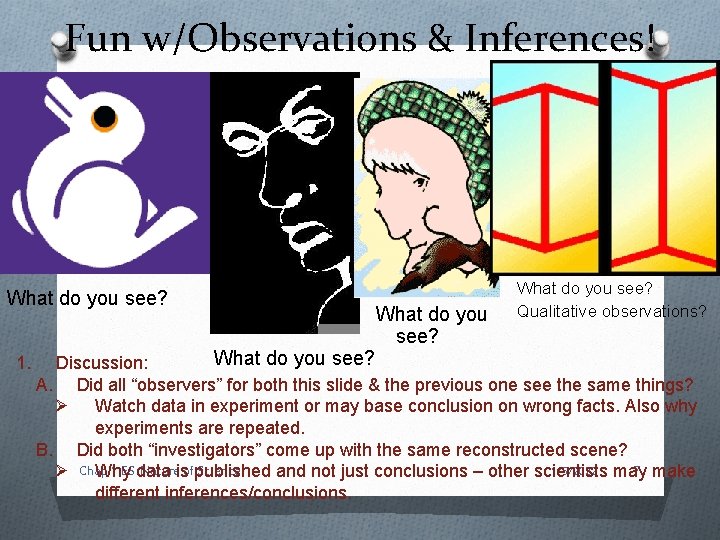
Fun w/Observations & Inferences! What do you see? 1. What do you see? Qualitative observations? What do you see? Discussion: A. Did all “observers” for both this slide & the previous one see the same things? Ø Watch data in experiment or may base conclusion on wrong facts. Also why experiments are repeated. B. Did both “investigators” come up with the same reconstructed scene? 1/5/2022 may 1 ES data Natureisofpublished Science 7 make Ø Chap Why and not just conclusions – other scientists different inferences/conclusions.
1. 2 Methods of Scientists Chap 1 ES Nature of Science 8 1/5/2022
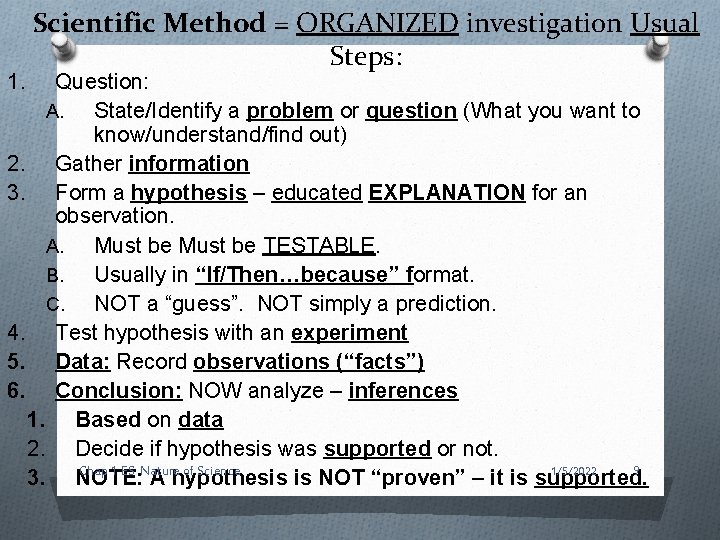
1. Scientific Method = ORGANIZED investigation Usual Steps: Question: A. State/Identify a problem or question (What you want to know/understand/find out) 2. Gather information 3. Form a hypothesis – educated EXPLANATION for an observation. A. Must be TESTABLE. B. Usually in “If/Then…because” format. C. NOT a “guess”. NOT simply a prediction. 4. Test hypothesis with an experiment 5. Data: Record observations (“facts”) 6. Conclusion: NOW analyze – inferences 1. Based on data 2. Decide if hypothesis was supported or not. 1/5/2022 Chap 1 ES Nature of Science 9 3. NOTE: A hypothesis is NOT “proven” – it is supported.
Experiment Requirements 1. Variable: A quantity that can vary & can affect the experiment outcome A. Independent variable: i. What scientist INTENTIONALLY changes. ii. Must have only ONE independent variable. iii. It is what you are “testing”. Usually the “if” part of hypothesis. B. Dependent variable: Measured outcome; the outcome “depends” on what the independent variable causes. It is usually the “then” part of the hypothesis. C. Constants: All other variables are kept the same for each test. Chap 1 ES Nature of Science 1/5/2022 10
Controlled Experiment: Experiment that contains 2 set-ups, with ONLY ONE factor/variable different between the set-ups. 1. 2. Control Group: Standard to compare to. May be the “normal” condition w/o the independent variable. A. Used for comparison to the experimental group. B. Helps determine the effect of the independent variable in the experimental group. Experimental Group: The group containing the independent variable – what you are testing. Chap 1 ES Nature of Science 1/5/2022 11
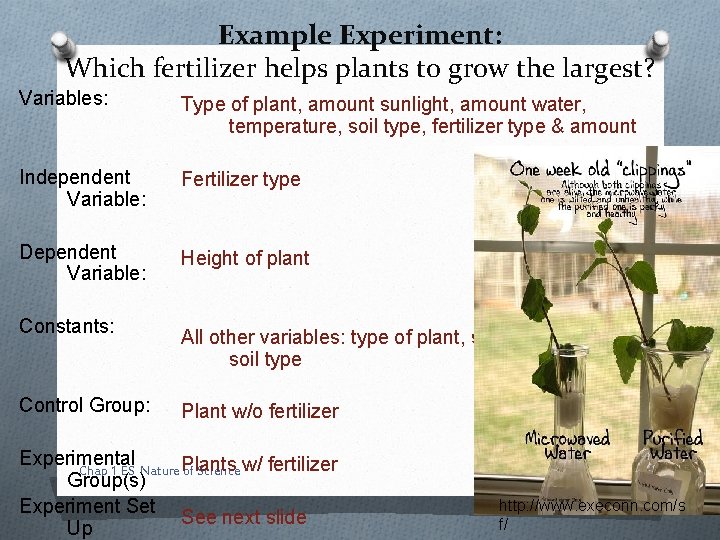
Example Experiment: Which fertilizer helps plants to grow the largest? Variables: Type of plant, amount sunlight, amount water, temperature, soil type, fertilizer type & amount Independent Variable: Fertilizer type Dependent Variable: Height of plant Constants: Control Group: All other variables: type of plant, sunlight, water, temp, soil type Plant w/o fertilizer Experimental Chap 1 ES Nature Plants of Science w/ fertilizer Group(s) Experiment See next slide Up 1/5/2022 12 http: //www. execonn. com/s f/
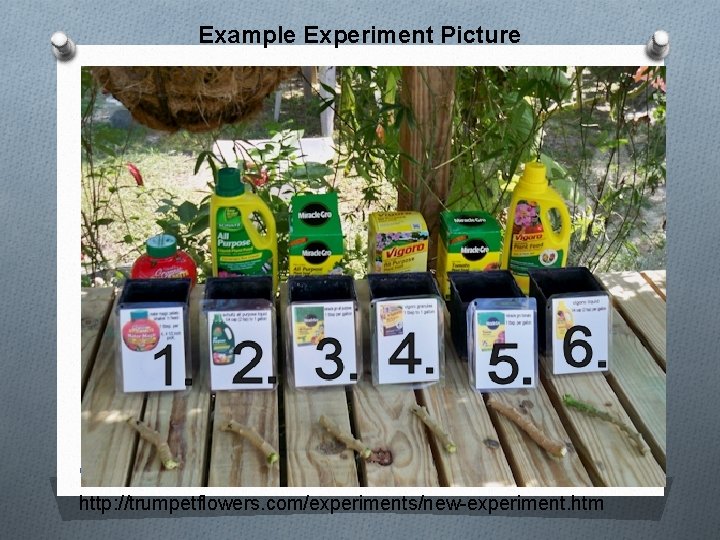
Example Experiment Picture Chap 1 ES Nature of Science 1/5/2022 http: //trumpetflowers. com/experiments/new-experiment. htm 13
Example Experiment (cont): Which fertilizer helps plants to grow the largest? Experiment Set Up 1. Same size pots: same soil & 1 marigold seed 2. Control: No fertilizer. Other pots, different fertilizer. 3. Same water, location, sunlight, temp, humidity, bugs, etc. 4. Daily record height in cm Chap 1 ES Nature of Science 1/5/2022 14
I Have My Data (Recorded Observations) & Conclusion, Now What? 1. Report Those Findings!! A. Very Important Step 2. Why? A. Credit – so YOU get the credit & not someone else B. Peers Check Work C. Repeat Experiments D. Build Off Your Work
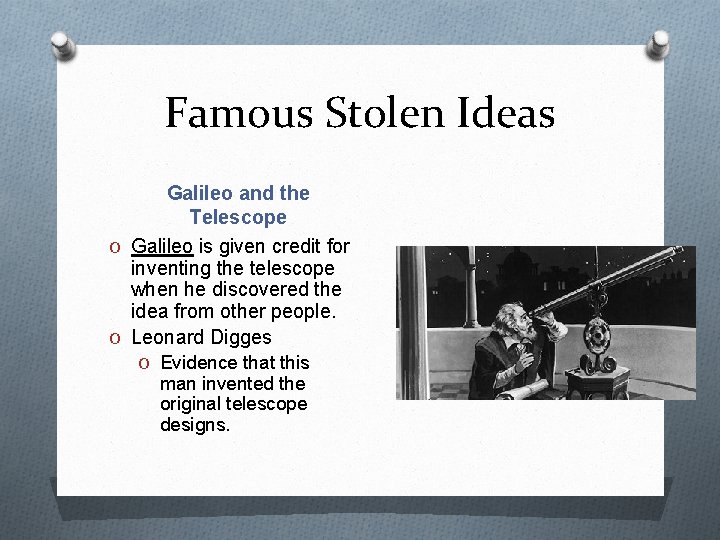
Famous Stolen Ideas Galileo and the Telescope O Galileo is given credit for inventing the telescope when he discovered the idea from other people. O Leonard Digges O Evidence that this man invented the original telescope designs.
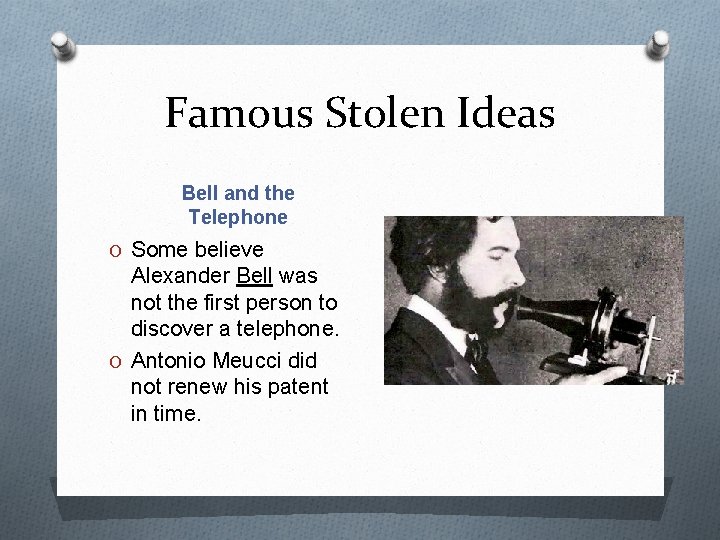
Famous Stolen Ideas Bell and the Telephone O Some believe Alexander Bell was not the first person to discover a telephone. O Antonio Meucci did not renew his patent in time.
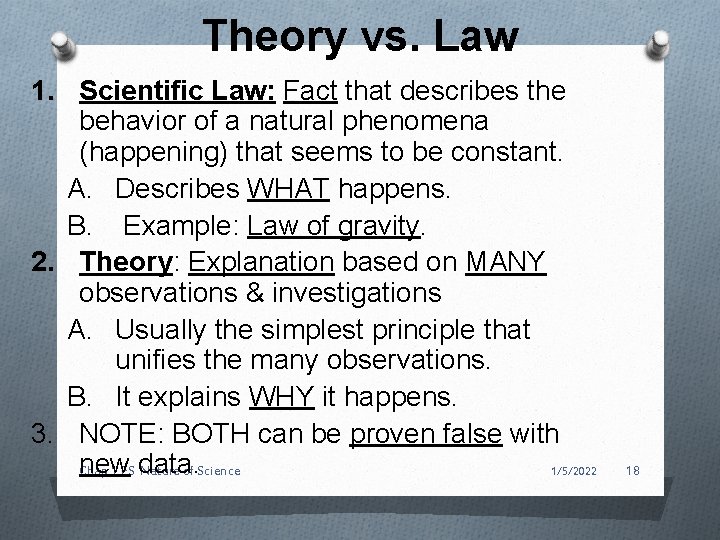
Theory vs. Law 1. Scientific Law: Fact that describes the behavior of a natural phenomena (happening) that seems to be constant. A. Describes WHAT happens. B. Example: Law of gravity. 2. Theory: Explanation based on MANY observations & investigations A. Usually the simplest principle that unifies the many observations. B. It explains WHY it happens. 3. NOTE: BOTH can be proven false with new 1/5/2022 Chap 1 ES data. Nature of Science 18
- Slides: 18