
Biology Chapter 1 Section 1 The Nature of
Biology Chapter 1 Section 1: The Nature of Science https: //www. youtube. com/watch? v =7 L 7 x 0 BAq. Wis Chap 1 Biology Nature of Science 12/17/2021 1
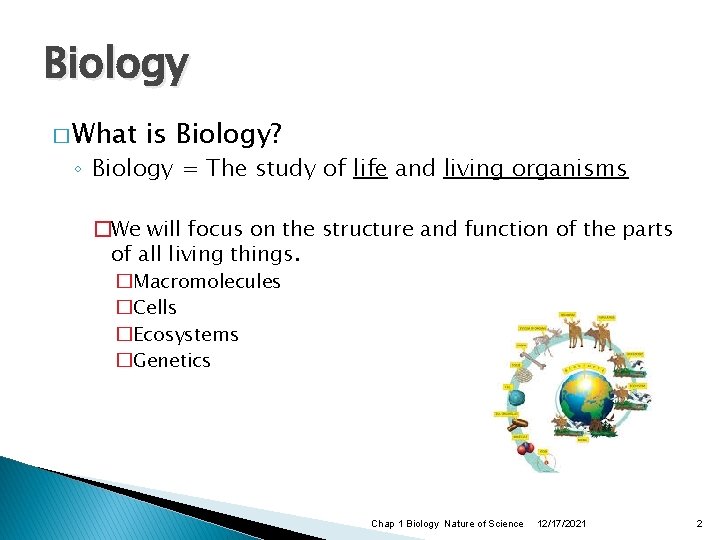
Biology � What is Biology? ◦ Biology = The study of life and living organisms �We will focus on the structure and function of the parts of all living things. �Macromolecules �Cells �Ecosystems �Genetics Chap 1 Biology Nature of Science 12/17/2021 2
Observation vs. Inference What’s the difference? Observation: 1. Using one of the 5 senses to make understand the world around you. A. Sight, touch, hearing, smell, taste (NOT in science class!) B. FACTS!!! Example: There is one TV in the room. 2. Recorded as DATA in an experiment. Data = RECORDED Observations Chap 1 Biology Nature of Science 12/17/2021 3
Inference: Logical interpretation/explanation. 1. Using reasoning to make sense of what you are observing 2. BASED on observations 1. Example: You entered the classroom and a new adult was by my desk. You might infer that I am sick or that the person is a substitute teacher. 3. Clues You Are Making an Inference; I think. . , Like…, Because… 4. Used in writing the CONCLUSION of a lab report. Chap 1 Biology Nature of Science 12/17/2021 4
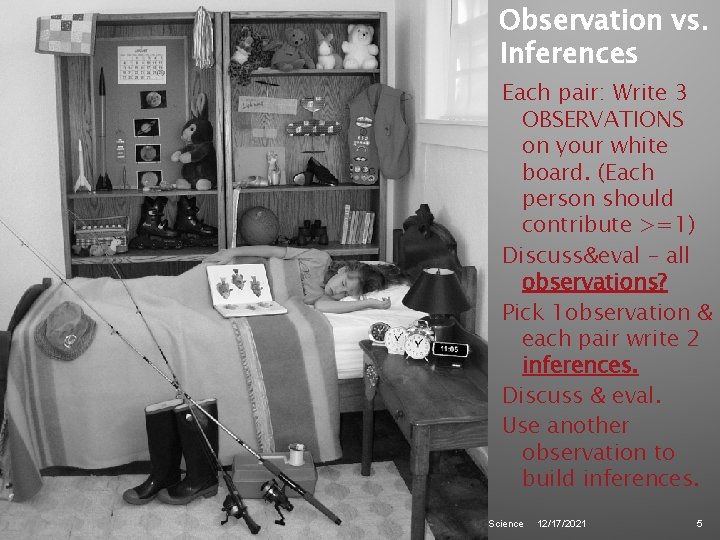
Observation vs. Inferences Each pair: Write 3 OBSERVATIONS on your white board. (Each person should contribute >=1) Discuss&eval – all observations? Pick 1 observation & each pair write 2 inferences. Discuss & eval. Use another observation to build inferences. Chap 1 Biology Nature of Science 12/17/2021 5
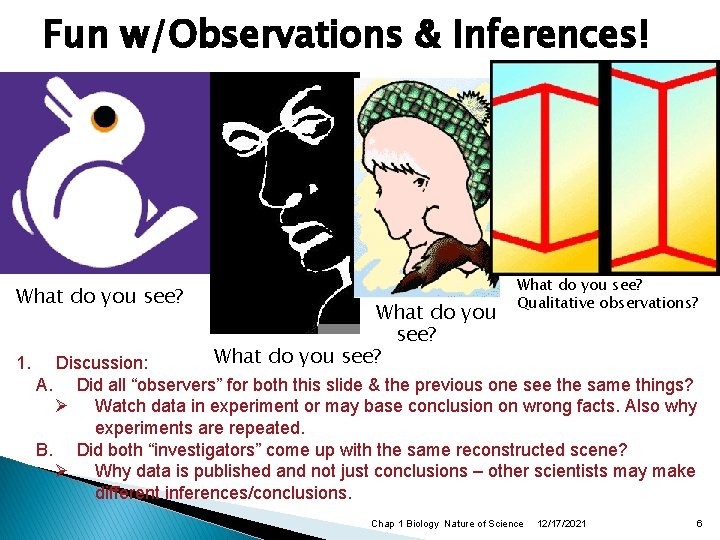
Fun w/Observations & Inferences! What do you see? 1. What do you see? Qualitative observations? Discussion: A. Did all “observers” for both this slide & the previous one see the same things? Ø Watch data in experiment or may base conclusion on wrong facts. Also why experiments are repeated. B. Did both “investigators” come up with the same reconstructed scene? Ø Why data is published and not just conclusions – other scientists may make different inferences/conclusions. Chap 1 Biology Nature of Science 12/17/2021 6
Scientific Process: = ORGANIZED investigation Usual Steps: 1. Question: A. State/Identify a problem or question (What you want to know/understand/find out) 2. Gather information 3. Form a hypothesis – educated EXPLANATION for an observation. A. Must be TESTABLE and Falsifiable. B. Usually in “If/Then…because” format. C. NOT a “guess”. NOT simply a prediction. Chap 1 Biology Nature of Science 12/17/2021 7

Scientific Process 4. Test hypothesis with an experiment 5. Data: Record observations (“facts”) 6. Conclusion: NOW analyze – inferences 1. Based on data 2. Decide if hypothesis was supported or not. 3. NOTE: A hypothesis is NOT “proven” – it is supported. � This is a process that changes and doesn’t have to occur in order. ◦ You can skip steps Chap 1 Biology Nature of Science 12/17/2021 8
Experiment Requirements 1. Variable: A quantity that can vary & can affect the experiment outcome A. Independent variable: i. What scientist INTENTIONALLY changes. ii. Must have only ONE independent variable. iii. It is what you are “testing”. Usually the “if” part of hypothesis. Chap 1 Biology Nature of Science 12/17/2021 9
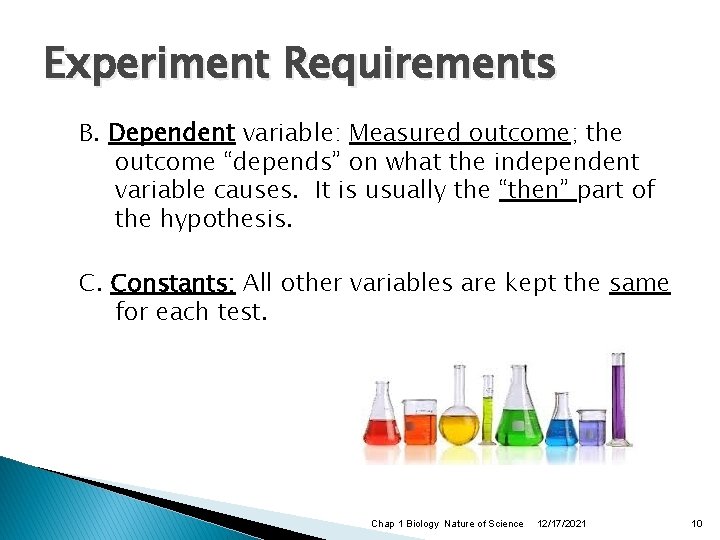
Experiment Requirements B. Dependent variable: Measured outcome; the outcome “depends” on what the independent variable causes. It is usually the “then” part of the hypothesis. C. Constants: All other variables are kept the same for each test. Chap 1 Biology Nature of Science 12/17/2021 10
Controlled Experiment: Experiment that contains 2 set-ups, with ONLY ONE factor/variable different between the set -ups. 1. 2. Control Group: Standard to compare to. May be the “normal” condition w/o the independent variable. A. Used for comparison to the experimental group. B. Helps determine the effect of the independent variable in the experimental group. Experimental Group: The group containing the independent variable – what you are testing. Chap 1 Biology Nature of Science 12/17/2021 11

Example Experiment: Which fertilizer helps plants to grow the largest? Variables: Type of plant, amount sunlight, amount water, temperature, soil type, fertilizer type & amount Independent Variable: Fertilizer type Dependent Variable: Height of plant Constants: All other variables: type of plant, sunlight, water, temp, soil type Control Group: Plant w/o fertilizer Experimental Group(s) Experiment Set Up Plants w/ fertilizer See next slide Chap 1 Biology http: //www. execonn. com/s Nature of Science 12/17/2021 f/ 12
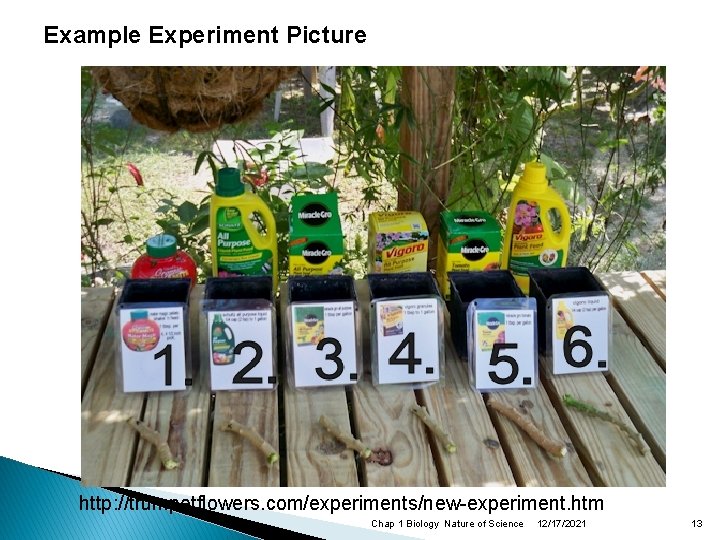
Example Experiment Picture http: //trumpetflowers. com/experiments/new-experiment. htm Chap 1 Biology Nature of Science 12/17/2021 13
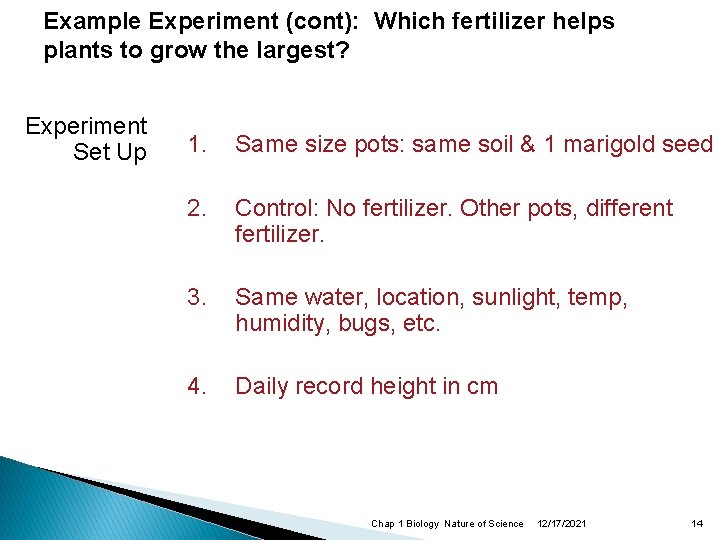
Example Experiment (cont): Which fertilizer helps plants to grow the largest? Experiment Set Up 1. Same size pots: same soil & 1 marigold seed 2. Control: No fertilizer. Other pots, different fertilizer. 3. Same water, location, sunlight, temp, humidity, bugs, etc. 4. Daily record height in cm Chap 1 Biology Nature of Science 12/17/2021 14
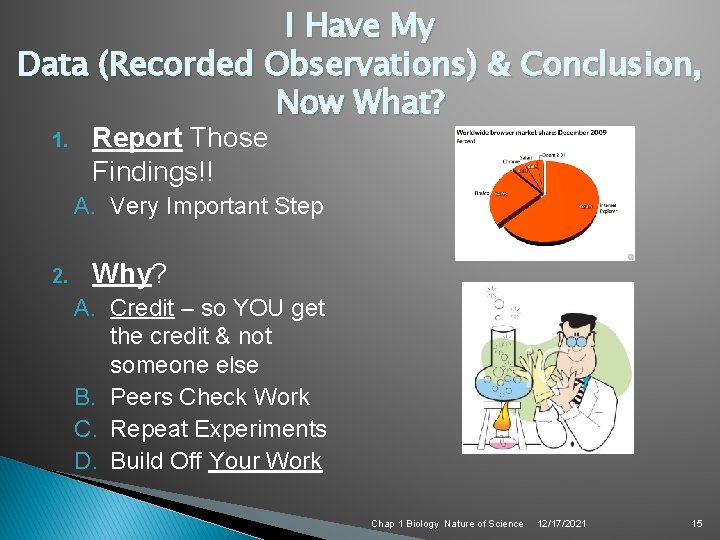
I Have My Data (Recorded Observations) & Conclusion, Now What? 1. Report Those Findings!! A. Very Important Step 2. Why? A. Credit – so YOU get the credit & not someone else B. Peers Check Work C. Repeat Experiments D. Build Off Your Work Chap 1 Biology Nature of Science 12/17/2021 15
When Experiments Are not Possible � When subjects need to not be disturbed � Ethical issues � Too many variables ◦ Example: It is difficult to run a controlled experiment during human medical studies…. WHY? ◦ Different ages, races, genetic makeup, pre existing medical conditions ◦ Goal would be to try to find subjects that are as similar as possible (but it never will be truly controlled) 12/17/2021 16
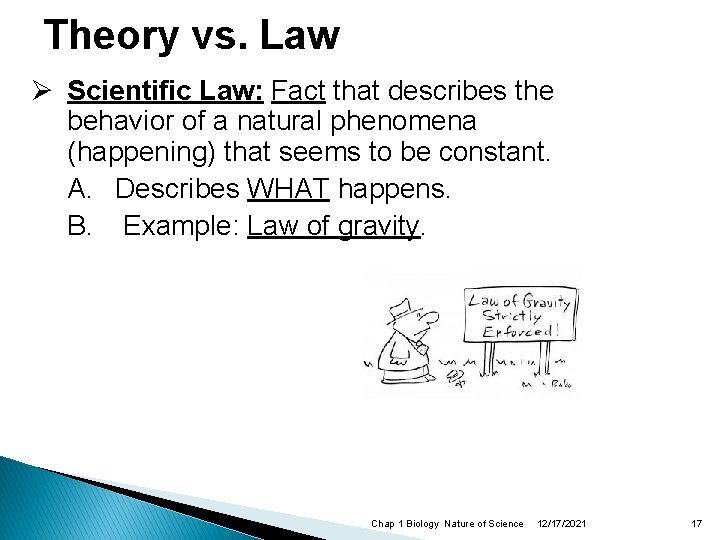
Theory vs. Law Ø Scientific Law: Fact that describes the behavior of a natural phenomena (happening) that seems to be constant. A. Describes WHAT happens. B. Example: Law of gravity. Chap 1 Biology Nature of Science 12/17/2021 17
Theory vs. Law � � Theory: Explanation based on MANY observations & investigations A. Usually the simplest principle that unifies the many observations. B. It explains WHY it happens. NOTE: BOTH can be proven false with new data. Chap 1 Biology Nature of Science 12/17/2021 18
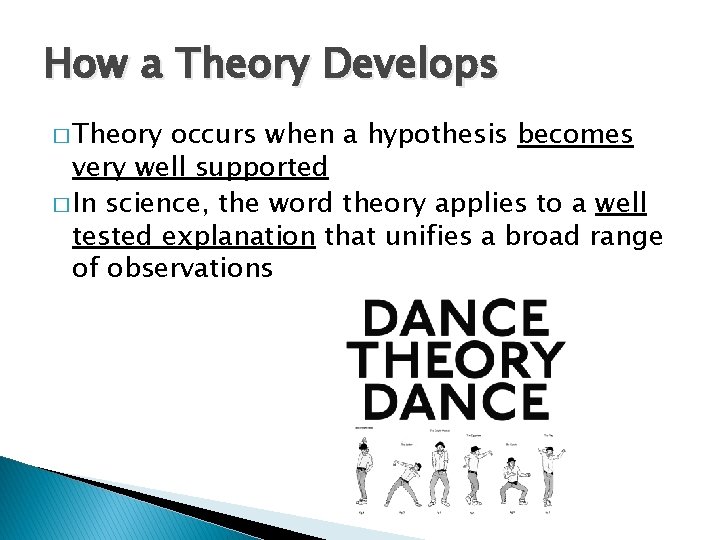
How a Theory Develops � Theory occurs when a hypothesis becomes very well supported � In science, the word theory applies to a well tested explanation that unifies a broad range of observations 12/17/2021 19
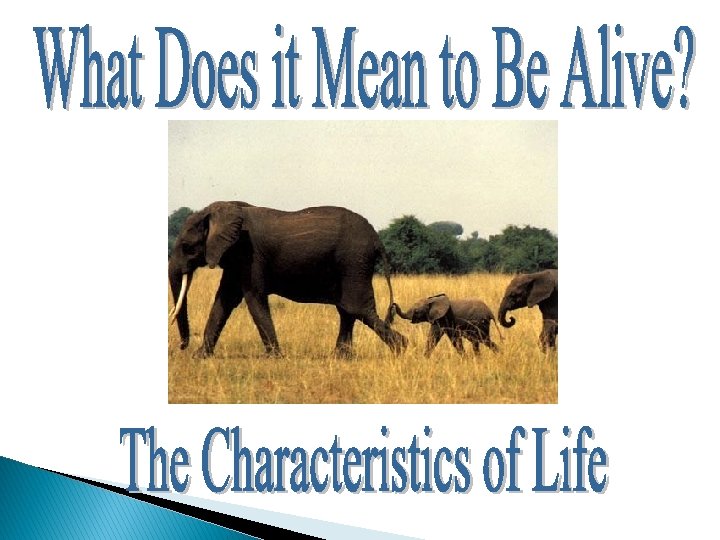
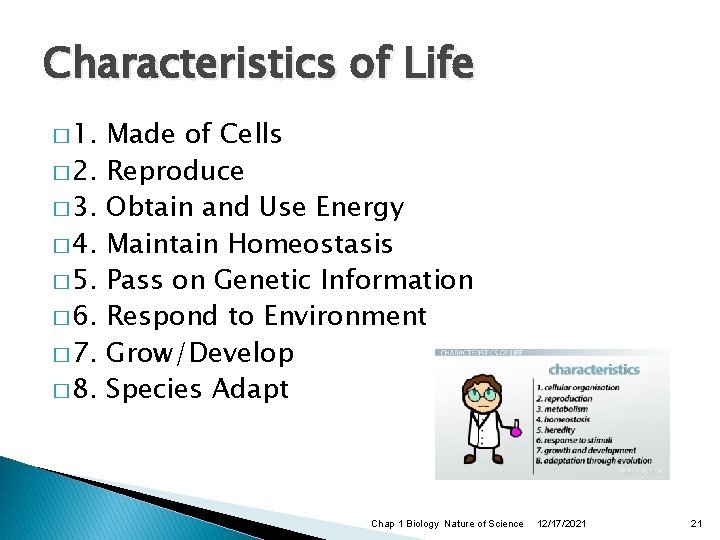
Characteristics of Life � 1. � 2. � 3. � 4. � 5. � 6. � 7. � 8. Made of Cells Reproduce Obtain and Use Energy Maintain Homeostasis Pass on Genetic Information Respond to Environment Grow/Develop Species Adapt Chap 1 Biology Nature of Science 12/17/2021 21
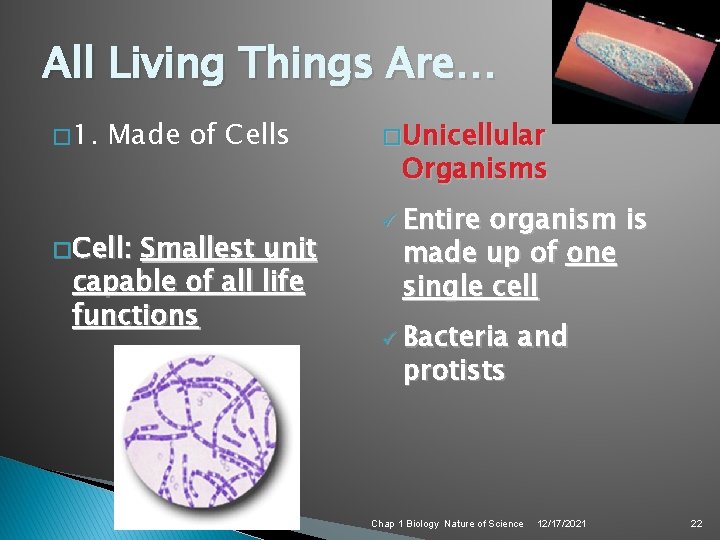
All Living Things Are… � 1. Made of Cells � Cell: Smallest unit capable of all life functions � Unicellular Organisms ü Entire organism is made up of one single cell ü Bacteria protists and Chap 1 Biology Nature of Science 12/17/2021 22
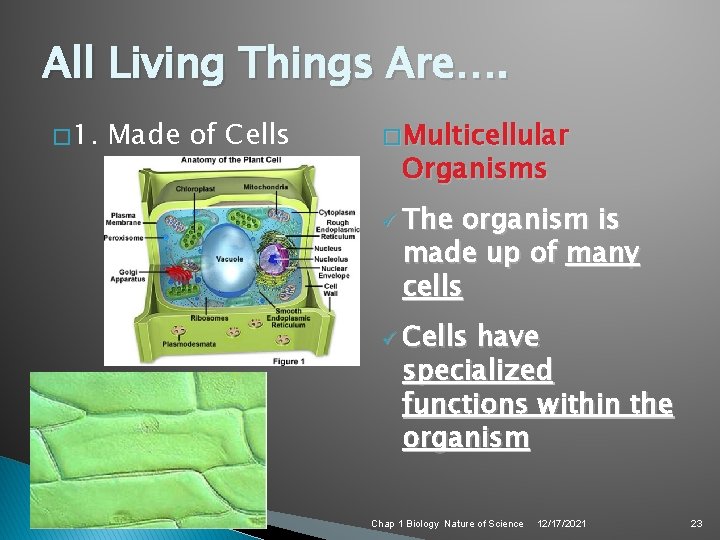
All Living Things Are…. � 1. Made of Cells � Multicellular Organisms ü The organism is made up of many cells ü Cells have specialized functions within the organism Chap 1 Biology Nature of Science 12/17/2021 23
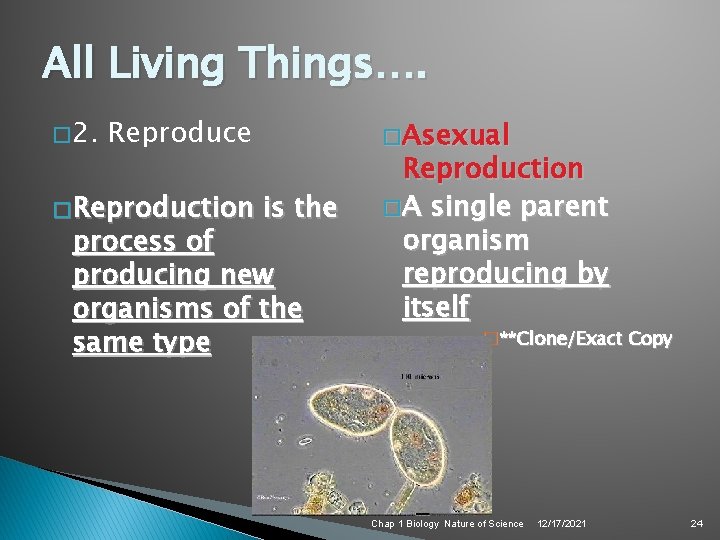
All Living Things…. � 2. Reproduce � Reproduction � Asexual is the process of producing new organisms of the same type Reproduction � A single parent organism reproducing by itself �**Clone/Exact Copy Chap 1 Biology Nature of Science 12/17/2021 24
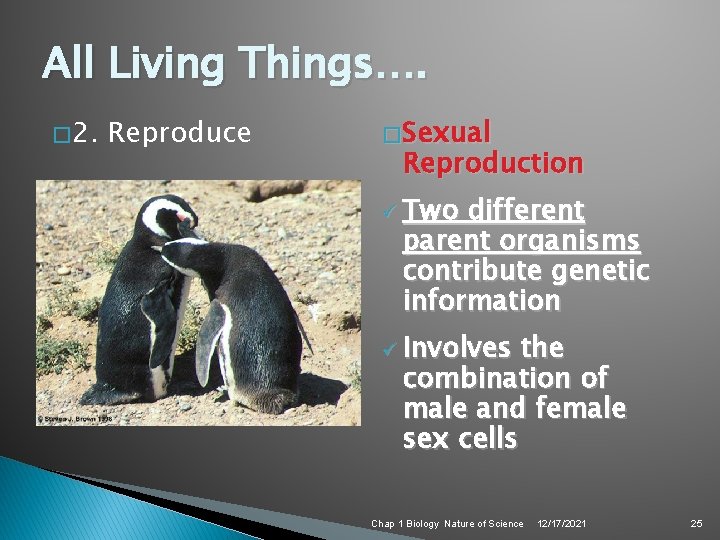
All Living Things…. � 2. Reproduce � Sexual Reproduction ü Two different parent organisms contribute genetic information ü Involves the combination of male and female sex cells Chap 1 Biology Nature of Science 12/17/2021 25
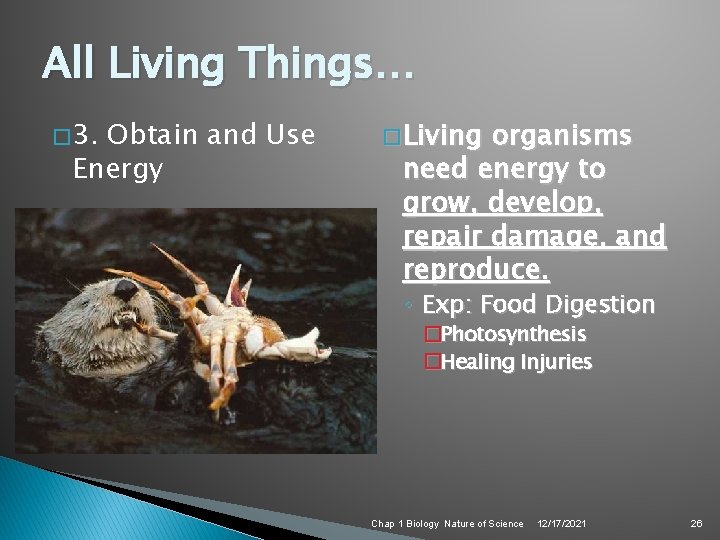
All Living Things… � 3. Obtain and Use Energy � Living organisms need energy to grow, develop, repair damage, and reproduce. ◦ Exp: Food Digestion �Photosynthesis �Healing Injuries Chap 1 Biology Nature of Science 12/17/2021 26
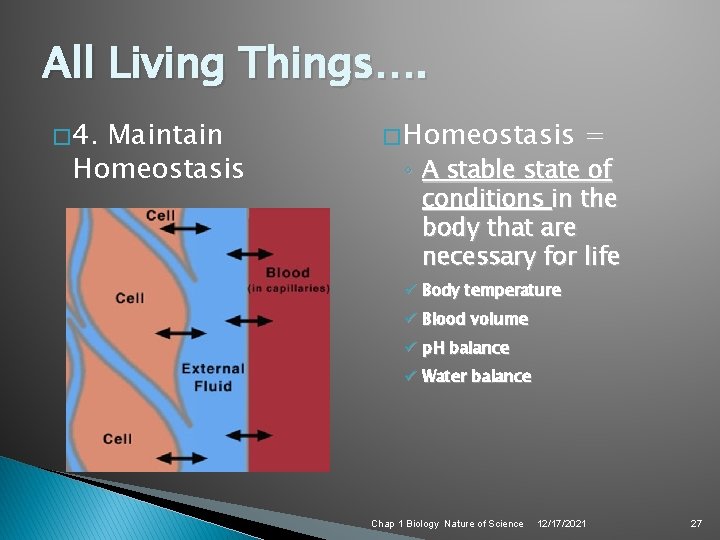
All Living Things…. � 4. Maintain Homeostasis � Homeostasis = ◦ A stable state of conditions in the body that are necessary for life ü Body temperature ü Blood volume ü p. H balance ü Water balance Chap 1 Biology Nature of Science 12/17/2021 27
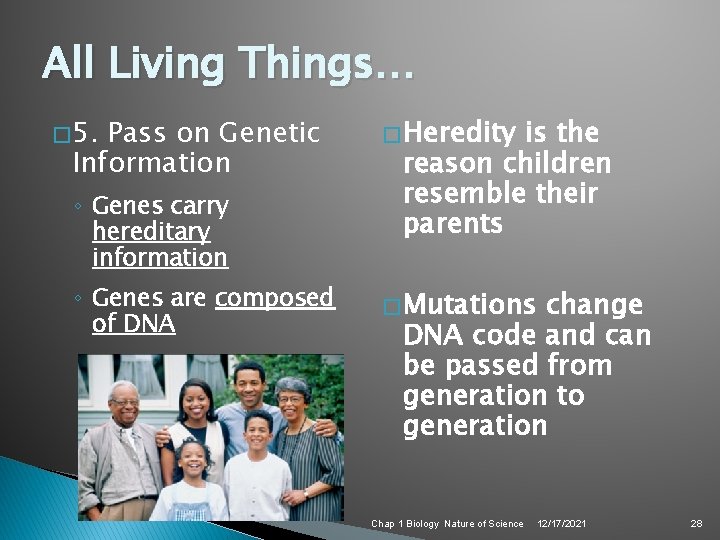
All Living Things… � 5. Pass on Genetic Information ◦ Genes carry hereditary information ◦ Genes are composed of DNA � Heredity is the reason children resemble their parents � Mutations change DNA code and can be passed from generation to generation Chap 1 Biology Nature of Science 12/17/2021 28
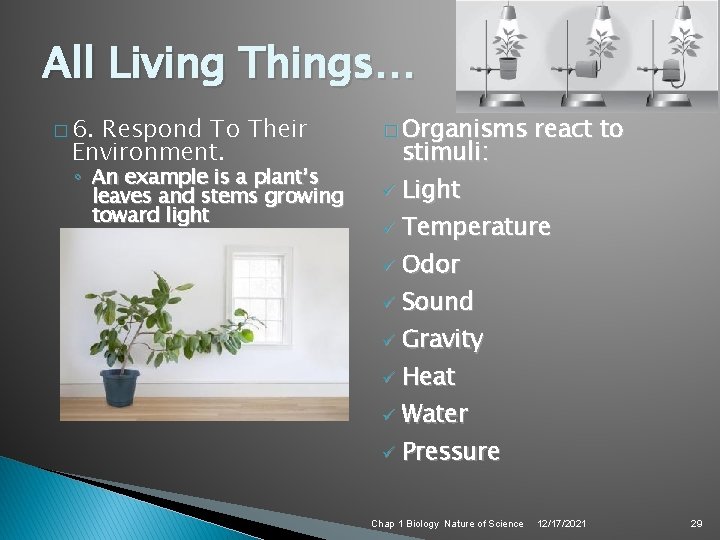
All Living Things… � 6. Respond To Their Environment. ◦ An example is a plant’s leaves and stems growing toward light � Organisms stimuli: ü ü ü ü react to Light Temperature Odor Sound Gravity Heat Water Pressure Chap 1 Biology Nature of Science 12/17/2021 29
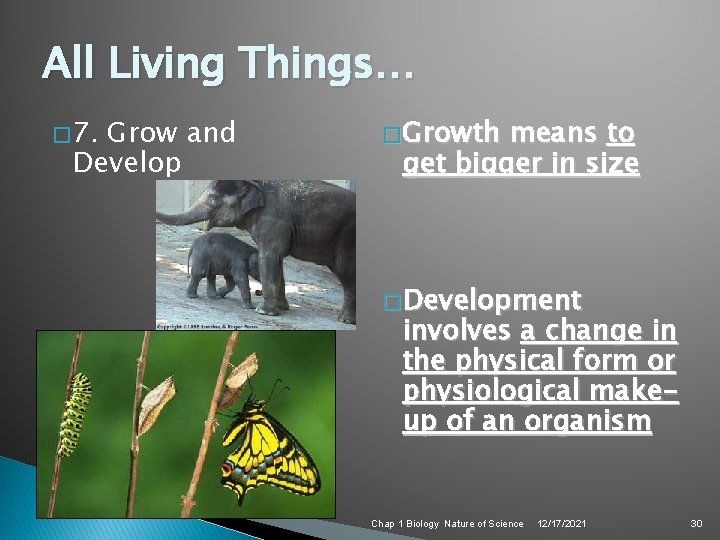
All Living Things… � 7. Grow and Develop � Growth means to get bigger in size � Development involves a change in the physical form or physiological makeup of an organism Chap 1 Biology Nature of Science 12/17/2021 30
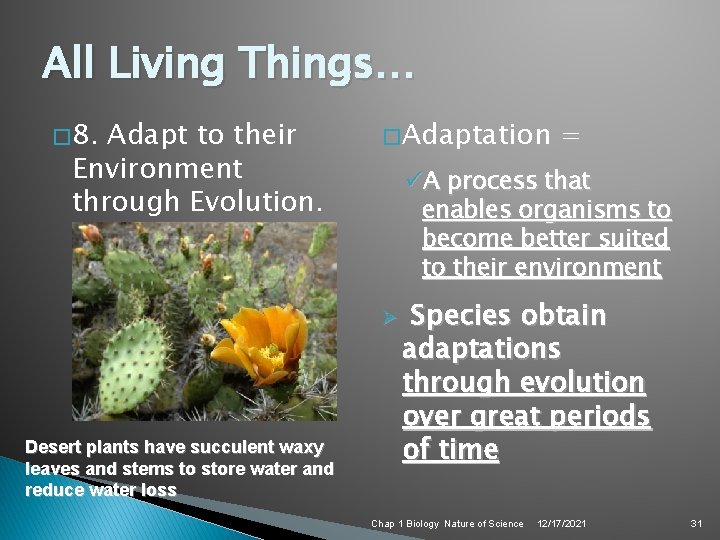
All Living Things… � 8. Adapt to their Environment through Evolution. � Adaptation üA process that enables organisms to become better suited to their environment Ø Desert plants have succulent waxy leaves and stems to store water and reduce water loss = Species obtain adaptations through evolution over great periods of time Chap 1 Biology Nature of Science 12/17/2021 31
What is spontaneous generation? What is biogenesis? Describe the experiment your scientist performed relating to spontaneous generation. What was your scientists’ hypothesis? What was the end result of your scientists work with spontaneous generation? Chap 1 Biology Nature of Science 12/17/2021 32
Scientist: Same Group Information: As a small group, go over the information you found regarding your scientists. Select 3 main points to share. Make sure everyone agrees that all information shared is accurate. You will be expected to share information with other people after this activity. Different Group Information: Share your main ideas with people that looked up other scientists. Record all information in the table below. Scientist Name: . 1. 2. 3. Chap 1 Biology Nature of Science 12/17/2021 33
Scientist Name: Main Ideas Redi Leeuwenhoek Needham Spallanzani Pasteur Chap 1 Biology Nature of Science 12/17/2021 34
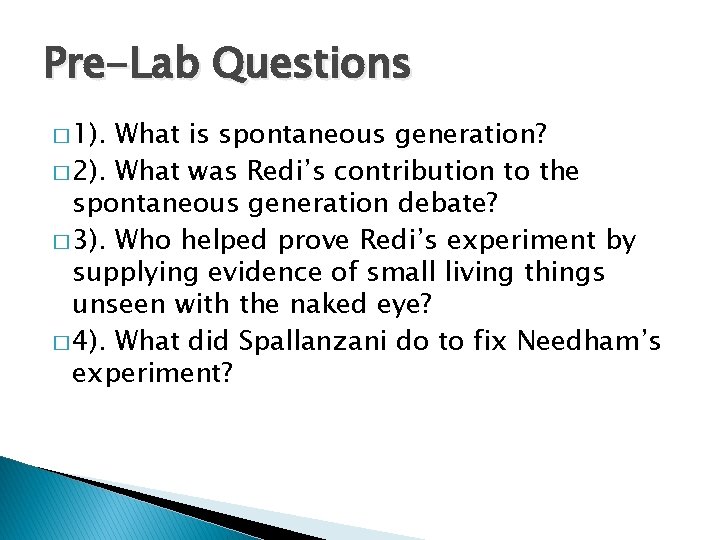
Pre-Lab Questions � 1). What is spontaneous generation? � 2). What was Redi’s contribution to the spontaneous generation debate? � 3). Who helped prove Redi’s experiment by supplying evidence of small living things unseen with the naked eye? � 4). What did Spallanzani do to fix Needham’s experiment? Chap 1 Biology Nature of Science 12/17/2021 35
- Slides: 35