
Biology Cells Key Concepts Key Words Cell membrane
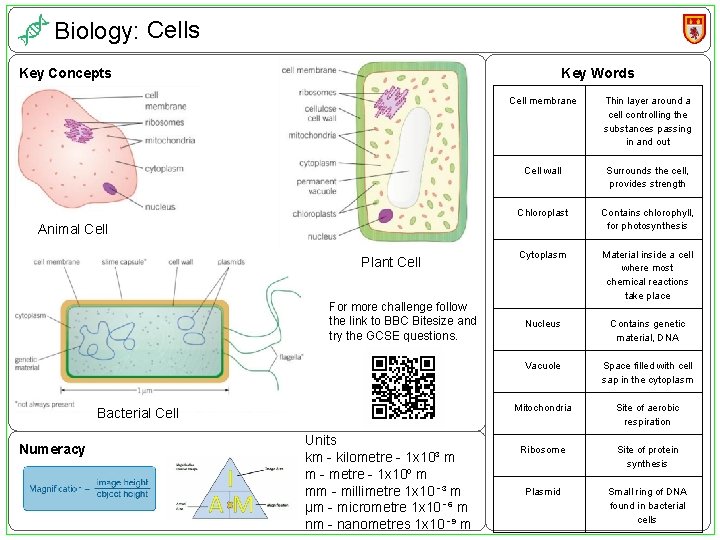
Biology: Cells Key Concepts Key Words Cell membrane Thin layer around a cell controlling the substances passing in and out Cell wall Surrounds the cell, provides strength Chloroplast Contains chlorophyll, for photosynthesis Cytoplasm Material inside a cell where most chemical reactions take place Nucleus Contains genetic material, DNA Vacuole Space filled with cell sap in the cytoplasm Mitochondria Site of aerobic respiration Ribosome Site of protein synthesis Plasmid Small ring of DNA found in bacterial cells Animal Cell Plant Cell For more challenge follow the link to BBC Bitesize and try the GCSE questions. Bacterial Cell Numeracy Units km - kilometre - 1 x 10³ m m - metre - 1 x 10⁰ m mm - millimetre 1 x 10⁻³ m μm - micrometre 1 x 10⁻⁶ m nm - nanometres 1 x 10⁻⁹ m
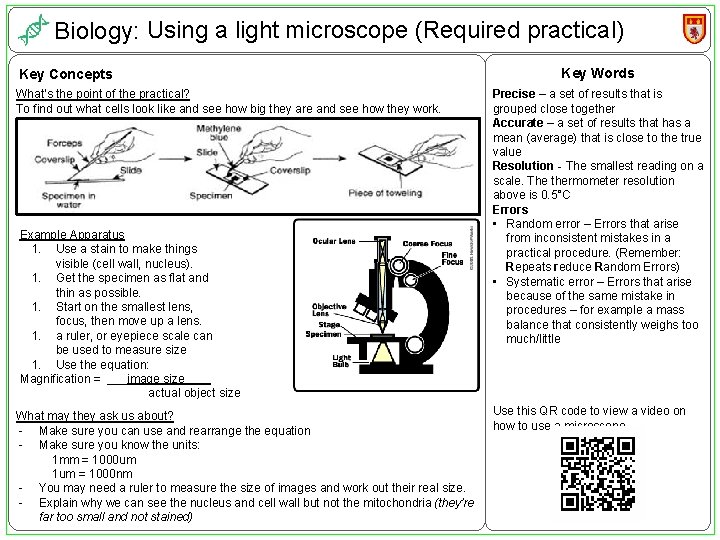
Biology: Using a light microscope (Required practical) Key Concepts What’s the point of the practical? To find out what cells look like and see how big they are and see how they work. Example Apparatus 1. Use a stain to make things visible (cell wall, nucleus). 1. Get the specimen as flat and thin as possible. 1. Start on the smallest lens, focus, then move up a lens. 1. a ruler, or eyepiece scale can be used to measure size 1. Use the equation: Magnification = ___image size____ actual object size What may they ask us about? - Make sure you can use and rearrange the equation - Make sure you know the units: 1 mm = 1000 um 1 um = 1000 nm - You may need a ruler to measure the size of images and work out their real size. - Explain why we can see the nucleus and cell wall but not the mitochondria (they’re far too small and not stained) Key Words Precise – a set of results that is grouped close together Accurate – a set of results that has a mean (average) that is close to the true value Resolution - The smallest reading on a scale. The thermometer resolution above is 0. 5°C Errors • Random error – Errors that arise from inconsistent mistakes in a practical procedure. (Remember: Repeats reduce Random Errors) • Systematic error – Errors that arise because of the same mistake in procedures – for example a mass balance that consistently weighs too much/little Use this QR code to view a video on how to use a microscope.
- Slides: 2