
Biology Cell Membrane Diffusion hypertonic hypotonic isotonic MT
Biology Cell Membrane: Diffusion, hypertonic, hypotonic, isotonic MT: Cell Processes Slide 1 of 47 Copyright Pearson Prentice Hall End Show
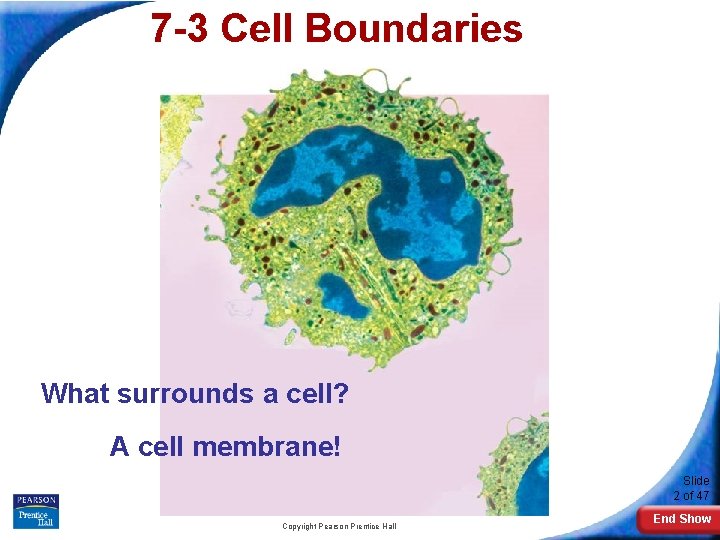
7 -3 Cell Boundaries What surrounds a cell? A cell membrane! Slide 2 of 47 Copyright Pearson Prentice Hall End Show
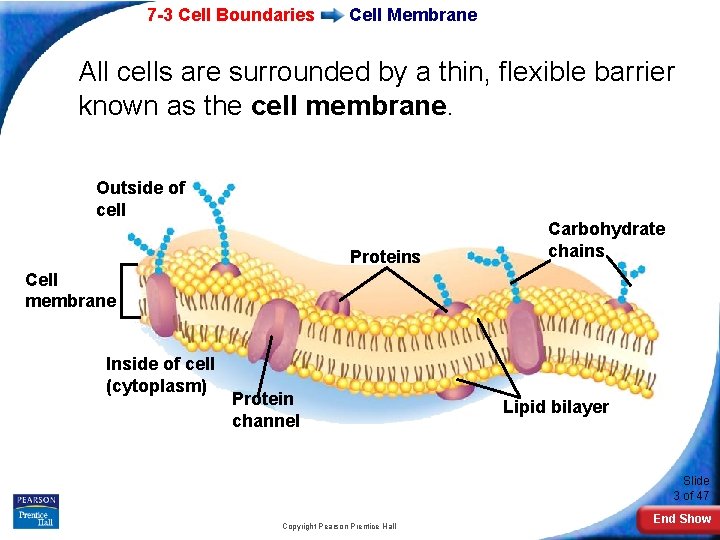
7 -3 Cell Boundaries Cell Membrane All cells are surrounded by a thin, flexible barrier known as the cell membrane. Outside of cell Proteins Carbohydrate chains Cell membrane Inside of cell (cytoplasm) Protein channel Lipid bilayer Slide 3 of 47 Copyright Pearson Prentice Hall End Show

7 -3 Cell Boundaries Cell Membrane What is the main function of the cell membrane? Slide 4 of 47 Copyright Pearson Prentice Hall End Show
7 -3 Cell Boundaries Cell Membrane 1. Regulates what enters and leaves the cell 2. Provides protection and support Slide 5 of 47 Copyright Pearson Prentice Hall End Show

7 -3 Cell Boundaries Cell Membrane The composition of nearly all cell membranes is a double-layered sheet called a phospholipid bilayer. Phospholipid bilayer Copyright Pearson Prentice Hall Slide 6 of 47 End Show
7 -3 Cell Boundaries Cell Membrane The cell membrane is: *Semi-permeable: only certain substances are let into/out of the cell. Usually small substances. Ex: Strainer: water is let through but the beans/noodles are not Ex: Window Screen: air and small bugs are let in but big bugs are not Slide 7 of 47 Copyright Pearson Prentice Hall End Show

7 -3 Cell Boundaries Diffusion Through Cell Boundaries Diffusion: - is the movement of substances across the cell membrane. - Passive process (does not require energy, naturally occurring) Slide 8 of 47 Copyright Pearson Prentice Hall End Show
7 -3 Cell Boundaries Diffusion Through Cell Boundaries What happens during diffusion? Slide 9 of 47 Copyright Pearson Prentice Hall End Show

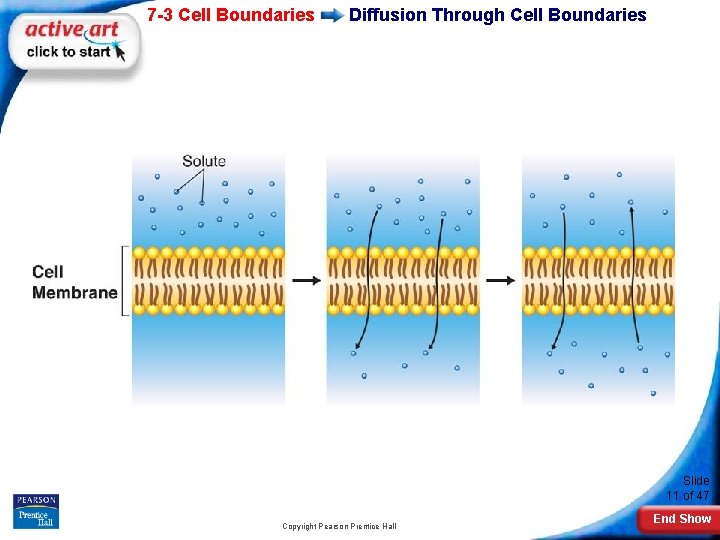
7 -3 Cell Boundaries Diffusion Through Cell Boundaries Diffusion Particles move from an area of HIGH concentration to an area of LOW concentration. When particles are balanced on both sides of the membrane, the system has reached equilibrium. Slide 10 of 47 Copyright Pearson Prentice Hall End Show
7 -3 Cell Boundaries Diffusion Through Cell Boundaries Slide 11 of 47 Copyright Pearson Prentice Hall End Show
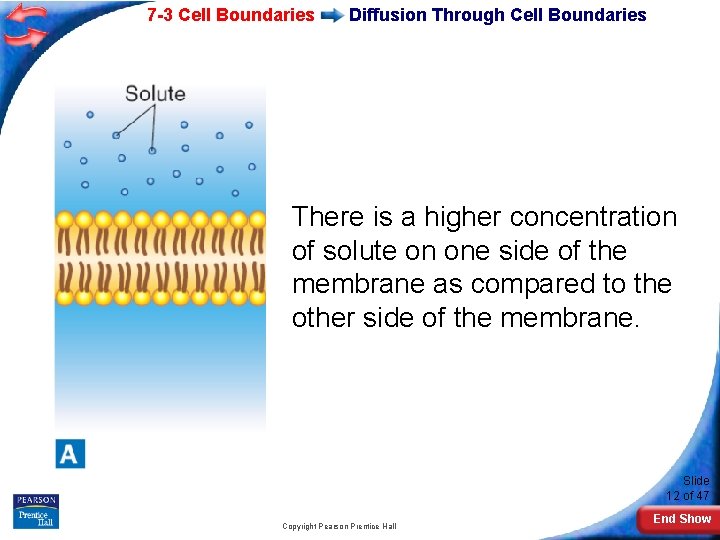
7 -3 Cell Boundaries Diffusion Through Cell Boundaries There is a higher concentration of solute on one side of the membrane as compared to the other side of the membrane. Slide 12 of 47 Copyright Pearson Prentice Hall End Show
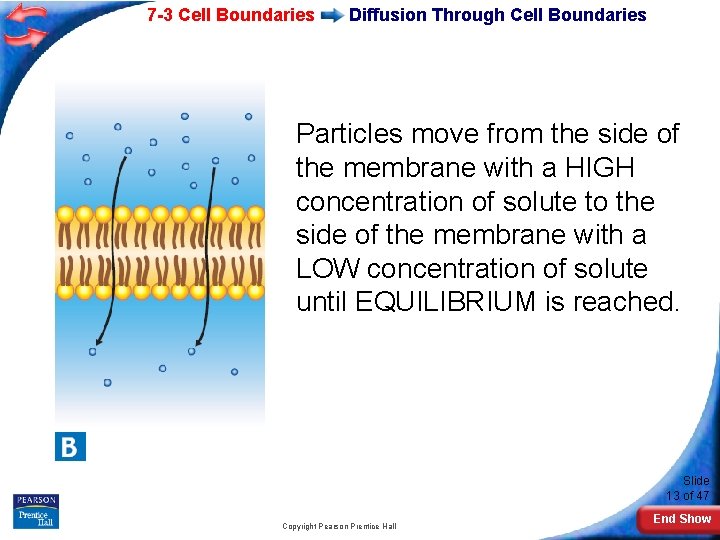
7 -3 Cell Boundaries Diffusion Through Cell Boundaries Particles move from the side of the membrane with a HIGH concentration of solute to the side of the membrane with a LOW concentration of solute until EQUILIBRIUM is reached. Slide 13 of 47 Copyright Pearson Prentice Hall End Show
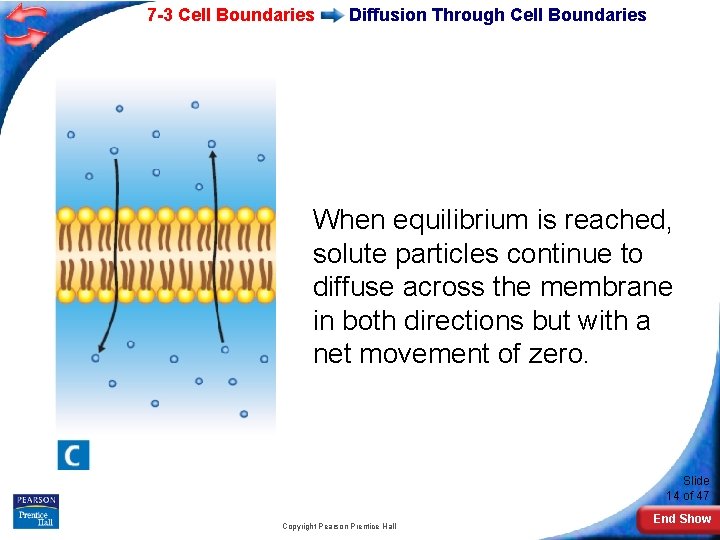
7 -3 Cell Boundaries Diffusion Through Cell Boundaries When equilibrium is reached, solute particles continue to diffuse across the membrane in both directions but with a net movement of zero. Slide 14 of 47 Copyright Pearson Prentice Hall End Show
7 -3 Cell Boundaries Osmosis What is osmosis? Slide 15 of 47 Copyright Pearson Prentice Hall End Show

7 -3 Cell Boundaries Osmosis is the diffusion of water through a membrane. Slide 16 of 47 Copyright Pearson Prentice Hall End Show
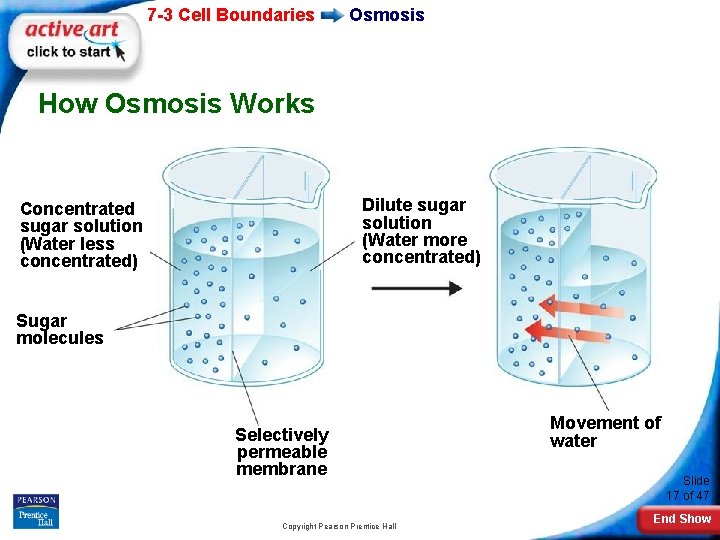
7 -3 Cell Boundaries Osmosis How Osmosis Works Dilute sugar solution (Water more concentrated) Concentrated sugar solution (Water less concentrated) Sugar molecules Selectively permeable membrane Copyright Pearson Prentice Hall Movement of water Slide 17 of 47 End Show

7 -3 Cell Boundaries Osmosis Water tends to diffuse from a HIGH concentration region to a LOW concentration region. hypertonic (“above strength”): more particles than the other side hypotonic (“below strength”): less particles than the other side Slide 18 of 47 Copyright Pearson Prentice Hall End Show

7 -3 Cell Boundaries Osmosis When concentrations of solutions are the same on both sides of a membrane, the solutions are isotonic (”same strength”). Slide 19 of 47 Copyright Pearson Prentice Hall End Show
- Slides: 19