
Biology as a Science Chapter 2 Characteristics of
Biology as a Science Chapter 2
Characteristics of Living Things • Generally accepted characteristics of life – All living things: – Are made up of one or more cells – Reproduce – Grow and develop – Obtain and use energy – Respond to their environment
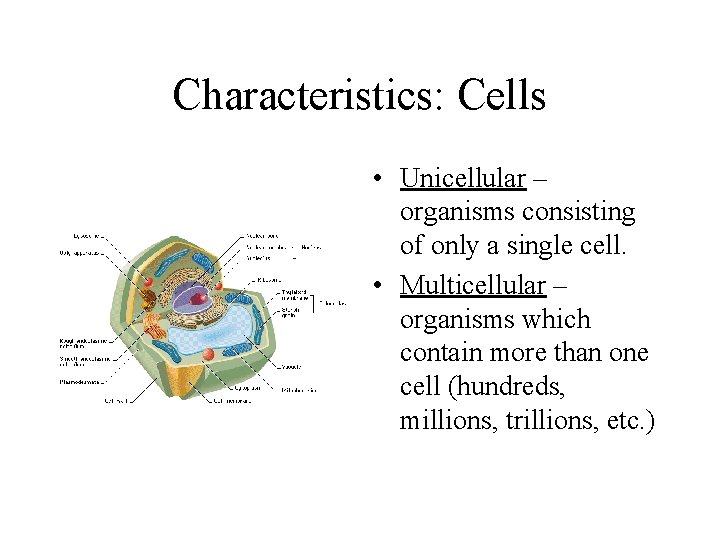
Characteristics: Cells • Unicellular – organisms consisting of only a single cell. • Multicellular – organisms which contain more than one cell (hundreds, millions, trillions, etc. )

Characteristics: Reproduction • Two basic kinds of reproduction: – Sexual – requires two cells from different individuals to unite to produce the first cell of a new organism. – Asexual – single organism is able to reproduce without the aid of another organism.
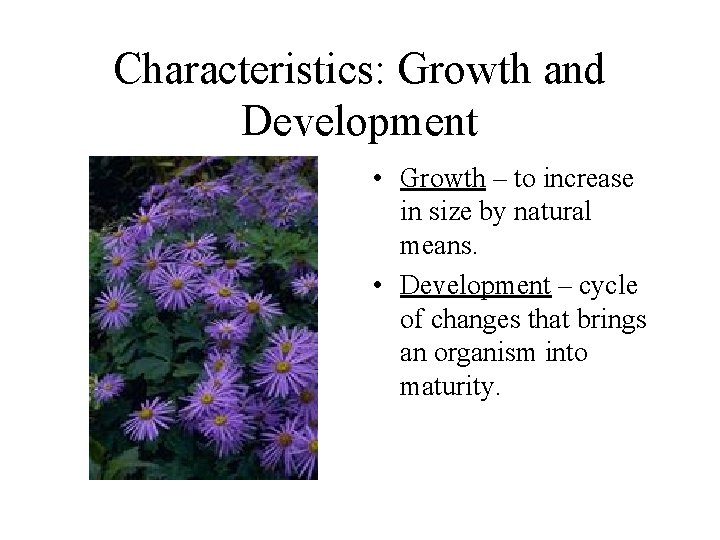
Characteristics: Growth and Development • Growth – to increase in size by natural means. • Development – cycle of changes that brings an organism into maturity.
Characteristics: Obtain and Use Energy • Anabolism – any process in a living that involves putting together (synthesizing) complex substances from simpler substances. • Catabolism – the final breakdown of a complex substance into a simpler substance. • Metabolism – total sum of all chem. Rxns in the body.
Characteristics: Respond to Their Environment • Homeostasis – the process by which an organism responds to stimuli in ways that keep conditions in their internal environment suitable for life.
- Slides: 7