
Biology and fisheries on NarrowBarred Spanish Mackerel and
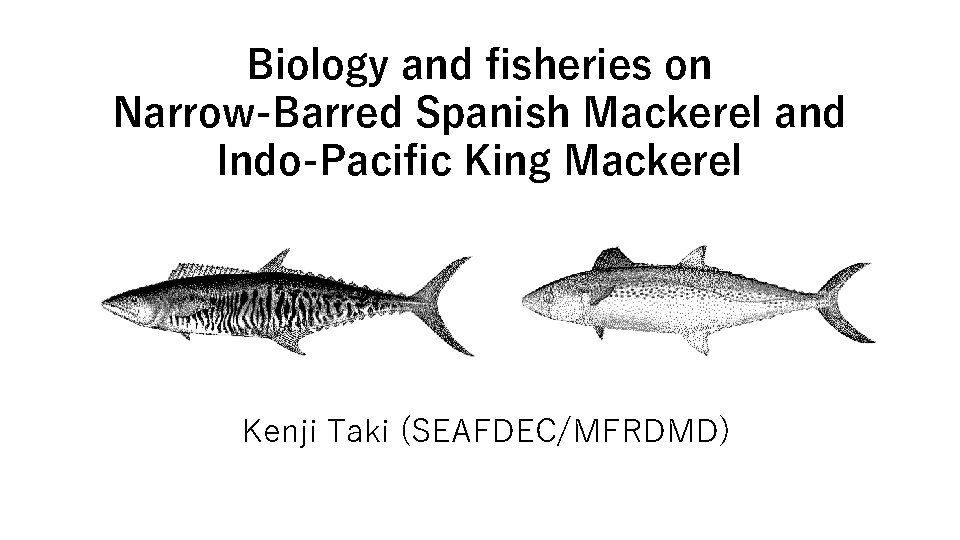
Biology and fisheries on Narrow-Barred Spanish Mackerel and Indo-Pacific King Mackerel Kenji Taki (SEAFDEC/MFRDMD)
Today’s presentation 1. Key to genus Scomberomorus and the two species 2. Biology and fisheries of Narrow-Bared Spanish Mackerel 3. Biology and fisheries of Indo-Pacific King Mackerel 4. Summary of biology and fisheries for the two species 5. References for the two species
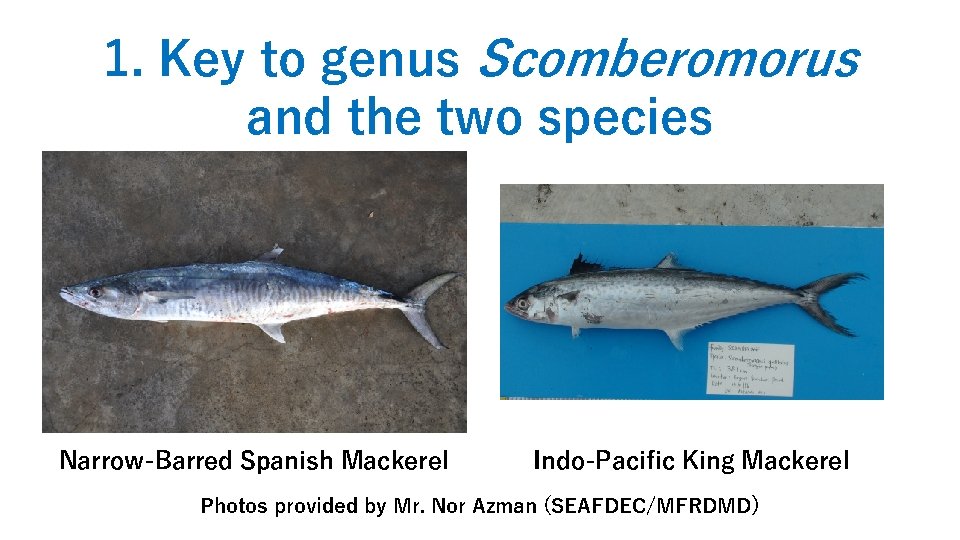
1. Key to genus Scomberomorus and the two species Narrow-Barred Spanish Mackerel Indo-Pacific King Mackerel Photos provided by Mr. Nor Azman (SEAFDEC/MFRDMD)
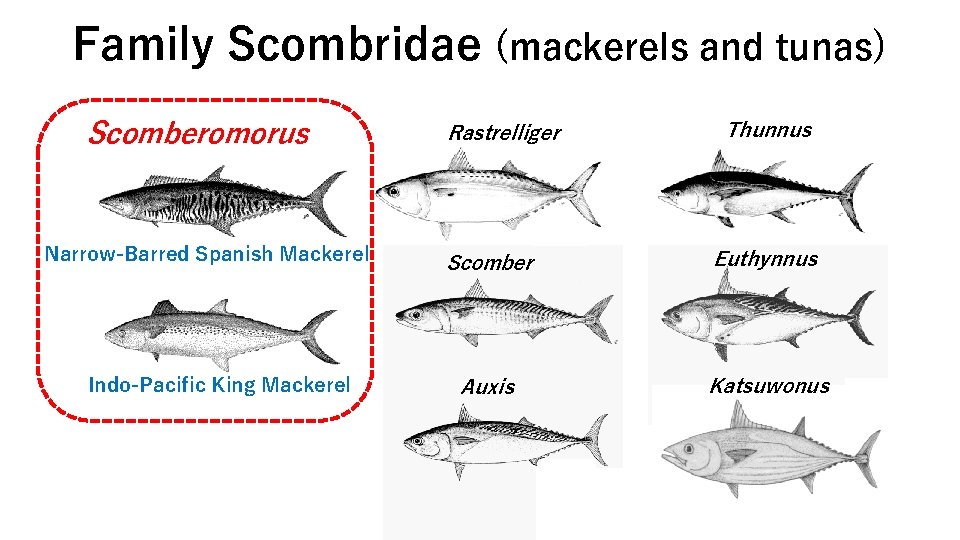
Family Scombridae (mackerels and tunas) Scomberomorus Narrow-Barred Spanish Mackerel Indo-Pacific King Mackerel Rastrelliger Thunnus Scomber Euthynnus Auxis Katsuwonus
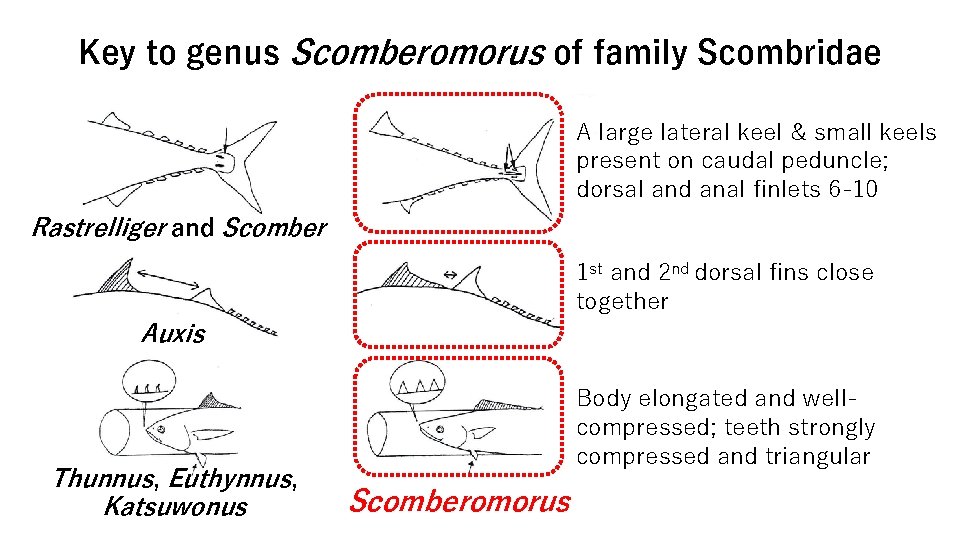
Key to genus Scomberomorus of family Scombridae A large lateral keel & small keels present on caudal peduncle; dorsal and anal finlets 6 -10 Rastrelliger and Scomber 1 st and 2 nd dorsal fins close together Auxis Thunnus, Euthynnus, Katsuwonus Body elongated and wellcompressed; teeth strongly compressed and triangular Scomberomorus
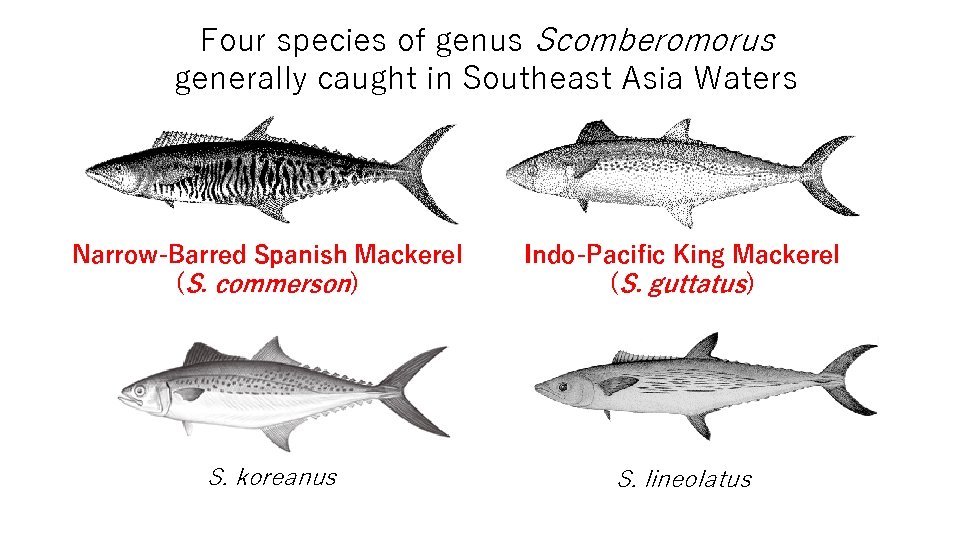
Four species of genus Scomberomorus generally caught in Southeast Asia Waters Narrow-Barred Spanish Mackerel (S. commerson) Indo-Pacific King Mackerel (S. guttatus) S. koreanus S. lineolatus
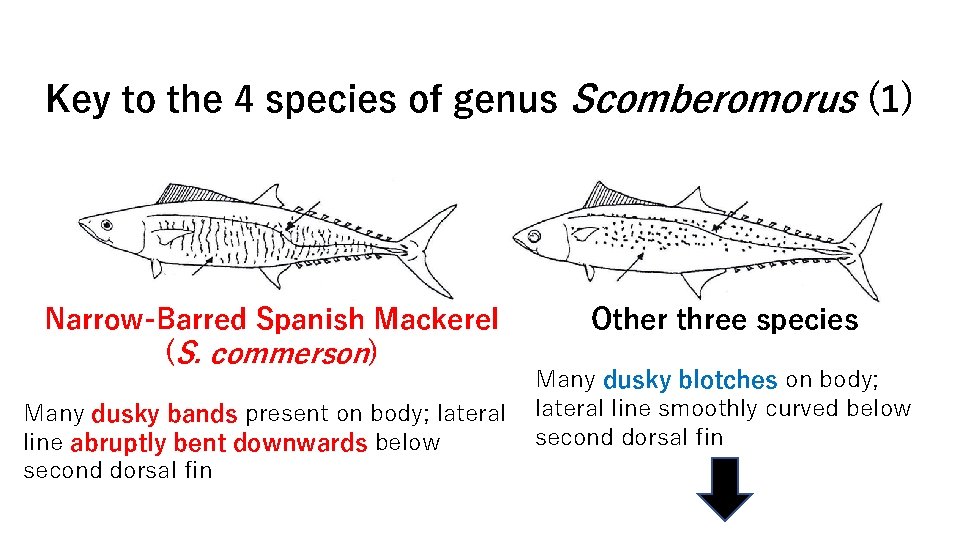
Key to the 4 species of genus Scomberomorus (1) Narrow-Barred Spanish Mackerel (S. commerson) Many dusky bands present on body; lateral line abruptly bent downwards below second dorsal fin Other three species Many dusky blotches on body; lateral line smoothly curved below second dorsal fin
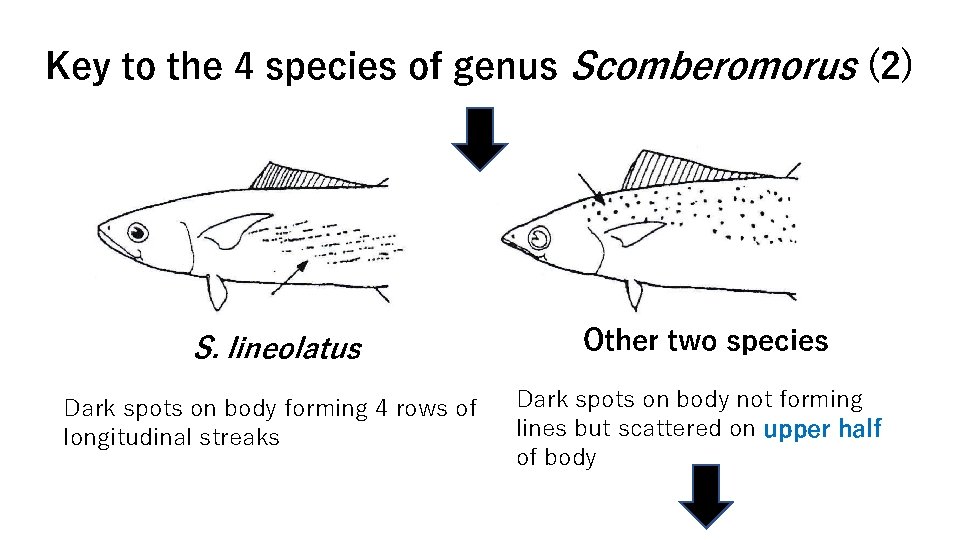
Key to the 4 species of genus Scomberomorus (2) S. lineolatus Other two species Dark spots on body forming 4 rows of longitudinal streaks Dark spots on body not forming lines but scattered on upper half of body
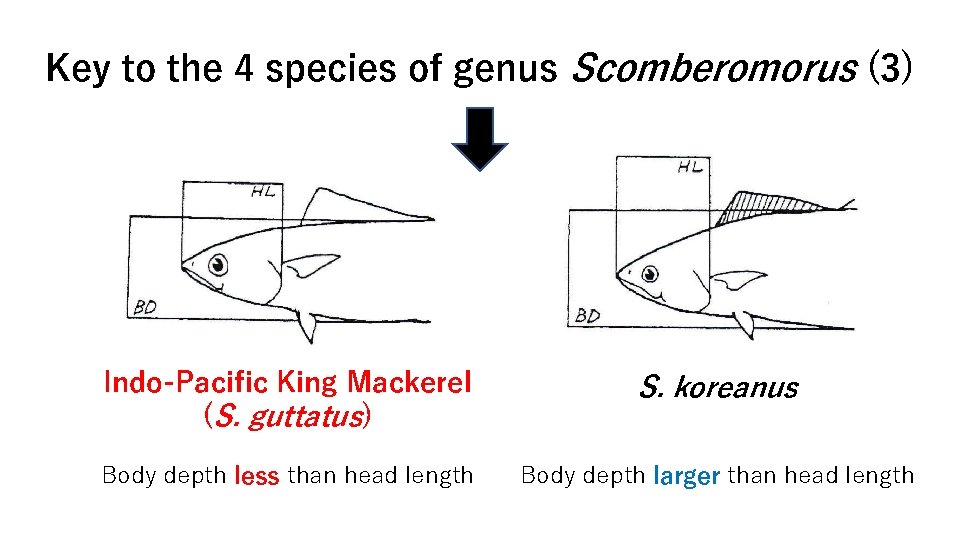
Key to the 4 species of genus Scomberomorus (3) Indo-Pacific King Mackerel (S. guttatus) S. koreanus Body depth less than head length Body depth larger than head length
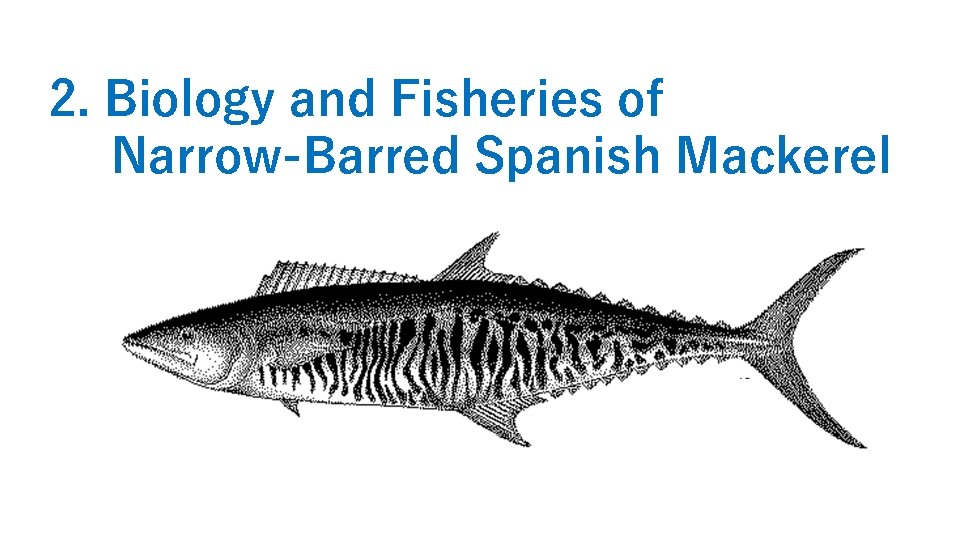
2. Biology and Fisheries of Narrow-Barred Spanish Mackerel
Narrow-Barred Spanish Mackerel Geographical distribution Widespread throughout the Indo-West Pacific from South Africa and the Red Sea east through the Indo. Australian Archipelago to Australia and Fiji and north to China and Japan
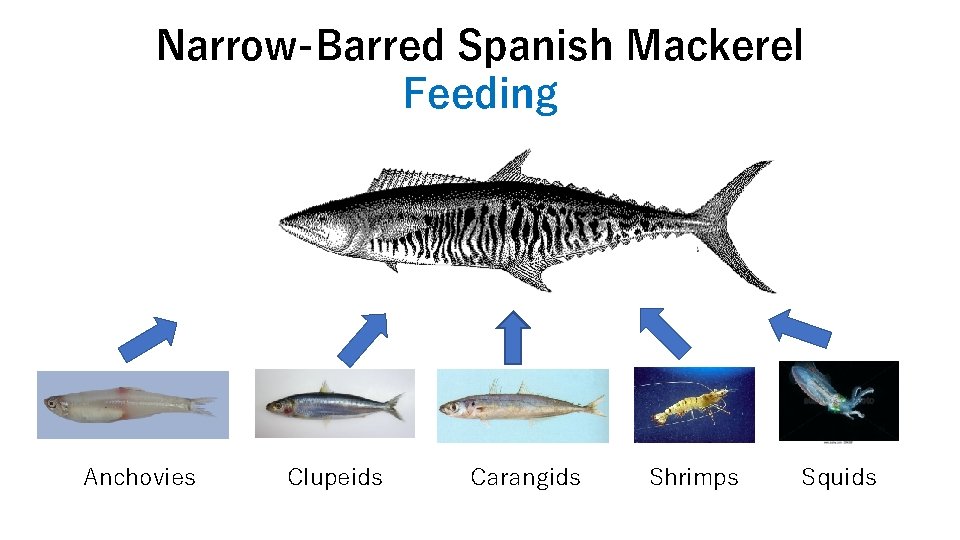
Narrow-Barred Spanish Mackerel Feeding Anchovies Clupeids Carangids Shrimps Squids
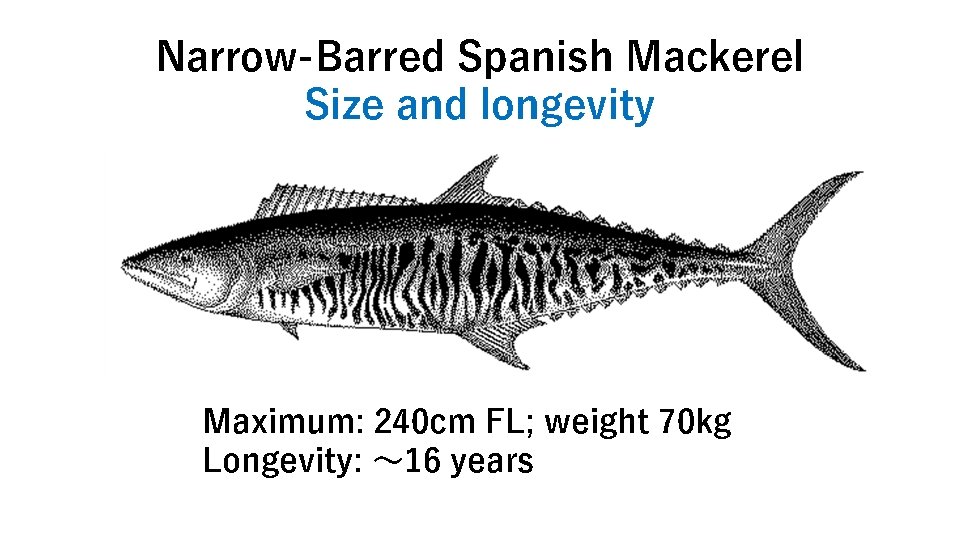
Narrow-Barred Spanish Mackerel Size and longevity Maximum: 240 cm FL; weight 70 kg Longevity: ~ 16 years
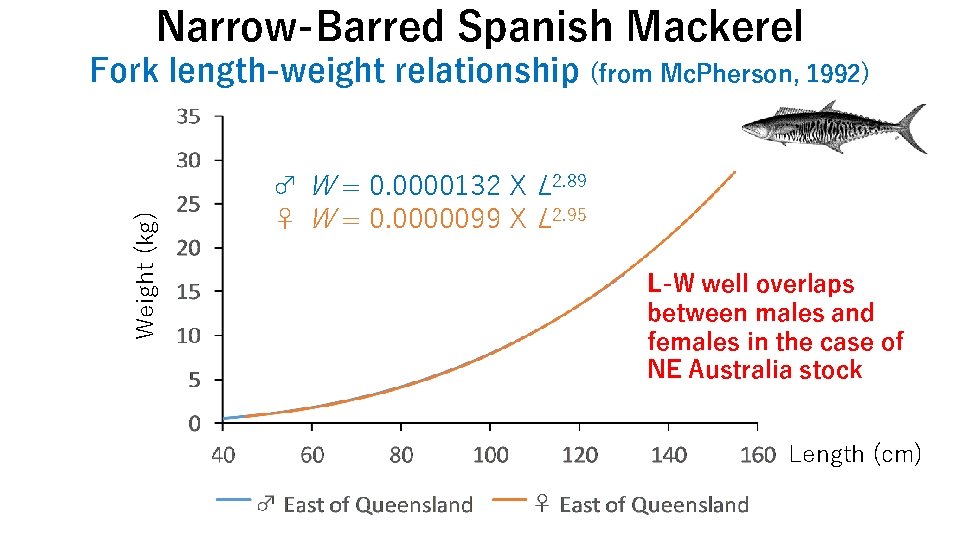
Narrow-Barred Spanish Mackerel Weight (kg) Fork length-weight relationship (from Mc. Pherson, 1992) ♂ W = 0. 0000132 X L 2. 89 ♀ W = 0. 0000099 X L 2. 95 L-W well overlaps between males and females in the case of NE Australia stock Length (cm)
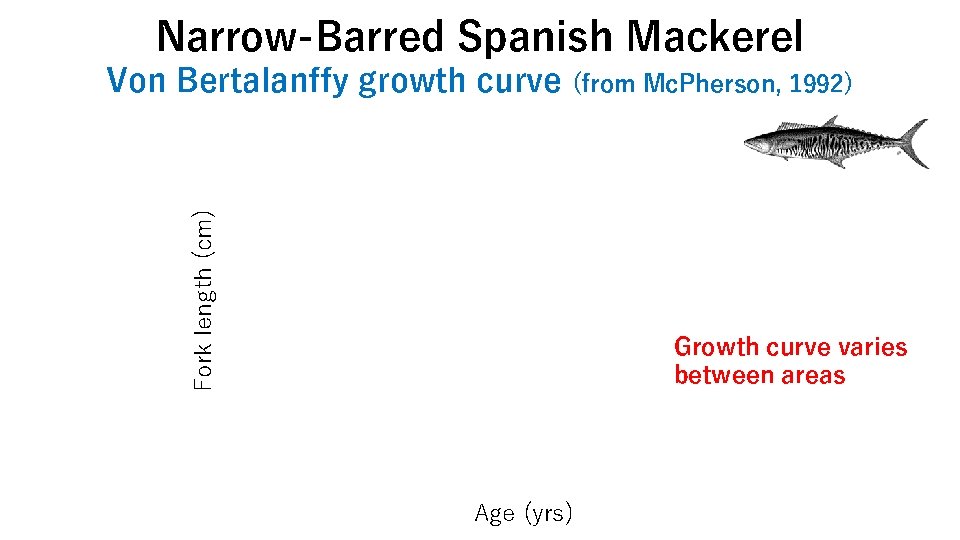
Narrow-Barred Spanish Mackerel Fork length (cm) Von Bertalanffy growth curve (from Mc. Pherson, 1992) Growth curve varies between areas Age (yrs)
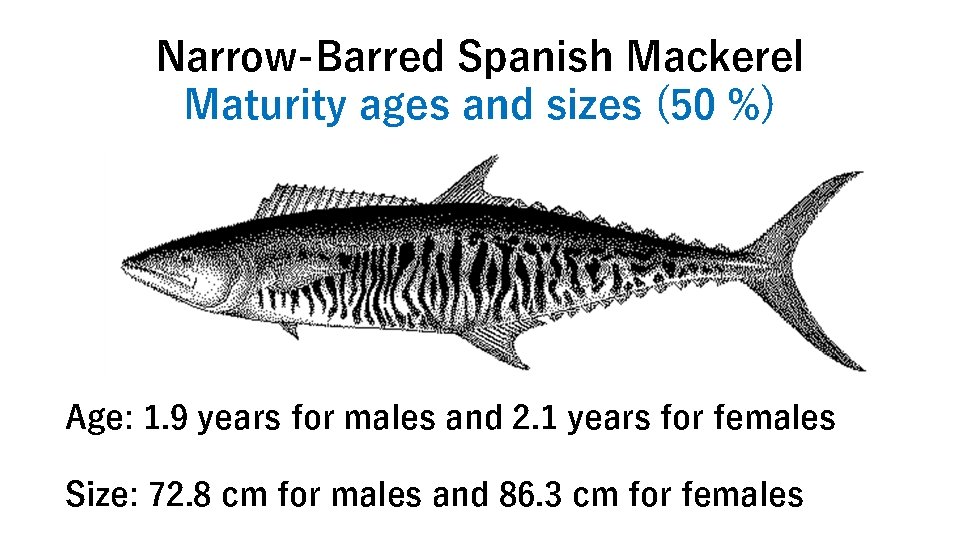
Narrow-Barred Spanish Mackerel Maturity ages and sizes (50 %) Age: 1. 9 years for males and 2. 1 years for females Size: 72. 8 cm for males and 86. 3 cm for females
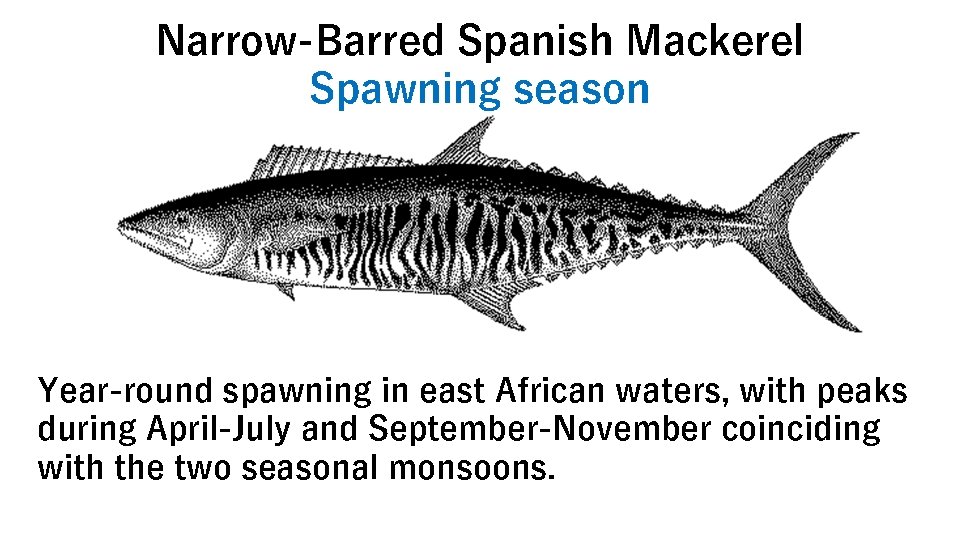
Narrow-Barred Spanish Mackerel Spawning season Year-round spawning in east African waters, with peaks during April-July and September-November coinciding with the two seasonal monsoons.
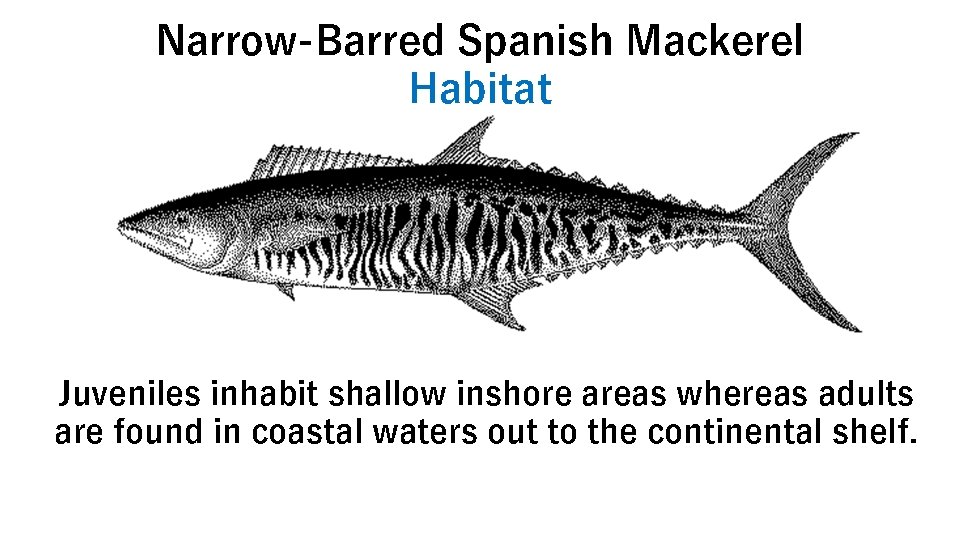
Narrow-Barred Spanish Mackerel Habitat Juveniles inhabit shallow inshore areas whereas adults are found in coastal waters out to the continental shelf.
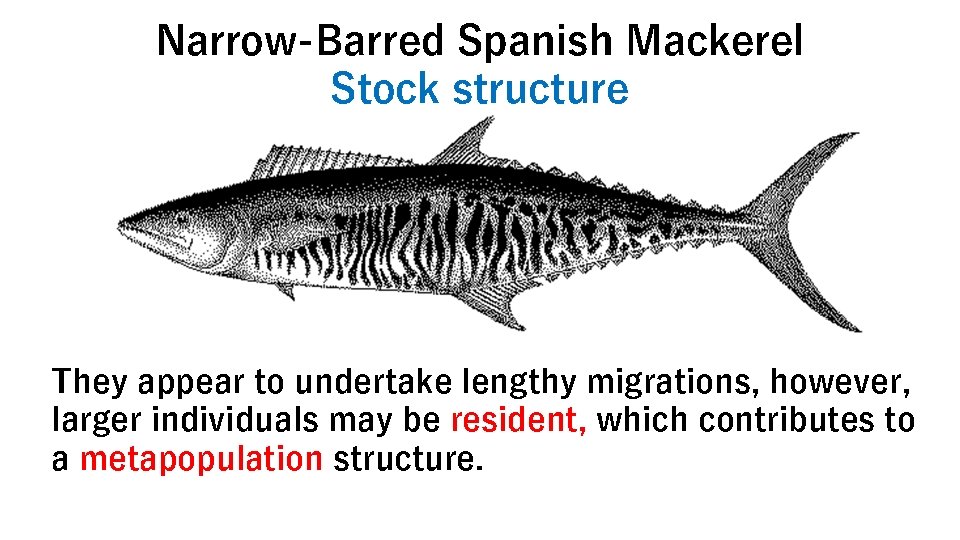
Narrow-Barred Spanish Mackerel Stock structure They appear to undertake lengthy migrations, however, larger individuals may be resident, which contributes to a metapopulation structure.
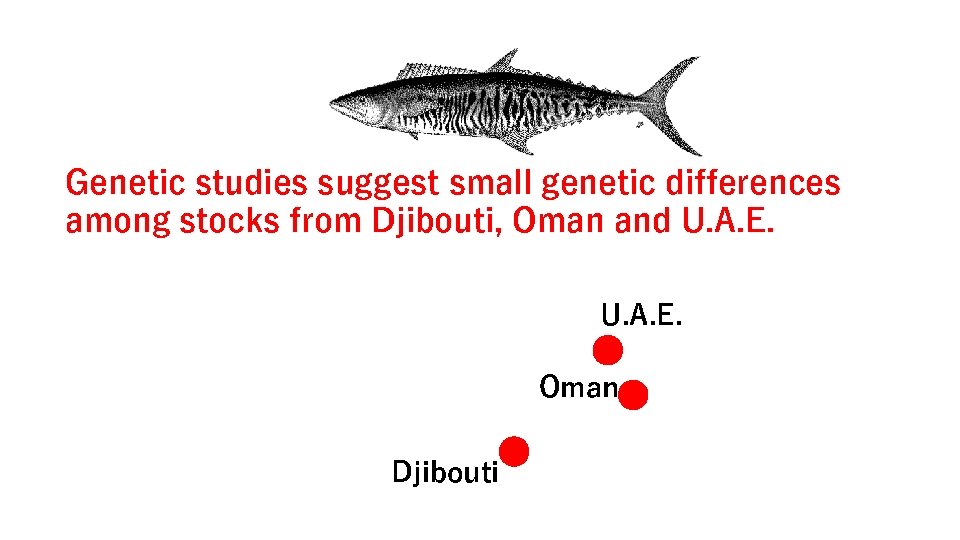
Genetic studies suggest small genetic differences among stocks from Djibouti, Oman and U. A. E. Oman Djibouti
Narrow-Barred Spanish Mackerel Annual catches based on the IOTC database Caught mainly using gillnet
Narrow-Barred Spanish Mackerel Average catches in the Indian Ocean over the period 2012 -16 Caught mainly by Indonesia and India
Narrow-Barred Spanish Mackerel Incomplete information on catch data ● The catches for artisanal fisheries have been only recently reported by gear in Indonesia and India. ● The catches of Indo-Pacific King Mackerel, other seerfish are sometimes mislabeled as Narrow-Barred Spanish Mackerel. ● The mislabeling is thought to have little impact in the case of the Narrow-Barred Spanish Mackerel but may be important for other seeffish species with smaller catch.
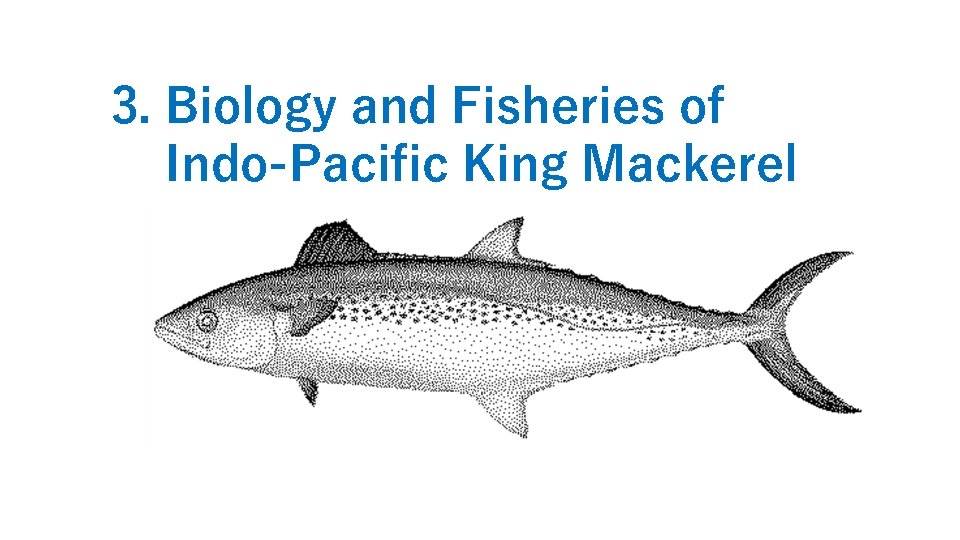
3. Biology and Fisheries of Indo-Pacific King Mackerel
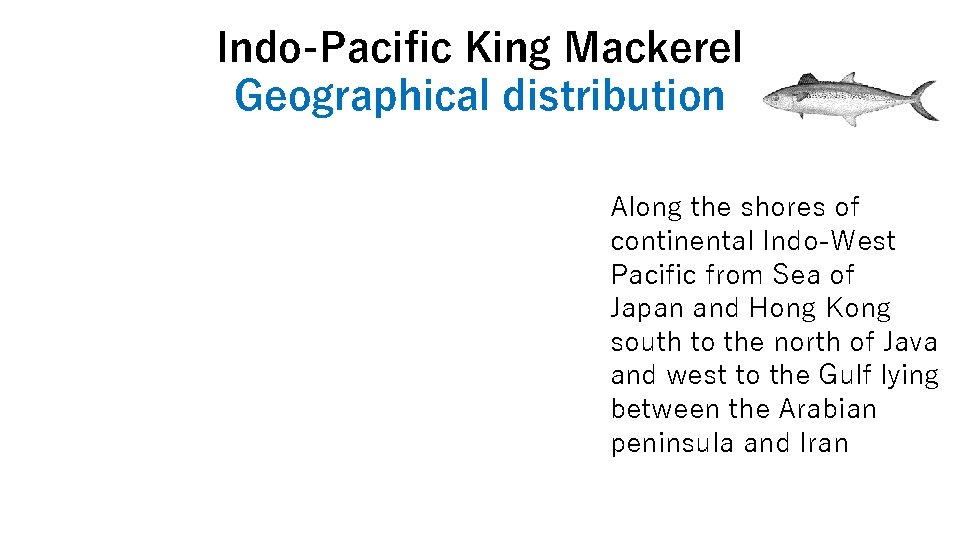
Indo-Pacific King Mackerel Geographical distribution Along the shores of continental Indo-West Pacific from Sea of Japan and Hong Kong south to the north of Java and west to the Gulf lying between the Arabian peninsula and Iran
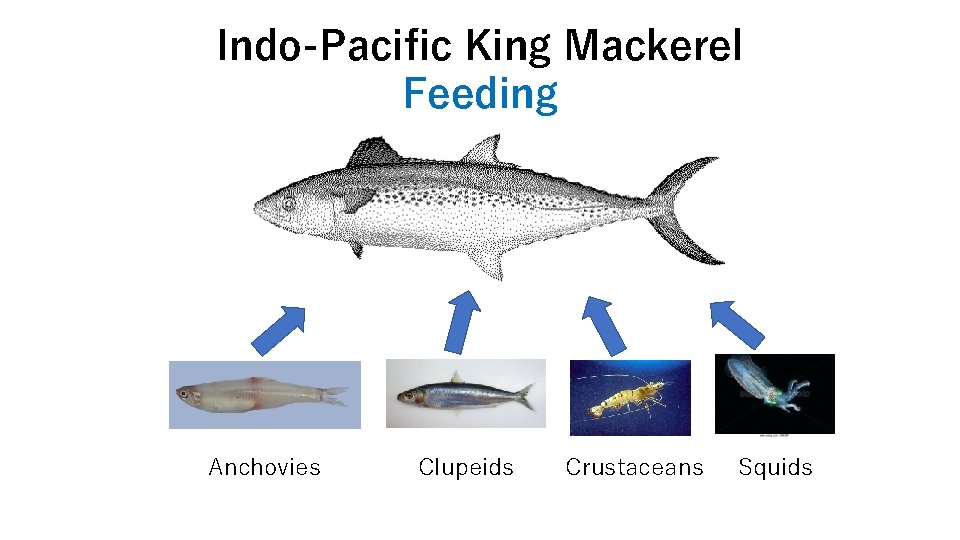
Indo-Pacific King Mackerel Feeding Anchovies Clupeids Crustaceans Squids
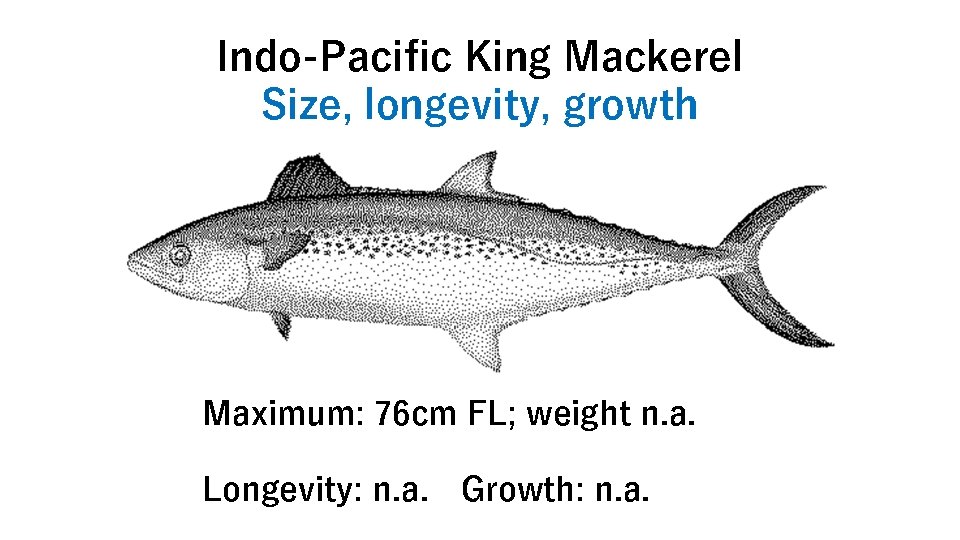
Indo-Pacific King Mackerel Size, longevity, growth Maximum: 76 cm FL; weight n. a. Longevity: n. a. Growth: n. a.
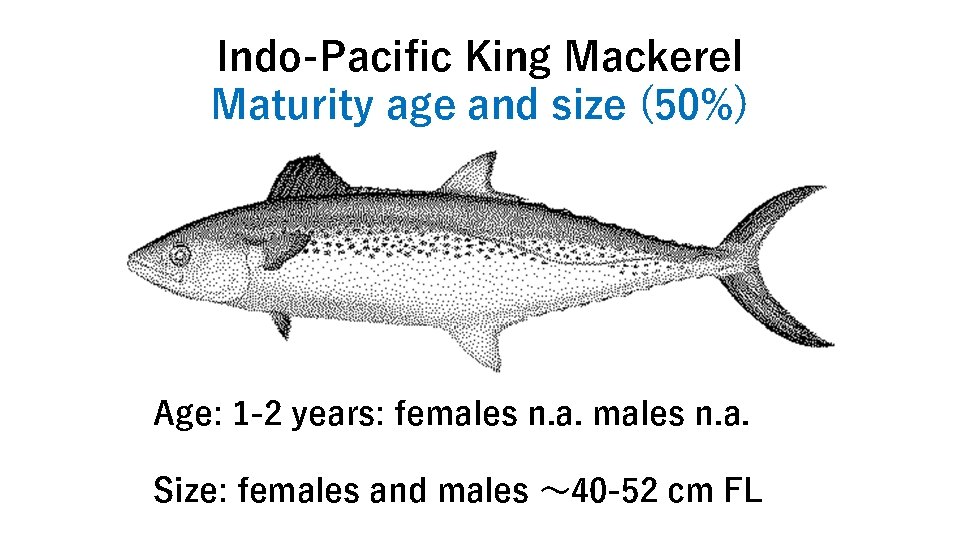
Indo-Pacific King Mackerel Maturity age and size (50%) Age: 1 -2 years: females n. a. Size: females and males ~ 40 -52 cm FL
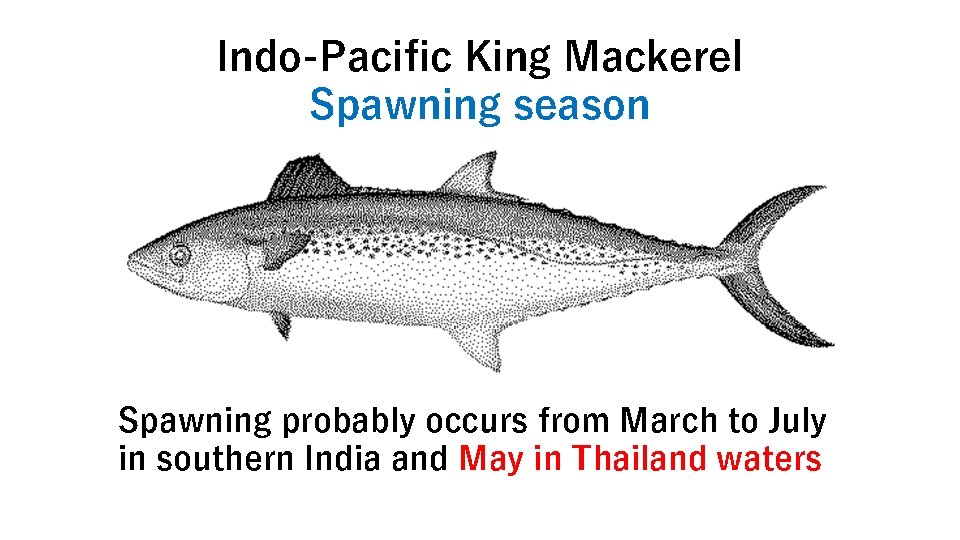
Indo-Pacific King Mackerel Spawning season Spawning probably occurs from March to July in southern India and May in Thailand waters
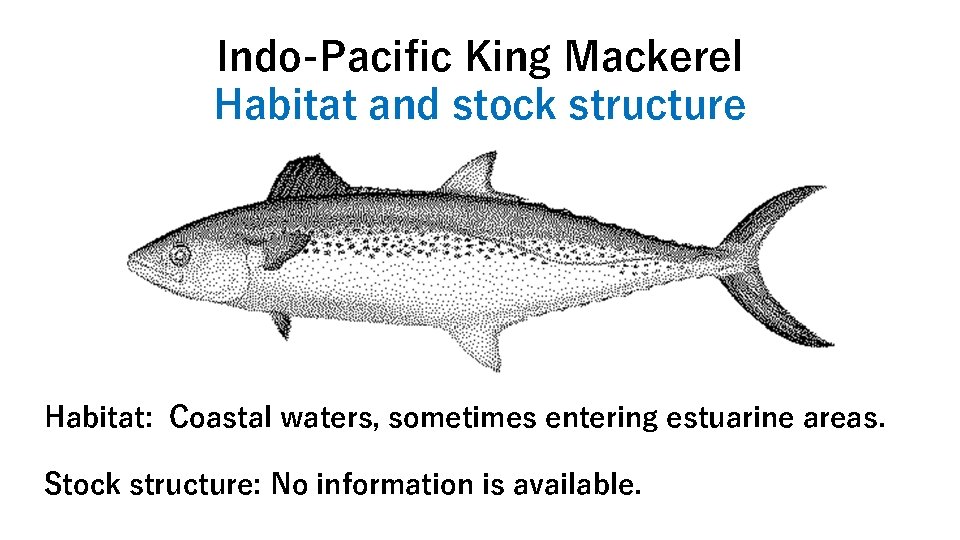
Indo-Pacific King Mackerel Habitat and stock structure Habitat: Coastal waters, sometimes entering estuarine areas. Stock structure: No information is available.
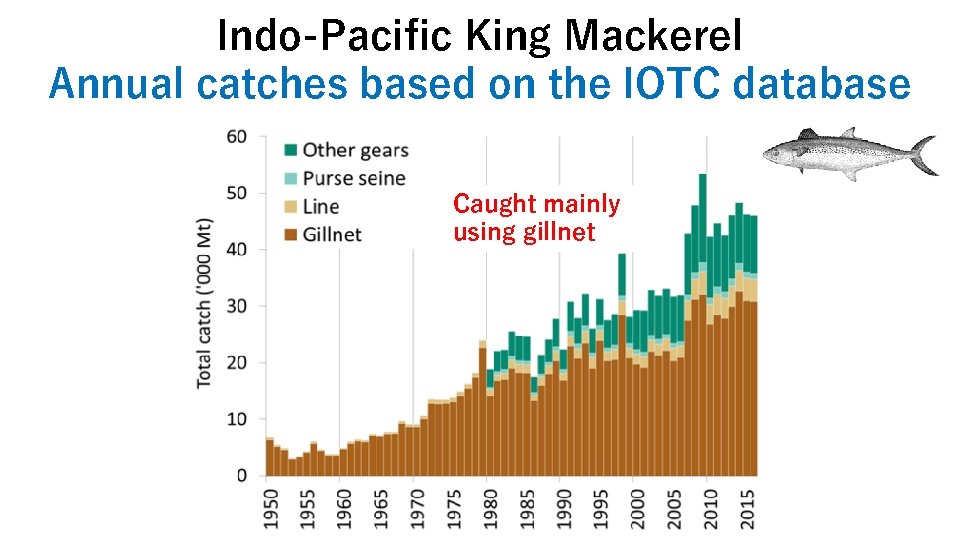
Indo-Pacific King Mackerel Annual catches based on the IOTC database Caught mainly using gillnet
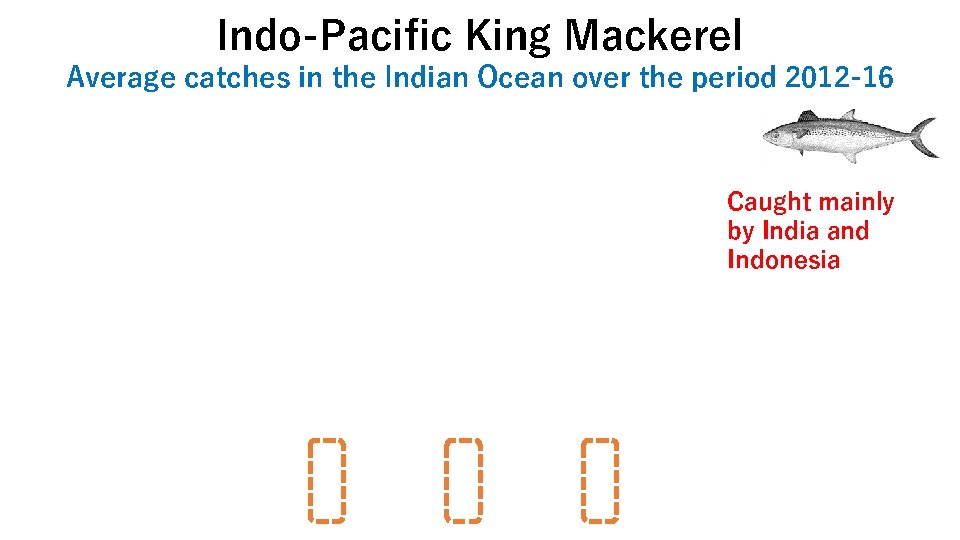
Indo-Pacific King Mackerel Average catches in the Indian Ocean over the period 2012 -16 Caught mainly by India and Indonesia
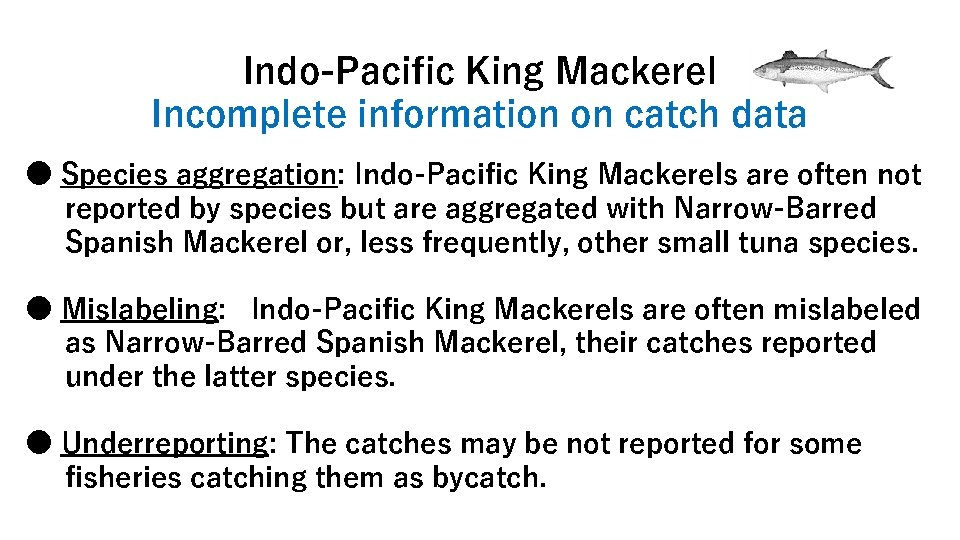
Indo-Pacific King Mackerel Incomplete information on catch data ● Species aggregation: Indo-Pacific King Mackerels are often not reported by species but are aggregated with Narrow-Barred Spanish Mackerel or, less frequently, other small tuna species. ● Mislabeling: Indo-Pacific King Mackerels are often mislabeled as Narrow-Barred Spanish Mackerel, their catches reported under the latter species. ● Underreporting: The catches may be not reported for some fisheries catching them as bycatch.
4. Summary (Biology) Narrow-Barred Spanish Mackerel ● Biological information such as growth, longevity and maturity is mainly derived from countries west of India and NE Australia, but scarce from Southeast Asia. ● Genetic studies suggest some genetic differences between different areas. Indo-Pacific King Mackerel ● Biological information is generally scarce. ● No information is available on the stock structure.
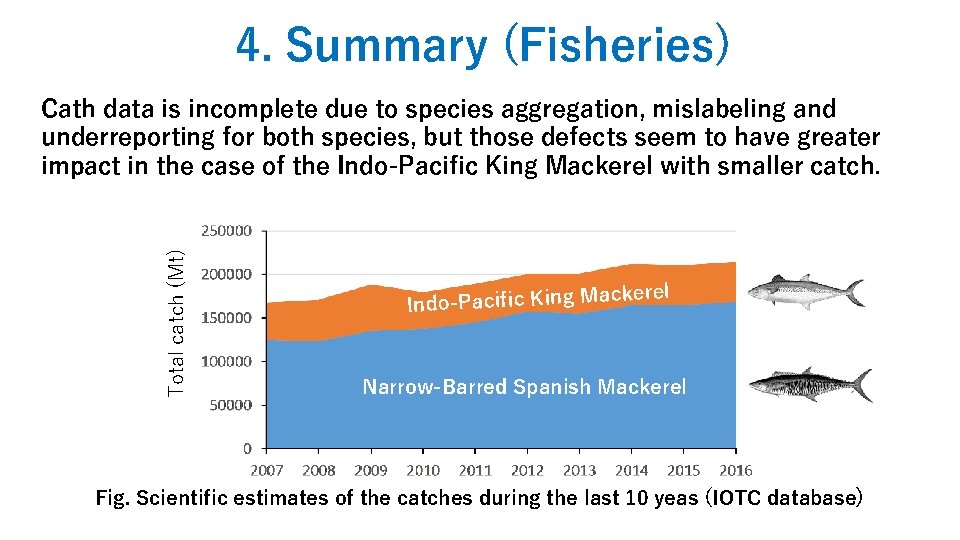
4. Summary (Fisheries) Total catch (Mt) Cath data is incomplete due to species aggregation, mislabeling and underreporting for both species, but those defects seem to have greater impact in the case of the Indo-Pacific King Mackerel with smaller catch. erel ack Indo-Pacific King M Narrow-Barred Spanish Mackerel Fig. Scientific estimates of the catches during the last 10 yeas (IOTC database)
5. Literatures Darvishi M, Kaymaram F, Salarpouri A, Behzadi S, Daghooghi B (2011) Population dynamic and biological aspects of Scombermorus commerson in the Persian Gulf and Oman Sea (Iranian coastal). IOTC– 2011–WPNT 01– 23 Froese R, Pauly DE (2009) Fish. Base, version 02/2009, Fish. Base Consortium, www. fishbase. org Grandcourt EM, Al Abdessalaam TZ, Francis F, Al Shamsi AT (2005) Preliminary assessment of the biology and fishery for the narrow-barred Spanish mackerel, Scomberomorus commerson (Lac´ep`ede, 1800), in the southern Arabian Gulf Fish Res 76: 277– 290 Mc. Pherson GR (1989) North-eastern Australian mackerel (Scomberomorus) fishery. In: Chavez EA, Ed). Proceedings of the workshop Australia-Mexico on marine sciences, Quintana Roo, Mexico, 6 -17 July 1989. Quintana Roo, Mexico. pp. 341 -348
Thank you for your attention!
- Slides: 37