
BIOLOGY 252 ANATOMY PHYSIOLOGY LAB NORTH CAROLINA COLLECTION
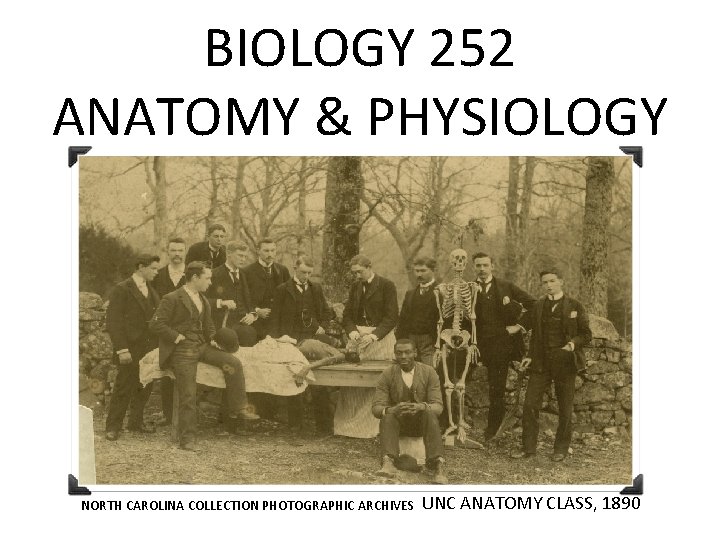
BIOLOGY 252 ANATOMY & PHYSIOLOGY LAB NORTH CAROLINA COLLECTION PHOTOGRAPHIC ARCHIVES UNC ANATOMY CLASS, 1890
Tips Expectations Yes it’s 1 credit hour, but PLAN to put in a lot of time to do well ▪ Just the “nature of the beast” -> A lot to cover in a little time! ▪ Work SMARTER not HARDER ▪ I’ll give you tips…. Study OFTEN ▪ Do not cram for exams – you will fail! ▪ Review each night (even a tiny bit) Mix it up ▪ Lab manual, review materials online, pictures ▪ Mnemonics, songs, USE YOUR OWN BODY ▪ Study Aids Spend (FULL) time wisely in LAB!!
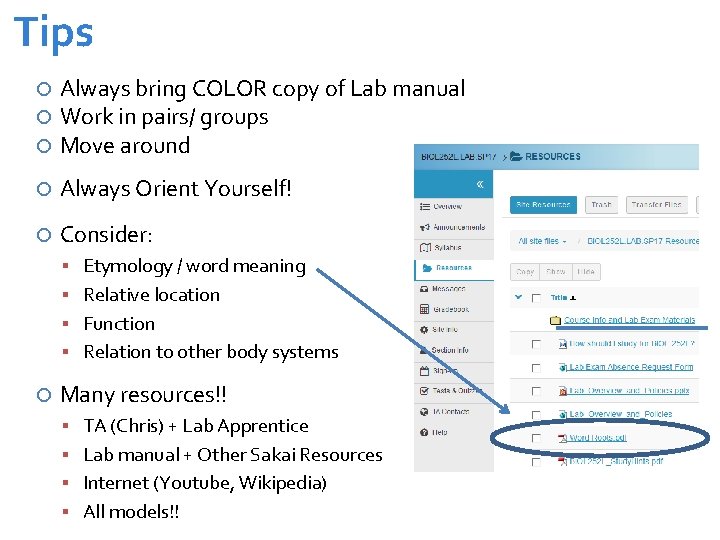
Tips Always bring COLOR copy of Lab manual Work in pairs/ groups Move around Always Orient Yourself! Consider: Etymology / word meaning Relative location Function Relation to other body systems Many resources!! TA (Chris) + Lab Apprentice Lab manual + Other Sakai Resources Internet (Youtube, Wikipedia) All models!!
Tips Always bring COLOR copy of Lab manual Work in pairs/ groups Move around Always Orient Yourself! Consider: #1 Tip! Etymology / word meaning Relative location Function Relation to other body systems Many resources!! TA (Chris) + Lab Apprentice Lab manual + Other Sakai Resources Internet (Youtube, Wikipedia) All models!! Approach this lab CONCEPTUALLY Do NOT attempt to simply MEMORIZE everything! ___________ Yes, a ton of memorization is important, but do so SMARTLY
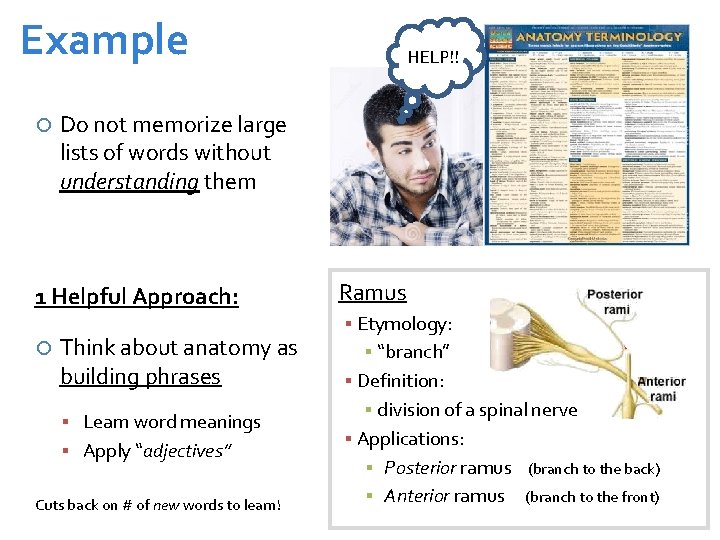
Example Do not memorize large lists of words without understanding them 1 Helpful Approach: HELP!! Think about anatomy as building phrases Learn word meanings Apply “adjectives” Cuts back on # of new words to learn! Ramus Etymology: ▪ “branch” Definition: ▪ division of a spinal nerve Applications: ▪ Posterior ramus (branch to the back) ▪ Anterior ramus (branch to the front)
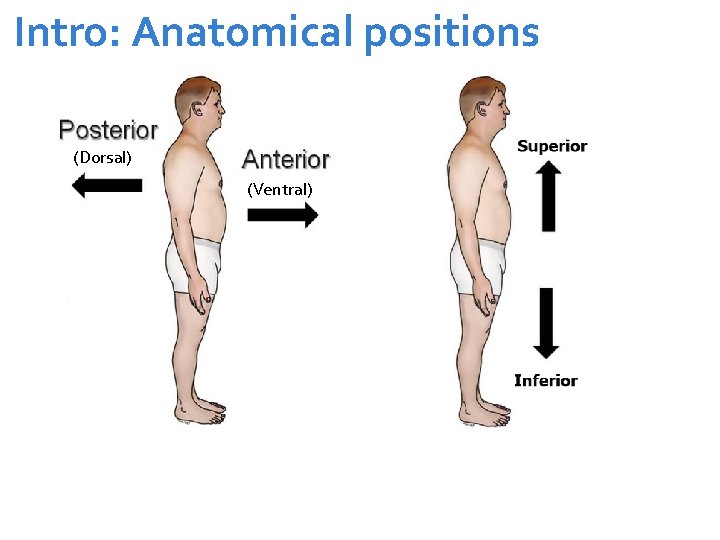
Intro: Anatomical positions (Dorsal) (Ventral)
How about those guided reading questions (GRQ’s on Connect)? ! Not “Homework”, but a tool. These are to PREPARE YOU for lab! Questions ≠ simple identification, but challenge you to understand what you’re reading They are open-book (manual). Actually read, don’t just hunt for answers. It’ll be easier in the long run Help you prepare + Easy points!!
ANNOUNCEMENTS Any technical problems with self-study or GRQs should be direct to Dr. Johnson: johnsonc@bio. unc. edu Next week’s GRQs should be competed after reading Chapter 2 of your manual. It must be completed before the start of lab. Peer mentoring available Thursdays 3 -6 & Fridays 9 -12 in W 111 • No appointment needed; walk in anytime • Get help or review models from current or past labs
Anatomy Lab #1: Spinal Cord & Spinal Nerves Objectives for this lab: Gross + cross-sectional anatomy of spinal cord Anatomical components of the spinal cord + nerves that participate in the autonomic nervous system Understand the spinal cord’s functional components Be able to describe the functional components that make up spinal nerves, roots, and rami Understand dermatomes Understand spinal reflexes
Anatomy
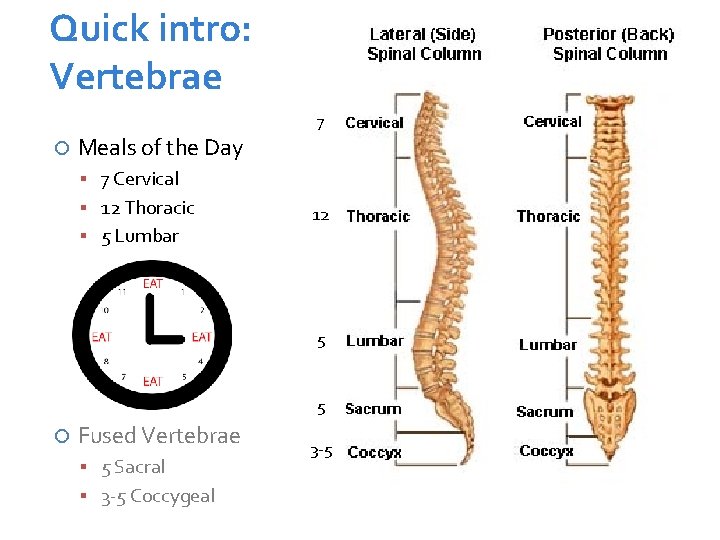
Quick intro: Vertebrae 7 Meals of the Day 7 Cervical 12 Thoracic 5 Lumbar 12 5 5 Fused Vertebrae 5 Sacral 3 -5 Coccygeal 3 -5
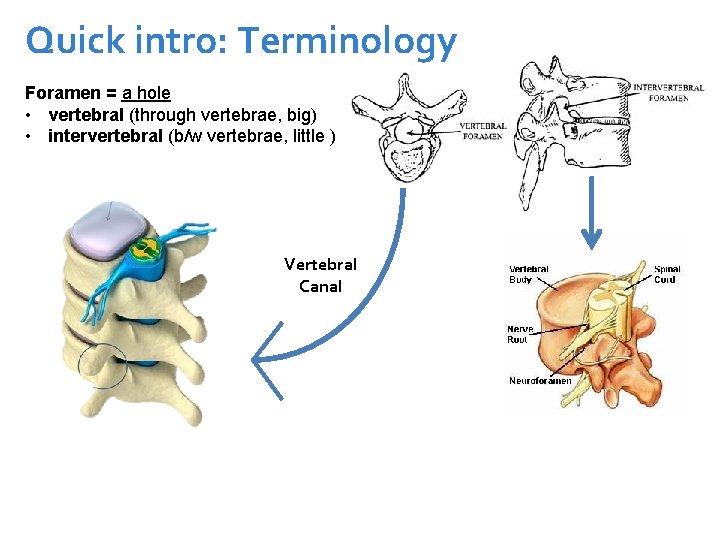
Quick intro: Terminology Foramen = a hole • vertebral (through vertebrae, big) • intervertebral (b/w vertebrae, little ) Vertebral Canal
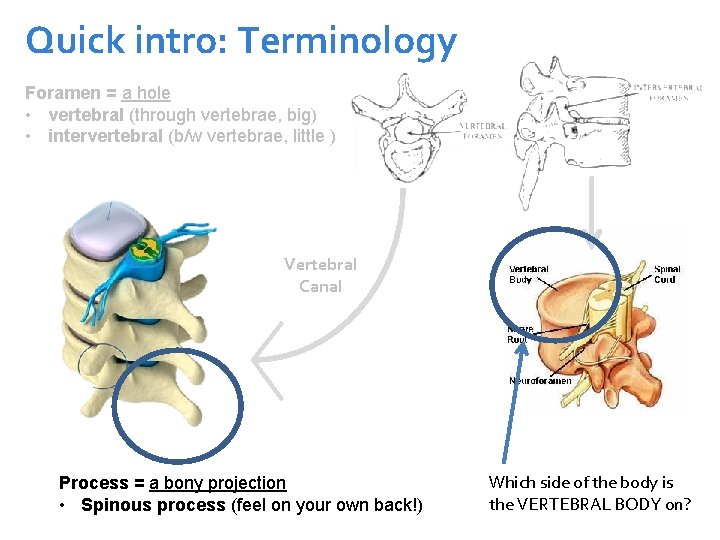
Quick intro: Terminology Foramen = a hole • vertebral (through vertebrae, big) • intervertebral (b/w vertebrae, little ) Vertebral Canal Process = a bony projection • Spinous process (feel on your own back!) Which side of the body is the VERTEBRAL BODY on?
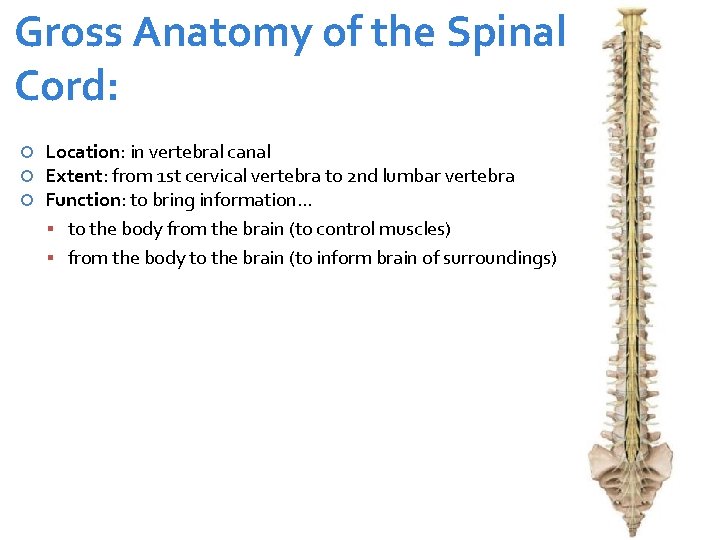
Gross Anatomy of the Spinal Cord: Location: in vertebral canal Extent: from 1 st cervical vertebra to 2 nd lumbar vertebra Function: to bring information. . . to the body from the brain (to control muscles) from the body to the brain (to inform brain of surroundings)
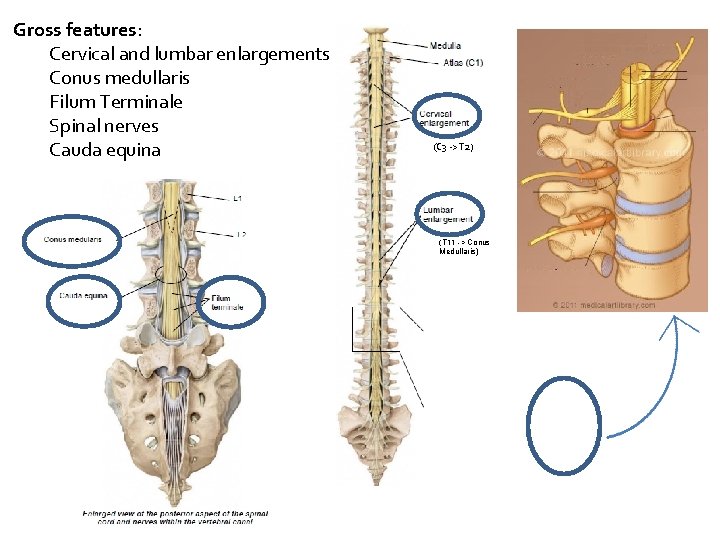
Gross features: Cervical and lumbar enlargements Conus medullaris Filum Terminale Spinal nerves Cauda equina (C 3 -> T 2) (T 11 -> Conus Medullaris) What’s their significance?
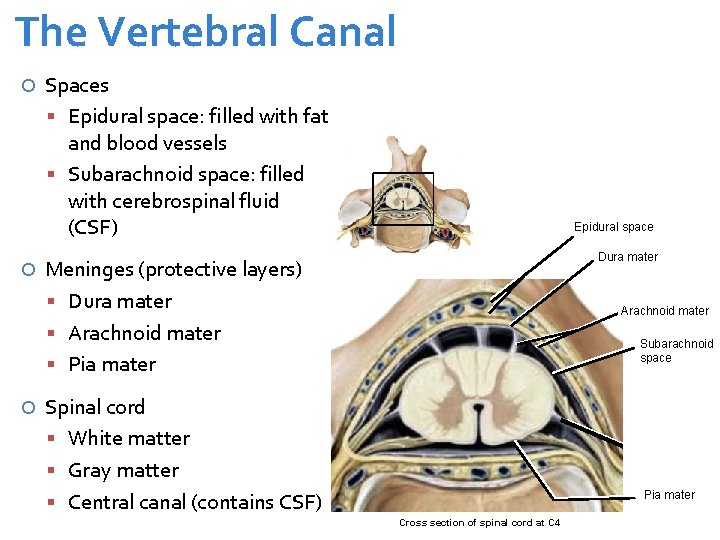
The Vertebral Canal Spaces Epidural space: filled with fat and blood vessels Subarachnoid space: filled with cerebrospinal fluid (CSF) Epidural space Dura mater Meninges (protective layers) Dura mater Arachnoid mater Pia mater Arachnoid mater Subarachnoid space Spinal cord White matter Gray matter Central canal (contains CSF) Denticulate ligament Pia mater Cross section of spinal cord at C 4
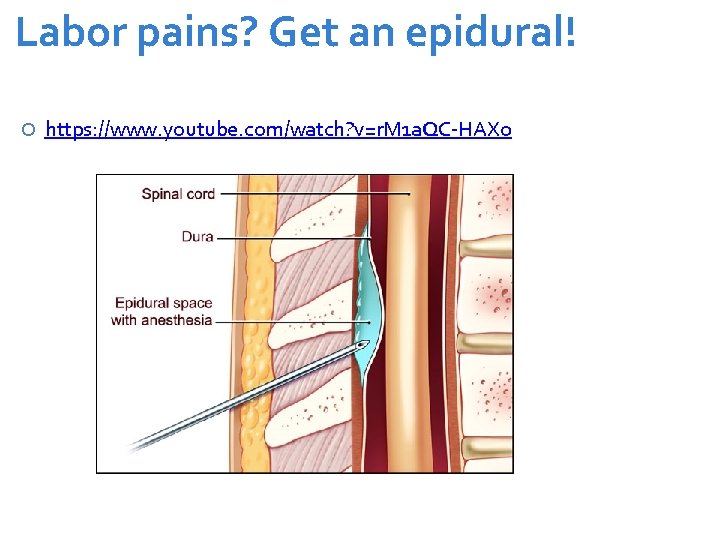
Labor pains? Get an epidural! https: //www. youtube. com/watch? v=r. M 1 a. QC-HAX 0
Identification Mini-quiz part 1 Get in groups of 3 -4 Use whiteboard to write down the answers This is not graded. You may use your groupmates, but try not to consult your lab manual.
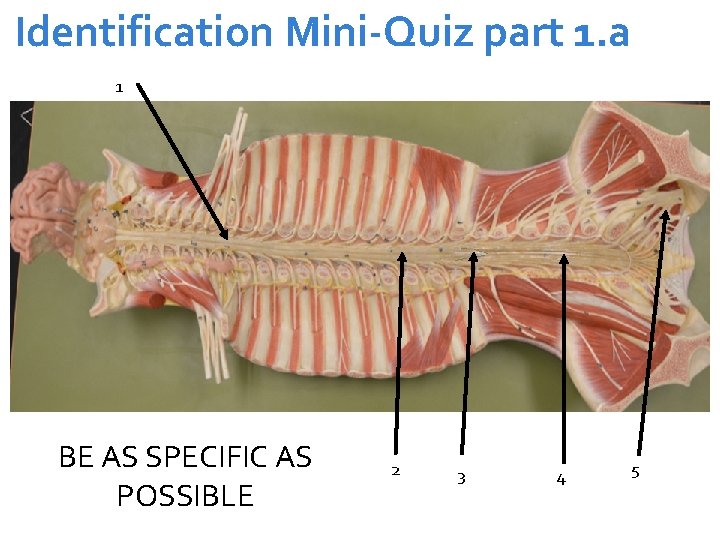
Identification Mini-Quiz part 1. a 1 BE AS SPECIFIC AS POSSIBLE 2 3 4 5
Function
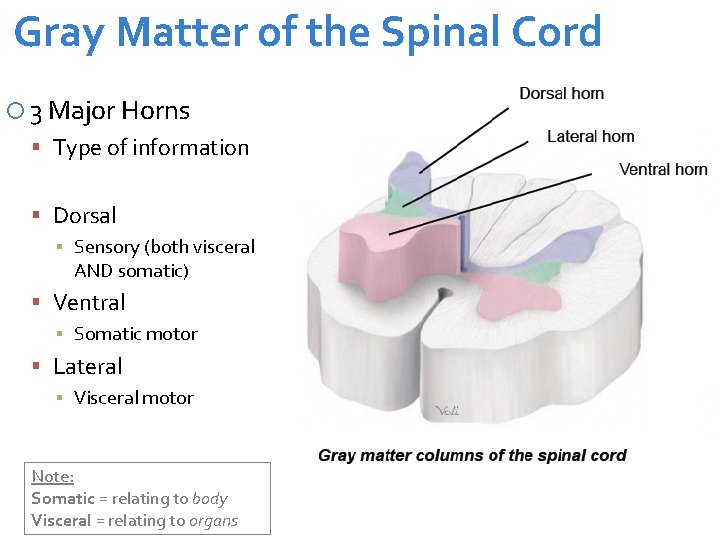
Gray Matter of the Spinal Cord 3 Major Horns Type of information Dorsal ▪ Sensory (both visceral AND somatic) Ventral ▪ Somatic motor Lateral ▪ Visceral motor Note: Somatic = relating to body Visceral = relating to organs
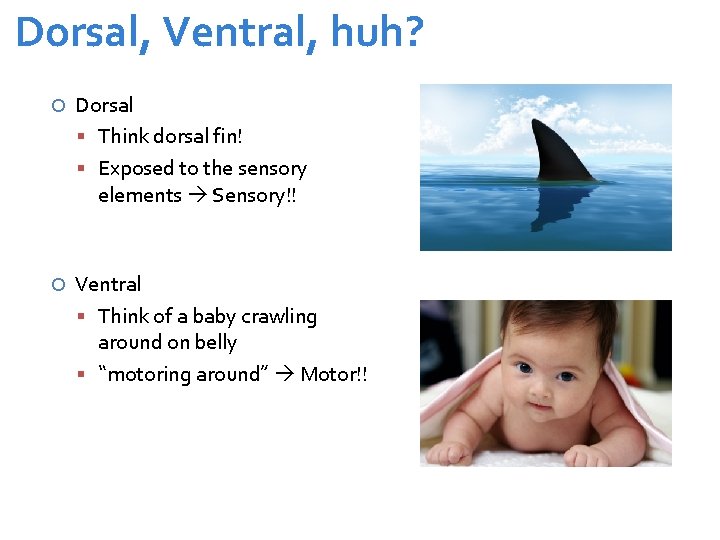
Dorsal, Ventral, huh? Dorsal Think dorsal fin! Exposed to the sensory elements Sensory!! Ventral Think of a baby crawling around on belly “motoring around” Motor!!
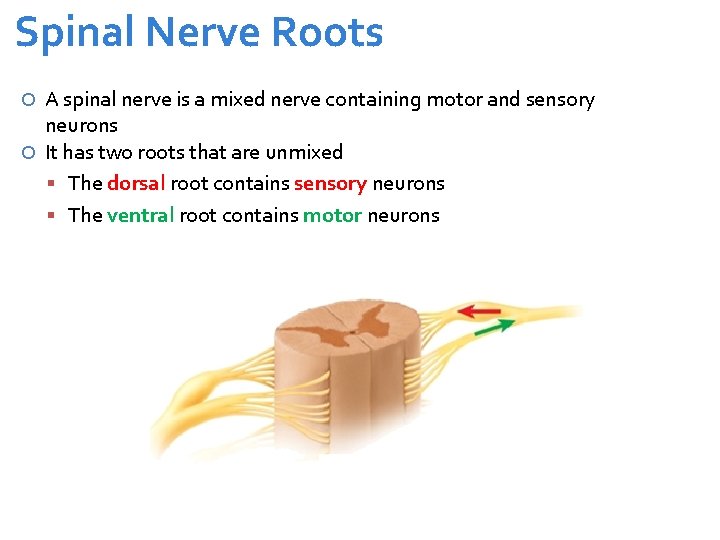
Spinal Nerve Roots A spinal nerve is a mixed nerve containing motor and sensory neurons It has two roots that are unmixed The dorsal root contains sensory neurons The ventral root contains motor neurons
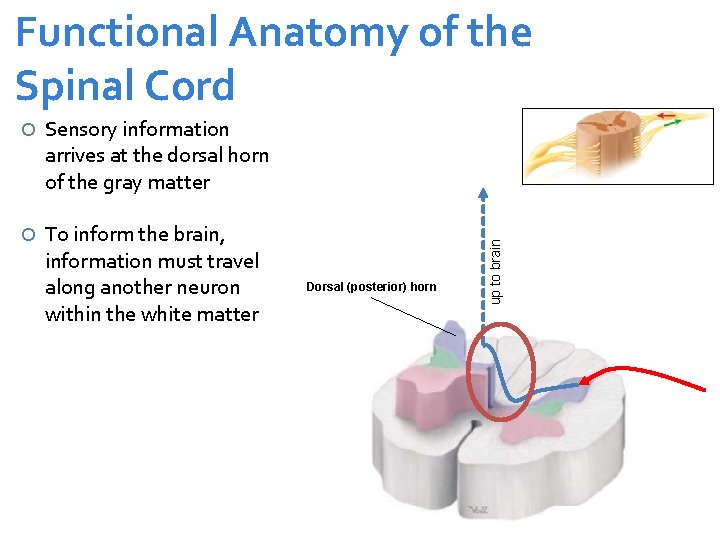
Sensory information arrives at the dorsal horn of the gray matter To inform the brain, information must travel along another neuron within the white matter Dorsal (posterior) horn up to brain Functional Anatomy of the Spinal Cord
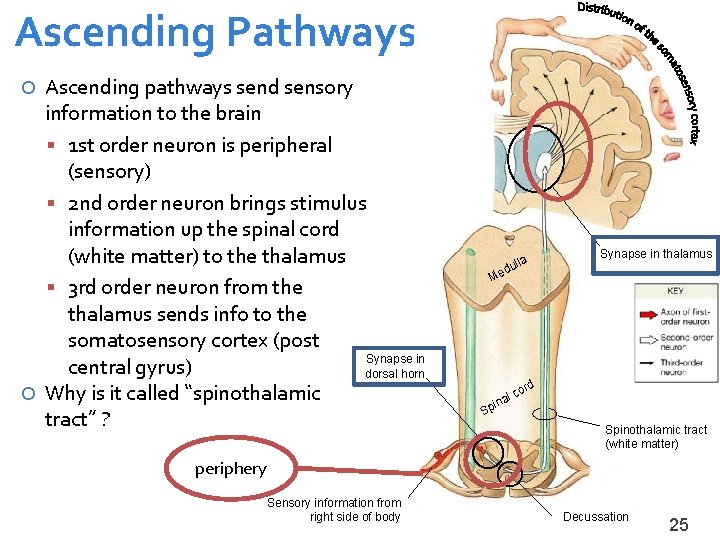
Ascending Pathways Ascending pathways send sensory information to the brain 1 st order neuron is peripheral (sensory) 2 nd order neuron brings stimulus information up the spinal cord (white matter) to the thalamus 3 rd order neuron from the thalamus sends info to the somatosensory cortex (post Synapse in central gyrus) dorsal horn Why is it called “spinothalamic tract” ? ulla ed Synapse in thalamus M rd co al in Sp Spinothalamic tract (white matter) periphery Sensory information from right side of body Decussation 25
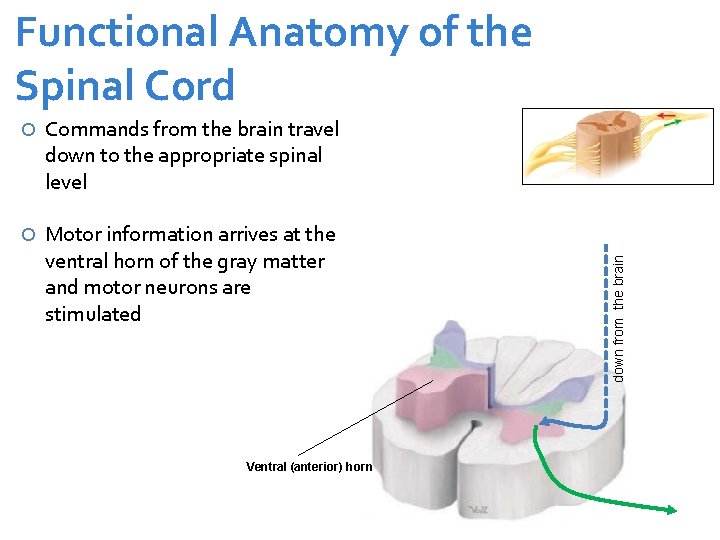
Commands from the brain travel down to the appropriate spinal level Motor information arrives at the ventral horn of the gray matter and motor neurons are stimulated Ventral (anterior) horn down from the brain Functional Anatomy of the Spinal Cord
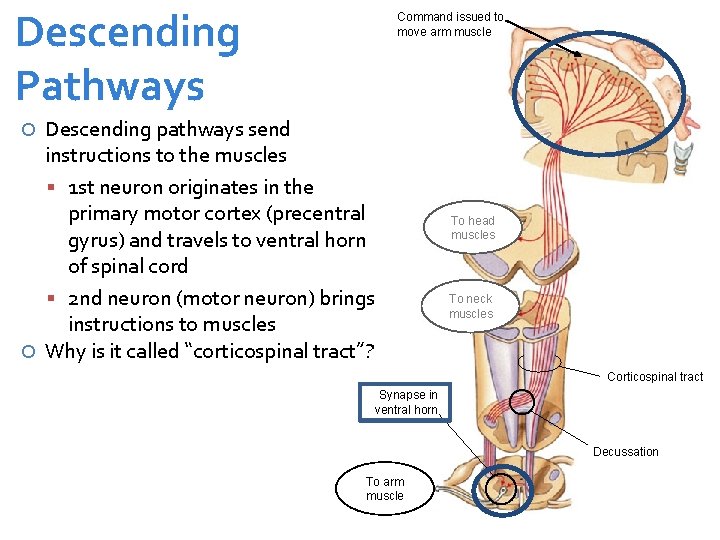
Descending Pathways Command issued to move arm muscle Descending pathways send instructions to the muscles 1 st neuron originates in the primary motor cortex (precentral gyrus) and travels to ventral horn of spinal cord 2 nd neuron (motor neuron) brings instructions to muscles Why is it called “corticospinal tract”? To head muscles To neck muscles Corticospinal tract Synapse in ventral horn Decussation To arm muscle
What’s the difference between the two tracts? Spinothalamic tract Corticospinal tract Ascending pathway Descending pathway 3 neurons 2 neurons Remember: Since it’s hasn’t reached the brain, it is NOT “smart” and needs 3 neurons to complete the task! coming from the brain, it is “smart” and only needs 2 neurons to complete the task!
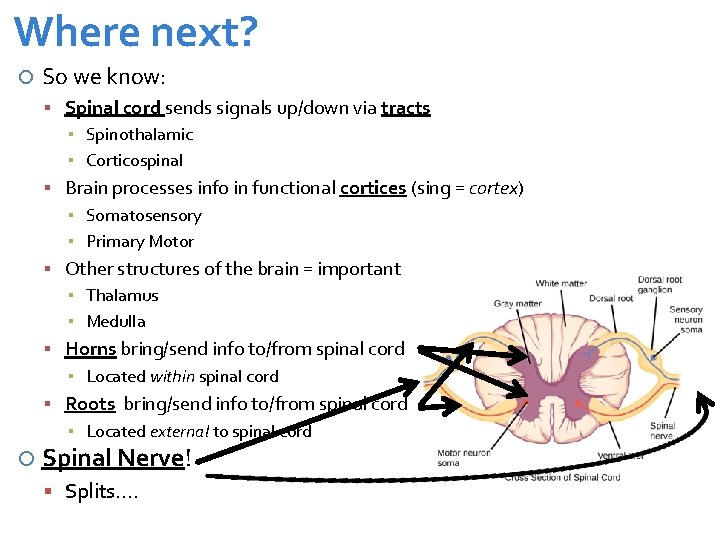
Where next? So we know: Spinal cord sends signals up/down via tracts ▪ Spinothalamic ▪ Corticospinal Brain processes info in functional cortices (sing = cortex) ▪ Somatosensory ▪ Primary Motor Other structures of the brain = important ▪ Thalamus ▪ Medulla Horns bring/send info to/from spinal cord ▪ Located within spinal cord Roots bring/send info to/from spinal cord ▪ Located external to spinal cord Spinal Nerve! Splits….
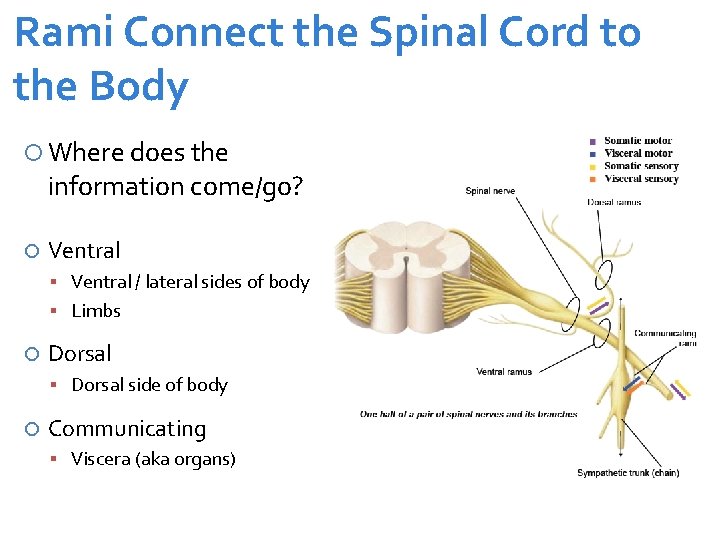
Rami Connect the Spinal Cord to the Body Where does the information come/go? Ventral / lateral sides of body Limbs Dorsal side of body Communicating Viscera (aka organs)
SO MANY WORDS!! I’m bound to get them all confused! If only there was some way to remember their order…
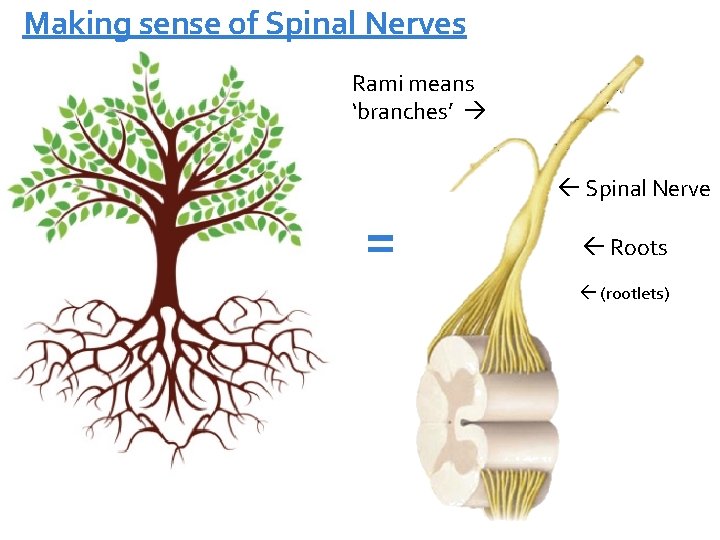
Making sense of Spinal Nerves Rami means ‘branches’ = Spinal Nerve Roots (rootlets)
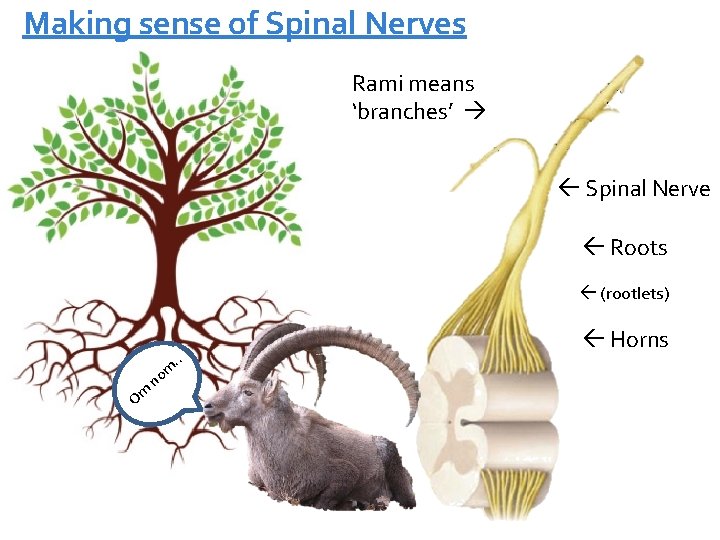
Making sense of Spinal Nerves Rami means ‘branches’ Spinal Nerve Roots (rootlets) Om n . . m o Horns
Group Activity: Neuronal Pathways Get in a group of 3 -4. Grab a whiteboard and draw/write out all of the neuronal pathways From fingertip to spinal cord to brain 2. From brain to spinal cord to back muscles 3. Your brain is receiving signals from your stomach, thus it tells your stomach to rumble. 1.
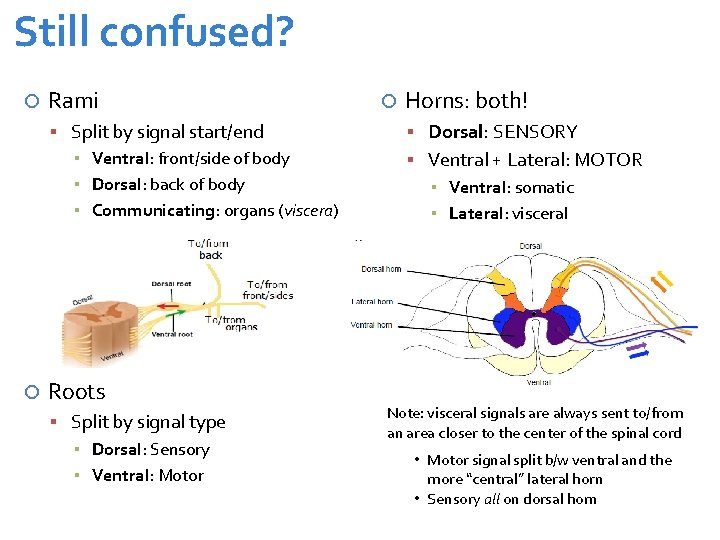
Still confused? Rami Split by signal start/end ▪ Ventral: front/side of body ▪ Dorsal: back of body ▪ Communicating: organs (viscera) Roots Split by signal type ▪ Dorsal: Sensory ▪ Ventral: Motor Horns: both! Dorsal: SENSORY Ventral + Lateral: MOTOR ▪ Ventral: somatic ▪ Lateral: visceral Note: visceral signals are always sent to/from an area closer to the center of the spinal cord • Motor signal split b/w ventral and the more “central” lateral horn • Sensory all on dorsal horn
More Function
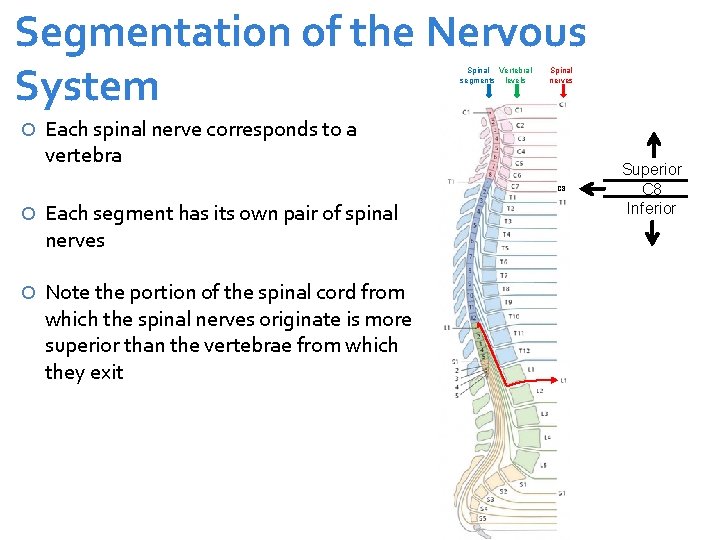
Segmentation of the Nervous System Spinal Vertebral segments levels Spinal nerves Each spinal nerve corresponds to a vertebra C 8 Each segment has its own pair of spinal nerves Note the portion of the spinal cord from which the spinal nerves originate is more superior than the vertebrae from which they exit Superior C 8 Inferior
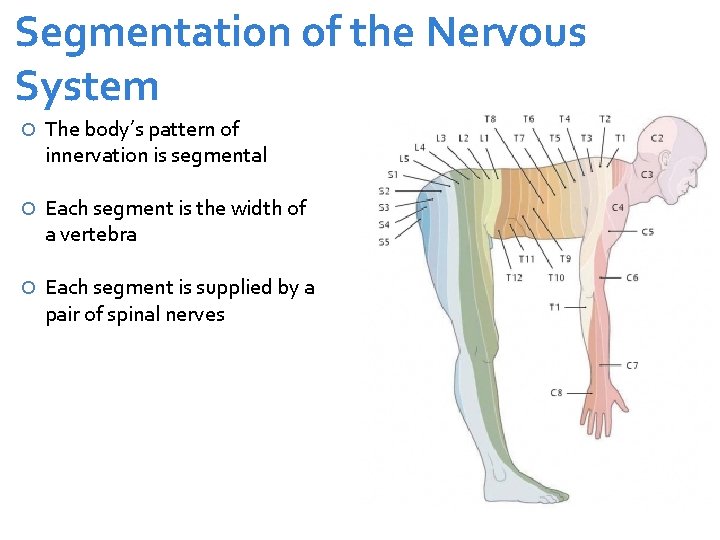
Segmentation of the Nervous System The body’s pattern of innervation is segmental Each segment is the width of a vertebra Each segment is supplied by a pair of spinal nerves
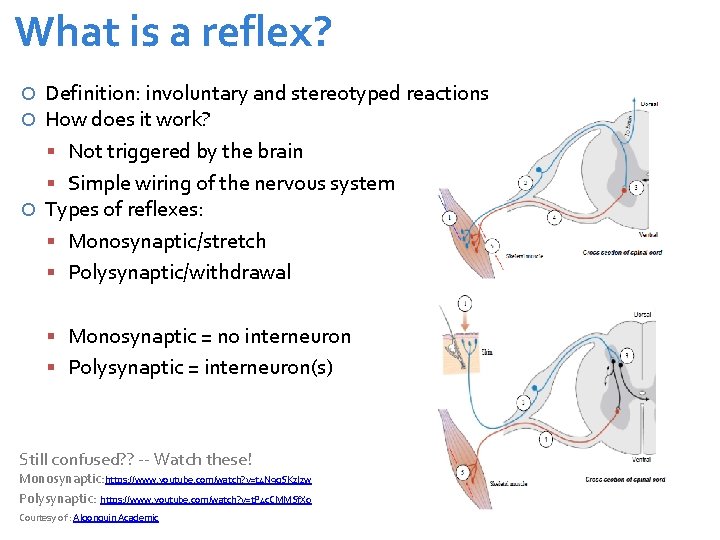
What is a reflex? Definition: involuntary and stereotyped reactions How does it work? Not triggered by the brain Simple wiring of the nervous system Types of reflexes: Monosynaptic/stretch Polysynaptic/withdrawal Monosynaptic = no interneuron Polysynaptic = interneuron(s) Still confused? ? -- Watch these! Monosynaptic: https: //www. youtube. com/watch? v=t 4 N 9 q. SKzlzw Polysynaptic: https: //www. youtube. com/watch? v=t. P 4 c. CMMSf. X 0 Courtesy of : Algonquin Academic
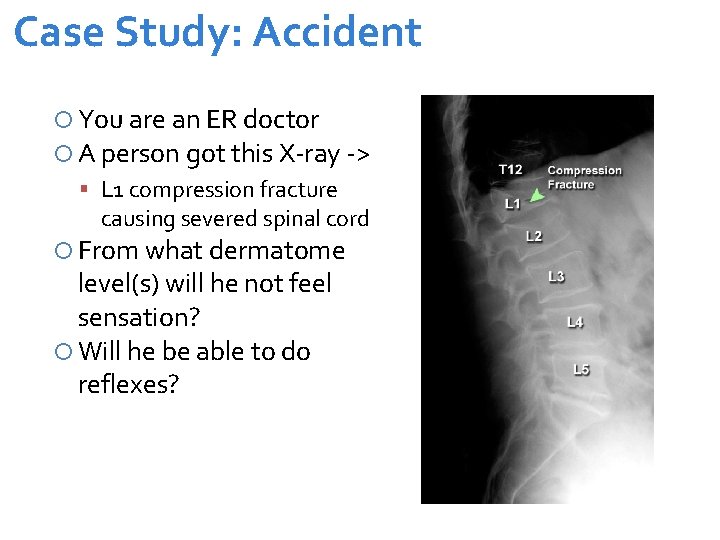
Case Study: Accident You are an ER doctor A person got this X-ray -> L 1 compression fracture causing severed spinal cord From what dermatome level(s) will he not feel sensation? Will he be able to do reflexes?
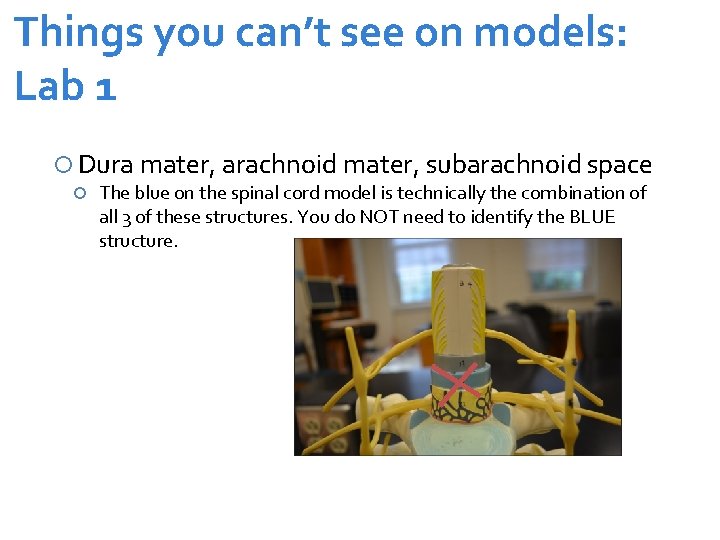
Things you can’t see on models: Lab 1 Dura mater, arachnoid mater, subarachnoid space The blue on the spinal cord model is technically the combination of all 3 of these structures. You do NOT need to identify the BLUE structure.
Before you leave, make sure that you… ❑ Identify all of the bold terms in the lab manual on a model ❑ Explain the function of all anatomical structures ❑ Quiz your partner(s) on the structures and their functions
- Slides: 42