
Biology 221 Anatomy Physiology II TOPIC 12 Reproductive
Biology 221 Anatomy & Physiology II TOPIC 12 Reproductive System Chapter 28 pp. 1071 -1107 E. Lathrop-Davis / E. Gorski / S. Kabrhel 1
Male Anatomy Overview Consists of: • Testes • Ducts – epididymus – ductus (vas) deferens – ejaculatory duct – urethra • Penis • Accessory glands – seminal vesicles – prostate – bulblurethral (Cowper’s) http: //www. msms. doe. k 12. ms. us/biology/anatomy/re productive/376 a. gif Fig. 28. 1, p. 1071 2
Male: Testis • Located in scrotum – temperature regulation (keeps them at about 33 o. C) • Structure of testis – seminiferous tubules – interstitial cells (cells of Leydig) – rete testis Fig. 28. 3, p. 1073 3
Male: Testis – Seminiferous Tubules • Produce sperm • Sustentacular (Sertoli) cells (5) – support spermatocytes and spermatozoa, and produce inhibin (inhibits FSH/LH secretion) http: //www. usc. edu/hsc/dental/ghisto/rep/d_74. html 4
Male: Testis – Interstitial Cells and Rete Testis • Interstitial cells (between seminiferous tubules) – produce testosterone (promotes sperm formation) • Rete testis – first collection area – network of tubules on posterior side – Lead to epididymus http: //www. usc. edu/hsc/dental/ghisto/rep/d_74. html http: //www. usc. edu/hsc/dental/ghisto/rep/d_75. html Fig. 28. 3, p. 1073 5
Male: Testis Coverings • tunica vaginalis (TV) – connective tissue, derived from peritoneum • tunica albuginea (TA) – fibrous capsule • septa (S; singular = septum) – extensions of tunica albuginea; divide testis into sections Fig. 28. 3, p. 1073 http: //www. usc. edu/hsc/dental/ghisto/rep/d_72. html 6
Male: Duct System • Epididymis – site of sperm maturation • Ductus (vas) deferens – carries sperm away from testis to ejaculatory duct • Ejaculatory Duct – extends from where ducts from seminal vesicles join ductus deferens to urethra Fig. 28. 1, p. 1071 http: //www. msms. doe. k 12. ms. us/biology/anatomy/reproductive/376 a. gif 7
Male: Urethra • Prostatic urethra – runs through prostate gland • Membranous urethra – runs from prostate to penis • Penile urethra – runs through penis Fig. 28. 4, p. 1075 http: //www. nku. edu/~dempseyd/REPRODUCTION_2. htm 8
Male: Penis • Designed to deliver sperm into vagina of female • Erectile tissues – Corpora cavernosa (CC) – Corpus spongiosum (CS) – surrounds urethra Fig. 28. 4, p. 1075 http: //wbiomed. curtin. edu. ou/teach/humanbiol/hb 134/134 hist/penis. htm 9
Male Accessory Glands & Semen • Semen = sperm plus products of the accessory glands that support and nourish the sperm + sperm • Glands (overview) – Seminal vesicles (SV) – Prostate gland – Bulbourethral (Cowper’s) glands Fig. 28. 1, p. 1071 10
Male Accessory Glands: Seminal Vesicles • produce about 60% of all semen • alkaline fluid – neutralizes acidity of vagina • fructose – nourishes sperm Fig. 28. 1, p. 1071 11
Male Accessory Glands: Prostate • encircles urethra below bladder • produces about 30% of semen • products play a role in activating and protecting sperm • citrate nourishes sperm http: //www. usc. edu/hsc/dental/ghisto/rep/d_96. html Fig. 28. 1, p. 1071 12

Male Accessory Gland: Bulbourethral Glands • Lie near base of penis • Produce mucus that neutralizes acidity of traces of urine in urethra Fig. 28. 1, p. 1071 13
Male Reproductive Physiology: Sperm Production Overview • Sperm (and ova) are produce by meiotic cell division • Sperm production involves two stages: – Spermatogenesis – in which diploid cells divide by meiotic cell division to yield haploid gametes – Spermiogenesis – maturation of spermatids into functional spermatozoa (sperm) 14
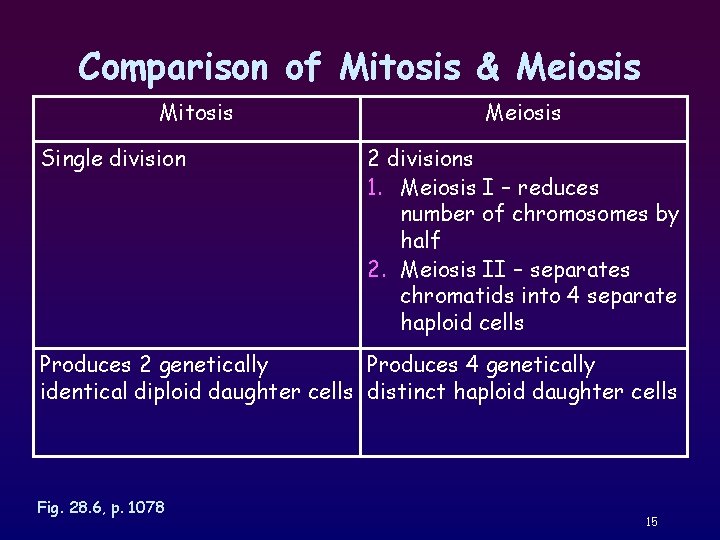
Comparison of Mitosis & Meiosis Mitosis Single division Meiosis 2 divisions 1. Meiosis I – reduces number of chromosomes by half 2. Meiosis II – separates chromatids into 4 separate haploid cells Produces 2 genetically Produces 4 genetically identical diploid daughter cells distinct haploid daughter cells Fig. 28. 6, p. 1078 15
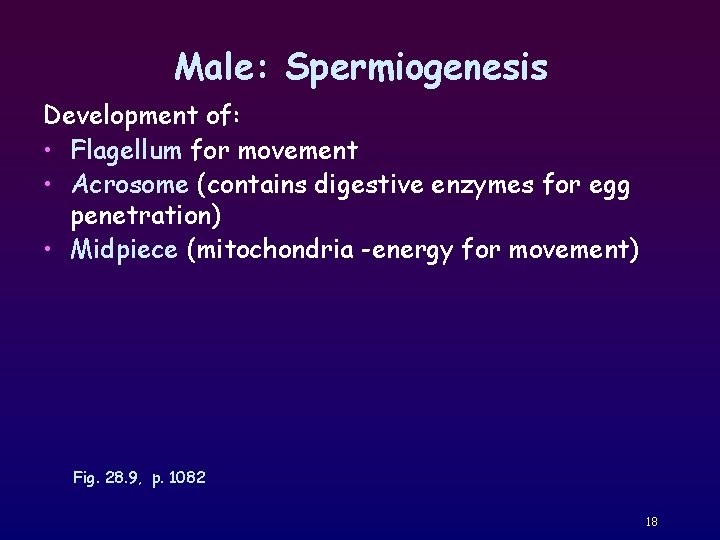
Male: Spermiogenesis Development of: • Flagellum for movement • Acrosome (contains digestive enzymes for egg penetration) • Midpiece (mitochondria -energy for movement) Fig. 28. 9, p. 1082 18
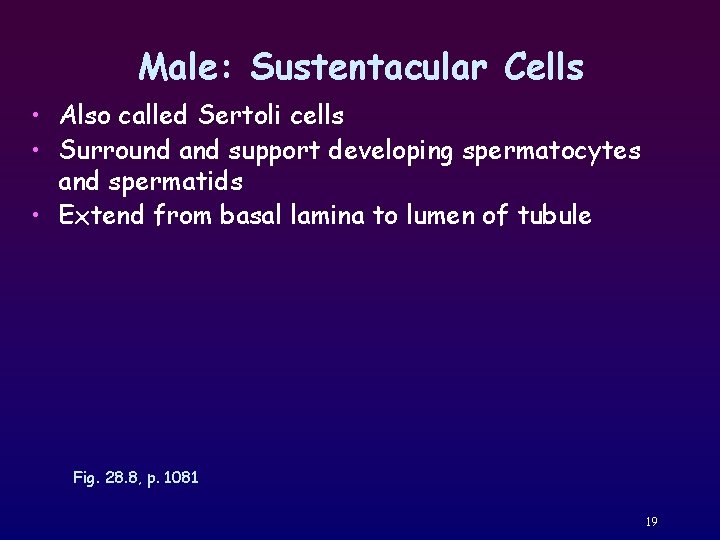
Male: Sustentacular Cells • Also called Sertoli cells • Surround and support developing spermatocytes and spermatids • Extend from basal lamina to lumen of tubule Fig. 28. 8, p. 1081 19
Male: Sustentacular Cells • Form blood-testis barrier – cells joined by tight junctions - prevents contact between developing sperm and blood – produce fluid different from surrounding interstitial fluid (higher in androgens, amino acids, potassium) – important because sperm are first produced after immune system has developed sense of “self” ° sperm would be recognized as foreign if contacted blood 20
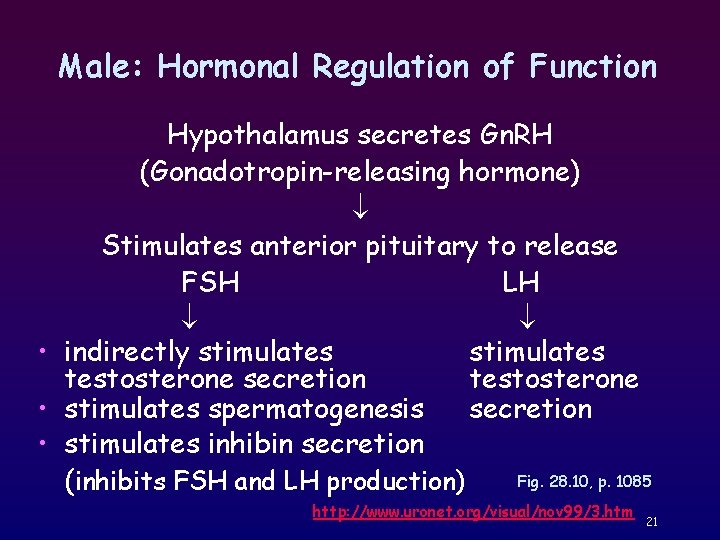
Male: Hormonal Regulation of Function Hypothalamus secretes Gn. RH (Gonadotropin-releasing hormone) Stimulates anterior pituitary to release FSH LH • indirectly stimulates testosterone secretion testosterone • stimulates spermatogenesis secretion • stimulates inhibin secretion Fig. 28. 10, p. 1085 (inhibits FSH and LH production) http: //www. uronet. org/visual/nov 99/3. htm 21
Male: Testosterone Stimulates • spermatogenesis • development and maintenance of male secondary sex characteristics (e. g. , facial hair, large muscles, etc. ) and male reproductive organs • development of sexual drive in CNS • protein synthesis in muscle cells and growth of muscle and bone http: //www. uronet. org/visual/nov 99/1. htm Fig. 28. 10, p. 1085 22
Female Anatomy Overview Consists of: • Ovaries • Fallopian (uterine) tubes (oviducts) • Uterus • Vagina • Mammary glands • Supporting structures http: //www. med. umich. edu/lrc/coursepages/M 1/anatomy/html/radiology/pelvis/h ysterosalpingogram. html Fig. 28. 11, p. 1086 24
Female: Ovaries • Located lateral to uterus • Ligaments anchor ovary to other structures – ovarian ligament – anchors ovary to uterus – broad ligament – parietal peritoneal tissue ° suspensory ligament – anchors ovary to lateral pelvic wall ° mesovarium – holds ovary between ovarian and suspensory ligaments • Contains oocytes surrounded by follicles • Release secondary oocytes into pelvic cavity Fig. 28. 14, p. 1089 25
Female: Uterine (Fallopian) Tubes • Carry oocyte toward uterus • Fimbriae (F) immediately pick up secondary oocyte released from ovary and transfer it into UT • Smooth muscle and cilia of simple columnar epithelium help move oocyte toward uterus Fig. 28. 14, p. 1089 http: //www. med. umich. edu/lrc/coursepages/M 1/anatomy/html/radiology/ pelvis/hysterosalpingogram. html 26
Female: Uterus • Normal site of implantation of fertilized ovum and development of fetus • Layers – endometrium (inner layer) – myometrium (smooth muscle) – perimetrium (covering of visceral peritoneum) Fig. 28. 14, p. 1089 27
Female: Uterus – Endometrium • Consists of two sublayers – stratum functionalis (f) – undergoes cyclical changes every month – stratum basalis (b) – overlies myometrium (m) and forms a new stratum functionalis • Forms maternal part of placenta http: //www. usc. edu/hsc/dental/ghisto/rep/d_33. html http: //www. usc. edu/hsc/dental/ghisto/rep/d_34. html 28
Female: Myometrium & Perimetrium • Myometrium – consists of smooth muscle – contracts to expel sloughed off endometrial tissue or fetus • Perimetrium (serosa) – peritoneal covering Fig. 28. 14, p. 1089 29
Female: Cervix and Vagina • Cervix – narrow “neck” of uterus • Vagina – “birth canal” – lined with stratified squamous epithelium Fig. 28. 14, p. 1089 30
Mammary Glands • • Modified sweat glands Only functional in females Produce milk to nourish newborn Hormonal control – prolactin - stimulates milk production in lactating female – oxytocin - stimulates milk ejection Fig. 28. 17, p. 1093 31
Female: Ovarian Cycle Overview • Consists of two phases: Follicular (1 -6 in diagram) & Luteal (7 -9 in diagram) Fig. 28. 20, p. 1097 32
Follicular Phase – 1 st to 14 th Day • Several primordial follicles develop into primary follicles • Primary follicle develops into secondary follicle – zona pellucida (thick, transparent membrane around oocyte) – begins to produce estrogens – antrum (opening around oocyte) forms • Secondary follicle (when antrum is present) becomes Vesicular follicle (Graafian follicle) – corona radiata forms (cells surrounding oocyte) – primary oocyte divides (finishes meiosis I) to form 1 secondary oocyte and 1 polar body Fig. 28. 12, p. 1087 Fig. 28. 19, p. 1095 33
Ovulation and Luteal Phase – 14 th to 28 th day • Ovulation = release of secondary oocyte (arrested in metaphase of meiosis II) from ovary • Luteal Phase – 14 th to 28 th day – cells of ruptured Graafian follicle become corpus luteum which begins to secrete progesterone and continue to secrete estrogen – corpus luteum degenerates in about 10 days if pregnancy does not occur then becomes corpus albicans Fig. 28. 12, p. 1087 34
Ovarian Cycle: Hormonal Control • Hypothalamus secretes Gn. RH (gonadotropin releasing hormone) • Gn. RH stimulates release of FSH (follicle stimulating hormone) and LH (lutenizing hormone) from anterior pituitary – FSH (& LH) stimulate follicle growth Fig. 28. 21, p. 1098 35
Ovarian Cycle: Hormonal Control • Enlarged follicles begin to secrete estrogens • Rising estrogen levels initially inhibit release of FSH & LH from anterior pituitary, but also stimulate it to produce and accumulate these hormones (i. e. , accumulate FSH and LH) Fig. 28. 21, p. 1098 36
Ovarian Cycle: Hormonal Control • Once estrogen levels reach critical level, exert positive feedback on hypothalamus & pituitary – result is sudden surge of LH • Surge of LH results in: – completion of meiosis I – release of secondary oocyte from Graafian follicle (i. e. , ovulation) • Ovulation results from positive feedback influence of estrogen on secretion of LH Fig. 28. 21, p. 1098 37
Ovarian Cycle: Hormonal Control • Surge of LH causes ruptured follicle to become corpus luteum and stimulates production of estrogens and progestins from it • Increased progesterone and estrogen cause decline in LH; corpus luteum is less stimulated and eventually becomes corpus albicans Fig. 28. 21, p. 1098 38
Uterine (Menstrual) Cycle • Cyclical changes in the endometrium that prepare it for implantation of a fertilized ovum. • Three phases: menstrual, proliferative, secretory Fig. 28. 15, p. 1091 Fig. 28. 22, p. 1100 39
Menstrual Phase (Days 1 -5) • Stratum functionalis is shed (passes through vagina as menstrual flow) • This is a response to declining estrogen levels http: //lpc 1. clpccd. cc. ca. us/lpc/zingg/anat/alecture/ach 27 f/sld 021. htm 40
Proliferative Phase (Days 6 -14) • Stratum functionalis rebuilt by stratum basale in response to stimulation from ovarian estrogens • Endometrial glands become larger • Estrogen induces formation of additional progesterone receptors • Increased blood supply 41
Secretory Phase (Days 15 -28) • Endometrium continues to develop in response to ovarian progesterone • Secretion of nutrient substances begins • Toward end, decline in progesterone results in declining condition of blood vessels in stratum functionalis, eventually resulting in its loss (start of next menstrual phase) 42
Correlation of Hormones With Cycles • During menstrual phase, all hormones are at their lowest levels • During proliferative phase, estrogens secreted by ovary cause proliferation of endrometrial cells such that stratum functionalis is rebuilt from stratum basale • During secretory phase, – high levels of progesterone continue to stimulate development of stratum functionalis – Levels of estrogen decrease somewhat Fig. 28. 22 43
Disorders of Reproduction: STDs • Gonorrhea – infection by Neisseria gonnorrhoeae bacteria; causes inflammation of the urethra and can lead to pelvic inflammatory disease in females • Syphilis – infection by Treponema pallidum bacteria • Chlamydia – infection by Chlamydia bacteria; causes pelvic inflammatory disease, urethritis, among other things • Genital warts – infection by human papillomavirus (HPV); causes warts in genital area; increases probability of developing cervical or penile cancer • Genital herpes – infection by herpes simplex virus; causes lesions on genital area; treated with acyclovir 44
Other Disorders of Reproduction • Pelvic inflammatory disease (PID) - severe inflammation of lower peritoneal cavity generally caused by STDs • Ectopic pregnancy – implantation of embryo outside uterus (e. g. , in oviduct or pelvic cavity) • Hypertrophy of prostate – enlargement of the prostate; impinges on prostate urethra making urination difficult and increasing the likelihood of bladder infection; common in elderly males • Breast cancer - cancer of the mammary gland; strikes 1: 8 women 45
Important Developmental Milestones • 8 weeks – ossification begins – blood cells begin to be formed by liver – all systems present (at least as basic plan) • 9 -12 weeks – bone marrow begins to form blood cells • 26 weeks – surfactant production begins in lung • 38 -42 weeks – birth ° if less than 38 weeks, systems not as developed ° if more than 42 weeks, placenta starts to degrade 46
- Slides: 43