
Biology 201 Dr Edwin De Mont Animal Classification
Biology 201 Dr. Edwin De. Mont Animal Classification, Phylogeny and Organization In the News: The case of the vanishing taxonomists St. Francis Xavier University

Classification About 1. 4 million species have been identified and named; three-fourths of these species are animals. This requires a very organized approach to classify the very large number of species. St. Francis Xavier University
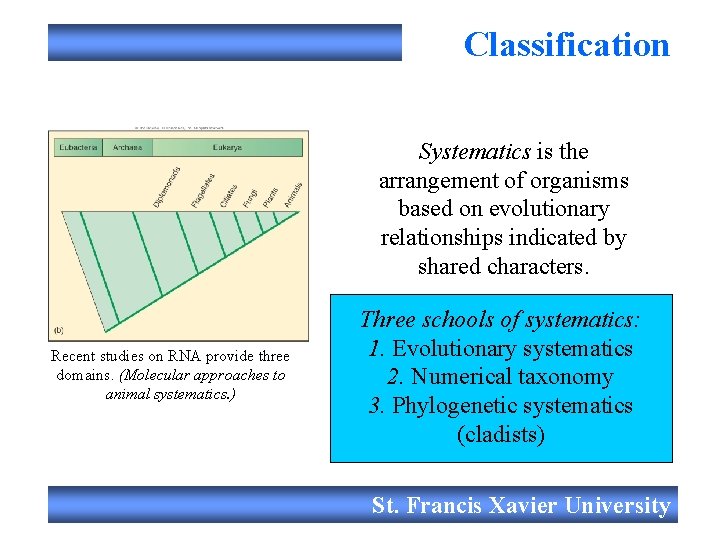
Classification Systematics is the arrangement of organisms based on evolutionary relationships indicated by shared characters. Recent studies on RNA provide three domains. (Molecular approaches to animal systematics. ) Three schools of systematics: 1. Evolutionary systematics 2. Numerical taxonomy 3. Phylogenetic systematics (cladists) St. Francis Xavier University

Classification 1. Evolutionary systematics Phylogenetic tree of vertebrate phylogeny Evolutionary systematics is a traditional approach which looks for similar characters and homologies to group organisms into taxa. The forelimbs of vertebrates evolved from an ancestral pattern. St. Francis Xavier University
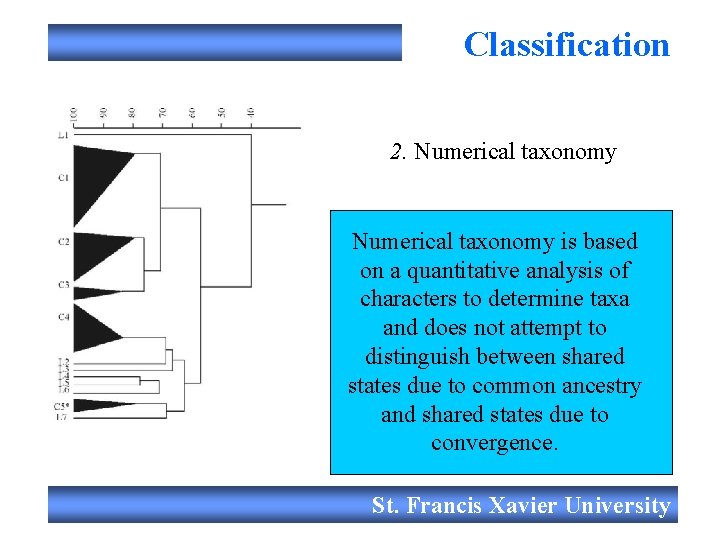
Classification 2. Numerical taxonomy is based on a quantitative analysis of characters to determine taxa and does not attempt to distinguish between shared states due to common ancestry and shared states due to convergence. St. Francis Xavier University
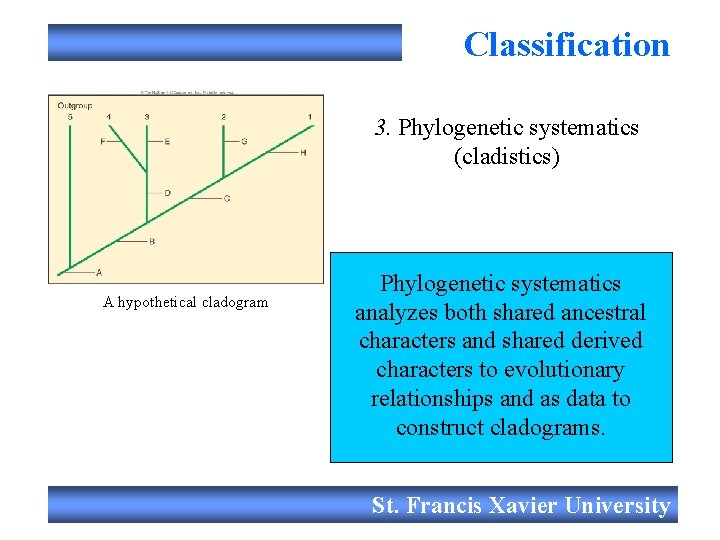
Classification 3. Phylogenetic systematics (cladistics) A hypothetical cladogram Phylogenetic systematics analyzes both shared ancestral characters and shared derived characters to evolutionary relationships and as data to construct cladograms. St. Francis Xavier University
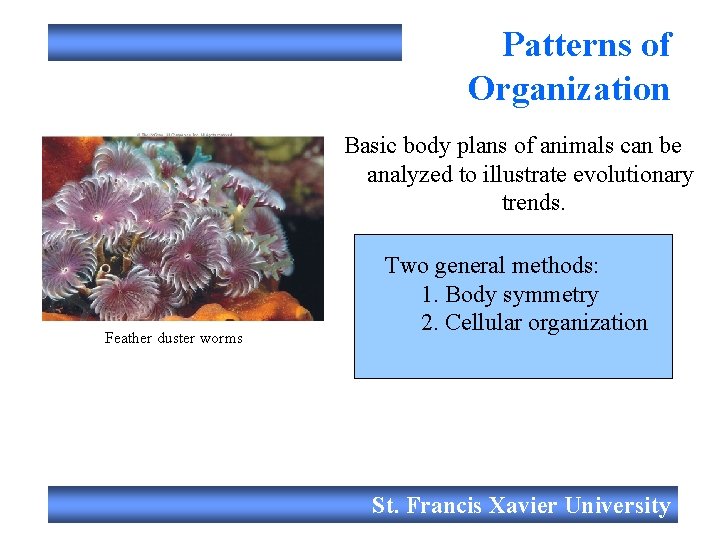
Patterns of Organization Basic body plans of animals can be analyzed to illustrate evolutionary trends. Feather duster worms Two general methods: 1. Body symmetry 2. Cellular organization St. Francis Xavier University

Patterns of Organization Body symmetry Feather duster worms Three different types of symmetry: 1. Asymmetrical 2. Radial symmetry 3. Bilateral symmetry St. Francis Xavier University

Patterns of Organization Body symmetry 1. Asymmetrical animals lack complex sensory and locomotory functions. A red encrusting sponge St. Francis Xavier University
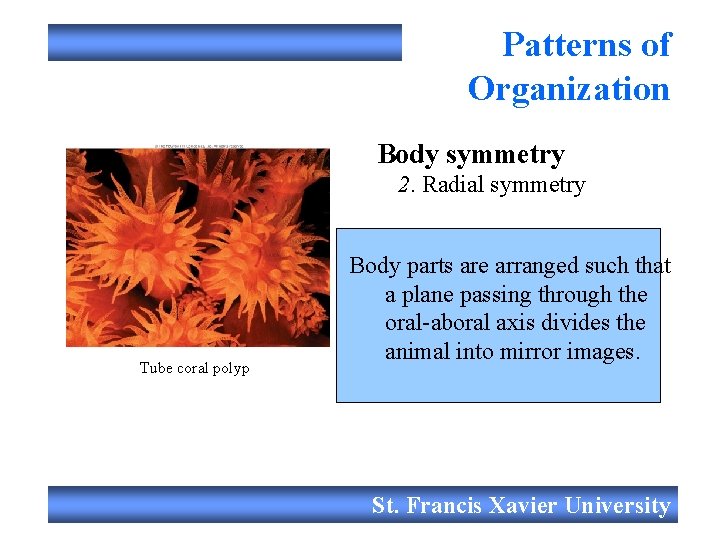
Patterns of Organization Body symmetry 2. Radial symmetry Tube coral polyp Body parts are arranged such that a plane passing through the oral-aboral axis divides the animal into mirror images. St. Francis Xavier University
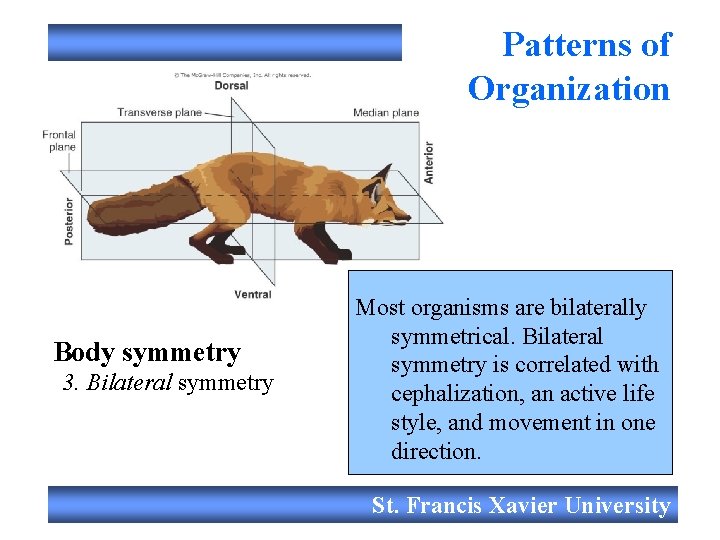
Patterns of Organization Body symmetry 3. Bilateral symmetry Most organisms are bilaterally symmetrical. Bilateral symmetry is correlated with cephalization, an active life style, and movement in one direction. St. Francis Xavier University
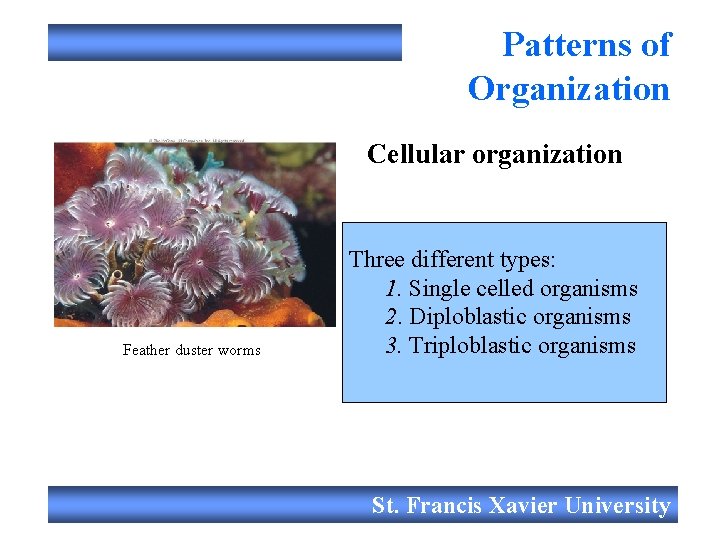
Patterns of Organization Cellular organization Feather duster worms Three different types: 1. Single celled organisms 2. Diploblastic organisms 3. Triploblastic organisms St. Francis Xavier University
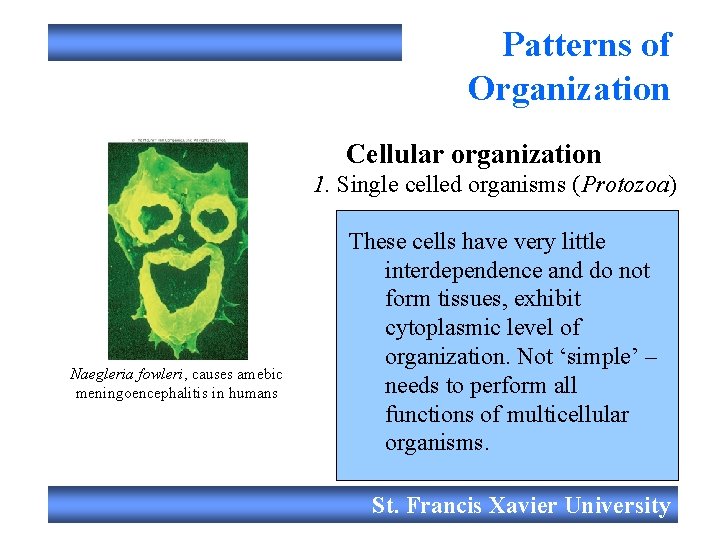
Patterns of Organization Cellular organization 1. Single celled organisms (Protozoa) Naegleria fowleri, causes amebic meningoencephalitis in humans These cells have very little interdependence and do not form tissues, exhibit cytoplasmic level of organization. Not ‘simple’ – needs to perform all functions of multicellular organisms. St. Francis Xavier University
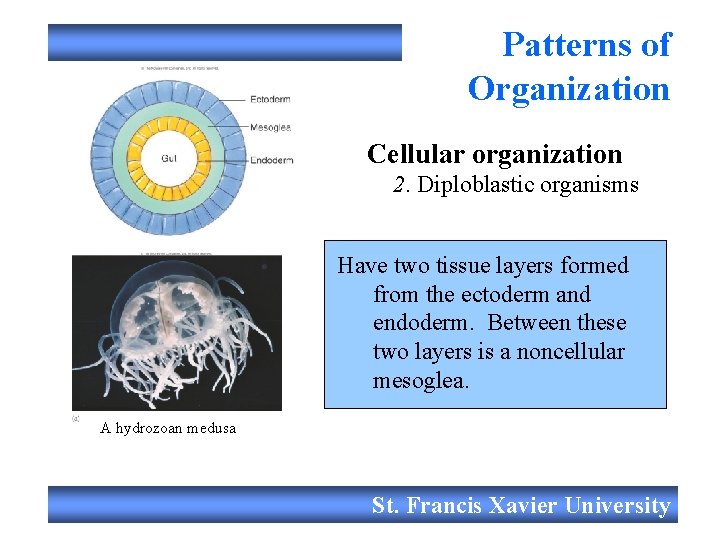
Patterns of Organization Cellular organization 2. Diploblastic organisms Have two tissue layers formed from the ectoderm and endoderm. Between these two layers is a noncellular mesoglea. A hydrozoan medusa St. Francis Xavier University
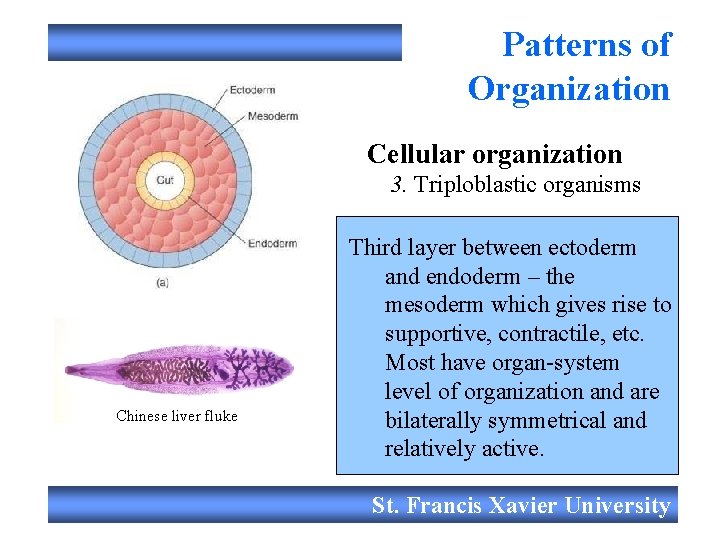
Patterns of Organization Cellular organization 3. Triploblastic organisms Chinese liver fluke Third layer between ectoderm and endoderm – the mesoderm which gives rise to supportive, contractile, etc. Most have organ-system level of organization and are bilaterally symmetrical and relatively active. St. Francis Xavier University

Online Tools Tree of Life Web project and Pub. Med St. Francis Xavier University
- Slides: 16