
BIOLOGY 2 E Chapter 8 PHOTOSYNTHESIS Power Point
BIOLOGY 2 E Chapter 8 PHOTOSYNTHESIS Power. Point Image Slideshow This work is licensed under a Creative Commons Attribution-Non. Commercial. Share. Alike 4. 0 International License.
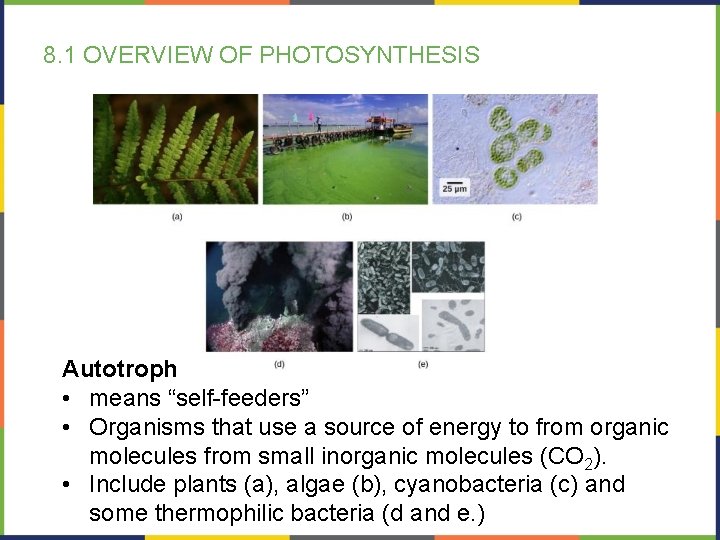
8. 1 OVERVIEW OF PHOTOSYNTHESIS Autotroph • means “self-feeders” • Organisms that use a source of energy to from organic molecules from small inorganic molecules (CO 2). • Include plants (a), algae (b), cyanobacteria (c) and some thermophilic bacteria (d and e. )
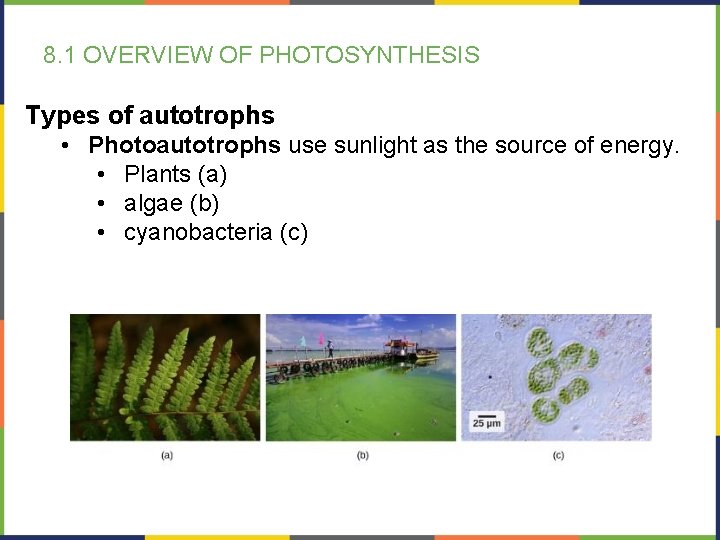
8. 1 OVERVIEW OF PHOTOSYNTHESIS Types of autotrophs • Photoautotrophs use sunlight as the source of energy. • Plants (a) • algae (b) • cyanobacteria (c)
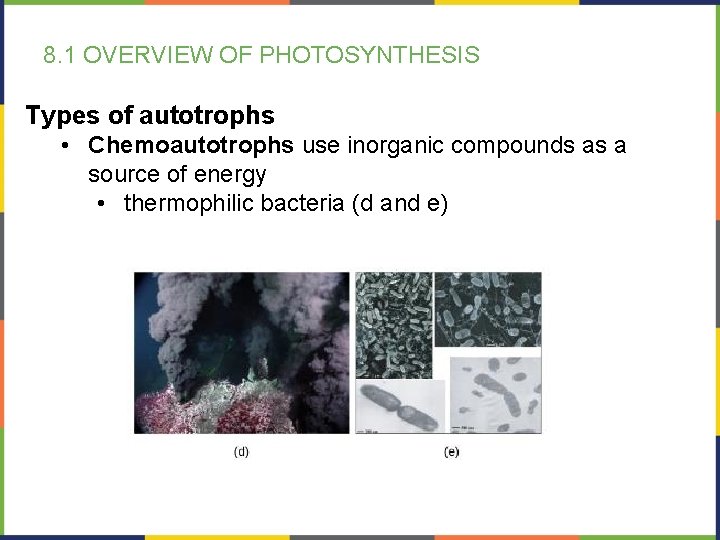
8. 1 OVERVIEW OF PHOTOSYNTHESIS Types of autotrophs • Chemoautotrophs use inorganic compounds as a source of energy • thermophilic bacteria (d and e)
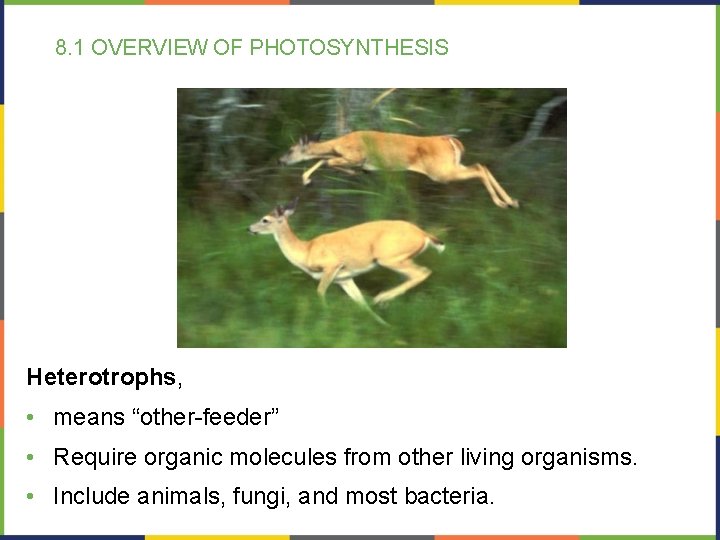
8. 1 OVERVIEW OF PHOTOSYNTHESIS Heterotrophs, • means “other-feeder” • Require organic molecules from other living organisms. • Include animals, fungi, and most bacteria.
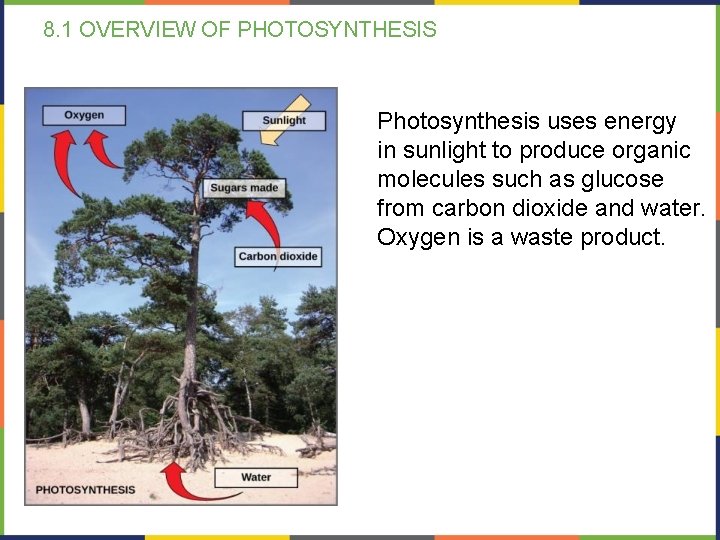
8. 1 OVERVIEW OF PHOTOSYNTHESIS Photosynthesis uses energy in sunlight to produce organic molecules such as glucose from carbon dioxide and water. Oxygen is a waste product.
8. 1 OVERVIEW OF PHOTOSYNTHESIS Basic Photosynthetic Structures https: //www. youtube. com/watch? v=Bf-RFPa. Ze. AM Animation from California Academy of Sciences
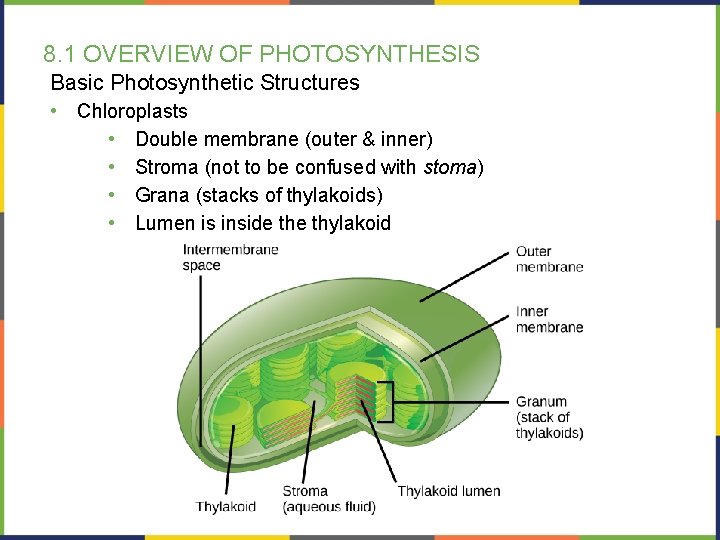
8. 1 OVERVIEW OF PHOTOSYNTHESIS Basic Photosynthetic Structures • Chloroplasts • Double membrane (outer & inner) • Stroma (not to be confused with stoma) • Grana (stacks of thylakoids) • Lumen is inside thylakoid
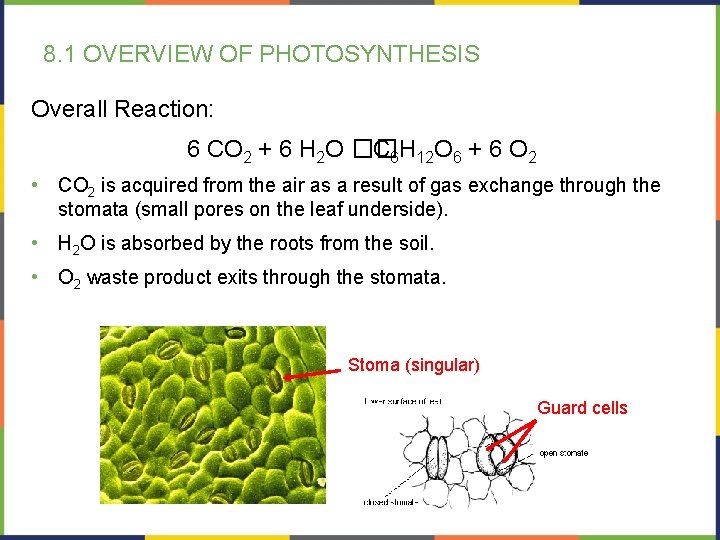
8. 1 OVERVIEW OF PHOTOSYNTHESIS Overall Reaction: 6 CO 2 + 6 H 2 O �� C 6 H 12 O 6 + 6 O 2 • CO 2 is acquired from the air as a result of gas exchange through the stomata (small pores on the leaf underside). • H 2 O is absorbed by the roots from the soil. • O 2 waste product exits through the stomata. Stoma (singular) Guard cells
8. 1 OVERVIEW OF PHOTOSYNTHESIS https: //www. youtube. com/watch? v=gz 5 L 1 GUaa. XA
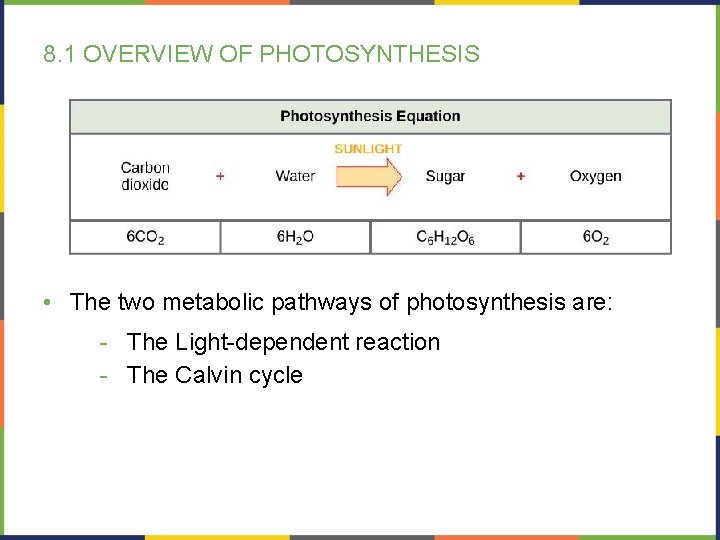
8. 1 OVERVIEW OF PHOTOSYNTHESIS • The two metabolic pathways of photosynthesis are: - The Light-dependent reaction - The Calvin cycle
8. 1 OVERVIEW OF PHOTOSYNTHESIS
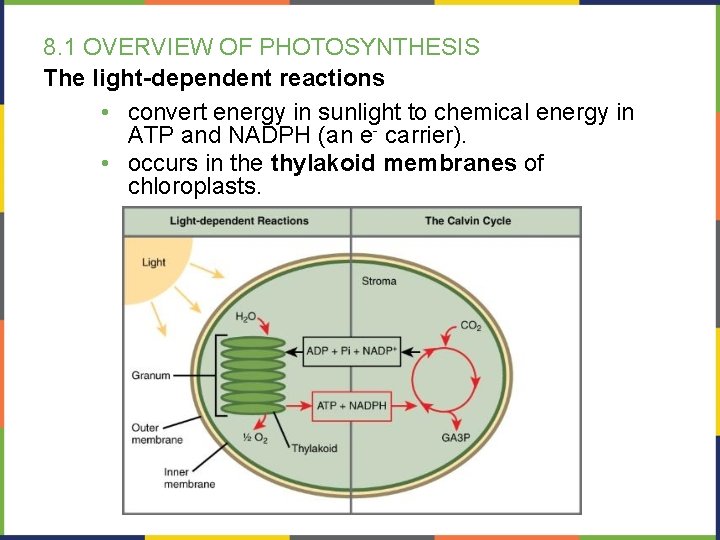
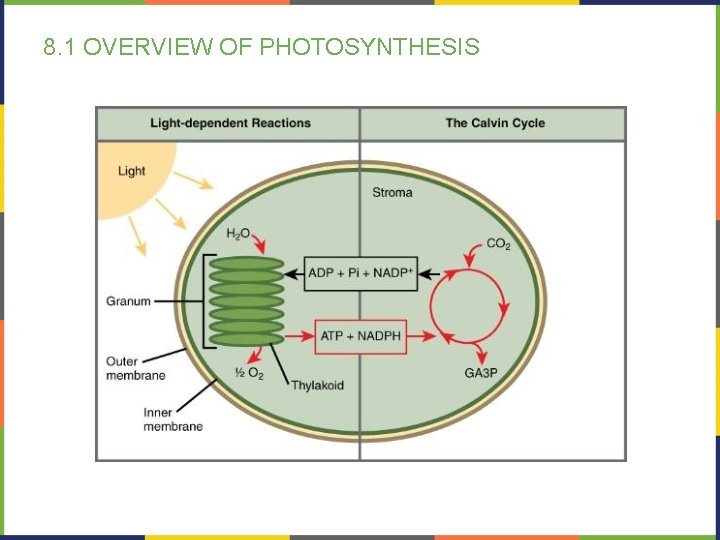
8. 1 OVERVIEW OF PHOTOSYNTHESIS The light-dependent reactions • convert energy in sunlight to chemical energy in ATP and NADPH (an e- carrier). • occurs in the thylakoid membranes of chloroplasts.
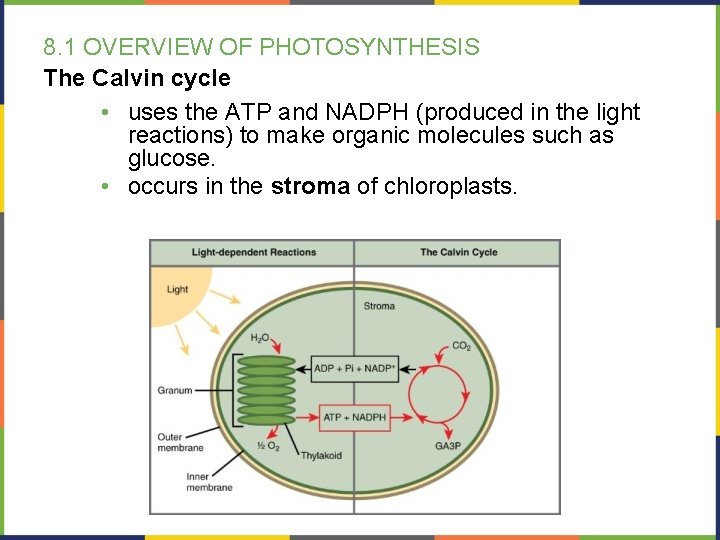
8. 1 OVERVIEW OF PHOTOSYNTHESIS The Calvin cycle • uses the ATP and NADPH (produced in the light reactions) to make organic molecules such as glucose. • occurs in the stroma of chloroplasts.
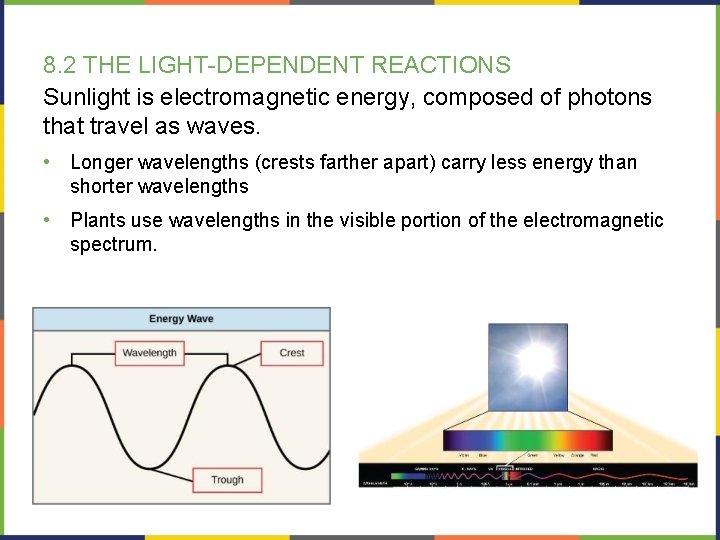
8. 2 THE LIGHT-DEPENDENT REACTIONS Sunlight is electromagnetic energy, composed of photons that travel as waves. • Longer wavelengths (crests farther apart) carry less energy than shorter wavelengths • Plants use wavelengths in the visible portion of the electromagnetic spectrum.
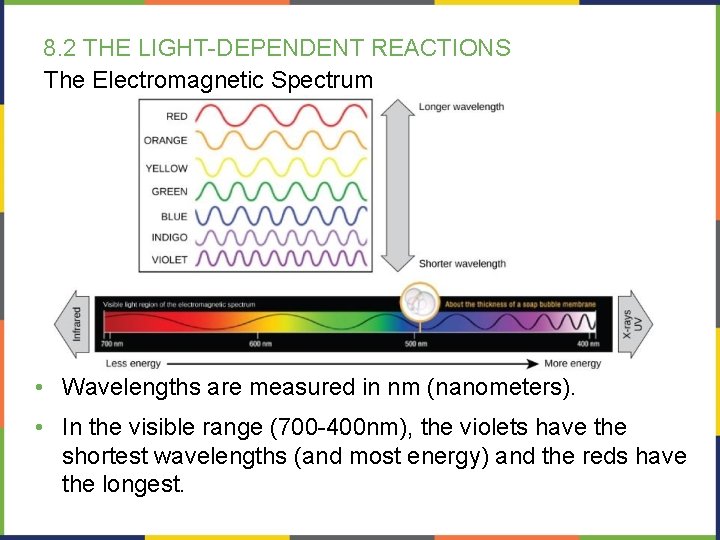
8. 2 THE LIGHT-DEPENDENT REACTIONS The Electromagnetic Spectrum • Wavelengths are measured in nm (nanometers). • In the visible range (700 -400 nm), the violets have the shortest wavelengths (and most energy) and the reds have the longest.
8. 2 THE LIGHT-DEPENDENT REACTIONS
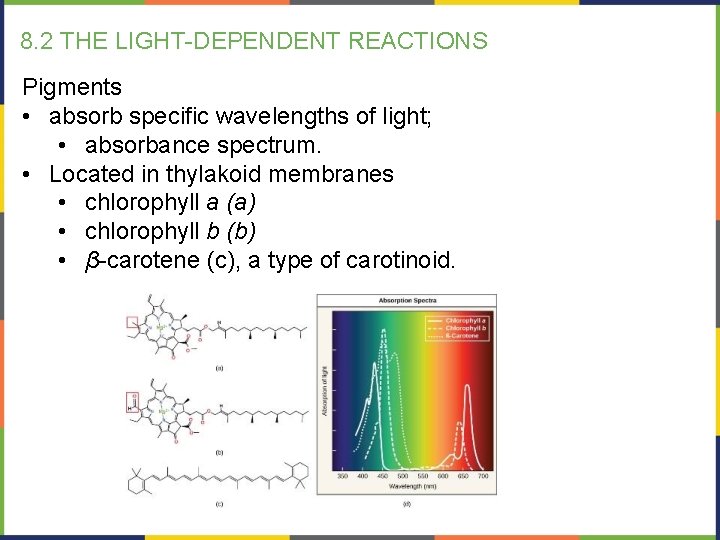
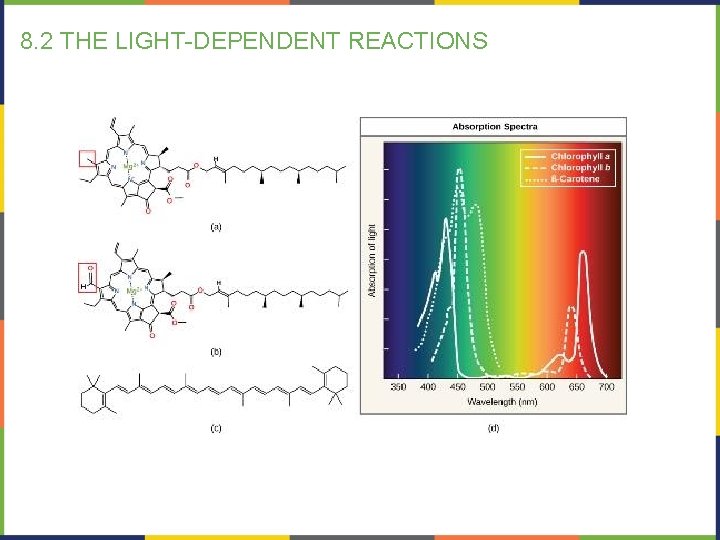
8. 2 THE LIGHT-DEPENDENT REACTIONS Pigments • absorb specific wavelengths of light; • absorbance spectrum. • Located in thylakoid membranes • chlorophyll a (a) • chlorophyll b (b) • β-carotene (c), a type of carotinoid.
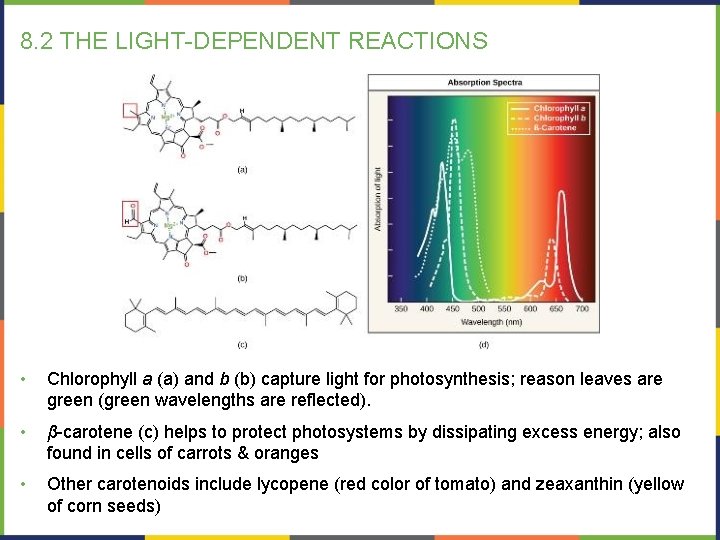
8. 2 THE LIGHT-DEPENDENT REACTIONS • Chlorophyll a (a) and b (b) capture light for photosynthesis; reason leaves are green (green wavelengths are reflected). • β-carotene (c) helps to protect photosystems by dissipating excess energy; also found in cells of carrots & oranges • Other carotenoids include lycopene (red color of tomato) and zeaxanthin (yellow of corn seeds)
8. 2 THE LIGHT-DEPENDENT REACTIONS https: //www. youtube. com/watch? v=hj_WKgn. L 6 MI&t=72 s
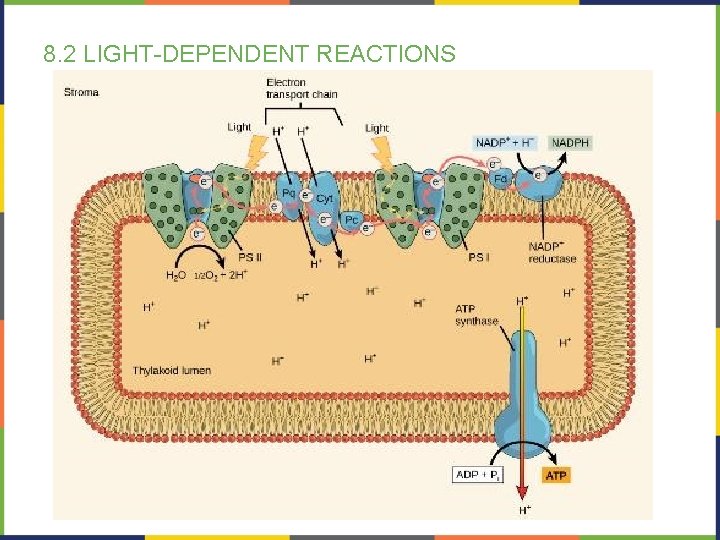
8. 2 LIGHT-DEPENDENT REACTIONS
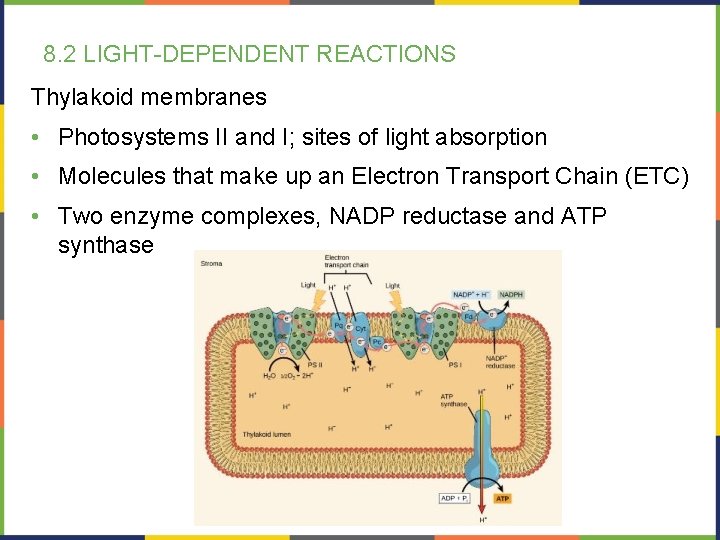
8. 2 LIGHT-DEPENDENT REACTIONS Thylakoid membranes • Photosystems II and I; sites of light absorption • Molecules that make up an Electron Transport Chain (ETC) • Two enzyme complexes, NADP reductase and ATP synthase
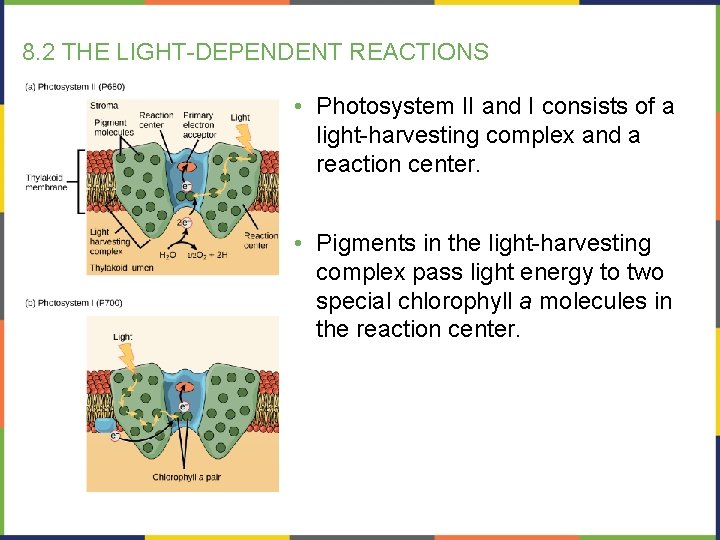
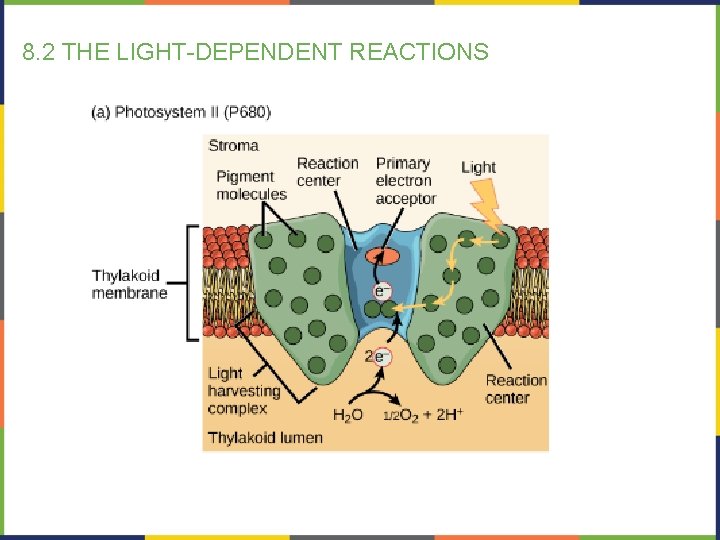
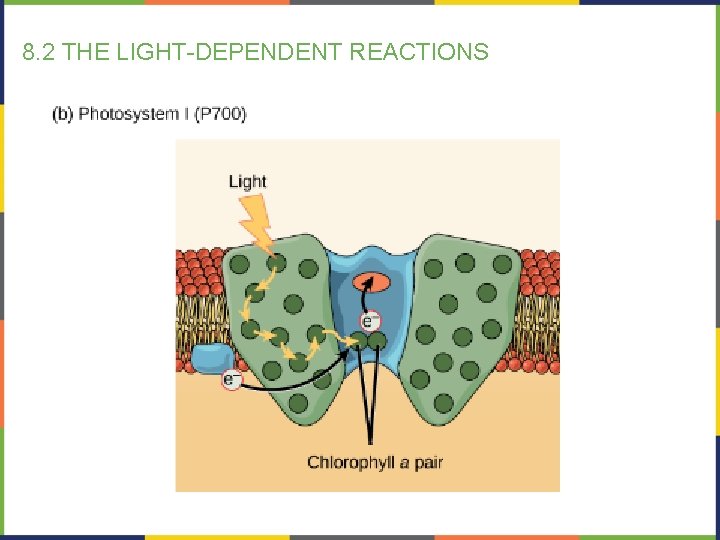
8. 2 THE LIGHT-DEPENDENT REACTIONS • Photosystem II and I consists of a light-harvesting complex and a reaction center. • Pigments in the light-harvesting complex pass light energy to two special chlorophyll a molecules in the reaction center.
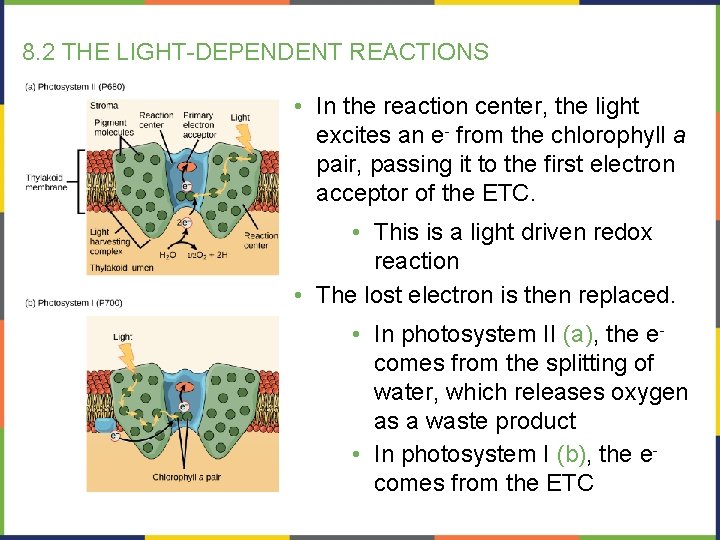
8. 2 THE LIGHT-DEPENDENT REACTIONS • In the reaction center, the light excites an e- from the chlorophyll a pair, passing it to the first electron acceptor of the ETC. • This is a light driven redox reaction • The lost electron is then replaced. • In photosystem II (a), the ecomes from the splitting of water, which releases oxygen as a waste product • In photosystem I (b), the ecomes from the ETC
8. 2 THE LIGHT-DEPENDENT REACTIONS
8. 2 THE LIGHT-DEPENDENT REACTIONS
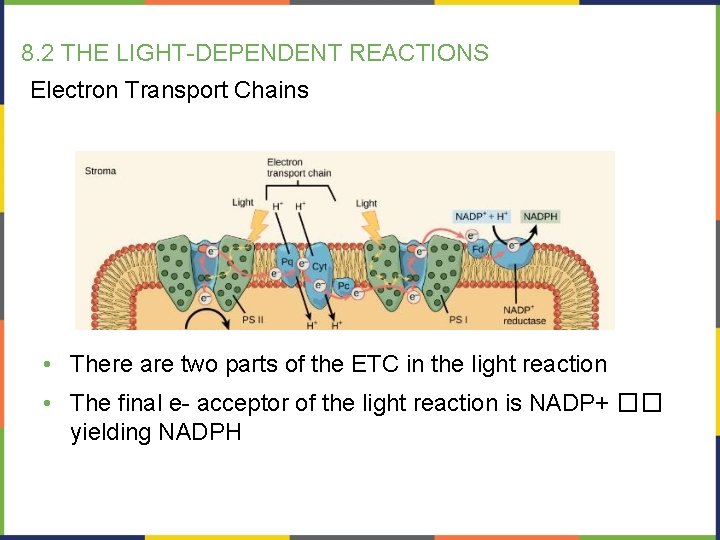
8. 2 THE LIGHT-DEPENDENT REACTIONS Electron Transport Chains • There are two parts of the ETC in the light reaction • The final e- acceptor of the light reaction is NADP+ �� yielding NADPH
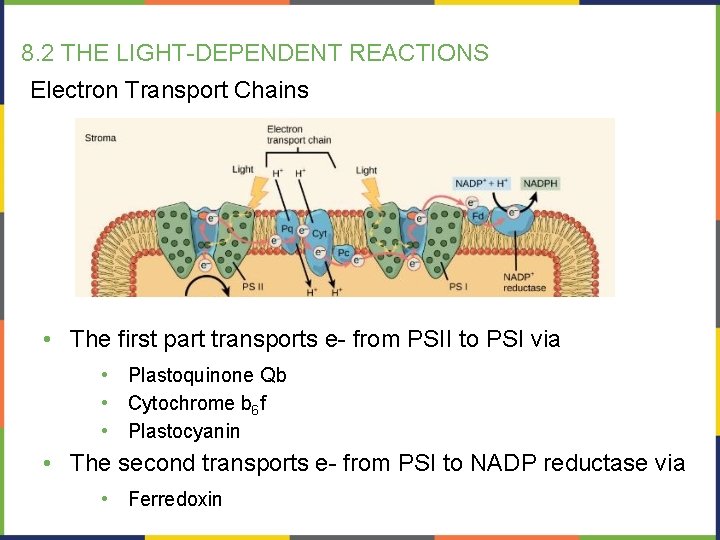
8. 2 THE LIGHT-DEPENDENT REACTIONS Electron Transport Chains • The first part transports e- from PSII to PSI via • • • Plastoquinone Qb Cytochrome b 6 f Plastocyanin • The second transports e- from PSI to NADP reductase via • Ferredoxin
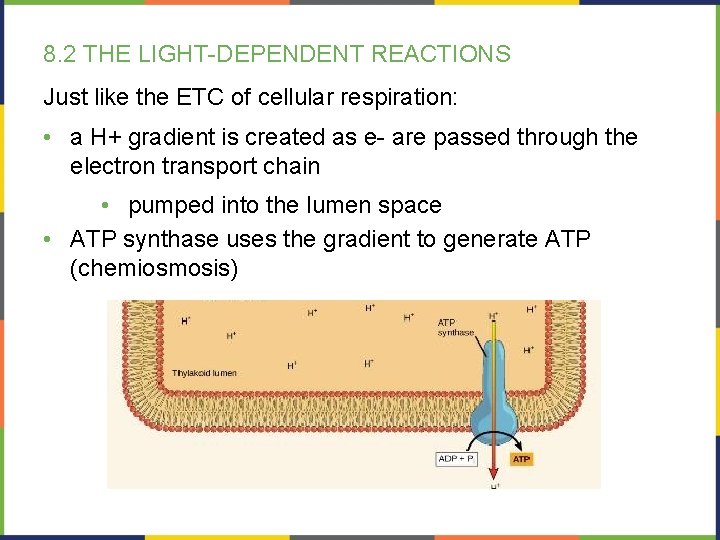
8. 2 THE LIGHT-DEPENDENT REACTIONS Just like the ETC of cellular respiration: • a H+ gradient is created as e- are passed through the electron transport chain • pumped into the lumen space • ATP synthase uses the gradient to generate ATP (chemiosmosis)
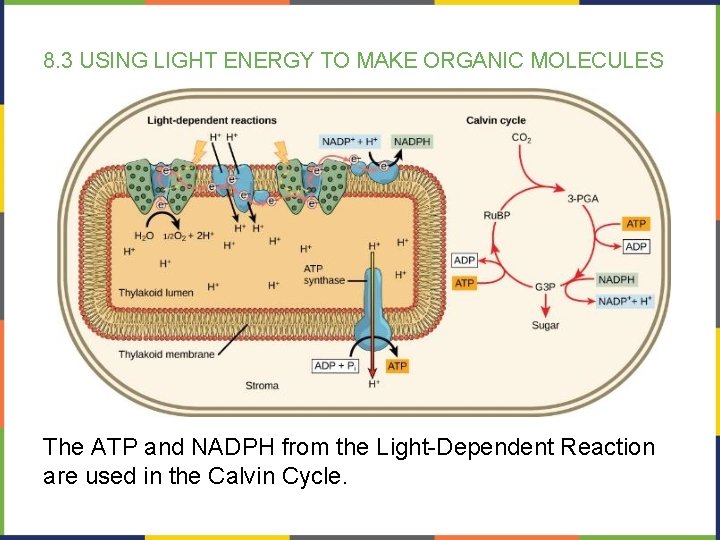
8. 3 USING LIGHT ENERGY TO MAKE ORGANIC MOLECULES The ATP and NADPH from the Light-Dependent Reaction are used in the Calvin Cycle.
8. 3 USING LIGHT ENERGY TO MAKE ORGANIC MOLECULES
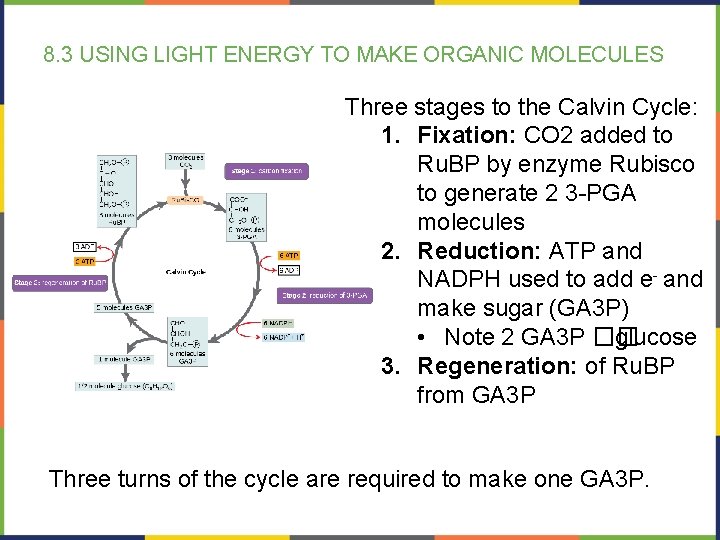
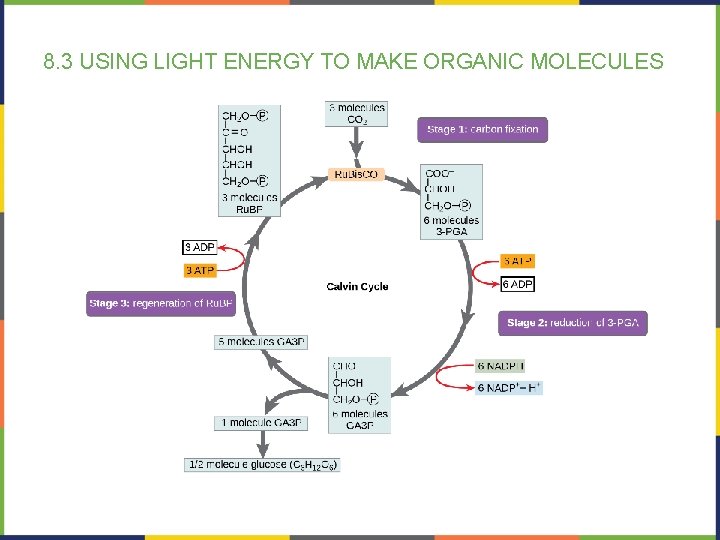
8. 3 USING LIGHT ENERGY TO MAKE ORGANIC MOLECULES Three stages to the Calvin Cycle: 1. Fixation: CO 2 added to Ru. BP by enzyme Rubisco to generate 2 3 -PGA molecules 2. Reduction: ATP and NADPH used to add e- and make sugar (GA 3 P) • Note 2 GA 3 P �� glucose 3. Regeneration: of Ru. BP from GA 3 P Three turns of the cycle are required to make one GA 3 P.
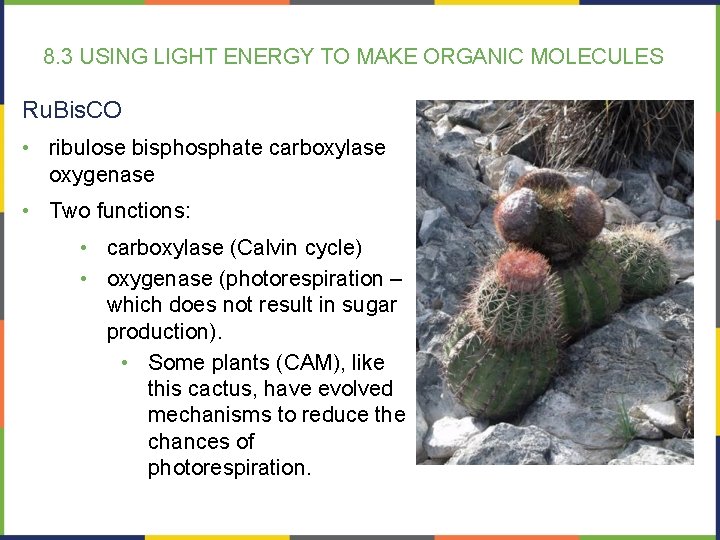
8. 3 USING LIGHT ENERGY TO MAKE ORGANIC MOLECULES Ru. Bis. CO • ribulose bisphosphate carboxylase oxygenase • Two functions: • carboxylase (Calvin cycle) • oxygenase (photorespiration – which does not result in sugar production). • Some plants (CAM), like this cactus, have evolved mechanisms to reduce the chances of photorespiration.
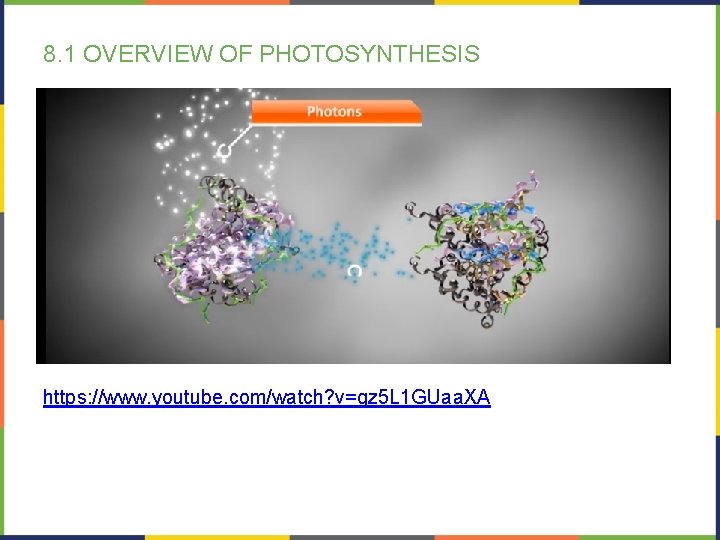
8. 1 OVERVIEW OF PHOTOSYNTHESIS https: //www. youtube. com/watch? v=gz 5 L 1 GUaa. XA
This Power. Point file is copyright Rice University. Modified and improved by E. G Cantonwine, Valdosta State University. Revised for Open. Stax Biology 2 e by Open. Stax.
- Slides: 35