
BIOLOGY 2 E Chapter 6 METABOLISM Power Point
BIOLOGY 2 E Chapter 6 METABOLISM Power. Point Image Slideshow This work is licensed under a Creative Commons Attribution-Non. Commercial. Share. Alike 4. 0 International License.
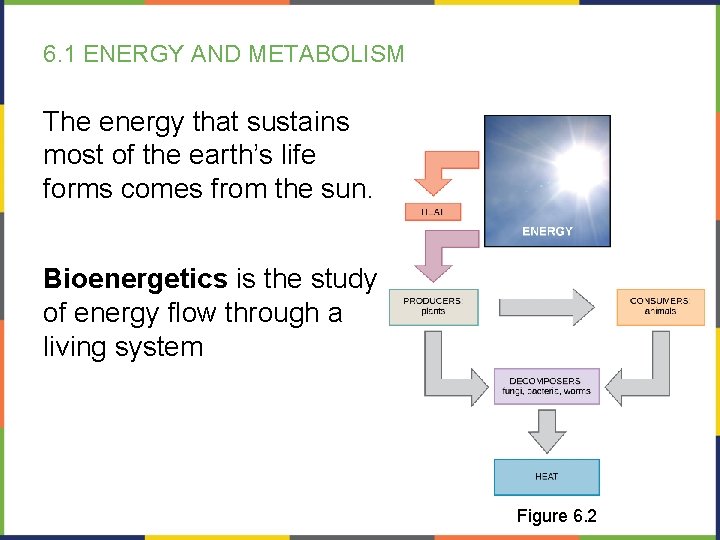
6. 1 ENERGY AND METABOLISM The energy that sustains most of the earth’s life forms comes from the sun. Bioenergetics is the study of energy flow through a living system Figure 6. 2
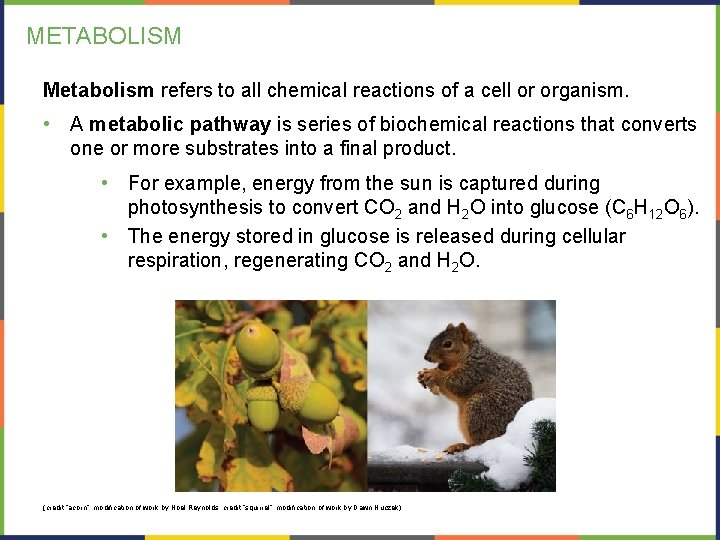
METABOLISM Metabolism refers to all chemical reactions of a cell or organism. • A metabolic pathway is series of biochemical reactions that converts one or more substrates into a final product. • For example, energy from the sun is captured during photosynthesis to convert CO 2 and H 2 O into glucose (C 6 H 12 O 6). • The energy stored in glucose is released during cellular respiration, regenerating CO 2 and H 2 O. (credit “acorn”: modification of work by Noel Reynolds; credit “squirrel”: modification of work by Dawn Huczek)
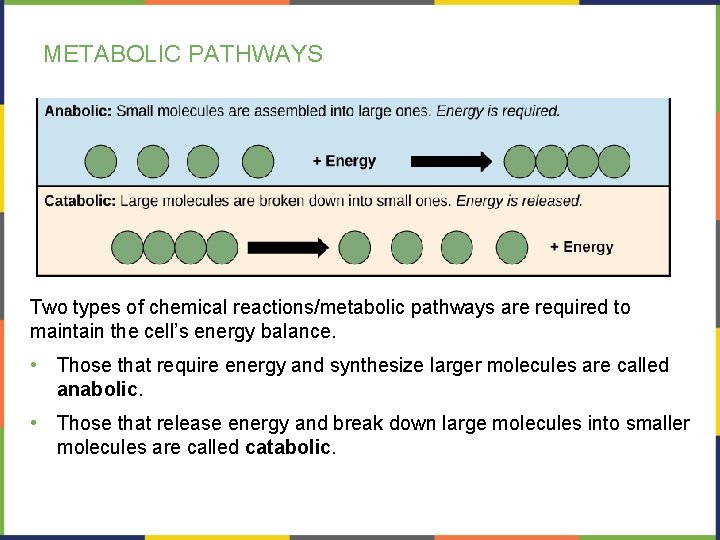
METABOLIC PATHWAYS Two types of chemical reactions/metabolic pathways are required to maintain the cell’s energy balance. • Those that require energy and synthesize larger molecules are called anabolic. • Those that release energy and break down large molecules into smaller molecules are called catabolic.

EVOLUTION OF METABOLIC PATHWAYS • All types of life share some of the same metabolic pathways. • This commonality provides more evidence that organisms evolved from common ancestors. • Over time, these pathways diverged. As organisms evolved, they developed specialized enzymes to help them adapt to their environments.

ANABOLIC AND CATABOLIC EXAMPLES
DISCUSSION QUESTION Is photosynthesis an anabolic or catabolic pathway? Note: In photosynthesis energy from the sun is captured and used to convert CO 2 and H 2 O into glucose (C 6 H 12 O 6). What evidence supports your answer?
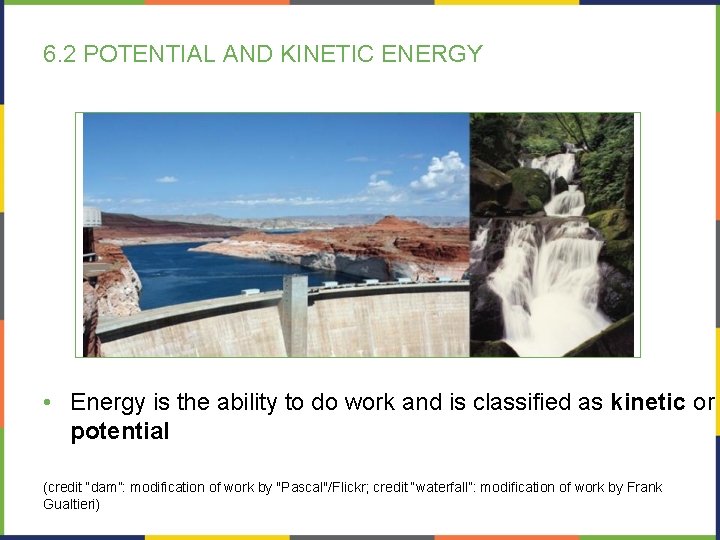
6. 2 POTENTIAL AND KINETIC ENERGY • Energy is the ability to do work and is classified as kinetic or potential (credit “dam”: modification of work by "Pascal"/Flickr; credit “waterfall”: modification of work by Frank Gualtieri)
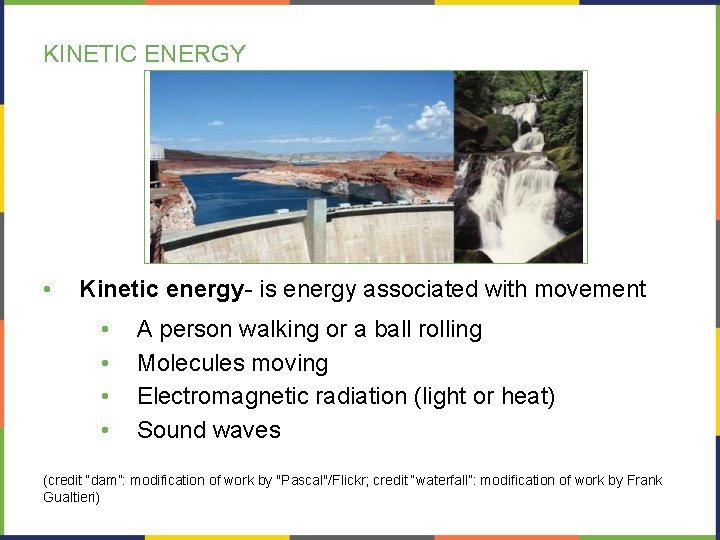
KINETIC ENERGY • Kinetic energy- is energy associated with movement • • A person walking or a ball rolling Molecules moving Electromagnetic radiation (light or heat) Sound waves (credit “dam”: modification of work by "Pascal"/Flickr; credit “waterfall”: modification of work by Frank Gualtieri)
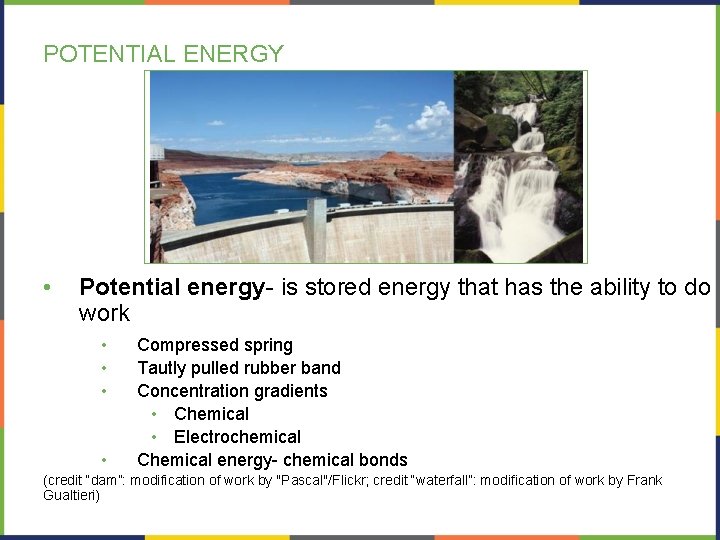
POTENTIAL ENERGY • Potential energy- is stored energy that has the ability to do work • • Compressed spring Tautly pulled rubber band Concentration gradients • Chemical • Electrochemical Chemical energy- chemical bonds (credit “dam”: modification of work by "Pascal"/Flickr; credit “waterfall”: modification of work by Frank Gualtieri)

POTENTIAL ENERGY • Concentration gradient - Energy associated with chemical/ electrochemical gradients across the plasma membrane. • Chemical energy – Energy stored in chemical bonds.
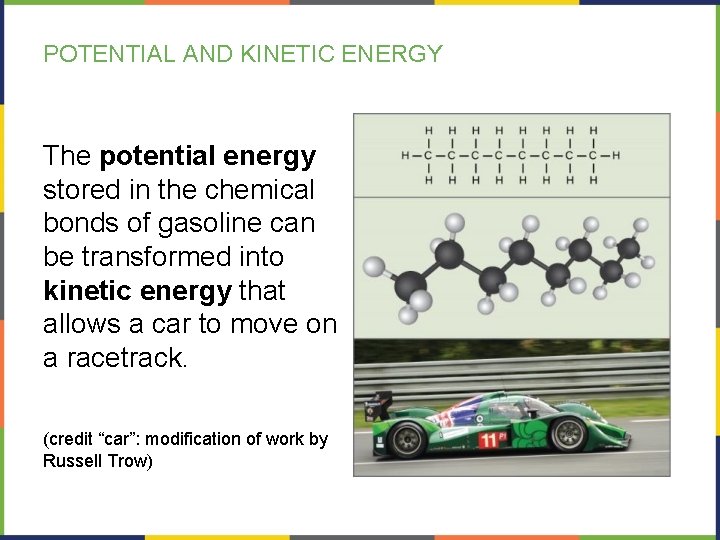
POTENTIAL AND KINETIC ENERGY The potential energy stored in the chemical bonds of gasoline can be transformed into kinetic energy that allows a car to move on a racetrack. (credit “car”: modification of work by Russell Trow)
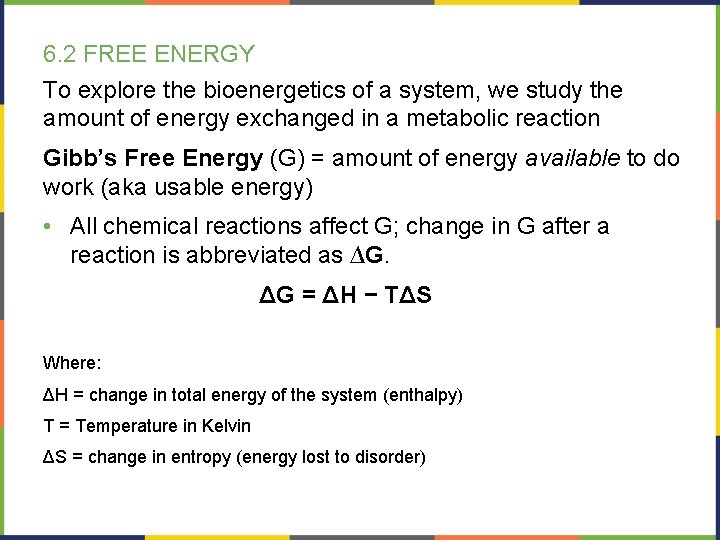
6. 2 FREE ENERGY To explore the bioenergetics of a system, we study the amount of energy exchanged in a metabolic reaction Gibb’s Free Energy (G) = amount of energy available to do work (aka usable energy) • All chemical reactions affect G; change in G after a reaction is abbreviated as ∆G. ΔG = ΔH − TΔS Where: ΔH = change in total energy of the system (enthalpy) T = Temperature in Kelvin ΔS = change in entropy (energy lost to disorder)
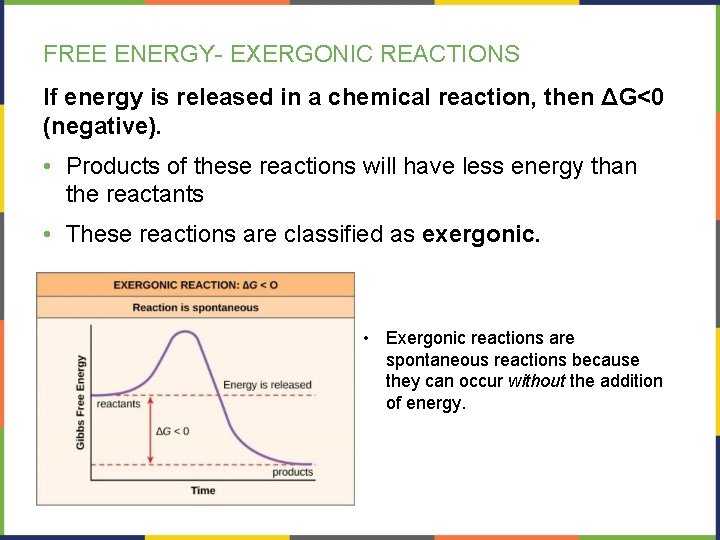
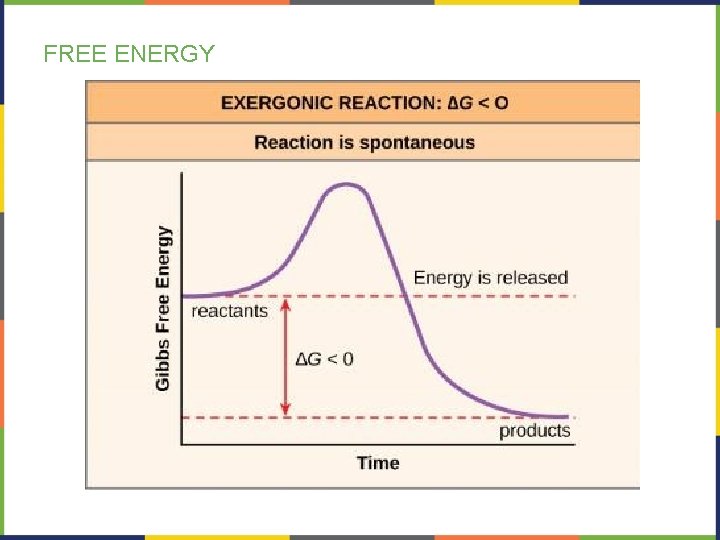
FREE ENERGY- EXERGONIC REACTIONS If energy is released in a chemical reaction, then ΔG<0 (negative). • Products of these reactions will have less energy than the reactants • These reactions are classified as exergonic. • Exergonic reactions are spontaneous reactions because they can occur without the addition of energy.
FREE ENERGY
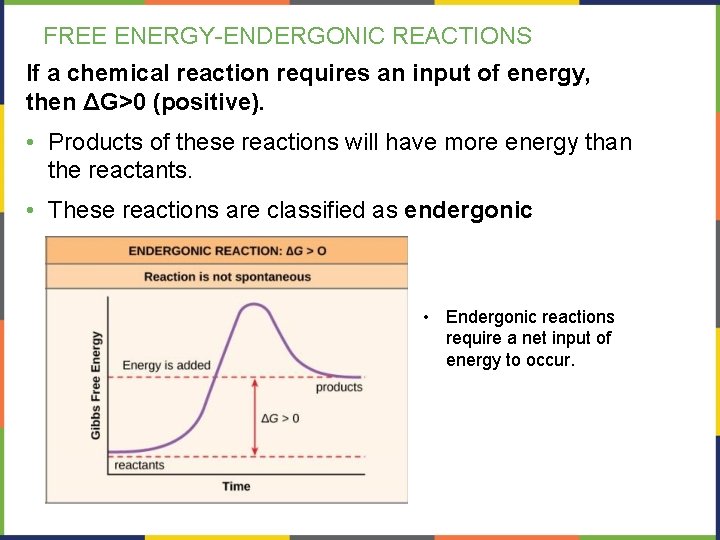
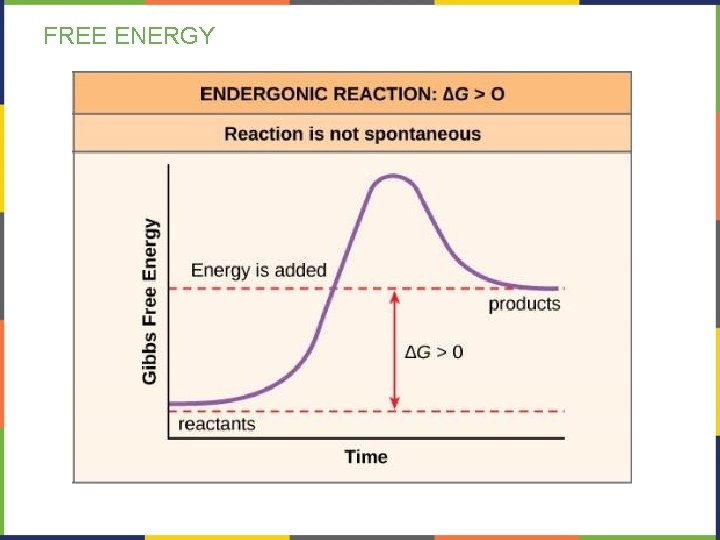
FREE ENERGY-ENDERGONIC REACTIONS If a chemical reaction requires an input of energy, then ΔG>0 (positive). • Products of these reactions will have more energy than the reactants. • These reactions are classified as endergonic • Endergonic reactions require a net input of energy to occur.
FREE ENERGY
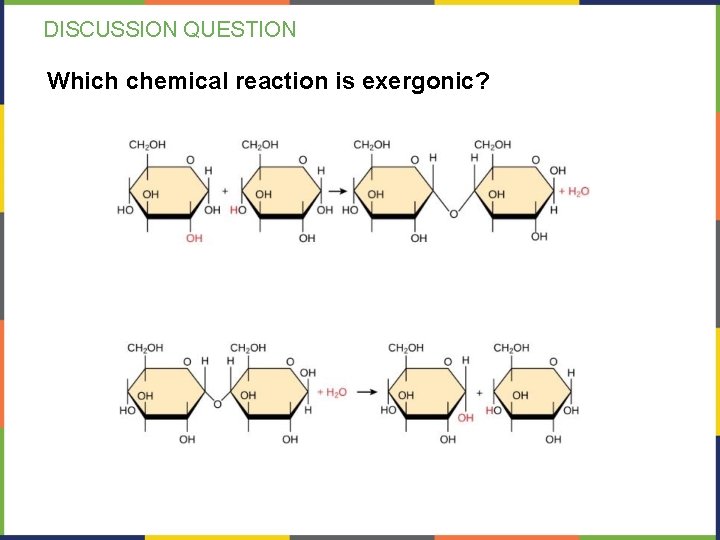
DISCUSSION QUESTION Which chemical reaction is exergonic?
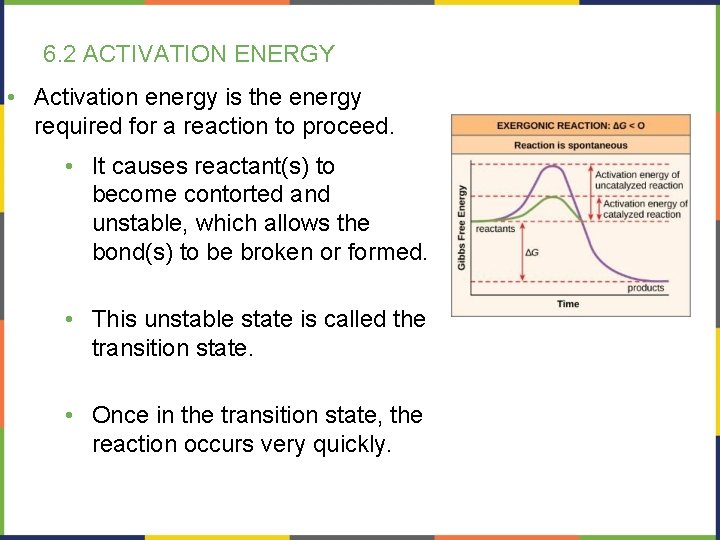
6. 2 ACTIVATION ENERGY • Activation energy is the energy required for a reaction to proceed. • It causes reactant(s) to become contorted and unstable, which allows the bond(s) to be broken or formed. • This unstable state is called the transition state. • Once in the transition state, the reaction occurs very quickly.
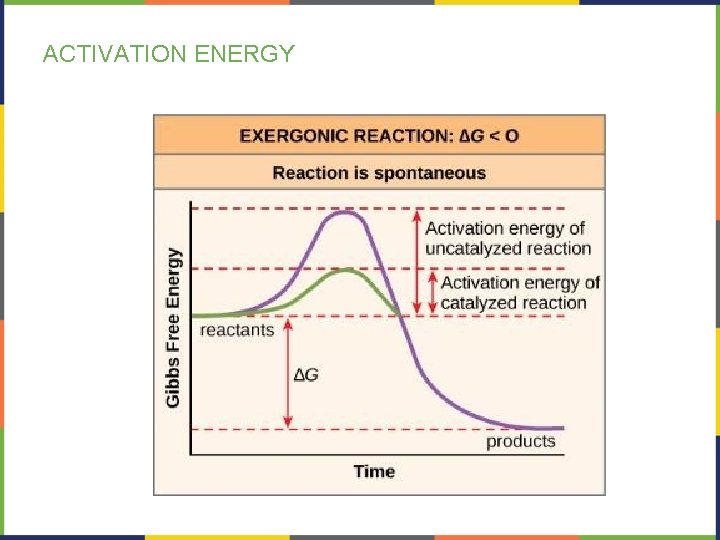
ACTIVATION ENERGY
ACTIVATION ENERGY • Heat energy is the main source for activation energy in a cell • Heat helps reactants reach their transition state • Activation energy is why, for example, the rusting of iron happens slowly despite being a spontaneous, exergonic reaction.
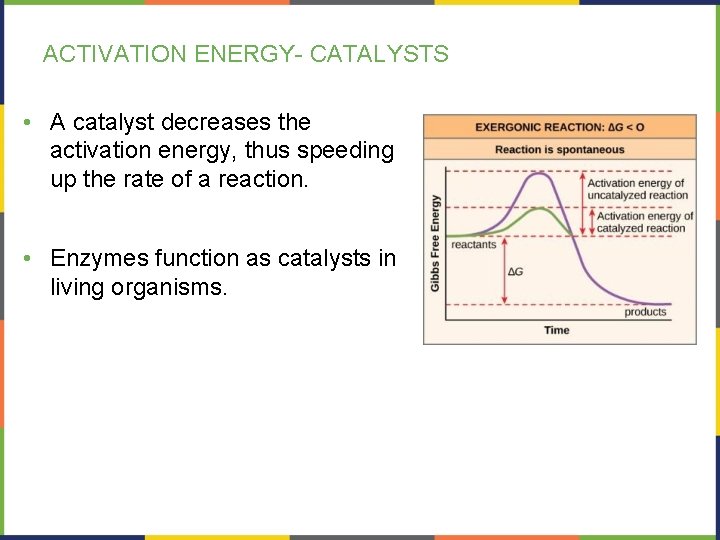
ACTIVATION ENERGY- CATALYSTS • A catalyst decreases the activation energy, thus speeding up the rate of a reaction. • Enzymes function as catalysts in living organisms.
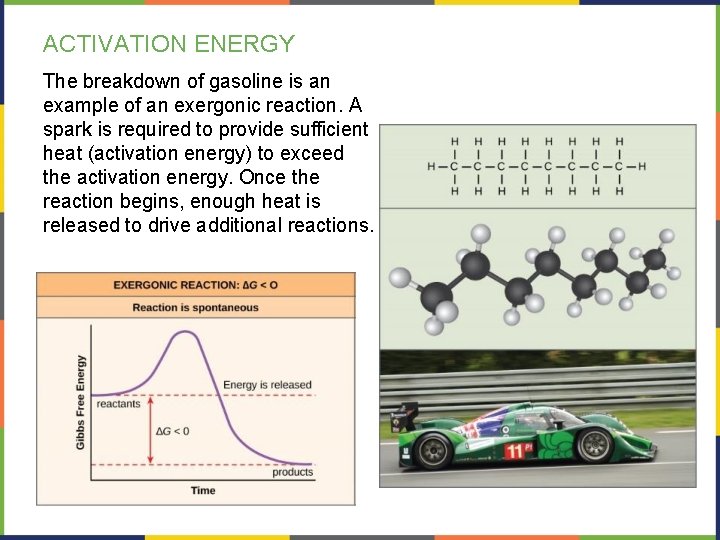
ACTIVATION ENERGY The breakdown of gasoline is an example of an exergonic reaction. A spark is required to provide sufficient heat (activation energy) to exceed the activation energy. Once the reaction begins, enough heat is released to drive additional reactions.
6. 3 THE LAWS OF THERMODYNAMICS Thermodynamics is the study of energy and energy transfer involving physical matter. • First law of thermodynamics - states that the total amount of energy in the universe if constant: energy cannot be created or destroyed. • Second law of thermodynamics - states that the transfer/conversion of energy is not completely efficient. • With each chemical reaction, some energy is lost in a form that is unusable, such as heat energy. The result is increased entropy (disorder).
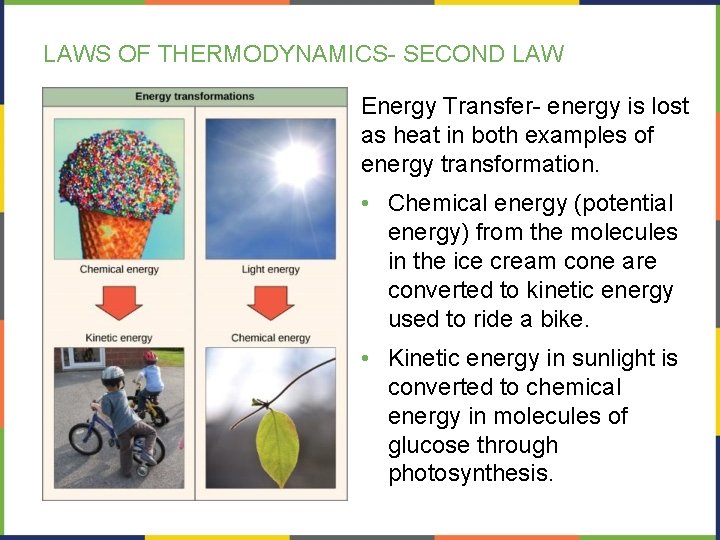
LAWS OF THERMODYNAMICS- SECOND LAW Energy Transfer- energy is lost as heat in both examples of energy transformation. • Chemical energy (potential energy) from the molecules in the ice cream cone are converted to kinetic energy used to ride a bike. • Kinetic energy in sunlight is converted to chemical energy in molecules of glucose through photosynthesis.
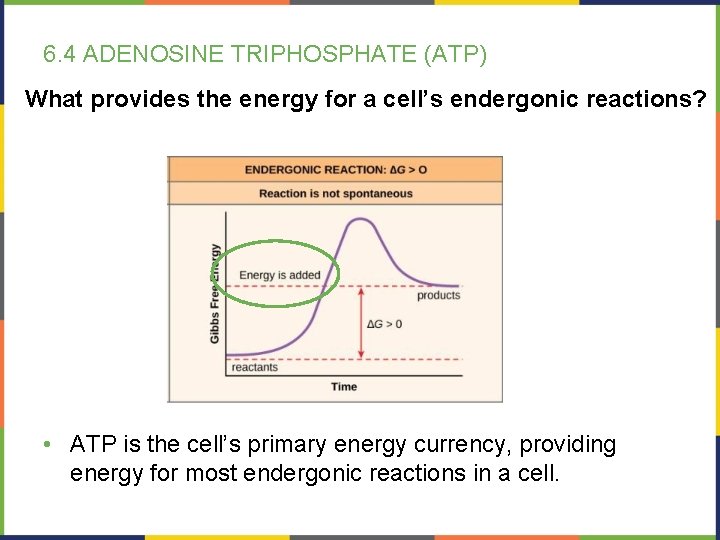
6. 4 ADENOSINE TRIPHOSPHATE (ATP) What provides the energy for a cell’s endergonic reactions? • ATP is the cell’s primary energy currency, providing energy for most endergonic reactions in a cell.
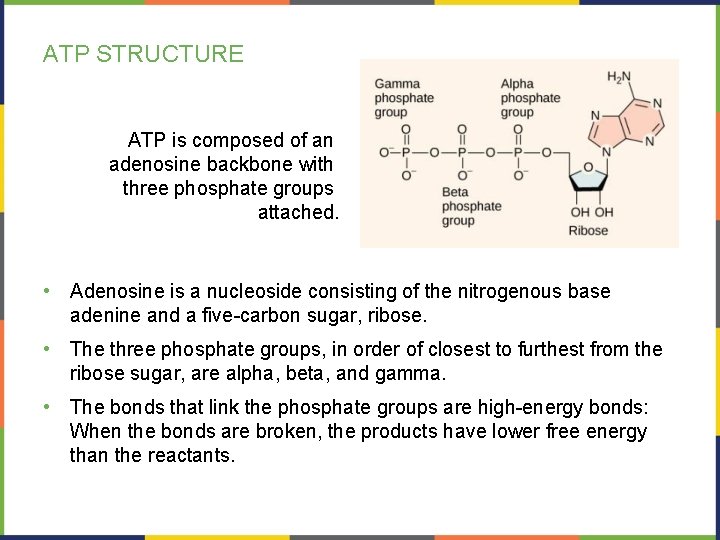
ATP STRUCTURE ATP is composed of an adenosine backbone with three phosphate groups attached. • Adenosine is a nucleoside consisting of the nitrogenous base adenine and a five-carbon sugar, ribose. • The three phosphate groups, in order of closest to furthest from the ribose sugar, are alpha, beta, and gamma. • The bonds that link the phosphate groups are high-energy bonds: When the bonds are broken, the products have lower free energy than the reactants.
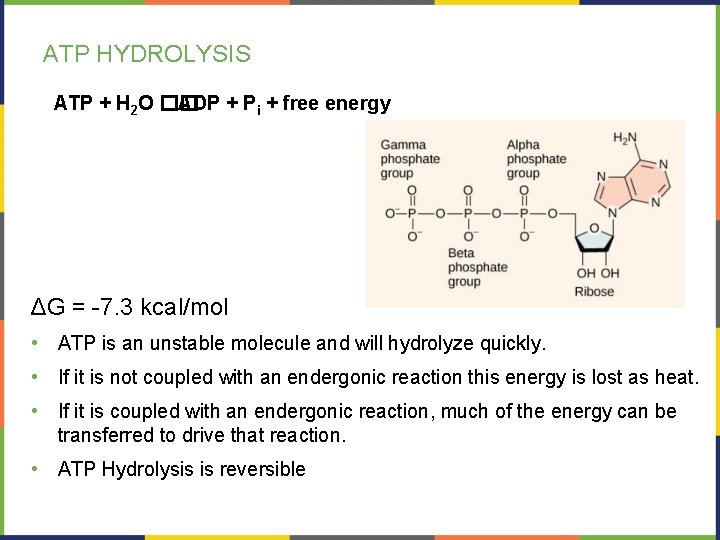
ATP HYDROLYSIS ATP + H 2 O �� ADP + Pi + free energy ΔG = -7. 3 kcal/mol • ATP is an unstable molecule and will hydrolyze quickly. • If it is not coupled with an endergonic reaction this energy is lost as heat. • If it is coupled with an endergonic reaction, much of the energy can be transferred to drive that reaction. • ATP Hydrolysis is reversible

ATP HYDROLYSIS The sodium-potassium pump is an example of energy coupling. The energy derived from exergonic ATP hydrolysis is used by the integral protein to pump 3 sodium ions out of the cell and 2 potassium ions into the cell.
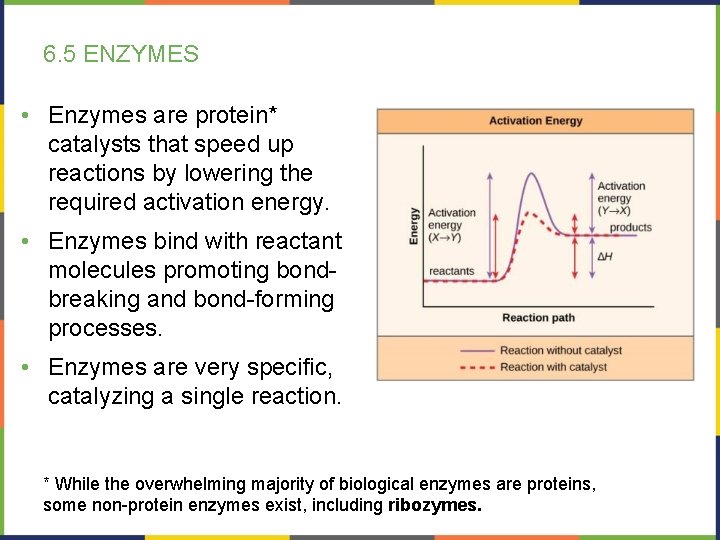
6. 5 ENZYMES • Enzymes are protein* catalysts that speed up reactions by lowering the required activation energy. • Enzymes bind with reactant molecules promoting bondbreaking and bond-forming processes. • Enzymes are very specific, catalyzing a single reaction. * While the overwhelming majority of biological enzymes are proteins, some non-protein enzymes exist, including ribozymes.
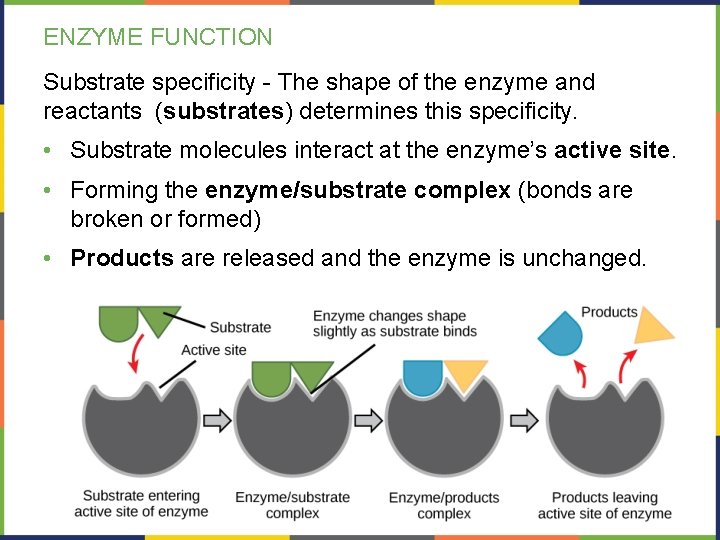
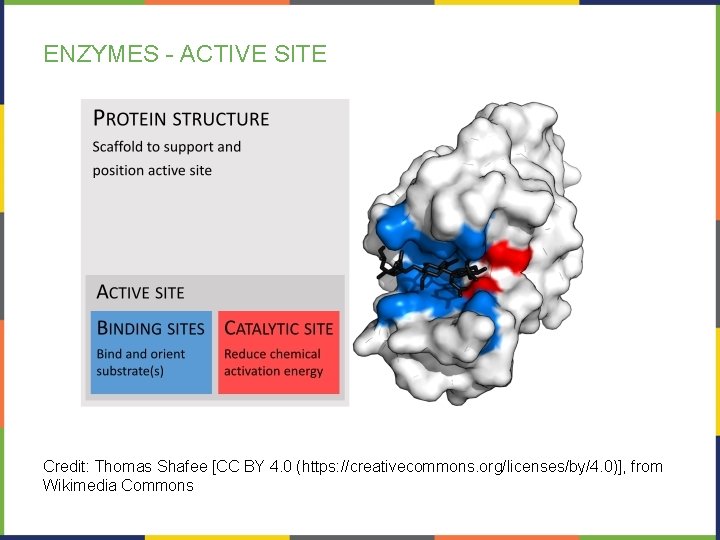
ENZYME FUNCTION Substrate specificity - The shape of the enzyme and reactants (substrates) determines this specificity. • Substrate molecules interact at the enzyme’s active site. • Forming the enzyme/substrate complex (bonds are broken or formed) • Products are released and the enzyme is unchanged.
ENZYMES - ACTIVE SITE Credit: Thomas Shafee [CC BY 4. 0 (https: //creativecommons. org/licenses/by/4. 0)], from Wikimedia Commons
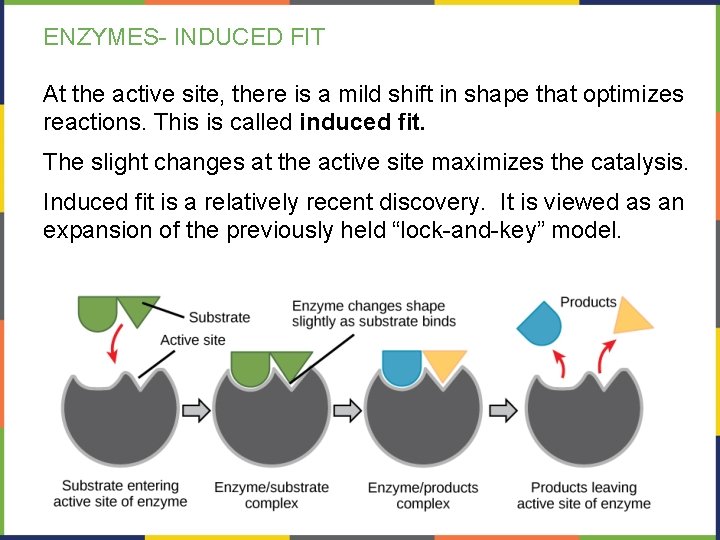
ENZYMES- INDUCED FIT At the active site, there is a mild shift in shape that optimizes reactions. This is called induced fit. The slight changes at the active site maximizes the catalysis. Induced fit is a relatively recent discovery. It is viewed as an expansion of the previously held “lock-and-key” model.
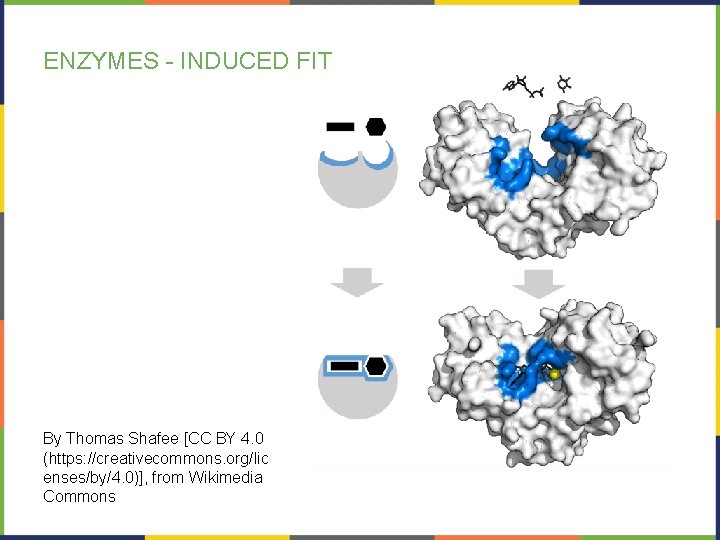
ENZYMES - INDUCED FIT By Thomas Shafee [CC BY 4. 0 (https: //creativecommons. org/lic enses/by/4. 0)], from Wikimedia Commons
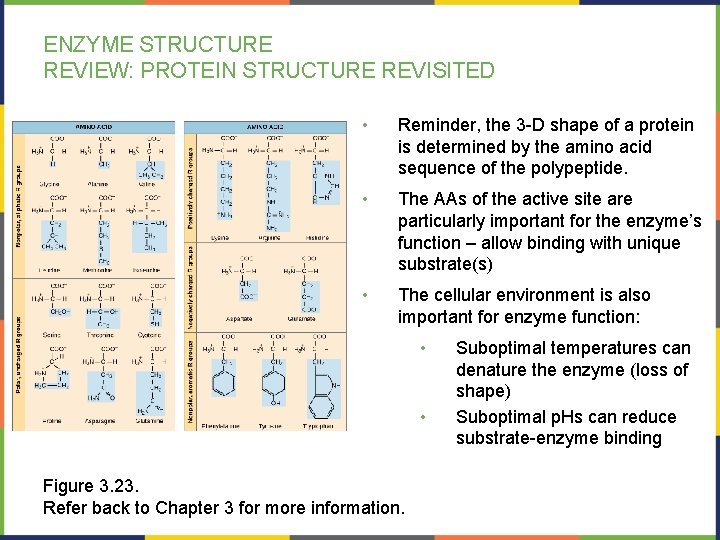
ENZYME STRUCTURE REVIEW: PROTEIN STRUCTURE REVISITED • Reminder, the 3 -D shape of a protein is determined by the amino acid sequence of the polypeptide. • The AAs of the active site are particularly important for the enzyme’s function – allow binding with unique substrate(s) • The cellular environment is also important for enzyme function: • • Figure 3. 23. Refer back to Chapter 3 for more information. Suboptimal temperatures can denature the enzyme (loss of shape) Suboptimal p. Hs can reduce substrate-enzyme binding
ENZYMES- ACTIVATION ENERGY • The enzyme can help the substrate reach its transition state, lowering activation energy, in one of the following ways: • • position two substrates so they align perfectly for the reaction provide an optimal environment, i. e. acidic or polar, within the active site for the reaction contort/stress the substrate so it is less stable and more likely to react temporarily react with the substrate (chemically change it) making the substrate less stable and more likely to react.
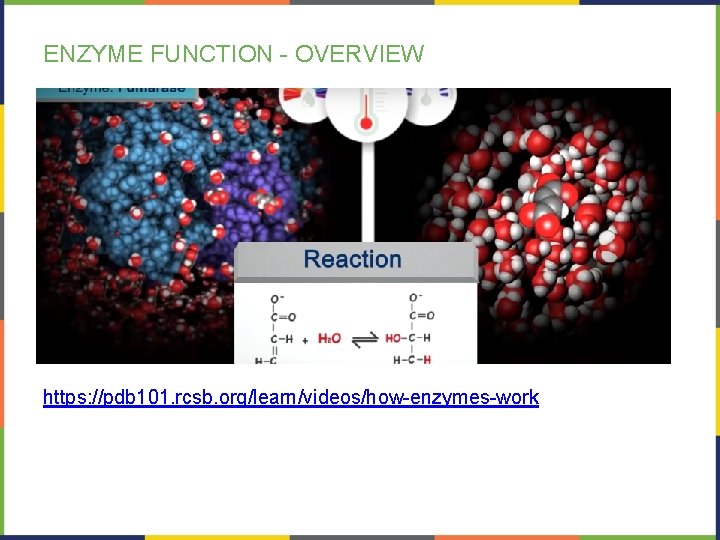
ENZYME FUNCTION - OVERVIEW https: //pdb 101. rcsb. org/learn/videos/how-enzymes-work
ENZYME REGULATION • Regulation of enzyme activity helps cells control their environment to meet their specific needs. • For example, digestive cells in your stomach work harder after a meal than when you sleep. • Enzymes can be regulated by • Modifications to temperature and/or p. H • Production of molecules that inhibit or promote enzyme function • Availability of coenzymes or cofactors
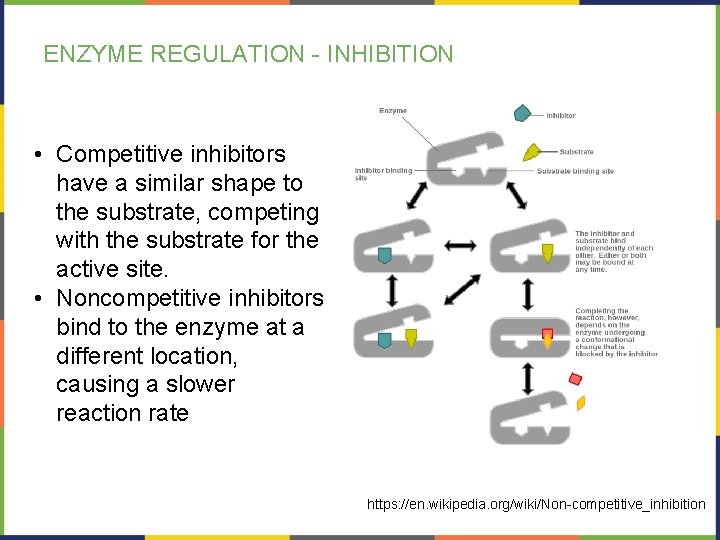
ENZYME REGULATION - INHIBITION • Competitive inhibitors have a similar shape to the substrate, competing with the substrate for the active site. • Noncompetitive inhibitors bind to the enzyme at a different location, causing a slower reaction rate https: //en. wikipedia. org/wiki/Non-competitive_inhibition
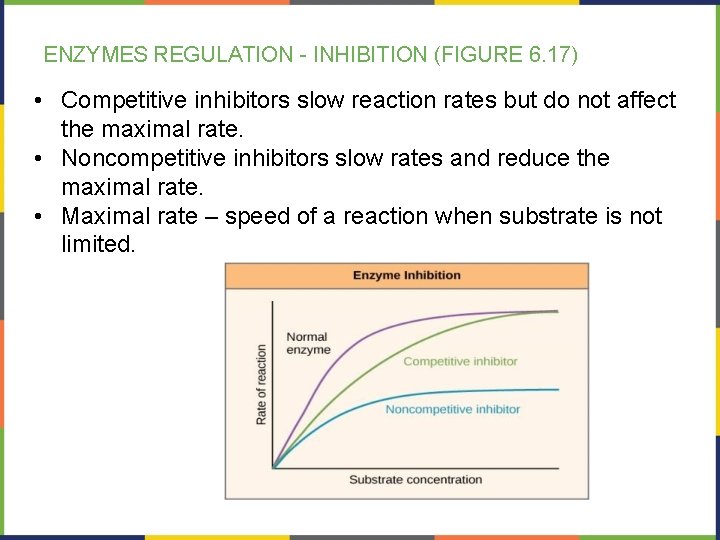
ENZYMES REGULATION - INHIBITION (FIGURE 6. 17) • Competitive inhibitors slow reaction rates but do not affect the maximal rate. • Noncompetitive inhibitors slow rates and reduce the maximal rate. • Maximal rate – speed of a reaction when substrate is not limited.
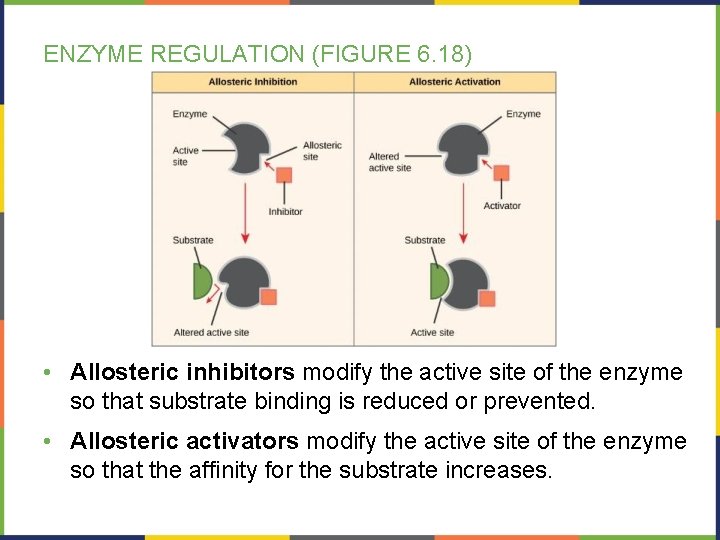
ENZYME REGULATION (FIGURE 6. 18) • Allosteric inhibitors modify the active site of the enzyme so that substrate binding is reduced or prevented. • Allosteric activators modify the active site of the enzyme so that the affinity for the substrate increases.
ENZYMES EVERY DAY CONNECTION - DRUG DISCOVERY (FIGURE 6. 19) Have you ever wondered how pharmaceutical drugs are developed? Look for inhibitors to enzymes in specific pathways
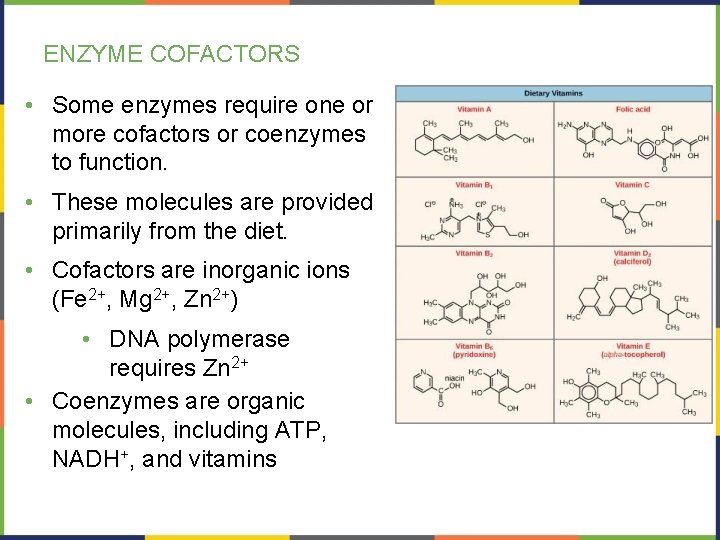
ENZYME COFACTORS • Some enzymes require one or more cofactors or coenzymes to function. • These molecules are provided primarily from the diet. • Cofactors are inorganic ions (Fe 2+, Mg 2+, Zn 2+) • DNA polymerase requires Zn 2+ • Coenzymes are organic molecules, including ATP, NADH+, and vitamins
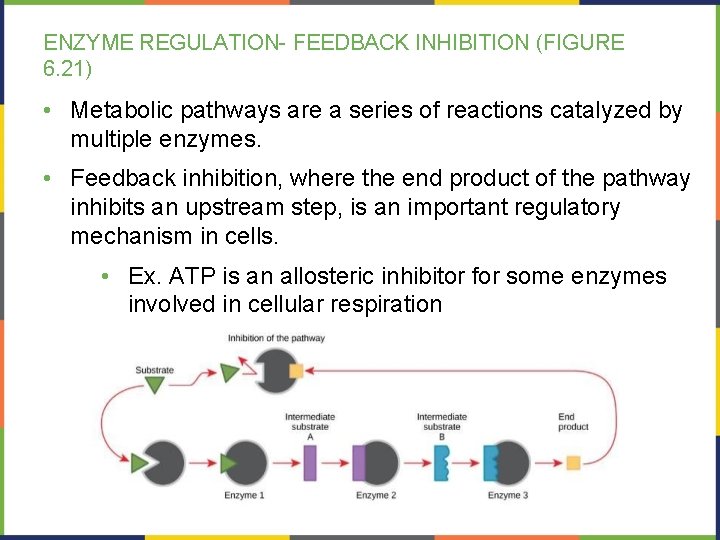
ENZYME REGULATION- FEEDBACK INHIBITION (FIGURE 6. 21) • Metabolic pathways are a series of reactions catalyzed by multiple enzymes. • Feedback inhibition, where the end product of the pathway inhibits an upstream step, is an important regulatory mechanism in cells. • Ex. ATP is an allosteric inhibitor for some enzymes involved in cellular respiration
COPYRIGHT AND CREDITS This Power. Point file is copyright Rice University. All Rights Reserved. Modified by E. G. Cantonwine, Valdosta State University. Updated for Biology 2 e by Open. Stax.
- Slides: 45