
BIOLOGY 2 E Chapter 32 PLANT REPRODUCTION Power
BIOLOGY 2 E Chapter 32 PLANT REPRODUCTION Power. Point Image Slideshow This work is licensed under a Creative Commons Attribution-Non. Commercial. Share. Alike 4. 0 International License.
INTRODUCTION ∙ Some plant species reproduce sexually while others reproduce asexually. ∙ Sexual reproduction often depends on pollinating agents. o Flowers attract pollinators. o Wind and water can also act as pollinating agents.
32. 1: REPRODUCTIVE DEVELOPMENT AND STRUCTURE ∙ Sexual reproduction takes place with slight variations in different groups of plants. ∙ Plants have two distinct stages in their lifecycle… o Gametophyte ▪ Haploid (from mitotic division of spores). ▪ Produces male and female gametes via mitosis. o Sporophyte ▪ Diploid (from fusion of male and female gametes).
∙ Alternation of generation: a plant will alternate between the sporophyte and gametophyte within its life cycle. o Sporophyte is the dominate stage in higher plants such as angiosperms. o In ferns the gametophyte is freeliving and distinct. o In bryophytes the gametophyte is more developed.
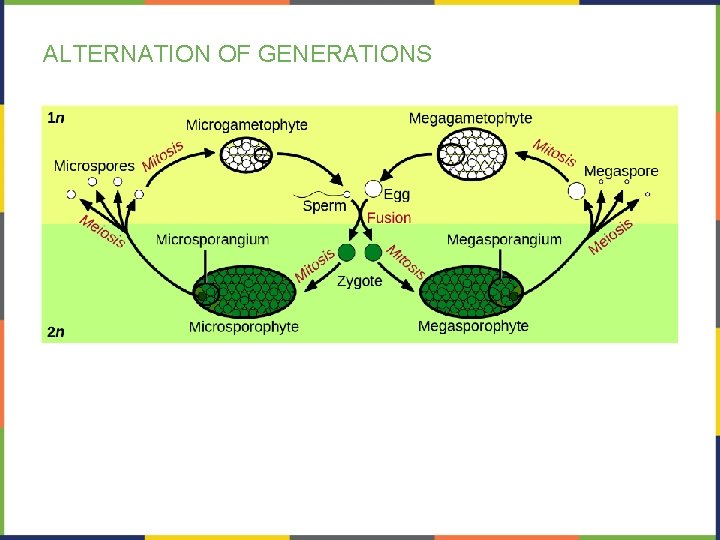
ALTERNATION OF GENERATIONS
∙ Plants will increase in size, develop a root system, as well as a shoot system during vegetative phase. ∙ Flowering plants will bear flowers on a receptacle during the reproductive phase. o Number of flowers, shape, size, and color vary between species.
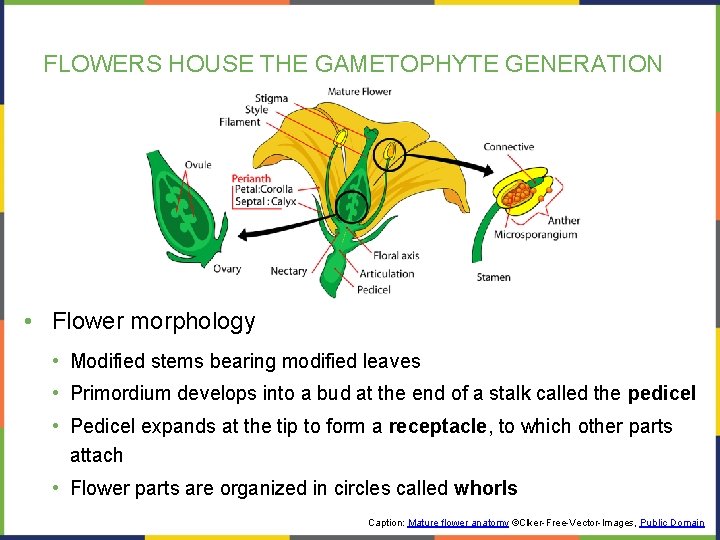
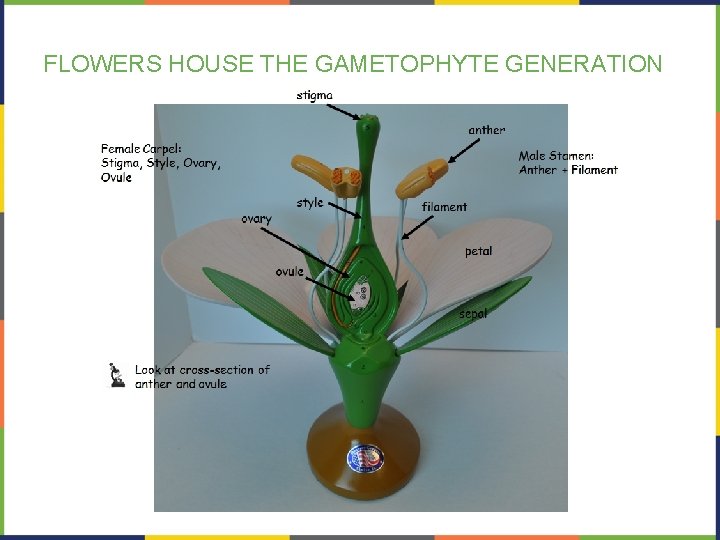
FLOWERS HOUSE THE GAMETOPHYTE GENERATION • Flower morphology • Modified stems bearing modified leaves • Primordium develops into a bud at the end of a stalk called the pedicel • Pedicel expands at the tip to form a receptacle, to which other parts attach • Flower parts are organized in circles called whorls Caption: Mature flower anatomy ©Clker-Free-Vector-Images, Public Domain
SEXUAL REPRODUCTION IN ANGIOSPERMS o. Haploid gametophyte alternates with the diploid sporophyte during sexual reproduction. o. Flowers contain the reproductive structures. o. Flower structure ▪ Four main parts (or whorls) of a typical flower… ∙ Calyx o. Outermost whorl. o. Made of sepals (green leafy structures).
o. Flower structure ▪ Four main parts (or whorls) of a typical flower… (cont. ) ∙ Corolla o. Second whorl. o. Brightly colored petals. o. Monocots: petals in multiples of three o. Dicots: petals in multiples of four or five ∙ Perianth (calyx and corolla) ∙ Androecium o. Third whorl with the male reproductive structures. o. Has stamens with anthers
o. Flower structure ▪ Four main parts (or whorls) of a typical flower… (cont. ) ∙ Gynoecium o. Fourth whorl or innermost whorl with the female reproductive components. o. Carpel is the individual unit. ▪ Contains a stigma, style, and ovary. ▪ The ovary contains megasporangia (ovules).

FLOWERS HOUSE THE GAMETOPHYTE GENERATION • Flower whorls • Outermost whorl – sepals • Second whorl – petals • Third whorl – stamens • Pollen is the male gametophyte • Each stamen has a pollenbearing anther and a filament (stalk) • Innermost whorl – carpel(s) • House the female gametophyte Caption: Picture of a Columbine (Aquilegia 'Blue Butterflies') flower ©Derek Ramsey, Share. Alike Caption: Aquilegia floral whorls ©Pavle Cikovac, Share. Alike
FLOWERS HOUSE THE GAMETOPHYTE GENERATION
▪Complete flowers contain all four whorls while incomplete do not. ▪Perfect flowers contain an androecium and gynoecium (are androgynous/hermaphroditic). ▪Incomplete flowers… ∙ Staminate only contain androecium. ∙ Carpellate only contain gynoecium.
▪Species that have male and female flowers borne on the same plant (such as corn) are known as monoecious. ▪Species that have male and female flowers borne on separate plants (such as papaya) are known as dioecious. ▪Ovaries may be placed above other flower parts (superior) or below (inferior).
MALE GAMETOPHYTE (POLLEN GRAIN) ▪Reaches maturity in an immature anther. ▪Development of pollen takes place in the microsporangium. ∙ Billowed sacs (pollen sacs) where microspores develop into pollen grains. ▪Within the microsporangium mother cells will undergo meiosis forming four microspores. ▪Microspore will ultimately form into a pollen grain.
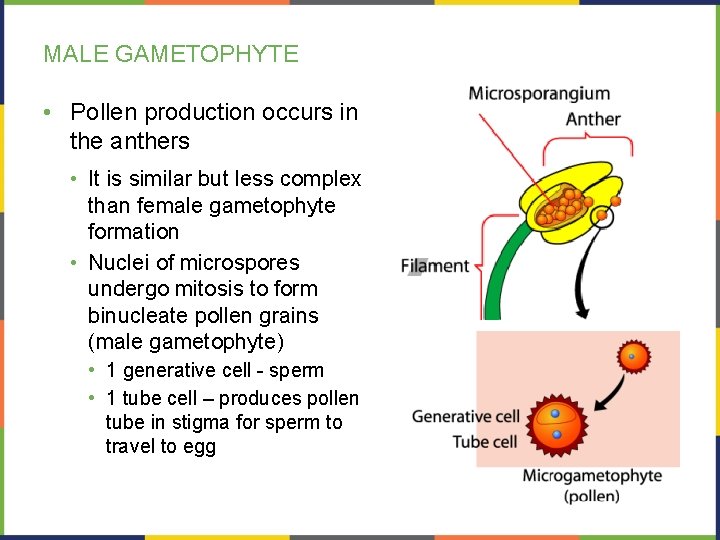
MALE GAMETOPHYTE • Pollen production occurs in the anthers • It is similar but less complex than female gametophyte formation • Nuclei of microspores undergo mitosis to form binucleate pollen grains (male gametophyte) • 1 generative cell - sperm • 1 tube cell – produces pollen tube in stigma for sperm to travel to egg
▪The tapetum provides nutrition to the developing microspores and contributes key components to the pollen wall. ∙ Inner layer of cells within the microsporangium. ▪The microsporangia burst upon maturity, releasing the pollen grains.

MALE GAMETOPHYTE
▪Mature pollen grains contain two cells; generative cell and pollen tube cell. ∙ The generative cell is held within the larger pollen tube cell. ∙ Upon germination the tube cell will form the pollen tube. ∙ As the generative cell migrates to enter the ovary it divides to form two male gametes (sperm cells).
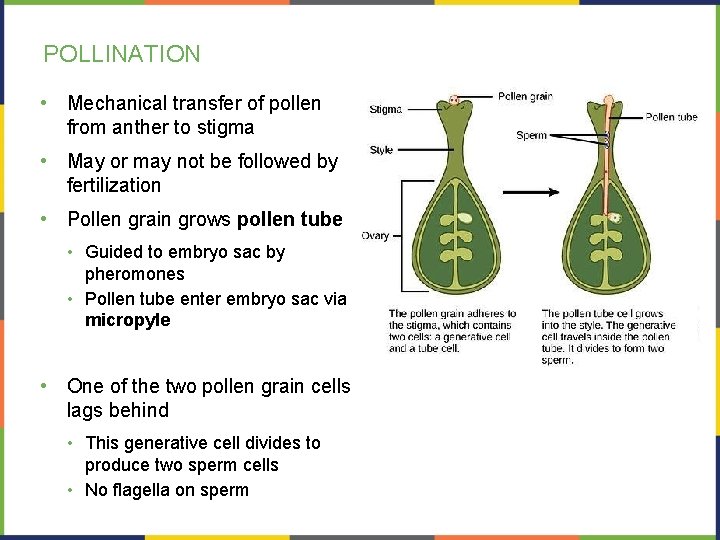
POLLINATION • Mechanical transfer of pollen from anther to stigma • May or may not be followed by fertilization • Pollen grain grows pollen tube • Guided to embryo sac by pheromones • Pollen tube enter embryo sac via micropyle • One of the two pollen grain cells lags behind • This generative cell divides to produce two sperm cells • No flagella on sperm
▪Each pollen grain has two coverings outside the cells… ∙ Exine o. Thicker, outer layer. o. Contains sporopollenin, a complex waterproofing substance supplied by the tapetum. o. Allows pollen to survive unfavorable conditions. ∙ Intine o. Thinner, inner layer.
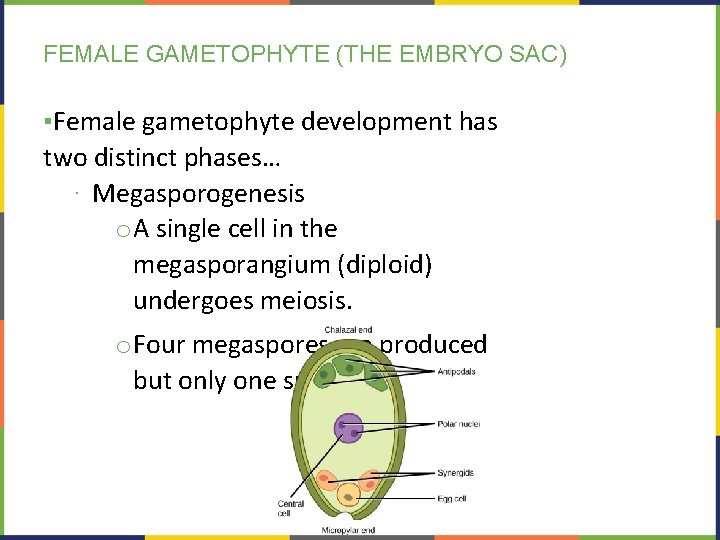
FEMALE GAMETOPHYTE (THE EMBRYO SAC) ▪Female gametophyte development has two distinct phases… ∙ Megasporogenesis o. A single cell in the megasporangium (diploid) undergoes meiosis. o. Four megaspores are produced but only one survives.
▪Female gametophyte development has two distinct phases…(cont. ) ∙ Megagametogenesis o. Surviving megaspore (haploid) undergoes mitosis. o. Produces an eight-nucleate, sevencell gametophyte. o. Known as a megagametophyte or embryo sac. o. Two of the nuclei (polar nuclei) move to the equator and fuse to form a single, diploid central cell. ▪ Central cell will fuse with a sperm to form the triploid
▪Female gametophyte development has two distinct phases…(cont. ) ∙ Megagametogenesis (cont. ) o Three other nuclei position themselves on the side opposite to the micropyle. ▪ Become the antipodal cells that later degenerate. o The nucleus closest to the micropyle becomes the female gamete (egg cell). o The two adjacent cells (to the egg cell) become synergid cells. ▪ Help guide the pollen tube and then degenerate. o After fertilization the diploid zygote develops into the embryo and the fertilized ovule forms the other tissues of the seed.
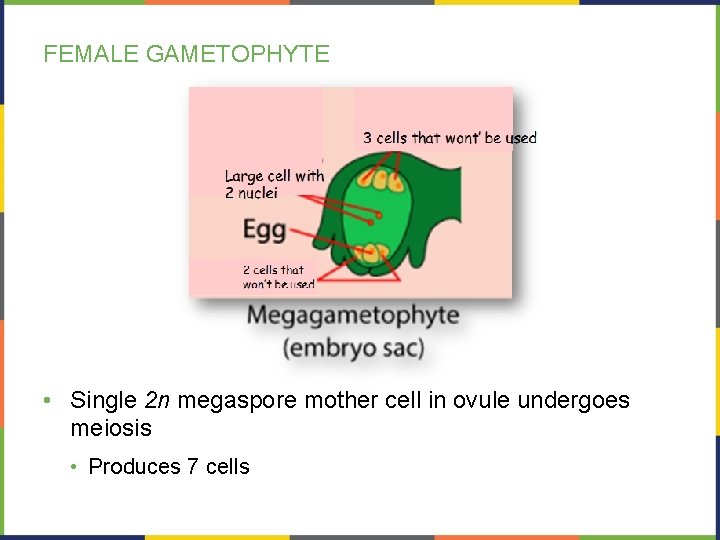
FEMALE GAMETOPHYTE • Single 2 n megaspore mother cell in ovule undergoes meiosis • Produces 7 cells
▪Double-layered integument protects the megasporangium (and eventually the embryo sac). ∙ Will develop into the seed coat. ▪Ovule wall will become part of the fruit. ▪Micropyle=opening in the integument that allows the pollen tube to enter.
SEXUAL REPRODUCTION IN GYMNOSPERMS o. Characterized by alternation of generation. o. In conifers (such as pine trees) the green leafy part is the sporophyte and the cones contain the gametophytes. ▪ Female cones are larger than male cones. ▪ Female cones are positioned towards the top of the tree. ▪ Difficult for self-pollination because they depend on wind dispersal for moving pollen.
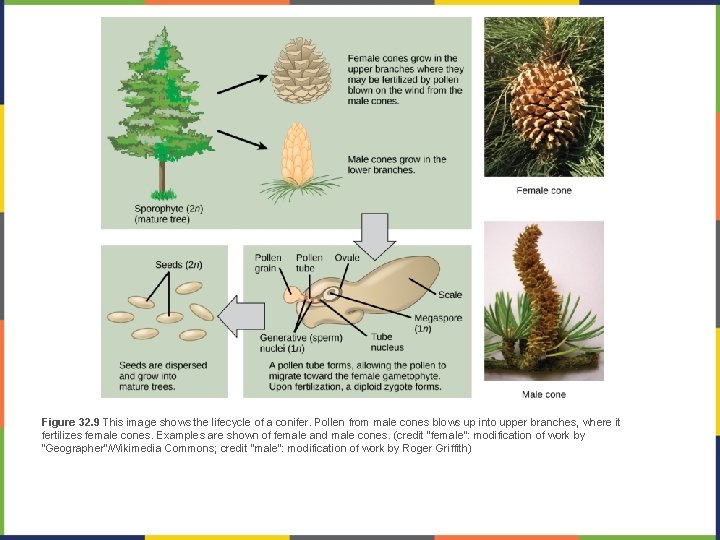
Figure 32. 9 This image shows the lifecycle of a conifer. Pollen from male cones blows up into upper branches, where it fertilizes female cones. Examples are shown of female and male cones. (credit “female”: modification of work by “Geographer”/Wikimedia Commons; credit “male”: modification of work by Roger Griffith)
MALE GAMETOPHYTE ▪Male cone has a central axis with bracts (modified leaf). ▪Bracts are known as microsporophylls. ∙ Contain microsporangium (site of microspore development). ∙ Within the microsporangium… omicrosporocytes undergo meiosis to form four haploid microspores. o. Further mitosis produces two nuclei (generative nucleus and tube cell nucleus). ▪Upon maturity the pollen is released from the male cone and carried by wind.
FEMALE GAMETOPHYTE ▪Female cone has a central axis with bracts known as megasporophylls. ∙ Contain megasporangium (site of megaspore development). ∙ Within the megasporangium… o. Megaspore mother cell divides by meiosis producing four haploid megaspores. o. One megaspore divides to form multicellular gametophyte. o. Others divide to form the rest of the structure. ▪ Female gametophyte contained within
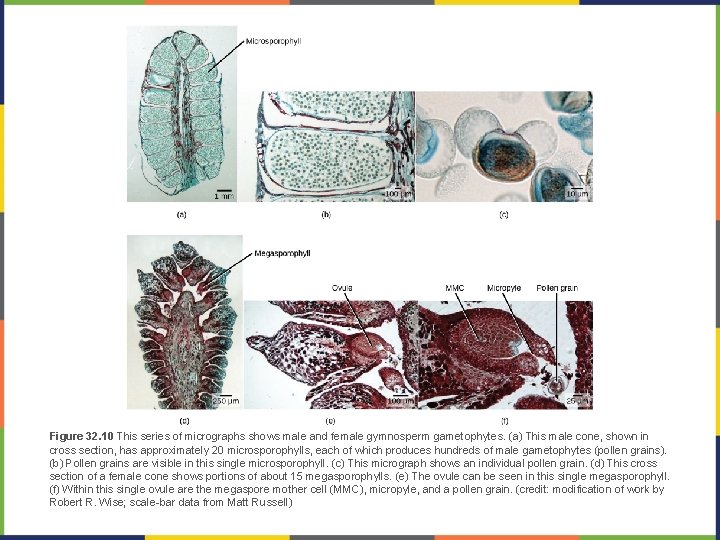
Figure 32. 10 This series of micrographs shows male and female gymnosperm gametophytes. (a) This male cone, shown in cross section, has approximately 20 microsporophylls, each of which produces hundreds of male gametophytes (pollen grains). (b) Pollen grains are visible in this single microsporophyll. (c) This micrograph shows an individual pollen grain. (d) This cross section of a female cone shows portions of about 15 megasporophylls. (e) The ovule can be seen in this single megasporophyll. (f) Within this single ovule are the megaspore mother cell (MMC), micropyle, and a pollen grain. (credit: modification of work by Robert R. Wise; scale-bar data from Matt Russell)
REPRODUCTIVE STRUCTURE ▪Upon landing on the female cone the tube cell forms the pollen tube. ▪The generative cell then migrates towards the female gametophyte through the micropyle. ∙ It takes about one year for this to occur. ▪Generative cell splits into two sperm nuclei (one fuses with the egg and one degenerates).
▪After fertilization the diploid zygote divides by mitosis to form the embryo. ▪Scales are closed during seed development. ▪The seed is covered by a seed coat (from female sporophyte). ∙ Seed development takes one to two years. ▪Bracts of the female cone will open when the seed is ready to be dispersed.
ANGIOSPERM VERSUS GYMNOSPERM o. Female gametophytes… ▪ Angiosperms: exist in enclosed ovules within the ovary ▪ Gymnosperms: present on exposed bracts o. Double fertilization is present in angiosperms but not gymnosperms. o. Angiosperms have their reproductive structures on flowers while gymnosperms use cones. o. Angiosperms have more mechanisms for pollen dispersal (including animal
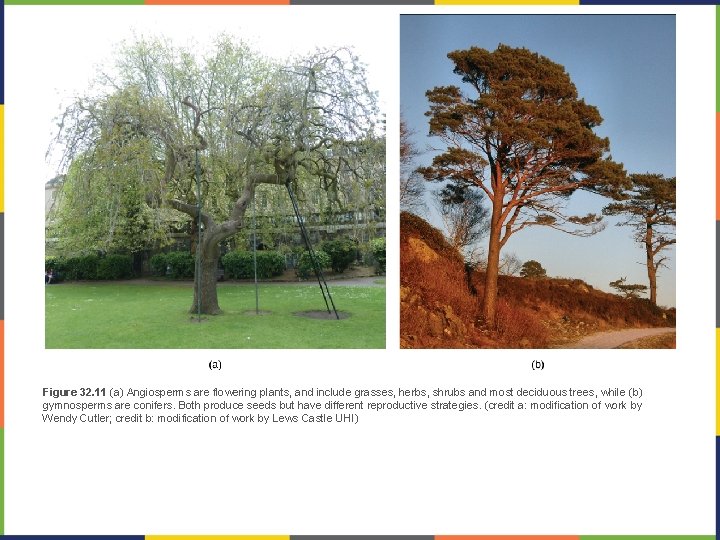
Figure 32. 11 (a) Angiosperms are flowering plants, and include grasses, herbs, shrubs and most deciduous trees, while (b) gymnosperms are conifers. Both produce seeds but have different reproductive strategies. (credit a: modification of work by Wendy Cutler; credit b: modification of work by Lews Castle UHI)
32. 2: POLLINATION AND FERTILIZATION ∙ Pollination… o Angiosperms: placement/transfer of pollen from the anther to the stigma o Gymnosperms: pollen transfer from the male cone to the female cone ∙ Gregor Mendel studied both self- and cross-pollination within many species of plants. ∙ Today’s crops are a result of plant breeding and years of artificial selection. o Ancestor of corn is the teosinte (drastically different physically, but the genetic difference is miniscule).
∙ Two forms of pollination… o Self-pollination: pollen from the anther is deposited on a stigma within the same plant. o Cross-pollination: transfer of pollen from an anther to a stigma on a different plant of the same species.
∙ Self-pollination can occur naturally when the stamen and carpel mature at the same time. o Must be positioned so pollen can land on the stigma. ∙ Many plants avoid self-pollination because it limits genetic diversity. o Pollen and ovary mature at different times. o Preventative physical features such as those found in the primrose (heterostyly). o Male and female reproductive flowers
∙ Cross-pollination relies on pollinators. o Can be either biotic (animals) or abiotic (wind or water).
INCOMPATIBILITY GENES IN FLOWERS o. Prevent pollen from germinating or growing into the stigma. o. Self-incompatibility is controlled by the S (sterility) locus. ▪ Primarily involves an interaction between the pollen and the stigma epidermal cells. ▪ Can cause… ∙ Pollen tube inhibition or death (by apoptosis or degradation of RNA). ∙ Results from the activity of a ribonuclease coded in the S locus. ▪ Mechanism to prevent self-fertilization
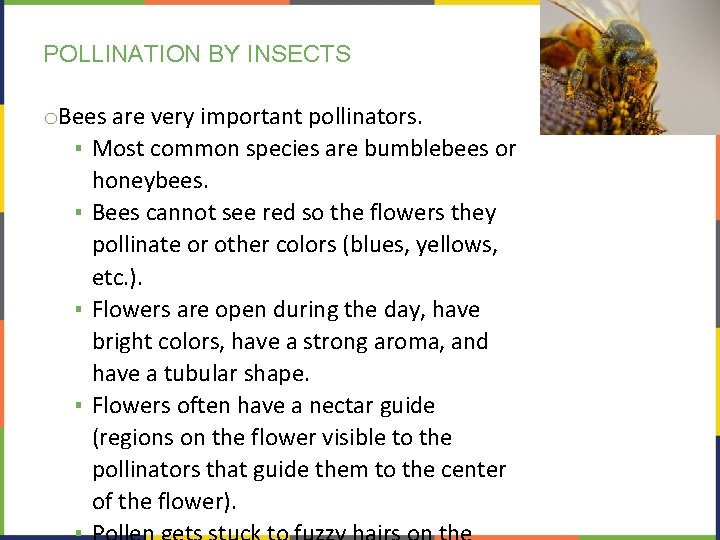
POLLINATION BY INSECTS o. Bees are very important pollinators. ▪ Most common species are bumblebees or honeybees. ▪ Bees cannot see red so the flowers they pollinate or other colors (blues, yellows, etc. ). ▪ Flowers are open during the day, have bright colors, have a strong aroma, and have a tubular shape. ▪ Flowers often have a nectar guide (regions on the flower visible to the pollinators that guide them to the center of the flower).
o. Many flies are attracted to flowers that have an odor of decay or rotting flesh. ▪ Flowers usually dull in color (brown or purple). ▪ Examples include the corpse flower, dragon arum, and carrion flower. ▪ The nectar provides energy, whereas the pollen provides protein.
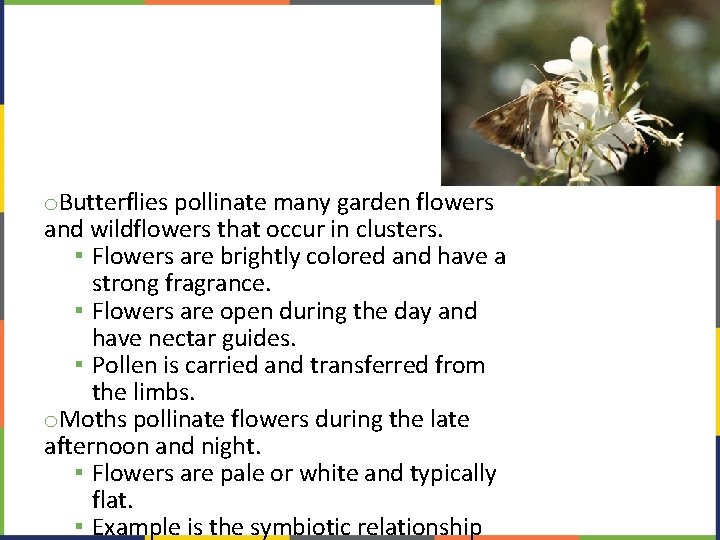
o. Butterflies pollinate many garden flowers and wildflowers that occur in clusters. ▪ Flowers are brightly colored and have a strong fragrance. ▪ Flowers are open during the day and have nectar guides. ▪ Pollen is carried and transferred from the limbs. o. Moths pollinate flowers during the late afternoon and night. ▪ Flowers are pale or white and typically flat. ▪ Example is the symbiotic relationship
POLLINATION BY BATS o. Usually occurs in the tropics and deserts. o. Flowers are nocturnal such as the agave, guava, and morning glory. o. Flowers are usually large and white/pale in color. o. Flowers have a strong fruity or musky fragrance. o. To accommodate the size of the bats the flowers are large and wide-mouthed.
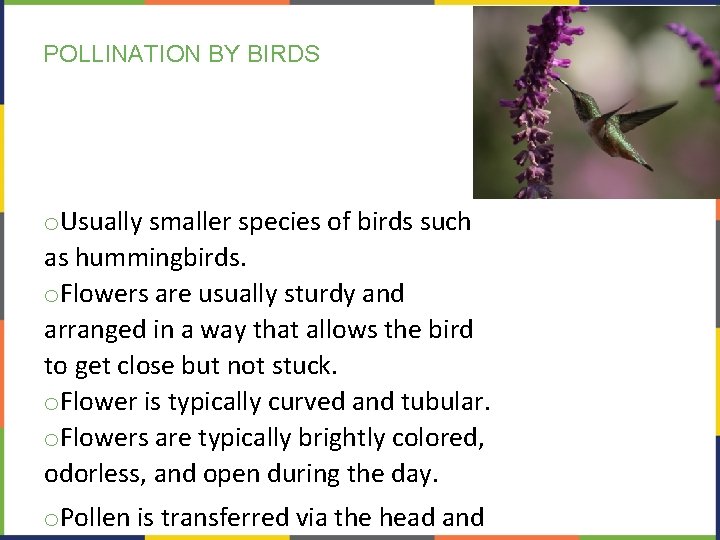
POLLINATION BY BIRDS o. Usually smaller species of birds such as hummingbirds. o. Flowers are usually sturdy and arranged in a way that allows the bird to get close but not stuck. o. Flower is typically curved and tubular. o. Flowers are typically brightly colored, odorless, and open during the day. o. Pollen is transferred via the head and
POLLINATION BY WIND o. Most species of conifers use the wind as a pollinator. o. Species of angiosperms such as grasses, maples, and oaks also use the wind. o. Flowers are usually green, small, and produce large amounts of pollen. o. Flowers may have small petals or none. o. Flowers do not produce a scent or nectar. o. The microsporangia often hang out of the flower to be picked up by the wind. o. The flowers usually emerge before the leaves in the spring. ▪ Prevents the leaves from blocking the wind during pollen dispersal.
POLLINATION BY WATER o. Some weeds are pollinated by water such as the Australian sea grass and pond weeds. o. The pollen floats on water and is deposited inside the flower upon contact.
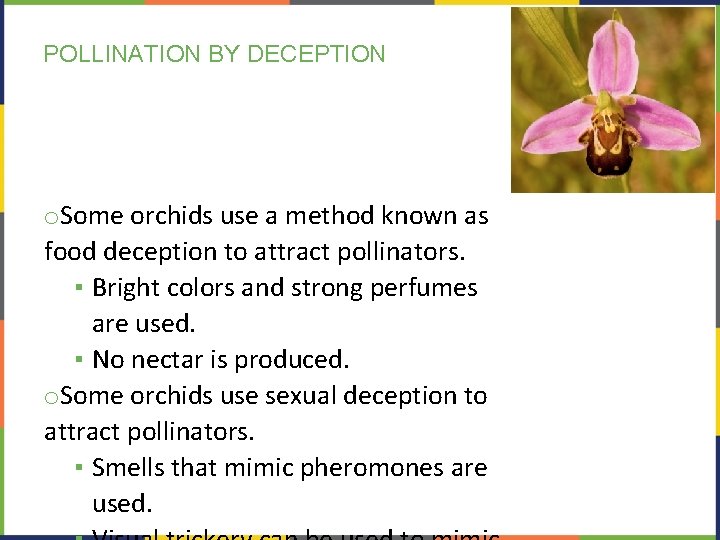
POLLINATION BY DECEPTION o. Some orchids use a method known as food deception to attract pollinators. ▪ Bright colors and strong perfumes are used. ▪ No nectar is produced. o. Some orchids use sexual deception to attract pollinators. ▪ Smells that mimic pheromones are used.
DOUBLE FERTILIZATION o. The microspores (pollen) contains two cells: pollen tube cell and generative cell. o. Germination of the pollen tube requires water, oxygen, and chemical signals. o. The growth of the pollen tube is supported by tissues in the style and guided by chemicals released by the synergids (in the embryo sac). o. The pollen tube enters the embryo sac via the micropyle. o. The generative cell divides to produce
o. One sperm cell fertilizes the egg (forms the zygote) and the other fuses with the two polar bodies (forms the endosperm). ▪ This is known as double fertilization. o. The fertilized ovule forms the seed and the tissues of the ovary form the fruit. o. The zygote divides to form two cells… ▪ Terminal cell (upper) ∙ Division gives rise to a globularshaped proembyro. ▪ Basal cell (lower) ∙ Division gives rise to the suspensor. ∙ Makes connection to the maternal tissue. ∙ Route for nutrition.
o. In dicots the developing embryo has a heart shape. ▪ Caused by the presence of two cotyledons. ▪ In non-endospermic dicots the cotyledons receive the food reserves. ▪ Provides food until the first leaves can undergo photosynthesis. o. As the embryo and cotyledons grow they are forced to bend within the seed. o. Eventually embryonic development is suspended and only resumes after the
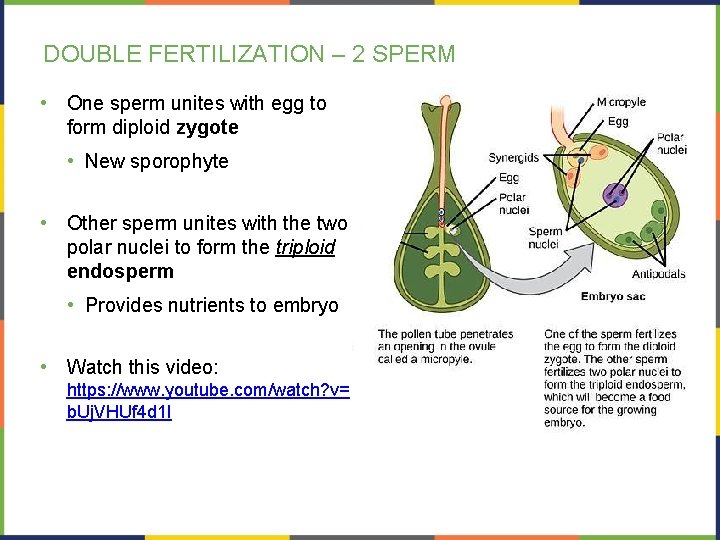
DOUBLE FERTILIZATION – 2 SPERM • One sperm unites with egg to form diploid zygote • New sporophyte • Other sperm unites with the two polar nuclei to form the triploid endosperm • Provides nutrients to embryo • Watch this video: https: //www. youtube. com/watch? v= b. Uj. VHUf 4 d 1 I
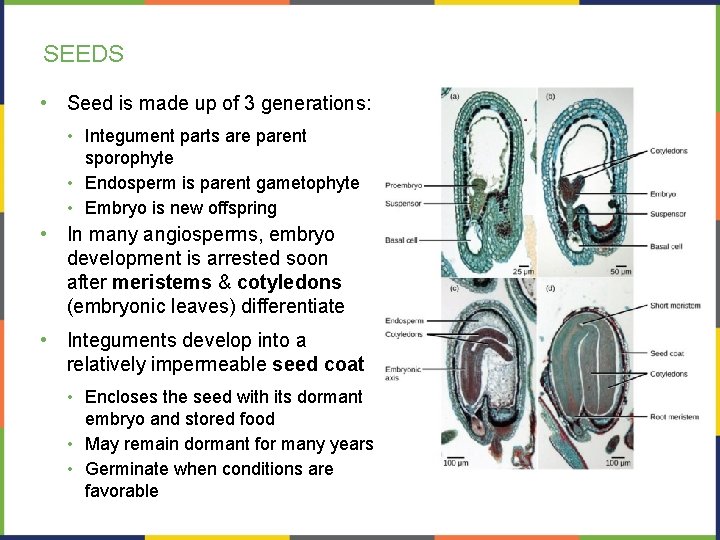
SEEDS • Seed is made up of 3 generations: • Integument parts are parent sporophyte • Endosperm is parent gametophyte • Embryo is new offspring • In many angiosperms, embryo development is arrested soon after meristems & cotyledons (embryonic leaves) differentiate • Integuments develop into a relatively impermeable seed coat • Encloses the seed with its dormant embryo and stored food • May remain dormant for many years • Germinate when conditions are favorable
DEVELOPMENT OF THE SEED ▪Mature ovule develops in the seed. ▪Typical seed contains a seed coat, cotyledons, endosperm, and a single embryo. ▪In monocots… ∙ Have a single cotyledon called the scutellum. ∙ Scutellum is directly connected to the embryo via vascular tissue. ∙ Food reserves are stored in the large endosperm. ∙ Upon fertilization enzymes are secreted by the aleurone (just inside the seed
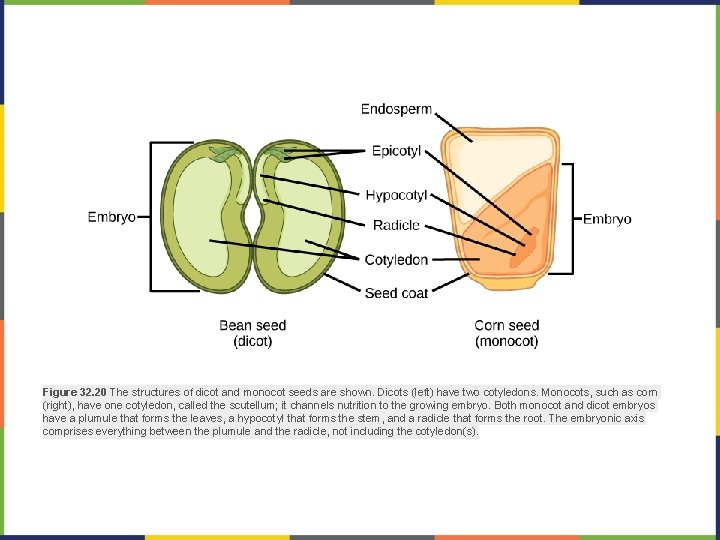
Figure 32. 20 The structures of dicot and monocot seeds are shown. Dicots (left) have two cotyledons. Monocots, such as corn (right), have one cotyledon, called the scutellum; it channels nutrition to the growing embryo. Both monocot and dicot embryos have a plumule that forms the leaves, a hypocotyl that forms the stem, and a radicle that forms the root. The embryonic axis comprises everything between the plumule and the radicle, not including the cotyledon(s).
▪In dicots… ∙ Two cotyledons have a vascular connection to the embryo. ∙ Endospermic dicots… o. Food reserves are held in the endosperm. o. Cotyledons absorb broken down food stuffs after germination. o. Examples include tomatoes and peppers. ∙ Non-endospermic dicots… o. The endosperm is broken down and food reserves are shipped to the cotyledons. o. Examples include peanuts and peas. ∙ In dicots the seed coat is divided into
▪The embryonic axis consists of three parts… ∙ Hypocotyl o. Between the cotyledon attachment point and radicle. o. In dicots this will extend above ground giving rise to the stem. ∙ Radicle o. End of the embryonic axis. o. Develops into the root system. ∙ Plumule o. Composed of the epicotyl, young leaves, and the shoot apical meristem. ▪The epicotyl projects above the cotyledons.
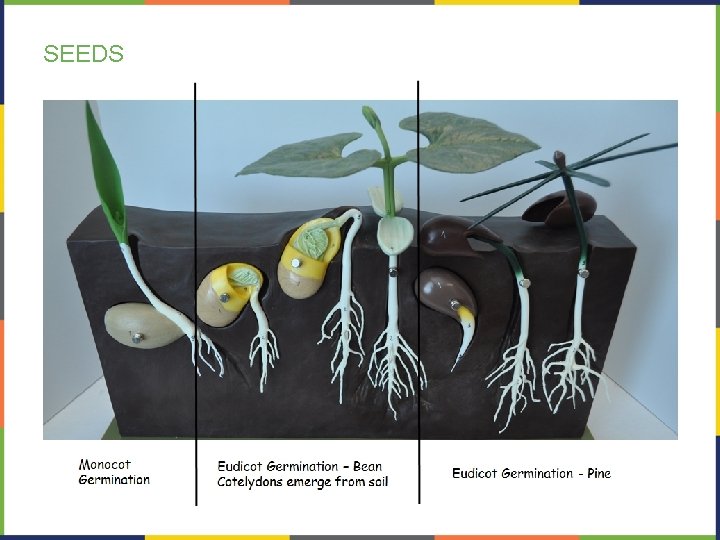
▪In dicot seeds… ∙ The epicotyl forms the plumule hook. o. Protects the plumule as it moves through soil. ∙ When exposed to light the hook straightens and the epicotyl continues to elongate. ∙ The radicle grows to produce the primary root. o. As it forms the tap root, lateral roots branch off to all sides.
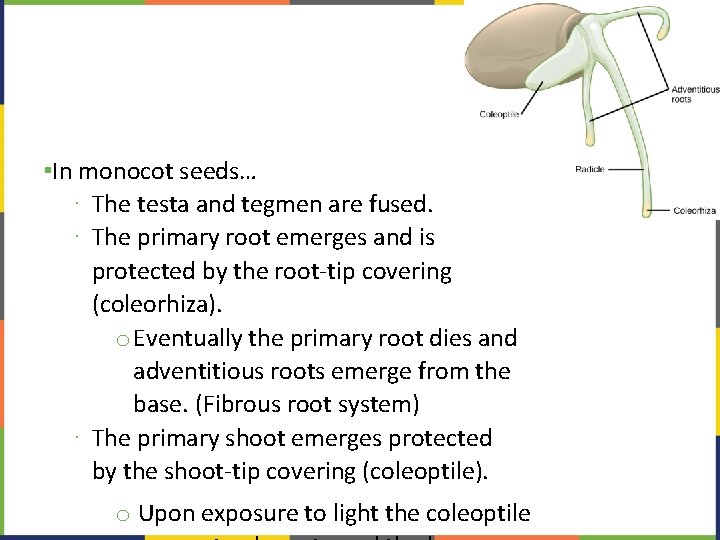
▪In monocot seeds… ∙ The testa and tegmen are fused. ∙ The primary root emerges and is protected by the root-tip covering (coleorhiza). o. Eventually the primary root dies and adventitious roots emerge from the base. (Fibrous root system) ∙ The primary shoot emerges protected by the shoot-tip covering (coleoptile). o Upon exposure to light the coleoptile
SEEDS
SEEDS • Seeds are an important adaptation 1. Maintain dormancy under unfavorable conditions 2. Protect young plant when it is most vulnerable 3. Provide food for the embryo until it can produce its own food 4. Facilitate dispersal of the embryo
SEED GERMINATION ∙Dormancy = period of inactivity or low metabolic activity o. In many mature seeds this may last from months to even centuries. • Dormancy helps keep seeds viable during unfavorable conditions.
∙Favorable conditions will enable germination and can include… o. Increased moisture. o. Fires. o. Vernalization (cold treatment). o. Heat treatment. o. Scarification (mechanical or chemical breakdown of the seed coat). ∙The time for a seedling to emerge may also vary. ∙Large seeds often have enough food reserves for germination to occur deep underground.
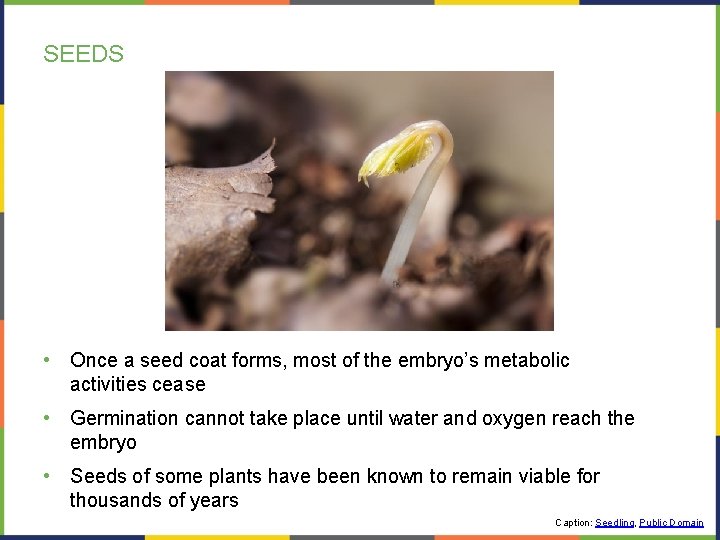
SEEDS • Once a seed coat forms, most of the embryo’s metabolic activities cease • Germination cannot take place until water and oxygen reach the embryo • Seeds of some plants have been known to remain viable for thousands of years Caption: Seedling, Public Domain
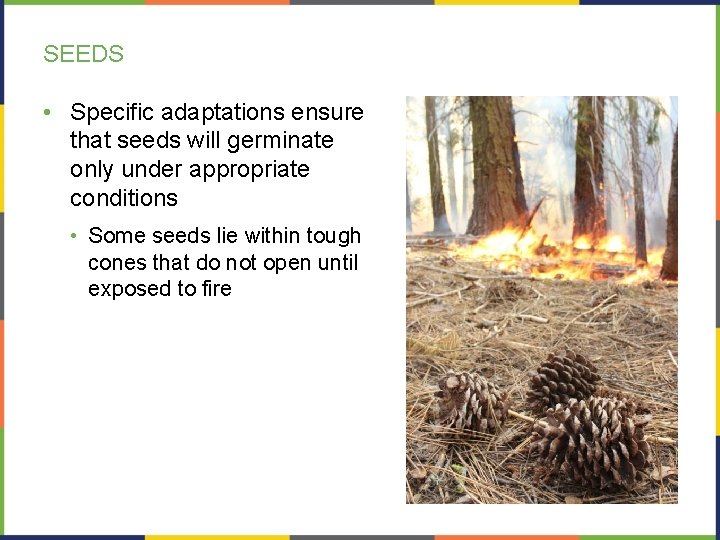
SEEDS • Specific adaptations ensure that seeds will germinate only under appropriate conditions • Some seeds lie within tough cones that do not open until exposed to fire
DEVELOPMENT OF FRUIT AND FRUIT TYPES ▪Ovary usually develops into the fruit after fertilization. ▪Botanically speaking a fruit is just a ripened ovary. ▪True fruits from directly from the ovary. ▪Accessory fruits develop from another part of the female gametophyte. ▪Dehiscent fruits readily disperse their seeds (such as peas). ▪Indehiscent fruits rely on decay to release their seeds (such as peaches).
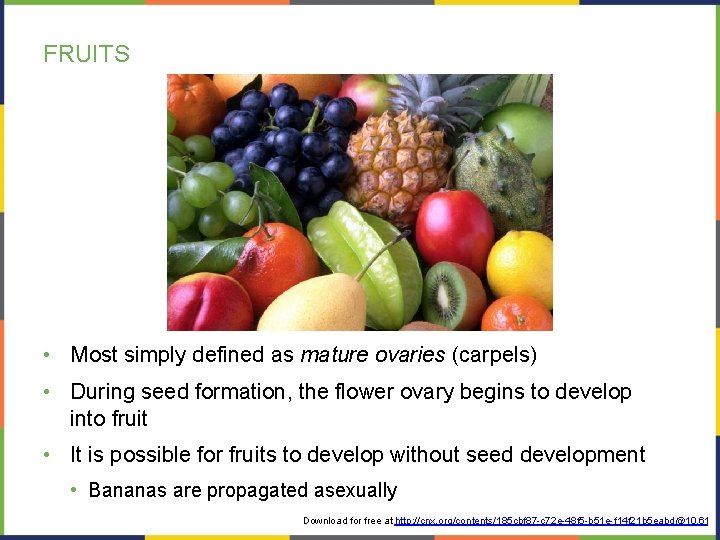
FRUITS • Most simply defined as mature ovaries (carpels) • During seed formation, the flower ovary begins to develop into fruit • It is possible for fruits to develop without seed development • Bananas are propagated asexually Download for free at http: //cnx. org/contents/185 cbf 87 -c 72 e-48 f 5 -b 51 e-f 14 f 21 b 5 eabd@10. 61
▪Fruits may be classified as… ∙ Simple o. Develops from a single carpel or fused carpels of one ovary. o. Nuts and beans are examples. ∙ Aggregate o. Develops from more than one carpel found on the same flower. o. Raspberries are an example.
▪Fruits may be classified as…(cont. ) ∙ Multiple o. Develops from an inflorescence or a cluster of flowers. o. Pineapples are an example. ∙ Accessory o. Derive from structures outside the ovary. o. Strawberries (receptacles) and apples (hypanthium) are examples.
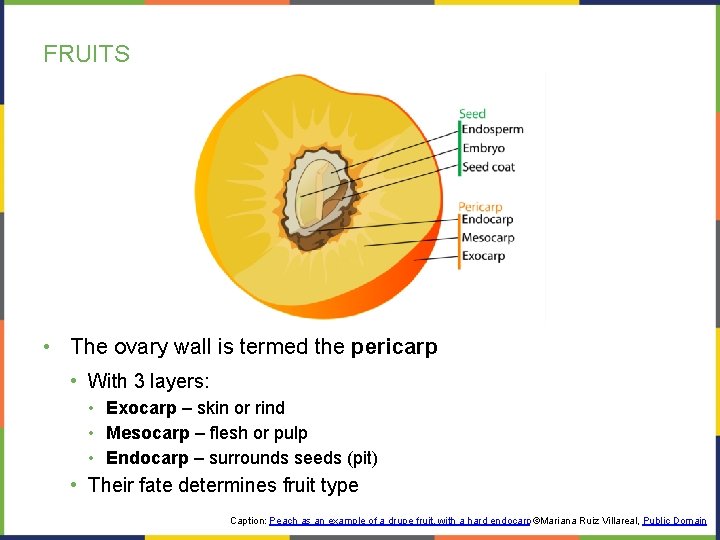
FRUITS • The ovary wall is termed the pericarp • With 3 layers: • Exocarp – skin or rind • Mesocarp – flesh or pulp • Endocarp – surrounds seeds (pit) • Their fate determines fruit type Caption: Peach as an example of a drupe fruit, with a hard endocarp ©Mariana Ruiz Villareal, Public Domain
FRUIT AND SEED DISPERSAL ▪Fruits only purpose is seed dispersal. ▪Seeds must be dispersed far enough away from the mother plant to reduce competitive conditions. ▪Some fruits have built-in mechanisms that aid in dispersal. ▪Some fruits have modifications in seed structure that aid in dispersal. ∙ Wing-like appendages for the wind. ∙ Light and buoyant fruit to float on water.
▪Animals will eat fruit and defecate some of the seeds. ▪Some fruits get buried or stuck on animals. ▪These mechanisms help disperse seeds through space. ▪Dormancy allows seeds to be dispersed through time.
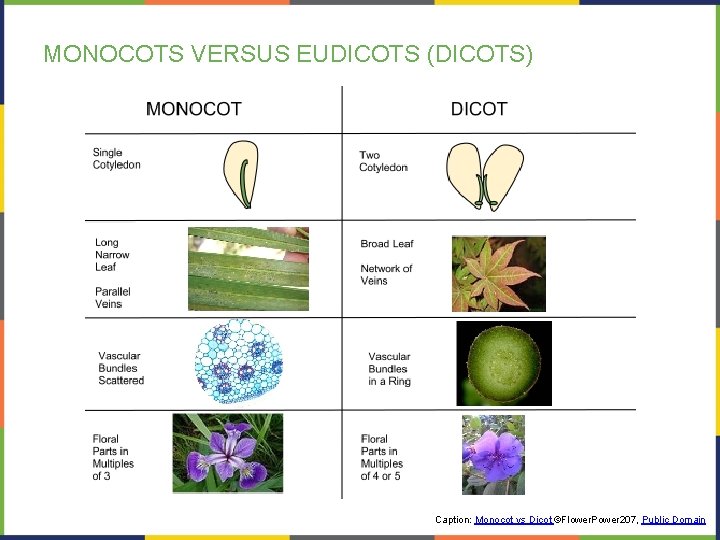
MONOCOTS VERSUS EUDICOTS (DICOTS) Caption: Monocot vs Dicot ©Flower. Power 207, Public Domain
32. 3: ASEXUAL REPRODUCTION ∙ Asexual reproduction does not require the investment needed for producing flowers, attracting pollinators, or seed dispersal. ∙ Produces genetically identical plants. (No mixing of male and female gametes. ) o Would work well in stable environments the plant is well adapted to.
∙ Many different types of roots exhibit this type of reproduction… o Corm (gladiolus and garlic) o Bulbs (lilies and daffodils) o Tubers (potatoes) o Rhizomes (ginger and iris) o Stolons (strawberry) ∙ Apomixis = diploid part of the ovule or ovary gives rise to a new seed ∙ Resulting plants usually reach maturity faster. ∙ Sturdier than a seedling.
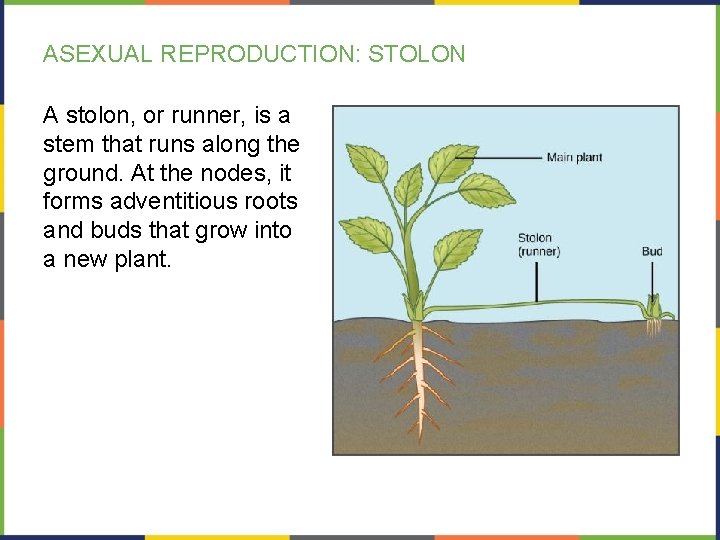
ASEXUAL REPRODUCTION: STOLON A stolon, or runner, is a stem that runs along the ground. At the nodes, it forms adventitious roots and buds that grow into a new plant.
NATURAL METHODS OF ASEXUAL REPRODUCTION o. Often associated with self-propagation. o. Plants can grow from buds present on the stem (such as onion and dahlia). o. Adventitious roots or runners can give rise to new plants (such as sweet potatoes). o. Leaves can have small buds in their margins (such as kalanchoe).
ARTIFICIAL METHODS OF ASEXUAL REPRODUCTION o. Grafting ▪ Used to create varieties of plants such as roses and citrus species. ▪ Part of the stem of the desirable plant is grafted onto a rooted plant called the stock. ▪ The part that is grafted is called the scion. ▪ Cuts are made at an oblique angle. ▪ Matching up and binding the two surfaces is vitally important. ▪ Eventually the vascular system of the two plants fuse to form a graft.
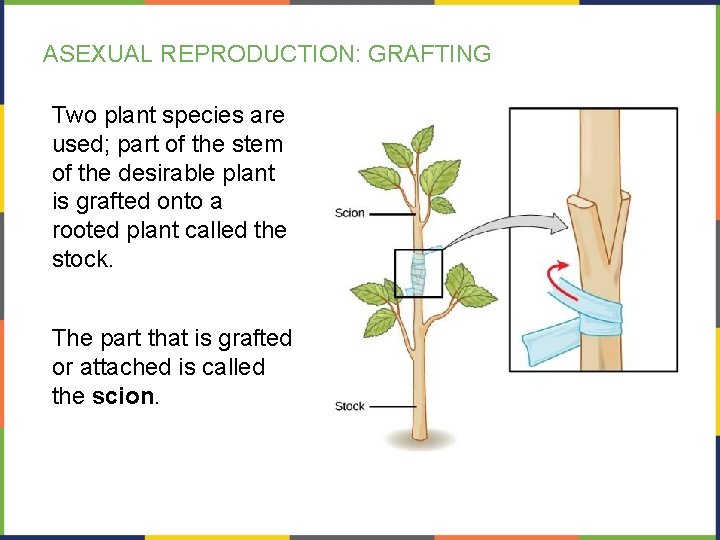
ASEXUAL REPRODUCTION: GRAFTING Two plant species are used; part of the stem of the desirable plant is grafted onto a rooted plant called the stock. The part that is grafted or attached is called the scion.
o. Cutting ▪ Portions of the stem containing nodes and internodes is placed in moist soil. ▪ Stem will eventually grow roots. o. Layering ▪ The stem attached to a plant is bent and covered by soil. ▪ Stems that can be easily bent are preferred.
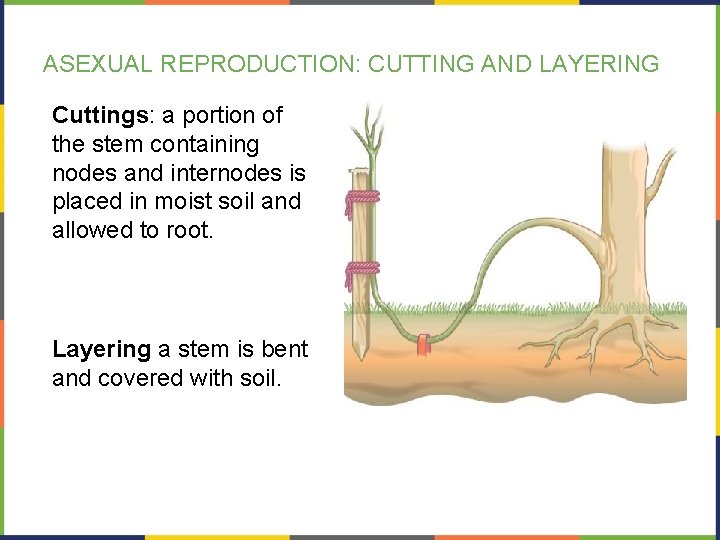
ASEXUAL REPRODUCTION: CUTTING AND LAYERING Cuttings: a portion of the stem containing nodes and internodes is placed in moist soil and allowed to root. Layering a stem is bent and covered with soil.
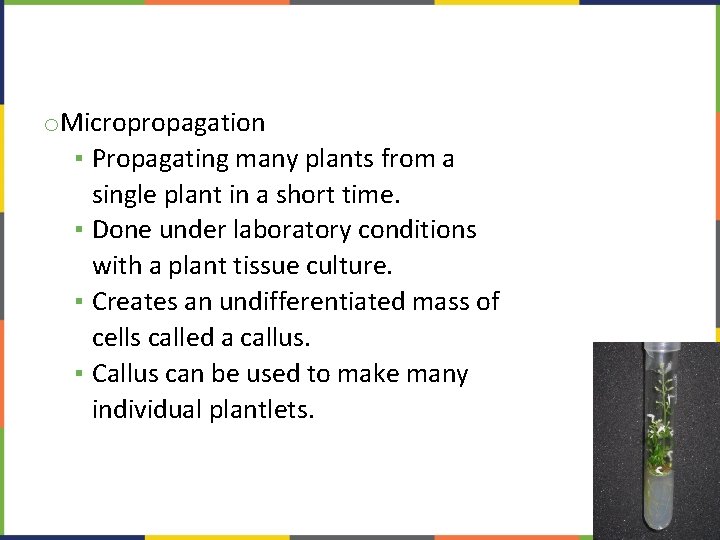
o. Micropropagation ▪ Propagating many plants from a single plant in a short time. ▪ Done under laboratory conditions with a plant tissue culture. ▪ Creates an undifferentiated mass of cells called a callus. ▪ Callus can be used to make many individual plantlets.
PLANT LIFE SPANS o. Life span = beginning of development to death o. Life cycle = sequence of stages a plant goes through from seed germination to seed production of the mature plant o. Annuals may only need a few weeks to grow, produce seeds, and die. o. Some plants live for thousands of years. (bristlecone pines have a documents age of 4, 500 years)
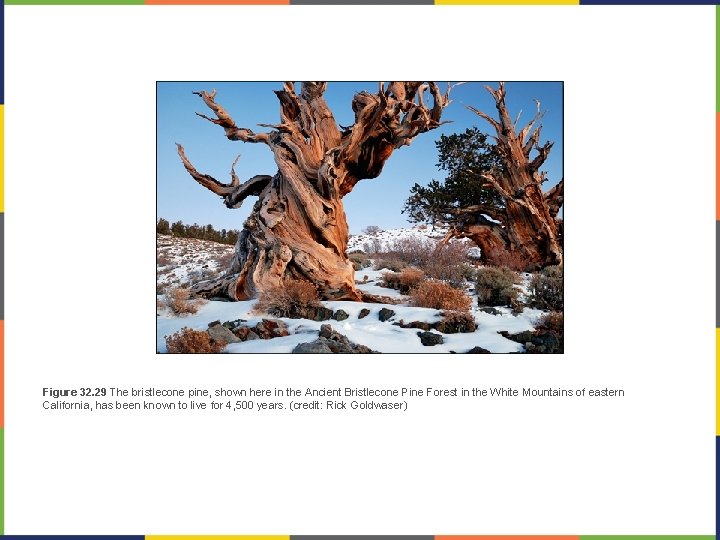
Figure 32. 29 The bristlecone pine, shown here in the Ancient Bristlecone Pine Forest in the White Mountains of eastern California, has been known to live for 4, 500 years. (credit: Rick Goldwaser)
o. Plant species that complete their life cycle in one season are called annuals. o. Plant species that complete their life cycles in two seasons are biennials. ▪ The first season is the vegetative stage and the second is the reproductive. o. Plants species that complete their life cycles in more than two years are known as perennials.
o. Monocarpic plants flower once in their lifetime. o. Polycarpic plants flower many times during their lifetime. o. Genetics and environmental conditions have a role in determining life spans. o. Nutrient recycling = using components of dead or dying parts in other aspects of the plant o. Senescence = the aging of the plant and all the associated processes
- Slides: 86