
BIOLOGY 2 E Chapter 13 MODERN UNDERSTANDING OF
BIOLOGY 2 E Chapter 13 MODERN UNDERSTANDING OF INHERITANCE Power. Point Image Slideshow This work is licensed under a Creative Commons Attribution-Non. Commercial. Share. Alike 4. 0 International License.
Modern genetics began with the rediscovery of Gregor Mendel’s work in 1900 • Mendel first published his work as a meeting paper titled Experiments on Plant Hybridization in 1865 and as a paper in an obscure journal in 1866. • The work was largely ignored and no one recognized its significance towards understanding heredity until 1900. • In that year 4 workers; Erich von Tschermak, Hugo de Vries, Carl Correns, and William Jasper Spillman , each independently trying to study heredity duplicated, then rediscovered Mendel’s work. • Note: Hugo de Vries coined the terms “gene” and “mutation”
Shortly after the rediscovery of Mendel’s work a search for the physical basis of the gene began. • Mendel’s findings were based in statistical results from numerous crosses and his “Laws” were purely conceptual deductions. • Mendel had no idea as to the actual physical nature of his conceptual “hereditary particles” (genes). • Rediscovery and recognition of the importance of his work triggered many into trying to find the physical cause of Mendel’s observations. • By 1900 microscopy was a well developed technology and the importance of the cell was well known. • Many microscopic studies of cells were undertaken to look for the physical gene.
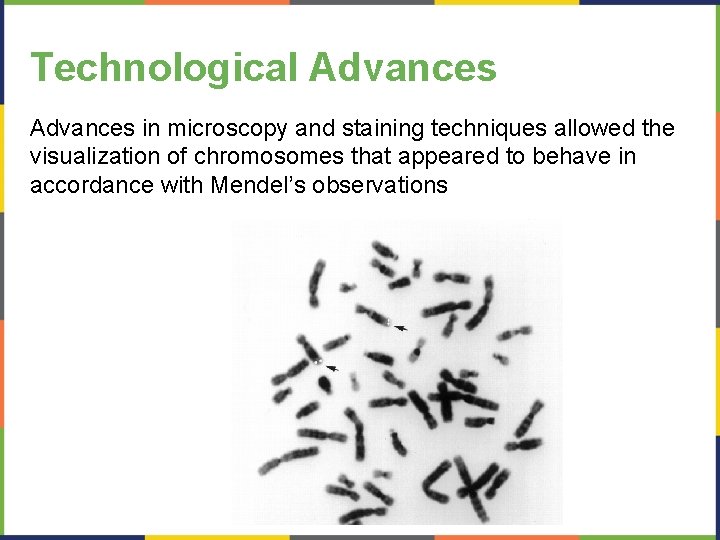
Technological Advances in microscopy and staining techniques allowed the visualization of chromosomes that appeared to behave in accordance with Mendel’s observations
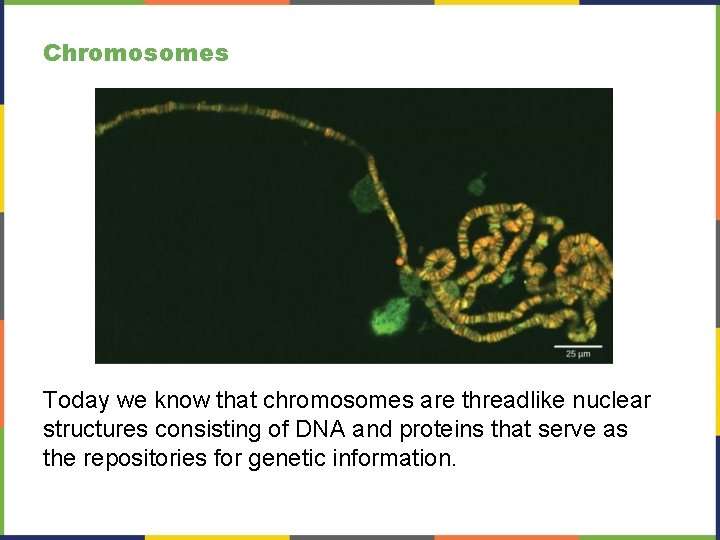
Chromosomes Today we know that chromosomes are threadlike nuclear structures consisting of DNA and proteins that serve as the repositories for genetic information.

CHROMOSOMAL THEORY OF INHERITANCE (a) Walter Sutton and (b) Theodor Boveri are credited with developing the Chromosomal Theory of Inheritance, which states that chromosomes carry the unit of heredity (genes).
CHROMOSOMAL THEORY OF INHERITANCE • During meiosis, chromosome pairs migrate as discrete structures. • Chromosome sorting from each homologous pair into pre-gametes appears to be random. • Each parent synthesizes gametes that contain only half their chromosomal complement. • Even though male and female gametes (sperm and egg) differ in size and morphology, they have the same number of chromosomes, suggesting equal genetic contributions from each parent. • The chromosomes in gametes combine during fertilization to produce offspring with the same chromosome number as their parents.
Chromosomal Theory of Inheritance • Proposed long before there was any direct evidence that traits were carried on chromosomes. • Working with sea urchins and grasshoppers, Boveri and Sutton (respectively) independently demonstrated that chromosomes occur in matched maternal and paternal pairs that segregate in meiosis. • Early support for their theory came from the work of Eleanor Carothers demonstrating independent assortment of chromosomes in grasshoppers. • Discovery of X and Y chromosome based inheritance of sex and T. H. Morgan’s subsequent work on genetic linkage in that system of Drosophilia melanogaster lead to the first real proof of a chromosome role in heredity.
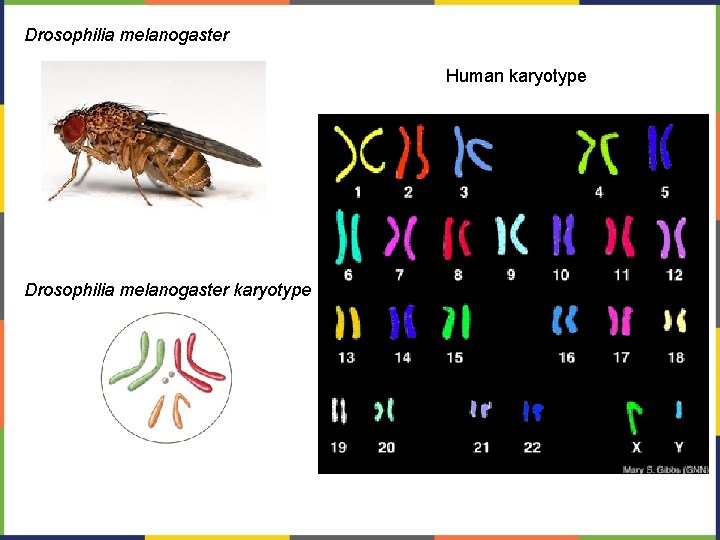
Drosophilia melanogaster Human karyotype Drosophilia melanogaster karyotype
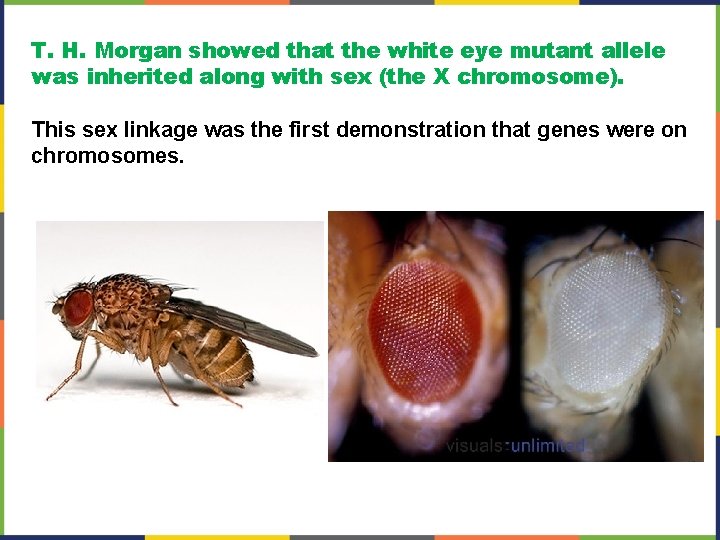
T. H. Morgan showed that the white eye mutant allele was inherited along with sex (the X chromosome). This sex linkage was the first demonstration that genes were on chromosomes.
The concept of linkage was further extended to map genes to chromosome positions – genetic linkage maps. • Morgan’s work with sex linkage showed that the trait for sex and the trait eye color were inherited together. • They did not segregate independently – violated Mendel’s second law. • When other traits were examined it was found that those on the same chromosome did not always segregate independently. • Traits on the same chromosome did segregate however. • • • Far apart traits segregated independently. Traits closer together segregated less often than independence predicted. Cross over between homologous chromosomes was the mechanism that segregated genes on the same chromosome. • • When genes were far apart crossover happened all the time. When the were close together cross over happened less frequently.
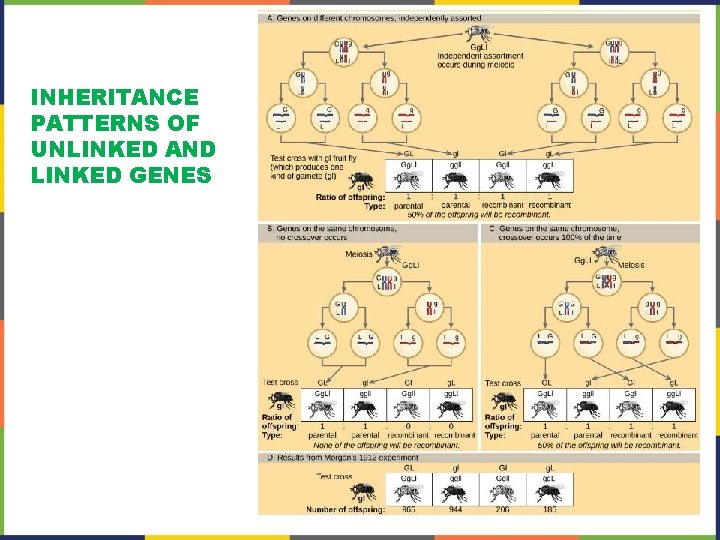
INHERITANCE PATTERNS OF UNLINKED AND LINKED GENES
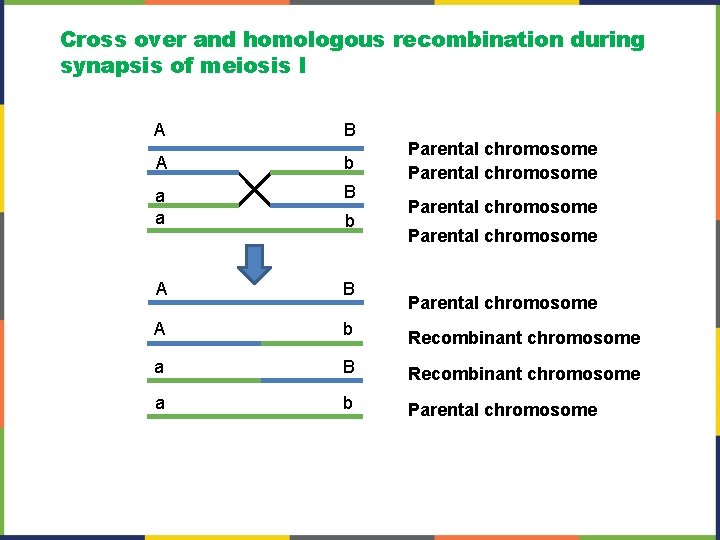
Cross over and homologous recombination during synapsis of meiosis I A B A b a a B A b Recombinant chromosome a B Recombinant chromosome a b Parental chromosome Parental chromosome
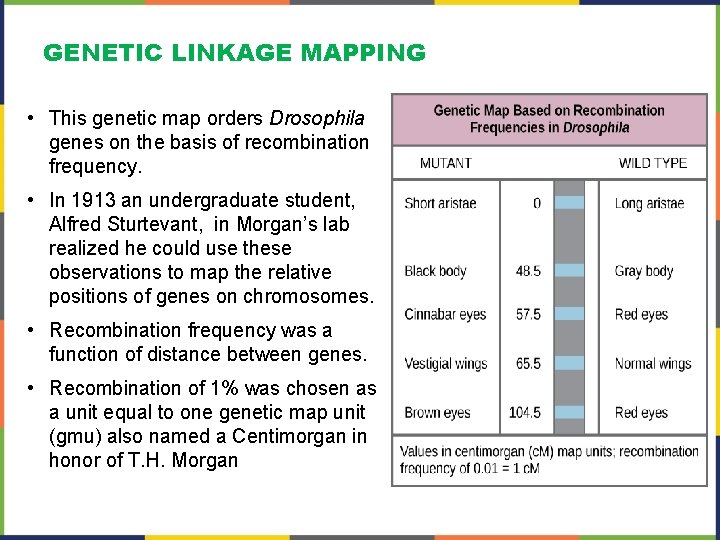
GENETIC LINKAGE MAPPING • This genetic map orders Drosophila genes on the basis of recombination frequency. • In 1913 an undergraduate student, Alfred Sturtevant, in Morgan’s lab realized he could use these observations to map the relative positions of genes on chromosomes. • Recombination frequency was a function of distance between genes. • Recombination of 1% was chosen as a unit equal to one genetic map unit (gmu) also named a Centimorgan in honor of T. H. Morgan
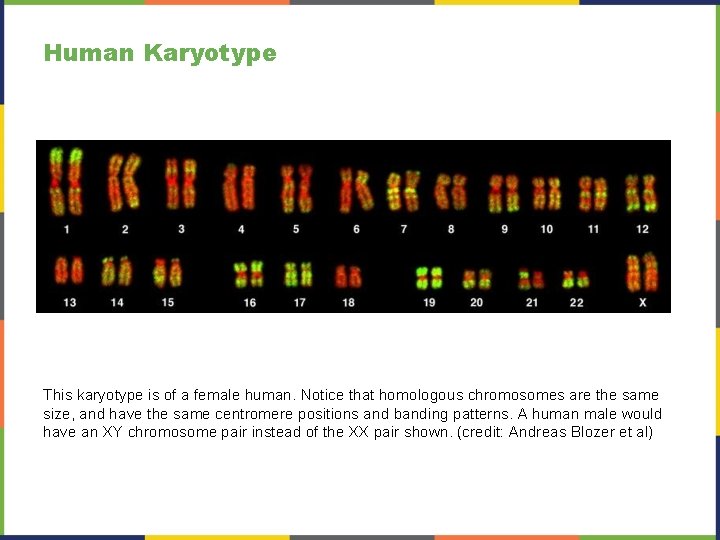
Human Karyotype This karyotype is of a female human. Notice that homologous chromosomes are the same size, and have the same centromere positions and banding patterns. A human male would have an XY chromosome pair instead of the XX pair shown. (credit: Andreas Blozer et al)
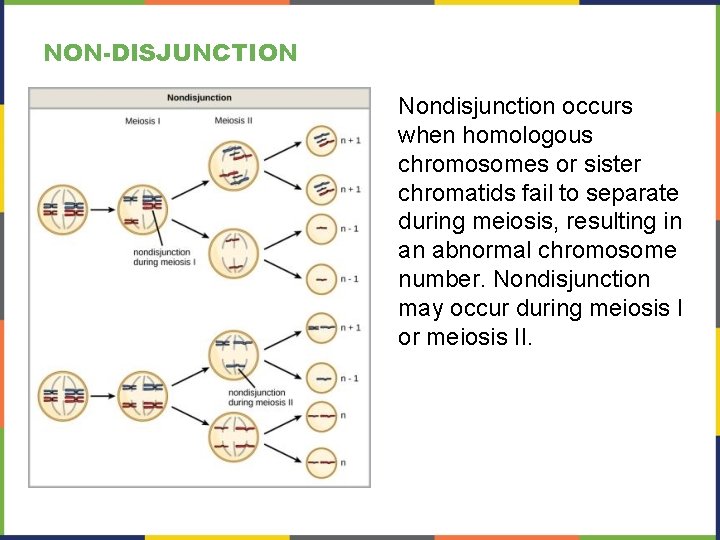
NON-DISJUNCTION Nondisjunction occurs when homologous chromosomes or sister chromatids fail to separate during meiosis, resulting in an abnormal chromosome number. Nondisjunction may occur during meiosis I or meiosis II.
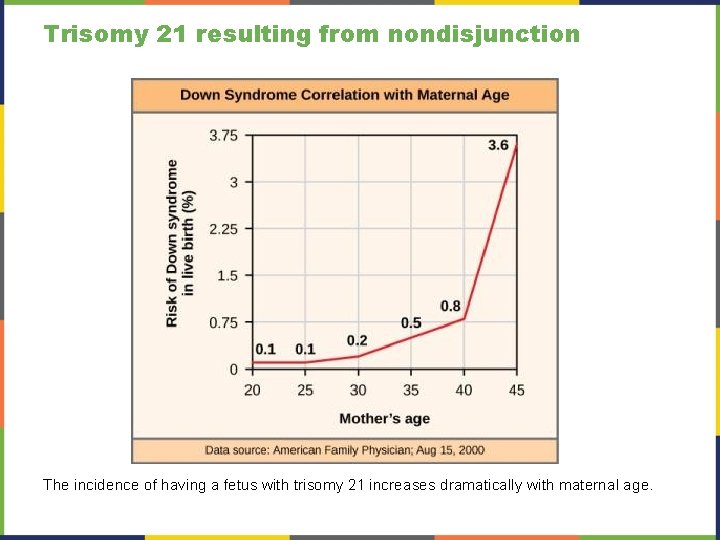
Trisomy 21 resulting from nondisjunction The incidence of having a fetus with trisomy 21 increases dramatically with maternal age.
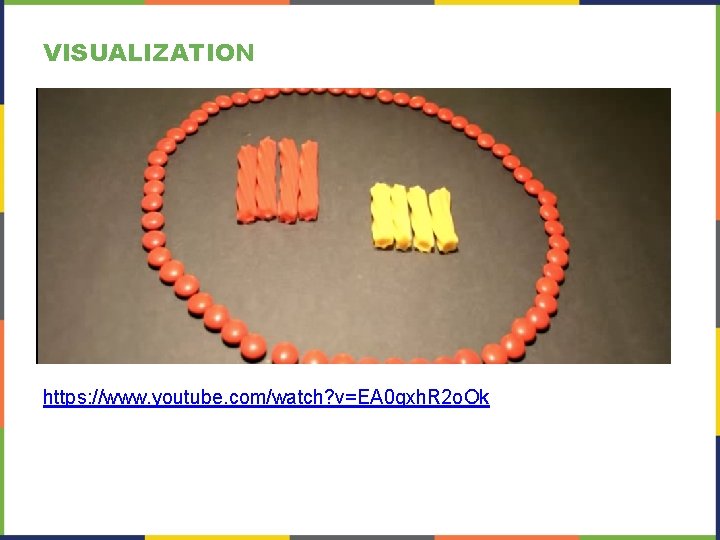
VISUALIZATION https: //www. youtube. com/watch? v=EA 0 qxh. R 2 o. Ok
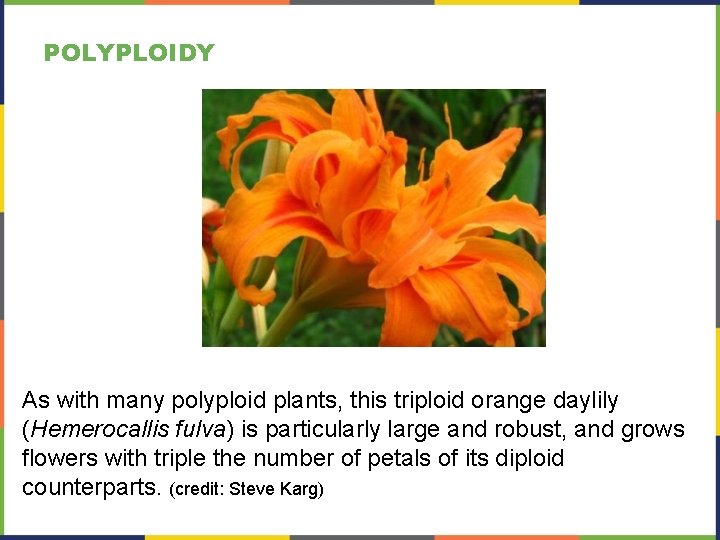
POLYPLOIDY As with many polyploid plants, this triploid orange daylily (Hemerocallis fulva) is particularly large and robust, and grows flowers with triple the number of petals of its diploid counterparts. (credit: Steve Karg)
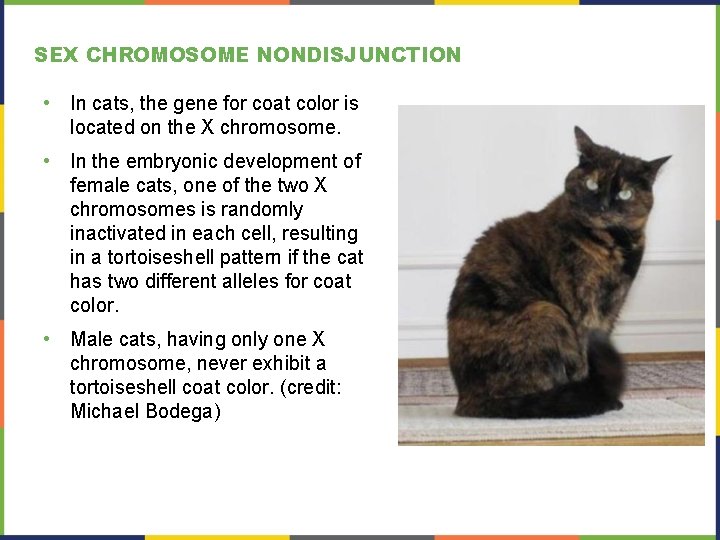
SEX CHROMOSOME NONDISJUNCTION • In cats, the gene for coat color is located on the X chromosome. • In the embryonic development of female cats, one of the two X chromosomes is randomly inactivated in each cell, resulting in a tortoiseshell pattern if the cat has two different alleles for coat color. • Male cats, having only one X chromosome, never exhibit a tortoiseshell coat color. (credit: Michael Bodega)
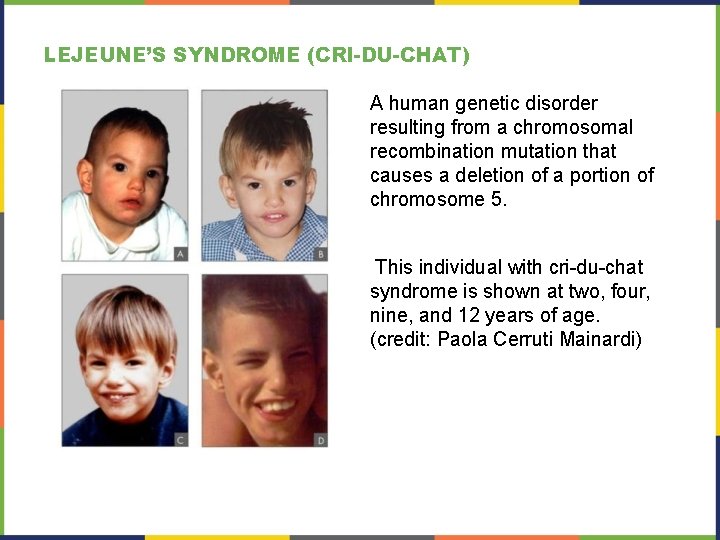
LEJEUNE’S SYNDROME (CRI-DU-CHAT) A human genetic disorder resulting from a chromosomal recombination mutation that causes a deletion of a portion of chromosome 5. This individual with cri-du-chat syndrome is shown at two, four, nine, and 12 years of age. (credit: Paola Cerruti Mainardi)
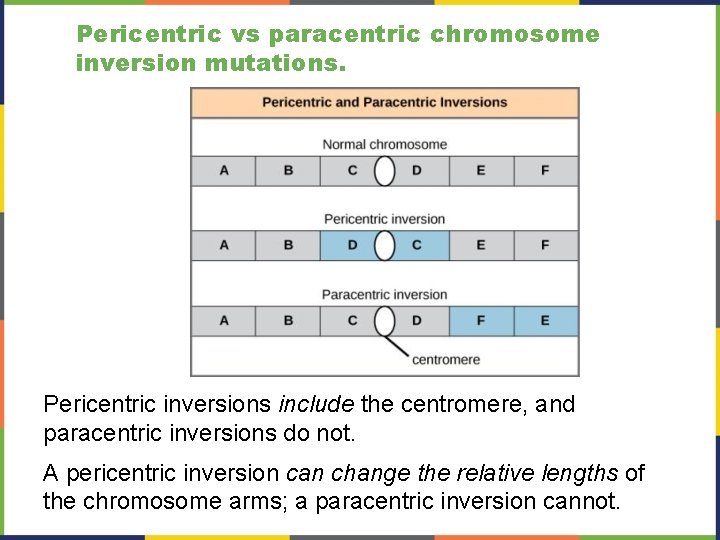
Pericentric vs paracentric chromosome inversion mutations. Pericentric inversions include the centromere, and paracentric inversions do not. A pericentric inversion can change the relative lengths of the chromosome arms; a paracentric inversion cannot.
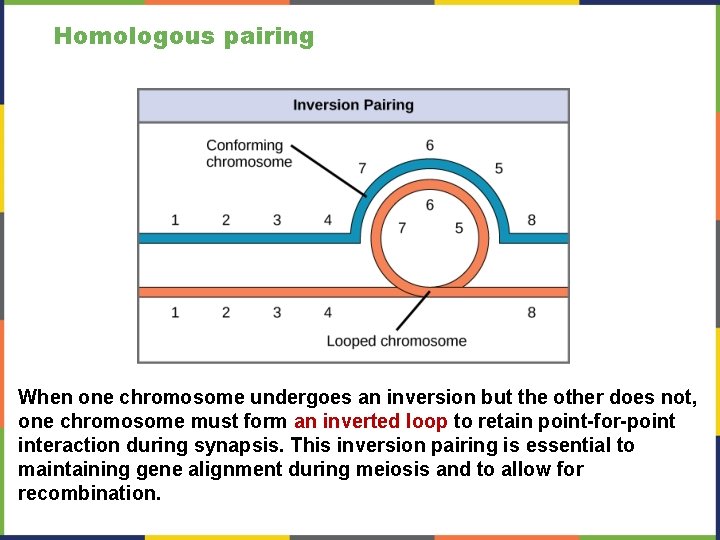
Homologous pairing When one chromosome undergoes an inversion but the other does not, one chromosome must form an inverted loop to retain point-for-point interaction during synapsis. This inversion pairing is essential to maintaining gene alignment during meiosis and to allow for recombination.
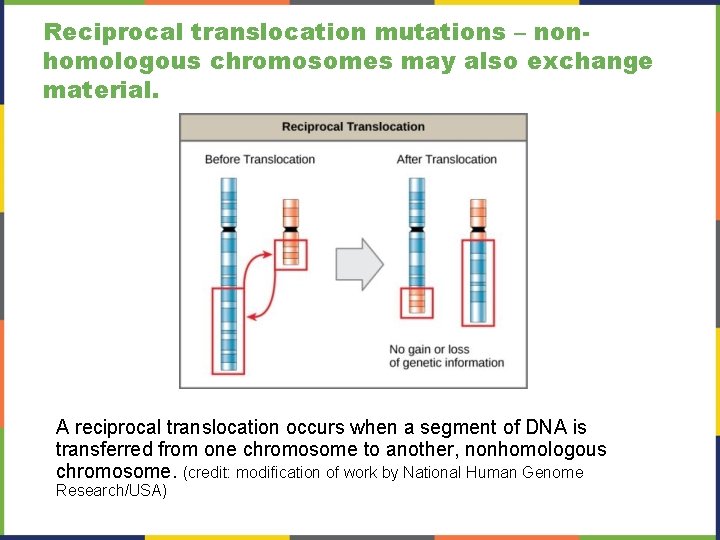
Reciprocal translocation mutations – nonhomologous chromosomes may also exchange material. A reciprocal translocation occurs when a segment of DNA is transferred from one chromosome to another, nonhomologous chromosome. (credit: modification of work by National Human Genome Research/USA)
- Slides: 24