
Biology 177 Principles of Modern Microscopy Lecture 13
Biology 177: Principles of Modern Microscopy Lecture 13: FRET, FLIM, Super-resolution microscopy Part I Andres Collazo, Director Biological Imaging Facility Wan-Rong (Sandy) Wong, Graduate Student, TA

Lecture 13: FRET, FLIM, NSOM • Review of previous lecture • FRET • FLIM • Super resolution microscopy • NSOM
The “F” words FRET FFS FLIM FLAM FRAP FCS FACS FIGS FCCS
The “F” words FRET FFS FLIM FLAM FRAP FCS FACS FIGS FCCS
Förster Resonance Energy Transfer (FRET) • Great method for the detection of: • Protein-protein interactions • Enzymatic activity • Small molecules interacting inside a cell
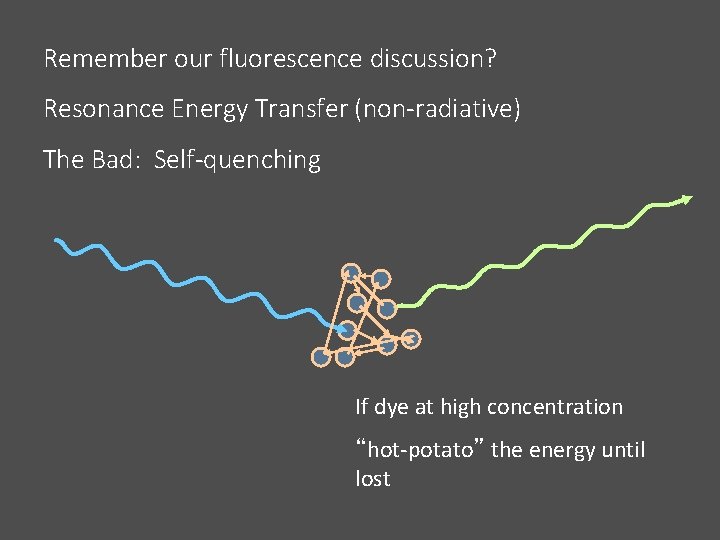
Remember our fluorescence discussion? Resonance Energy Transfer (non-radiative) The Bad: Self-quenching If dye at high concentration “hot-potato” the energy until lost
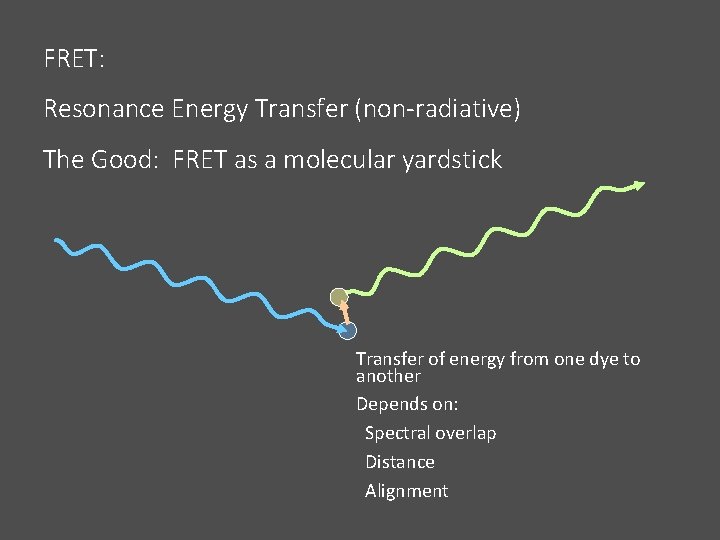
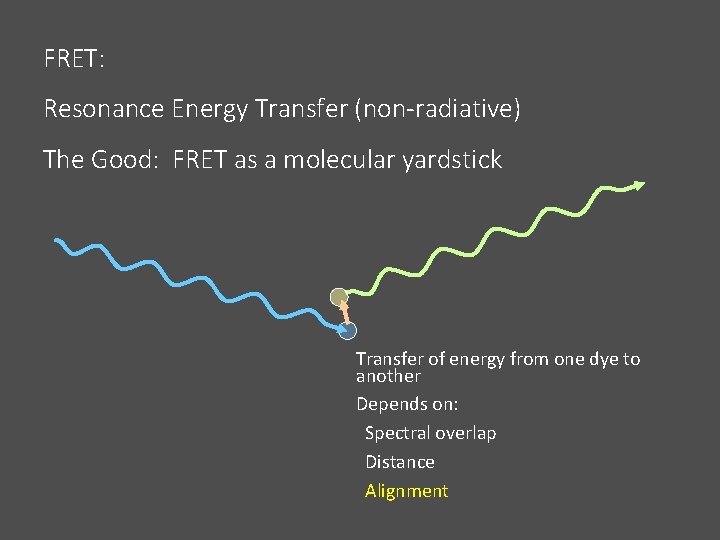
FRET: Resonance Energy Transfer (non-radiative) The Good: FRET as a molecular yardstick Transfer of energy from one dye to another Depends on: Spectral overlap Distance Alignment

donor acceptor FRET: Optimize spectral overlap Optimize k 2 -- alignment of dipoles Minimize direct excitement of the acceptor (extra challenge for filter design)
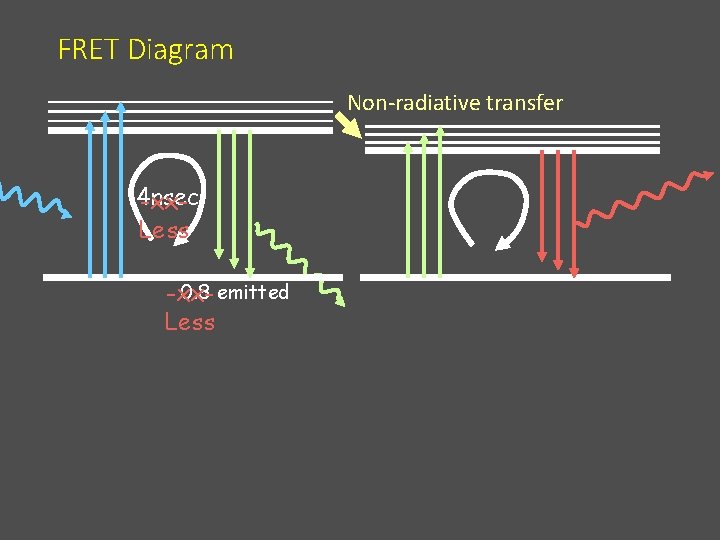
FRET Diagram Non-radiative transfer 4 nsec -xx. Less 0. 8 emitted -xx. Less
![KT = (1/τD) • [R 0/r]6 The Förster Equations. R 0 = 2. 11](http://slidetodoc.com/presentation_image/3588c7e3eb5d712d6b690f068a82b357/image-10.jpg "KT = (1/τD) • [R 0/r]6 The Förster Equations. R 0 = 2. 11")
KT = (1/τD) • [R 0/r]6 The Förster Equations. R 0 = 2. 11 × 10 -2 • [κ 2 • J(λ) • η-4 • QD]1/6 J (λ) A r is the center-to-center distance (in cm) between the donor and acceptor t. D is the fluorescence lifetime of the donor in the absence of FRET k 2 is the dipole-dipole orientation factor, QD is the quantum yield of the donor in the absence of the acceptor is the refractive index of the intervening medium, FD ( ) is the fluorescence emission intensity at a given wavelength (in cm) A ( ) is the extinction coefficient of the acceptor (in cm -1 M -1). The orientation factor k 2 can vary between 0 and 4, but typically k 2 = 2/3 for randomly oriented molecules (Stryer, 1978). When r = R 0, the efficiency of FRET is 50% (fluorescein-tetramethylrhodamine pair is 55 Å)
FRET: Resonance Energy Transfer (non-radiative) The Good: FRET as a molecular yardstick Transfer of energy from one dye to another Depends on: Spectral overlap Distance Alignment
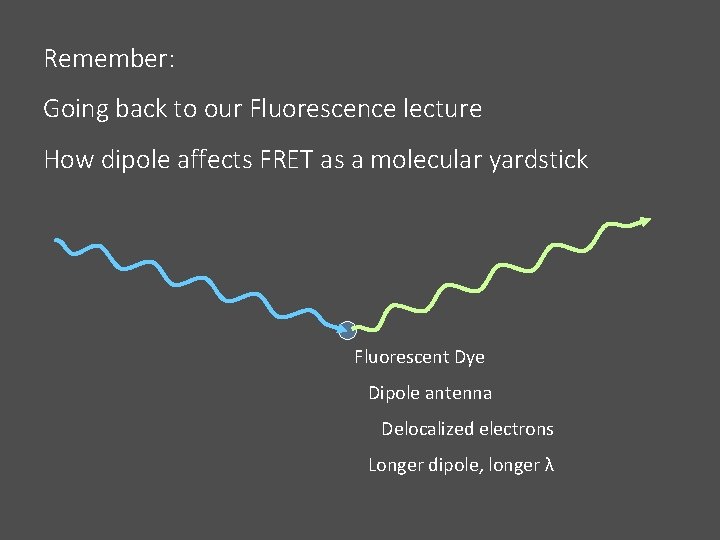
Remember: Going back to our Fluorescence lecture How dipole affects FRET as a molecular yardstick Fluorescent Dye Dipole antenna Delocalized electrons Longer dipole, longer λ
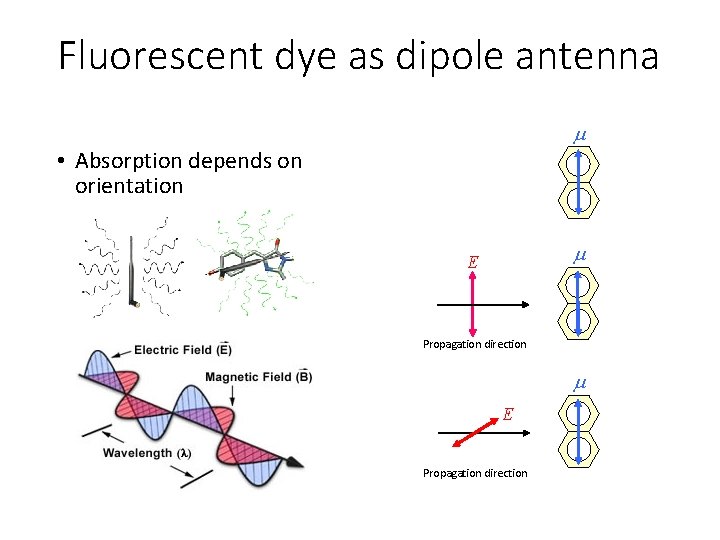
Fluorescent dye as dipole antenna • Absorption depends on orientation E Propagation direction
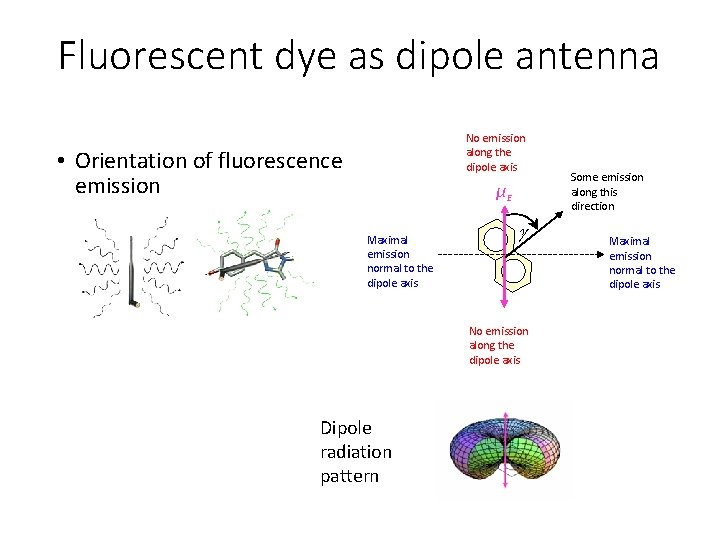
Fluorescent dye as dipole antenna No emission along the dipole axis • Orientation of fluorescence emission μE Maximal emission normal to the dipole axis No emission along the dipole axis Dipole radiation pattern Some emission along this direction Maximal emission normal to the dipole axis
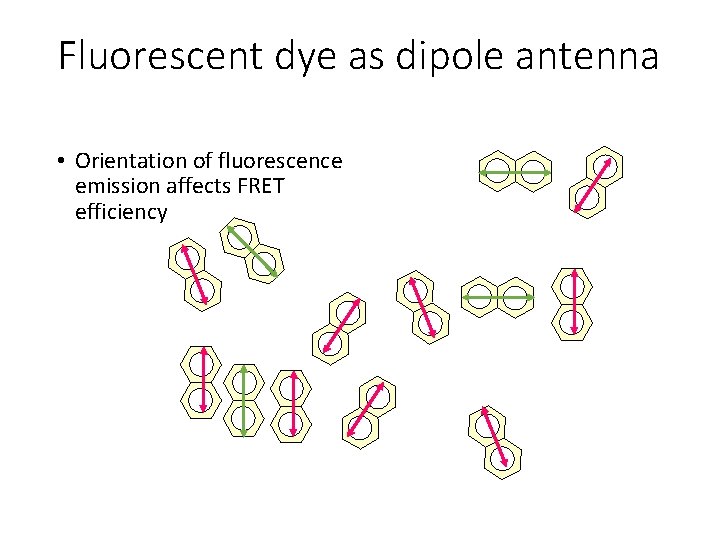
Fluorescent dye as dipole antenna • Orientation of fluorescence emission affects FRET efficiency
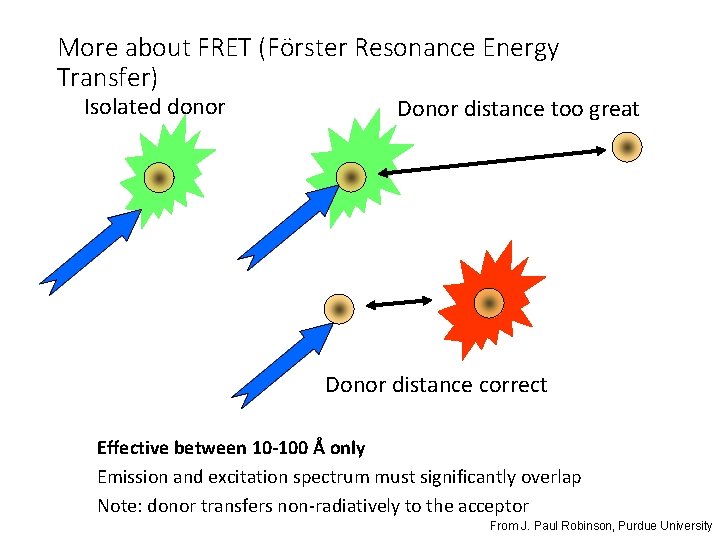
More about FRET (Förster Resonance Energy Transfer) Isolated donor Donor distance too great Donor distance correct Effective between 10 -100 Å only Emission and excitation spectrum must significantly overlap Note: donor transfers non-radiatively to the acceptor From J. Paul Robinson, Purdue University
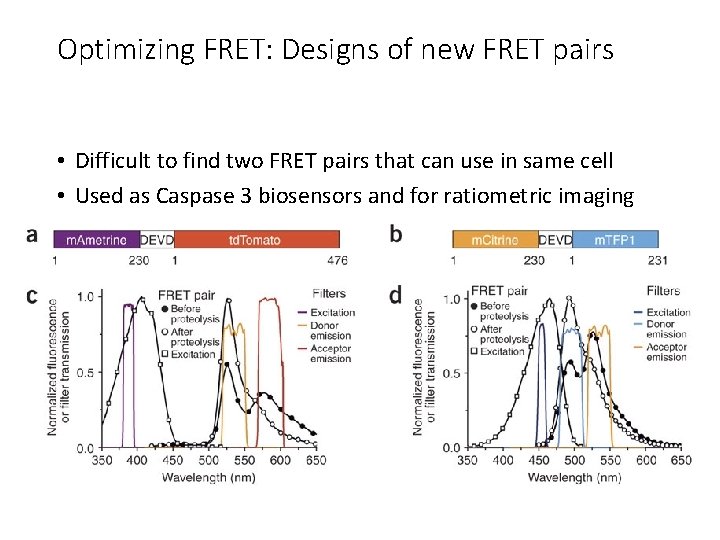
Optimizing FRET: Designs of new FRET pairs • Difficult to find two FRET pairs that can use in same cell • Used as Caspase 3 biosensors and for ratiometric imaging
Properties of fluorescent protein variants Shaner et al, Nature Biotechnology, 2004
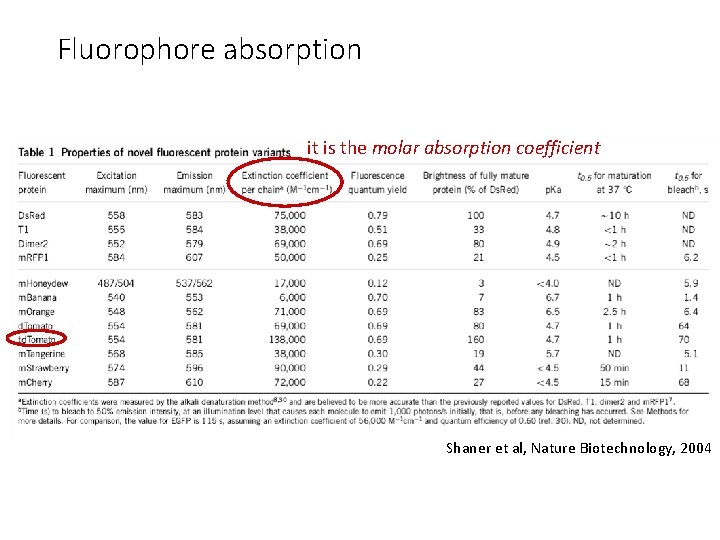
Fluorophore absorption it is the molar absorption coefficient Shaner et al, Nature Biotechnology, 2004
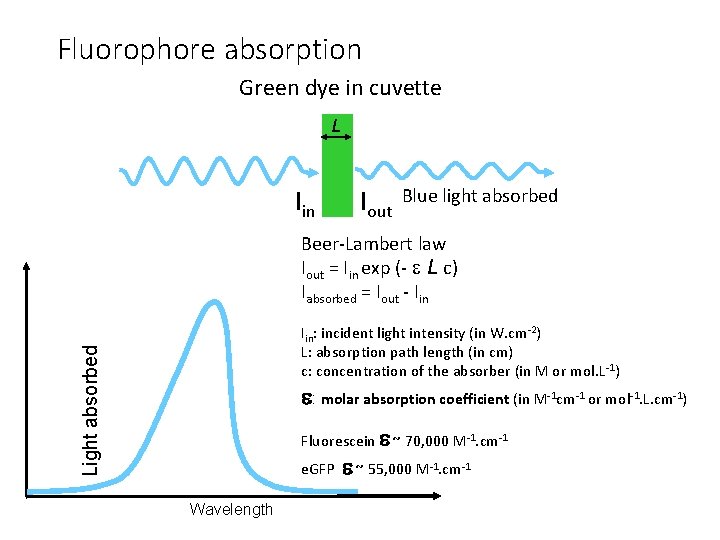
Fluorophore absorption Green dye in cuvette L Iin Iout Blue light absorbed Beer-Lambert law Iout = Iin exp (- L c) Iabsorbed = Iout - Iin Light absorbed Iin: incident light intensity (in W. cm-2) L: absorption path length (in cm) c: concentration of the absorber (in M or mol. L-1) : molar absorption coefficient (in M-1 cm-1 or mol-1. L. cm-1) Fluorescein ~ 70, 000 M-1. cm-1 e. GFP ~ 55, 000 M-1. cm-1 Wavelength
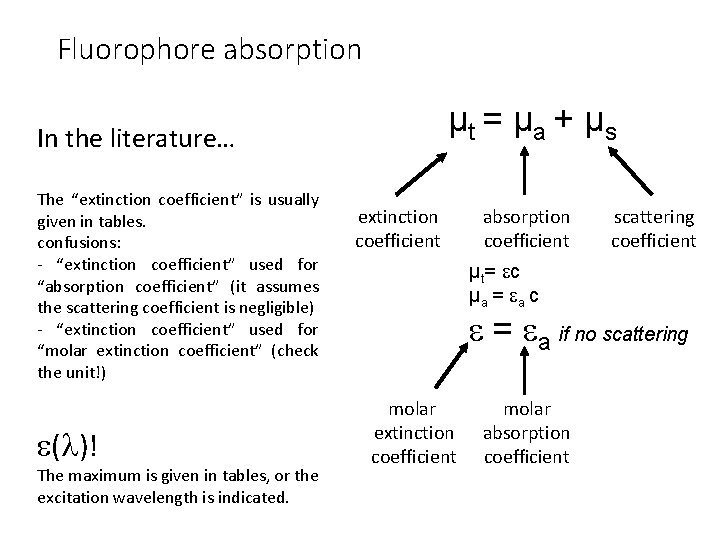
Fluorophore absorption µt = µ a + µ s In the literature… The “extinction coefficient” is usually given in tables. confusions: - “extinction coefficient” used for “absorption coefficient” (it assumes the scattering coefficient is negligible) - “extinction coefficient” used for “molar extinction coefficient” (check the unit!) ( )! The maximum is given in tables, or the excitation wavelength is indicated. extinction coefficient absorption coefficient µt= c µa = a c scattering coefficient = a if no scattering molar extinction coefficient molar absorption coefficient
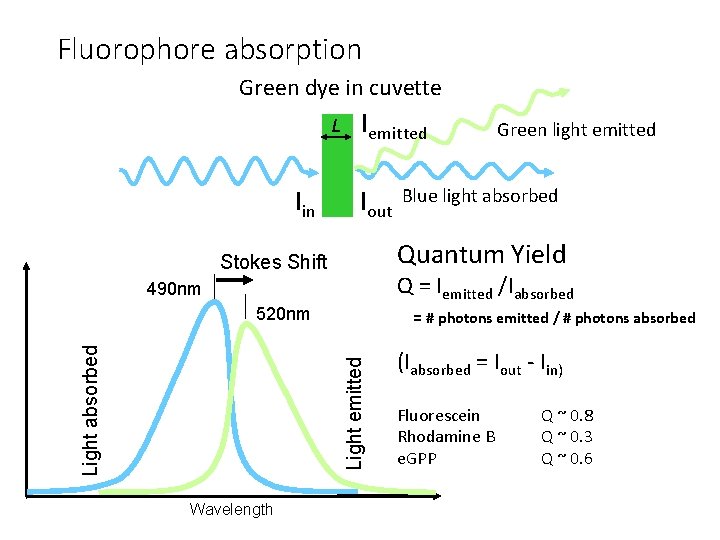
Fluorophore absorption Green dye in cuvette L Iin Iemitted Iout Q = Iemitted /Iabsorbed 490 nm 520 nm = # photons emitted / # photons absorbed Light emitted Light absorbed Blue light absorbed Quantum Yield Stokes Shift Wavelength Green light emitted (Iabsorbed = Iout - Iin) Fluorescein Rhodamine B e. GPP Q ~ 0. 8 Q ~ 0. 3 Q ~ 0. 6
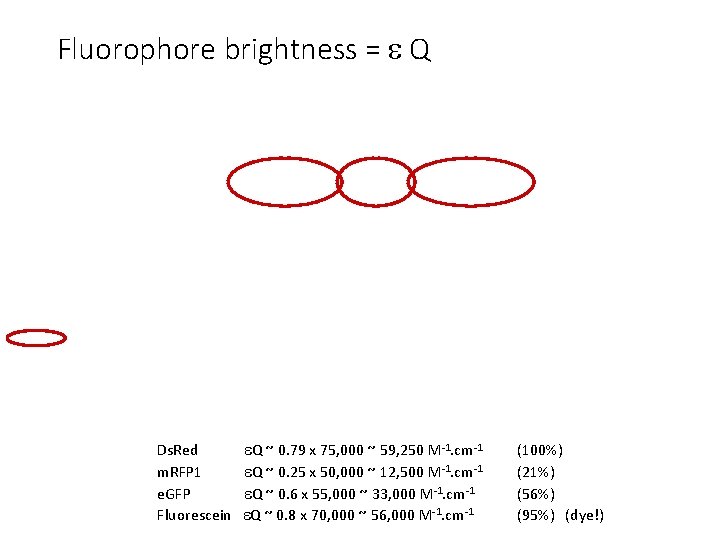
Fluorophore brightness = Q Ds. Red Q ~ 0. 79 x 75, 000 ~ 59, 250 M-1. cm-1 m. RFP 1 Q ~ 0. 25 x 50, 000 ~ 12, 500 M-1. cm-1 e. GFP Q ~ 0. 6 x 55, 000 ~ 33, 000 M-1. cm-1 Fluorescein Q ~ 0. 8 x 70, 000 ~ 56, 000 M-1. cm-1 (100%) (21%) (56%) (95%) (dye!)
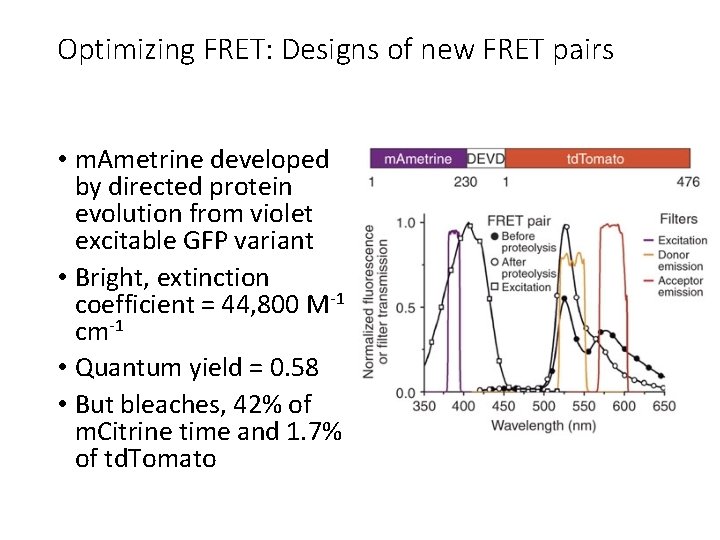
Optimizing FRET: Designs of new FRET pairs • m. Ametrine developed by directed protein evolution from violet excitable GFP variant • Bright, extinction coefficient = 44, 800 M-1 cm-1 • Quantum yield = 0. 58 • But bleaches, 42% of m. Citrine time and 1. 7% of td. Tomato
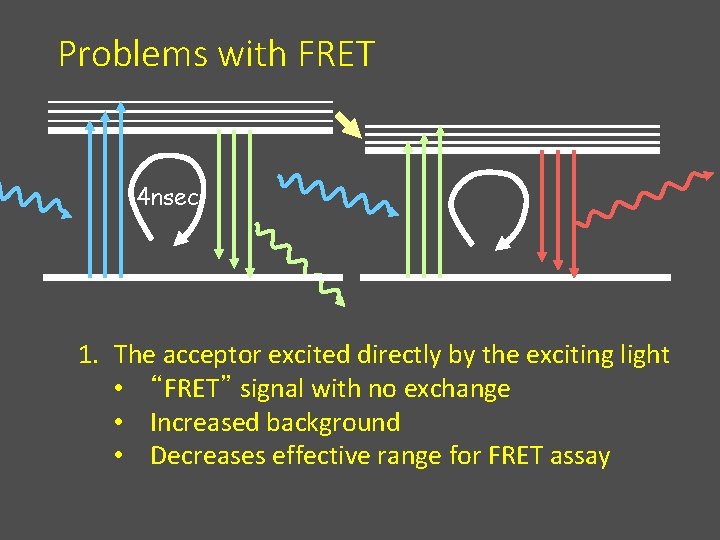
Problems with FRET 4 nsec 1. The acceptor excited directly by the exciting light • “FRET” signal with no exchange • Increased background • Decreases effective range for FRET assay
Problems with FRET 2. Hard to really serve as a molecular yardstick* • Orientation seldom known assume k 2 = 2/3 (random assortment) • Exchange depends on environment of dipoles • Amount of FRET varies with the lifetime of the donor fluorophore * r = R 0, the efficiency of FRET is 50% (fluorescein-tetramethylrhodamine pair is 55 Å)
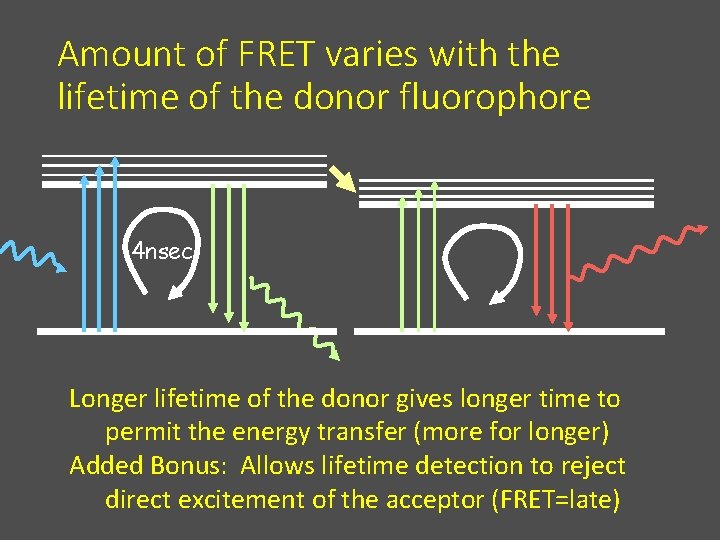
Amount of FRET varies with the lifetime of the donor fluorophore 4 nsec Longer lifetime of the donor gives longer time to permit the energy transfer (more for longer) Added Bonus: Allows lifetime detection to reject direct excitement of the acceptor (FRET=late)
Fluorescence Lifetime Imaging Microscopy (FLIM) • Measure spatial distribution of differences in the timing of fluorescence excitation of fluorophores • Combines microscopy with fluorescence spectroscopy • Fluorescent lifetimes very short (ns) so need fast excitation and/or fast detectors • Requirements for FLIM instruments 1. Excitation light intensity modulated or pulsed 2. Emitted fluorescence measured time resolved

Fluorescence Lifetime Imaging Microscopy (FLIM) • Two methods for FLIM 1. Frequency-domain 1. Intensity of excitation light continuously modulated 2. For emission measure phase shift & decrease in modulation 2. Time-domain 1. Pulsed excitation that is faster than fluorescence lifetime 2. Emission measurement is time-resolved
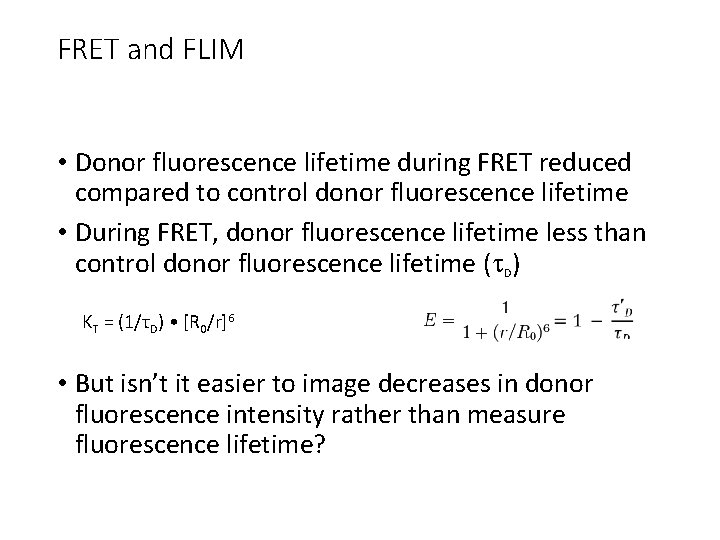
FRET and FLIM • Donor fluorescence lifetime during FRET reduced compared to control donor fluorescence lifetime • During FRET, donor fluorescence lifetime less than control donor fluorescence lifetime (t. D) KT = (1/τD) • [R 0/r]6 • But isn’t it easier to image decreases in donor fluorescence intensity rather than measure fluorescence lifetime?
FRET and FLIM: addressing nonlinearities • Brightness (or intensity) of fluorophore, as measured on your image, more than just Q 1. 2. 3. 4. Local concentration of fluorophore Optical path of microscope Local excitation light intensity Local fluorescence detection efficiency • FLIM provides independent measure of local donor lifetime
Going back to those problems with FRET: These drawbacks can all be used to make sensors Change in FRET for changes in: • Orientation • cameleon dye for Ca++ • Local environment • Phosphate near fluorophore • Membrane voltage (flash) • Change in lifetime of donor • Binding of molecule displacing water
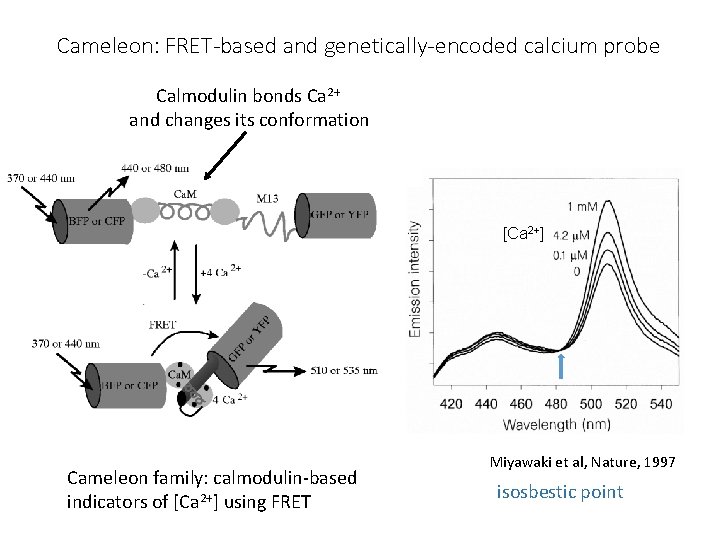
Cameleon: FRET-based and genetically-encoded calcium probe Calmodulin bonds Ca 2+ and changes its conformation [Ca 2+] Cameleon family: calmodulin-based indicators of [Ca 2+] using FRET Miyawaki et al, Nature, 1997 isosbestic point
Paper to read • Pearson, H. , 2007. The good, the bad and the ugly. Nature 447, 138 -140. • http: //www. nature. com/nature/journal/v 447/n 714 1/full/447138 a. html
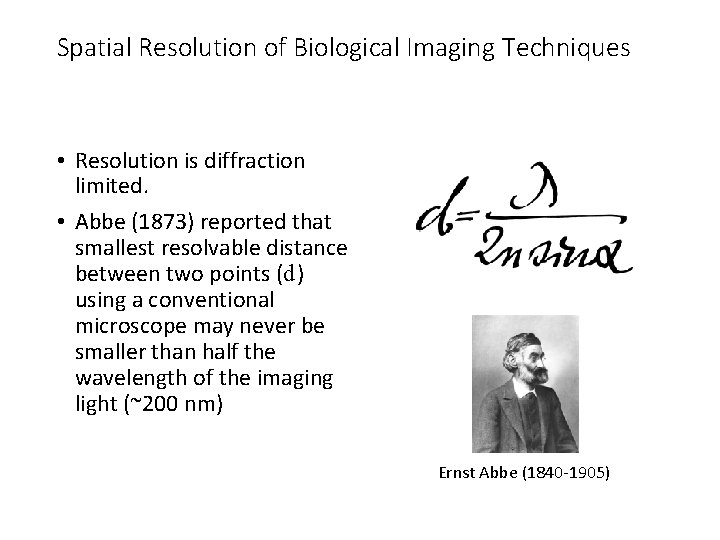
Spatial Resolution of Biological Imaging Techniques • Resolution is diffraction limited. • Abbe (1873) reported that smallest resolvable distance between two points (d) using a conventional microscope may never be smaller than half the wavelength of the imaging light (~200 nm) Ernst Abbe (1840 -1905)
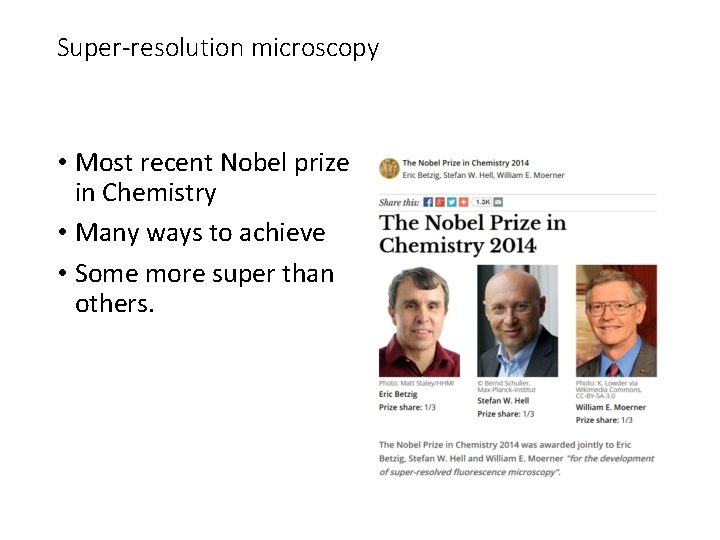
Super-resolution microscopy • Most recent Nobel prize in Chemistry • Many ways to achieve • Some more super than others.
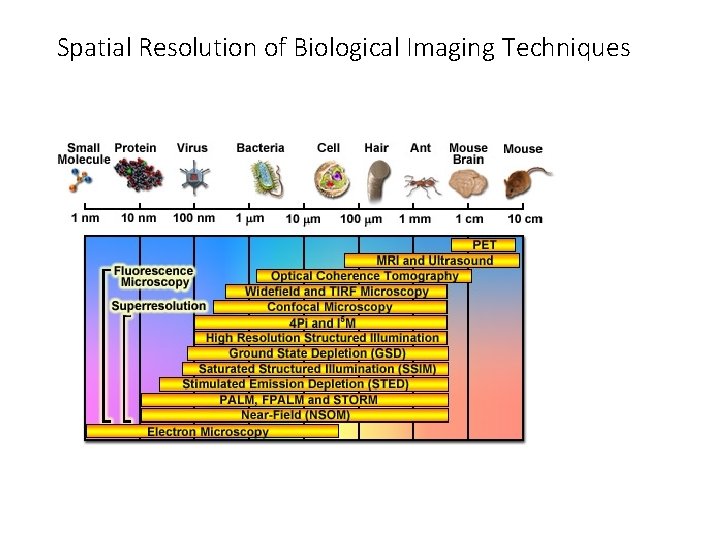
Spatial Resolution of Biological Imaging Techniques
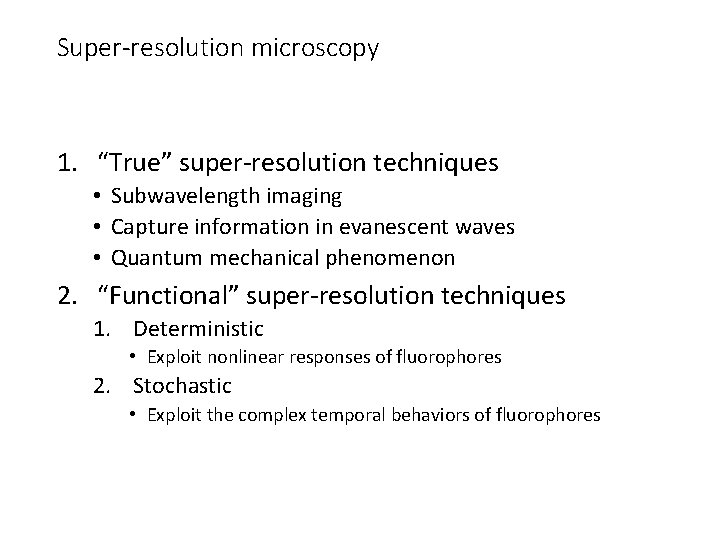
Super-resolution microscopy 1. “True” super-resolution techniques • Subwavelength imaging • Capture information in evanescent waves • Quantum mechanical phenomenon 2. “Functional” super-resolution techniques 1. Deterministic • Exploit nonlinear responses of fluorophores 2. Stochastic • Exploit the complex temporal behaviors of fluorophores

Spatial Resolution of Biological Imaging Techniques “True” super-resolution “Functional”
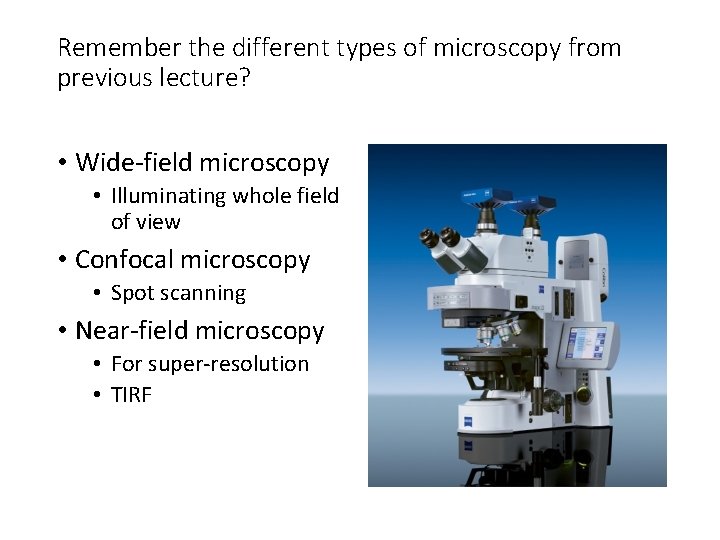
Remember the different types of microscopy from previous lecture? • Wide-field microscopy • Illuminating whole field of view • Confocal microscopy • Spot scanning • Near-field microscopy • For super-resolution • TIRF

Near-Field Scanning Optical Microscopy (NSOM) • Scanning Near-Field Optical Microscopy (SNOM) • Likely the super-resolution technique with the highest resolution • But only for superficial structures • A form of Scanning Probe Microscopy (SPM)
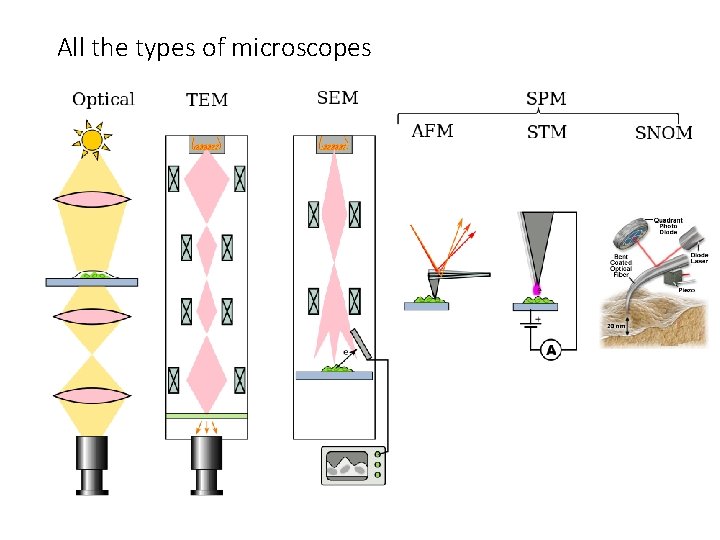
All the types of microscopes
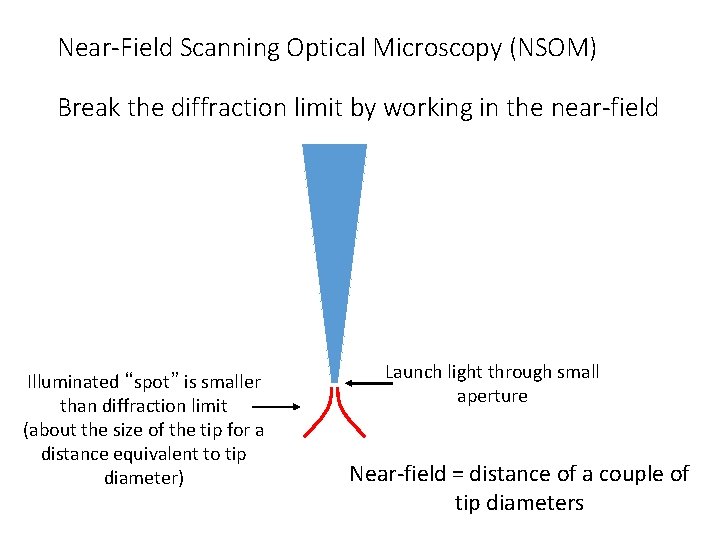
Near-Field Scanning Optical Microscopy (NSOM) Break the diffraction limit by working in the near-field Illuminated “spot” is smaller than diffraction limit (about the size of the tip for a distance equivalent to tip diameter) Launch light through small aperture Near-field = distance of a couple of tip diameters
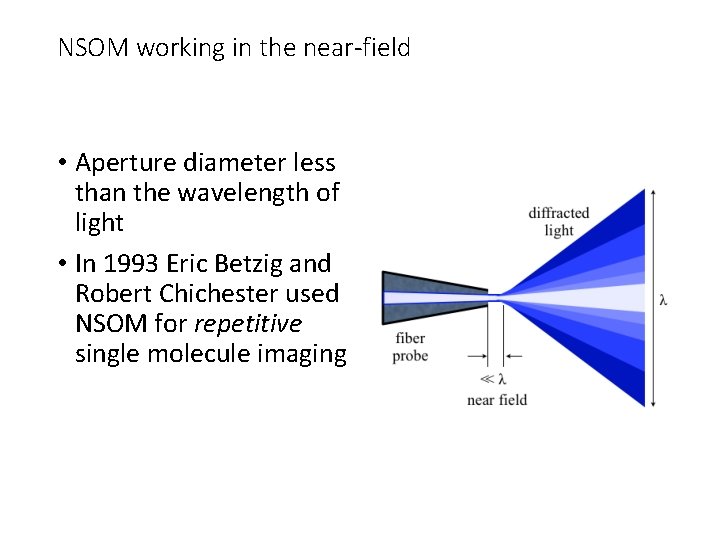
NSOM working in the near-field • Aperture diameter less than the wavelength of light • In 1993 Eric Betzig and Robert Chichester used NSOM for repetitive single molecule imaging
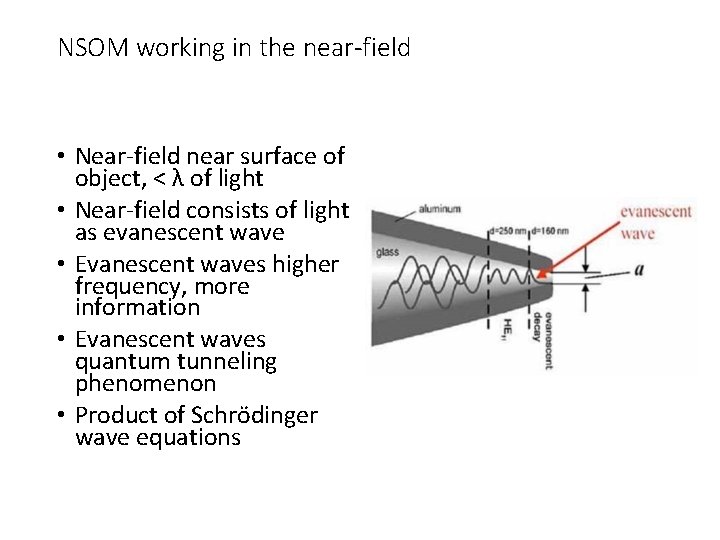
NSOM working in the near-field • Near-field near surface of object, < λ of light • Near-field consists of light as evanescent wave • Evanescent waves higher frequency, more information • Evanescent waves quantum tunneling phenomenon • Product of Schrödinger wave equations
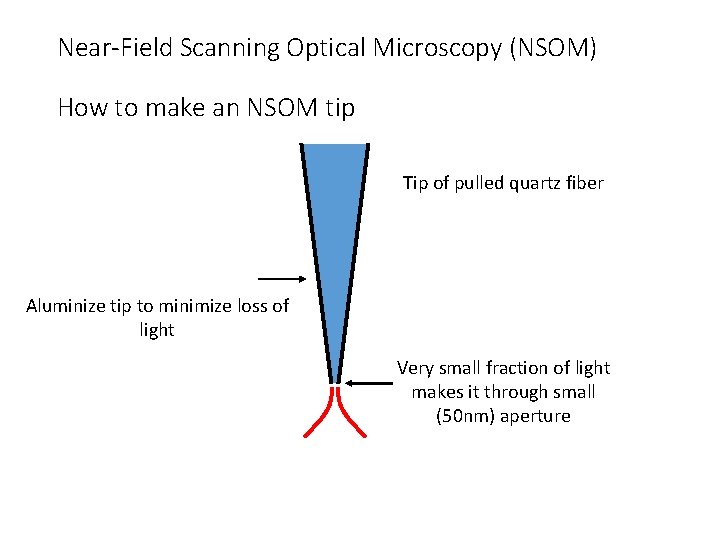
Near-Field Scanning Optical Microscopy (NSOM) How to make an NSOM tip Tip of pulled quartz fiber Aluminize tip to minimize loss of light Very small fraction of light makes it through small (50 nm) aperture
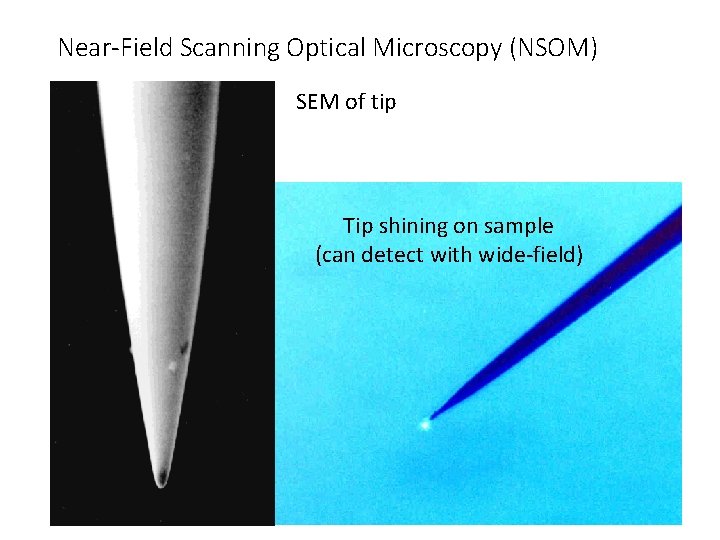
Near-Field Scanning Optical Microscopy (NSOM) SEM of tip Tip shining on sample (can detect with wide-field)
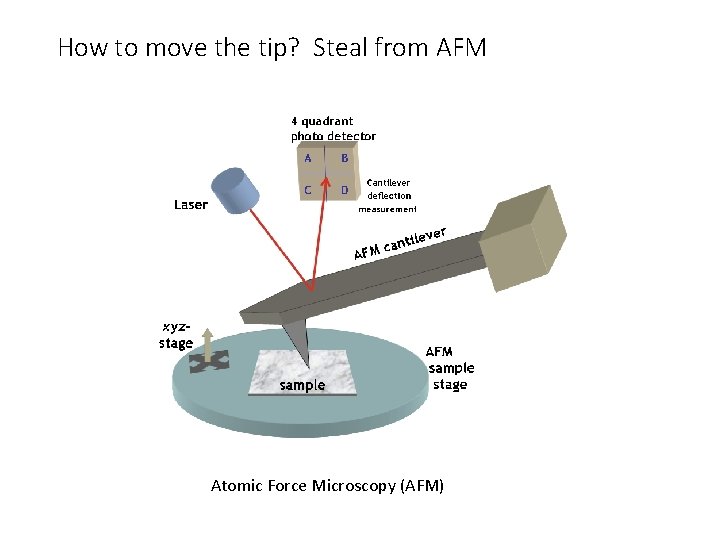
How to move the tip? Steal from AFM Atomic Force Microscopy (AFM)
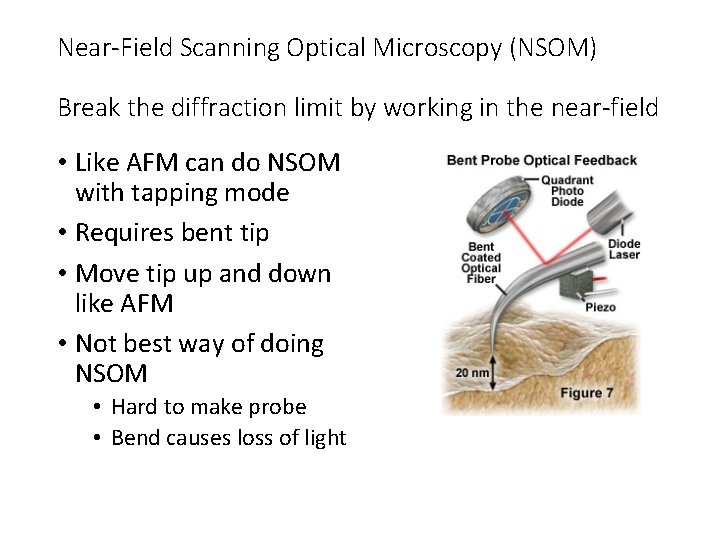
Near-Field Scanning Optical Microscopy (NSOM) Break the diffraction limit by working in the near-field • Like AFM can do NSOM with tapping mode • Requires bent tip • Move tip up and down like AFM • Not best way of doing NSOM • Hard to make probe • Bend causes loss of light
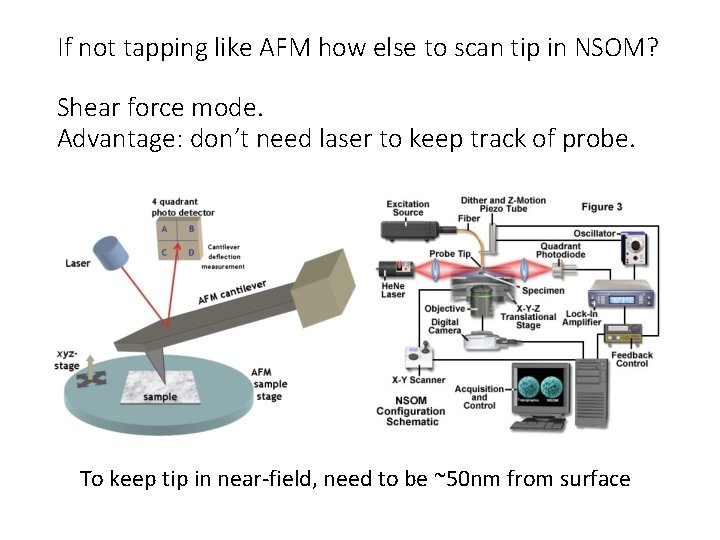
If not tapping like AFM how else to scan tip in NSOM? Shear force mode. Advantage: don’t need laser to keep track of probe. To keep tip in near-field, need to be ~50 nm from surface
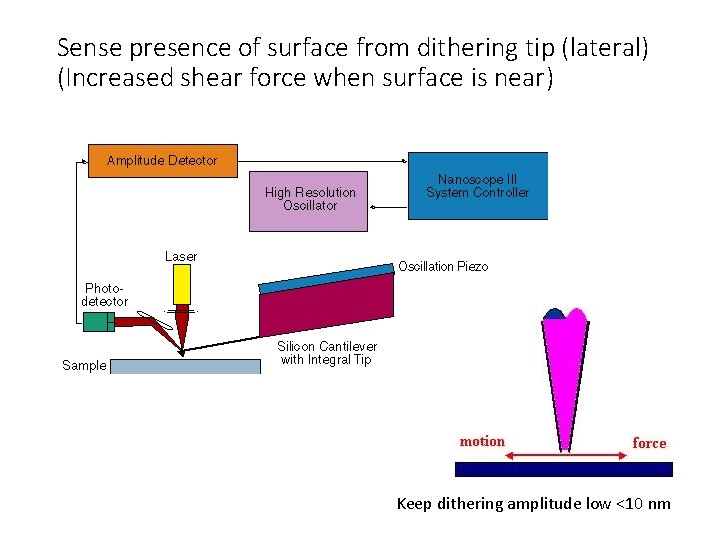
Sense presence of surface from dithering tip (lateral) (Increased shear force when surface is near) Keep dithering amplitude low <10 nm
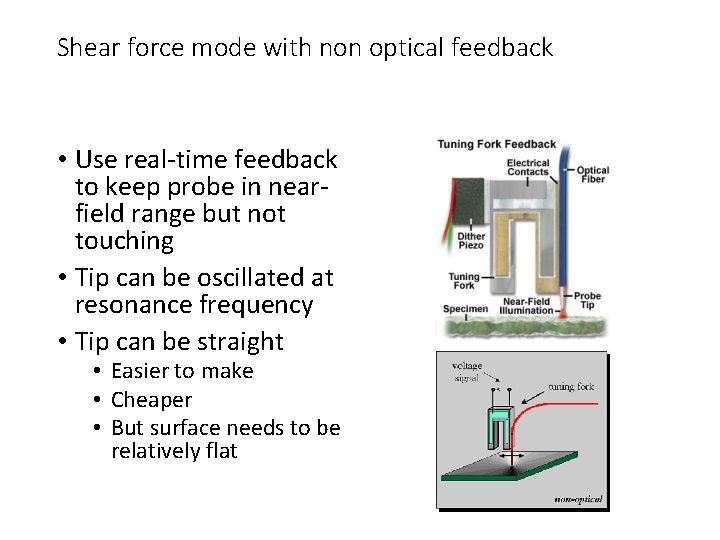
Shear force mode with non optical feedback • Use real-time feedback to keep probe in nearfield range but not touching • Tip can be oscillated at resonance frequency • Tip can be straight • Easier to make • Cheaper • But surface needs to be relatively flat
Illumination Techniques - Overview Transmitted Light Reflected (Incident) Light • Bright-field • Oblique Darkfield Phase Contrast Polarized Light DIC (Differential Interference Contrast) • Fluorescence - not any more > Epi ! • • Darkfield Not any more (DIC !) Polarized Light DIC (Differential Interference Contrast) • Fluorescence (Epi)
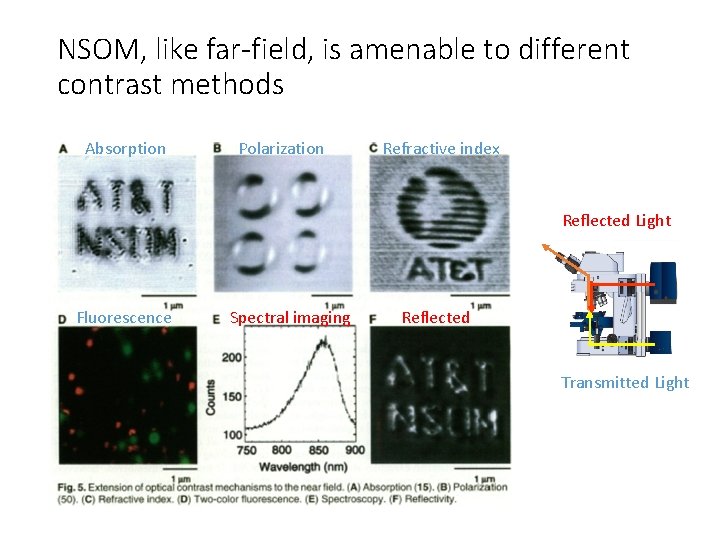
NSOM, like far-field, is amenable to different contrast methods Absorption Polarization Refractive index Reflected Light Fluorescence Spectral imaging Reflected Transmitted Light
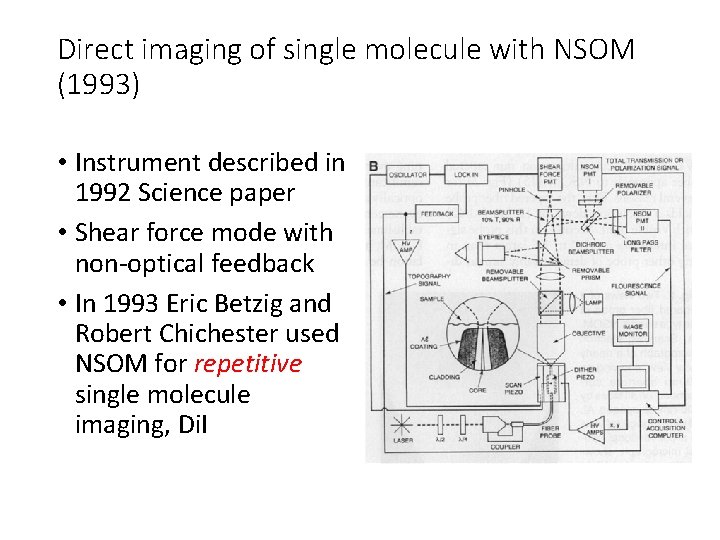
Direct imaging of single molecule with NSOM (1993) • Instrument described in 1992 Science paper • Shear force mode with non-optical feedback • In 1993 Eric Betzig and Robert Chichester used NSOM for repetitive single molecule imaging, Di. I
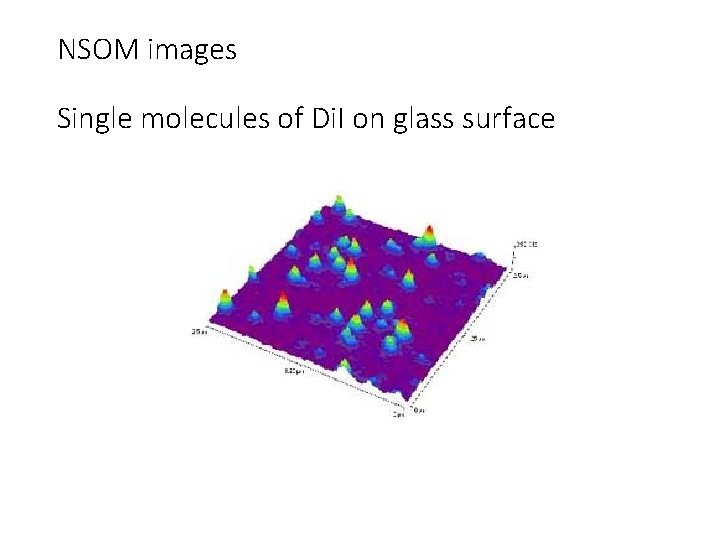
NSOM images Single molecules of Di. I on glass surface
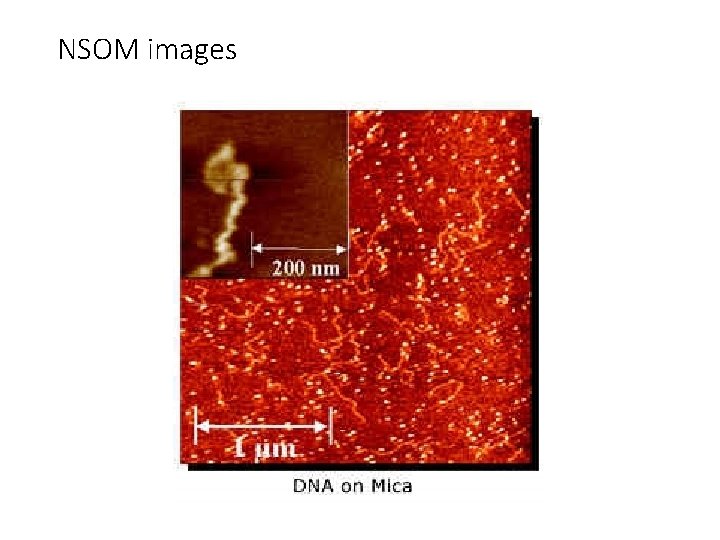
NSOM images
NSOM disadvantages
NSOM disadvantages • Practically zero working distance and small depth of field. • Extremely long scan times for high resolution images or large specimen areas. • Very low little light through such a tiny aperture. • Only features at surface of specimens can be studied. • Fiber optic probes are somewhat problematic for imaging soft materials due to their high spring constants, especially in shear-force mode.
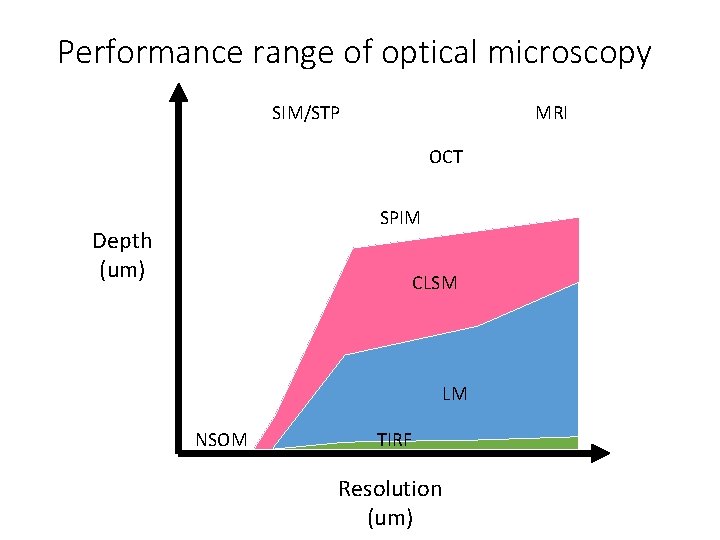
Performance range of optical microscopy SIM/STP MRI OCT SPIM Depth (um) CLSM LM NSOM TIRF Resolution (um)
Homework 4 The New Horizons probe has given us new insights on the dwarf planet Pluto. What color is the sky of Pluto and explain why in terms of scattering? Hint – The particles that scatter light in the atmosphere of Pluto (Tholins) are considered to be small like the smaller light scattering particles in earth’s atmosphere.
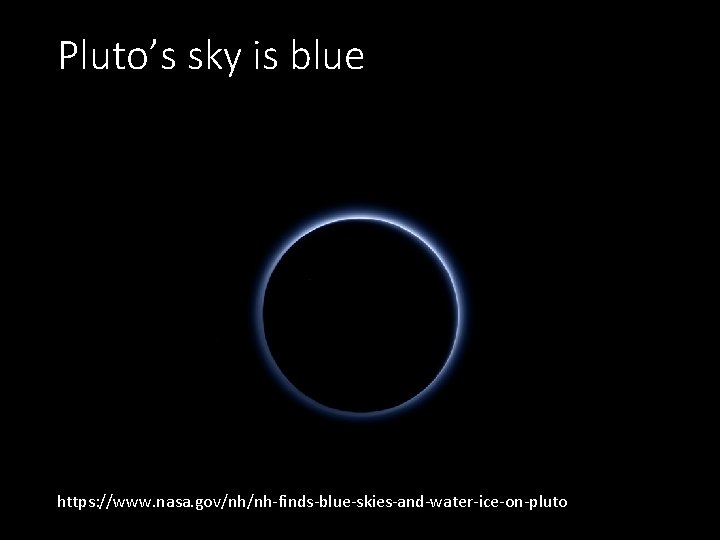
Pluto’s sky is blue https: //www. nasa. gov/nh/nh-finds-blue-skies-and-water-ice-on-pluto
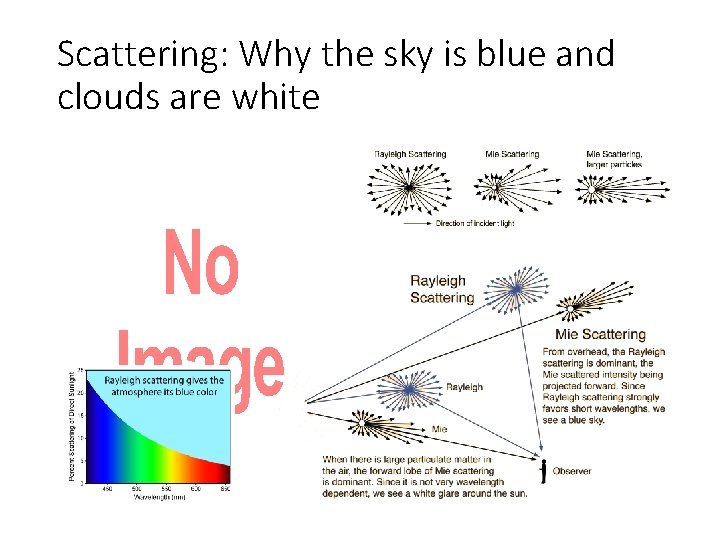
Scattering: Why the sky is blue and clouds are white •
- Slides: 63