
BIOLOGY 157 LIFE SCIENCE AN ENVIRONMENTAL APPROACH Introduction

BIOLOGY 157: LIFE SCIENCE: AN ENVIRONMENTAL APPROACH (Introduction, Science, etc. )

TEXT & SYLLABUS • Principles of Environmental Science: Inquiry and Applications. W. P. Cunningham and M. A. Cunningham (4 th ed. ). 2008. • REQUIRED • READ syllabus packet before next class • Lecture Topics, Text Readings, Exams • Class materials also on my web site www. lasalle. edu/~belzer
CLASS ATTENDANCE, ETC. • Attendance EXPECTED (No ‘cuts’) • Power. Point materials are NOT a substitute for class • Class meets from 6: 00 p. m. to 9: 15 p. m. • Class STARTS promptly at 6: 00 p. m. • QUIZ at BEGINNING and/or END of most classes -- Quizzes count for 1/2 of participation grade • Cell Phones (OFF / MUTE and AWAY!)
GRADE DETERMINATION • EXAMS (5) -------- 72% – 4 regular semester – final (45% comprehensive) • PARTICIPATION ----- 8% (1/2 for quizzes) • 2 WRITING ASSIGNMENTS and/or PROJECTS --- 20% (8% and 12%) • Letter Grade Limits – plus/minus system – 90 (A-), 80 (B-), 70 (C-), 60 (D-)
EXAMINATIONS • Exam Format(s)? ? ? • What to study? ? ? • When to study? ? ? • How to study? ? ?
A Simple Exercise • Break into groups of 3 • What are the environmental 3 R’s? • Define: Population, Ecology, Fauna, Herbivore • Give the complete scientific name for humans. • How long has our species been on earth? • How many centimeters in a meter?

Compare / Contrast Environmental Science & Ecology • ENVIRONMENTAL SCIENCE: an interdisciplinary field that studies the interrelated issues of human populations, resources and pollution. • ECOLOGY: the study of the interrelationships of organisms AND the reciprocal relationships between organisms and their abiotic environment.
A Question • Why do we want to know (= to understand) about organisms and their environment and their interactions? • Why do we want to know (= to understand) about anything?
An Answer The best answer might be: • “To know (= to understand) is to control. ” • IF we really understand something then we have at least a chance of using it to our benefit.
Can You Do Science? • The answer is YES! • ANYONE can! • EVERYONE should!
What is 'SCIENCE'? • Break out into your groups for a few minutes and come up with ONE answer from your group.
Science Defined (I) • Definition #1 is an archaic one. • Definition #2 is the one we will use because the definition, in itself, just about explains the so-called “Scientific Method”.
Science Defined (II) • 1) Knowledge, especially knowledge gained through experience. • 2) The observation, identification, description, experimental investigation, and explanation of NATURAL phenomena.
Scientific Method (I) • The method or pattern by which good 'science' is accomplished is a multi-step process. • Many sources will list a set number of steps. • In reality it is more of a ‘flowing’ PROCESS and the exact number of steps one defines really doesn’t matter. However, generally it has the following pattern:
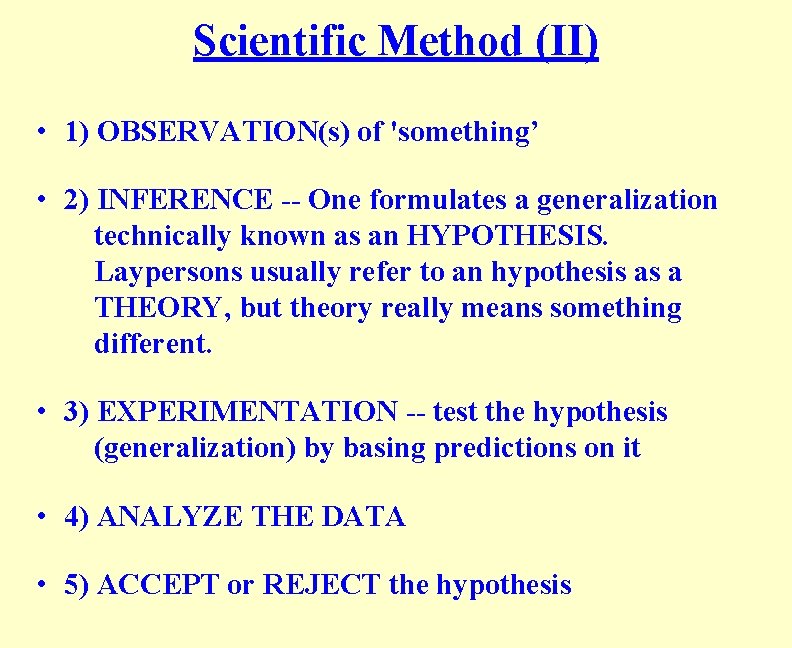
Scientific Method (II) • 1) OBSERVATION(s) of 'something’ • 2) INFERENCE -- One formulates a generalization technically known as an HYPOTHESIS. Laypersons usually refer to an hypothesis as a THEORY, but theory really means something different. • 3) EXPERIMENTATION -- test the hypothesis (generalization) by basing predictions on it • 4) ANALYZE THE DATA • 5) ACCEPT or REJECT the hypothesis
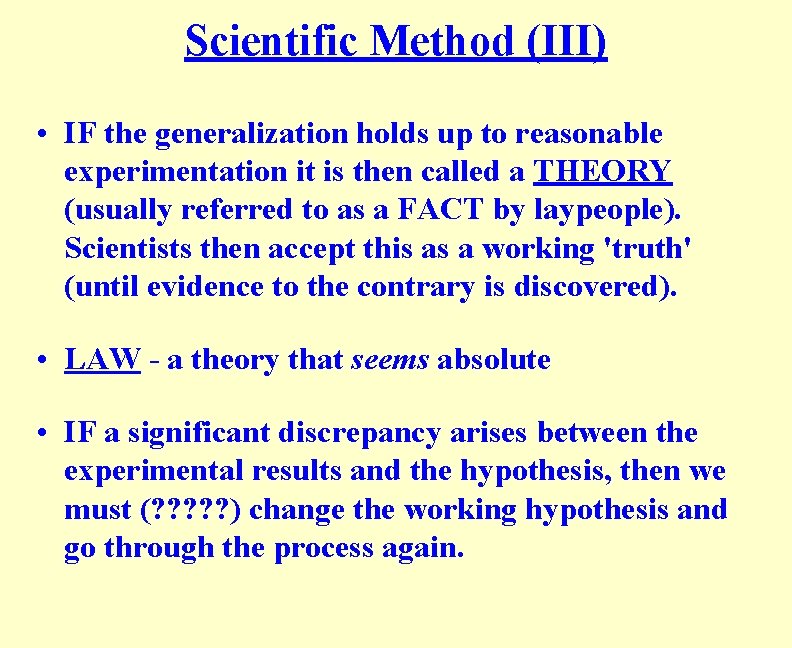
Scientific Method (III) • IF the generalization holds up to reasonable experimentation it is then called a THEORY (usually referred to as a FACT by laypeople). Scientists then accept this as a working 'truth' (until evidence to the contrary is discovered). • LAW - a theory that seems absolute • IF a significant discrepancy arises between the experimental results and the hypothesis, then we must (? ? ? ) change the working hypothesis and go through the process again.

Science and Technology are NOT the same. • SCIENCE: essentially is a search for knowledge about nature. • TECHNOLOGY: is the creation of new products and processes which are supposed to improve our efficiency, chances for survival, comfort and quality of life.
Some Things About Science / Scientists (I) • What are some things we associate with science / scientists? • Come up with 3 or 4 things you would associate with science / scientists. Try to keep each ‘thing’ to one or two words.
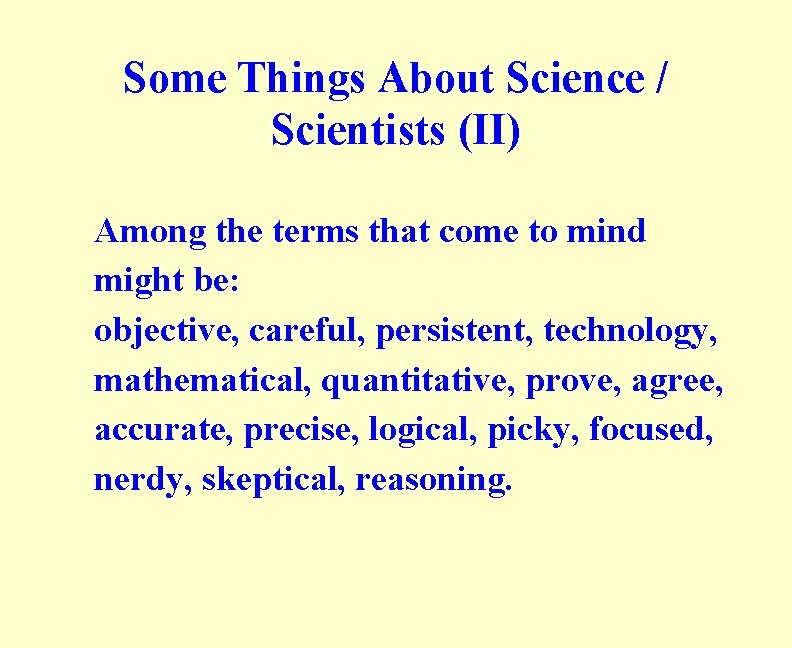
Some Things About Science / Scientists (II) Among the terms that come to mind might be: objective, careful, persistent, technology, mathematical, quantitative, prove, agree, accurate, precise, logical, picky, focused, nerdy, skeptical, reasoning.
Some Things About Science / Scientists (III) • 1) What can science PROVE? • 2) Should all scientists agree? • 3) Are scientists always objective? • 4) QUANTITATIVE vs. QUALITATIVE • 5) PRECISION vs. ACCURACY • 6) TYPES OF REASONING used by scientists: Deductive Inductive
Some Things About Science / Scientists (IV) ÙQuantitative • usually very meaningful / useful • numerical data such as 14. 7 kilograms, 75 kilometers, 370 C. ÚQualitative: • usually not very meaningful / useful • large, small, long, short, hot, cold, etc.
Precision and Accuracy are NOT the same. • Precision: degree of exactness with which a measurement is made (such as 19. 427 kilometers from point A to point B) • Accuracy the extent to which the measurement agrees with the accepted (= real? ) value
TYPES OF REASONING • DEDUCTIVE REASONING (= syllogistic reasoning) reason from a known principle to an unknown, or from a premise to a logical conclusion (general to specific or “top down”) • INDUCTIVE REASONING reason from particular facts or individual cases to a general conclusion (“bottom up”)
What, if any, difference is there between the way scientists work and the way people work in other areas? • Nothing done by scientists is UNIQUE to science. • IF there is a difference, it is one of degree.
“Types” of Science • MAINSTREAM (= CONSENSUS or SOUND) SCIENCE: that which has sufficient data and is generally accepted by the scientific community • FRONTIER SCIENCE: that which, at the present time, does not have sufficient evidence for it to make it generally acceptable (but it may get that in the future) • PSEUDO-SCIENCE (= ? ? QUACKERY or BALONEY ? ? ): ideas which not only lack support but may even have evidence against them
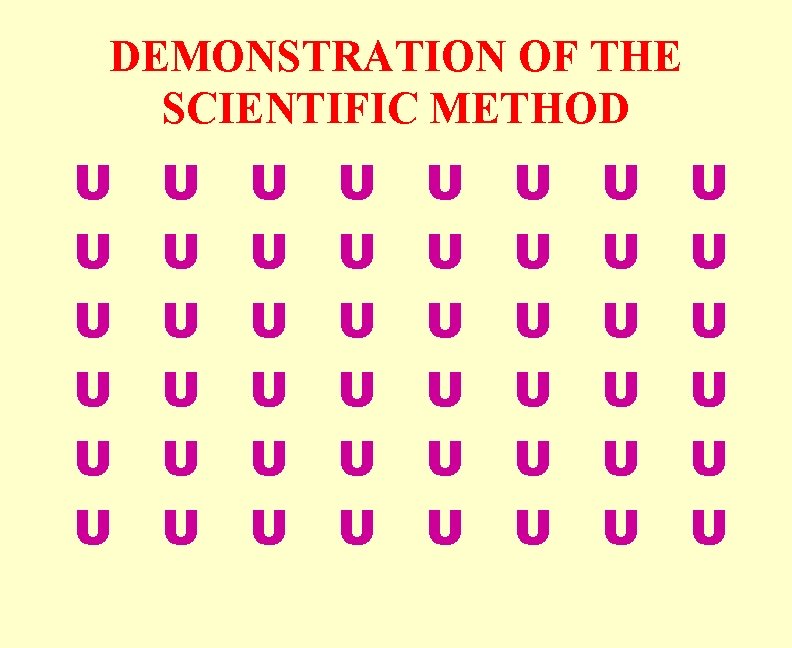
DEMONSTRATION OF THE SCIENTIFIC METHOD U U U U U U U U U U U U
About Terminology • A specialized and fixed terminology IS necessary: • It allows us to communicate more easily and accurately! • Natural vs. Not Natural ? ? • Theory vs. Hypothesis • Good vs. Bad ? ?
Gaia Hypothesis I • Gaia (also spelled Gaea) from Greek mythology, the earth personified as a goddess (“Mother Earth”) • The idea has surfaced numerous times. • James Lovelock; Lynn Margulis • ? ? ? The earth is a giant self-regulating creature. ? ? ?
Gaia Hypothesis II • The earth functions LIKE a giant organism. • Living things have changed the earth AND its abiotic environment. • Living things assist in maintaining the abiotic environment. • Everything is tied together. Anything that happens in one place has repercussions in other places.
ADDITIONAL things from chapter 1 for YOU to investigate • Law of Parsimony • Empiricism • Blind and Double Blind Studies • Paradigm (can you think of some that were accepted in the past but now) • Types of THINKING (p. 11) • Which idea (Biocentric Conservation or Utilitarian Conservation) most closely follows Genesis in the Bible?
- Slides: 31