
Biologisk mngfald och klimatfrndring ur ett vetenskapligt perspektiv
Biologisk mångfald och klimatförändring ur ett vetenskapligt perspektiv Europahuset Inför CBD 2010 4 e oktober 2010 Prof. Johan Rockström Stockholm Resilience Centre Stockholm Environment Institute
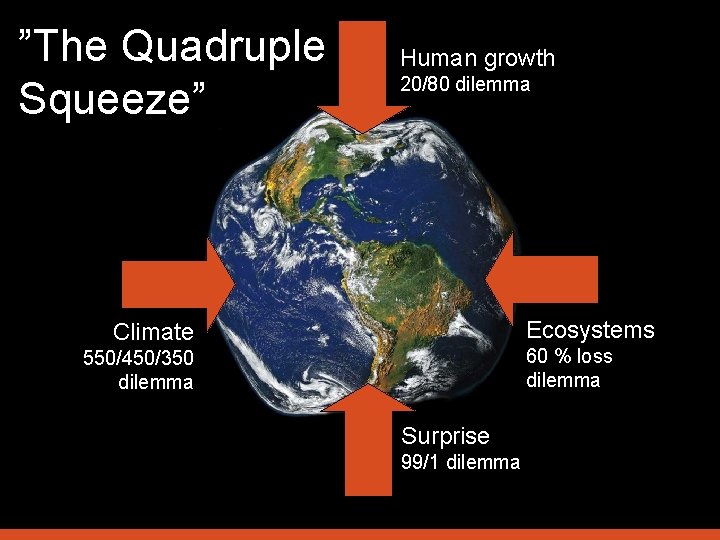
”The Quadruple Squeeze” Human growth 20/80 dilemma Ecosystems Climate 60 % loss dilemma 550/450/350 dilemma Surprise 99/1 dilemma
Accelerated biodiversity loss during the Anthropocene – The 6 th Major extinction event in the History of Planet Earth THE GLOBAL DRAMA OF BIODIVERSITY LOSS Growing evidence of importance of biodiversity - to sustaining ecosystem functioning and services - to prevent ecosystems from tipping into undesired states - to prevent other Earth system processes from flipping
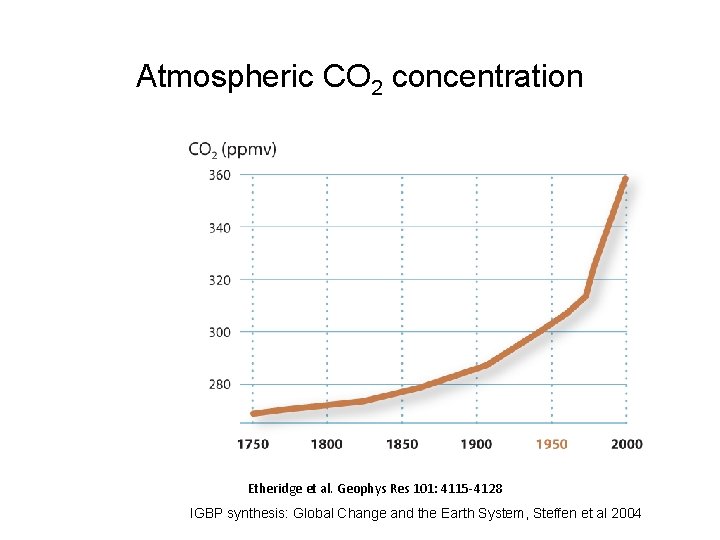
Atmospheric CO 2 concentration Etheridge et al. Geophys Res 101: 4115 -4128 IGBP synthesis: Global Change and the Earth System, Steffen et al 2004
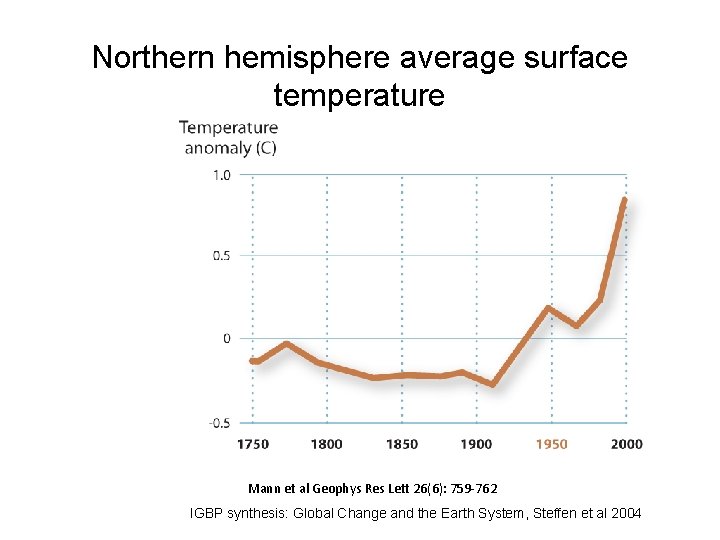
Northern hemisphere average surface temperature Mann et al Geophys Res Lett 26(6): 759 -762 IGBP synthesis: Global Change and the Earth System, Steffen et al 2004
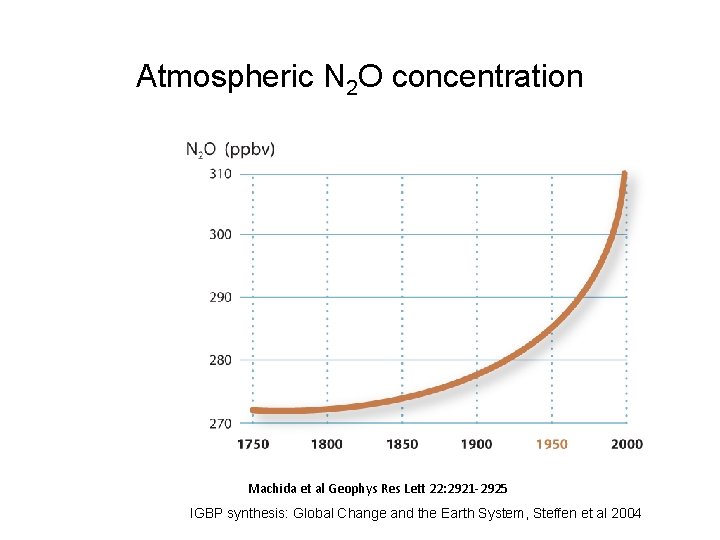
Atmospheric N 2 O concentration Machida et al Geophys Res Lett 22: 2921 -2925 IGBP synthesis: Global Change and the Earth System, Steffen et al 2004
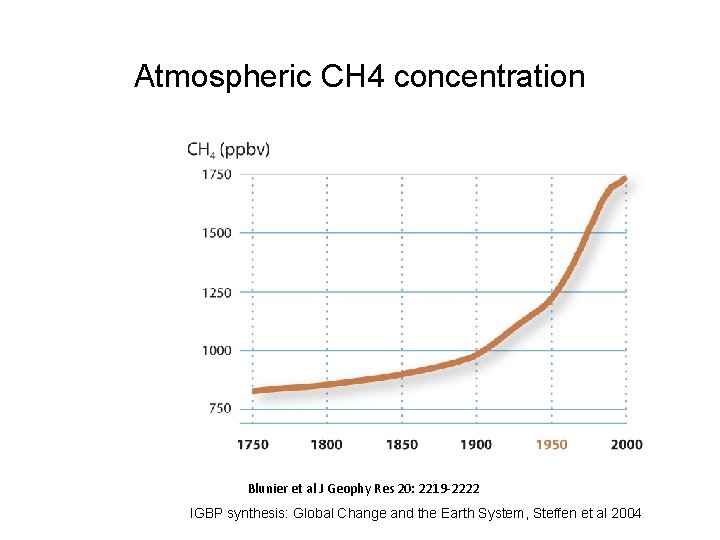
Atmospheric CH 4 concentration Blunier et al J Geophy Res 20: 2219 -2222 IGBP synthesis: Global Change and the Earth System, Steffen et al 2004
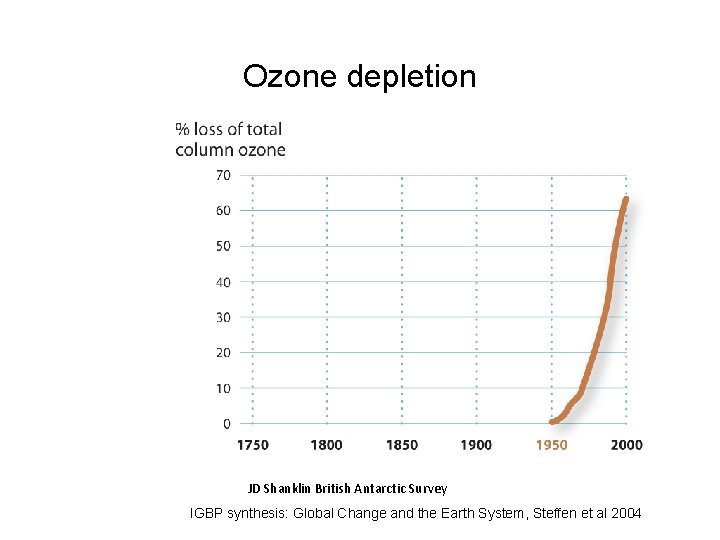
Ozone depletion JD Shanklin British Antarctic Survey IGBP synthesis: Global Change and the Earth System, Steffen et al 2004
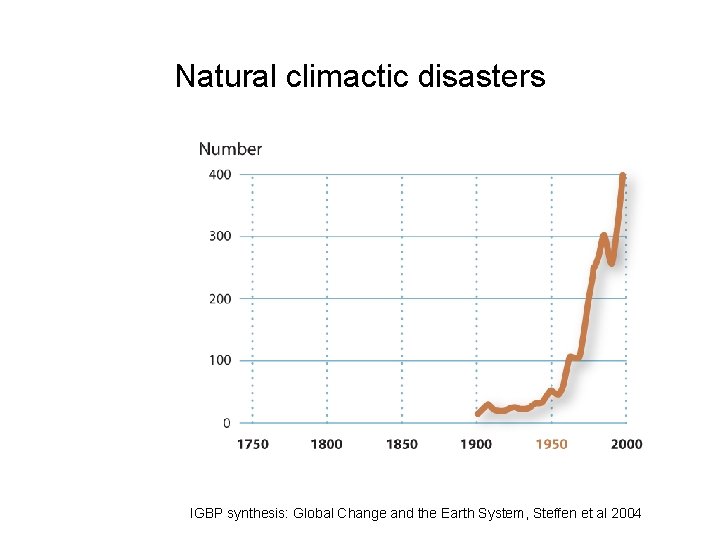
Natural climactic disasters IGBP synthesis: Global Change and the Earth System, Steffen et al 2004
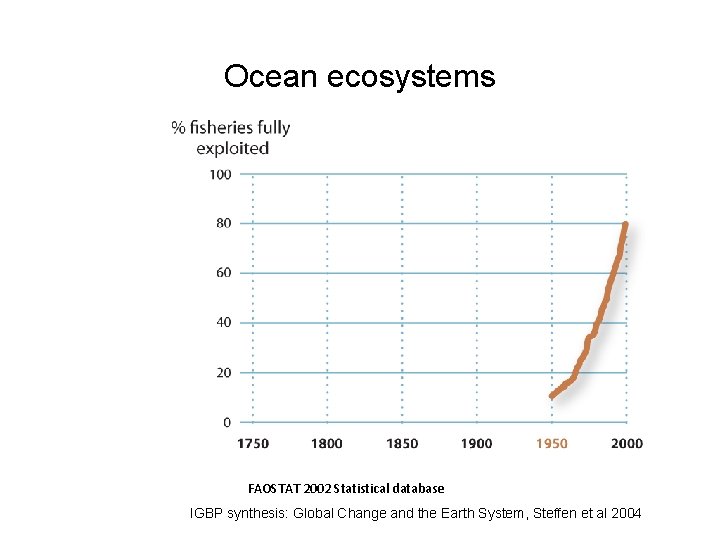
Ocean ecosystems FAOSTAT 2002 Statistical database IGBP synthesis: Global Change and the Earth System, Steffen et al 2004
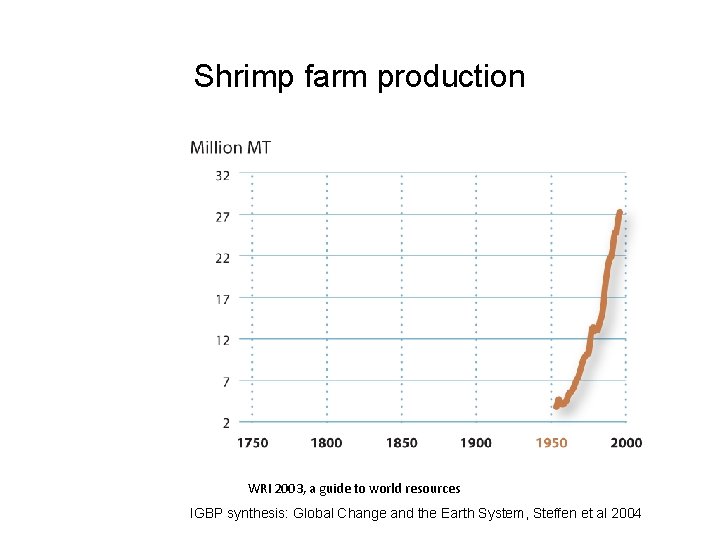
Shrimp farm production WRI 2003, a guide to world resources IGBP synthesis: Global Change and the Earth System, Steffen et al 2004
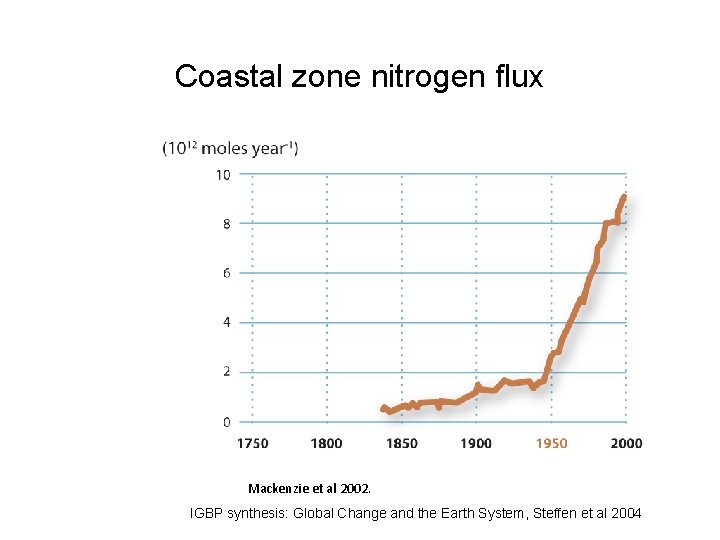
Coastal zone nitrogen flux Mackenzie et al 2002. IGBP synthesis: Global Change and the Earth System, Steffen et al 2004
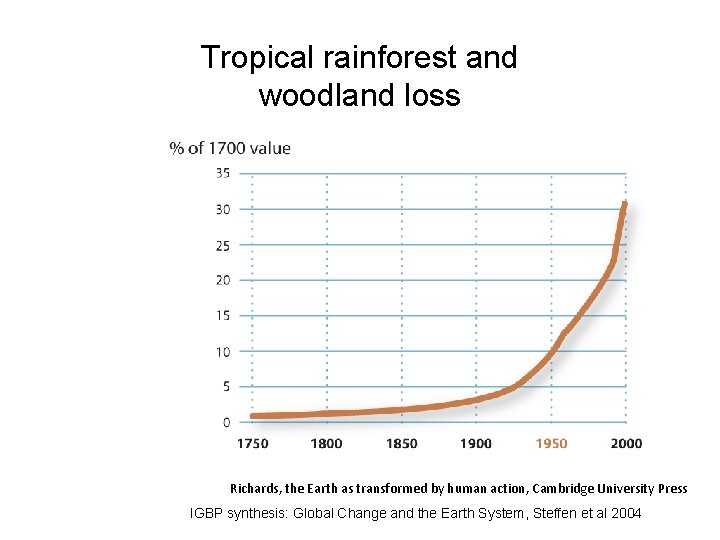
Tropical rainforest and woodland loss Richards, the Earth as transformed by human action, Cambridge University Press IGBP synthesis: Global Change and the Earth System, Steffen et al 2004
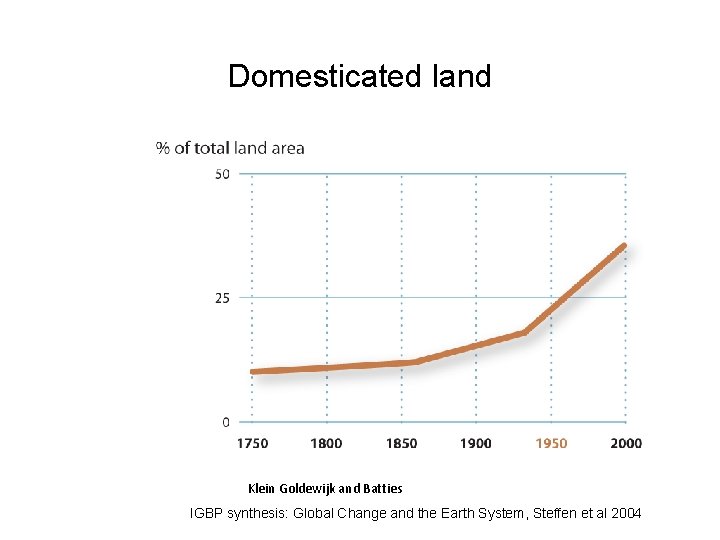
Domesticated land Klein Goldewijk and Batties IGBP synthesis: Global Change and the Earth System, Steffen et al 2004
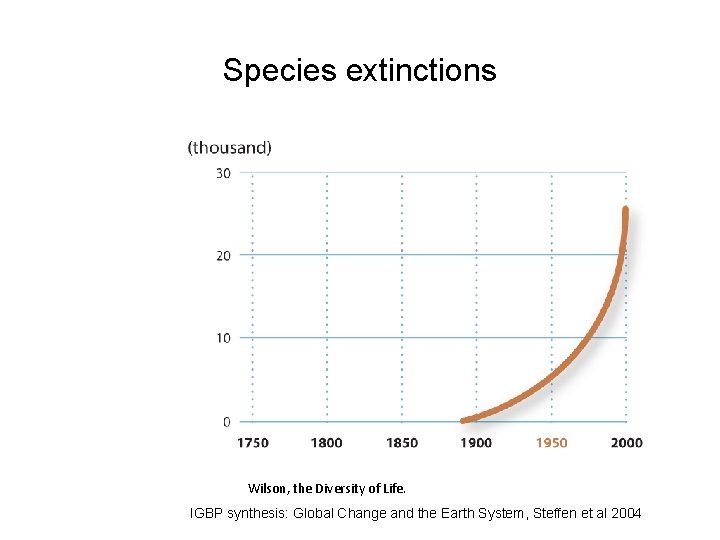
Species extinctions Wilson, the Diversity of Life. IGBP synthesis: Global Change and the Earth System, Steffen et al 2004
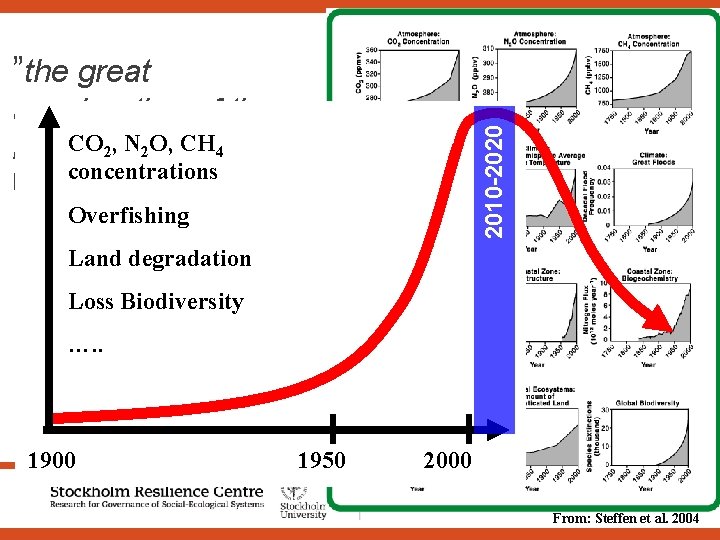
”the great 2010 -2020 acceleration of the CO 2, entreprise”, N 2 O, CH 4 human concentrations Professor Will Steffen Overfishing Land degradation The Planetary Loss Biodiversity Response to the …. . drivers of the Anthropocene 1900 1950 2000 From: Steffen et al. 2004
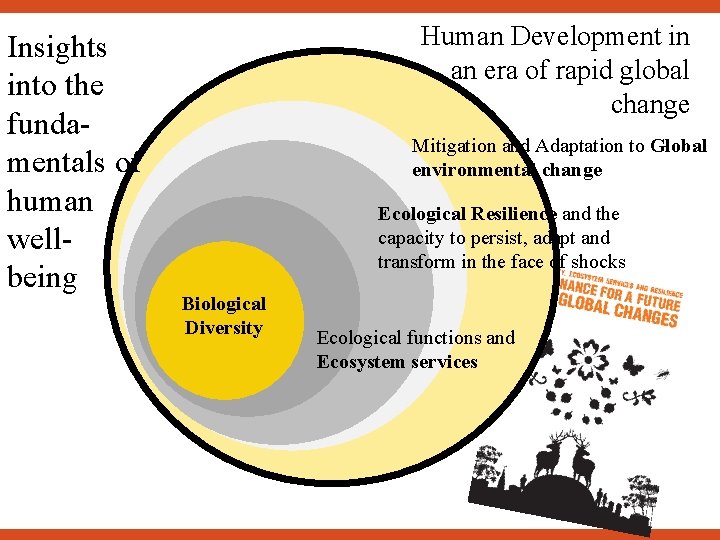
Insights into the fundamentals of human wellbeing Human Development in an era of rapid global change Mitigation and Adaptation to Global environmental change Ecological Resilience and the capacity to persist, adapt and transform in the face of shocks Biological Diversity Ecological functions and Ecosystem services
5 4 3 2 1 0
Biodiversity and ecosystem functions functional diversity (functional complementarity) species that perform different ecosystem functions (nitrogen fixation, pollination, etc. ) response diversity Species (gene complexes) that perform the same function in different ways with different response capacities to environmental changes (redundancy, biological insurance)
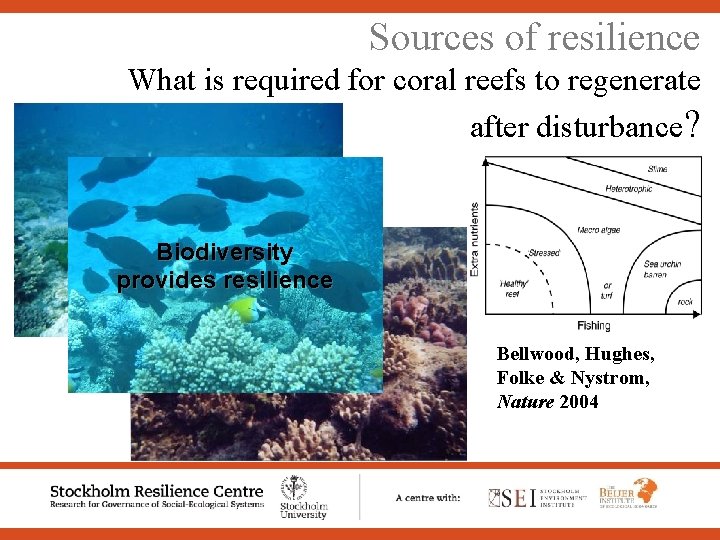
Sources of resilience What is required for coral reefs to regenerate after disturbance? Biodiversity provides resilience Bellwood, Hughes, Folke & Nystrom, Nature 2004
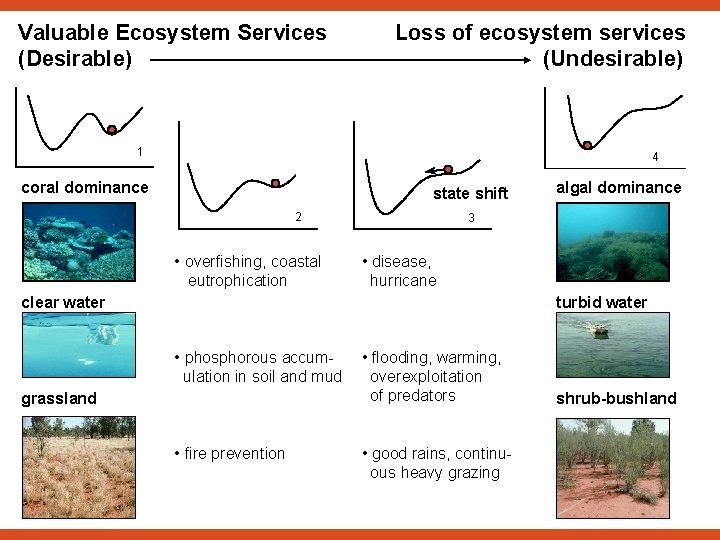
Valuable Ecosystem Services (Desirable) Loss of ecosystem services (Undesirable) 1 4 coral dominance state shift 2 • overfishing, coastal eutrophication algal dominance 3 • disease, hurricane clear water turbid water • phosphorous accumulation in soil and mud grassland • fire prevention • flooding, warming, overexploitation of predators • good rains, continuous heavy grazing shrub-bushland
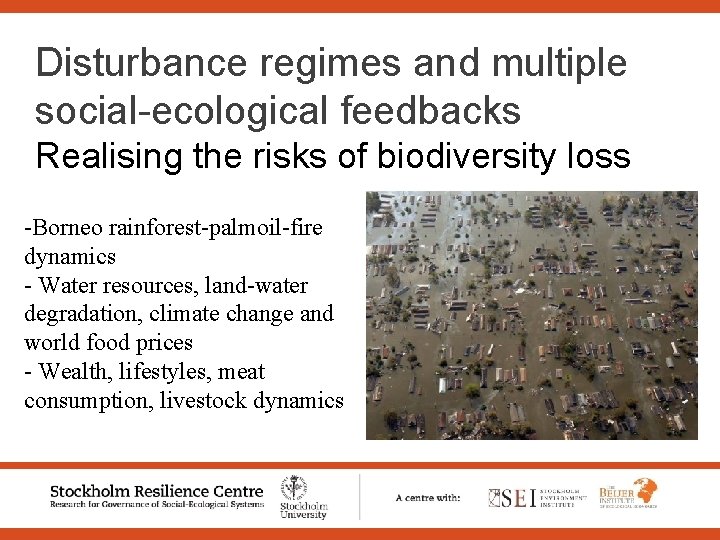
Disturbance regimes and multiple social-ecological feedbacks Realising the risks of biodiversity loss -Borneo rainforest-palmoil-fire dynamics - Water resources, land-water degradation, climate change and world food prices - Wealth, lifestyles, meat consumption, livestock dynamics
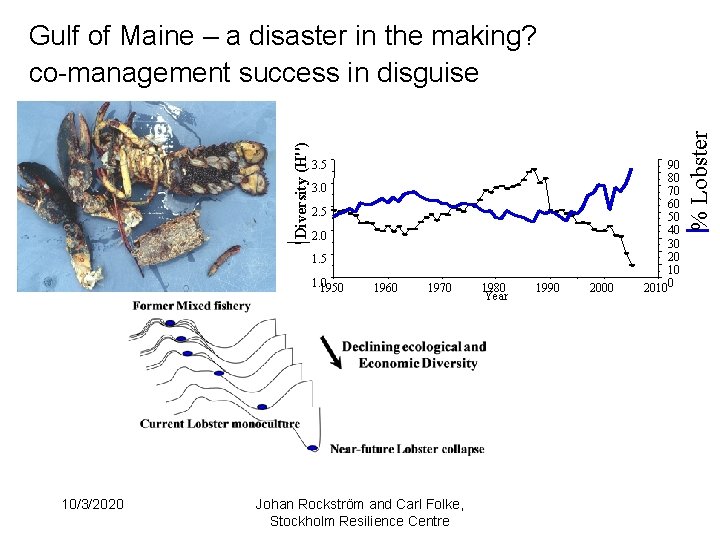
3. 5 3. 0 2. 5 2. 0 1. 5 1. 0 1950 10/3/2020 1960 1970 Johan Rockström and Carl Folke, Stockholm Resilience Centre 1980 Year 1990 2000 90 80 70 60 50 40 30 20 10 0 2010 % Lobster Diversity (H'') Gulf of Maine – a disaster in the making? co-management success in disguise
Photo: CC Jason Auch / Azote
Photo: S Zeff / Azote
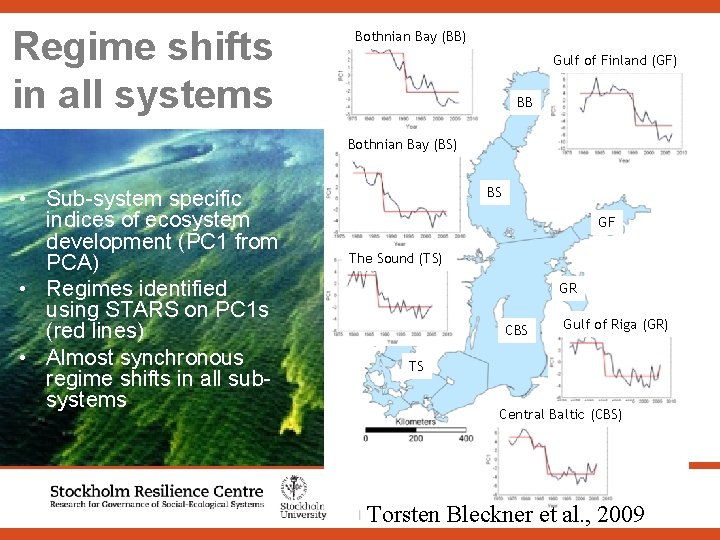
Regime shifts in all systems Bothnian Bay (BB) Gulf of Finland (GF) BB Bothnian Bay (BS) • Sub-system specific indices of ecosystem development (PC 1 from PCA) • Regimes identified using STARS on PC 1 s (red lines) • Almost synchronous regime shifts in all subsystems BS GF The Sound (TS) GR CBS Gulf of Riga (GR) TS Central Baltic (CBS) Torsten Bleckner et al. , 2009
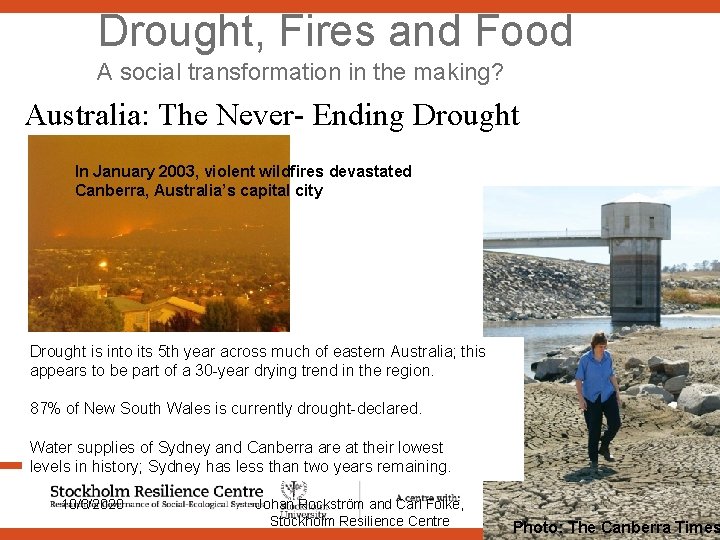
Drought, Fires and Food A social transformation in the making? Australia: The Never- Ending Drought In January 2003, violent wildfires devastated Canberra, Australia’s capital city Drought is into its 5 th year across much of eastern Australia; this appears to be part of a 30 -year drying trend in the region. 87% of New South Wales is currently drought-declared. Water supplies of Sydney and Canberra are at their lowest levels in history; Sydney has less than two years remaining. 10/3/2020 Johan Rockström and Carl Folke, Stockholm Resilience Centre Photo: The Canberra Times
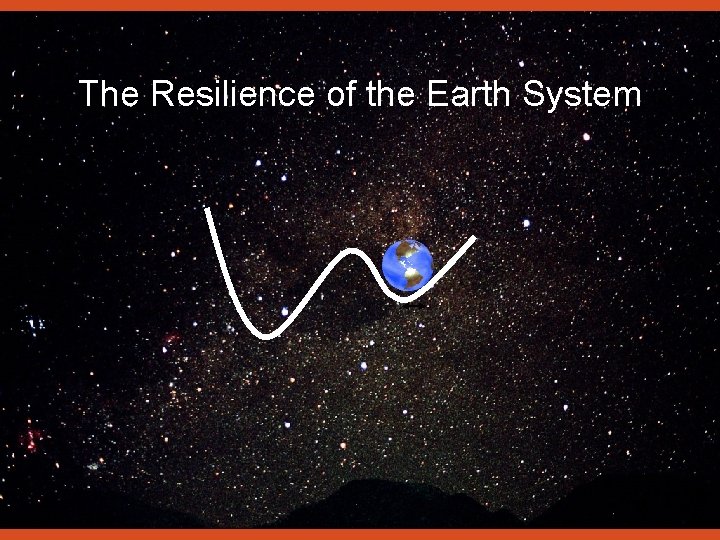
The Resilience of the Earth System
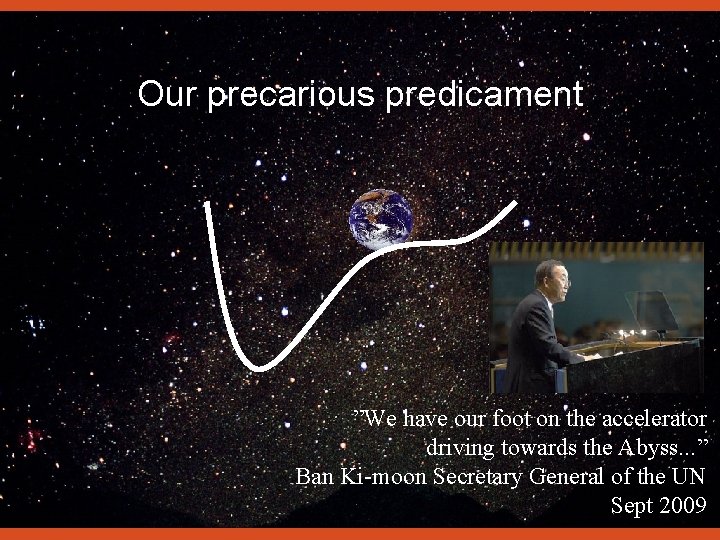
Our precarious predicament ”We have our foot on the accelerator driving towards the Abyss. . . ” Ban Ki-moon Secretary General of the UN Sept 2009
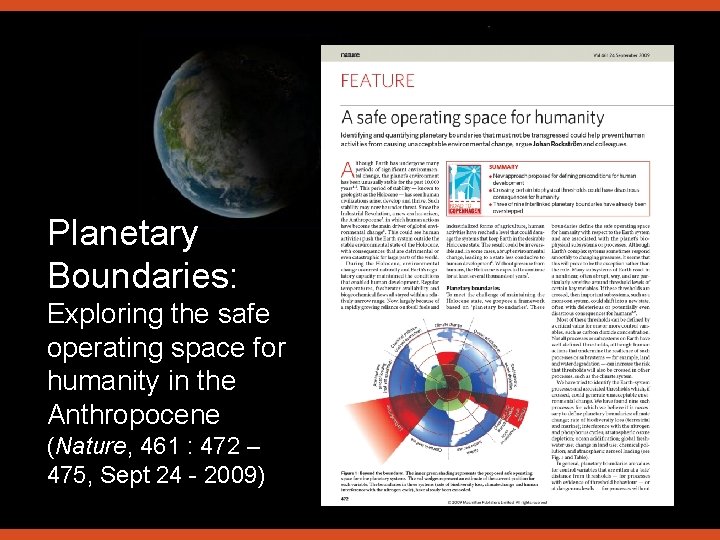
Planetary Boundaries: Exploring the safe operating space for humanity in the Anthropocene (Nature, 461 : 472 – 475, Sept 24 - 2009)
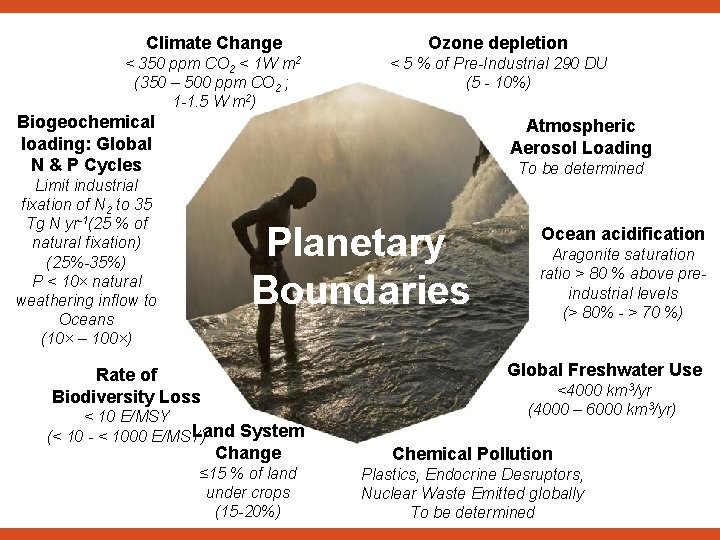
Climate Change Ozone depletion < 350 ppm CO 2 < 1 W m 2 (350 – 500 ppm CO 2 ; 1 -1. 5 W m 2) < 5 % of Pre-Industrial 290 DU (5 - 10%) Biogeochemical loading: Global N & P Cycles Atmospheric Aerosol Loading To be determined Limit industrial fixation of N 2 to 35 Tg N yr-1(25 % of natural fixation) (25%-35%) P < 10× natural weathering inflow to Oceans (10× – 100×) Planetary Boundaries Ocean acidification Aragonite saturation ratio > 80 % above preindustrial levels (> 80% - > 70 %) Global Freshwater Use Rate of Biodiversity Loss < 10 E/MSY Land System (< 10 - < 1000 E/MSY) <4000 km 3/yr (4000 – 6000 km 3/yr) Change Chemical Pollution ≤ 15 % of land under crops (15 -20%) Plastics, Endocrine Desruptors, Nuclear Waste Emitted globally To be determined
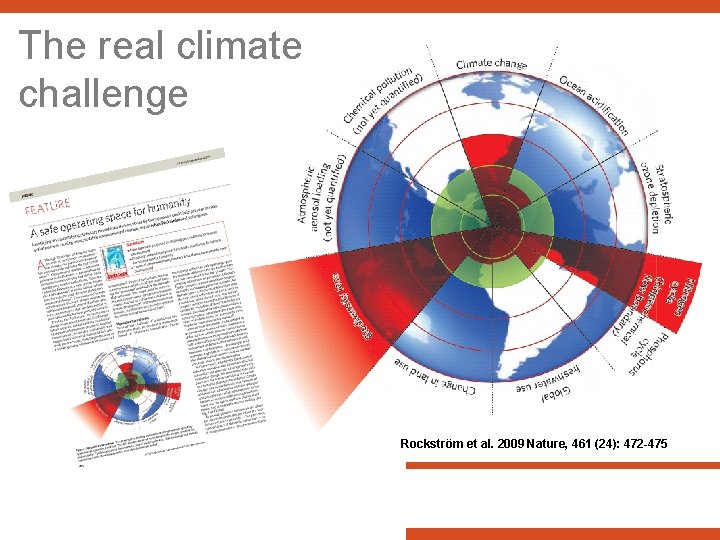
The real climate challenge Global freshwater use … Rockström et al. 2009 Nature, 461 (24): 472 -475
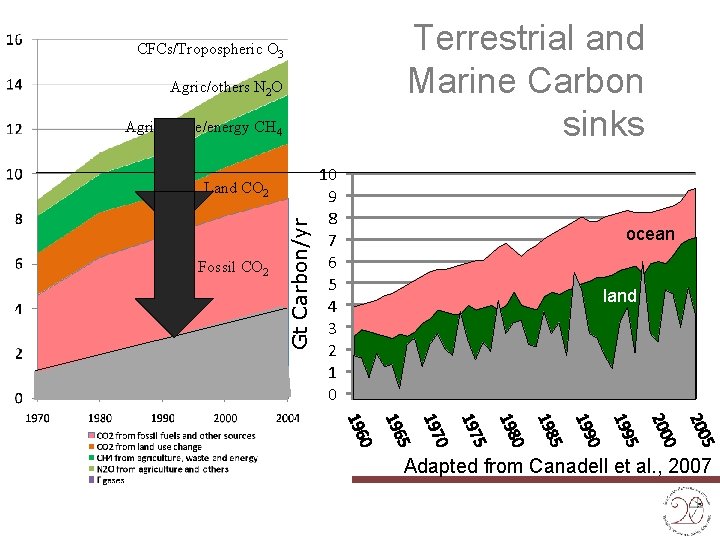
Terrestrial and Marine Carbon sinks CFCs/Tropospheric O 3 Agric/others N 2 O Agric/waste/energy CH 4 Fossil CO 2 Gt Carbon/yr Land CO 2 10 9 8 7 6 5 4 3 2 1 0 ocean land Adapted from Canadell et al. , 2007
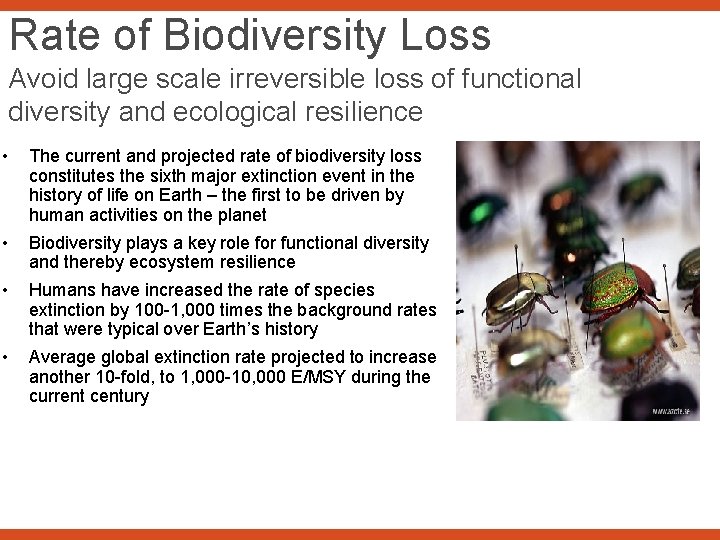
Rate of Biodiversity Loss Avoid large scale irreversible loss of functional diversity and ecological resilience • The current and projected rate of biodiversity loss constitutes the sixth major extinction event in the history of life on Earth – the first to be driven by human activities on the planet • Biodiversity plays a key role for functional diversity and thereby ecosystem resilience • Humans have increased the rate of species extinction by 100 -1, 000 times the background rates that were typical over Earth’s history • Average global extinction rate projected to increase another 10 -fold, to 1, 000 -10, 000 E/MSY during the current century
Biodiversity Loss Setting the boundary: • Suggesting a safe planetary boundary (here placed at 10 E/MSY) • within an order of magnitude of the natural background rate
Biodiversity provides resilience for humanity in an era of rapid global change
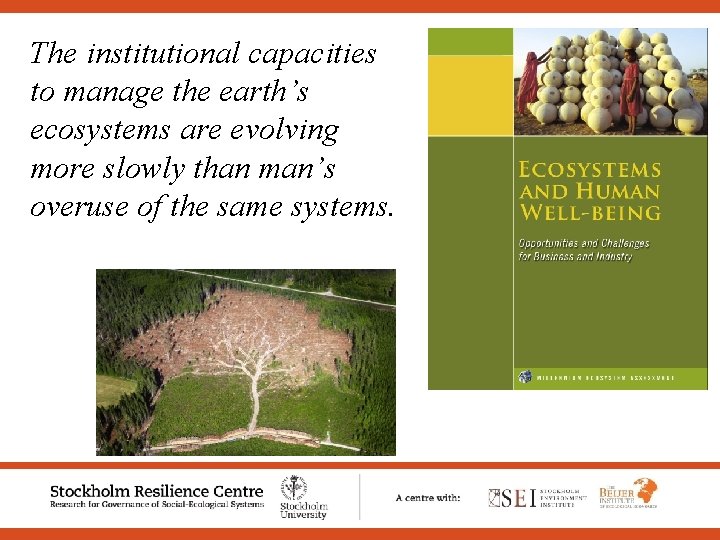
The institutional capacities to manage the earth’s ecosystems are evolving more slowly than man’s overuse of the same systems.
- Slides: 38