
BiologicalStructural Bases Mechanics of the Musculoskeletal System Tissue
Biological/Structural Bases Mechanics of the Musculoskeletal System
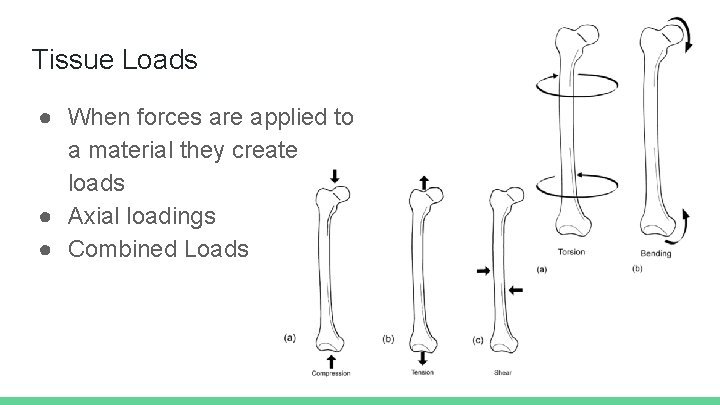
Tissue Loads ● When forces are applied to a material they create loads ● Axial loadings ● Combined Loads
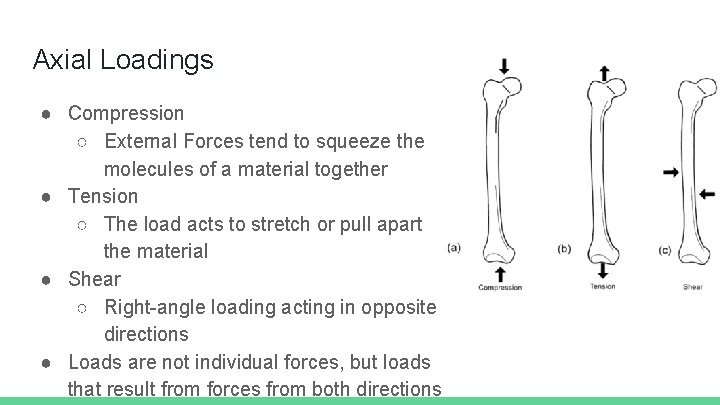
Axial Loadings ● Compression ○ External Forces tend to squeeze the molecules of a material together ● Tension ○ The load acts to stretch or pull apart the material ● Shear ○ Right-angle loading acting in opposite directions ● Loads are not individual forces, but loads that result from forces from both directions
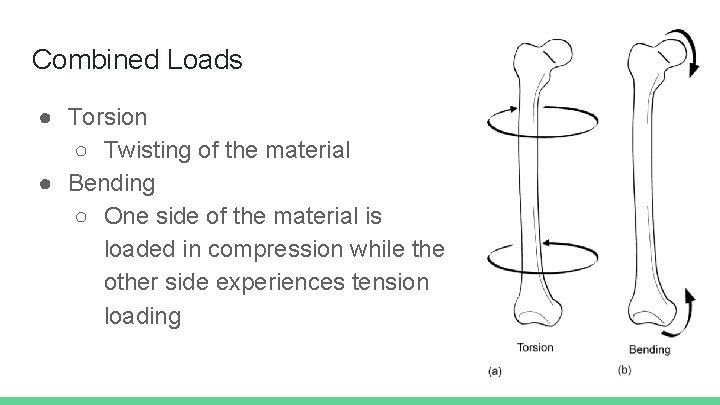
Combined Loads ● Torsion ○ Twisting of the material ● Bending ○ One side of the material is loaded in compression while the other side experiences tension loading
Response of Tissues to Forces ● Immediate response of tissues structure will change ○ ○ Size and direction of forces Mechanical strength and shape of the tissue ● Mechanical strength and muscular strength are different ● Mechanical Variables that explain how musculoskeletal tissues respond to forces or loading ○ ○ Stress Strain Stiffness and Mechanical Strength Viscoelasticity
Stress ● How hard a load works to change the shape of a material is measured by mechanical stress ● Defined as force per unit area within a material ○ Calculation ● Similar to the concept of pressure ● Tensor quantity ○ Generalized vectors that have multiple directions accounted for
Strain ● ● ● Measure of the deformation of a material created by a load Expressed as a ratio of the normal or resting length Calculated by change in length divided by normal length Rubber Band Which can withstand greater tensile strain ○ Tennis racket, golf club, or diving board
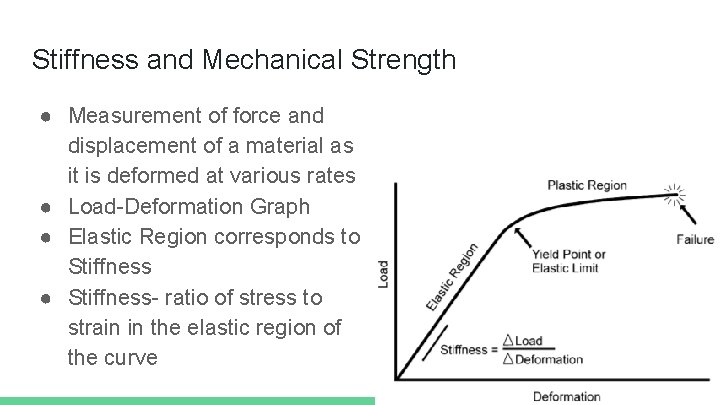
Stiffness and Mechanical Strength ● Measurement of force and displacement of a material as it is deformed at various rates ● Load-Deformation Graph ● Elastic Region corresponds to Stiffness ● Stiffness- ratio of stress to strain in the elastic region of the curve
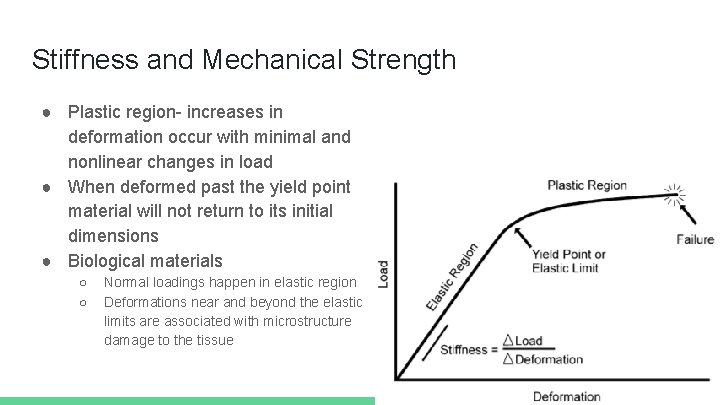
Stiffness and Mechanical Strength ● Plastic region- increases in deformation occur with minimal and nonlinear changes in load ● When deformed past the yield point material will not return to its initial dimensions ● Biological materials ○ ○ Normal loadings happen in elastic region Deformations near and beyond the elastic limits are associated with microstructure damage to the tissue
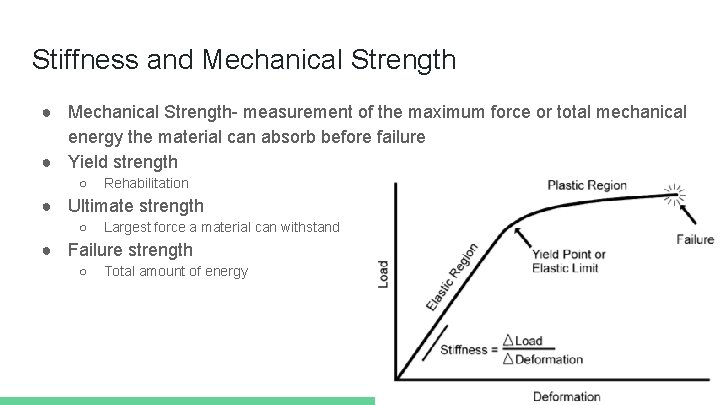
Stiffness and Mechanical Strength ● Mechanical Strength- measurement of the maximum force or total mechanical energy the material can absorb before failure ● Yield strength ○ Rehabilitation ● Ultimate strength ○ Largest force a material can withstand ● Failure strength ○ Total amount of energy
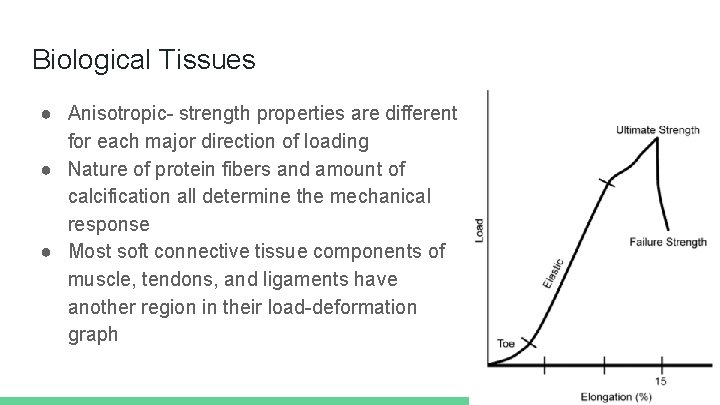
Biological Tissues ● Anisotropic- strength properties are different for each major direction of loading ● Nature of protein fibers and amount of calcification all determine the mechanical response ● Most soft connective tissue components of muscle, tendons, and ligaments have another region in their load-deformation graph
Viscoelasticity ● Stress and strain in a material are dependent on the rate of loading ● Timing of the force application affects the strain response of the material ○ ○ High rate of stretch ■ High stiffness Slow rate of stretch ■ Small increase in passive resistance (high compliance) ● Silly Putty
Properties of Viscoelastic Materials ● Creep ○ Gradual elongation (strain) of a material over time ● Stress Relaxation ○ Decrease in stress over time when a material is elongated to a set length ● Hysteresis ○ Property of materials to have a different unloading response than its loading response
Passive Muscle-Tendon Unit (MTU) ● Passive stretching is viscoelastic ● High rate of passive stretch- stiff ● Slow stretch results in less passive tension in the muscle
Passive Muscle-Tendon Unit (MTU) ● Tendon is the connective tissue that links muscles to bones ● Much stronger than muscle tissue ○ Vascularized, parallel arrangement with cross-links ● Great tensile strength ○ Rupture injuries are rare ● Acute overloading of the MTU ○ Strains and failures at the muscletendon junction or the tendon/bone interface
Passive Muscle-Tendon Unit (MTU) ● Tendons act as a spring in fast bouncing movements ● Short tendons transfers force to the bone more quickly (less “slack”) ● Intrinsic hand muscles are well suited for fast movements ○ Short tendons ● Achilles tendon provides shock absorption and compliance to smooth out the forces of the large calf muscle group ○ Long tendon
Biomechanics of Bone ● Primary loads are compressive ● Response of bone to compression, tension, and other complex loads depends on the bone structure ● Strength depends heavily on its density, dietary habits and physical activity ● Immobilization and inactivity results in decrease of bone density, stiffness, and mechanical strength

Wolff’s Law ● Bones remodel (lay down greater mineral deposits) according to the mechanical stress in that area ● https: //vimeo. com/143468200
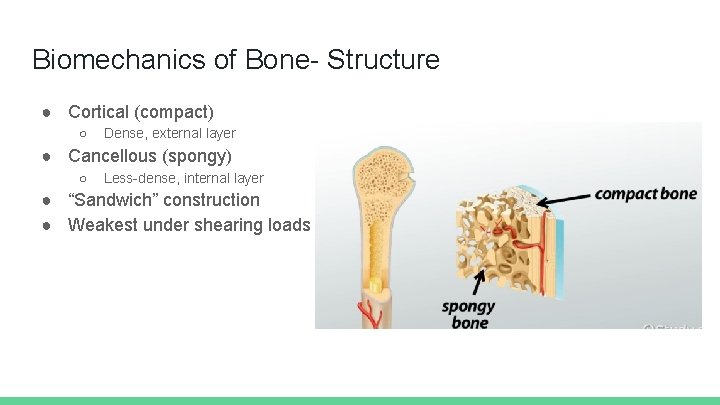
Biomechanics of Bone- Structure ● Cortical (compact) ○ Dense, external layer ● Cancellous (spongy) ○ Less-dense, internal layer ● “Sandwich” construction ● Weakest under shearing loads
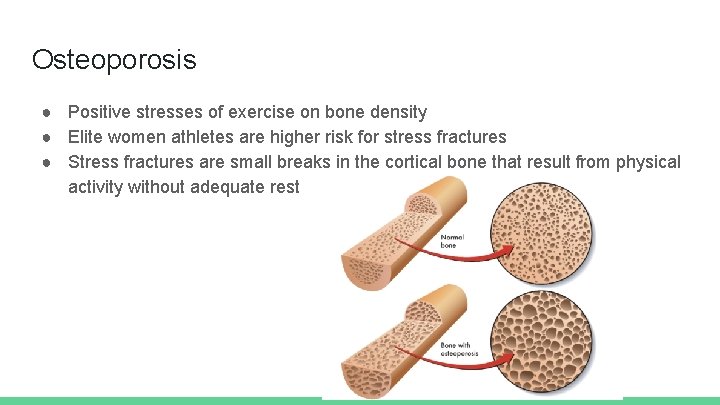
Osteoporosis ● Positive stresses of exercise on bone density ● Elite women athletes are higher risk for stress fractures ● Stress fractures are small breaks in the cortical bone that result from physical activity without adequate rest
Biomechanics of Ligaments ● Tough connective tissue that connect bones to guide and limit joint motion ● Proprioceptive and afferent signals ● Like bones, ligaments and tendons remodel according to stress they are subjected to ● https: //www. physio-pedia. com/Anterior_Cruciate_Ligament_(ACL)__Structure_and_Biomechanical_Properties

Female Athlete Triad Read and write a summary on the components of the Female Athlete Triad. Use the article posted on the Google Classroom Page and search for new information from other sources.

Stretch-Shortening Cycle (SSC) ● Countermovement away from the intended direction of motion that is slowed down with eccentric muscle action that is immediately followed by concentric action in the direction of interest ● This bounce out of an eccentric results in potentiation (increase) of force in the following concentric action if there is minimal delay between the actions

Neuromuscular Control ● Muscle activation ● The Functional Unit of Control: Motor Units ○ One motor neuron and all the muscle fibers it innervates ○ Activation of a motor axon results in stimulation of all the fibers of that motor unit and the resulting twitch ○ “All-or-nothing” response
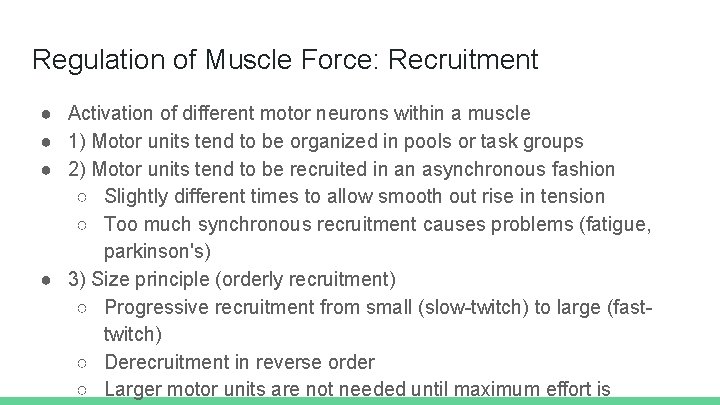
Regulation of Muscle Force: Recruitment ● Activation of different motor neurons within a muscle ● 1) Motor units tend to be organized in pools or task groups ● 2) Motor units tend to be recruited in an asynchronous fashion ○ Slightly different times to allow smooth out rise in tension ○ Too much synchronous recruitment causes problems (fatigue, parkinson's) ● 3) Size principle (orderly recruitment) ○ Progressive recruitment from small (slow-twitch) to large (fasttwitch) ○ Derecruitment in reverse order ○ Larger motor units are not needed until maximum effort is
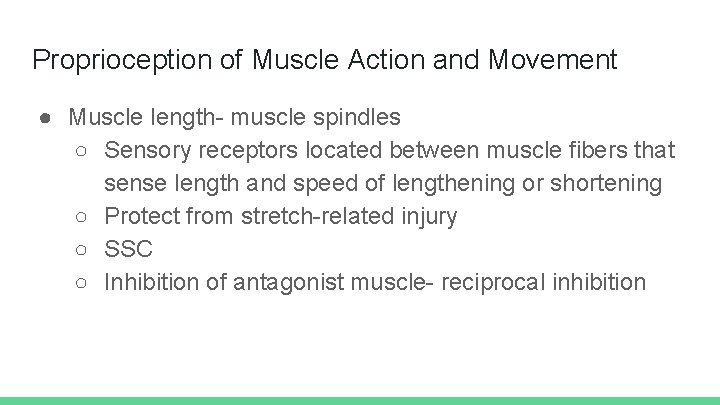
Proprioception of Muscle Action and Movement ● Muscle length- muscle spindles ○ Sensory receptors located between muscle fibers that sense length and speed of lengthening or shortening ○ Protect from stretch-related injury ○ SSC ○ Inhibition of antagonist muscle- reciprocal inhibition
Proprioception of Muscle Action and Movement ● Force- golgi tendon ○ Tension developed from an activated muscle is sensed ○ Located at the musculotendinous junction ○ Inhibitory effect on the creation of tension in the muscle ○ Connect to the motor neurons and relax the muscle to protect from excessive loading
Summary ● Forces applied to the musculoskeletal system? ○ Based on direction and line of action relative to their direction. ● How hard forces act on tissue? ○ Mechanical stress ● Tissue deformation? ○ Strain ● Simultaneous measurement of force and deformation allows to determine? ○ Stiffness and mechanical strength ● Bones are strongest in compression, while ligaments and tendons are strongest in tension
Summary ● What is the stretch-shortening cycle? ○ Maximize initial muscle force in most movements with the rapid reversal of a countermovement ● Creation of muscular force is controlled by recruitment of what? ○ Motor units ● Proprioceptors provide length and tension information to the central nervous system to help regulate muscle actions ● What is viscoelasticity? ● Wolff’s Law
- Slides: 31