
Biologically Inspired Design for more Scalable Robots CBA
Biologically Inspired Design for (more) Scalable Robots CBA Fall 2002 Cynthia Breazeal MIT Media Lab Robotic Life Group

Robots Inspired by Nature n n Robots as interesting complex systems Similarity to animals n n n Consequences of having a real body Real tasks in the real world --- cannot predict all interactions Lessons learned from biological creatures n n CBA Fall 2002 Increase physical complexity Increase behavioral complexity Breazeal Robotic Life Group

Inspiration from Insects n Exploit physical modularity n Complex robot made of simpler robots n n Sensors Actuation Computation Examples n n n CBA Fall 2002 Hannibal Reconfigurable robots (Daniela Rus) Design by Evolution Breazeal Robotic Life Group

Adaptive, Distributed Control reflective deliberative reactive n No “homunculus” n Decompose complex robot control problem to coordination of several simpler control problems n Multi-joint coordination arises from interaction n Through physical interactions from world and body n Communication between simpler robot systems n Tolerant to external perturbations from tight coupling to real world CBA Fall 2002 Breazeal Robotic Life Group
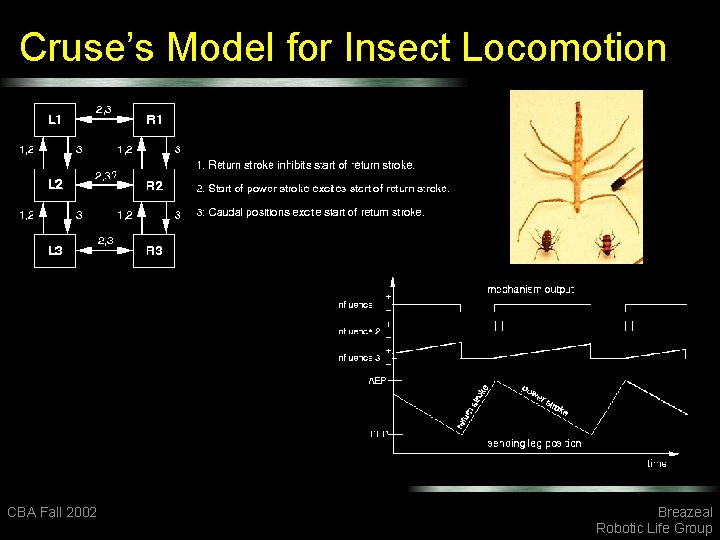
Cruse’s Model for Insect Locomotion CBA Fall 2002 Breazeal Robotic Life Group

Robust, Flexible Control n Smooth transitions for a family of wave gait n n Energy consumption Speed Stability Extended to rough terrain CBA Fall 2002 n Robust & adaptive arm coordination n n Coupled neural oscillators Exploit physical coupling Extends to multiple tasks Matt Williamson, MIT AI Lab Breazeal Robotic Life Group
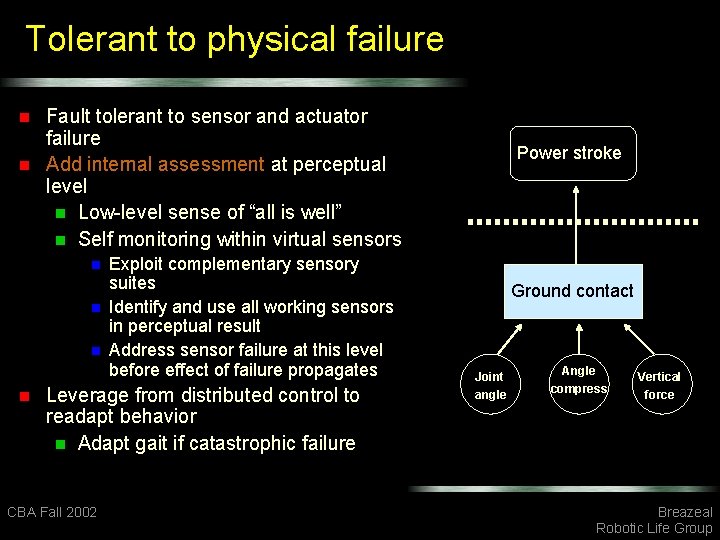
Tolerant to physical failure n n Fault tolerant to sensor and actuator failure Add internal assessment at perceptual level n Low-level sense of “all is well” n Self monitoring within virtual sensors n n Exploit complementary sensory suites Identify and use all working sensors in perceptual result Address sensor failure at this level before effect of failure propagates Leverage from distributed control to readapt behavior n Adapt gait if catastrophic failure CBA Fall 2002 Power stroke Ground contact Joint angle Angle compress Vertical force Breazeal Robotic Life Group
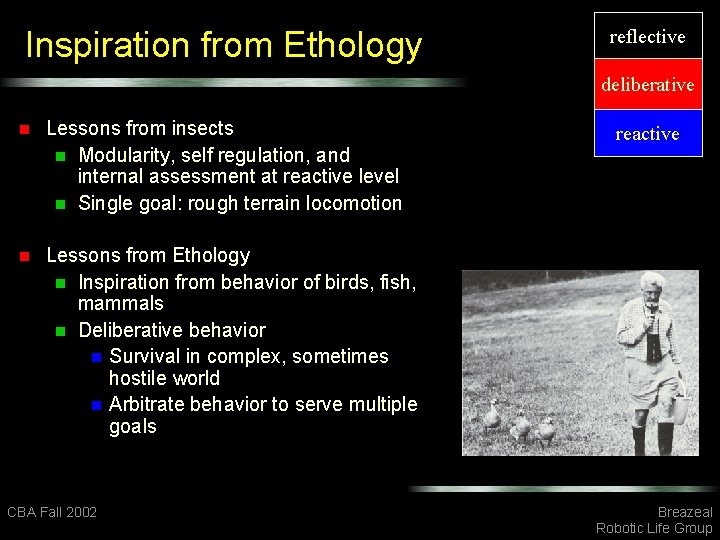
Inspiration from Ethology reflective deliberative n Lessons from insects n Modularity, self regulation, and internal assessment at reactive level n Single goal: rough terrain locomotion n Lessons from Ethology n Inspiration from behavior of birds, fish, mammals n Deliberative behavior n Survival in complex, sometimes hostile world n Arbitrate behavior to serve multiple goals CBA Fall 2002 reactive Breazeal Robotic Life Group
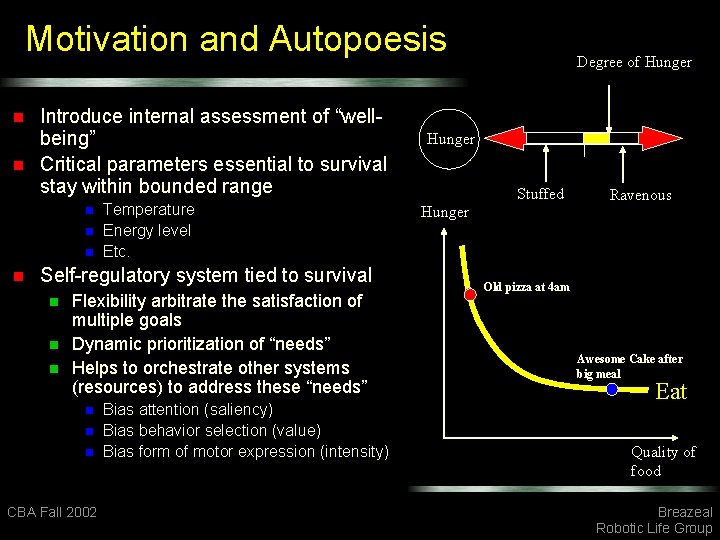
Motivation and Autopoesis n n Introduce internal assessment of “wellbeing” Critical parameters essential to survival stay within bounded range n n Temperature Energy level Etc. Self-regulatory system tied to survival n n n Flexibility arbitrate the satisfaction of multiple goals Dynamic prioritization of “needs” Helps to orchestrate other systems (resources) to address these “needs” n n n CBA Fall 2002 Bias attention (saliency) Bias behavior selection (value) Bias form of motor expression (intensity) Degree of Hunger Stuffed Hunger Ravenous Old pizza at 4 am Awesome Cake after big meal Eat Quality of food Breazeal Robotic Life Group
Affect & decision making n Promotes better decision making and learning n n Emotion theorists – people make poor decisions concerning their welfare without emotions Marvin Minsky’s The Emotion Machine Roz Picard’s Affective Computation Two complementary systems for systems that must perform tasks in dynamic, unpredictable, and sometimes hostile world. n n Cognition interprets and makes sense of the world Affect evaluates and judges n n n Modulates operating parameters of cognition n Negative leads to “depth first” (tunnel vision, increased vigilance) n Positive leads to “breadth first” (creativity, increased curiosity) Provides warning of possible dangers Deeply intertwined! Handle the unexpected problems Affect introduces another kind of assessment system n n A value system with respect to the creature Assess whether something is n n n Good or bad for me? Hospitable or harmful to me? Desirable or undesirable for me, etc? Sets expectations as to whether something is potentially problematic to guide CBA Fall 2002 behavior n Breazeal Robotic Life Group
Emotion & decision making n Emotion introduces another kind of self-regulation system n Serves of orchestrate other systems to alter goals and their priority n n n Basic emotions honed for survival n n n Attention, Memory, Arousal, Behavior & decision making, Learning, etc. When to explore When to persevere or give up When to escape from a dangerous situation When to confront, etc. But, provides another motivation system not strictly tied to survival n n n Social The more social the species, the more intelligent, emotional, and expressive Humans being the most CBA Fall 2002 Breazeal Robotic Life Group
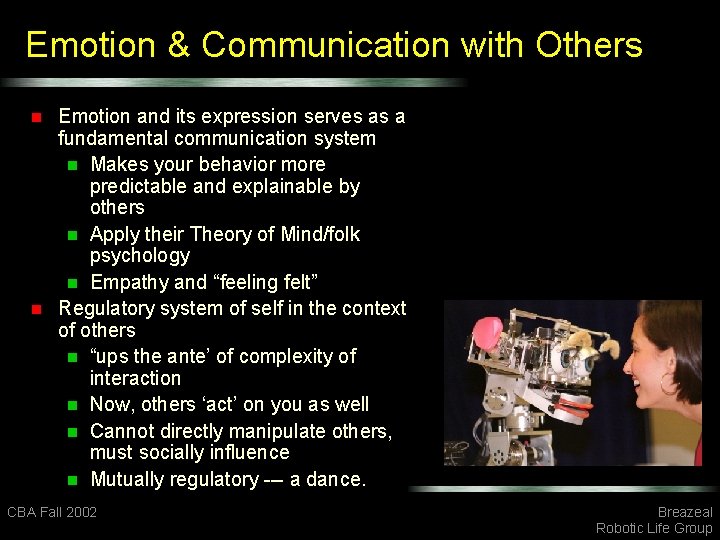
Emotion & Communication with Others n n Emotion and its expression serves as a fundamental communication system n Makes your behavior more predictable and explainable by others n Apply their Theory of Mind/folk psychology n Empathy and “feeling felt” Regulatory system of self in the context of others n “ups the ante’ of complexity of interaction n Now, others ‘act’ on you as well n Cannot directly manipulate others, must socially influence n Mutually regulatory --- a dance. CBA Fall 2002 Breazeal Robotic Life Group
Communicative Affective Intent Communication through shared affective state CBA Fall 2002 Breazeal Robotic Life Group
Issues in Learning Something New n Issues for learning systems n n n n Knowing what matters Knowing what action to try Evaluating actions Correcting errors Recognize success Structuring learning For robots, these are addressed in design of learning architecture, algorithm for known task But what if want to learn something that the system has not been designed to learn? CBA Fall 2002 Breazeal Robotic Life Group
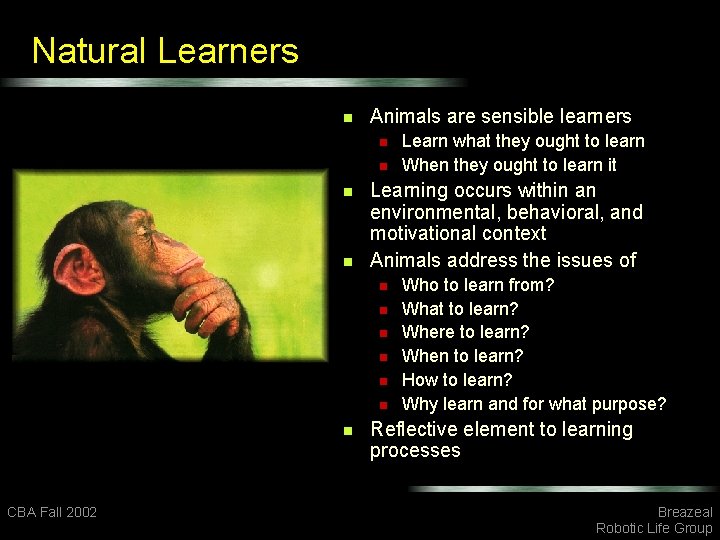
Natural Learners n Animals are sensible learners n n Learning occurs within an environmental, behavioral, and motivational context Animals address the issues of n n n n CBA Fall 2002 Learn what they ought to learn When they ought to learn it Who to learn from? What to learn? Where to learn? When to learn? How to learn? Why learn and for what purpose? Reflective element to learning processes Breazeal Robotic Life Group
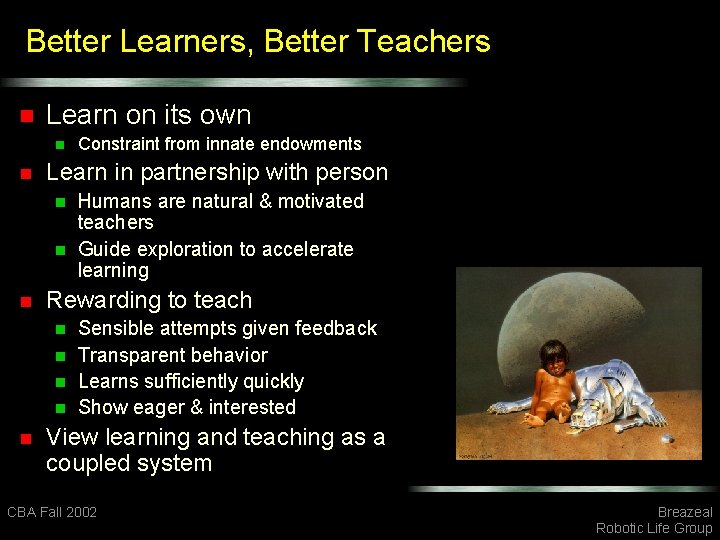
Better Learners, Better Teachers n Learn on its own n n Learn in partnership with person n Humans are natural & motivated teachers Guide exploration to accelerate learning Rewarding to teach n n n Constraint from innate endowments Sensible attempts given feedback Transparent behavior Learns sufficiently quickly Show eager & interested View learning and teaching as a coupled system CBA Fall 2002 Breazeal Robotic Life Group
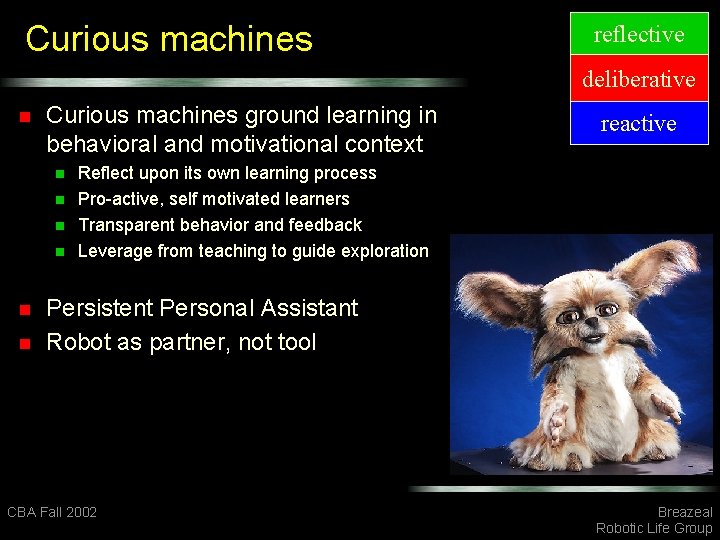
Curious machines reflective deliberative n Curious machines ground learning in behavioral and motivational context n n n reactive Reflect upon its own learning process Pro-active, self motivated learners Transparent behavior and feedback Leverage from teaching to guide exploration Persistent Personal Assistant Robot as partner, not tool CBA Fall 2002 Breazeal Robotic Life Group
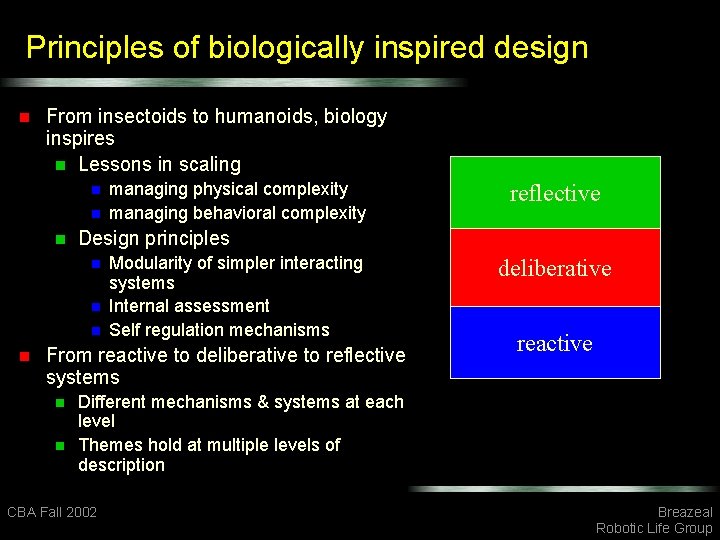
Principles of biologically inspired design n From insectoids to humanoids, biology inspires n Lessons in scaling n n n Modularity of simpler interacting systems Internal assessment Self regulation mechanisms From reactive to deliberative to reflective systems n n reflective Design principles n n managing physical complexity managing behavioral complexity deliberative reactive Different mechanisms & systems at each level Themes hold at multiple levels of description CBA Fall 2002 Breazeal Robotic Life Group
- Slides: 18