
Biological Synthesis of Nanoparticles from Plants PHYSICAL AND
Biological Synthesis of Nanoparticles from Plants
� PHYSICAL AND CHEMICAL METHODS Various physical and chemical processes have been exploited in the synthesis of several organic metal nanoparticles. -The high energy requirement in physical methods of nanoparticle synthesis. -and the waste disposal problems in chemical synthesis, -so both methods are costly. -and generate toxic by product are major demerits of the conventional nanoparticle synthesis. by Dr. Neihaya Heikmat
Biosynthesis of nanoparticles �Accordingly, there is a necessary need to extend for environmentally benign procedures for synthesis of nanoparticles. �A promising move towards to reach this objective is to develop the array of biological resources in nature. by Dr. Neihaya Heikmat
�Such drawbacks demand the development of clean, �biocompatible, �nonhazardous, �inexpensive, �energy-efficient, �and eco-friendly methods for nanoparticles synthesis.
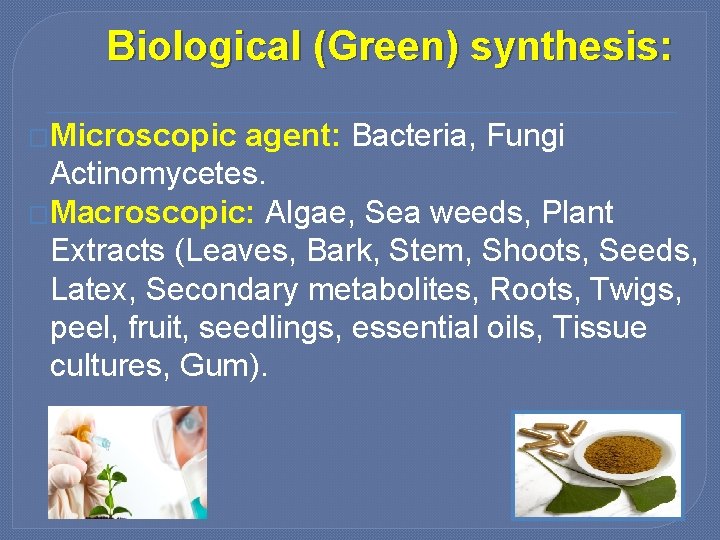
Biological (Green) synthesis: �Microscopic agent: Bacteria, Fungi Actinomycetes. �Macroscopic: Algae, Sea weeds, Plant Extracts (Leaves, Bark, Stem, Shoots, Seeds, Latex, Secondary metabolites, Roots, Twigs, peel, fruit, seedlings, essential oils, Tissue cultures, Gum).
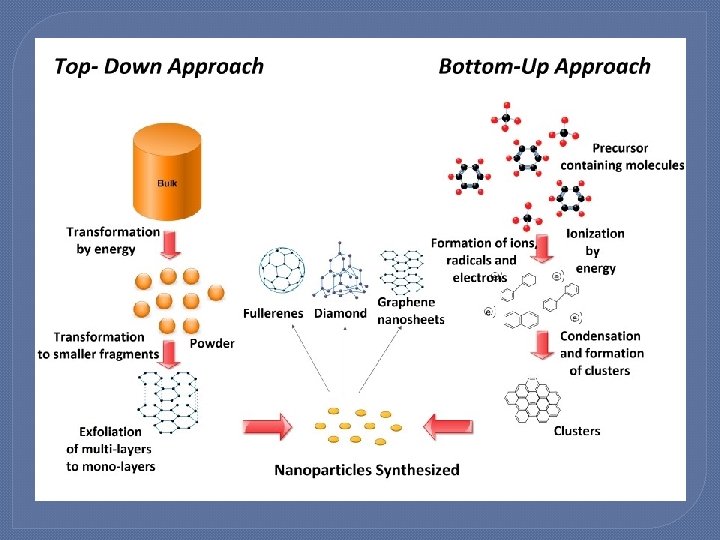
Nanomaterials fabrication �methods can be classified according to whether their assembly followed either: �i) Bottom-up approach, where smaller components of atomic or molecular dimensions self-assemble together, according to a natural physical principle or an externally applied driving force, to give rise to larger and more organized systems;
Self-assembly �Self-assembly is the ‘fabrication tool’ of nature: all natural materials, organic and inorganic, are produced through a selfassembly route to create complex structures with nanoscale precision. �Examples are the formation of the DNA double helix or the formation of the membrane cell from phospholipids.
�In self-assembly, sub-units spontaneously organize and aggregate into stable, well-defined structures through non-covalent interaction.

� ii) the top-down approach, a process that starts from a large piece and subsequently uses finer and finer tools for creating correspondingly smaller structures.
phytonanotechnology �phytonanotechnology has provided new avenues for the synthesis of nanoparticles and is an: �ecofriendly, �simple, �rapid, �stable, �and cost-effective method.
�Phytonanotechnology has advantages, including: �biocompatibility, �Scalability, and � the medical applicability of synthesizing nanoparticles using the universal solvent, water, as a reducing medium.
Mechanism of Biosynthesis �The exact mechanism and the components responsible for plant-mediated synthetic nanoparticles remain to be elucidated. �It has been proposed that proteins, amino acids, organic acid, vitamins, as well as secondary metabolites, such as:
�flavonoids, alkaloids, polyphenols, terpenoids, heterocyclic compounds, and polysaccharides, �have significant roles in metal salt reduction and, furthermore, �act as capping and stabilizing agents for synthesized nanoparticles.
�Reports also suggest that different mechanisms for synthesizing nanoparticles exist in different plant species.
Plant extracts �The reduction method using plant extracts is �one step, low cost and eco-friendly, hence considered as the most preferred way for the synthesis of metal nanoparticles. �Thus, this method may be included in the class of green technology.
�various plant parts, including leaves, fruits, stems, roots, and their extracts, have been used for the synthesis of metal nanoparticles.
�Among various nanometals explored so far, nanoparticles of silver, gold, copper, zinc, palladium, titanium, nickel, indium etc. have been prepared by using a wide variety of plant extracts.
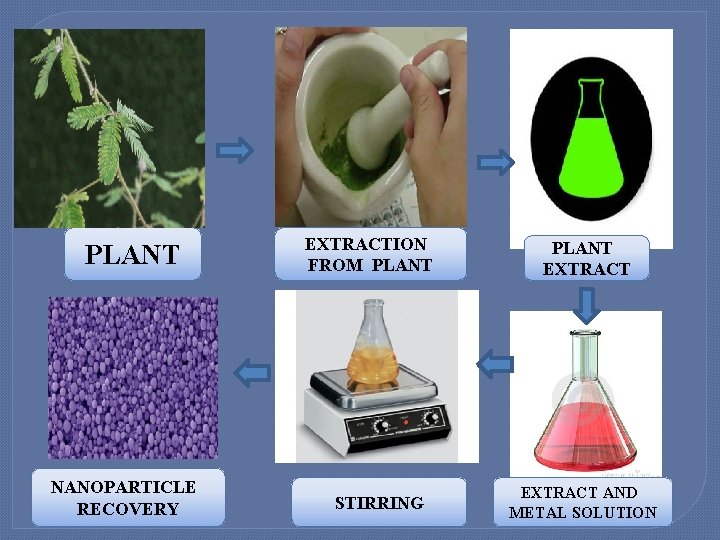
PLANT NANOPARTICLE RECOVERY EXTRACTION FROM PLANT STIRRING PLANT EXTRACT AND METAL SOLUTION
Leaf extracts � The leaves of plants like Mentha, Ocimum, and Eucalyptus were reported for the synthesis of gold nanoparticles. � Ocimum leaf provided finer particles compared with other plant leaves used. � The polymorphic gold nanoparticles synthesis was reported from Citrus limon � � The gold nanoparticles were polymorphic, stable, size 30– 130 nm in non agglomerated form. �
Seed extracts �The synthesis of silver nanoparticles through seeds of the plant Elaeocarpus granitrus was reported. �The nanoparticles were involved for development of bionanocomposite with chitosan matrix and antimicrobial assay was done.
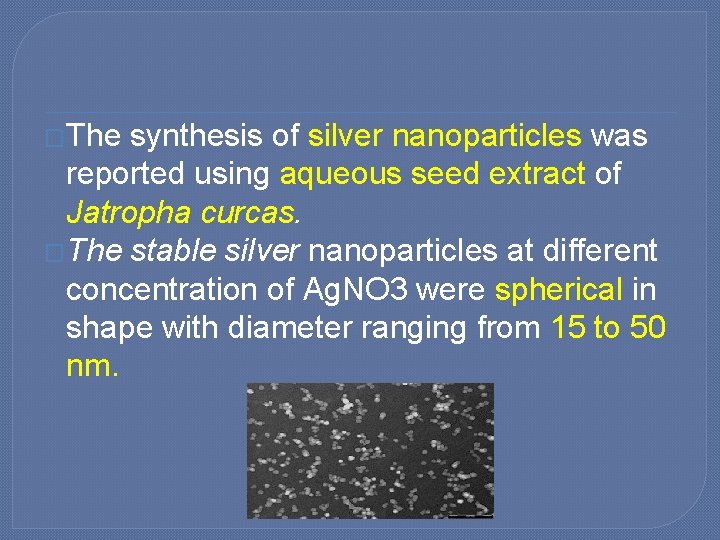
�The synthesis of silver nanoparticles was reported using aqueous seed extract of Jatropha curcas. �The stable silver nanoparticles at different concentration of Ag. NO 3 were spherical in shape with diameter ranging from 15 to 50 nm.
Essential oils �The synthesis of gold nanoparticles with essential oils extracted from the fresh leaves of Anacardium occidentale was reported. �The NPs synthesized at room temperature were hexagonal in shape while at higher temperature were mixture of an isotropic particles.
peel extract � The biosynthesis of silver nanoparticles (Ag. NPs) from Citrus sinensis peel extract was reported. � The synthesized Ag. NPs were effective antibacterial agent. � The aqueous extracts from the peels of Citrus fruits (orange, grapefruit, tangelo, lemon and lime) were used for the synthesis of Ag. NPs using microwave technology; the synthesis was successful for the orange peel extract.
Secondary metabolites � The plant broth of Phyllanthus amarus containing secondary metabolites was used for the formation of silver nanoparticles (Ag. NPs). � The coconut water was used for synthesis of gold nanoparticles through microwave irradiation. � The nanoparticles were tested for cytotoxicity on two human cancer cell lines, and found to be nontoxic.
Stem extracts �The stem extract of Breynia rhamnoides was used for synthesis of gold and silver nanoparticles was reported. �The nanoparticles showed antibacterial property against multi-drug resistant bacteria such as Pseudomonas aeruginosa, Escherichia coli, and Staphylococcus aureus.
Fruit extracts �Tribulus terrestris fruit bodies were used for synthesis of silver nanoparticles. �The nanoparticles were spherical shaped with 16 -28 nm of size.
Latex extracts �The latex of Jatropha curcas was used in silver nanoparticles synthesis. �The particles radius was 10– 20 nm and stabilized by the cyclic peptides. �The latex of Euphorbia milii was used in silver nanoparticles synthesis, and sizes were of 10– 50 nm.
Tissue culture extracts �The extracts from tissue culture-derived callus and leaf of the salt marsh plant (Sesuvium portulacastrum L. ) used in the synthesis of silver nanoparticles. �The callus extract was able to produce antimicrobial silver nanoparticles than leaf extract. �The silver nanoparticles synthesized were spherical in shape with size 5 to 20 nm.
- Slides: 29