
BIOLOGICAL SCIENCE Freeman Quillin Allison 12 The Cell
BIOLOGICAL SCIENCE Freeman Quillin Allison 12 The Cell Cycle Lecture Presentation by Cindy S. Malone, Ph. D, California State University Northridge © 2014 Pearson Education, Inc. FIFTH EDITION
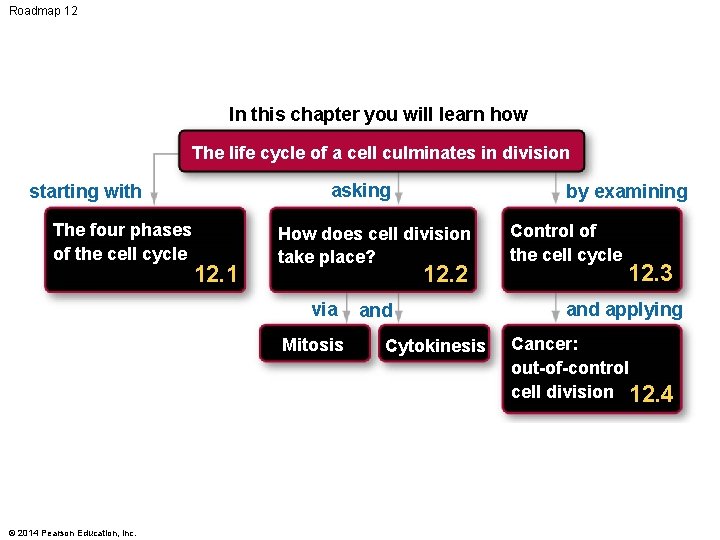
Roadmap 12 In this chapter you will learn how The life cycle of a cell culminates in division asking starting with The four phases of the cell cycle 12. 1 How does cell division take place? 12. 2 via Mitosis © 2014 Pearson Education, Inc. by examining and Cytokinesis Control of the cell cycle 12. 3 and applying Cancer: out-of-control cell division 12. 4
Introduction to Cell Division §Cells arise through the division of preexisting cells §There are two types of cell division: – meiosis and mitosis §Both forms of cell division are accompanied by cytokinesis – The cytoplasm of the cell divides into two distinct daughter cells © 2014 Pearson Education, Inc.
Contrasting Mitosis and Meiosis §Meiosis leads to – Production of gametes (eggs and sperm) – Daughter cells have half the amount of genetic material as the parent cell §Mitosis leads to – The production of all other cell types referred to as somatic cells – Genetic material is copied and then divided equally – Daughter cells are genetically identical to the parent cell © 2014 Pearson Education, Inc.
Functions of Mitosis §Mitosis and cytokinesis are responsible for three key events in multicellular eukaryotes: 1. Growth 2. Wound repair 3. Asexual reproduction © 2014 Pearson Education, Inc.
What Is a Chromosome? §DNA encodes the cell’s genetic information §A gene is a section of DNA that encodes a specific RNA and therefore a specific protein §Chromosomes – Contain a single long double helix of deoxyribonucleic acid (DNA) – Are wrapped around proteins §Chromosomes can be – Stained with dyes – Observed under the light microscope © 2014 Pearson Education, Inc.
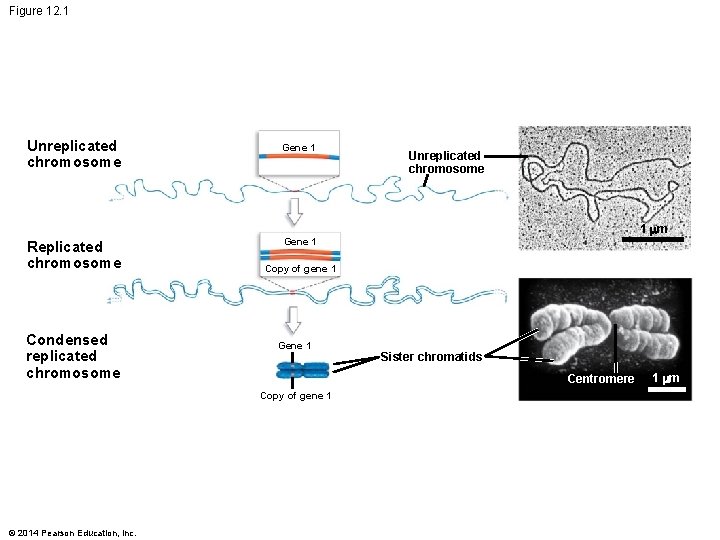
Figure 12. 1 Unreplicated chromosome Gene 1 Replicated chromosome Gene 1 Condensed replicated chromosome 1 m Copy of gene 1 Gene 1 Sister chromatids Centromere Copy of gene 1 © 2014 Pearson Education, Inc. Unreplicated chromosome 1 m
Chromosomes Change before and during Mitosis §The purpose of mitosis is to distribute chromosomes to daughter cells during cell division §Each chromosome is replicated before mitosis §Chromosomes condense from long, thin filaments into compact structures that can be moved around the cell §At the end of mitosis, one of the chromosome copies is distributed to each of two daughter cells © 2014 Pearson Education, Inc.
Chromosome Replication §Before mitosis, each chromosome is replicated §Each of the DNA copies in a replicated chromosome is called a chromatid §Chromatids – Are joined together along their entire length – As well as at a specialized region of the chromosome called the centromere © 2014 Pearson Education, Inc.
Chromosome Replication §Chromatids from the same chromosome are referred to as sister chromatids §A replicated chromosome consists of two chromatids – It is still considered a single chromosome © 2014 Pearson Education, Inc.
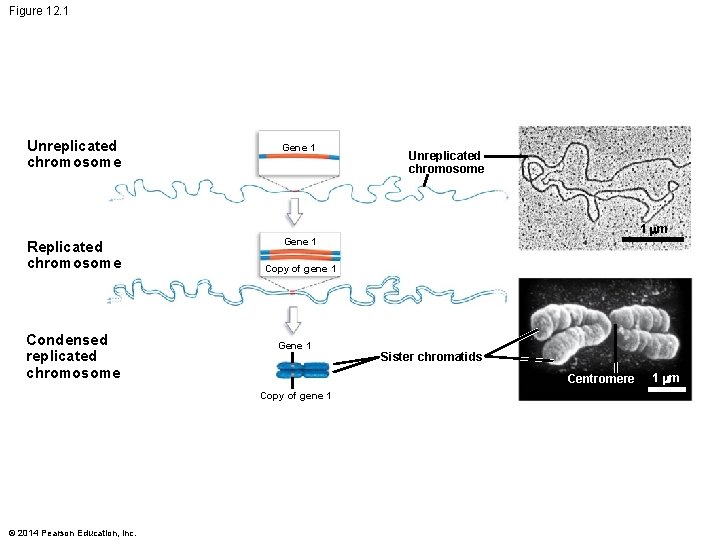
Figure 12. 1 Unreplicated chromosome Gene 1 Replicated chromosome Gene 1 Condensed replicated chromosome 1 m Copy of gene 1 Gene 1 Sister chromatids Centromere Copy of gene 1 © 2014 Pearson Education, Inc. Unreplicated chromosome 1 m
M Phase and Interphase §Growing cells cycle between two phases: 1. A dividing phase called the mitotic (M) phase 2. A nondividing phase called interphase © 2014 Pearson Education, Inc.
Interphase: S Phase §The cell cycle is – The orderly sequence of events – That occurs from the formation of a eukaryotic cell – Through the duplication of its chromosomes – To the time it undergoes cell division §A visualization technique called autoradiography – Allowed researchers to identify the part of the cell cycle – During which DNA replication occurs © 2014 Pearson Education, Inc.
Interphase: S Phase §Chromosome replication occurs only during interphase – It does not occur during M phase §The stage in which DNA replication occurs is called the synthesis (S) phase © 2014 Pearson Education, Inc.
Interphase: Gap Phases §Interphase also includes two gap phases, during which no DNA synthesis occurs §G 1 phase – Is the first gap – Occurs before the S phase §G 2 phase – Is the second gap – Occurs between S phase and mitosis © 2014 Pearson Education, Inc.
Interphase: Gap Phases §During the gap phases – Organelles replicate – Additional cytoplasm is made in preparation for cell division §It takes a cell about 24 hours to complete one cell cycle – G 1 phase lasts 7– 9 hours – S phase lasts 6– 8 hours – G 2 phase lasts 4– 5 hours © 2014 Pearson Education, Inc.
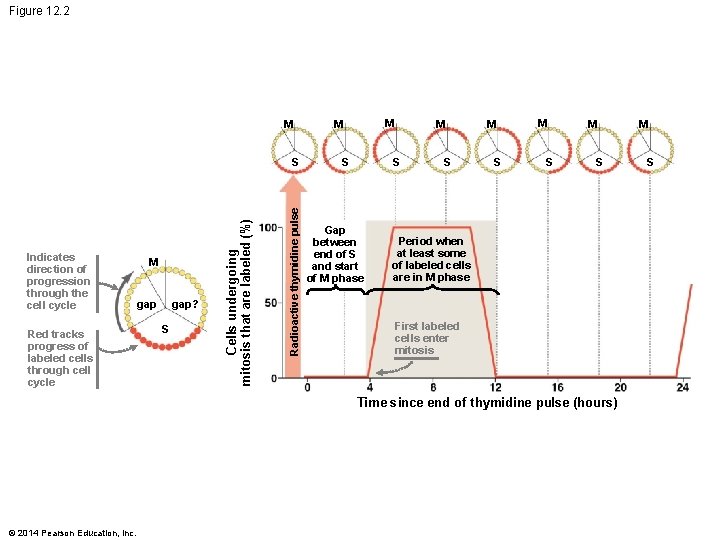
Figure 12. 2 M Red tracks progress of labeled cells through cell cycle M gap? S Radioactive thymidine pulse Indicates direction of progression through the cell cycle Cells undergoing mitosis that are labeled (%) S M M S Gap between end of S and start of M phase S M S M S Period when at least some of labeled cells are in M phase First labeled cells enter mitosis Time since end of thymidine pulse (hours) © 2014 Pearson Education, Inc. M S
The Cell Cycle §There a total of four phases in the cell cycle: – M phase – An interphase consisting of the G 1, S, and G 2 phases §Gap phases allow the cell to – Grow large enough – Synthesize enough organelles to ensure the daughter cells – Be normal in size and function © 2014 Pearson Education, Inc.
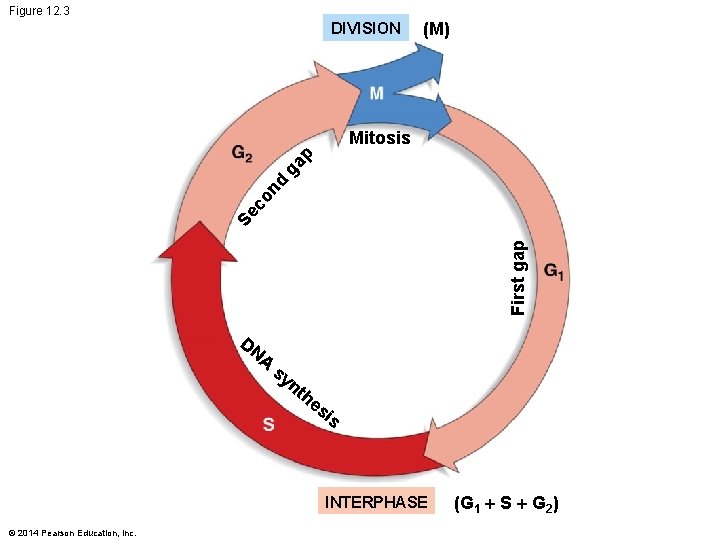
Figure 12. 3 DIVISION (M) First gap Se co nd ga p Mitosis DN A sy nt he si s INTERPHASE © 2014 Pearson Education, Inc. (G 1 S G 2)
The Four Phases of the Cell Cycle Web Activity: The Four Phases of the Cell Cycle © 2014 Pearson Education, Inc.
Mitosis Overview §Mitosis results in – The division of replicated chromosomes – Formation of two daughter nuclei – With identical chromosomes and genes §Mitosis is usually accompanied by cytokinesis §Every species – Has a characteristic number of chromosomes – Humans have 46 chromosomes © 2014 Pearson Education, Inc.
Chromosomes Change during the Cell Cycle §Eukaryotic chromosomes consist of DNA associated with histone proteins §In eukaryotes, this DNA-protein material – Is called chromatin – Is “relaxed” or uncondensed – Forms long, threadlike strands © 2014 Pearson Education, Inc.
Chromosomes Change during the Cell Cycle §After replication during S phase, each chromosome consists of – Two genetically identical sister chromatids – Attached at the centromere §At the start of mitosis, the replicated chromosomes condense © 2014 Pearson Education, Inc.
Events in Mitosis §During mitosis: – The two sister chromatids separate to form independent chromosomes – One copy of each chromosome goes to each of the two daughter cells – Each daughter cell receives a copy of the genetic information that is contained in each chromosome © 2014 Pearson Education, Inc.
Events in Mitosis §Mitosis (M phase) is a continuous process with five subphases based on specific events 1. Prophase 2. Prometaphase 3. Metaphase 4. Anaphase 5. Telophase © 2014 Pearson Education, Inc.
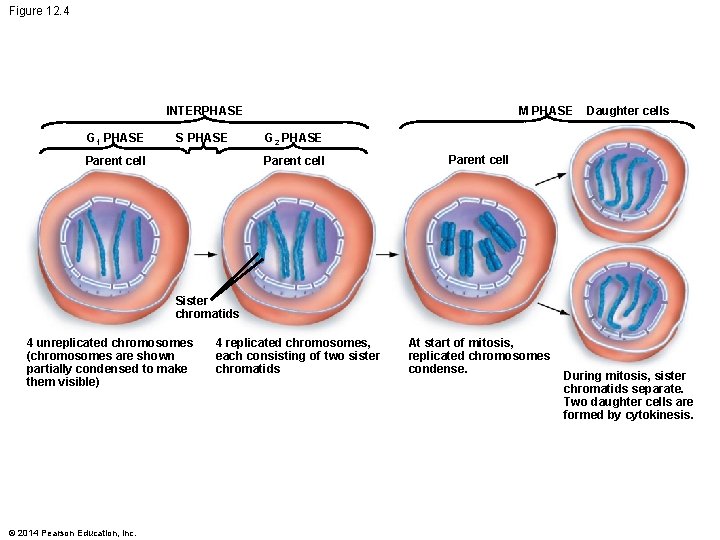
Figure 12. 4 M PHASE INTERPHASE G 1 PHASE S PHASE Parent cell Daughter cells G 2 PHASE Parent cell Sister chromatids 4 unreplicated chromosomes (chromosomes are shown partially condensed to make them visible) © 2014 Pearson Education, Inc. 4 replicated chromosomes, each consisting of two sister chromatids At start of mitosis, replicated chromosomes condense. During mitosis, sister chromatids separate. Two daughter cells are formed by cytokinesis.
Mitosis Cell Biology Video: Mitosis © 2014 Pearson Education, Inc.
Prophase §During prophase – Chromosomes condense – First become visible in the light microscope §The mitotic spindle – Is made up of microtubules called spindle fibers – Forms from a microtubule-organizing center – Polar microtubules push the poles of the cell away from each other during mitosis – Kinetochore microtubules pull chromosomes to the poles of the cell during mitosis © 2014 Pearson Education, Inc.
Prophase §The microtubule-organizing center is a centrosome – Contains a pair of centrioles © 2014 Pearson Education, Inc.
Prometaphase §During prometaphase – The nuclear envelope breaks down – The nucleolus disappears §Kinetochore microtubules from each mitotic spindle attach to one of the sister chromatids of each chromosome §Attachment occurs in the centromere region at the kinetochore © 2014 Pearson Education, Inc.
Metaphase §During metaphase – Formation of the mitotic spindle is completed §Motor proteins on the kinetochore microtubules – Pull each chromosome in opposite directions – Causing the chromosomes to line up in the middle of the cell §The imaginary plane formed by metaphase is called the metaphase plate © 2014 Pearson Education, Inc.
Anaphase §During anaphase – Centromeres split – Sister chromatids are pulled by the spindle fibers toward opposite poles of the cell §Replicated chromosomes split – Into two identical sets of unreplicated chromosomes §As soon as they are no longer attached at the centromere – Sister chromatids become daughter chromosomes §Motor proteins of the polar microtubules – Push the two poles of the cell away from each other © 2014 Pearson Education, Inc.
Telophase §During telophase §A new nuclear envelope begins to form around each set of chromosomes §The mitotic spindle disintegrates §The chromosomes begin to decondense §Mitosis is complete – When two independent nuclei have formed © 2014 Pearson Education, Inc.
Cytokinesis §Cytokinesis typically occurs immediately after mitosis §During this process – The cytoplasm divides to form two daughter cells – Each daughter cell has its own nucleus and complete set of organelles © 2014 Pearson Education, Inc.
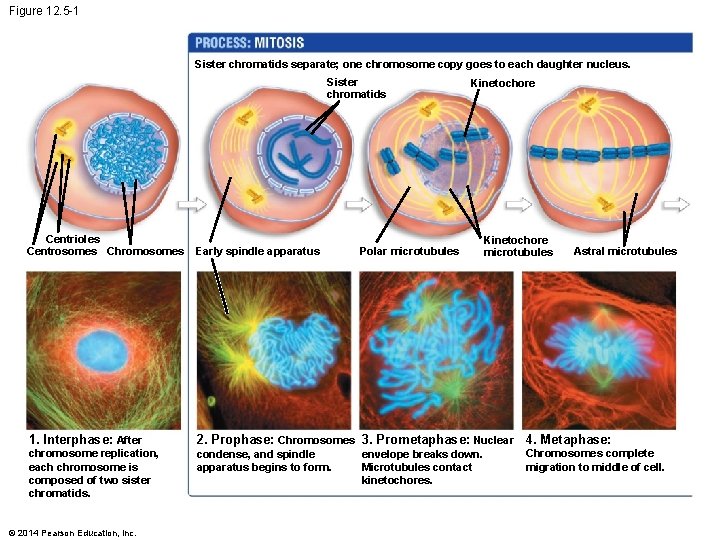
Figure 12. 5 -1 Sister chromatids separate; one chromosome copy goes to each daughter nucleus. Sister chromatids Kinetochore Centrioles Centrosomes Chromosomes Early spindle apparatus 1. Interphase: After 2. Prophase: Chromosomes 3. Prometaphase: Nuclear 4. Metaphase: chromosome replication, each chromosome is composed of two sister chromatids. condense, and spindle apparatus begins to form. © 2014 Pearson Education, Inc. Polar microtubules envelope breaks down. Microtubules contact kinetochores. Kinetochore microtubules Astral microtubules Chromosomes complete migration to middle of cell.
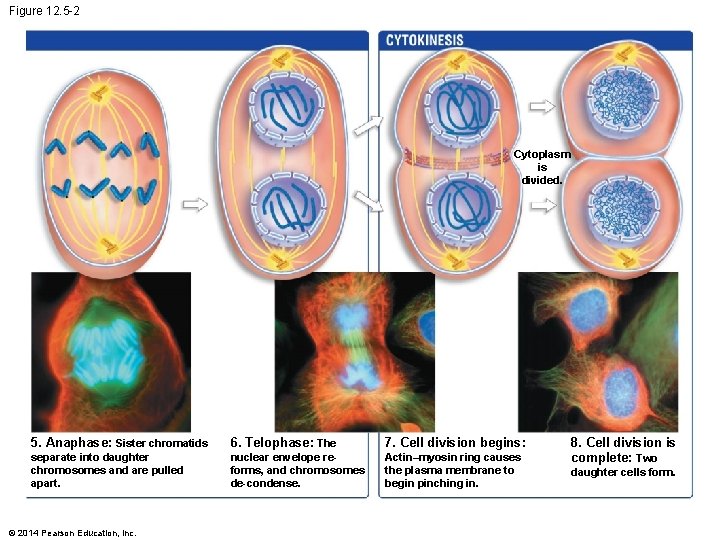
Figure 12. 5 -2 Cytoplasm is divided. 5. Anaphase: Sister chromatids 6. Telophase: The 7. Cell division begins: separate into daughter chromosomes and are pulled apart. nuclear envelope reforms, and chromosomes de-condense. Actin–myosin ring causes the plasma membrane to begin pinching in. © 2014 Pearson Education, Inc. 8. Cell division is complete: Two daughter cells form.
The Phases of Mitosis Web Activity: The Phases of Mitosis © 2014 Pearson Education, Inc.
How Do Chromosomes Move during Mitosis? §Kinetochore microtubules – Remain stationary during anaphase – Shorten because tubulin subunits of the microtubules are lost from their plus ends at the kinetochore §Dyneins and other kinetochore motor proteins – Are attached to the kinetochore’s fibrous crown – “Walk” toward the minus end of the spindle fiber §As the microtubule shortens and the detach-movereattach cycle of the motor proteins repeats – The chromosome is pulled to one end of the mitotic spindle © 2014 Pearson Education, Inc.
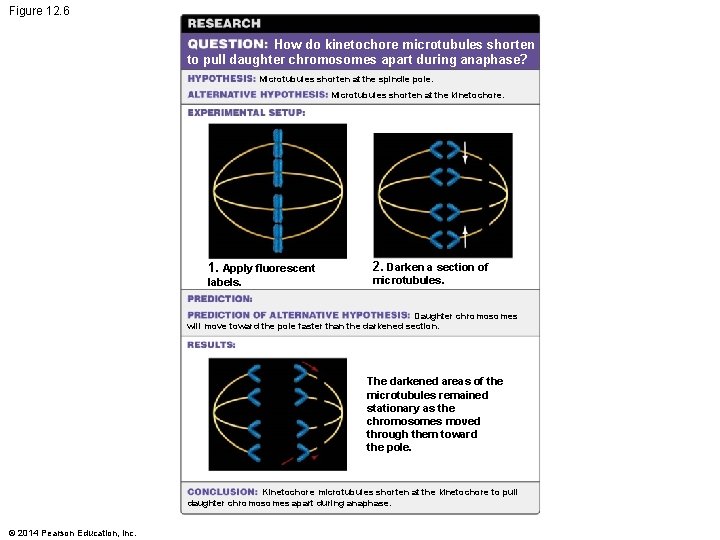
Figure 12. 6 How do kinetochore microtubules shorten to pull daughter chromosomes apart during anaphase? Microtubules shorten at the spindle pole. Microtubules shorten at the kinetochore. 1. Apply fluorescent labels. 2. Darken a section of microtubules. Daughter chromosomes will move toward the pole faster than the darkened section. The darkened areas of the microtubules remained stationary as the chromosomes moved through them toward the pole. Kinetochore microtubules shorten at the kinetochore to pull daughter chromosomes apart during anaphase. © 2014 Pearson Education, Inc.
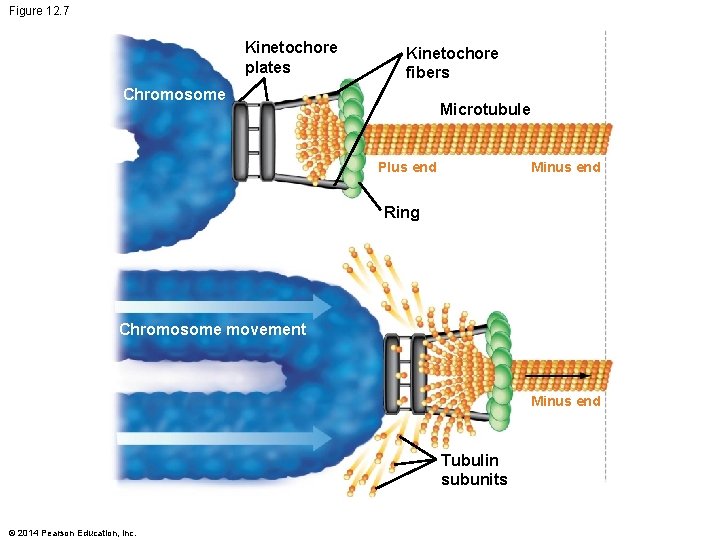
Figure 12. 7 Kinetochore plates Kinetochore fibers Chromosome Microtubule Plus end Minus end Ring Chromosome movement Minus end Tubulin subunits © 2014 Pearson Education, Inc.
Different Cell Types Undergo Cytokinesis Differently §Cytokinesis in plants occurs – As vesicles are transported from the Golgi apparatus to the middle of the dividing cell – These vesicles fuse to form a cell plate §Cytokinesis in animals, fungi, and slime molds occurs – When a ring of actin and myosin filaments contracts inside the cell membrane – Causing it to pinch inward in a cleavage furrow © 2014 Pearson Education, Inc.
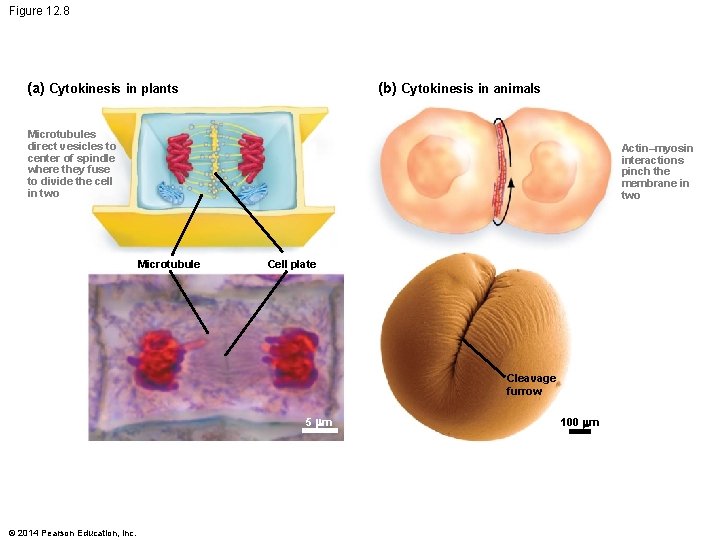
Figure 12. 8 (a) Cytokinesis in plants (b) Cytokinesis in animals Microtubules direct vesicles to center of spindle where they fuse to divide the cell in two Actin–myosin interactions pinch the membrane in two Microtubule Cell plate Cleavage furrow 5 m © 2014 Pearson Education, Inc. 100 m
Plant Cytokinesis BLAST Animation: Plant Cytokinesis © 2014 Pearson Education, Inc.
Different Cell Types Undergo Cytokinesis Differently §Bacteria do not undergo cytokinesis – Instead, they divide via fission – This is a process similar to animal cytokinesis © 2014 Pearson Education, Inc.
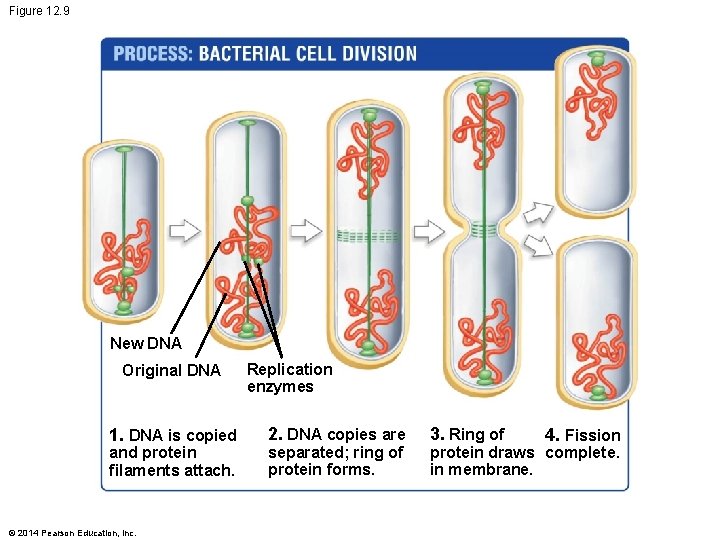
Figure 12. 9 New DNA Original DNA 1. DNA is copied and protein filaments attach. © 2014 Pearson Education, Inc. Replication enzymes 2. DNA copies are separated; ring of protein forms. 3. Ring of 4. Fission protein draws complete. in membrane.
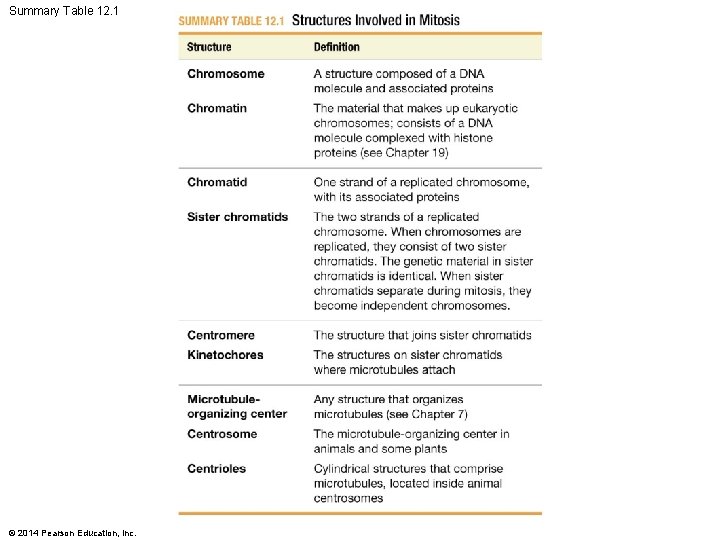
Summary Table 12. 1 © 2014 Pearson Education, Inc.
Control of the Cell Cycle §Cell-cycle length can vary greatly among cell types – Variation in the length of G 1 phase is responsible for differences §G 1 phase is essentially eliminated in rapidly dividing cells §Nondividing cells get permanently stuck in G 1 phase – This arrested stage is called the G 0 state © 2014 Pearson Education, Inc.
Control of the Cell Cycle §The rate of cell division can also respond to changes in environmental conditions §These variations in cell-cycle length suggest – The cell cycle is regulated – Regulation varies among cells and organisms © 2014 Pearson Education, Inc.

Mitosis-Promoting Factor Induces Mitosis §Mitosis-promoting factor (MPF) – Is present in the cytoplasm of M-phase cells – Induces mitosis in all eukaryotes §MPF is composed of two distinct subunits – A protein kinase and a cyclin §The protein kinase is – An enzyme that catalyzes the transfer of a phosphate group – From ATP to a target protein (phosphorylation) §The cyclin subunit functions as a regulatory protein © 2014 Pearson Education, Inc.
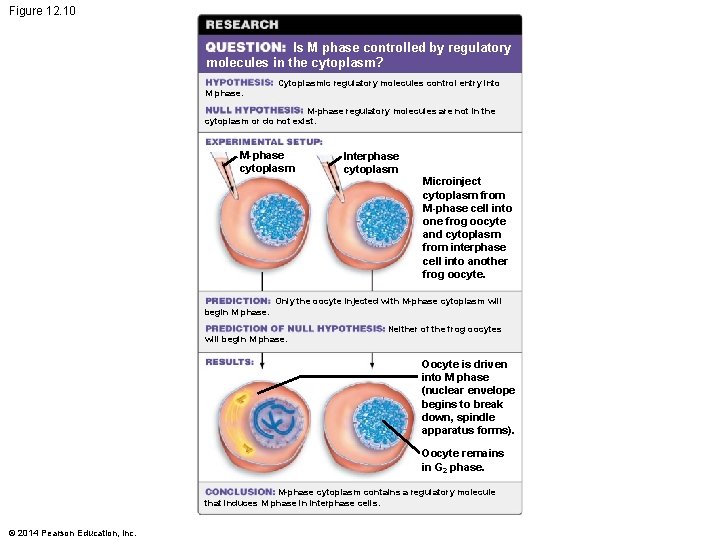
Figure 12. 10 Is M phase controlled by regulatory molecules in the cytoplasm? Cytoplasmic regulatory molecules control entry into M phase. M-phase regulatory molecules are not in the cytoplasm or do not exist. M-phase cytoplasm Interphase cytoplasm Microinject cytoplasm from M-phase cell into one frog oocyte and cytoplasm from interphase cell into another frog oocyte. Only the oocyte injected with M-phase cytoplasm will begin M phase. Neither of the frog oocytes will begin M phase. Oocyte is driven into M phase (nuclear envelope begins to break down, spindle apparatus forms). Oocyte remains in G 2 phase. M-phase cytoplasm contains a regulatory molecule that induces M phase in interphase cells. © 2014 Pearson Education, Inc.
Cyclin Concentration Regulates MPF Concentration §The concentration of MPF cyclin – Increases during interphase – Peaks in M phase before decreasing again §The MPF protein kinase is – A cyclin-dependent kinase (Cdk) – Active only when bound to the cyclin subunit §When cyclin concentrations are high – More MPF is active – The target proteins are phosphorylated, initiating mitosis © 2014 Pearson Education, Inc.
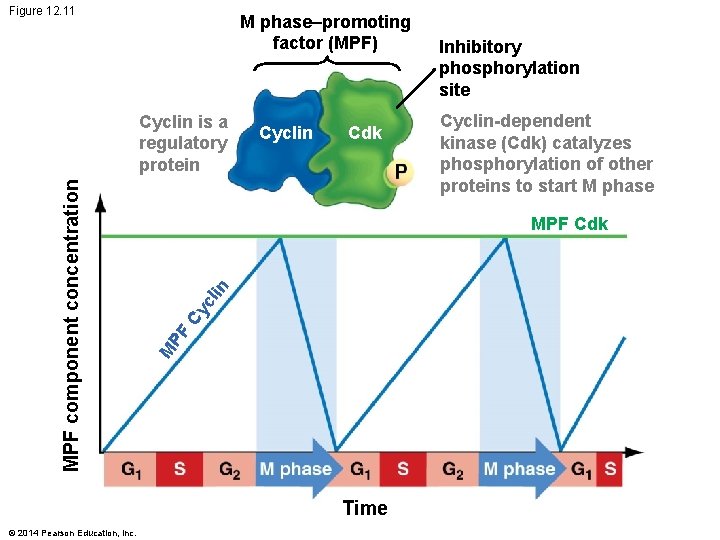
Figure 12. 11 M phase–promoting factor (MPF) Cyclin Cdk in Cy cl PF Time © 2014 Pearson Education, Inc. Cyclin-dependent kinase (Cdk) catalyzes phosphorylation of other proteins to start M phase MPF Cdk M MPF component concentration Cyclin is a regulatory protein Inhibitory phosphorylation site
MPF Activation §After it binds to cyclin – MPF’s Cdk subunit becomes phosphorylated at two sites – This event renders the Cdk subunit inactive §Late in G 2 phase – Enzymes cause one of the phosphate groups on the Cdk subunit to drop off © 2014 Pearson Education, Inc.
MPF Activation §This dephosphorylation reaction changes MPF’s shape by activating it §Once MPF is activated, it triggers a chain of events: – Culminates in the condensation of chromosomes – Forms the mitotic spindle apparatus © 2014 Pearson Education, Inc.
MPF Deactivation §During anaphase, an enzyme complex begins degrading MPF’s cyclin subunit §MPF triggers a chain of events that leads to its own destruction © 2014 Pearson Education, Inc.
Cell-Cycle Checkpoints §Many other protein complexes are involved in regulating the cell cycle §There are three distinct cell-cycle checkpoints: – During the four phases of the cell cycle §Interactions among regulatory molecules at each checkpoint allow – A cell to “decide” whether to proceed with division §If these regulatory molecules are defective: – The checkpoint may fail – Cells may start dividing in an uncontrolled fashion © 2014 Pearson Education, Inc.
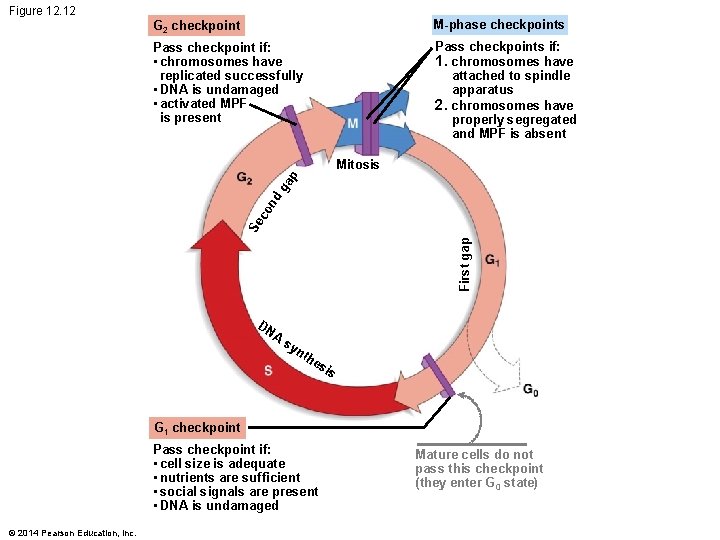
Figure 12. 12 G 2 checkpoint M-phase checkpoints Pass checkpoint if: • chromosomes have replicated successfully • DNA is undamaged • activated MPF is present Pass checkpoints if: 1. chromosomes have attached to spindle apparatus 2. chromosomes have properly segregated and MPF is absent First gap Se co n d ga p Mitosis DN A sy n th es is G 1 checkpoint Pass checkpoint if: • cell size is adequate • nutrients are sufficient • social signals are present • DNA is undamaged © 2014 Pearson Education, Inc. Mature cells do not pass this checkpoint (they enter G 0 state)
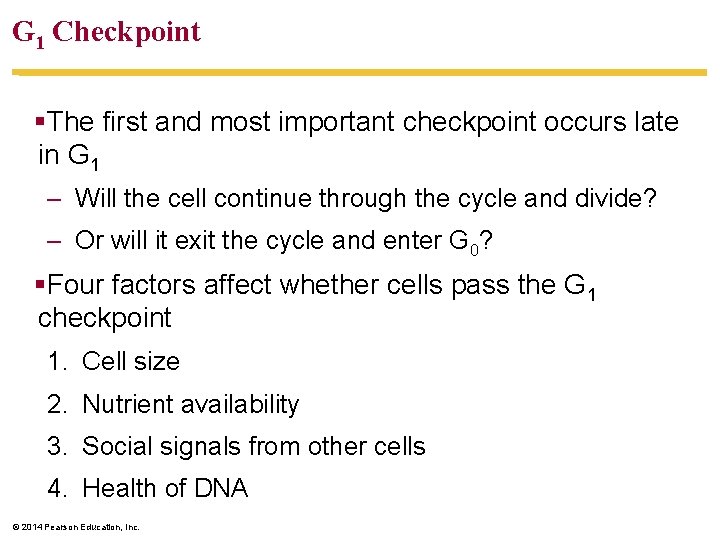
G 1 Checkpoint §The first and most important checkpoint occurs late in G 1 – Will the cell continue through the cycle and divide? – Or will it exit the cycle and enter G 0? §Four factors affect whether cells pass the G 1 checkpoint 1. Cell size 2. Nutrient availability 3. Social signals from other cells 4. Health of DNA © 2014 Pearson Education, Inc.
Will a Given Cell Pass the G 1 Checkpoint? §Cells must be large enough to split into two functional daughter cells §Food must be sufficient for cell growth §Cells in multicellular organisms pass (or do not pass) through the G 1 checkpoint: – In response to signaling molecules from other cells © 2014 Pearson Education, Inc.
Will a Given Cell Pass the G 1 Checkpoint? §If the DNA is physically damaged, the p 53 protein – Either pauses the cell cycle – Or initiates apoptosis programmed cell death §p 53 is an example of a tumor suppressor – Damage to the p 53 gene can lead to uncontrolled cell division © 2014 Pearson Education, Inc.
G 2 Checkpoint §The second checkpoint is between the G 2 and M phases §Cells stop growing here – If chromosome replication has not proceeded properly – Or if DNA is damaged © 2014 Pearson Education, Inc.
Metaphase Checkpoint §The third and final checkpoint is during M phase §Cell growth ceases during metaphase – If the chromosomes are not properly attached to the mitotic spindle §This mechanism – Prevents incorrect chromosome separation – Could give daughter cells the wrong number of chromosomes © 2014 Pearson Education, Inc.
Metaphase Checkpoint §The three cell-cycle checkpoints prevent the division of cells that are damaged – The growth of mature cells that should stay in the G 0 state © 2014 Pearson Education, Inc.
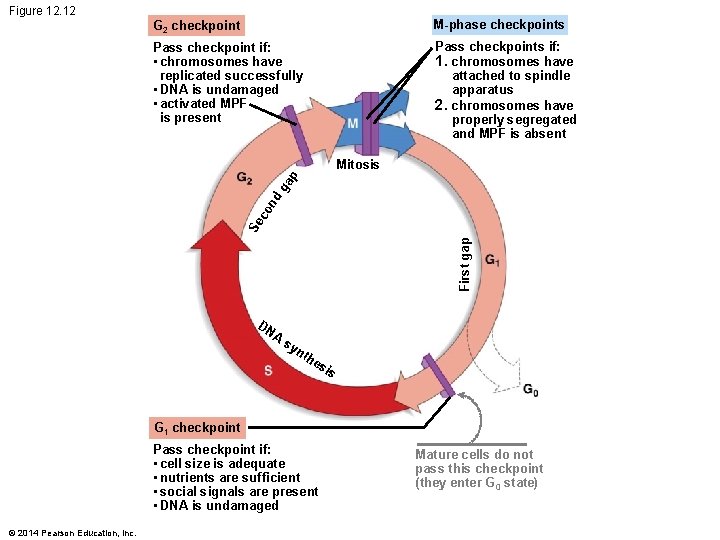
Figure 12. 12 G 2 checkpoint M-phase checkpoints Pass checkpoint if: • chromosomes have replicated successfully • DNA is undamaged • activated MPF is present Pass checkpoints if: 1. chromosomes have attached to spindle apparatus 2. chromosomes have properly segregated and MPF is absent First gap Se co n d ga p Mitosis DN A sy n th es is G 1 checkpoint Pass checkpoint if: • cell size is adequate • nutrients are sufficient • social signals are present • DNA is undamaged © 2014 Pearson Education, Inc. Mature cells do not pass this checkpoint (they enter G 0 state)
Cancer: Out-of-Control Cell Division §Cancer – Is a common, sometimes lethal disease – Affects many humans – Is a complex family of diseases caused by cells that: – Grow in an uncontrolled fashion – Invade nearby tissues – Spread to other sites in the body © 2014 Pearson Education, Inc.
Cancer: Out-of-Control Cell Division §Cancers vary widely in: – Time of onset – Growth rate – Seriousness – Cause §Despite their differences, all cancers arise from cells in which cell-cycle checkpoints have failed © 2014 Pearson Education, Inc.
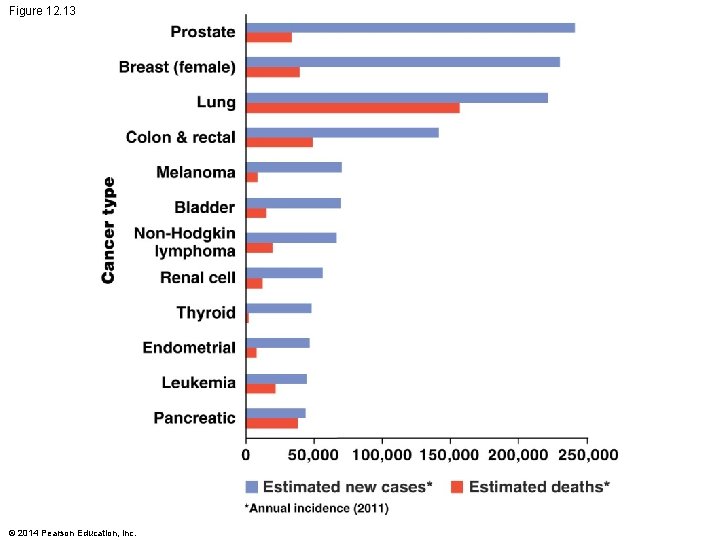
Figure 12. 13 © 2014 Pearson Education, Inc.
Types of Cancerous Cell Defects §Cancerous cells have two types of defects: 1. Defects that make the proteins required for cell growth active when they should not be 2. Defects that prevent tumor suppressor genes from shutting down the cell cycle © 2014 Pearson Education, Inc.
Properties of Cancer Cells §A tumor forms when one or more cells – In a multicellular organism – Begin to divide in an uncontrolled fashion §Benign tumors are – Noninvasive – Noncancerous © 2014 Pearson Education, Inc.
Properties of Cancer Cells §Malignant tumors – Are invasive – Are cancerous – Can spread throughout the body via the blood or lymph – Initiate secondary tumors §Metastasis – When cancer cells detach from the original tumor – Invade other tissues © 2014 Pearson Education, Inc.
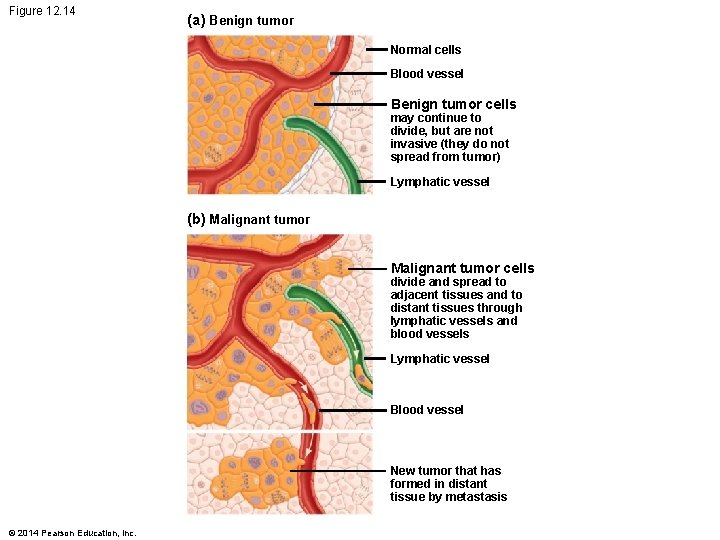
Figure 12. 14 (a) Benign tumor Normal cells Blood vessel Benign tumor cells may continue to divide, but are not invasive (they do not spread from tumor) Lymphatic vessel (b) Malignant tumor cells divide and spread to adjacent tissues and to distant tissues through lymphatic vessels and blood vessels Lymphatic vessel Blood vessel New tumor that has formed in distant tissue by metastasis © 2014 Pearson Education, Inc.
Cancer Involves Loss of Cell-Cycle Control §Cancers are thought to arise from cells with defects in the G 1 checkpoint © 2014 Pearson Education, Inc.
Social Control §Social control – Cells respond to signals from other cells – Divide only when their growth benefits the whole organism – Social control is based on growth factors – Small proteins released by cells that stimulate division in other Cells – Cell cultures will not grow unless growth factors are present © 2014 Pearson Education, Inc.
Social Control §Cancer cells – Divide without growth factors – Are no longer subject to social control at the G 1 checkpoint © 2014 Pearson Education, Inc.
Social Controls and Cell-Cycle Checkpoints §Rb protein enforces the G 1 checkpoint – It keeps the cell in G 0 §Excessive growth factors can – Override the inhibitory effects of Rb – Trigger cyclin synthesis – Activate cyclin–Cdk complexes – Leading to activation of the S-phase proteins © 2014 Pearson Education, Inc.
Social Controls and Cell-Cycle Checkpoints §In some human cancers, the G 1 cyclin is overproduced – Permanently activates Cdk – Continuously phosphorylates its target proteins §Either excessive growth factors or cyclin production – In the absence of growth factors – Can cause cyclin overproduction © 2014 Pearson Education, Inc.
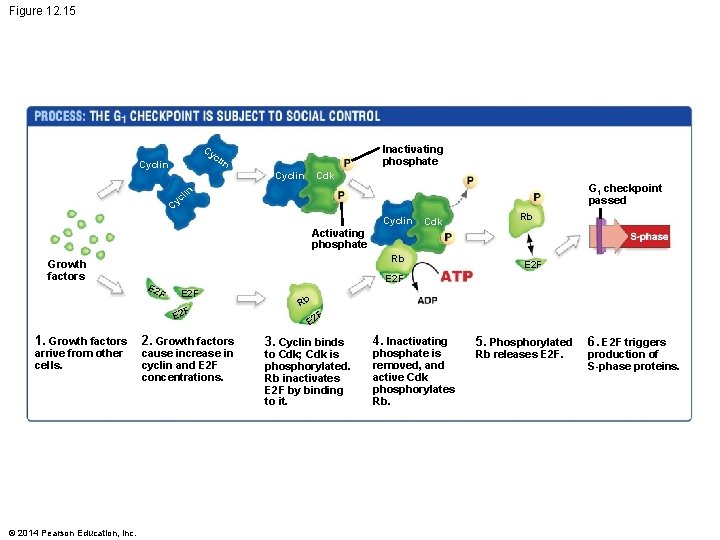
Figure 12. 15 Cy Inactivating phosphate cli Cyclin n Cyclin Cdk G 1 checkpoint passed in l yc C Cyclin Activating phosphate Growth factors © 2014 Pearson Education, Inc. E 2 F E 2 F arrive from other cells. Rb S-phase Rb F 1. Growth factors Cdk 2. Growth factors cause increase in cyclin and E 2 F concentrations. Rb F E 2 3. Cyclin binds to Cdk; Cdk is phosphorylated. Rb inactivates E 2 F by binding to it. 4. Inactivating phosphate is removed, and active Cdk phosphorylates Rb. 5. Phosphorylated Rb releases E 2 F. 6. E 2 F triggers production of S-phase proteins.
Cancer Is a Family of Diseases §Many different types of defects can cause the G 1 checkpoint to fail §Most cancers – Result from multiple defects in cell-cycle regulation – Develop only after several genes have been damaged §The combined damage is enough to – Break cell-cycle control – Induce uncontrolled growth and metastasis §Each type of cancer is caused by a unique combination of errors © 2014 Pearson Education, Inc.
- Slides: 78