
BIOLOGICAL SAFETY CABINET BASICS BEST PRODUCTS BEST PERFORMANCE
BIOLOGICAL SAFETY CABINET BASICS BEST PRODUCTS · BEST PERFORMANCE · BEST PROTECTION
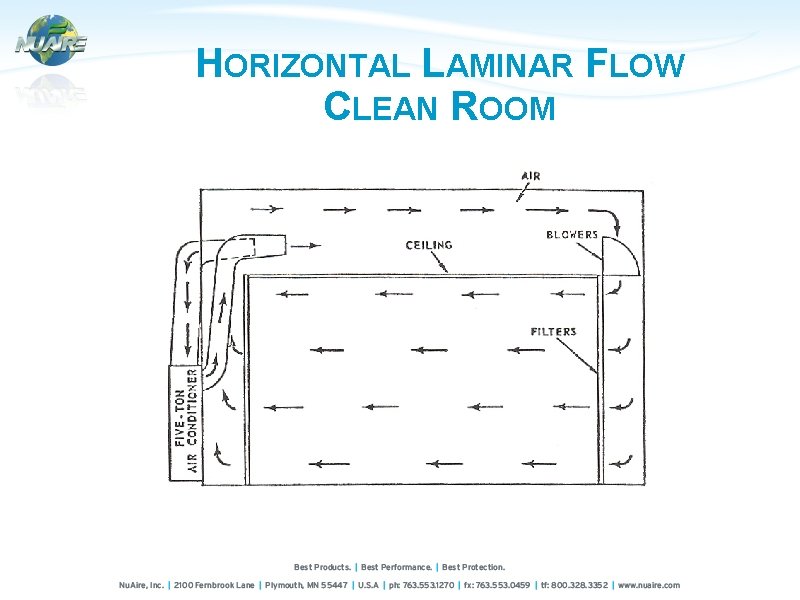
HORIZONTAL LAMINAR FLOW CLEAN ROOM

VERTICAL LAMINAR FLOW CLEAN ROOM
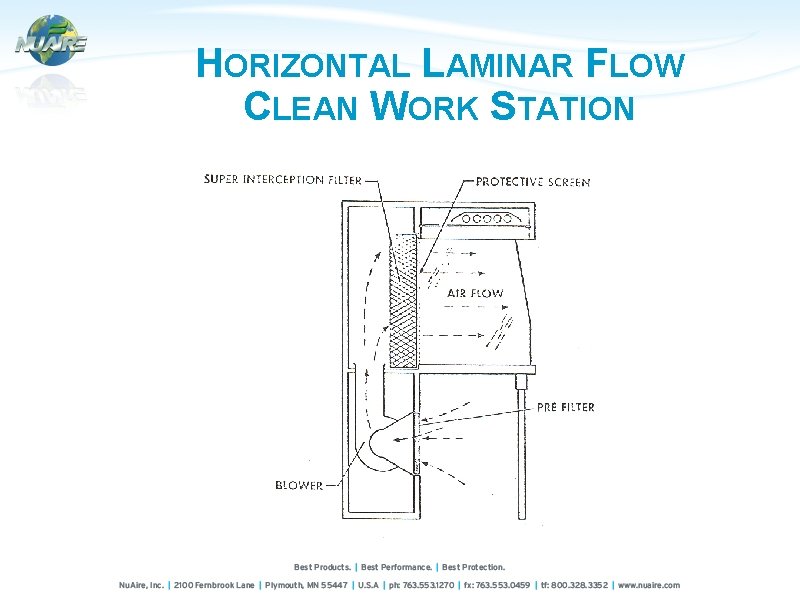
HORIZONTAL LAMINAR FLOW CLEAN WORK STATION
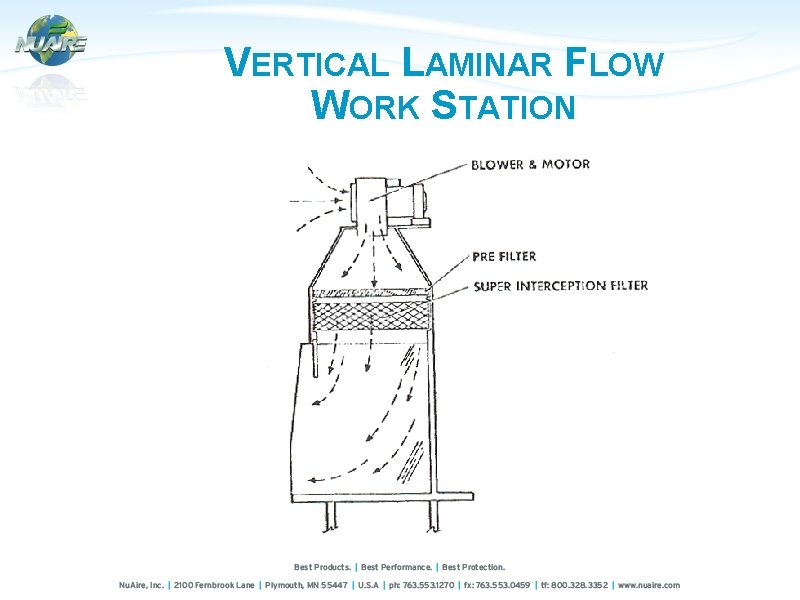
VERTICAL LAMINAR FLOW WORK STATION
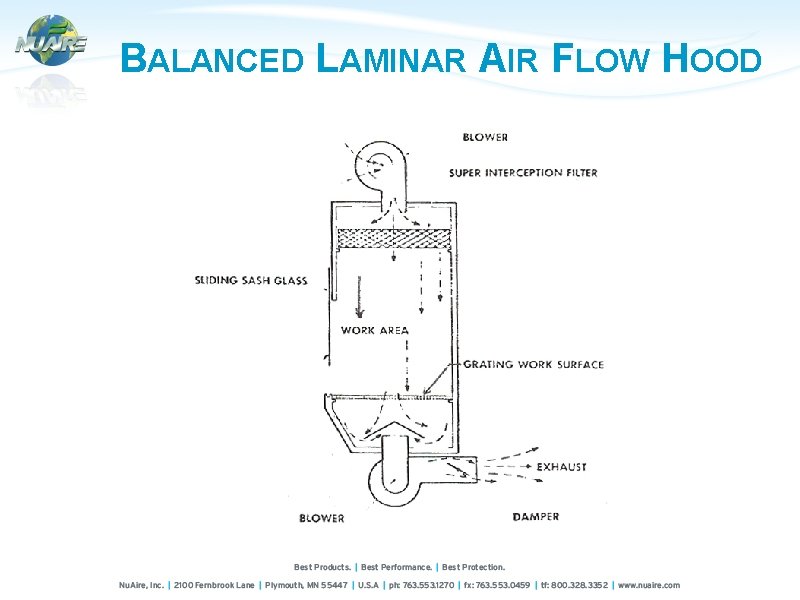
BALANCED LAMINAR AIR FLOW HOOD
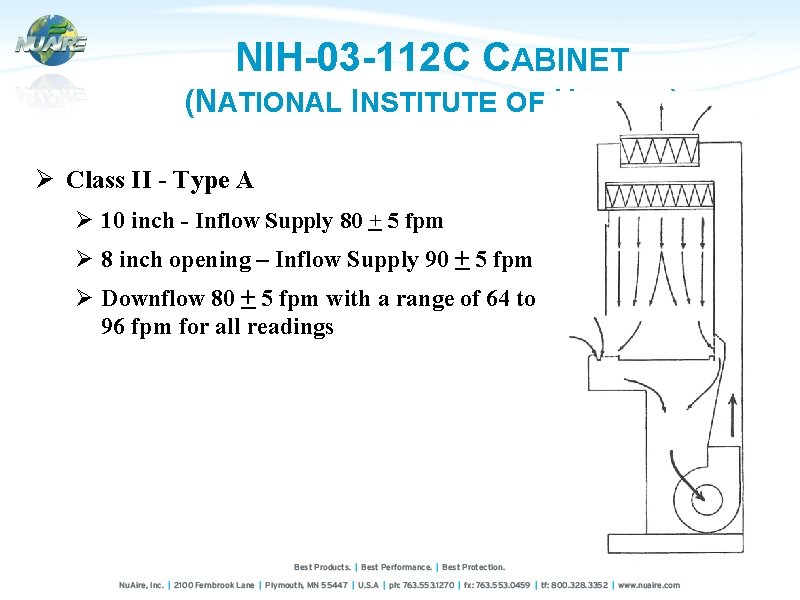
NIH-03 -112 C CABINET (NATIONAL INSTITUTE OF HEALTH) Ø Class II - Type A Ø 10 inch - Inflow Supply 80 + 5 fpm Ø 8 inch opening – Inflow Supply 90 + 5 fpm Ø Downflow 80 + 5 fpm with a range of 64 to 96 fpm for all readings
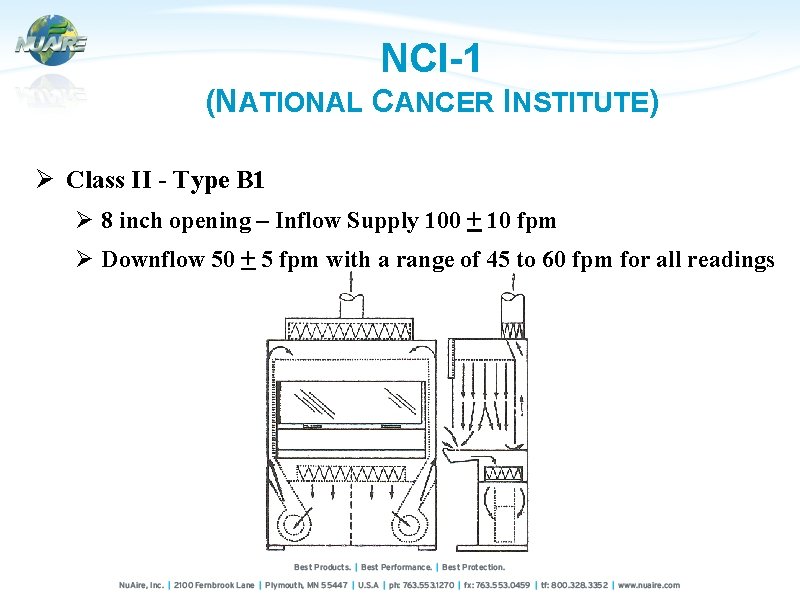
NCI-1 (NATIONAL CANCER INSTITUTE) Ø Class II - Type B 1 Ø 8 inch opening – Inflow Supply 100 + 10 fpm Ø Downflow 50 + 5 fpm with a range of 45 to 60 fpm for all readings
NSF-49 (NATIONAL SANITATION FOUNDATION) Ø June 1976 Ø Committee composed of: Ø NIH Ø NCI Ø CDC Ø Manufactures Ø Users Ø May 1993 changed from a construction specifications in favor of performance criteria
HORIZONTAL LAMINAR FLOW CLEAN WORK BENCH (PRODUCT PROTECTION ONLY) Ø Unit Components Ø Unit Air flows Ø Unit Types Ø Bench Top Ø Console Ø Vertical
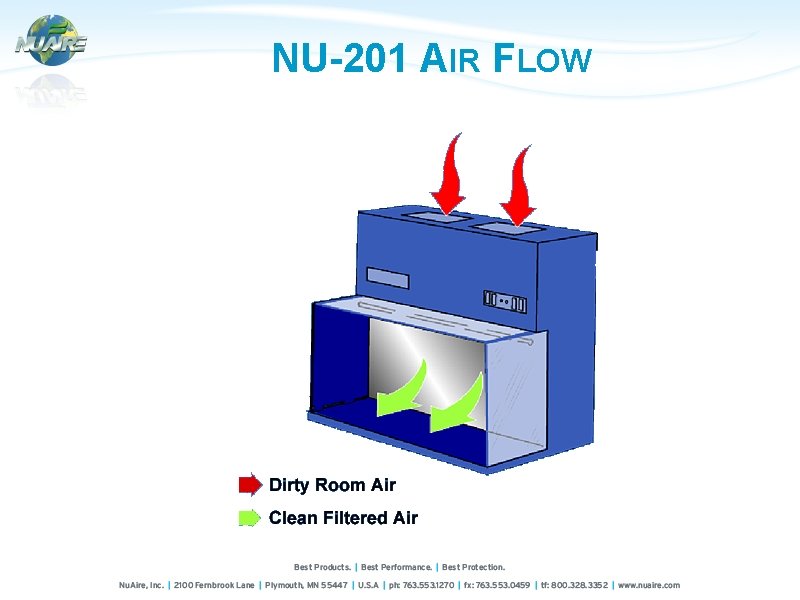
NU-201 AIR FLOW

NU-301 AIR FLOW
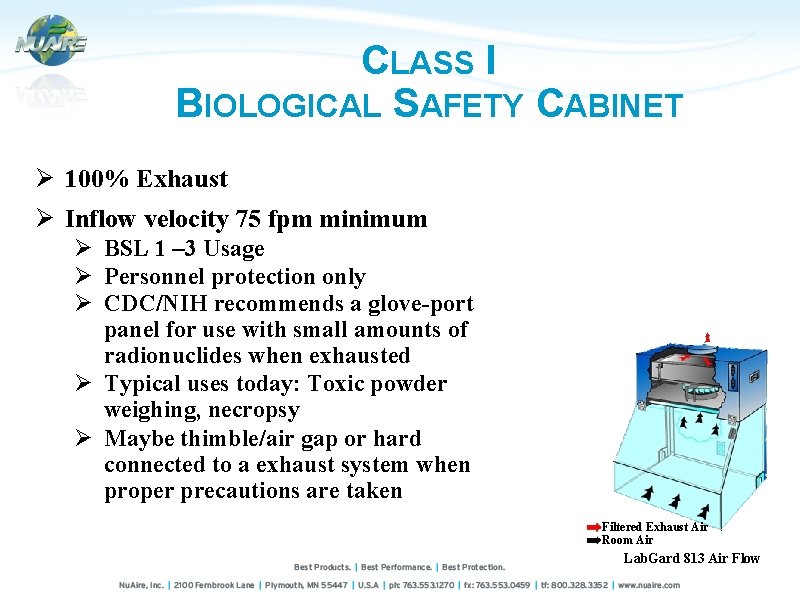
CLASS I BIOLOGICAL SAFETY CABINET Ø 100% Exhaust Ø Inflow velocity 75 fpm minimum Ø BSL 1 – 3 Usage Ø Personnel protection only Ø CDC/NIH recommends a glove-port panel for use with small amounts of radionuclides when exhausted Ø Typical uses today: Toxic powder weighing, necropsy Ø Maybe thimble/air gap or hard connected to a exhaust system when proper precautions are taken Filtered Exhaust Air Room Air Lab. Gard 813 Air Flow

CLASS I AIR FLOW
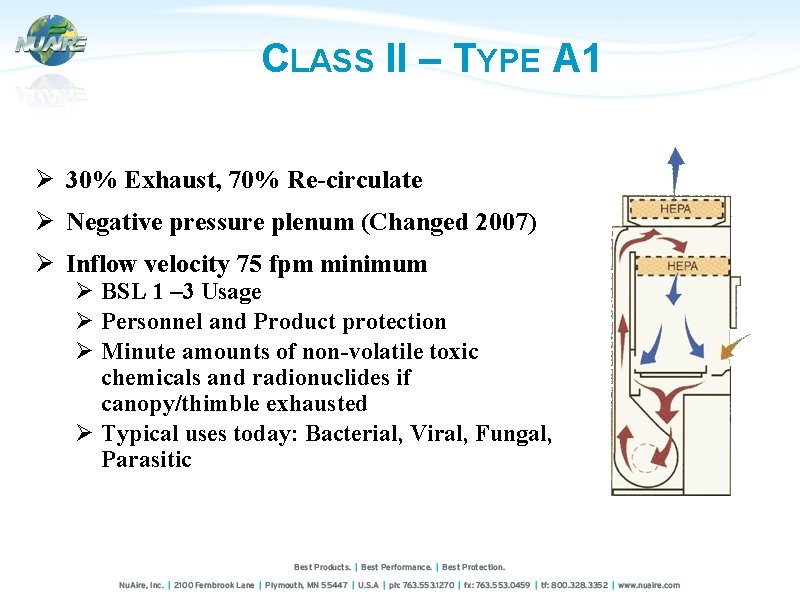
CLASS II – TYPE A 1 Ø 30% Exhaust, 70% Re-circulate Ø Negative pressure plenum (Changed 2007) Ø Inflow velocity 75 fpm minimum Ø BSL 1 – 3 Usage Ø Personnel and Product protection Ø Minute amounts of non-volatile toxic chemicals and radionuclides if canopy/thimble exhausted Ø Typical uses today: Bacterial, Viral, Fungal, Parasitic
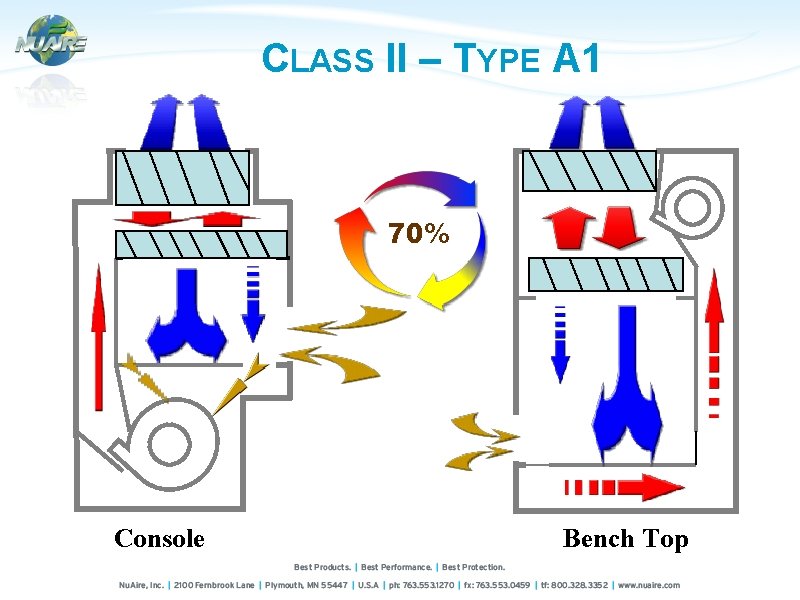
CLASS II – TYPE A 1 70% Console Bench Top
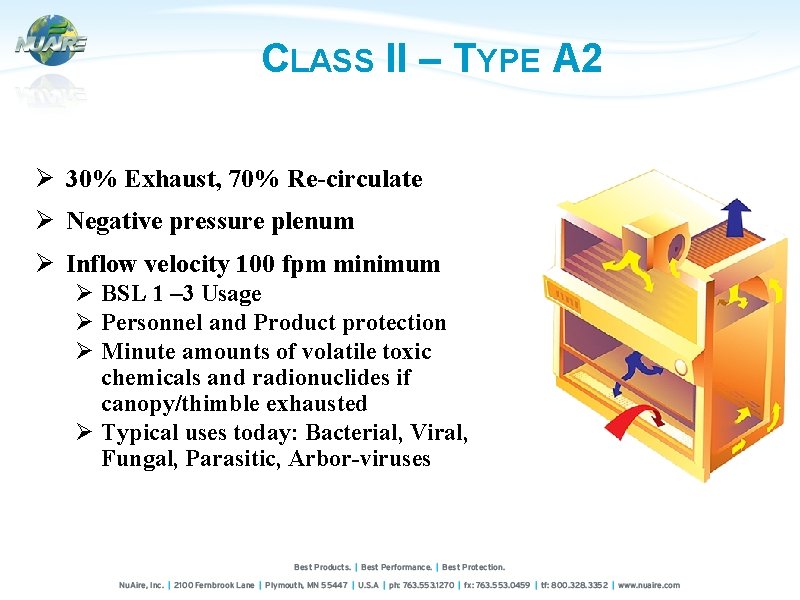
CLASS II – TYPE A 2 Ø 30% Exhaust, 70% Re-circulate Ø Negative pressure plenum Ø Inflow velocity 100 fpm minimum Ø BSL 1 – 3 Usage Ø Personnel and Product protection Ø Minute amounts of volatile toxic chemicals and radionuclides if canopy/thimble exhausted Ø Typical uses today: Bacterial, Viral, Fungal, Parasitic, Arbor-viruses
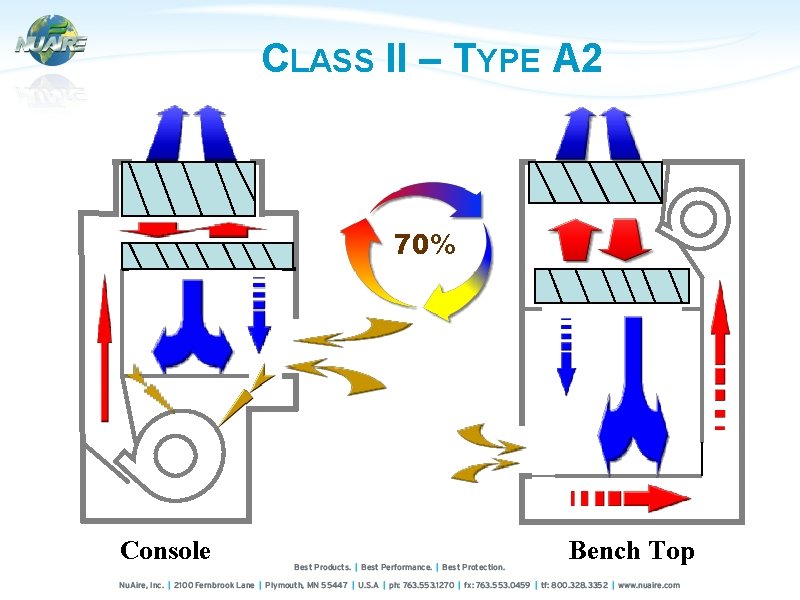
CLASS II – TYPE A 2 70% Console Bench Top
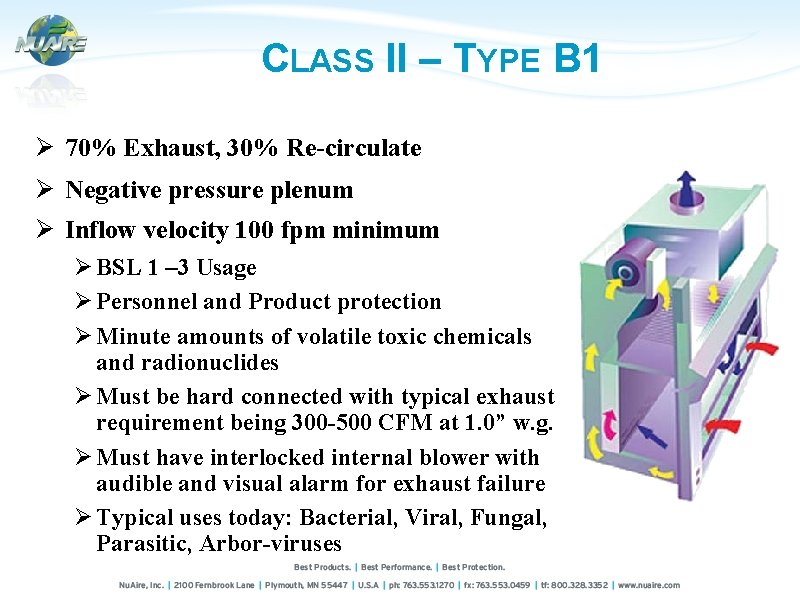
CLASS II – TYPE B 1 Ø 70% Exhaust, 30% Re-circulate Ø Negative pressure plenum Ø Inflow velocity 100 fpm minimum Ø BSL 1 – 3 Usage Ø Personnel and Product protection Ø Minute amounts of volatile toxic chemicals and radionuclides Ø Must be hard connected with typical exhaust requirement being 300 -500 CFM at 1. 0” w. g. Ø Must have interlocked internal blower with audible and visual alarm for exhaust failure Ø Typical uses today: Bacterial, Viral, Fungal, Parasitic, Arbor-viruses

CLASS II – TYPE B 1
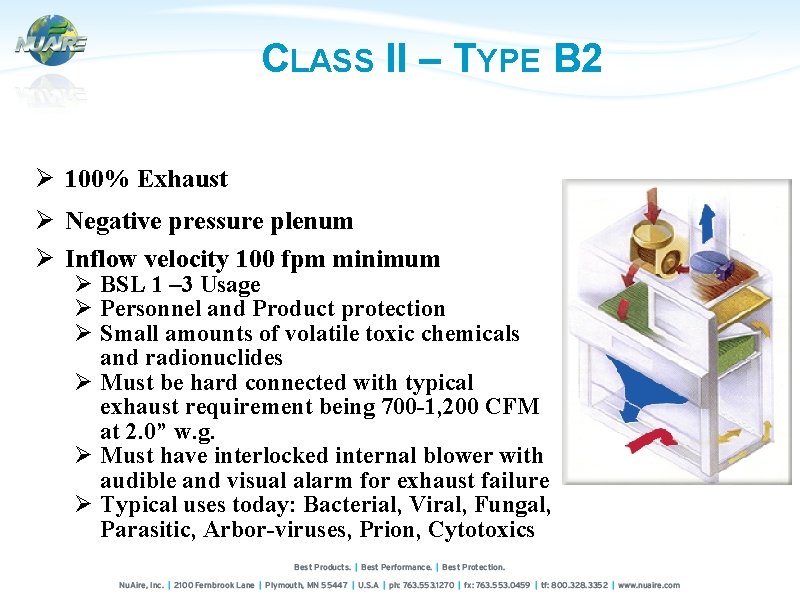
CLASS II – TYPE B 2 Ø 100% Exhaust Ø Negative pressure plenum Ø Inflow velocity 100 fpm minimum Ø BSL 1 – 3 Usage Ø Personnel and Product protection Ø Small amounts of volatile toxic chemicals and radionuclides Ø Must be hard connected with typical exhaust requirement being 700 -1, 200 CFM at 2. 0” w. g. Ø Must have interlocked internal blower with audible and visual alarm for exhaust failure Ø Typical uses today: Bacterial, Viral, Fungal, Parasitic, Arbor-viruses, Prion, Cytotoxics

CLASS II – TYPE B 2
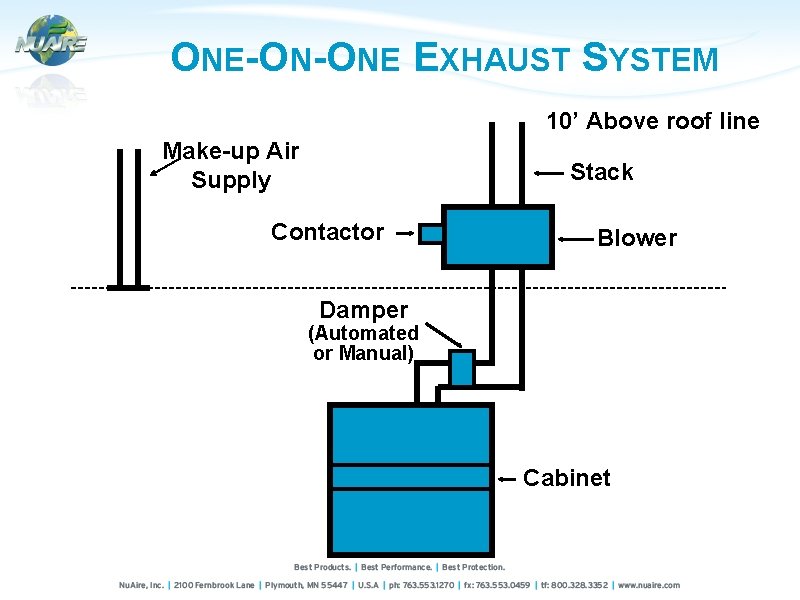
ONE-ON-ONE EXHAUST SYSTEM 10’ Above roof line Make-up Air Supply Stack Contactor Blower Damper (Automated or Manual) Cabinet
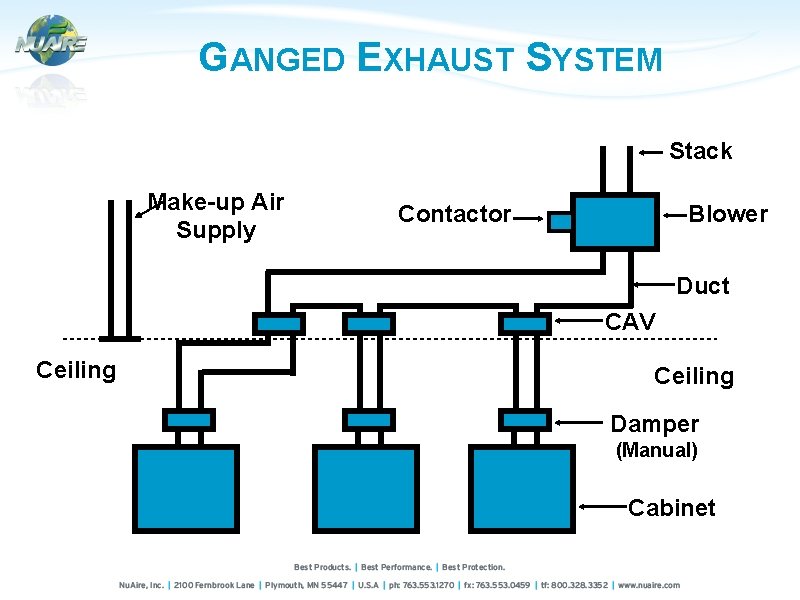
GANGED EXHAUST SYSTEM Stack Make-up Air Supply Contactor Blower Duct CAV Ceiling Damper (Manual) Cabinet
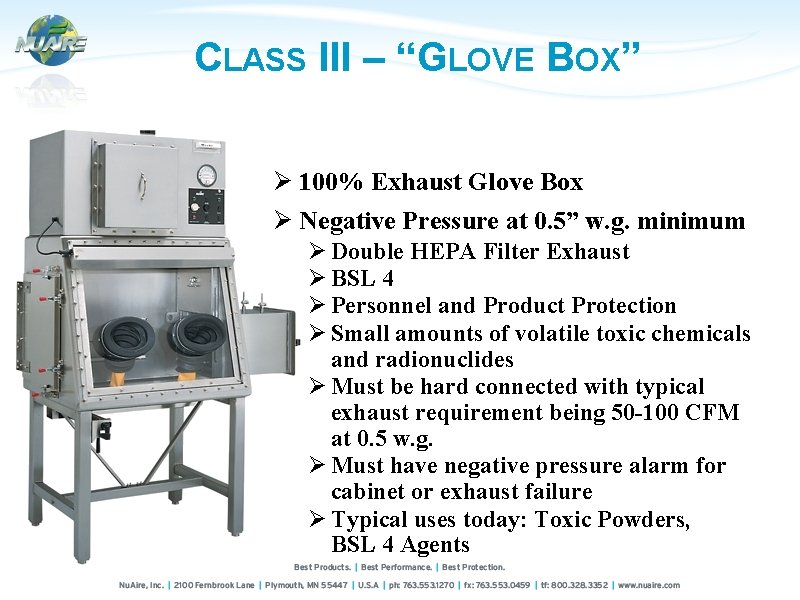
CLASS III – “GLOVE BOX” Ø 100% Exhaust Glove Box Ø Negative Pressure at 0. 5” w. g. minimum Ø Double HEPA Filter Exhaust Ø BSL 4 Ø Personnel and Product Protection Ø Small amounts of volatile toxic chemicals and radionuclides Ø Must be hard connected with typical exhaust requirement being 50 -100 CFM at 0. 5 w. g. Ø Must have negative pressure alarm for cabinet or exhaust failure Ø Typical uses today: Toxic Powders, BSL 4 Agents
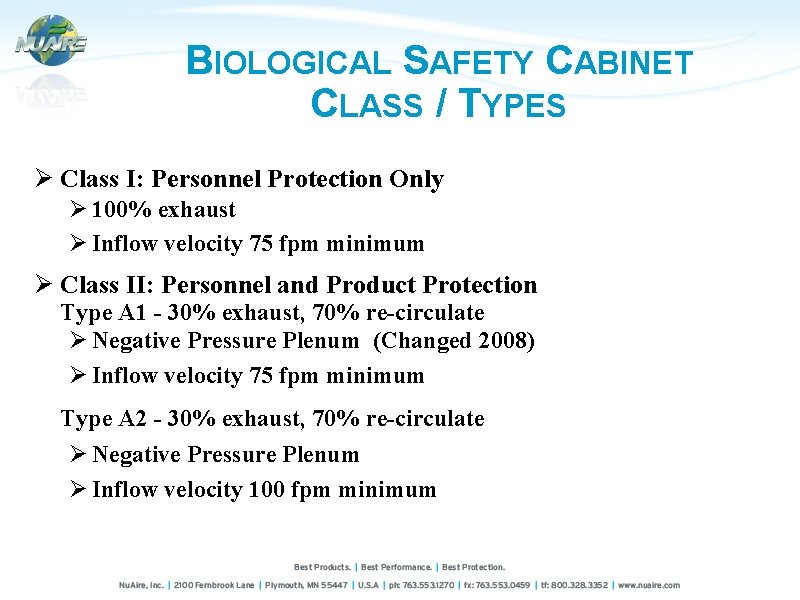
BIOLOGICAL SAFETY CABINET CLASS / TYPES Ø Class I: Personnel Protection Only Ø 100% exhaust Ø Inflow velocity 75 fpm minimum Ø Class II: Personnel and Product Protection Type A 1 - 30% exhaust, 70% re-circulate Ø Negative Pressure Plenum (Changed 2008) Ø Inflow velocity 75 fpm minimum Type A 2 - 30% exhaust, 70% re-circulate Ø Negative Pressure Plenum Ø Inflow velocity 100 fpm minimum
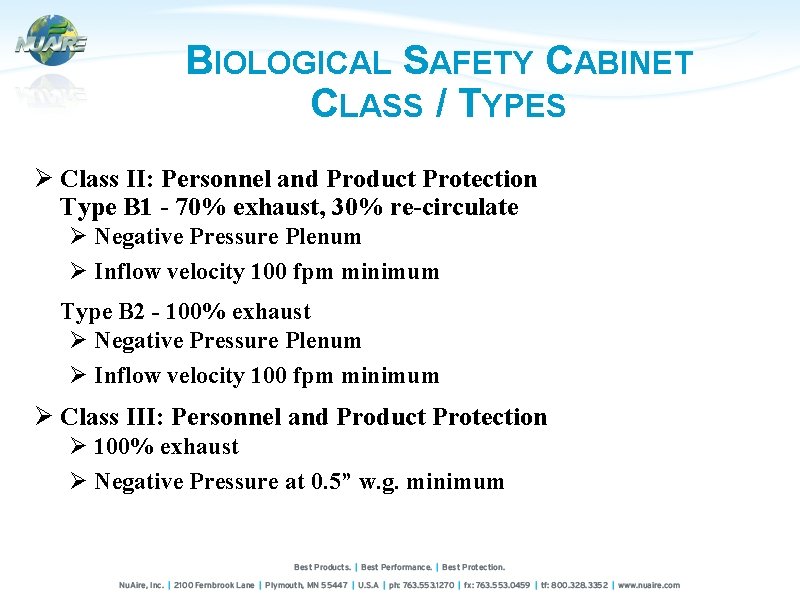
BIOLOGICAL SAFETY CABINET CLASS / TYPES Ø Class II: Personnel and Product Protection Type B 1 - 70% exhaust, 30% re-circulate Ø Negative Pressure Plenum Ø Inflow velocity 100 fpm minimum Type B 2 - 100% exhaust Ø Negative Pressure Plenum Ø Inflow velocity 100 fpm minimum Ø Class III: Personnel and Product Protection Ø 100% exhaust Ø Negative Pressure at 0. 5” w. g. minimum
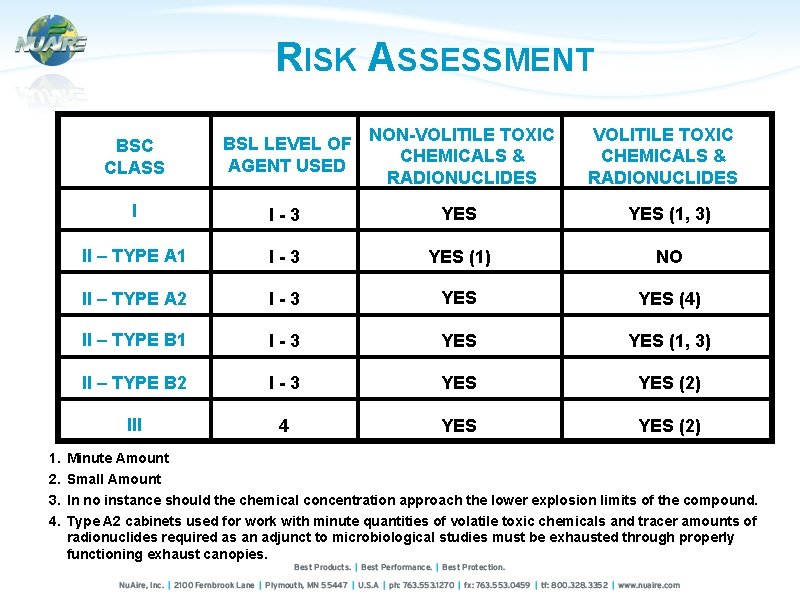
RISK ASSESSMENT 1. 2. 3. 4. BSC CLASS BSL LEVEL OF AGENT USED NON-VOLITILE TOXIC CHEMICALS & RADIONUCLIDES I I-3 YES (1, 3) II – TYPE A 1 I-3 YES (1) NO II – TYPE A 2 I-3 YES (4) II – TYPE B 1 I-3 YES (1, 3) II – TYPE B 2 I-3 YES (2) III 4 YES (2) Minute Amount Small Amount In no instance should the chemical concentration approach the lower explosion limits of the compound. Type A 2 cabinets used for work with minute quantities of volatile toxic chemicals and tracer amounts of radionuclides required as an adjunct to microbiological studies must be exhausted through properly functioning exhaust canopies.
AIRFLOW BALANCE OPTIMIZATION
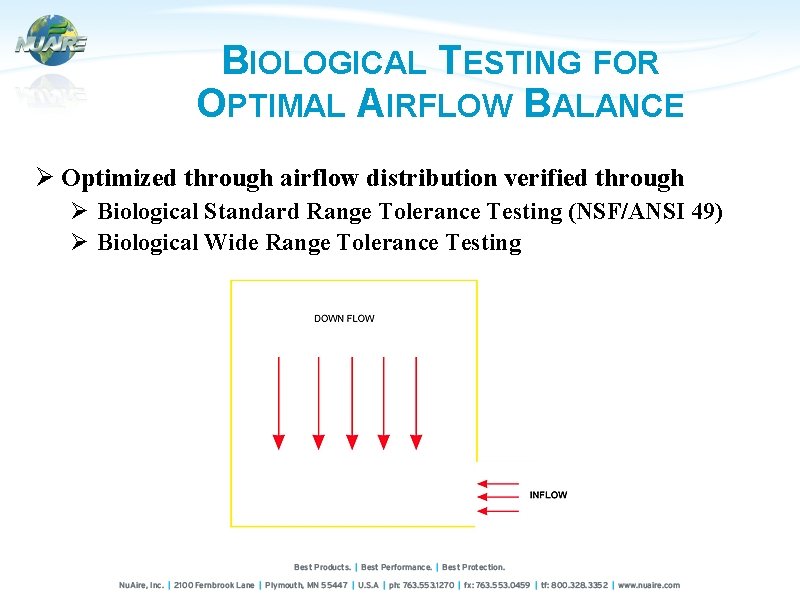
BIOLOGICAL TESTING FOR OPTIMAL AIRFLOW BALANCE Ø Optimized through airflow distribution verified through Ø Biological Standard Range Tolerance Testing (NSF/ANSI 49) Ø Biological Wide Range Tolerance Testing

PERSONAL PROTECTION

PRODUCT PROTECTION

CROSS CONTAMINATION
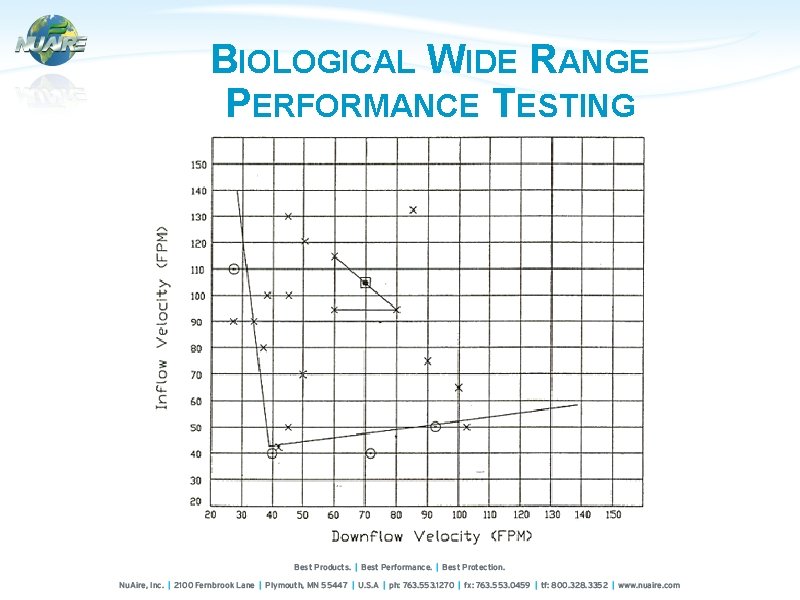
BIOLOGICAL WIDE RANGE PERFORMANCE TESTING
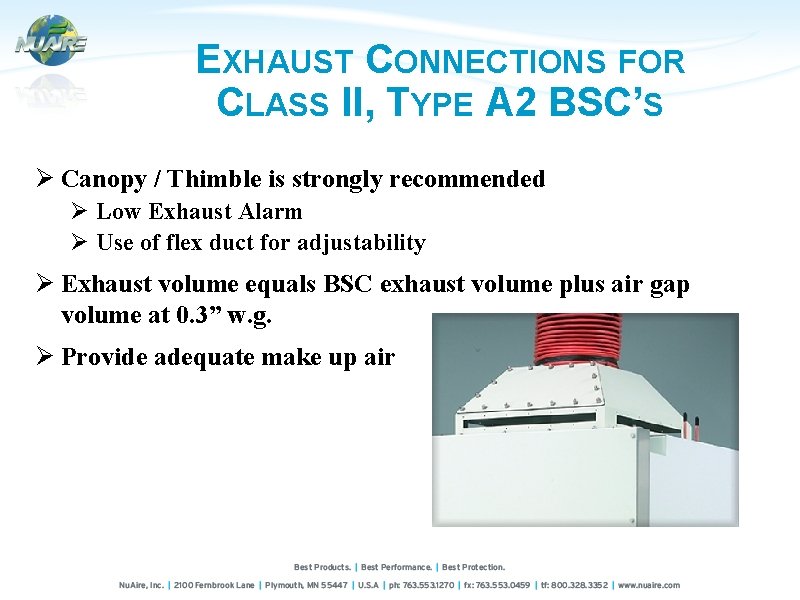
EXHAUST CONNECTIONS FOR CLASS II, TYPE A 2 BSC’S Ø Canopy / Thimble is strongly recommended Ø Low Exhaust Alarm Ø Use of flex duct for adjustability Ø Exhaust volume equals BSC exhaust volume plus air gap volume at 0. 3” w. g. Ø Provide adequate make up air
EXHAUST CONNECTIONS FOR CLASS II, TYPE B 1/B 2 BSC’S Ø Direct hard connection is required Ø Provide gas-tight exhaust damper for decontamination process Ø Evaluate connection restrictions based on BSC requirements (i. e. exhaust sensor type used) Ø Provide adequate make-up air for laboratory pressure requirements Ø Use Concurrent Balance Value from manufacturer to design and balance BSC
CBV DEFINITION Concurrent Balance Value (CBV) is determined by a duct traverse measurement method as specified in ASHRAE Standard 111 – 2008, a minimum of 7. 5 duct diameters downstream of a direct connected BSC at its nominal setpoint calibrated using the primary DIM method. The static pressure is measured approximately 2 duct diameters above the BSC. Appropriate filter load and tolerance values are added to accommodate filter loading. The resulting values may be used for design and balance exhaust/supply HVAC Requirements.
BREIF HISTORY Ø Since the use of the DIM in the early 90’s, differences in measurement results have been noted between duct traverse and BSC face measurement methods Ø ASHRAE Study Results (1212 – RP) Ø BSC face measurement is consistent and repeatable Ø Lack of correlation between methods makes BSC face measurement method suspect for mechanical system design and air balancers Ø NSF 49 Joint Committee Ø Reviewed ASHRAE study results and voted to incorporate the CBV into the listing
BSC FACILITY ASSESSMENT Ø Ceiling Height / Door Width and Height -must accommodate the needs of the user within the constraints of the facility Ø Personnel movements / Door movements / pass-thru’s / and flow patterns in the facility must be analyzed Ø Design criteria; BSL 1, 2, 3 or 4 Ø HVAC - Facility air handling system
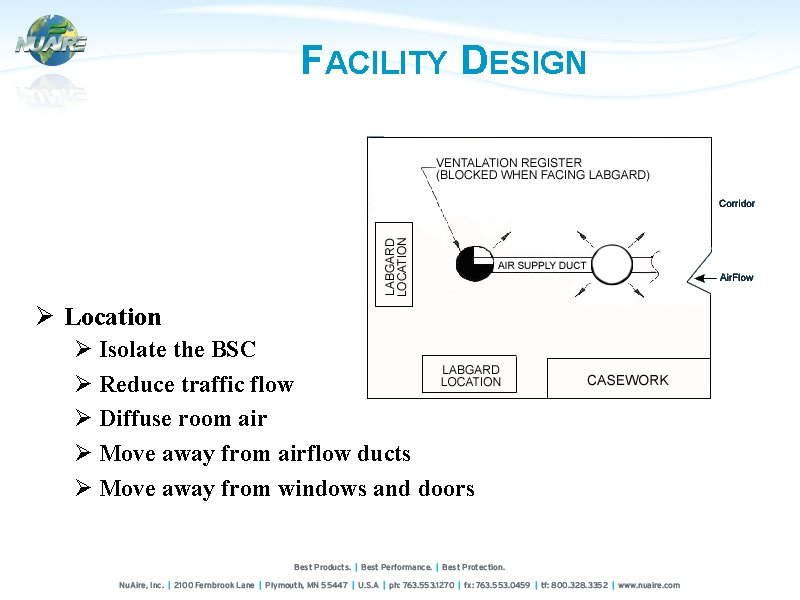
FACILITY DESIGN Ø Location Ø Isolate the BSC Ø Reduce traffic flow Ø Diffuse room air Ø Move away from airflow ducts Ø Move away from windows and doors
FACILITY DESIGN Ø HVAC Ø BSC’s if exhausted require a constant volume (+/- 5%) Ø Laboratory balance positive or negative Ø Laboratory ventilation rates Ø Class II, Type B cabinets should never be the dedicated exhaust for the Lab. Ø Spatial and temporal uniform distribution of room air Ø Review system dynamics, personnel movement, door movement, pass-thrus, etc. Ø National, Local Code Conformity
PROCESS ASSESSMENT Ø Process Plan Analysis Ø Applicable Automation Ø Applicable facility SOP’s Ø c. GMP Requirement
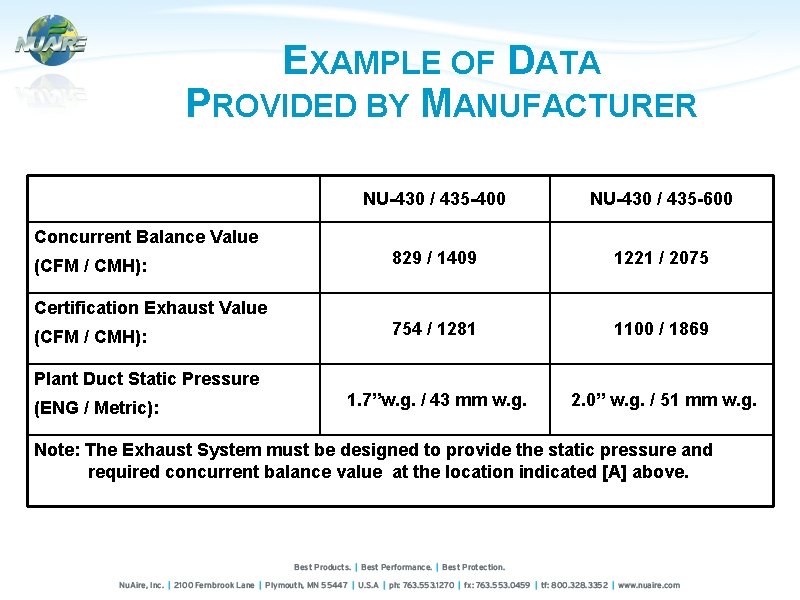
EXAMPLE OF DATA PROVIDED BY MANUFACTURER NU-430 / 435 -400 NU-430 / 435 -600 829 / 1409 1221 / 2075 754 / 1281 1100 / 1869 1. 7”w. g. / 43 mm w. g. 2. 0” w. g. / 51 mm w. g. Concurrent Balance Value (CFM / CMH): Certification Exhaust Value (CFM / CMH): Plant Duct Static Pressure (ENG / Metric): Note: The Exhaust System must be designed to provide the static pressure and required concurrent balance value at the location indicated [A] above.
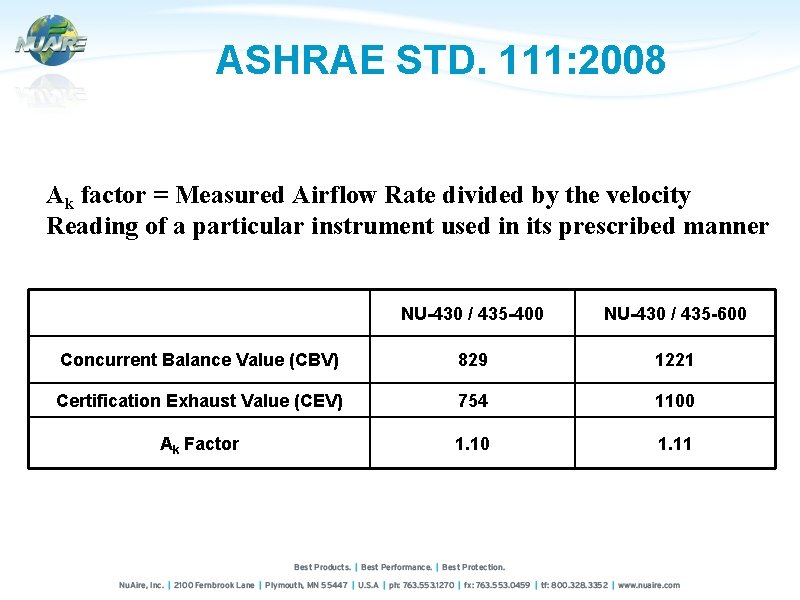
ASHRAE STD. 111: 2008 Ak factor = Measured Airflow Rate divided by the velocity Reading of a particular instrument used in its prescribed manner NU-430 / 435 -400 NU-430 / 435 -600 Concurrent Balance Value (CBV) 829 1221 Certification Exhaust Value (CEV) 754 1100 Ak Factor 1. 10 1. 11
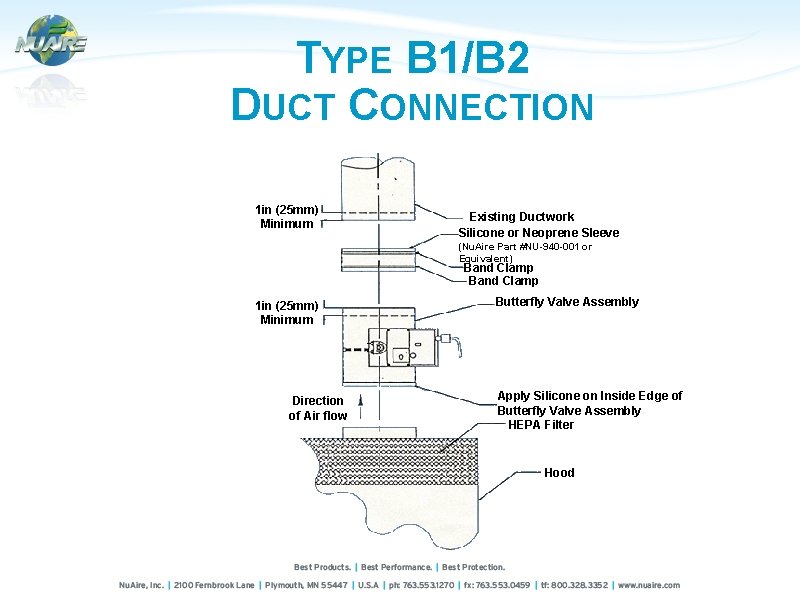
TYPE B 1/B 2 DUCT CONNECTION 1 in (25 mm) Minimum Existing Ductwork Silicone or Neoprene Sleeve (Nu. Aire Part #NU-940 -001 or Equivalent) Band Clamp 1 in (25 mm) Minimum Direction of Air flow Butterfly Valve Assembly Apply Silicone on Inside Edge of Butterfly Valve Assembly HEPA Filter Hood
CABINET / BAS CONNECTIONS FOR CLASS II, TYPE B 1/B 2 BSC’S Ø Contacts outputs Ø Fan Relay Ø Alarm Relay Ø Contact input from BAS Ø Night Setback Ø Remote Override
BSC TESTING AND CERTIFICATION TO NSF/ANSI 49 ANNEX F
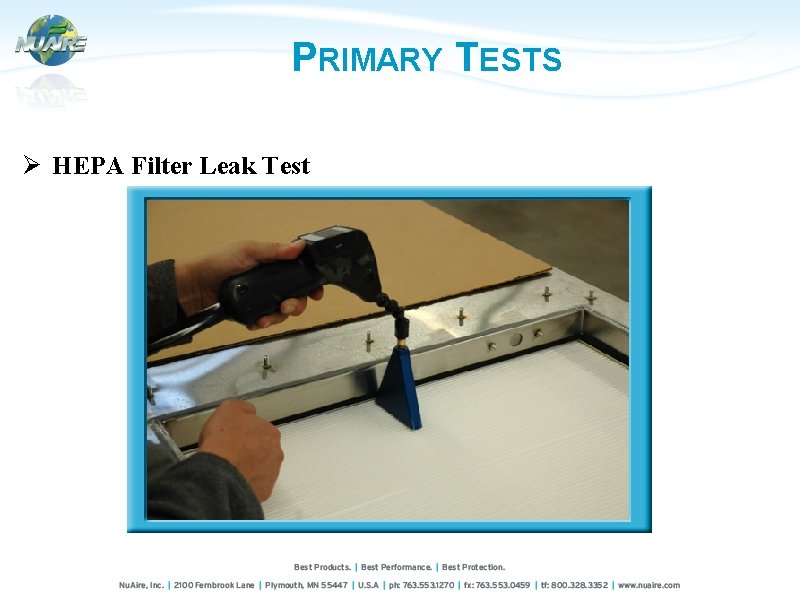
PRIMARY TESTS Ø HEPA Filter Leak Test
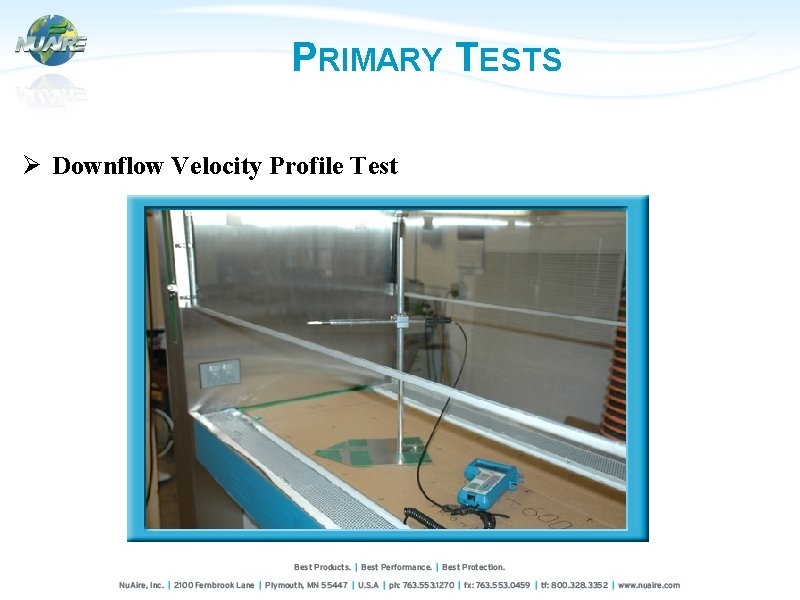
PRIMARY TESTS Ø Downflow Velocity Profile Test
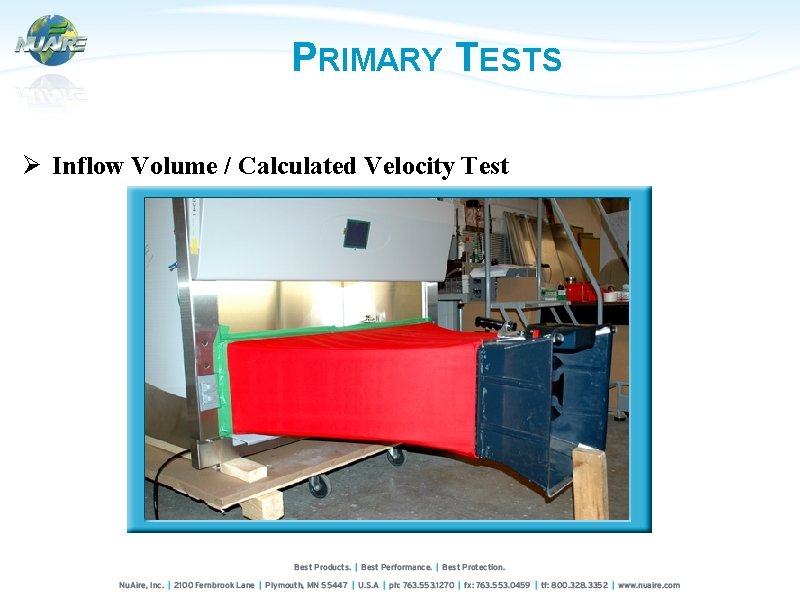
PRIMARY TESTS Ø Inflow Volume / Calculated Velocity Test
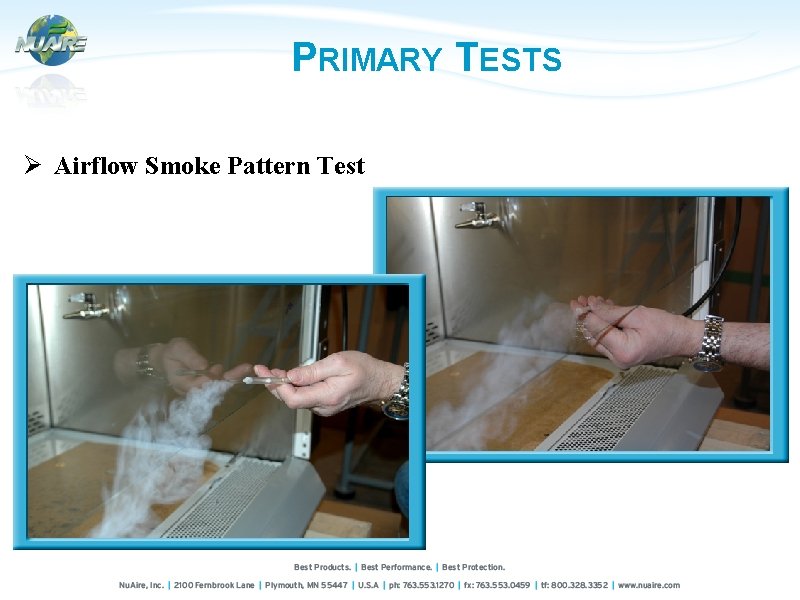
PRIMARY TESTS Ø Airflow Smoke Pattern Test
PRIMARY TESTS Ø Site Installation Assessment Test Ø Alarm Functions Ø Blower interlock, Type B 1/B 2 Ø Exhaust System Performance Ø Canopy connection. Type A 2 Ø Room Influences
SECONDARY TESTS Ø Lighting Ø Vibration Ø Noise
INFORMATIONAL WEBSITES www. hc-sc. gc. ca/pphb-dgspsp/ols-bsl www. cdc. gov/od/ohs www. absa. org www. absa-canada. org www. ebsa. be www. inspection. gc. ca www. who. int www. biosafety. be www. hse. gov. uk www. nsf. org www. nuaire. com
BSC ENERGY IMPROVEMENTS Ø BSC Energy Consumption Ø Conventional BSC Energy Consumption Ø Considerations for Improvement of BSC Energy Consumption Ø Additional Cost of Ownership Considerations Ø Night Setback BSC’s Ø Nu. Aire’s Energy Saver (ES Series)
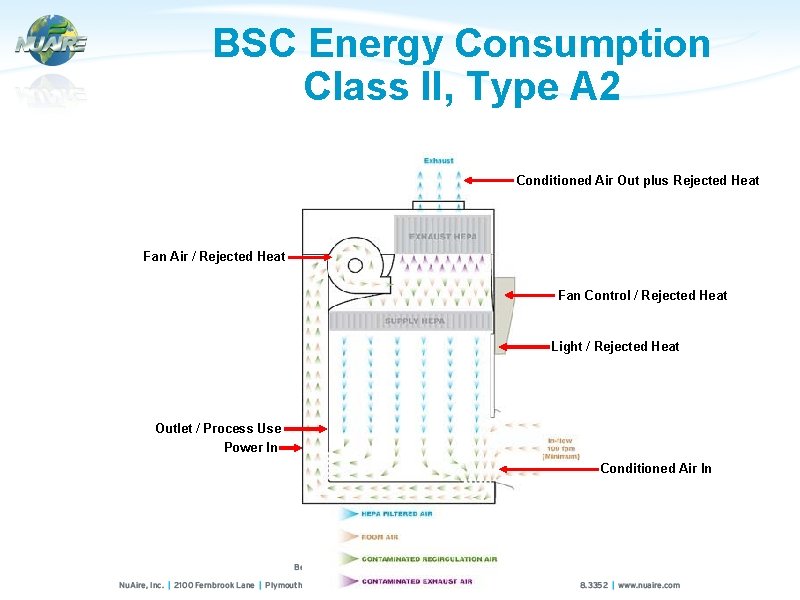
BSC Energy Consumption Class II, Type A 2 Conditioned Air Out plus Rejected Heat Fan Air / Rejected Heat Fan Control / Rejected Heat Light / Rejected Heat Outlet / Process Use Power In Conditioned Air In
CONVENTIONAL BSC ENERGY CONSUMPTION Ø Lighting Ø Fan / Motor Ø Fan Control
CONVENTIONAL BSC ENERGY CONSUMPTION LIGHTING Ø Pre 1995: T 12 Lamp with magnetic ballast Ø. 7 to 1. 0 Amp (80 to 120 watts) Ø 1995 – 2008: T 8 Lamp with electronic ballast Ø. 2 to. 35 Amp (20 to 40 watts)
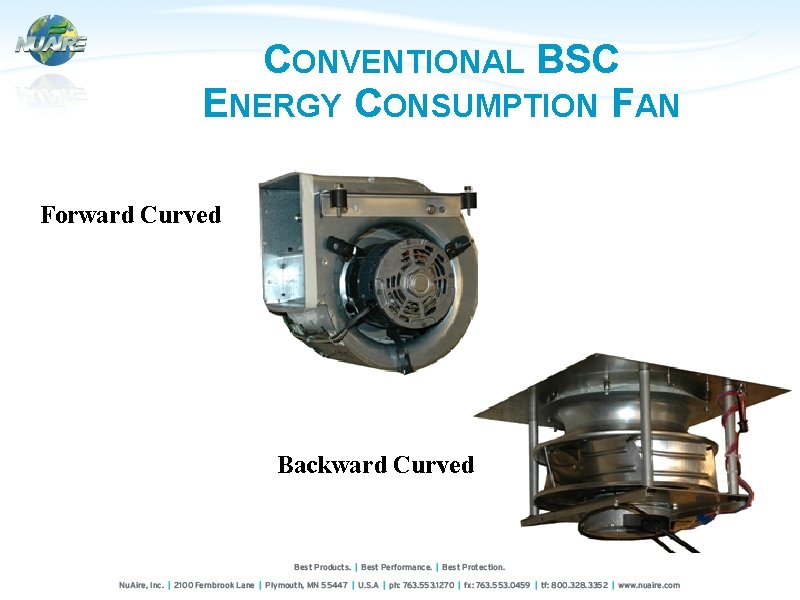
CONVENTIONAL BSC ENERGY CONSUMPTION FAN Forward Curved Backward Curved
CONVENTIONAL BSC ENERGY CONSUMPTION FAN Ø AC PSC (35% to 60% efficiency) Ø 4 to 10 Amps (460 to 1150 watts) Ø 9 inch diameter fan / 1100 to 1625 RPM Ø Fan Control Ø TRIAC –. 5 Amp (60 watts)
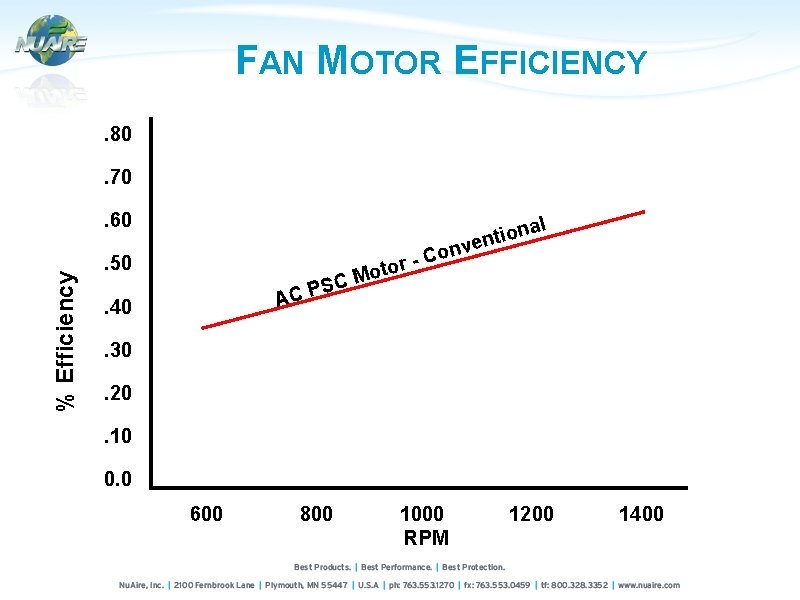
FAN MOTOR EFFICIENCY. 80. 70 % Efficiency . 60 al ion t n e nv o . 50 SC P C A . 40 C r o ot M . 30. 20. 10 0. 0 600 800 1000 RPM 1200 1400
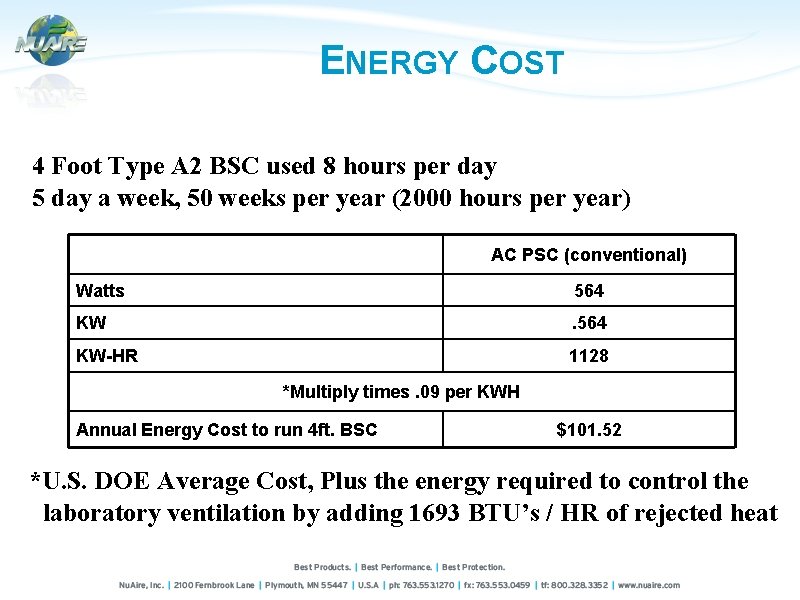
ENERGY COST 4 Foot Type A 2 BSC used 8 hours per day 5 day a week, 50 weeks per year (2000 hours per year) AC PSC (conventional) Watts 564 KW . 564 KW-HR 1128 *Multiply times. 09 per KWH Annual Energy Cost to run 4 ft. BSC $101. 52 *U. S. DOE Average Cost, Plus the energy required to control the laboratory ventilation by adding 1693 BTU’s / HR of rejected heat
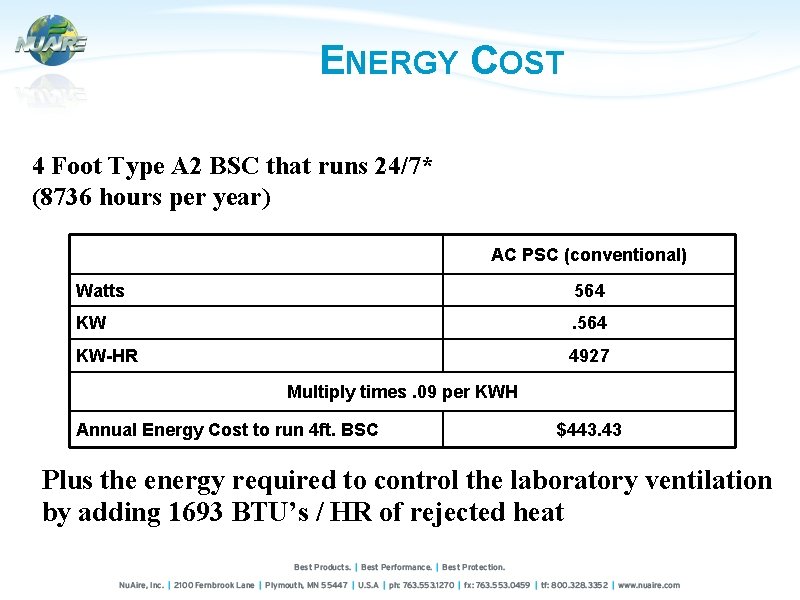
ENERGY COST 4 Foot Type A 2 BSC that runs 24/7* (8736 hours per year) AC PSC (conventional) Watts 564 KW . 564 KW-HR 4927 Multiply times. 09 per KWH Annual Energy Cost to run 4 ft. BSC $443. 43 Plus the energy required to control the laboratory ventilation by adding 1693 BTU’s / HR of rejected heat
CONSIDERATIONS FOR IMPROVEMENT OF BSC ENERGY CONSUMPTION Ø Lighting Ø Fan / Motor Ø Fan Control
LIGHTING SYSTEMS AVAILABLE FOR BSC IMPROVEMENT Ø T 8 Lamp (3500 Lumens) with electronic ballast Ø. 2 to. 35 Amp (20 to 40 watts) Ø T 5 Lamp (3300 Lumens) with electronic ballast Ø. 2 to. 33 Amp (20 to 35 watts) Ø LED (3000 Lumens) no ballast Ø. 05 to. 2 Amp (5 to 20 watts)
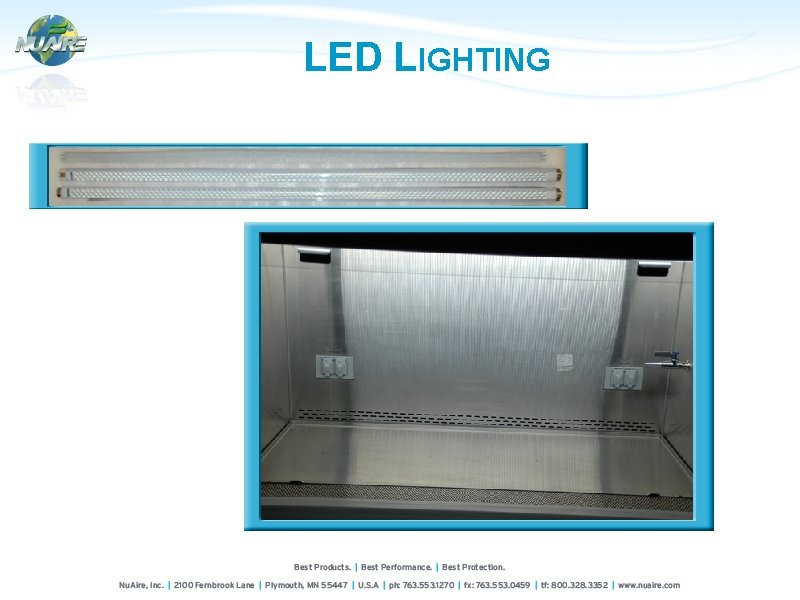
LED LIGHTING
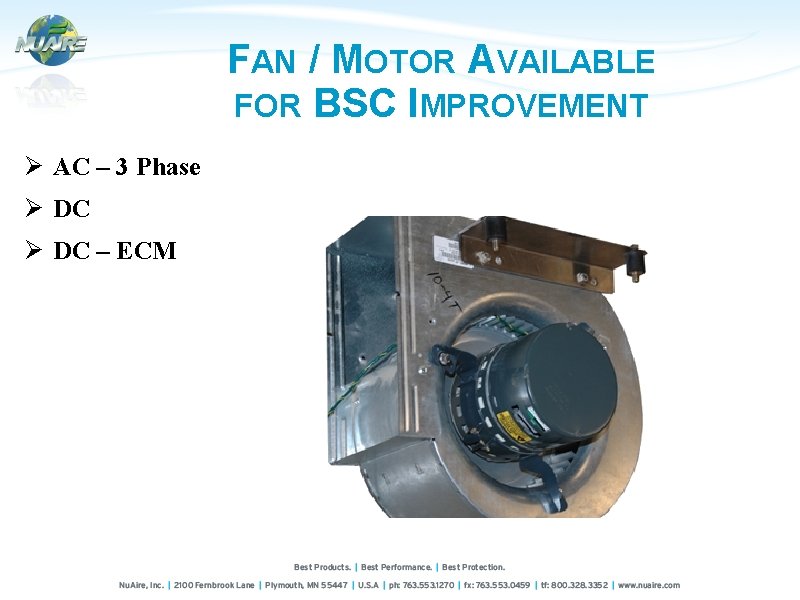
FAN / MOTOR AVAILABLE FOR BSC IMPROVEMENT Ø AC – 3 Phase Ø DC – ECM
AC – 3 PHASE Ø Forward Curved Fan (10 -inch Diameter Wheel) Ø Extended RPM Range (800 to 1400 RPM) Ø Frequency Drive Controller (constant volume) Ø Minimal Motor noise (frequency)
DC Ø Backward Inclined / Small Forward Curved Fan Ø High RPM Range (1400 – 2200 RPM) Ø Regulated Power Supply (48 VDC) with Potentiometer Control Ø No Motor noise
DC – ECM Ø Forward Curved Fan (10 -inch Diameter Wheel) Ø Extended RPM Range (800 to 1400 RPM) Ø Built in power supply with PWM Control (constant volume) Ø No Motor noise
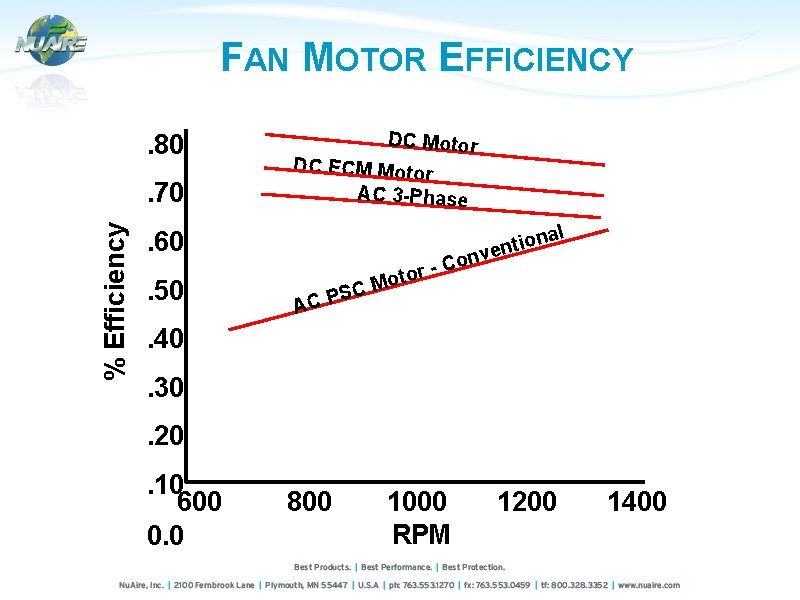
FAN MOTOR EFFICIENCY. 80 % Efficiency . 70 DC Motor DC ECM Motor AC 3 -Phase l . 60. 50 SC P C A r Moto - na o i t n ve Con . 40. 30. 20. 10 600 0. 0 800 1000 RPM 1200 1400
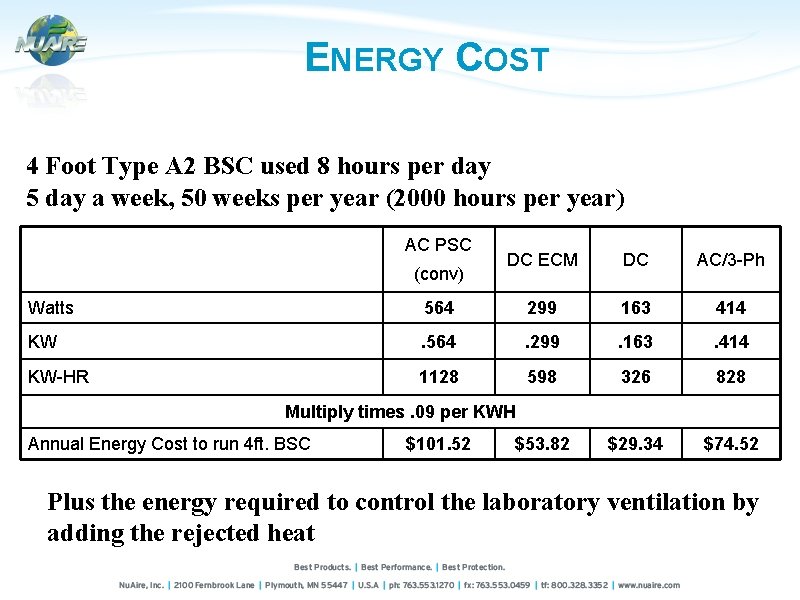
ENERGY COST 4 Foot Type A 2 BSC used 8 hours per day 5 day a week, 50 weeks per year (2000 hours per year) AC PSC (conv) DC ECM DC AC/3 -Ph Watts 564 299 163 414 KW . 564 . 299 . 163 . 414 KW-HR 1128 598 326 828 $53. 82 $29. 34 $74. 52 Multiply times. 09 per KWH Annual Energy Cost to run 4 ft. BSC $101. 52 Plus the energy required to control the laboratory ventilation by adding the rejected heat
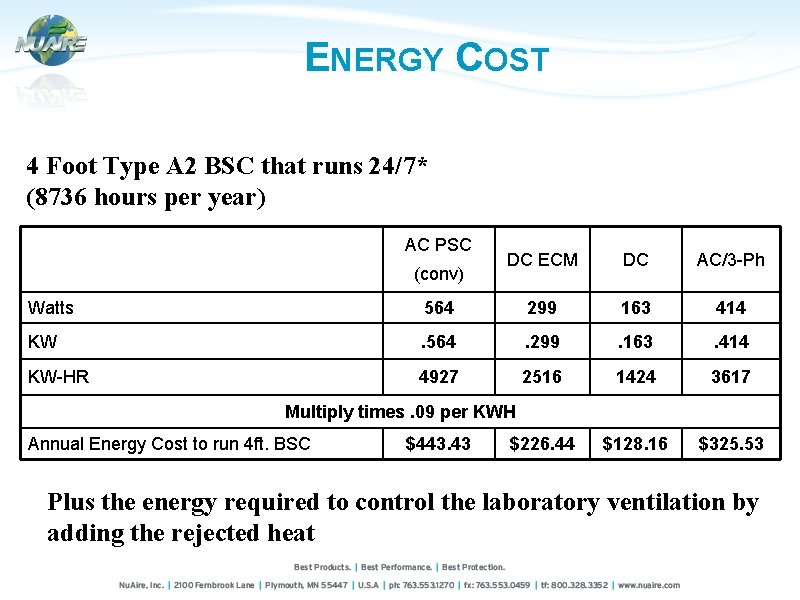
ENERGY COST 4 Foot Type A 2 BSC that runs 24/7* (8736 hours per year) AC PSC (conv) DC ECM DC AC/3 -Ph Watts 564 299 163 414 KW . 564 . 299 . 163 . 414 KW-HR 4927 2516 1424 3617 $226. 44 $128. 16 $325. 53 Multiply times. 09 per KWH Annual Energy Cost to run 4 ft. BSC $443. 43 Plus the energy required to control the laboratory ventilation by adding the rejected heat
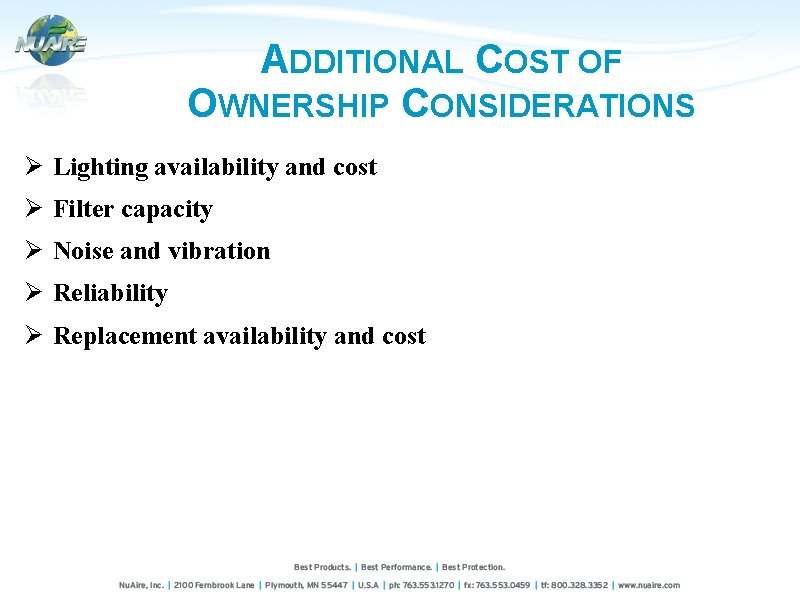
ADDITIONAL COST OF OWNERSHIP CONSIDERATIONS Ø Lighting availability and cost Ø Filter capacity Ø Noise and vibration Ø Reliability Ø Replacement availability and cost
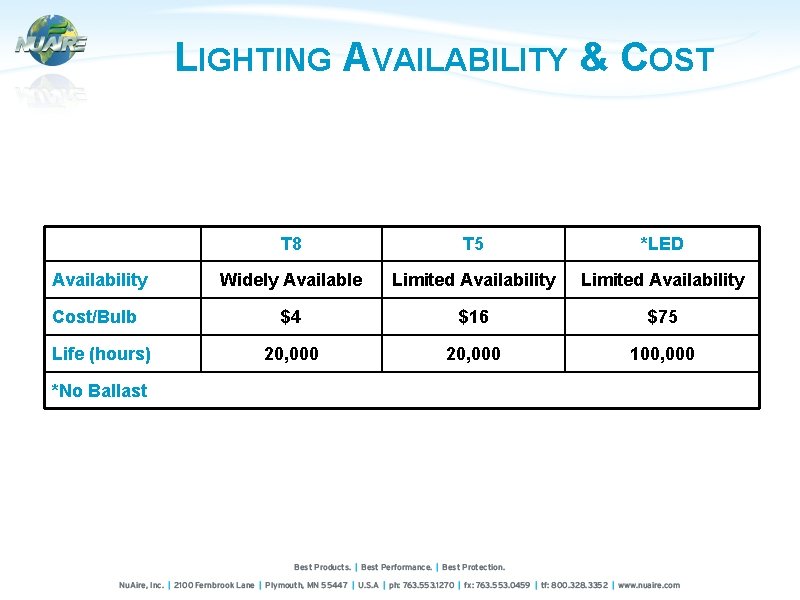
LIGHTING AVAILABILITY & COST T 8 T 5 *LED Availability Widely Available Limited Availability Cost/Bulb $4 $16 $75 20, 000 100, 000 Life (hours) *No Ballast
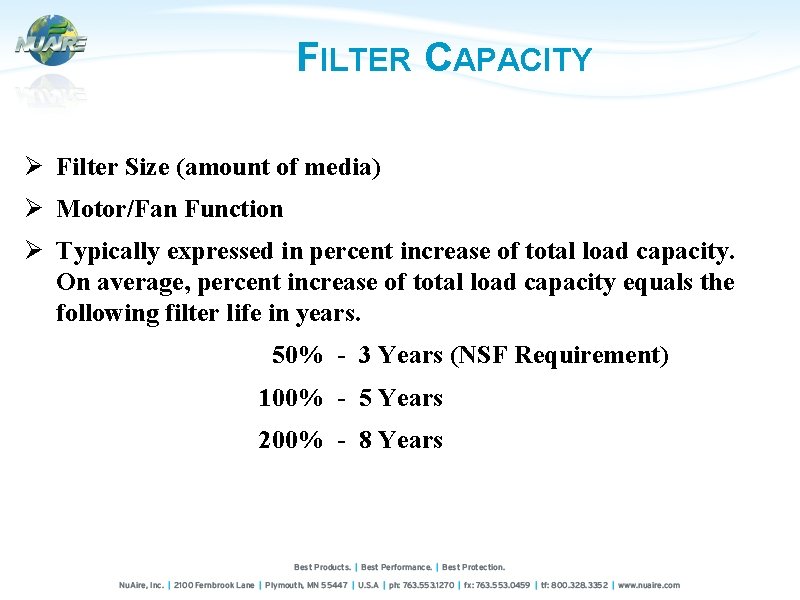
FILTER CAPACITY Ø Filter Size (amount of media) Ø Motor/Fan Function Ø Typically expressed in percent increase of total load capacity. On average, percent increase of total load capacity equals the following filter life in years. 50% - 3 Years (NSF Requirement) 100% - 5 Years 200% - 8 Years
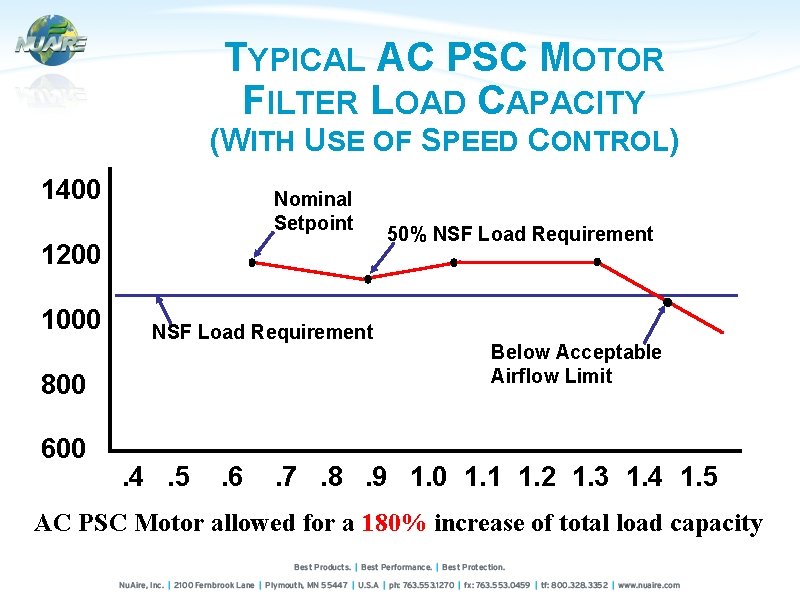
TYPICAL AC PSC MOTOR FILTER LOAD CAPACITY (WITH USE OF SPEED CONTROL) 1400 Nominal Setpoint 1200 1000 NSF Load Requirement 800 600 . 4. 5 . 6 50% NSF Load Requirement Below Acceptable Airflow Limit . 7. 8. 9 1. 0 1. 1 1. 2 1. 3 1. 4 1. 5 AC PSC Motor allowed for a 180% increase of total load capacity
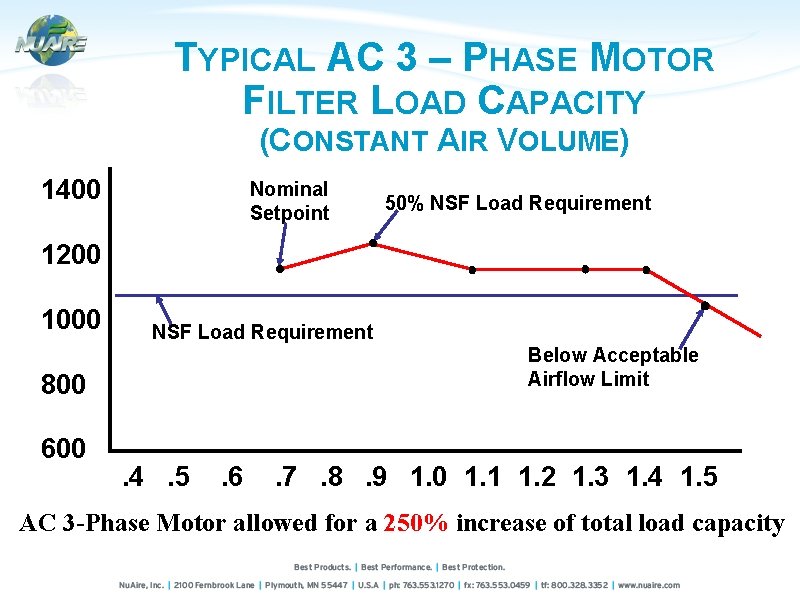
TYPICAL AC 3 – PHASE MOTOR FILTER LOAD CAPACITY (CONSTANT AIR VOLUME) 1400 Nominal Setpoint 50% NSF Load Requirement 1200 1000 NSF Load Requirement Below Acceptable Airflow Limit 800 600 . 4. 5 . 6 . 7. 8. 9 1. 0 1. 1 1. 2 1. 3 1. 4 1. 5 AC 3 -Phase Motor allowed for a 250% increase of total load capacity
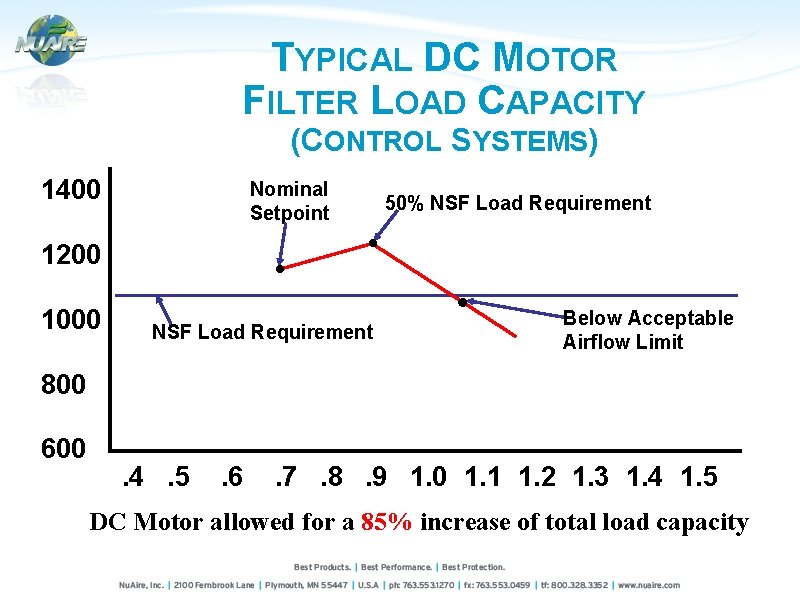
TYPICAL DC MOTOR FILTER LOAD CAPACITY (CONTROL SYSTEMS) 1400 Nominal Setpoint 50% NSF Load Requirement 1200 1000 NSF Load Requirement Below Acceptable Airflow Limit 800 600 . 4. 5 . 6 . 7. 8. 9 1. 0 1. 1 1. 2 1. 3 1. 4 1. 5 DC Motor allowed for a 85% increase of total load capacity
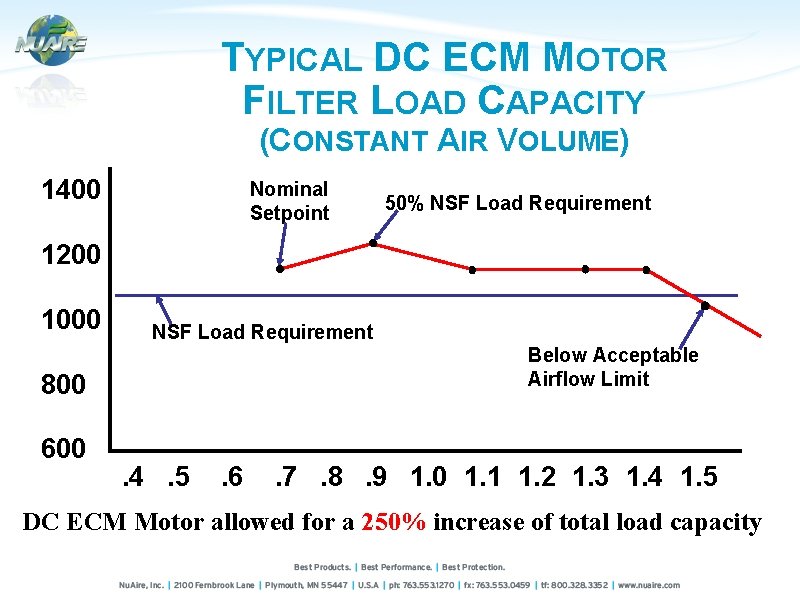
TYPICAL DC ECM MOTOR FILTER LOAD CAPACITY (CONSTANT AIR VOLUME) 1400 Nominal Setpoint 50% NSF Load Requirement 1200 1000 NSF Load Requirement Below Acceptable Airflow Limit 800 600 . 4. 5 . 6 . 7. 8. 9 1. 0 1. 1 1. 2 1. 3 1. 4 1. 5 DC ECM Motor allowed for a 250% increase of total load capacity
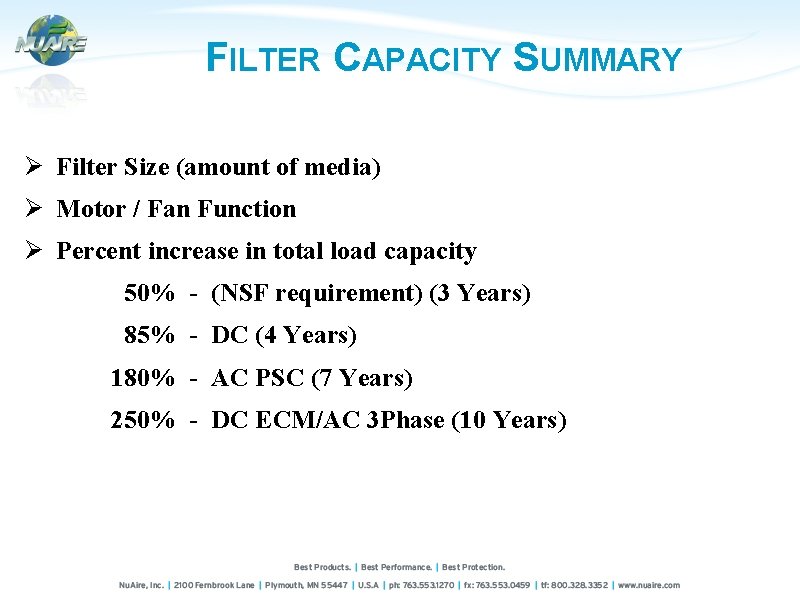
FILTER CAPACITY SUMMARY Ø Filter Size (amount of media) Ø Motor / Fan Function Ø Percent increase in total load capacity 50% - (NSF requirement) (3 Years) 85% - DC (4 Years) 180% - AC PSC (7 Years) 250% - DC ECM/AC 3 Phase (10 Years)
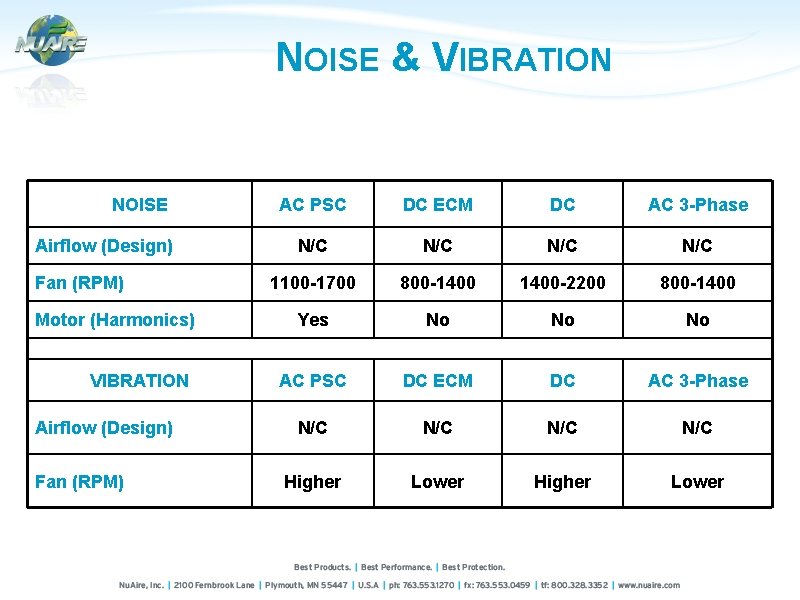
NOISE & VIBRATION NOISE Airflow (Design) Fan (RPM) Motor (Harmonics) VIBRATION Airflow (Design) Fan (RPM) AC PSC DC ECM DC AC 3 -Phase N/C N/C 1100 -1700 800 -1400 -2200 800 -1400 Yes No No No AC PSC DC ECM DC AC 3 -Phase N/C N/C Higher Lower
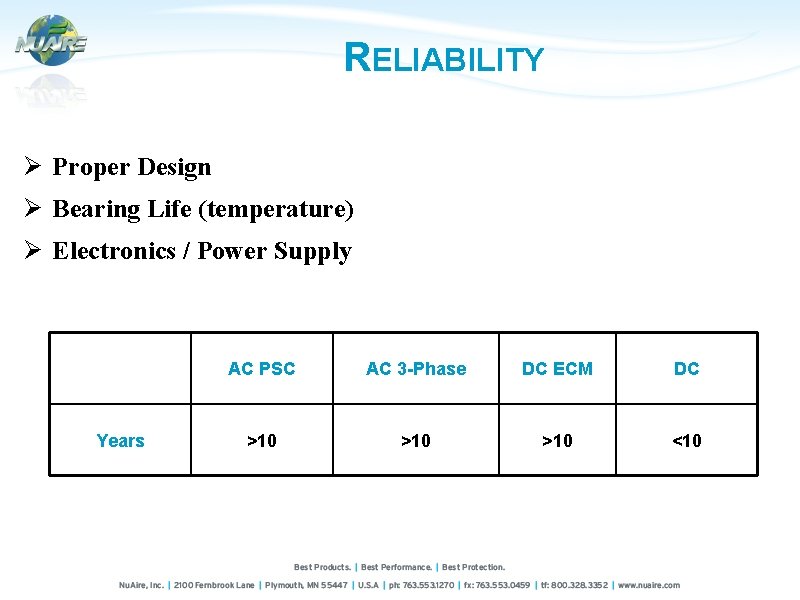
RELIABILITY Ø Proper Design Ø Bearing Life (temperature) Ø Electronics / Power Supply Years AC PSC AC 3 -Phase DC ECM DC >10 >10 <10
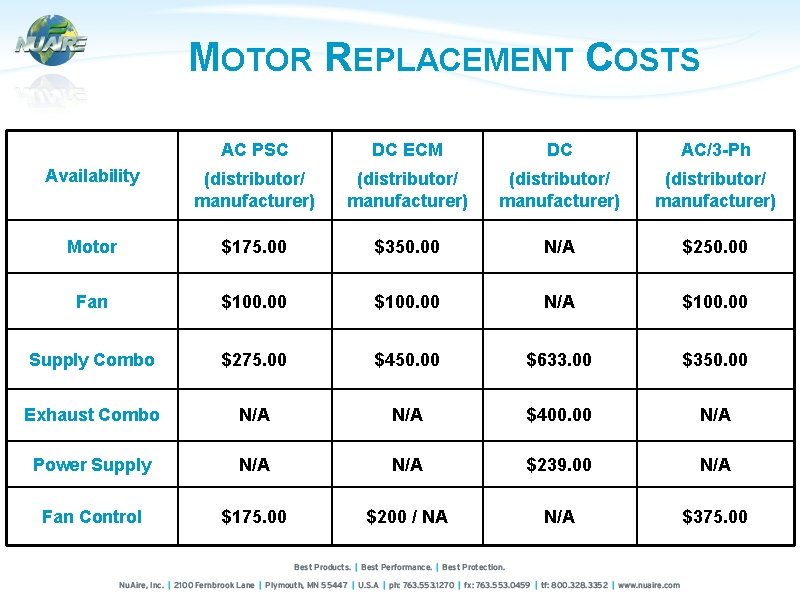
MOTOR REPLACEMENT COSTS AC PSC DC ECM DC AC/3 -Ph Availability (distributor/ manufacturer) Motor $175. 00 $350. 00 N/A $250. 00 Fan $100. 00 N/A $100. 00 Supply Combo $275. 00 $450. 00 $633. 00 $350. 00 Exhaust Combo N/A $400. 00 N/A Power Supply N/A $239. 00 N/A Fan Control $175. 00 $200 / NA N/A $375. 00
NIGHT SETBACK Ø Application Driven Ø Type A 2 BSC’s – reduce fan / motor speed & close window Ø Type B 1/B 2 BSC’s – reduce exhaust volume and/or fan / motor and close window Ø BSC / HVAC interface

- Slides: 86