
Biological Pest Control in Global Agriculture William C
Biological Pest Control in Global Agriculture William C. Dunham Managing Partner Dunham. Trimmer LLC 1 May 2015 1
Overview • • Introduction Climate Change Sustainable Agriculture Biological Ag Industries Global Landscape / Stats “Snake Oil” to Science Market Attractiveness 1 May 2015 Market Drivers Multinationals M&A Bio. Control Companies— Types--Limiters • Case Study—Brazil 2014 • Closing • • 2
Introduction Personal Background 2007—Founded International Bio Consultants LLC • >35 years in global agri-business • Crop protection-Seeds • Agra. Quest, BASF, American Cyanamid, Dekalb Genetics, ICI, Stauffer Chemical • Worked in Argentina-Spain-UK-USA • >10 years in Biological Industries • • 2013—Launched 2 BMonthly 2011—Co-Founded Dunham. Trimmer LLC • The Global Biocontrol & Biostimulant e-Newsletter • Joint effort New Ag Int’l & Dunham. Trimmer • Subscribers: Companies, individuals interested in biological industries • Premier Biological Industries Market Research Firm • Clients: Multinational CPC; Bio Companies; Investors; NGO’s • Due Diligence, Multi-client market data, Single client studies 1 May 2015 Global Bio. Control Industry Global Project Management Launch companies internationally Launch product internationally 3
Climate Change Impacts Crops Through: q Increased CO 2 concentration q Higher temperatures q Altered, more variable precipitation patterns EFFECTS W Ø Vary b ILL NOT BE UNIF ORM y crop & geograp hy blems: ro p st e p r e lt a l il w Climate Change itude is uncertain n g a m l a ti n te o than crops P O v C r e h ig 2 h m o fr ct pressure more t se fi in e n & e b se s a d e e is e d w t n e la v Som se or reduce p a re c in n a c s re tu le will change p o v Higher tempera e p r o s p ro c g in sts attack v The range of pe Extreme weather events will be more common: ü Heat waves, droughts, freezing, floods……… ü Timing & location of these events during crop development can greatly influence the impact Source: US EPA 1 May 2015 4
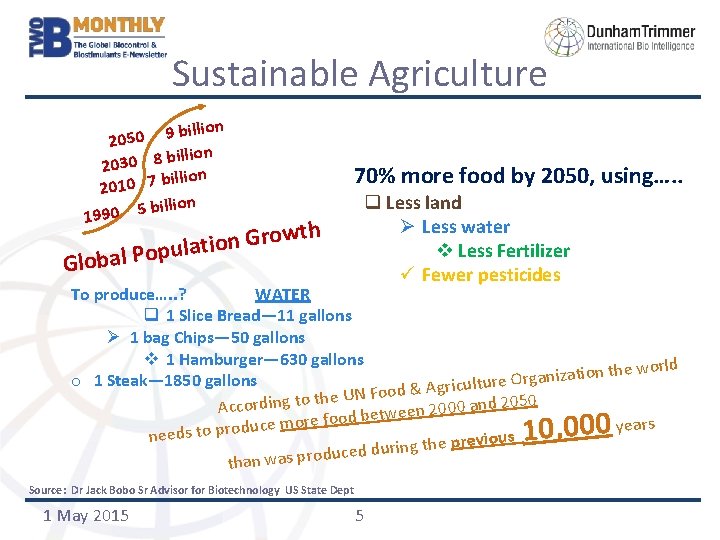
Sustainable Agriculture llion i b 9 0 205 billion 2030 8 illion 2010 7 b illion b 5 0 9 19 Glob 70% more food by 2050, using…. . th row G n o i t a l al Popu q Less land Ø Less water v Less Fertilizer ü Fewer pesticides To produce…. . ? WATER q 1 Slice Bread— 11 gallons Ø 1 bag Chips— 50 gallons v 1 Hamburger— 630 gallons e world h t n io t a iz n a g o 1 Steak— 1850 gallons iculture Or r g A & d o o F the UN and 2050 0 0 According to 0 2 n e e w t re food be o m e c u years d o r p needs to s u g the previo in r u d d e c u d than was pro 10, 000 Source: Dr Jack Bobo Sr Advisor for Biotechnology US State Dept 1 May 2015 5
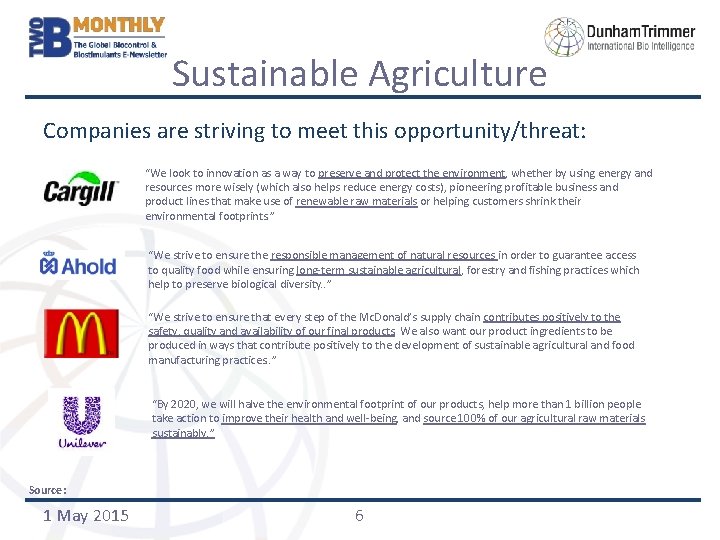
Sustainable Agriculture Companies are striving to meet this opportunity/threat: “We look to innovation as a way to preserve and protect the environment, whether by using energy and resources more wisely (which also helps reduce energy costs), pioneering profitable business and product lines that make use of renewable raw materials or helping customers shrink their environmental footprints. ” “We strive to ensure the responsible management of natural resources in order to guarantee access to quality food while ensuring long-term sustainable agricultural, forestry and fishing practices which help to preserve biological diversity. . ” “We strive to ensure that every step of the Mc. Donald’s supply chain contributes positively to the safety, quality and availability of our final products. We also want our product ingredients to be produced in ways that contribute positively to the development of sustainable agricultural and food manufacturing practices. . ” “By 2020, we will halve the environmental footprint of our products, help more than 1 billion people take action to improve their health and well-being, and source 100% of our agricultural raw materials sustainably. ” Source: 1 May 2015 6
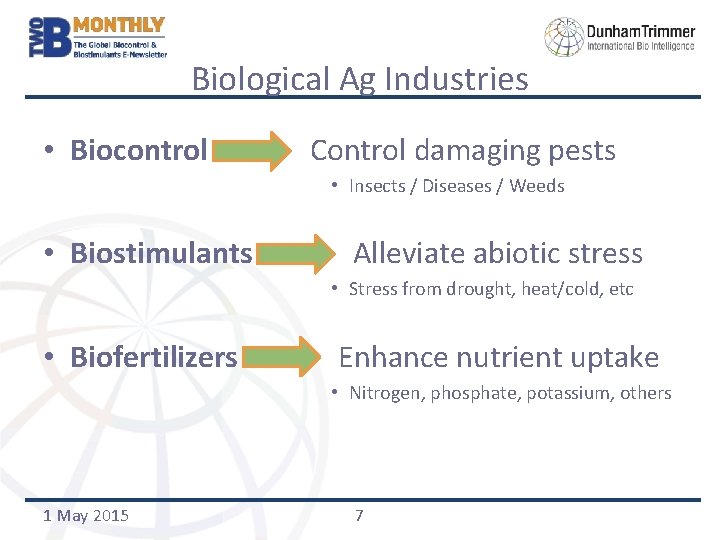
Biological Ag Industries • Biocontrol Control damaging pests • Insects / Diseases / Weeds • Biostimulants Alleviate abiotic stress • Stress from drought, heat/cold, etc • Biofertilizers Enhance nutrient uptake • Nitrogen, phosphate, potassium, others 1 May 2015 7
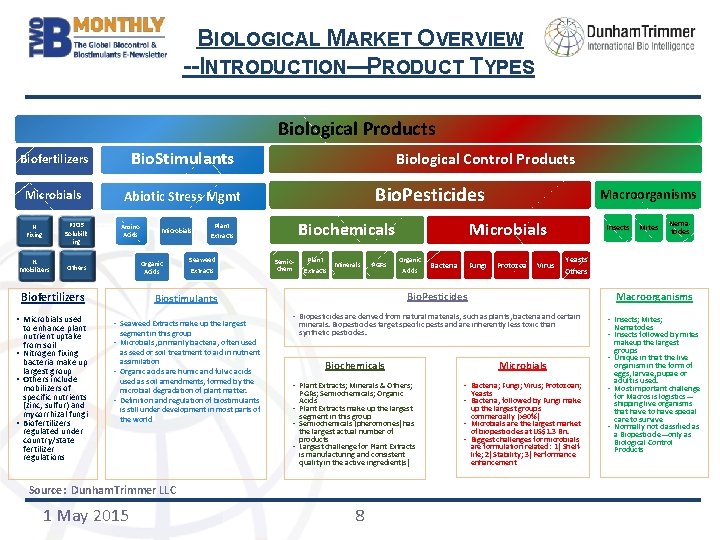
BIOLOGICAL MARKET OVERVIEW --INTRODUCTION—PRODUCT TYPES Biological Products Biofertilizers Bio. Stimulants Microbials Abiotic Stress Mgmt N Fixing P 2 O 5 Solubiliz ing K Mobilizers Others Amino Acids Organic Acids Biofertilizers • Microbials used to enhance plant nutrient uptake from soil • Nitrogen fixing bacteria make up largest group • Others include mobilizers of specific nutrients (zinc, sulfur) and mycorrhizal fungi • Biofertilizers regulated under country/state fertilizer regulations Microbials Biological Control Products Bio. Pesticides Biochemicals Plant Extracts Seaweed Extracts Semiochem Plant Extracts Minerals PGRs segment in this group • Microbials, primarily bacteria, often used as seed or soil treatment to aid in nutrient assimilation • Organic acids are humic and fulvic acids used as soil amendments, formed by the microbial degradation of plant matter. • Definition and regulation of biostimulants is still under development in most parts of the world Organic Acids Fungi Bacteria Protozoa Virus Insects Biochemicals PGRs; Semiochemicals; Organic Acids • Plant Extracts make up the largest segment in this group • Semiochemicals (pheromones) has the largest actual number of products • Largest challenge for Plant Extracts is manufacturing and consistent quality in the active ingredient(s) 8 Nematodes Macroorganisms minerals. Biopesticides target specific pests and are inherently less toxic than synthetic pesticides. • Plant Extracts; Minerals & Others; Mites Yeasts Others • Biopesticides are derived from natural materials, such as plants, bacteria and certain Source: Dunham. Trimmer LLC 1 May 2015 Microbials Bio. Pesticides Biostimulants • Seaweed Extracts make up the largest Macroorganisms Microbials • Bacteria; Fungi; Virus; Protozoan; Yeasts • Bacteria, followed by Fungi make up the largest groups commercially (>90%) • Microbials are the largest market of biopesticides at US$1. 3 Bn. • Biggest challenges for microbials are formulation related: 1) Shelflife; 2) Stability; 3) Performance enhancement • Insects; Mites; Nematodes • Insects followed by mites makeup the largest groups • Unique in that the live organism in the form of eggs, larvae, pupae or adult is used. • Most important challenge for Macros is logistics— shipping live organisms that have to have special care to survive • Normally not classified as a Biopesticide—only as Biological Control Products
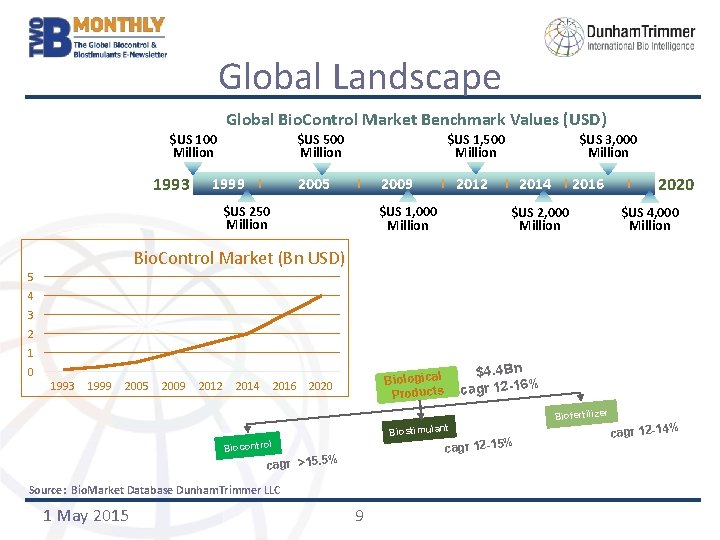
Global Landscape Global Bio. Control Market Benchmark Values (USD) $US 100 Million 1993 $US 500 Million 1999 $US 3, 000 Million $US 1, 500 Million 2005 2009 $US 250 Million 2012 $US 1, 000 Million 2014 2016 $US 2, 000 Million 2020 $US 4, 000 Million Bio. Control Market (Bn USD) 5 4 3 2 1 0 1993 1999 2005 2009 2012 2014 2016 $4. 4 Bn cagr 12 -16% Biological Products 2020 Biostimulan cagr 12 -15% Biocontrol cagr >15. 5% Source: Bio. Market Database Dunham. Trimmer LLC 1 May 2015 t 9 Biofertilizer cagr 12 -14%
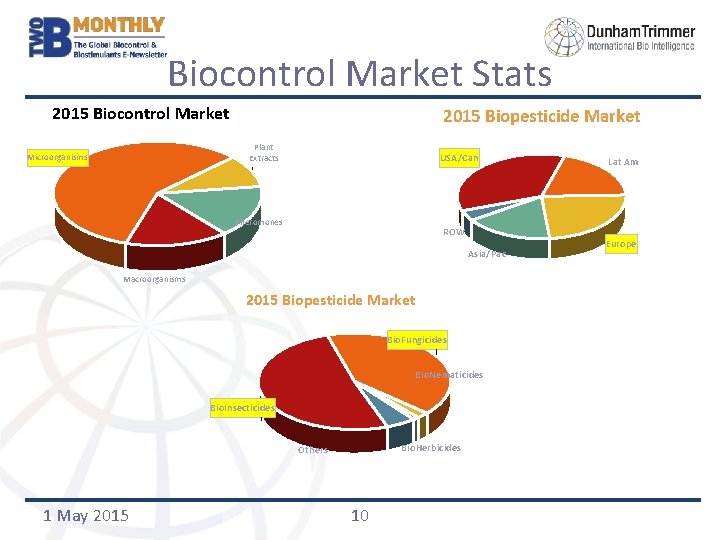
Biocontrol Market Stats 2015 Biocontrol Market 2015 Biopesticide Market Plant Extracts Microorganisms USA/Can Pheromones ROW Asia/Pac Macroorganisms 2015 Biopesticide Market Bio. Fungicides Bio. Nematicides Bio. Insecticides Bio. Herbicides Others 1 May 2015 10 Lat Am Europe
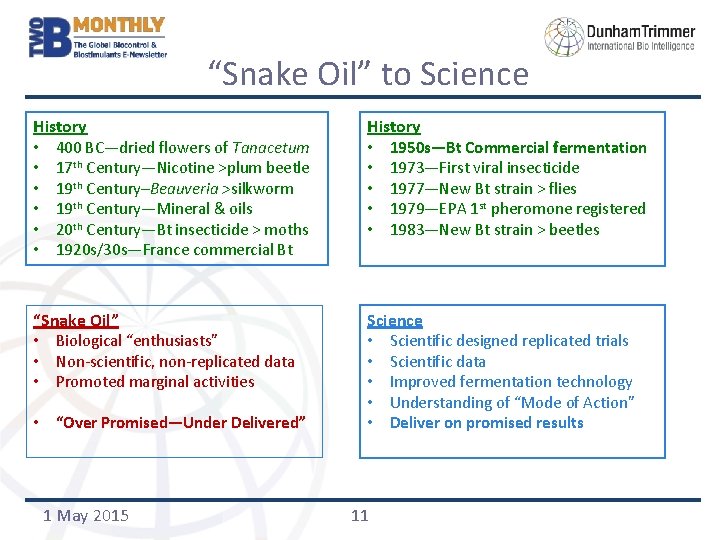
“Snake Oil” to Science History • 400 BC—dried flowers of Tanacetum • 17 th Century—Nicotine >plum beetle • 19 th Century–Beauveria >silkworm • 19 th Century—Mineral & oils • 20 th Century—Bt insecticide > moths • 1920 s/30 s—France commercial Bt History • 1950 s—Bt Commercial fermentation • 1973—First viral insecticide • 1977—New Bt strain > flies • 1979—EPA 1 st pheromone registered • 1983—New Bt strain > beetles “Snake Oil” • Biological “enthusiasts” • Non-scientific, non-replicated data • Promoted marginal activities Science • Scientific designed replicated trials • Scientific data • Improved fermentation technology • Understanding of “Mode of Action” • Deliver on promised results • “Over Promised—Under Delivered” 1 May 2015 11
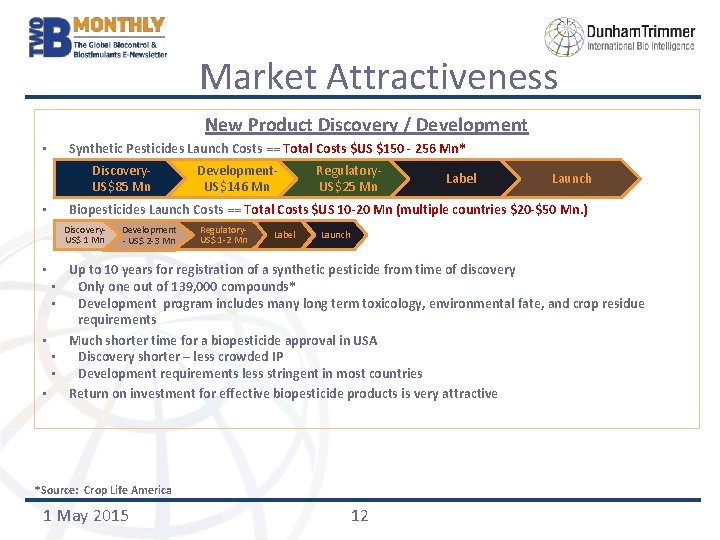
Market Attractiveness New Product Discovery / Development Synthetic Pesticides Launch Costs == Total Costs $US $150 - 256 Mn* • Discovery. US$85 Mn Regulatory. US$25 Mn Label Launch Biopesticides Launch Costs == Total Costs $US 10 -20 Mn (multiple countries $20 -$50 Mn. ) • Discovery. US$ 1 Mn • • Development. US$146 Mn Development - US$ 2 -3 Mn Regulatory. US$ 1 -2 Mn Label Launch Up to 10 years for registration of a synthetic pesticide from time of discovery Only one out of 139, 000 compounds* Development program includes many long term toxicology, environmental fate, and crop residue requirements Much shorter time for a biopesticide approval in USA Discovery shorter – less crowded IP Development requirements less stringent in most countries Return on investment for effective biopesticide products is very attractive *Source: Crop Life America 1 May 2015 12
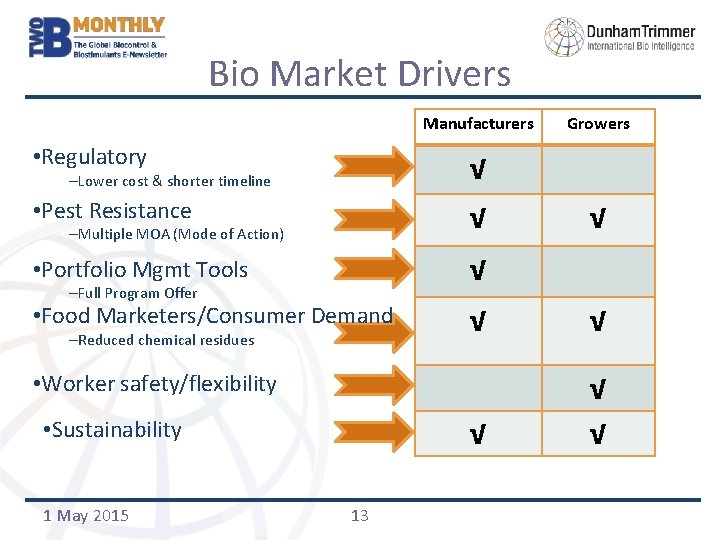
Bio Market Drivers Manufacturers Growers • Regulatory √ • Pest Resistance √ • Portfolio Mgmt Tools √ • Food Marketers/Consumer Demand √ √ √ –Lower cost & shorter timeline –Multiple MOA (Mode of Action) –Full Program Offer –Reduced chemical residues • Worker safety/flexibility • Sustainability 1 May 2015 13 √
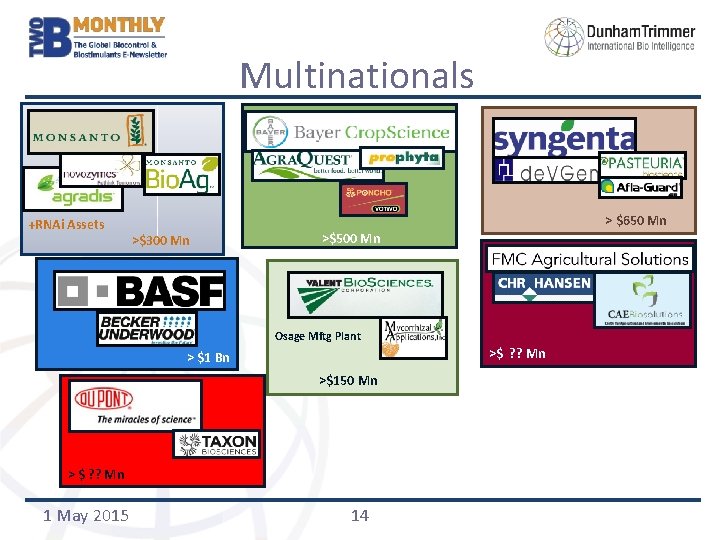
Multinationals +RNAi Assets > $650 Mn >$300 Mn >$500 Mn Osage Mftg Plant >$ ? ? Mn > $1 Bn >$150 Mn > $ ? ? Mn 1 May 2015 14
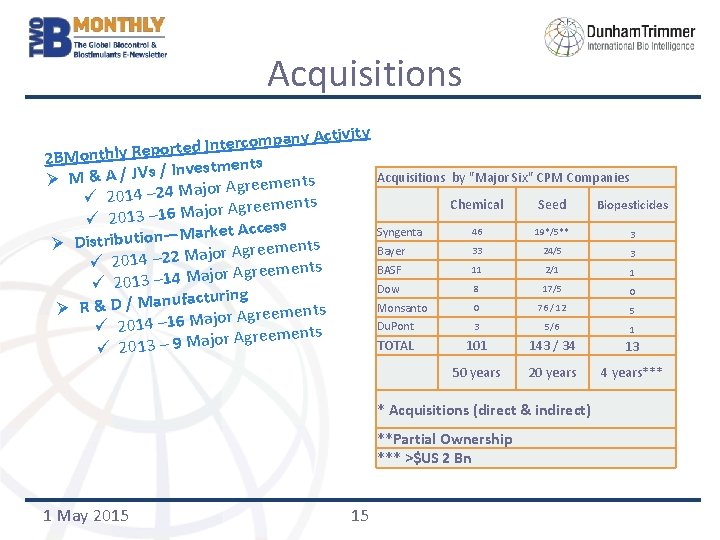
Acquisitions ny Activity a p m o c r e t In d orte 2 BMonthly Rep / Investments s JV / A & M Ø reements g A r jo a M 4 2 – ü 2014 ements e r g A r jo a M 6 1 ü 2013 – Access t e k r a M — n io t Ø Distribu reements g A r jo a M 2 2 – ü 2014 ments e e r g A r jo a M 4 ü 2013 – 1 cturing fa u n a M / D & Ø R ements e r g A r jo a M 6 1 ü 2014 – greements A r jo a M 9 – 3 1 ü 20 Acquisitions by "Major Six" CPM Companies Chemical Seed Biopesticides Syngenta 46 19*/5** 3 Bayer 33 24/5 3 BASF 11 2/1 1 Dow 8 17/5 0 Monsanto 0 76 / 12 5 Du. Pont 3 5/6 1 TOTAL 101 143 / 34 13 50 years 20 years 4 years*** * Acquisitions (direct & indirect) **Partial Ownership *** >$US 2 Bn 1 May 2015 15
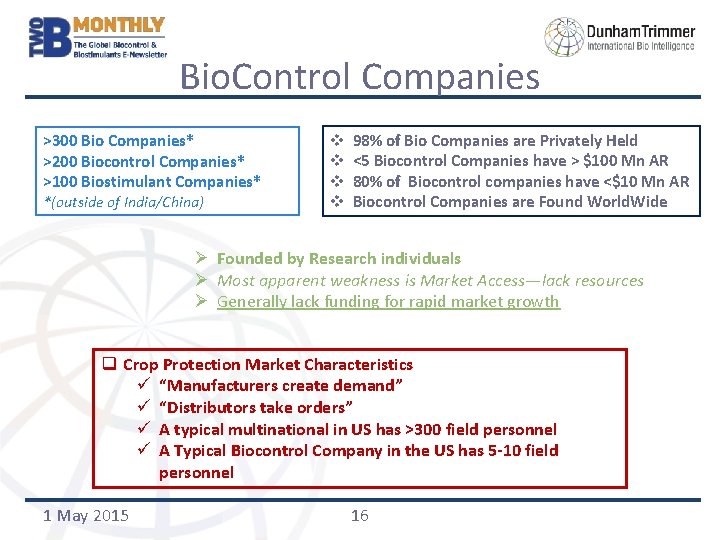
Bio. Control Companies >300 Bio Companies* >200 Biocontrol Companies* >100 Biostimulant Companies* *(outside of India/China) v v 98% of Bio Companies are Privately Held <5 Biocontrol Companies have > $100 Mn AR 80% of Biocontrol companies have <$10 Mn AR Biocontrol Companies are Found World. Wide Ø Founded by Research individuals Ø Most apparent weakness is Market Access—lack resources Ø Generally lack funding for rapid market growth q Crop Protection Market Characteristics ü “Manufacturers create demand” ü “Distributors take orders” ü A typical multinational in US has >300 field personnel ü A Typical Biocontrol Company in the US has 5 -10 field personnel 1 May 2015 16
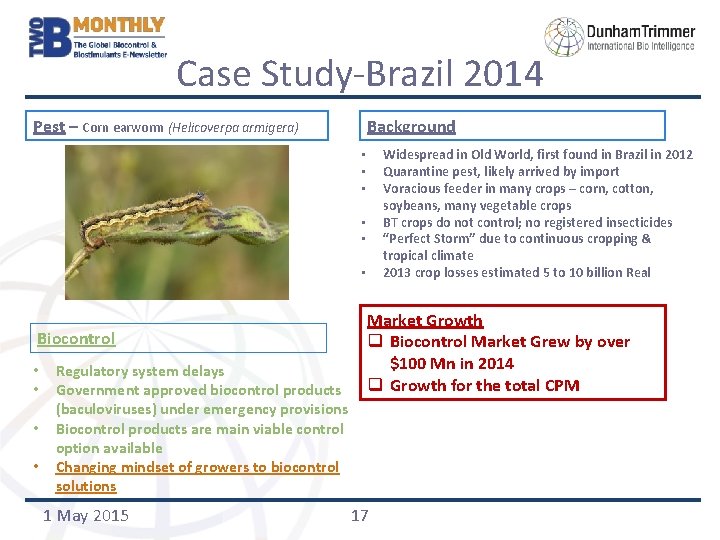
Case Study-Brazil 2014 Pest – Corn earworm (Helicoverpa armigera) Background Widespread in Old World, first found in Brazil in 2012 Quarantine pest, likely arrived by import Voracious feeder in many crops – corn, cotton, soybeans, many vegetable crops BT crops do not control; no registered insecticides “Perfect Storm” due to continuous cropping & tropical climate 2013 crop losses estimated 5 to 10 billion Real • • • Biocontrol • • Regulatory system delays Government approved biocontrol products (baculoviruses) under emergency provisions Biocontrol products are main viable control option available Changing mindset of growers to biocontrol solutions 1 May 2015 Market Growth q Biocontrol Market Grew by over $100 Mn in 2014 q Growth for the total CPM 17
Closing • Biological Ag Industries – Biocontrol / Biostimulants / Biofertilizers • Green technology / Sustainable technology • More efficient use of resources – Pesticides / Fertilizers / Inputs • Rapidly growing entrepreneurial companies 1 May 2015 18
THANK-YOU FOR YOUR ATTENTION DUNHAMTRIMMER. COM Bill@ or Mark@ Dunham. Trimmer. com 1 May 2015 19
- Slides: 19