
Biological or biochemical oxygen demand BOD NoorusSabah Lecturer

Biological or biochemical oxygen demand (BOD) Noor-us-Sabah Lecturer Dept. Soil & Environmental Sciences
BOD • In the presence of free oxygen, aerobic bacteria use the organic matter found in wastewater as “food”. • The BOD test is an estimate of the “food” available in the sample. • The more “food” present in the waste, the more Dissolved Oxygen (DO) will be required. • The BOD test measures the strength of the wastewater by measuring the amount of oxygen used by the bacteria as they stabilize the organic matter under controlled conditions of time and temperature.
• The BOD test is used to measure waste loads to treatment plants, determine plant efficiency (in terms of BOD removal), and control plant processes. • It is also used to determine the effects of discharges on receiving waters. A major disadvantage of the BOD test is the amount of time (5 days) required to obtain the results. • When a measurement is made of all oxygen consuming materials in a sample, the result is termed “Total Biochemical Oxygen Demand” (TBOD), or often just simply “Biochemical Oxygen Demand” (BOD). Because the test is performed over a five day period, it is often referred to as a “Five Day BOD”, or a BOD 5.
• In many biological treatment plants, the facility effluent contains large numbers of nitrifying organisms which are developed during the treatment process. • These organisms can exert an oxygen demand as they convert nitrogenous compounds (ammonia and organic nitrogen) to more stable forms (nitrites and nitrates). • At least part of this oxygen demand is normally measured in a five day BOD. • Sometimes it is advantageous to measure just the oxygen demand exerted by organic (carbonaceous) compounds, excluding the oxygen demand exerted by the nitrogenous compounds. • To accomplish this, the nitrifying organisms can be inhibited from using oxygen by the addition of a nitrification inhibitor to the samples. The result is termed “Carbonaceous Biochemical Oxygen Demand”, or CBOD.
• What is biological oxygen demand (BOD)? • Biological oxygen demand (BOD), also known as biochemical oxygen demand, is a procedure that measures the dissolved oxygen (DO) consumed by bacteria from the decomposition of organic matter. • The BOD analysis is an attempt to simulate by a laboratory test the effect that organic material in a water body will have on the DO in that water body. Biochemical oxygen demand values are a measure of food for naturally occurring microorganisms or, in other words, a measure of the concentration of biodegradable organic material. When nutrients are introduced, naturally occurring microorganisms begin to multiply at an exponential rate, resulting in the reduction of DO in the water. The test does not determine the total amount of oxygen demand present, since many compounds are not oxidized by microorganisms under conditions of the test.

• Pure water BOD = 1 ppm • Polluted water BOD = 5 ppm or above

BOD level in ppm Water Quality 1 -2 Very Good There will not be much organic waste present in the water supply 3 -5 Fair: Moderately Clean 6 -9 Poor: Somewhat Polluted Usually indicates organic matter is present and bacteria are decomposing this waste. 100 or greater Very Poor: Very Polluted Contains organic waste.
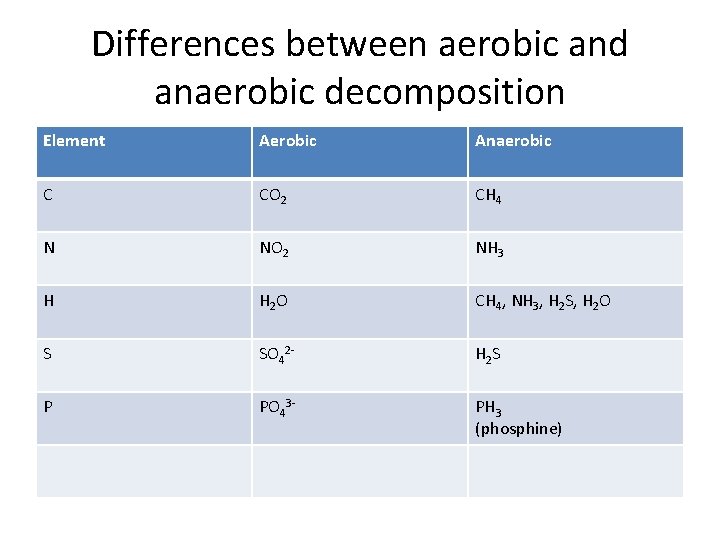
Differences between aerobic and anaerobic decomposition Element Aerobic Anaerobic C CO 2 CH 4 N NO 2 NH 3 H H 2 O CH 4, NH 3, H 2 S, H 2 O S SO 42 - H 2 S P PO 43 - PH 3 (phosphine)
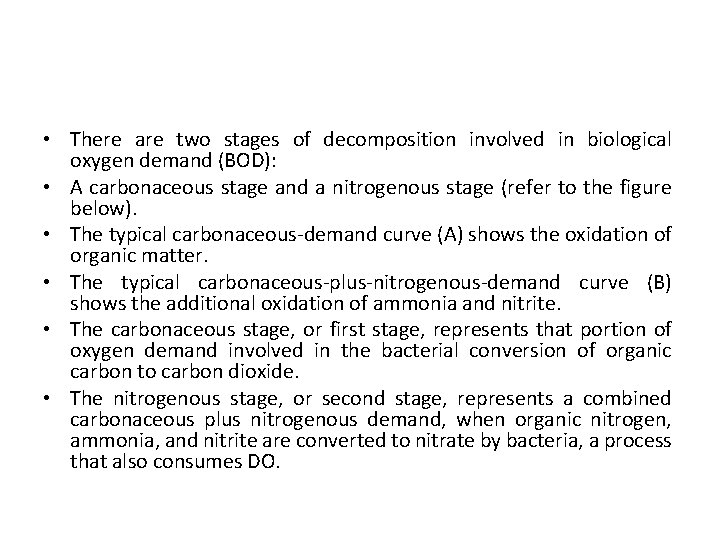
• There are two stages of decomposition involved in biological oxygen demand (BOD): • A carbonaceous stage and a nitrogenous stage (refer to the figure below). • The typical carbonaceous-demand curve (A) shows the oxidation of organic matter. • The typical carbonaceous-plus-nitrogenous-demand curve (B) shows the additional oxidation of ammonia and nitrite. • The carbonaceous stage, or first stage, represents that portion of oxygen demand involved in the bacterial conversion of organic carbon to carbon dioxide. • The nitrogenous stage, or second stage, represents a combined carbonaceous plus nitrogenous demand, when organic nitrogen, ammonia, and nitrite are converted to nitrate by bacteria, a process that also consumes DO.
• The most common method for measuring BOD is the 5 -day BOD method (BOD 5), which is a method approved by the U. S. Environmental Protection Agency (EPA) for use during regulatory monitoring. • In the BOD 5 test, which uses naturally occurring microorganisms to oxidize the carbonaceous organic matter, the change in DO concentration is measured before and after a 5 -day period in water samples that are incubated at a specified temperature (20 °C ± 1 °C) in darkness. • The BOD test results are reported as mg/L DO. 1 The BOD 5 method measures most of the carbonaceous stage of the BOD (typically about 60% to 70%; refer to the figure showing Biological Oxygen Demand). • This method has been widely adopted as a standard, based on historical use and convenience, since it is usually impractical to wait 20 or more days for the outcome of the test.
• Why measure BOD? • Biological oxygen demand is an important water quality parameter because it greatly influences the concentration of DO that will be in the water. • The Q-value curve for BOD used in calculating a water quality index 2 illustrates the relationship between BOD and water quality—the higher the BOD, the lower the water quality, with 0 to 2 mg/L being associated with high water quality and values greater than 10 mg/L being associated with low water quality (refer to the BOD Test Results chart).
• The BOD 5 test is used to measure the potential of wastewater and other waters to deplete the oxygen level of receiving waters. • The test is also used to examine influents and effluents from wastewater processing facilities to compute the efficiency of operation of the treatment units. • The Q-curve for BOD used in calculating a water quality index illustrates the relationship between BOD and water quality.
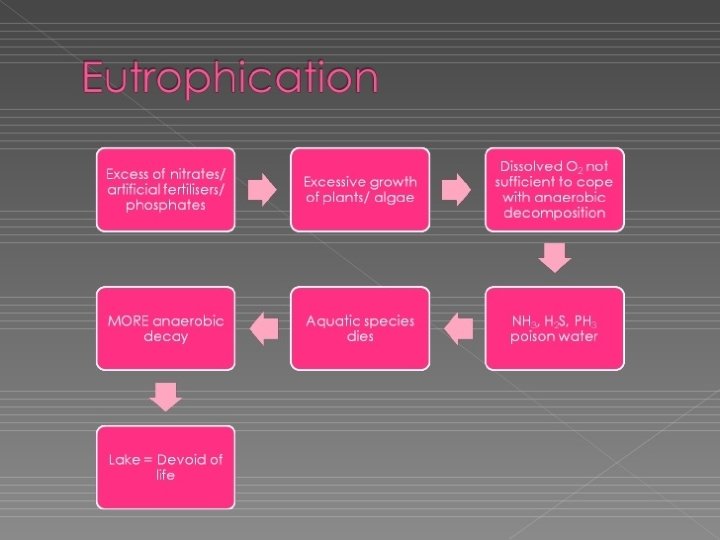
• What factors affect BOD levels? • Human and animal waste in sewage is a significant contributor to elevated BOD levels. • Runoff containing fertilizer from farms and other sources contributes to accelerated eutrophication, in which water bodies become choked with excessive plant growth, which contributes to the carbonaceous (organic) content of water bodies as these plants die and decompose. • Levels of BOD can be reduced by the introduction of low-BOD water from rain or snow melt. • Additionally, when animals and plants die and settle on the bottom of the water body under conditions that permanently remove them from the water column, BOD levels can drop. • Ultimately, river waters with high BOD discharge into the oceans where nutrients become highly diluted. The high BOD levels of untreated sewage are greatly reduced by wastewater treatment procedures.
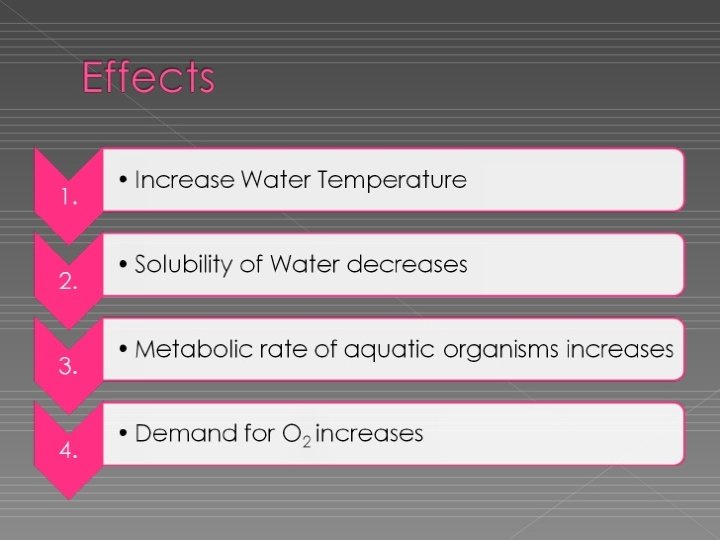
• What are ideal BOD values? • As shown on the BOD Q-curve, the less the BOD value, the better. • High BOD levels will result in anoxic conditions, with the resulting growth of anaerobic microorganisms that produce noxious gases and cause the death of aerobic aquatic organisms. • In the case of wastewater, the larger the drop in BOD following treatment procedures, the better. The regulated level of wastewater effluents depends on local conditions.
• GLOSSARY • Aerobic: A condition in which “free” or dissolved oxygen is present in an aquatic environment. • Anaerobic: A condition in which “free” or dissolved oxygen is not present in an aquatic environment. • Blank: A preliminary analysis omitting only the sample to provide an unbiased reference point or baseline for comparison. • Nitrification: An aerobic process in which bacteria change ammonia and organic nitrogen in wastewater into oxidized nitrogen (usually nitrate). The second-stage BOD is sometimes referred to as the “nitrification stage”. (The first stage is called the “carbonaceous stage”. ) • Nutrient: Any substance used by living things that promotes growth. • Respiration: The process in which an organism uses oxygen for its life processes and gives off carbon dioxide. • Seeding: The process of adding live bacteria to a sample.
- Slides: 17