
Biological Network Integration Using Convolutions Duncan Forster University

Biological Network Integration Using Convolutions Duncan Forster, University of Toronto Bader, Boone Labs June 16, 2020 1
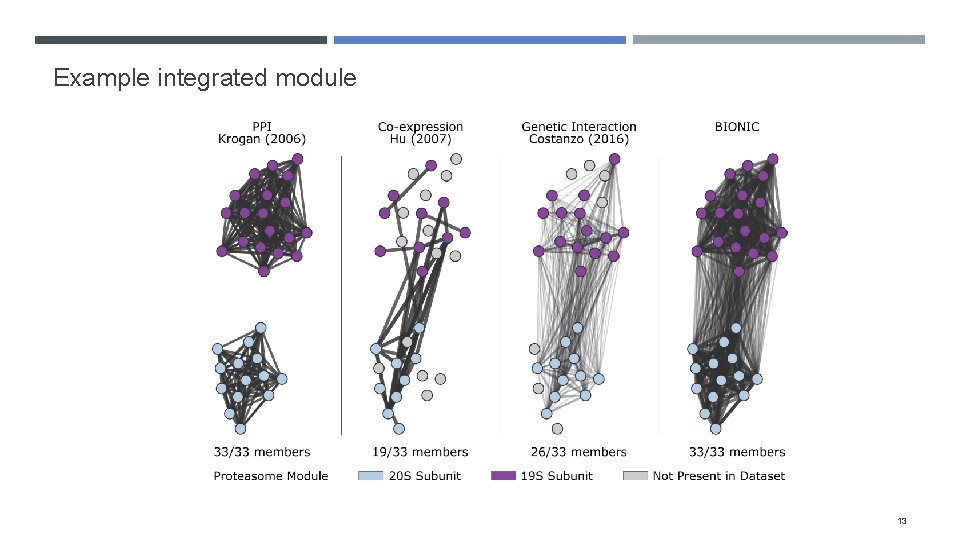
Some quick background A major goal in systems biology is to functionally characterize genes and identify the systems in which they operate (i. e. modules) Biological networks (i. e. PPI, COEX, GI) encode useful functional information, but each contain their own individual biases (e. g. only measure a certain part of the functional spectrum) and noise (include spurious relationships or miss true relationships) By integrating networks we can overcome these issues in order to more effectively characterize genes We’ve developed a network integration algorithm, BIONIC (Biological Network Integration using Convolutions), to do this 2
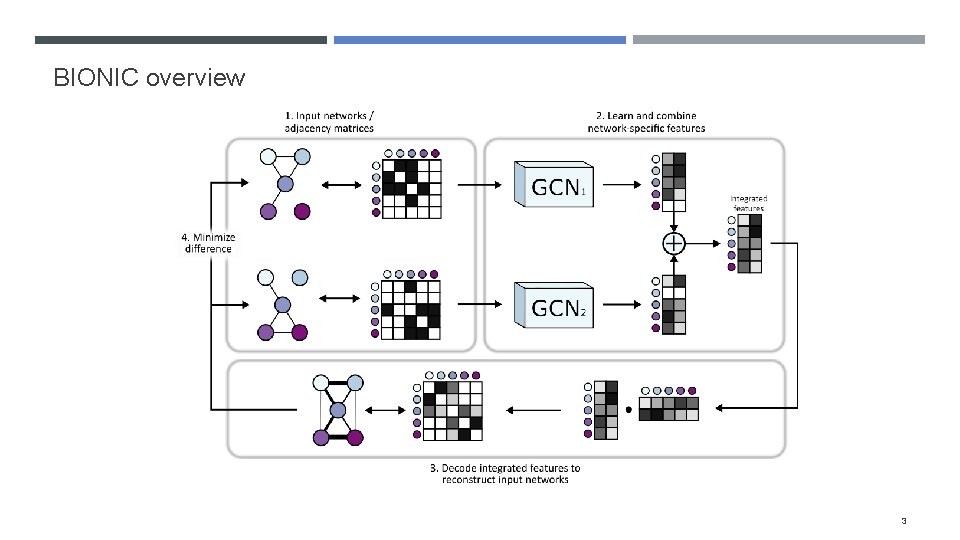
BIONIC overview 3

Some problems we encountered 4
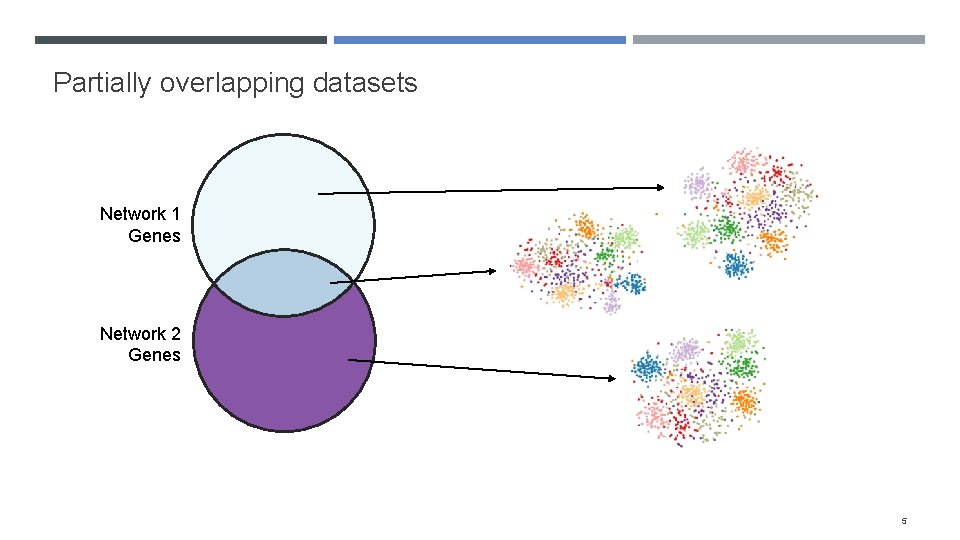
Partially overlapping datasets Network 1 Genes Network 2 Genes 5
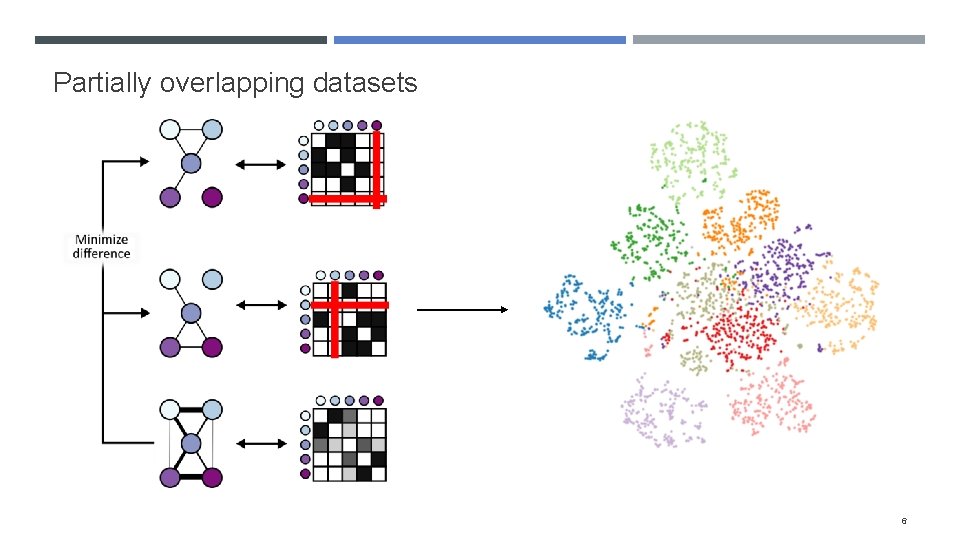
Partially overlapping datasets 6
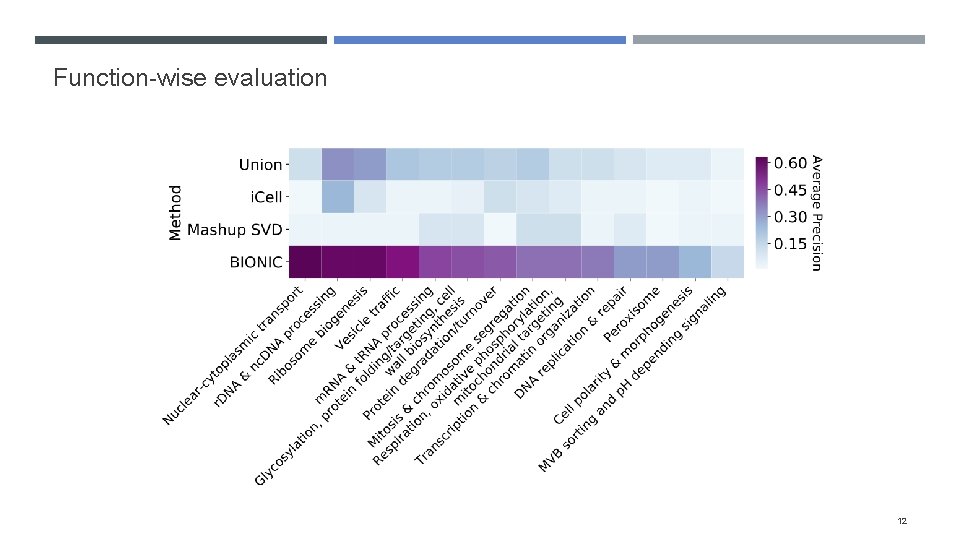
Evaluation techniques How do we construct benchmarks? Comparing method output to individual input networks is difficult when the input network has a subset of output genes How do we ensure method performance isn’t driven by bias in certain functional categories? We opted for three evaluation approaches: Gene-gene interaction assessment Functional module detection (cluster quality) Supervised gene function prediction 7

Acknowledgements Supervisors - Gary Bader - Charlie Boone Collaborators - Bo Wang 8
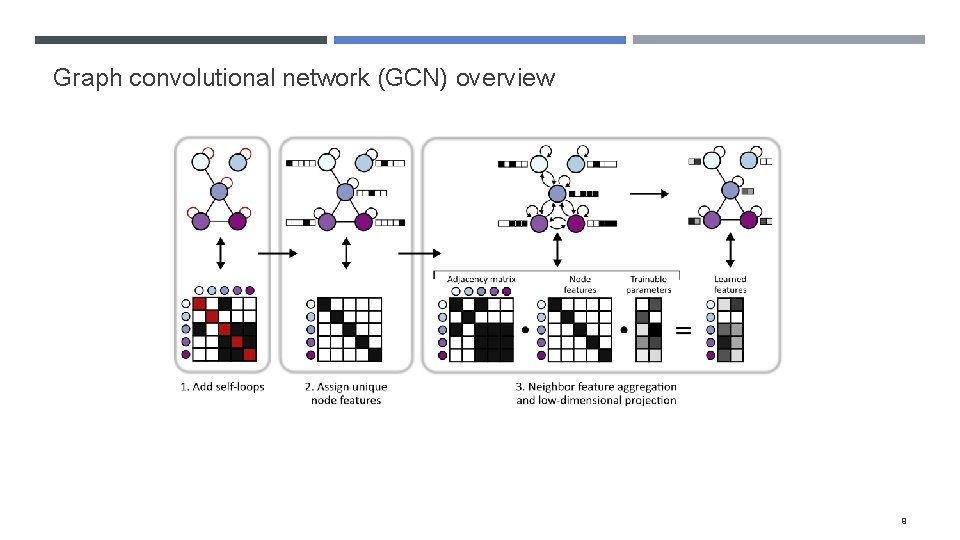
Graph convolutional network (GCN) overview 9
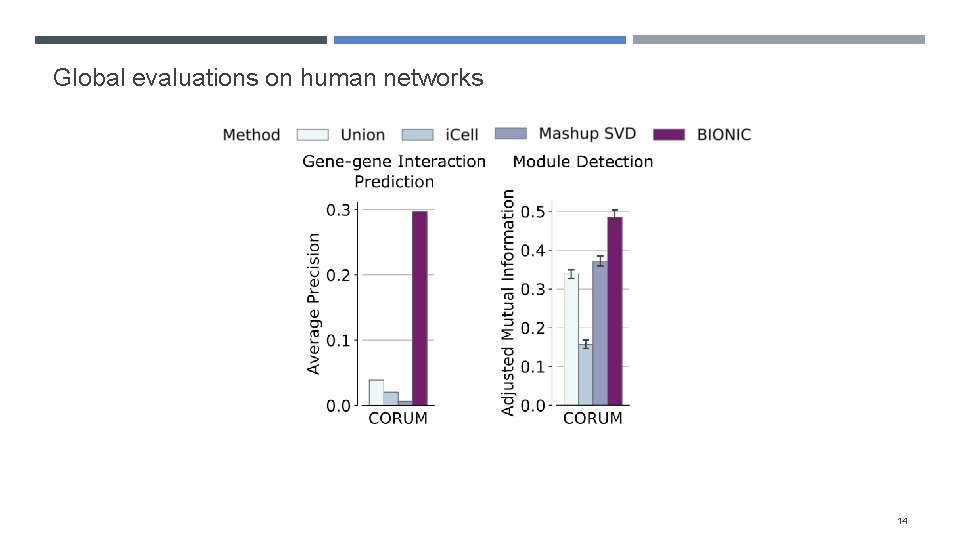
Evaluating BIONIC features Integrated 68 yeast networks, consisting of GI, COEX and PPI experiments Also integrated 37 human PPI networks Evaluated the performance of BIONIC integrated gene features on three downstream tasks Gene-gene interaction prediction Functional module detection Gene function prediction Compared BIONIC to three other integration approaches A naïve union of networks (combine all nodes and edges across networks) i. Cell, a matrix factorization approach Mashup, a diffusion state approximation method 10
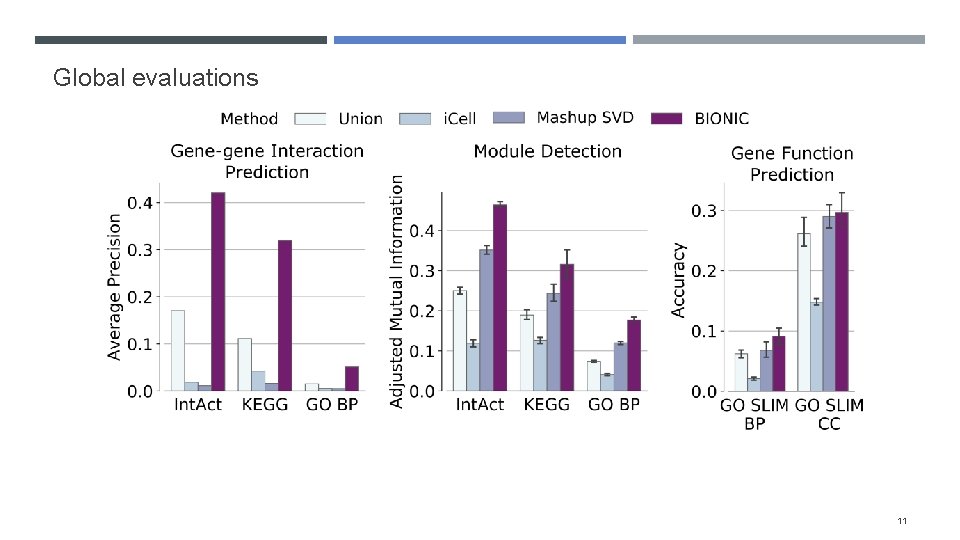
Global evaluations 11
Function-wise evaluation 12
Example integrated module 13
Global evaluations on human networks 14
Evaluating BIONIC scalability Many integration approaches either cannot scale to many networks or networks with many genes These methods either don’t run, or run with reduced performance (e. g. Mashup SVD) To assess whether BIONIC scales in number of networks, we integrate increasing numbers of yeast coexpression networks To determine if BIONIC scales in network size, we subsample genes from four human PPI networks and integrate them with increasing sample sizes 15
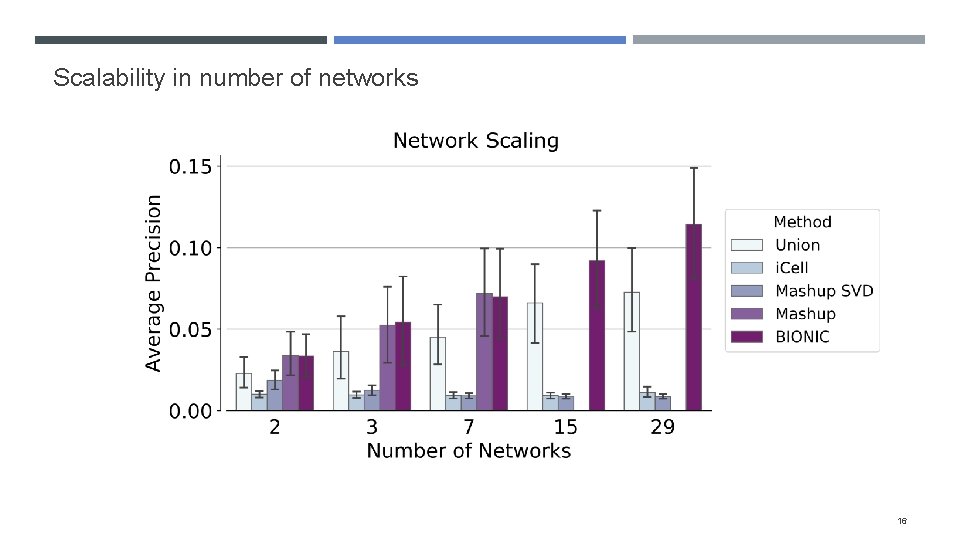
Scalability in number of networks 16
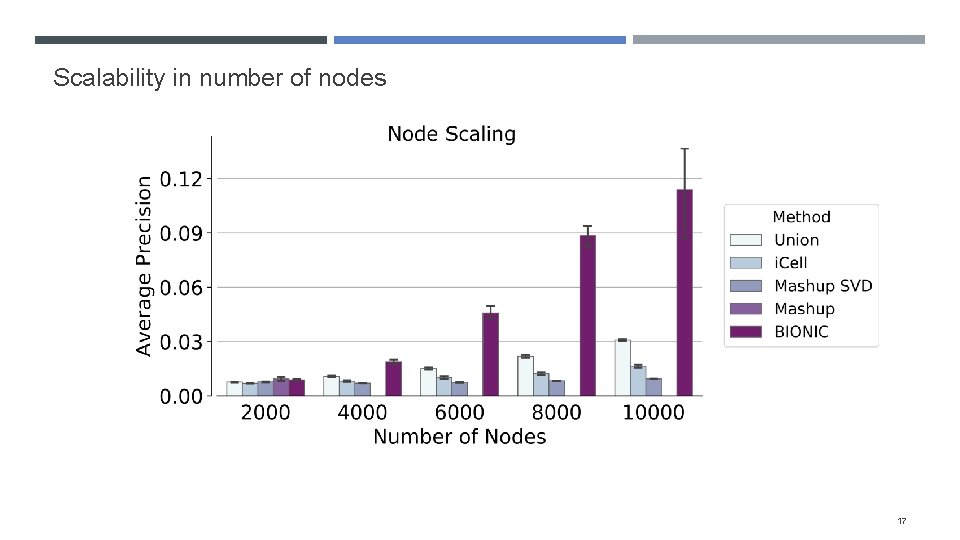
Scalability in number of nodes 17
- Slides: 17