
Biological Modeling of Neural Networks 1 1 Neurons
Biological Modeling of Neural Networks 1. 1 Neurons and Synapses: Overview Neuronal Dynamics: Computational Neuroscience of Single Neurons Week 1 – neurons and mathematics: a first simple neuron Wulfram Gerstner model EPFL, Lausanne, Switzerland 1. 2 The Passive Membrane - Linear circuit - Dirac delta-function 1. 3 Leaky Integrate-and-Fire Model 1. 4 Generalized Integrate-and -Fire Model 1. 5. Quality of Integrate-and. Fire Models
Biological Modeling of Neural Networks 1. 1 Neurons and Synapses: Overview 1. 2 The Passive Membrane - Linear circuit - Dirac delta-function 1. 3 Leaky Integrate-and-Fire Model 1. 4 Generalized Integrate-and -Fire Model 1. 5. Quality of Integrate-and. Fire Models
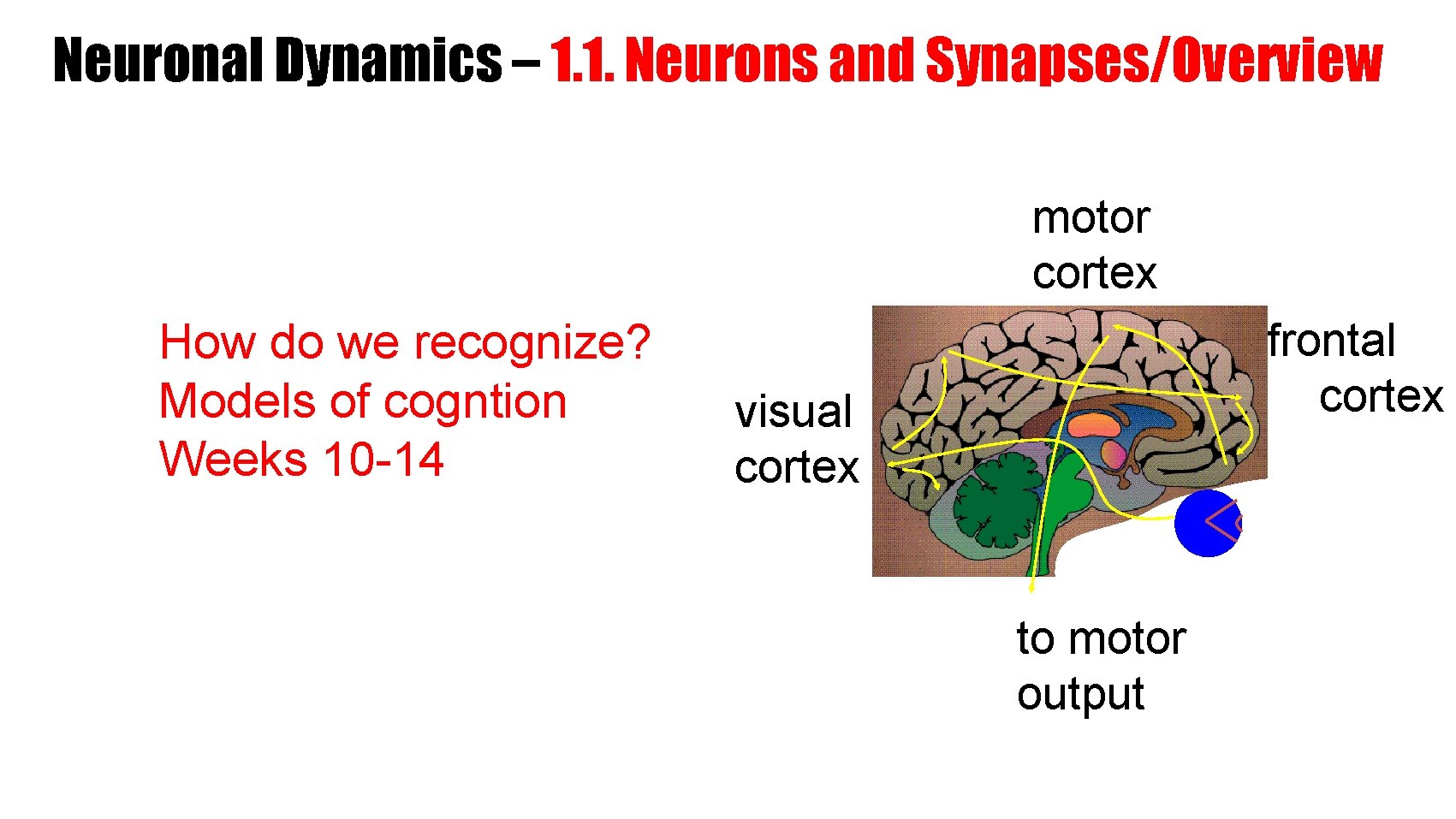
Neuronal Dynamics – 1. 1. Neurons and Synapses/Overview motor cortex How do we recognize? Models of cogntion Weeks 10 -14 frontal cortex visual cortex to motor output
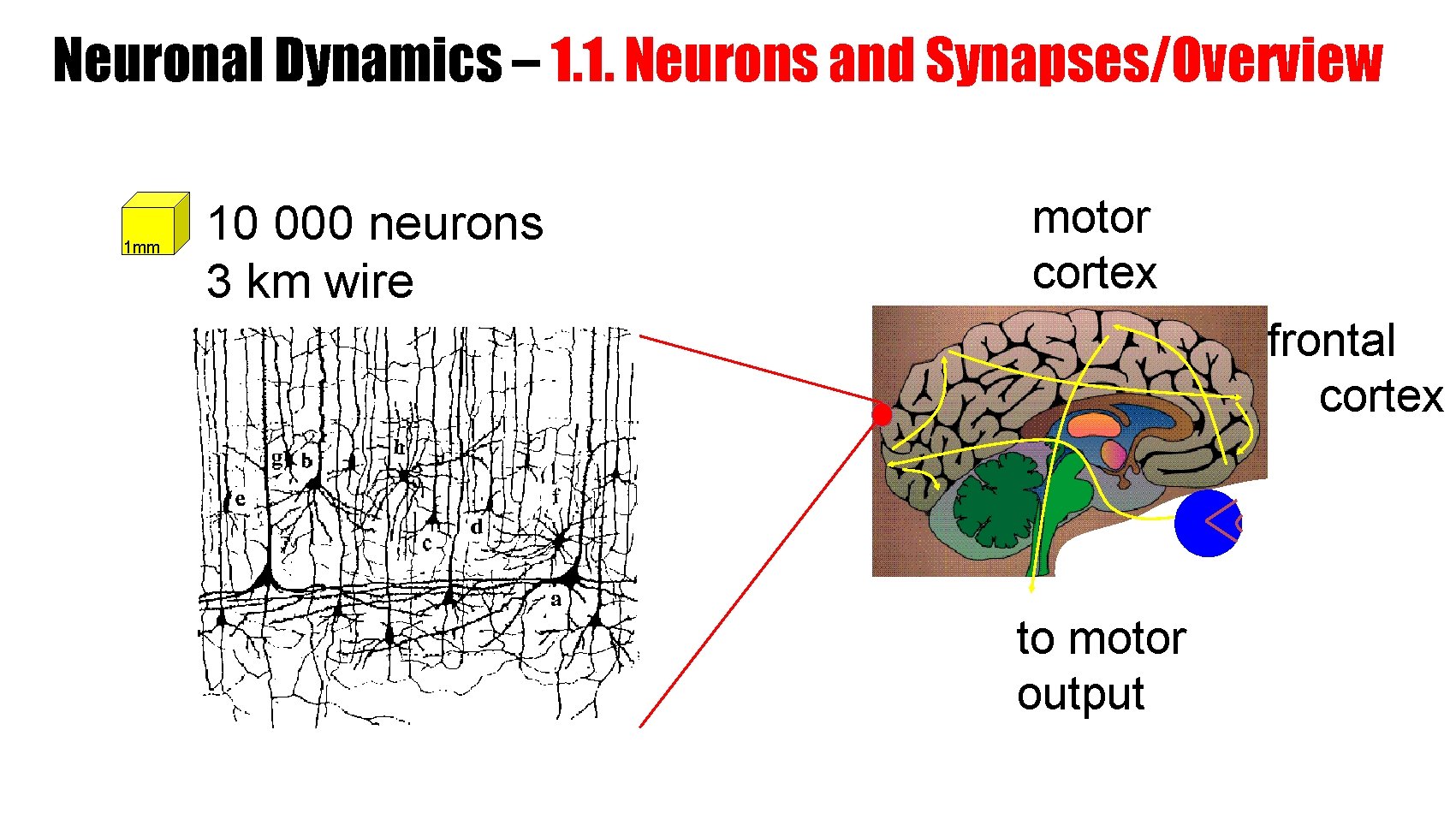
Neuronal Dynamics – 1. 1. Neurons and Synapses/Overview 1 mm 10 000 neurons 3 km wire motor cortex frontal cortex to motor output
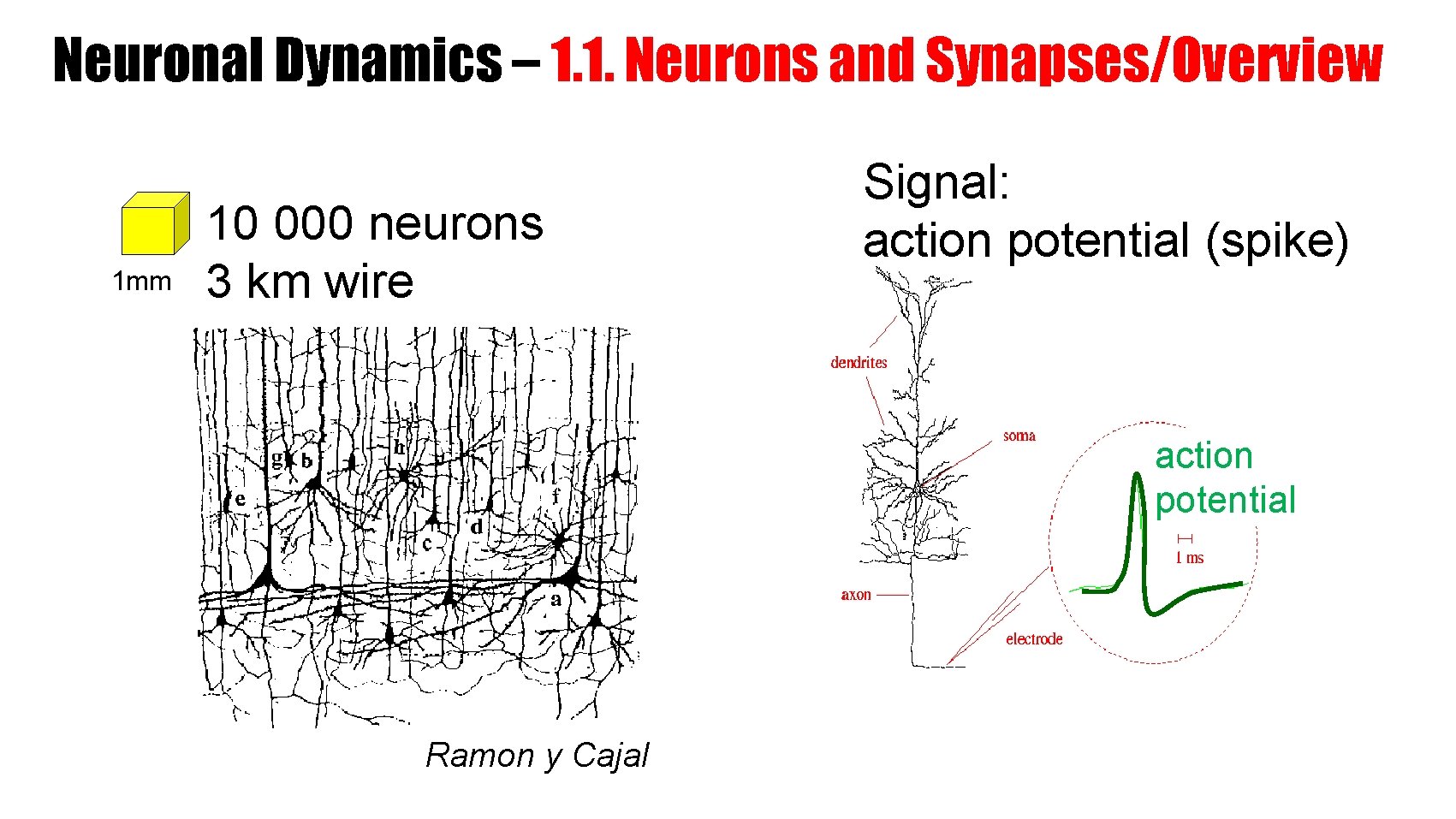
Neuronal Dynamics – 1. 1. Neurons and Synapses/Overview 1 mm 10 000 neurons 3 km wire Signal: action potential (spike) action potential Ramon y Cajal
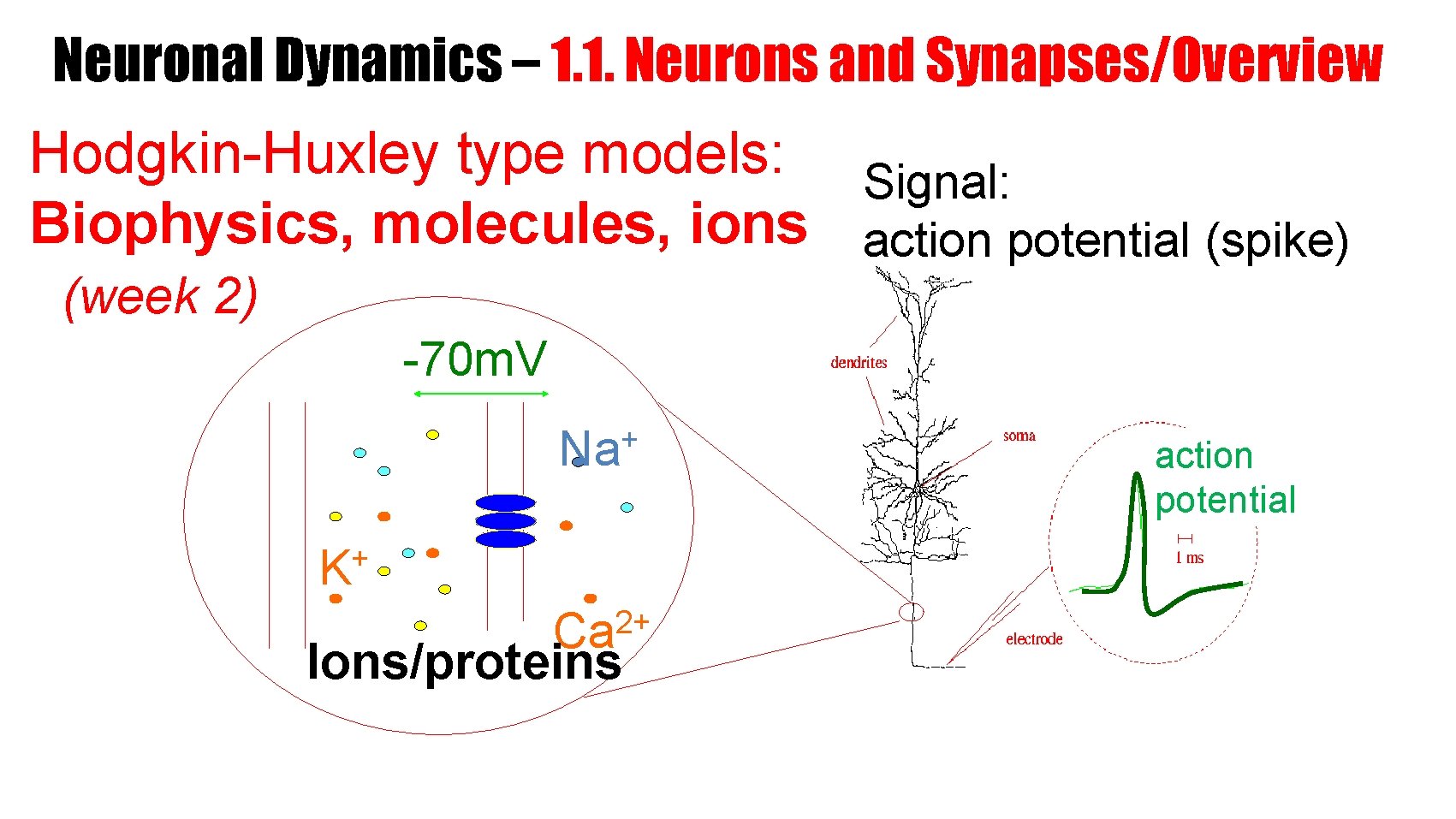
Neuronal Dynamics – 1. 1. Neurons and Synapses/Overview Hodgkin-Huxley type models: Signal: Biophysics, molecules, ions action potential (spike) (week 2) -70 m. V + Na + K 2+ Ca Ions/proteins action potential
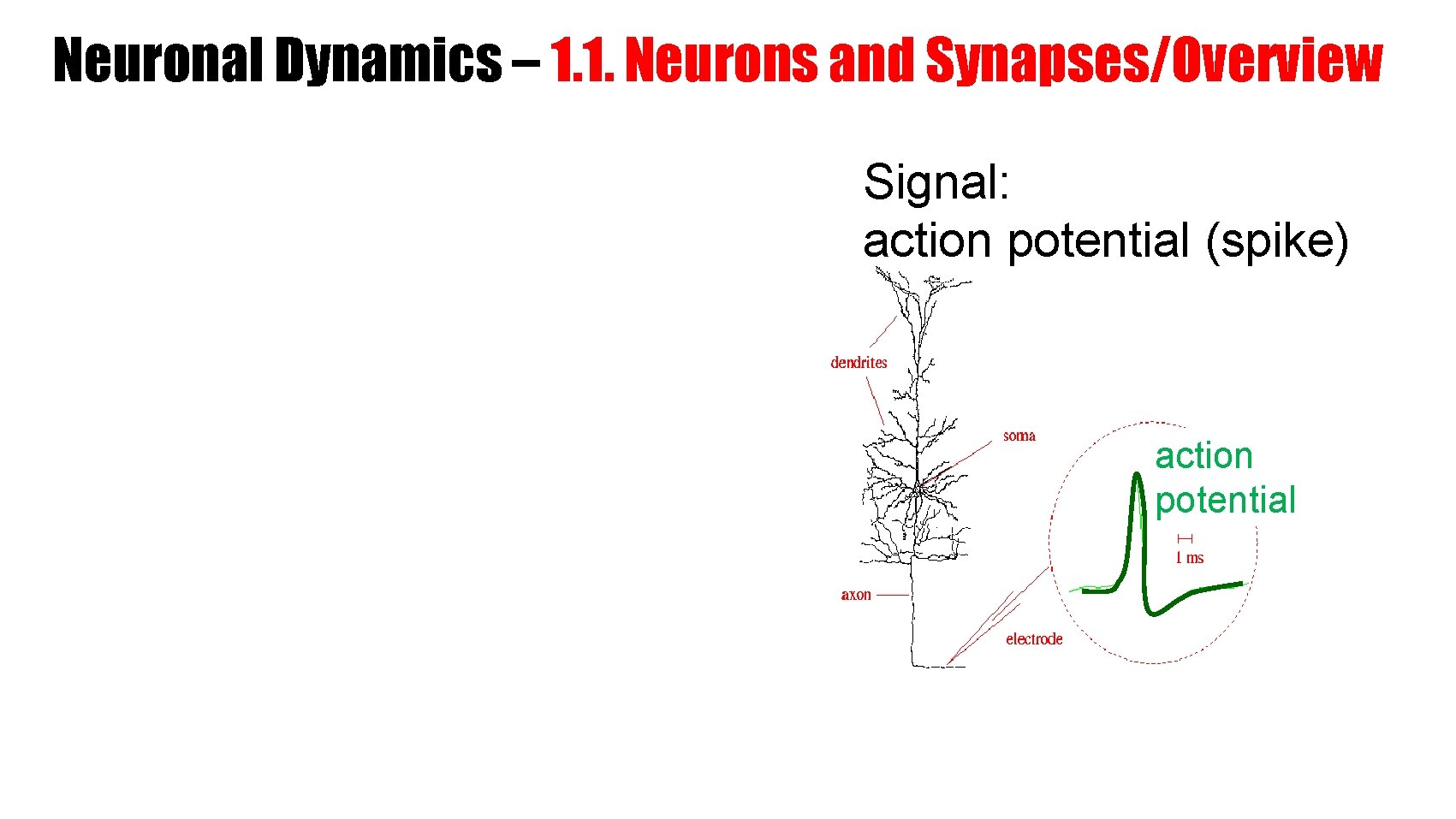
Neuronal Dynamics – 1. 1. Neurons and Synapses/Overview Signal: action potential (spike) action potential
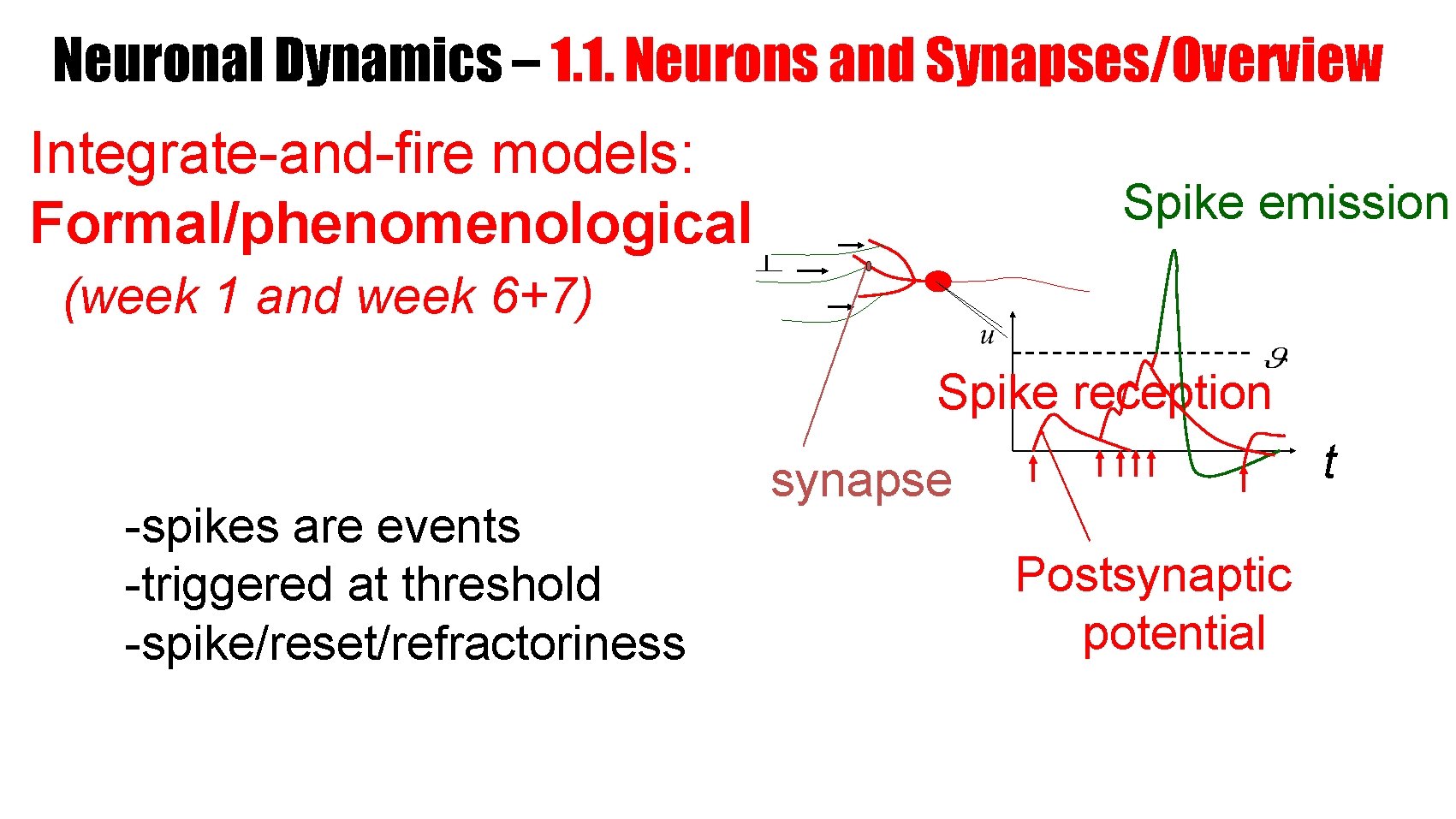
Neuronal Dynamics – 1. 1. Neurons and Synapses/Overview Integrate-and-fire models: Formal/phenomenological Spike emission (week 1 and week 6+7) Spike reception -spikes are events -triggered at threshold -spike/reset/refractoriness t synapse Postsynaptic potential
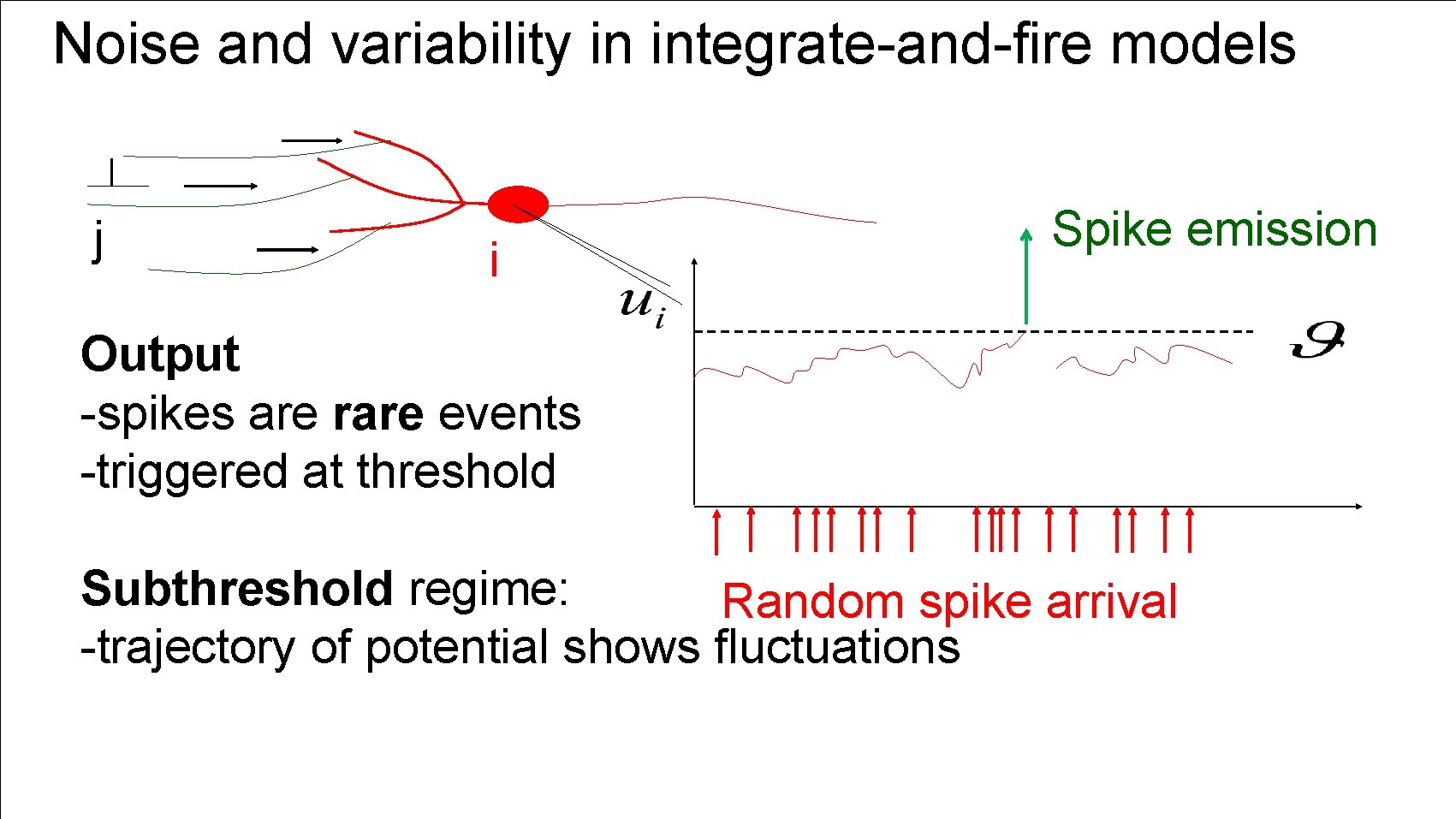
Noise and variability in integrate-and-fire models j i Spike emission Output -spikes are rare events -triggered at threshold Subthreshold regime: Random spike arrival -trajectory of potential shows fluctuations
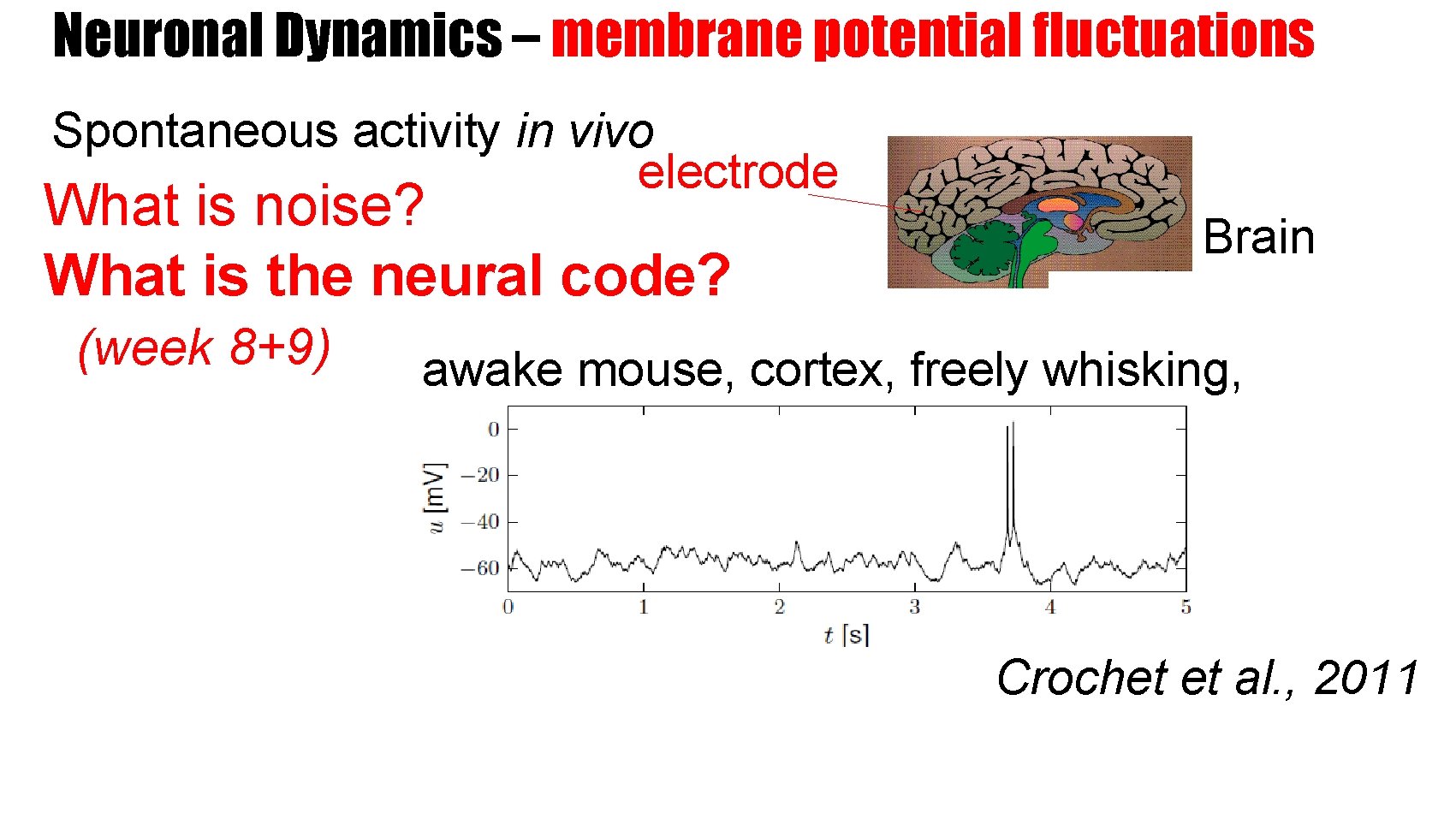
Neuronal Dynamics – membrane potential fluctuations Spontaneous activity in vivo electrode What is noise? What is the neural code? (week 8+9) Brain awake mouse, cortex, freely whisking, Crochet et al. , 2011
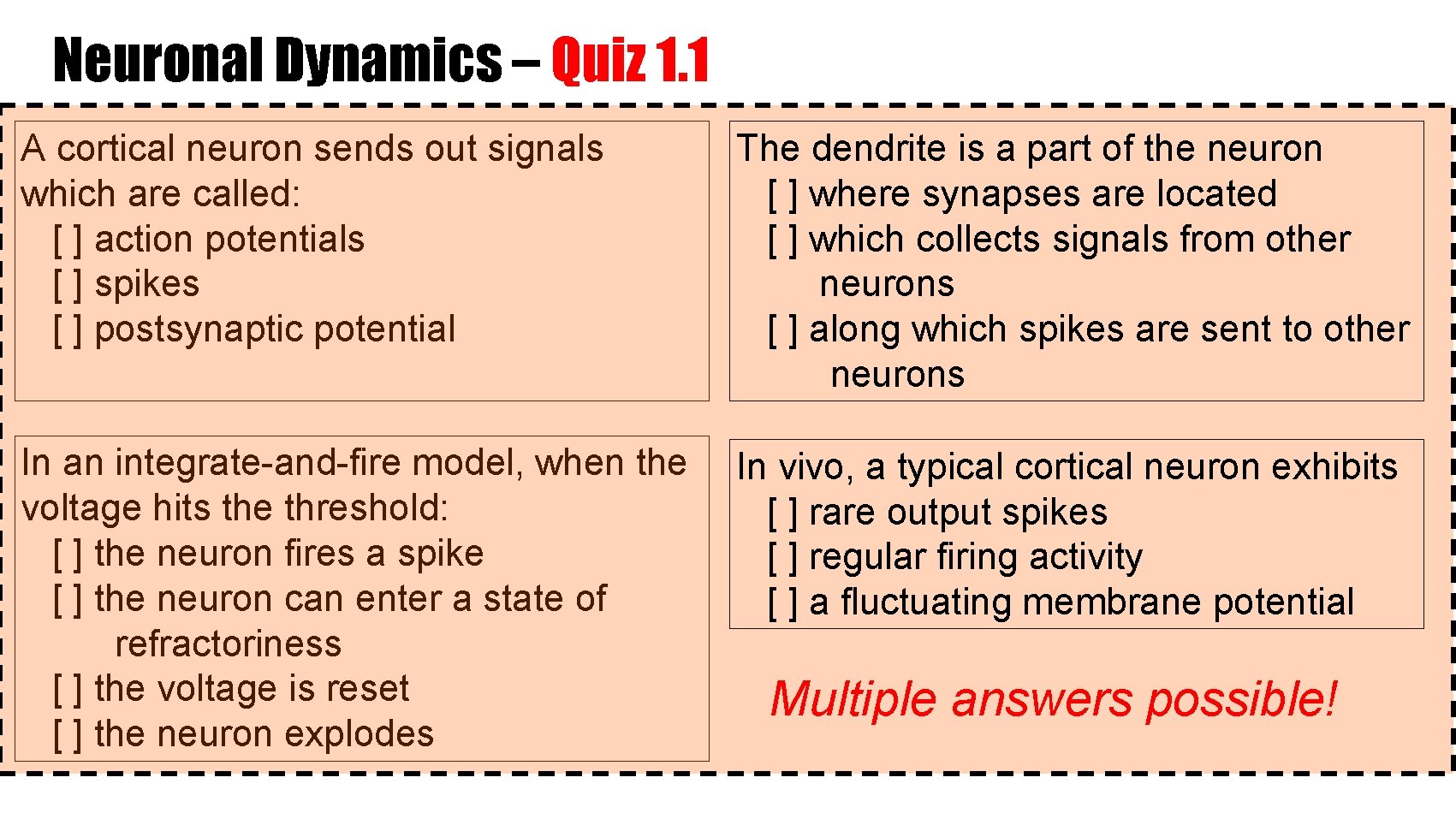
Neuronal Dynamics – Quiz 1. 1 A cortical neuron sends out signals which are called: [ ] action potentials [ ] spikes [ ] postsynaptic potential The dendrite is a part of the neuron [ ] where synapses are located [ ] which collects signals from other neurons [ ] along which spikes are sent to other neurons In an integrate-and-fire model, when the voltage hits the threshold: [ ] the neuron fires a spike [ ] the neuron can enter a state of refractoriness [ ] the voltage is reset [ ] the neuron explodes In vivo, a typical cortical neuron exhibits [ ] rare output spikes [ ] regular firing activity [ ] a fluctuating membrane potential Multiple answers possible!
Neural Networks and Biological Modeling – 1. 1. Overview action potential Week 1: A first simple neuron model/ neurons and mathematics Week 2: Hodgkin-Huxley models and biophysical modeling Week 3: Two-dimensional models and phase plane analysis Week 4: Two-dimensional models Dendrites Week 5, 6, 7: Associative Memory, Learning, Hebb, Hopfield Week 8, 9: Noise models, noisy neurons and coding Week 10: Estimating neuron models for coding and decoding Week 11 -14: Networks and cognitions
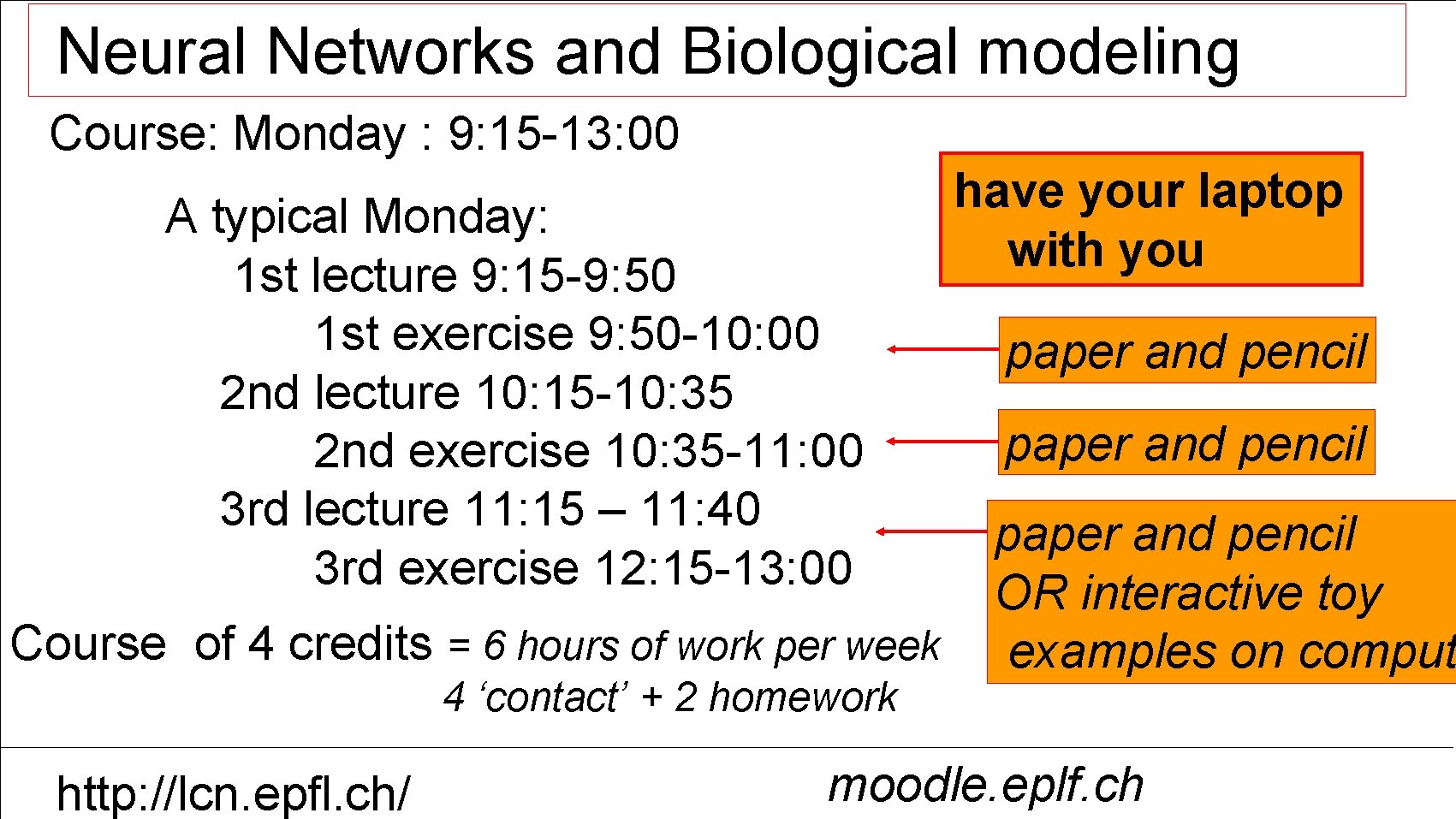
Neural Networks and Biological modeling Course: Monday : 9: 15 -13: 00 A typical Monday: 1 st lecture 9: 15 -9: 50 1 st exercise 9: 50 -10: 00 2 nd lecture 10: 15 -10: 35 2 nd exercise 10: 35 -11: 00 3 rd lecture 11: 15 – 11: 40 3 rd exercise 12: 15 -13: 00 Course of 4 credits = 6 hours of work per week 4 ‘contact’ + 2 homework http: //lcn. epfl. ch/ have your laptop with you paper and pencil OR interactive toy examples on comput moodle. eplf. ch
Neural Networks and Biological Modeling Questions?
Week 1 – part 2: The Passive Membrane 1. 1 Neurons and Synapses: Overview Neuronal Dynamics: Computational Neuroscience of Single Neurons 1. 2 The Passive Membrane - Linear circuit - Dirac delta-function 1. 3 Leaky Integrate-and-Fire Model Week 1 – neurons and mathematics: 1. 4 Generalized Integrate-and a first simple neuron model -Fire Model Wulfram Gerstner 1. 5. Quality of Integrate-and. EPFL, Lausanne, Switzerland Fire Models
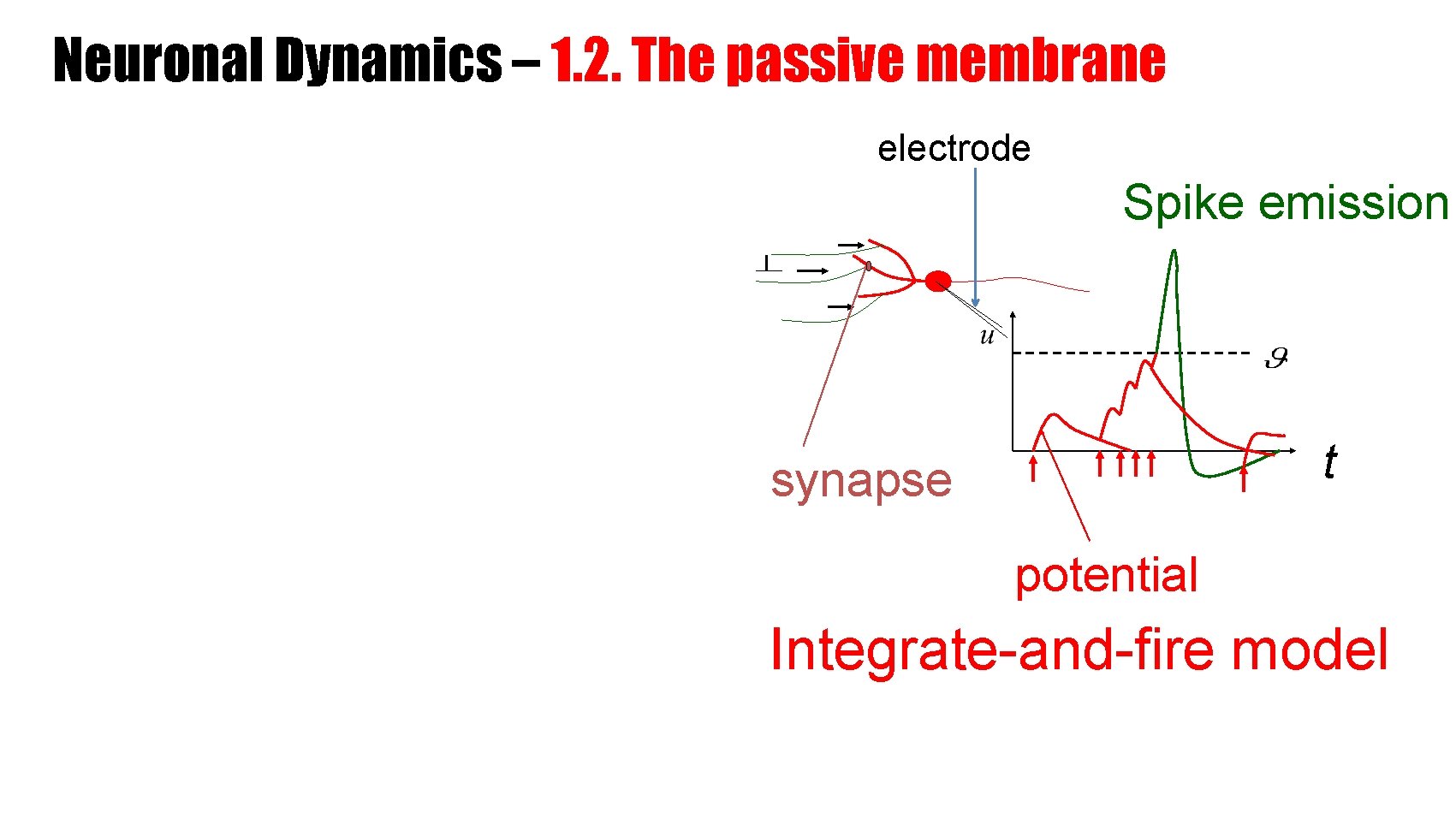
Neuronal Dynamics – 1. 2. The passive membrane electrode Spike emission t synapse potential Integrate-and-fire model
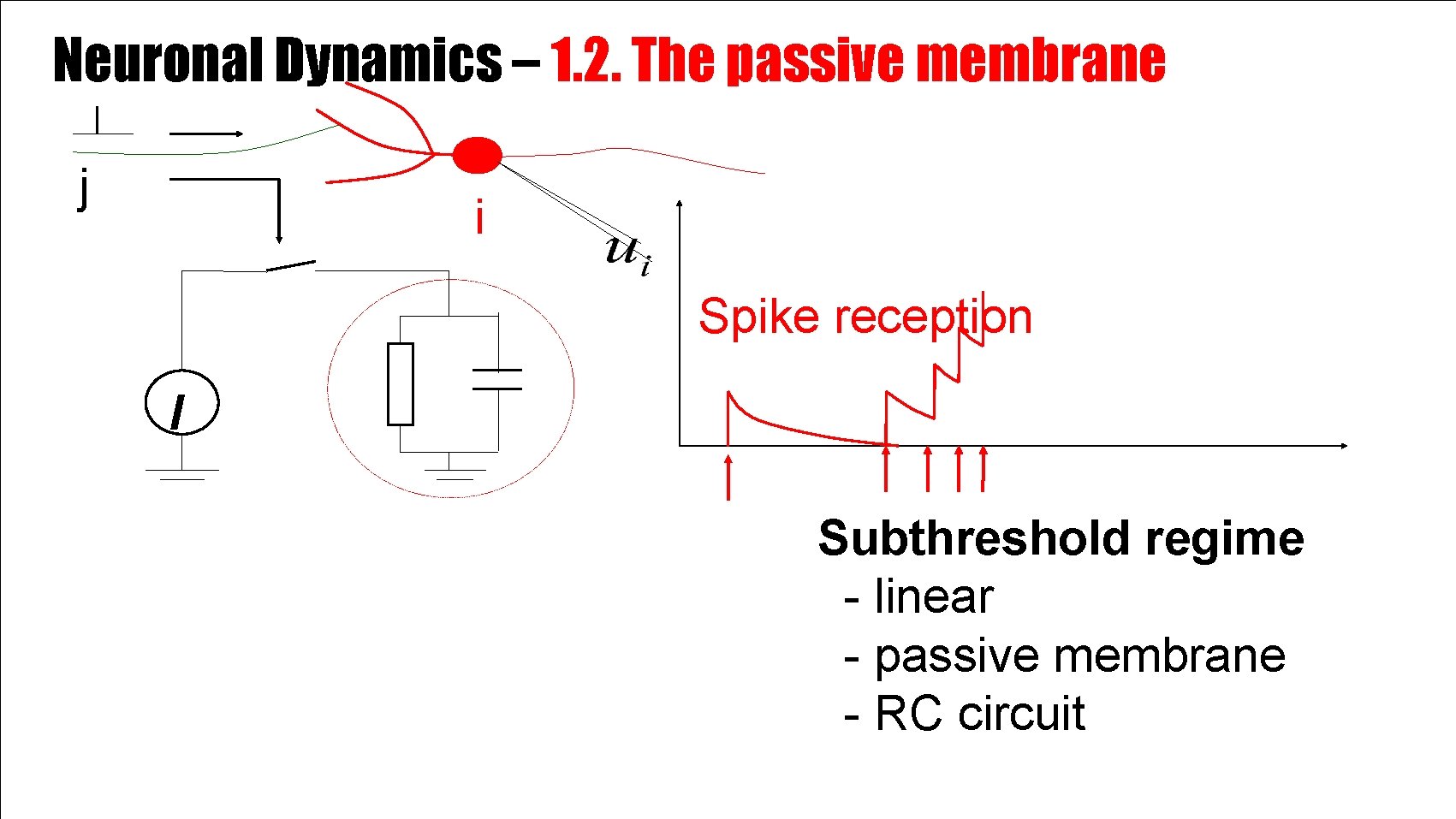
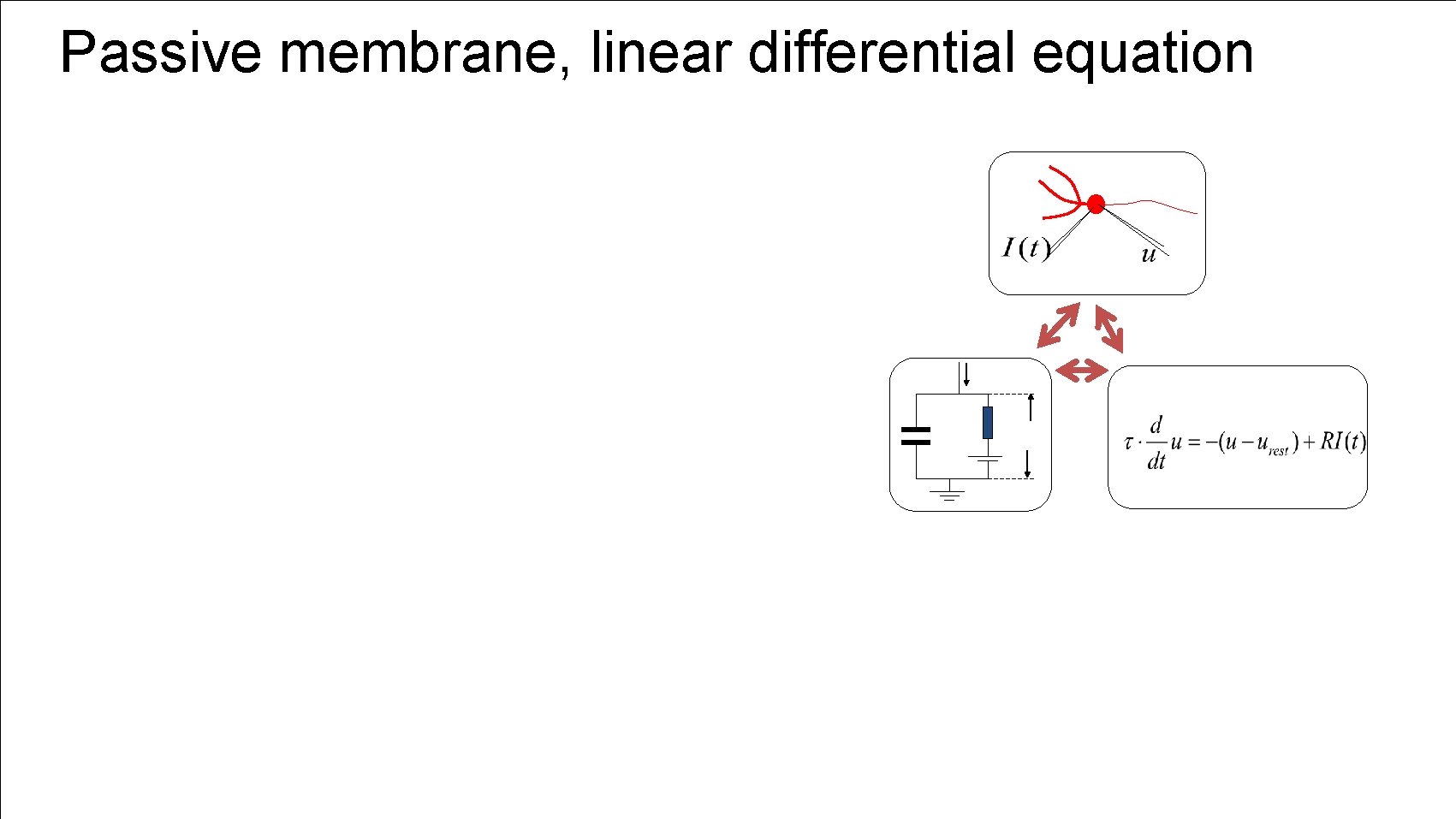
Neuronal Dynamics – 1. 2. The passive membrane j i Spike reception I Subthreshold regime - linear - passive membrane - RC circuit
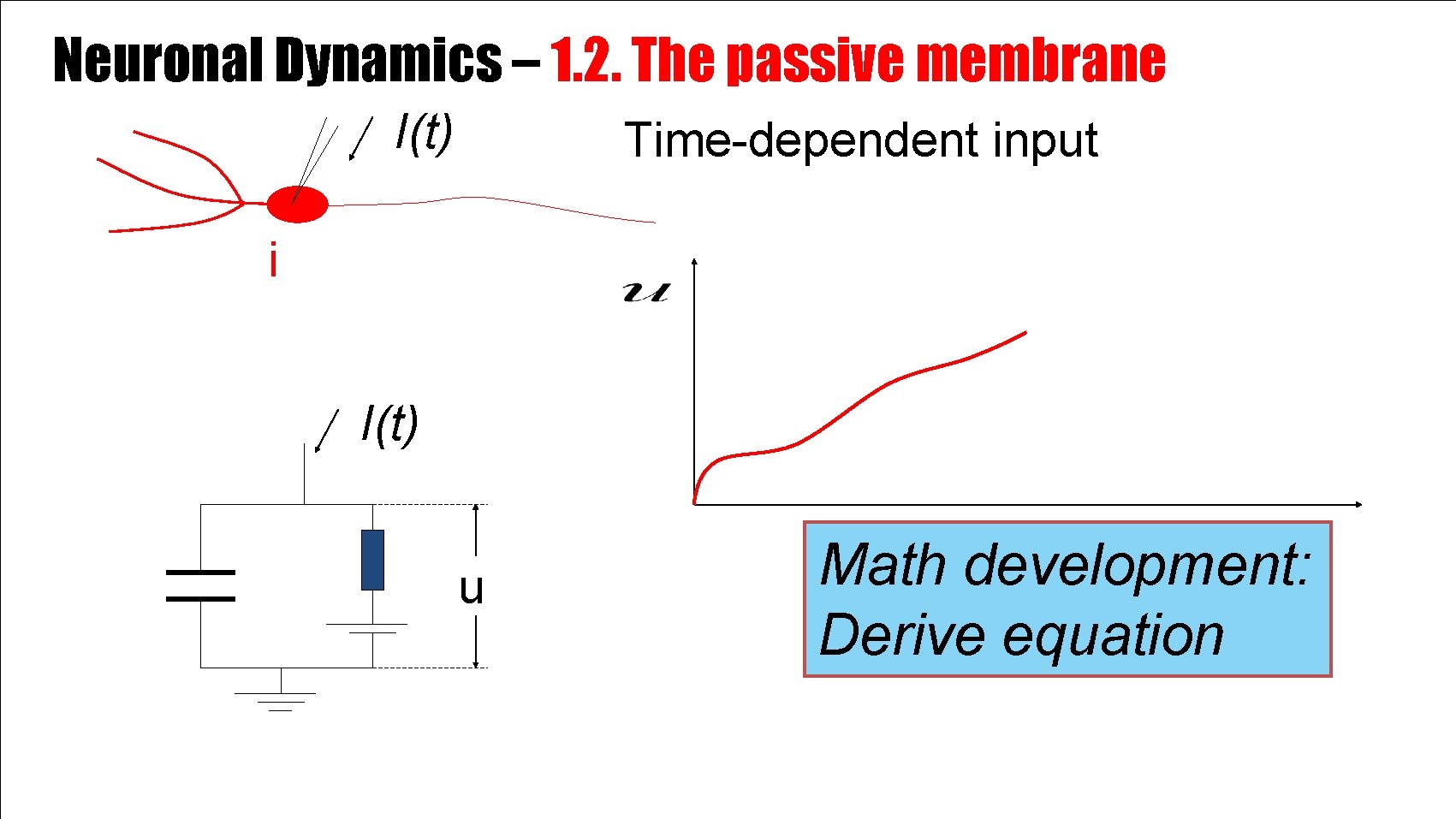
Neuronal Dynamics – 1. 2. The passive membrane I(t) Time-dependent input i I(t) u Math development: Derive equation
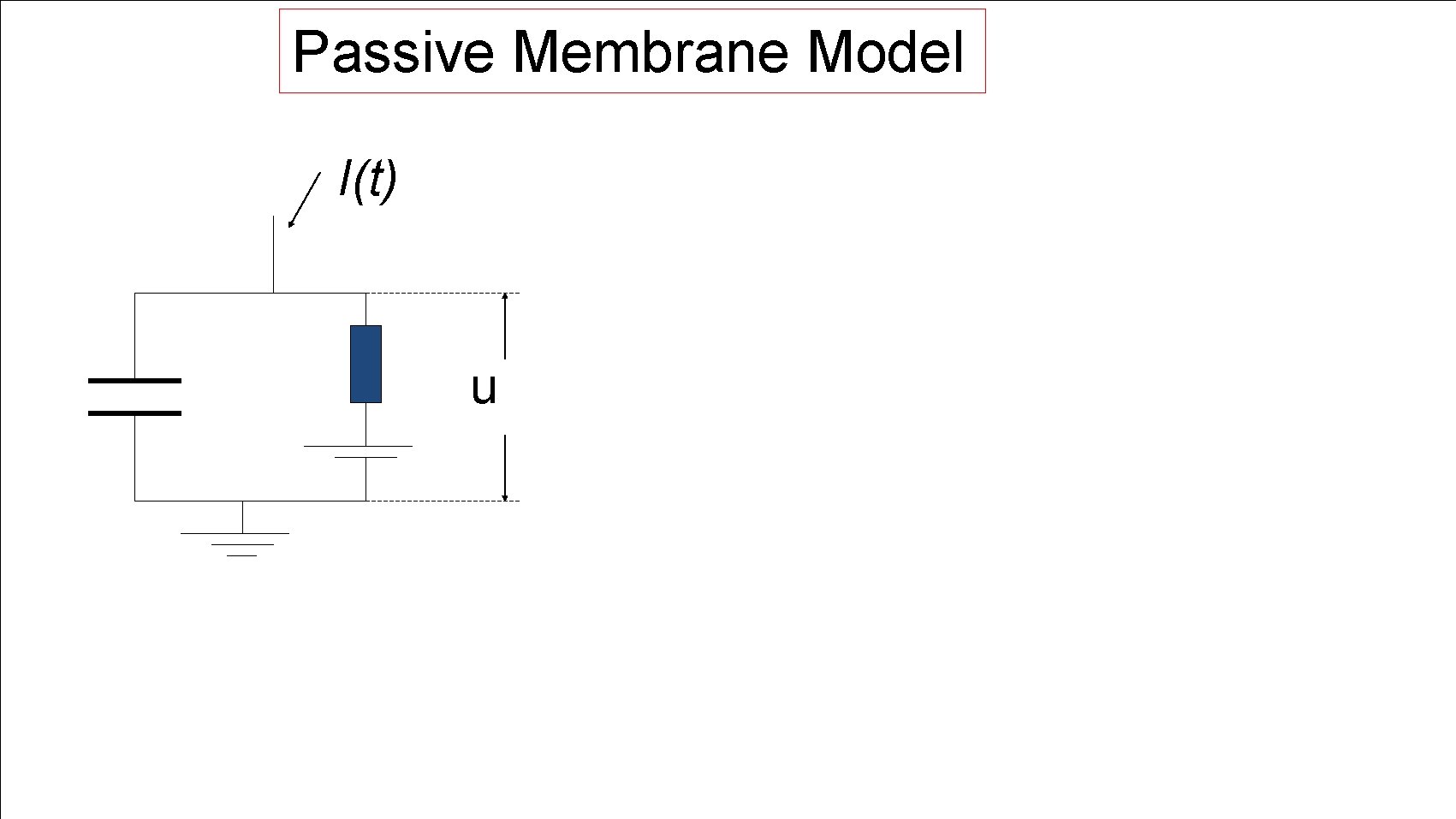
Passive Membrane Model I(t) u
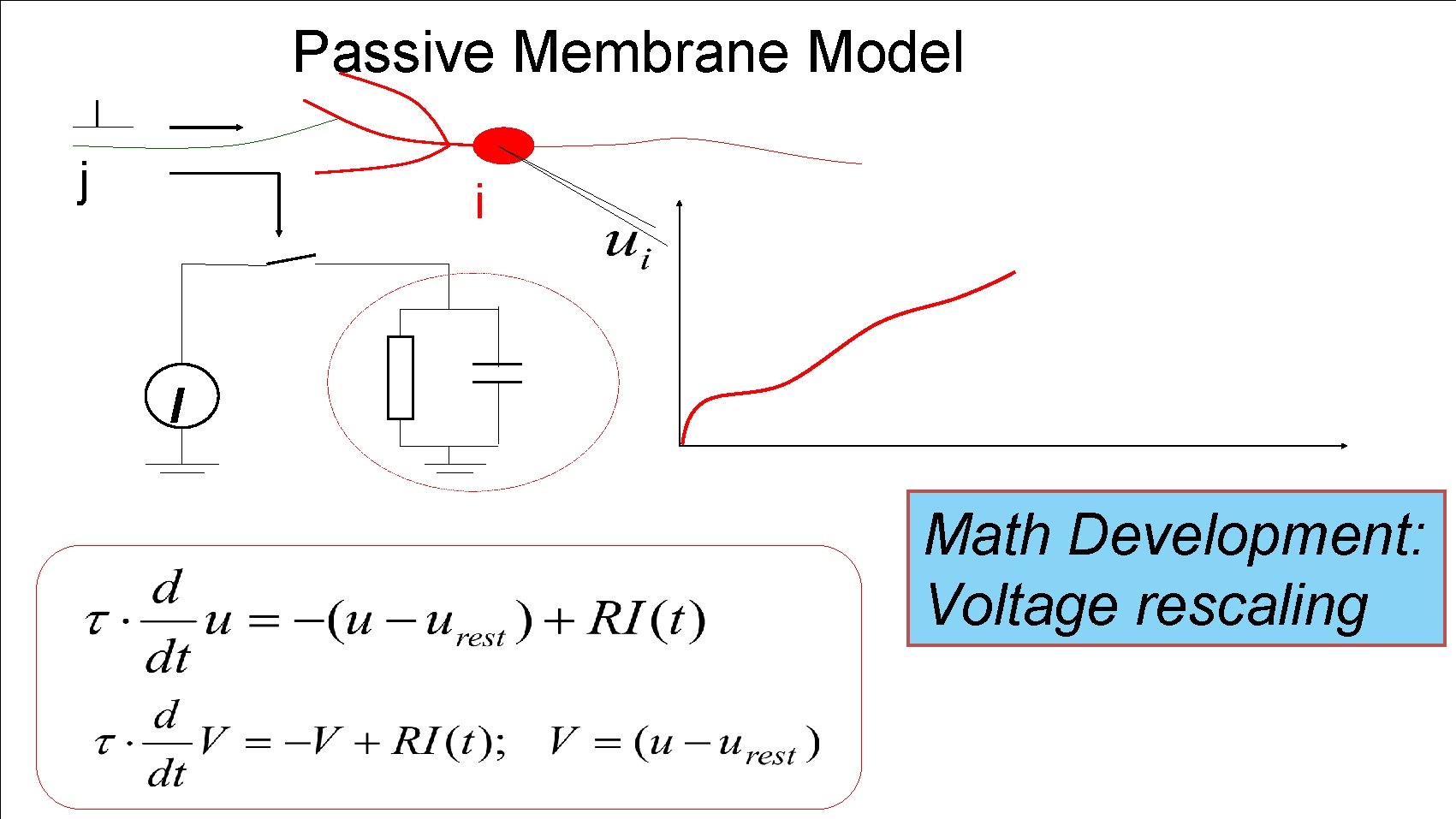
Passive Membrane Model j i I Math Development: Voltage rescaling
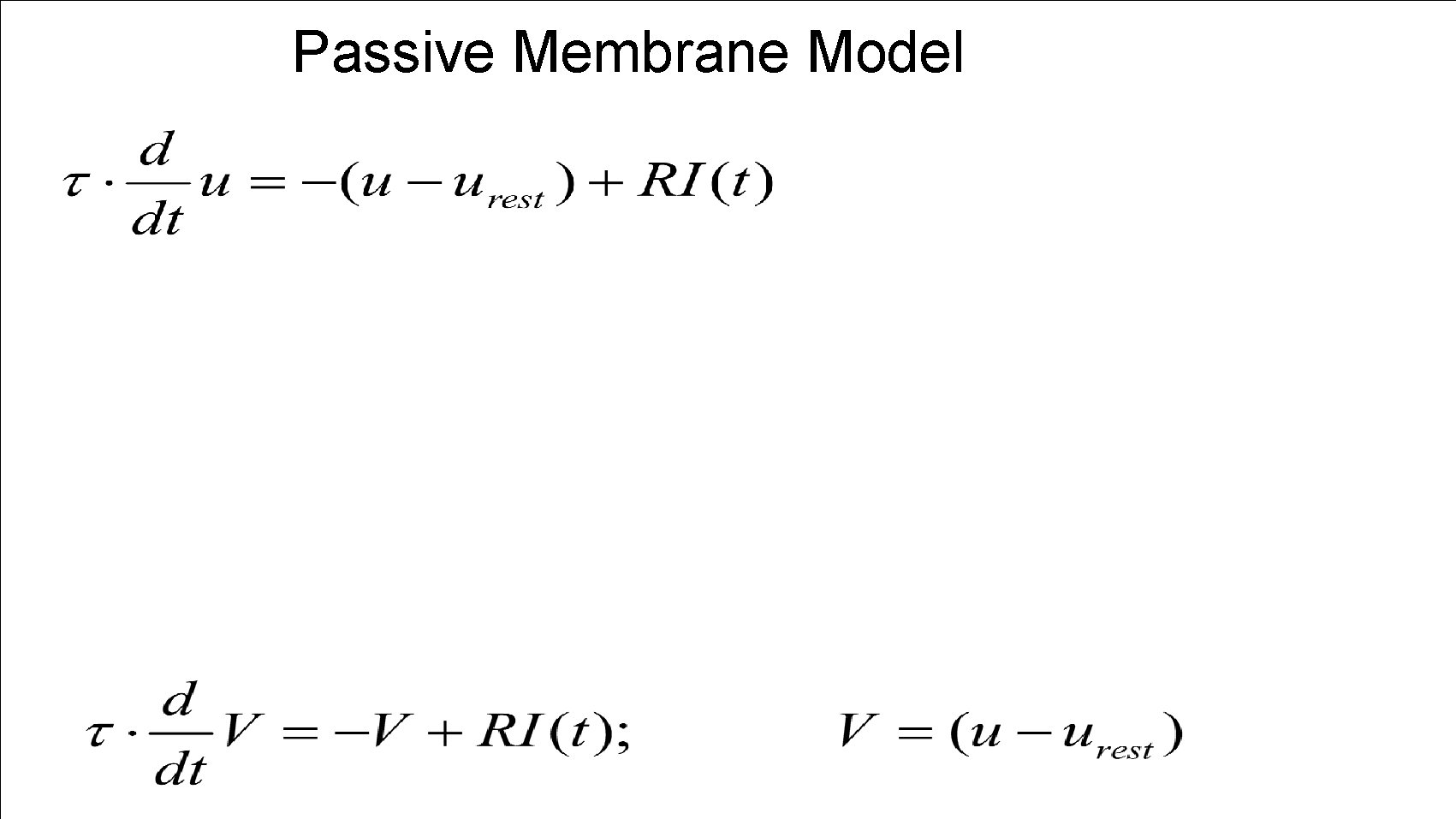
Passive Membrane Model
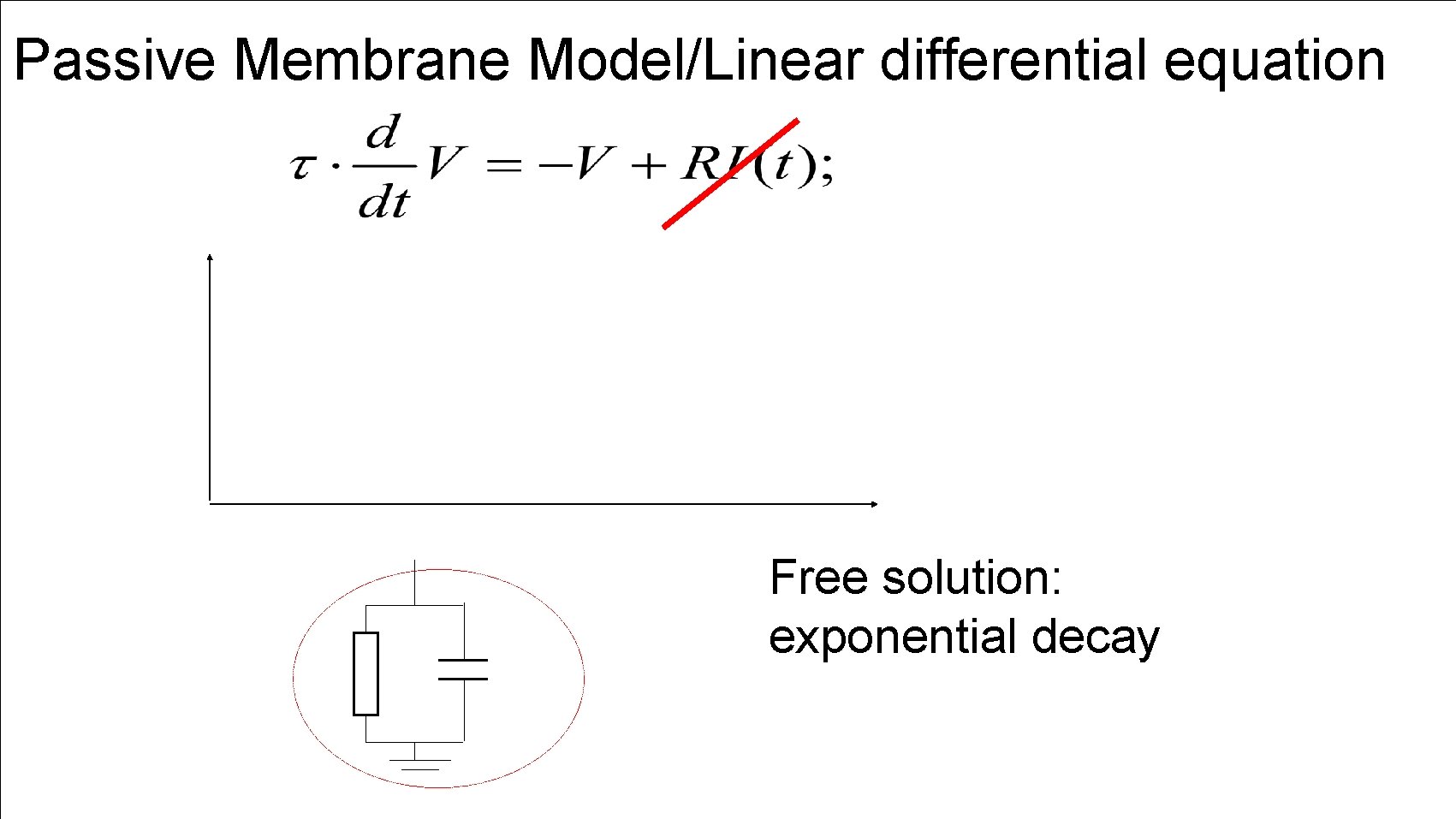
Passive Membrane Model/Linear differential equation Free solution: exponential decay
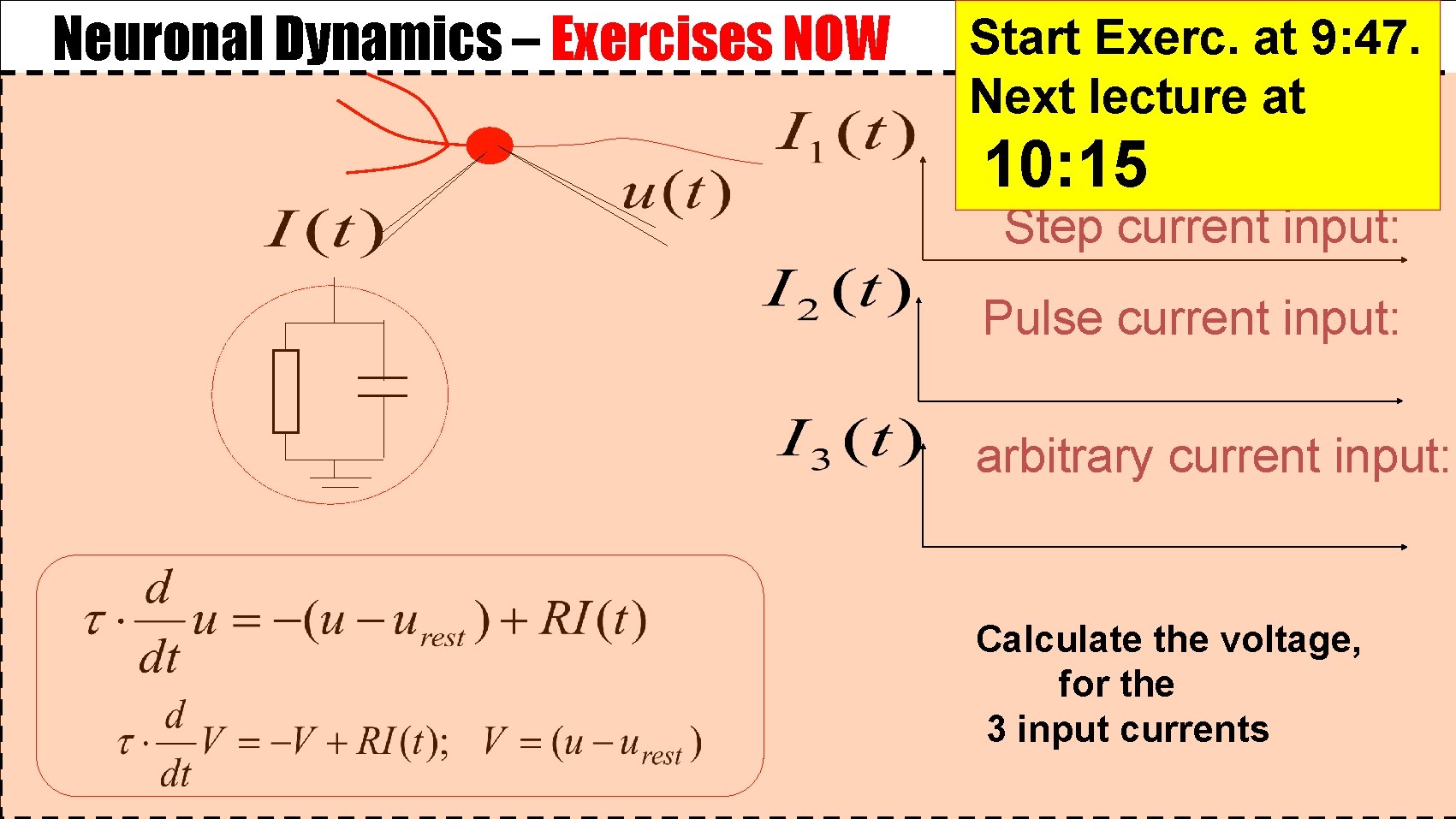
Neuronal Dynamics – Exercises NOW Start Exerc. at 9: 47. Next lecture at 10: 15 Step current input: Pulse current input: arbitrary current input: Calculate the voltage, for the 3 input currents
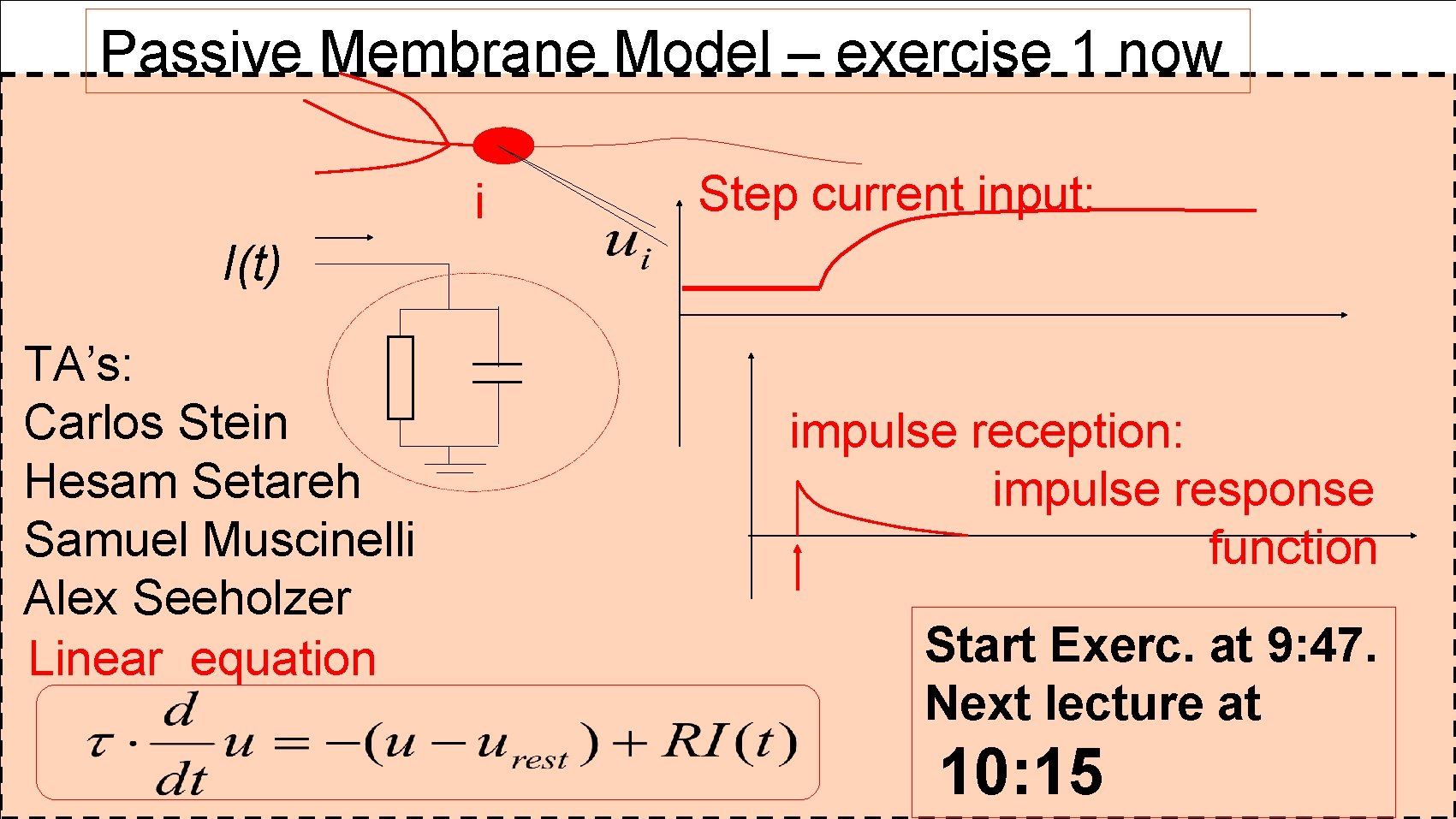
Passive Membrane Model – exercise 1 now i Step current input: I(t) TA’s: Carlos Stein Hesam Setareh Samuel Muscinelli Alex Seeholzer Linear equation impulse reception: impulse response function Start Exerc. at 9: 47. Next lecture at 10: 15
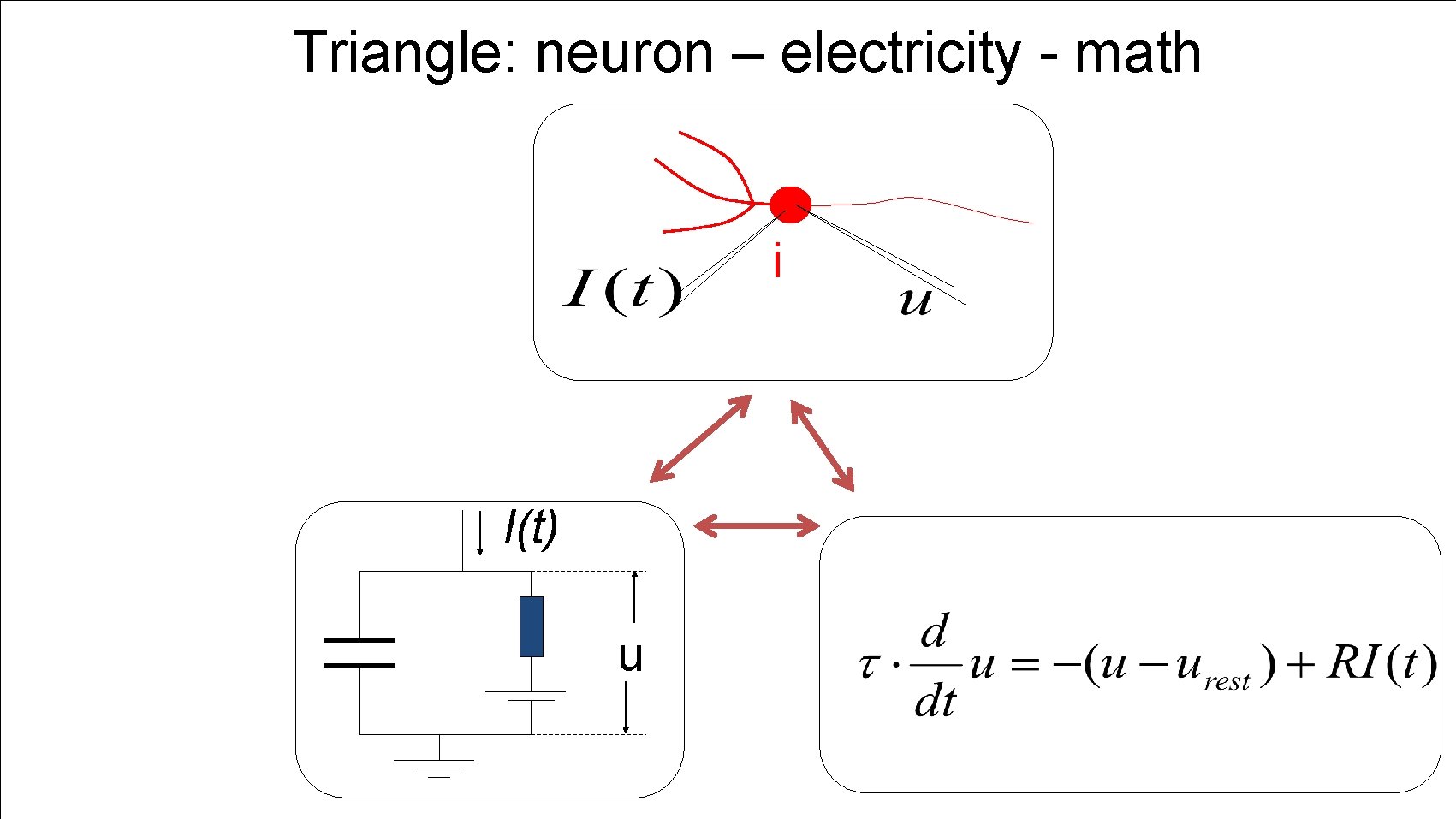
Triangle: neuron – electricity - math i I(t) u
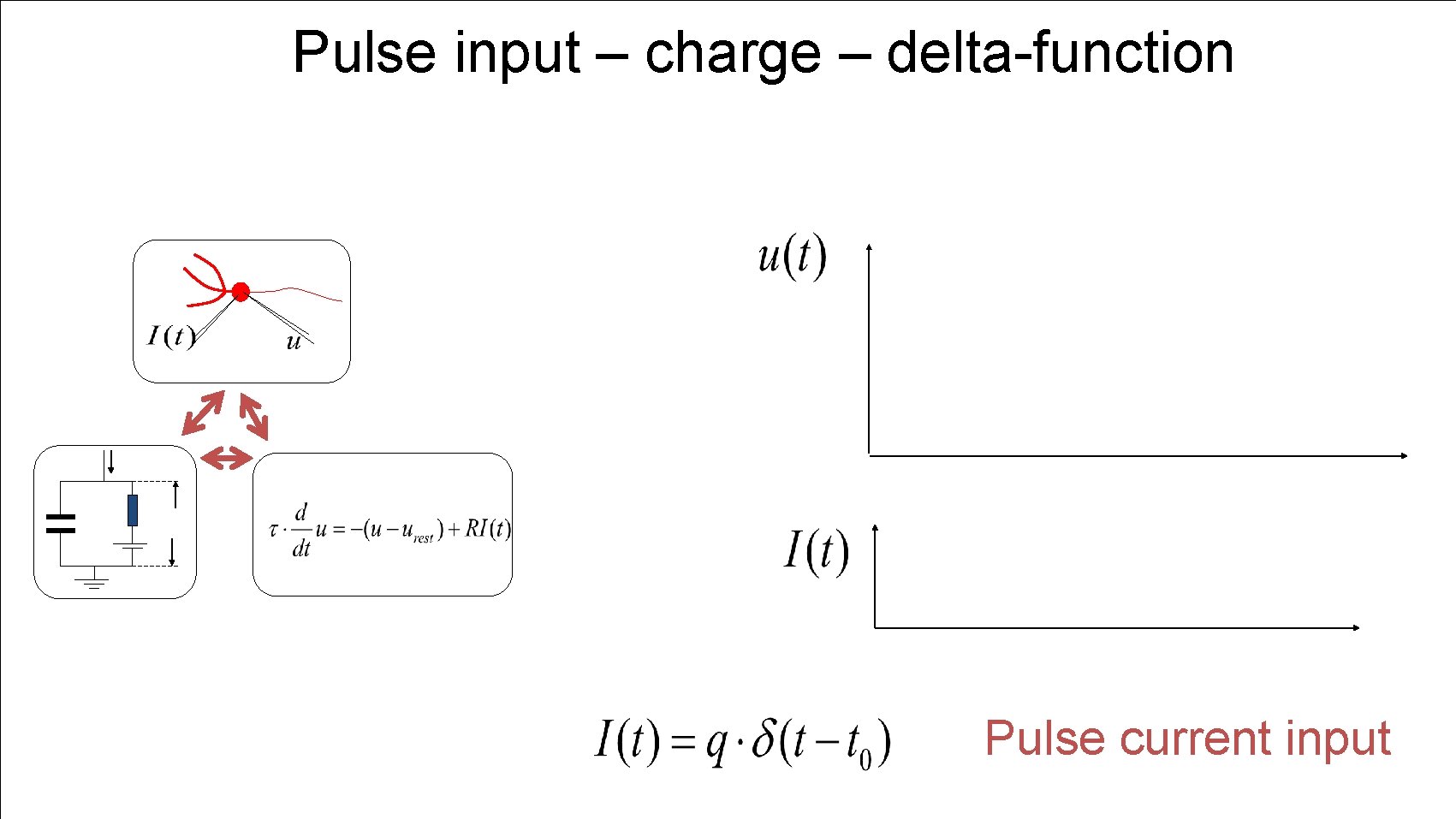
Pulse input – charge – delta-function Pulse current input
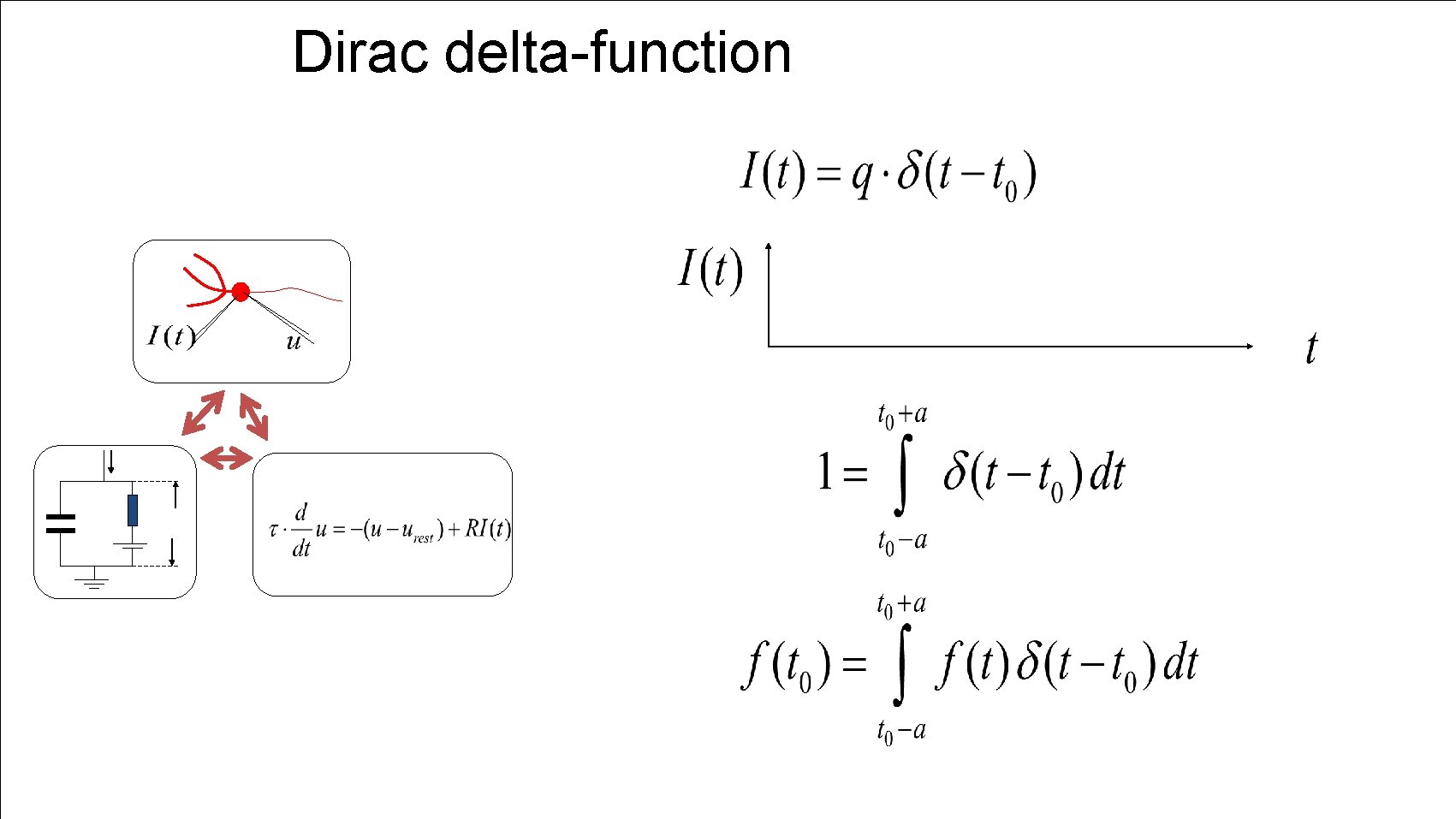
Dirac delta-function
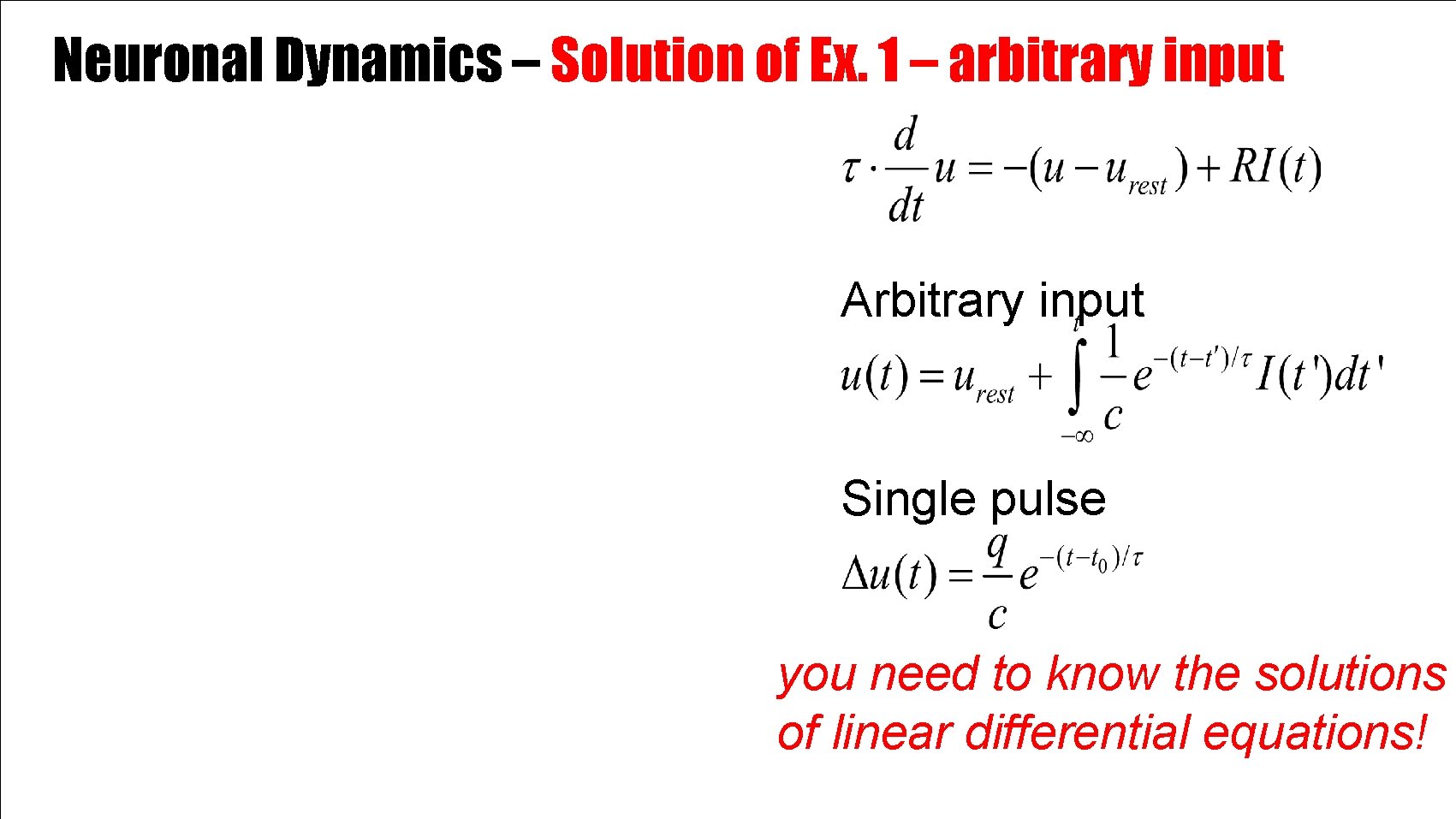
Neuronal Dynamics – Solution of Ex. 1 – arbitrary input Arbitrary input Single pulse you need to know the solutions of linear differential equations!
Passive membrane, linear differential equation
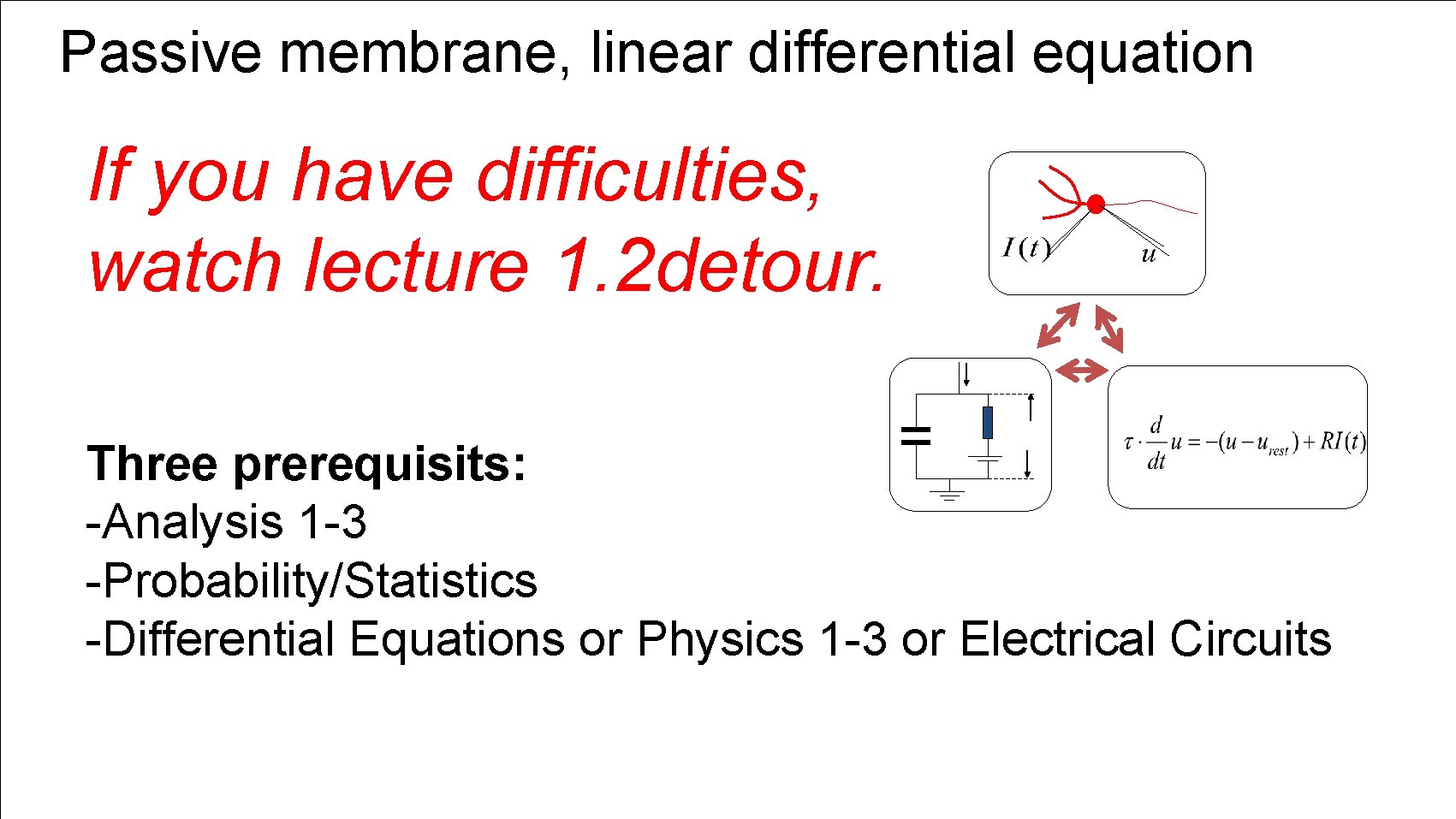
Passive membrane, linear differential equation If you have difficulties, watch lecture 1. 2 detour. Three prerequisits: -Analysis 1 -3 -Probability/Statistics -Differential Equations or Physics 1 -3 or Electrical Circuits
Neurons and Synapses: Week 1 – part 3: Leaky 1. 1 Integrate-and-Fire Model Overview 1. 2 The Passive Membrane Neuronal Dynamics: Computational Neuroscience of Single Neurons - Linear circuit - Dirac delta-function - Detour: solution of 1 -dim linear differential equation 1. 3 Leaky Integrate-and-Fire Model Week 1 – neurons and mathematics: 1. 4 Generalized Integrate-and a first simple neuron model -Fire Model Wulfram Gerstner 1. 5. Quality of Integrate-and. EPFL, Lausanne, Switzerland Fire Models
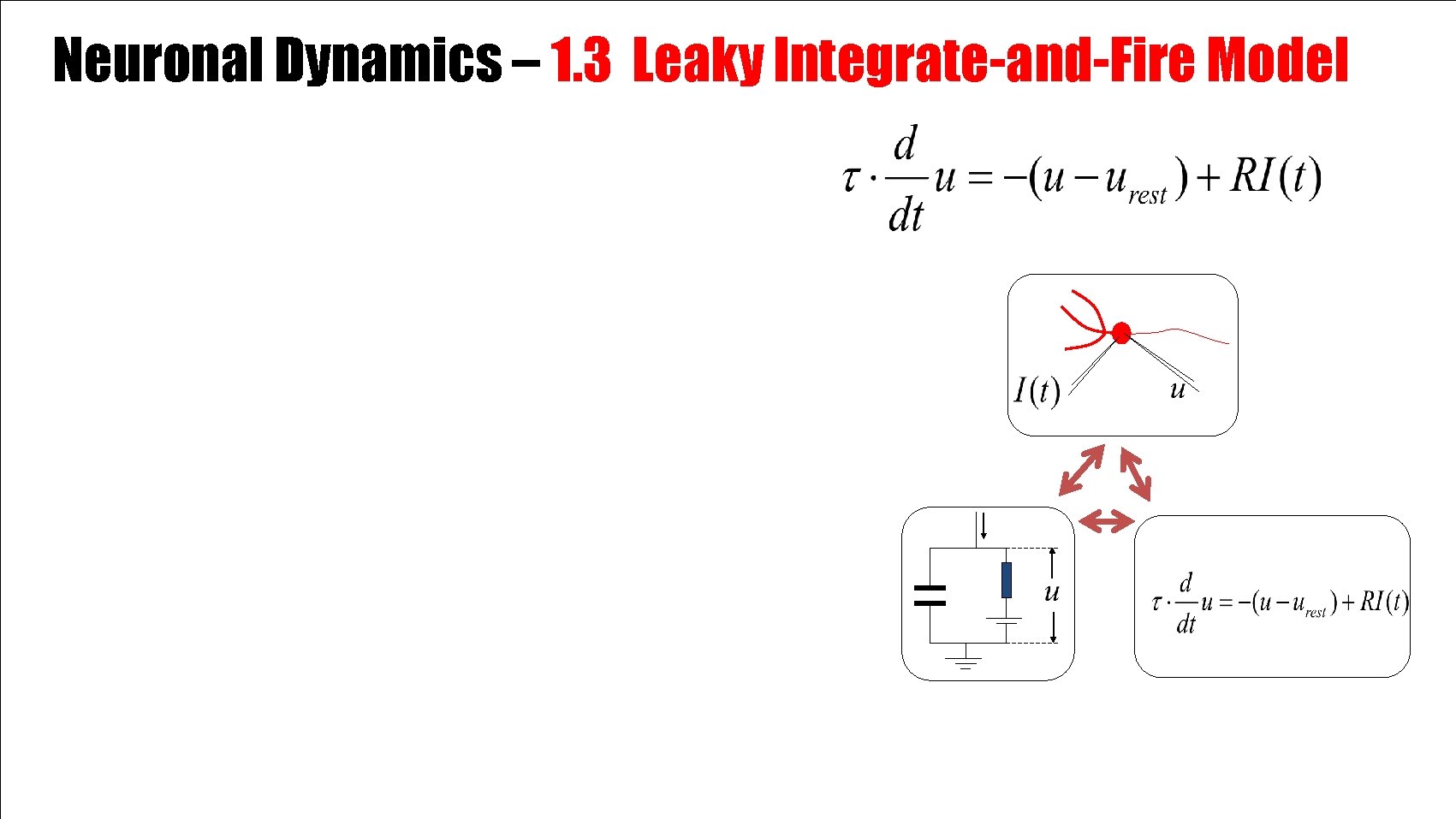
Neuronal Dynamics – 1. 3 Leaky Integrate-and-Fire Model
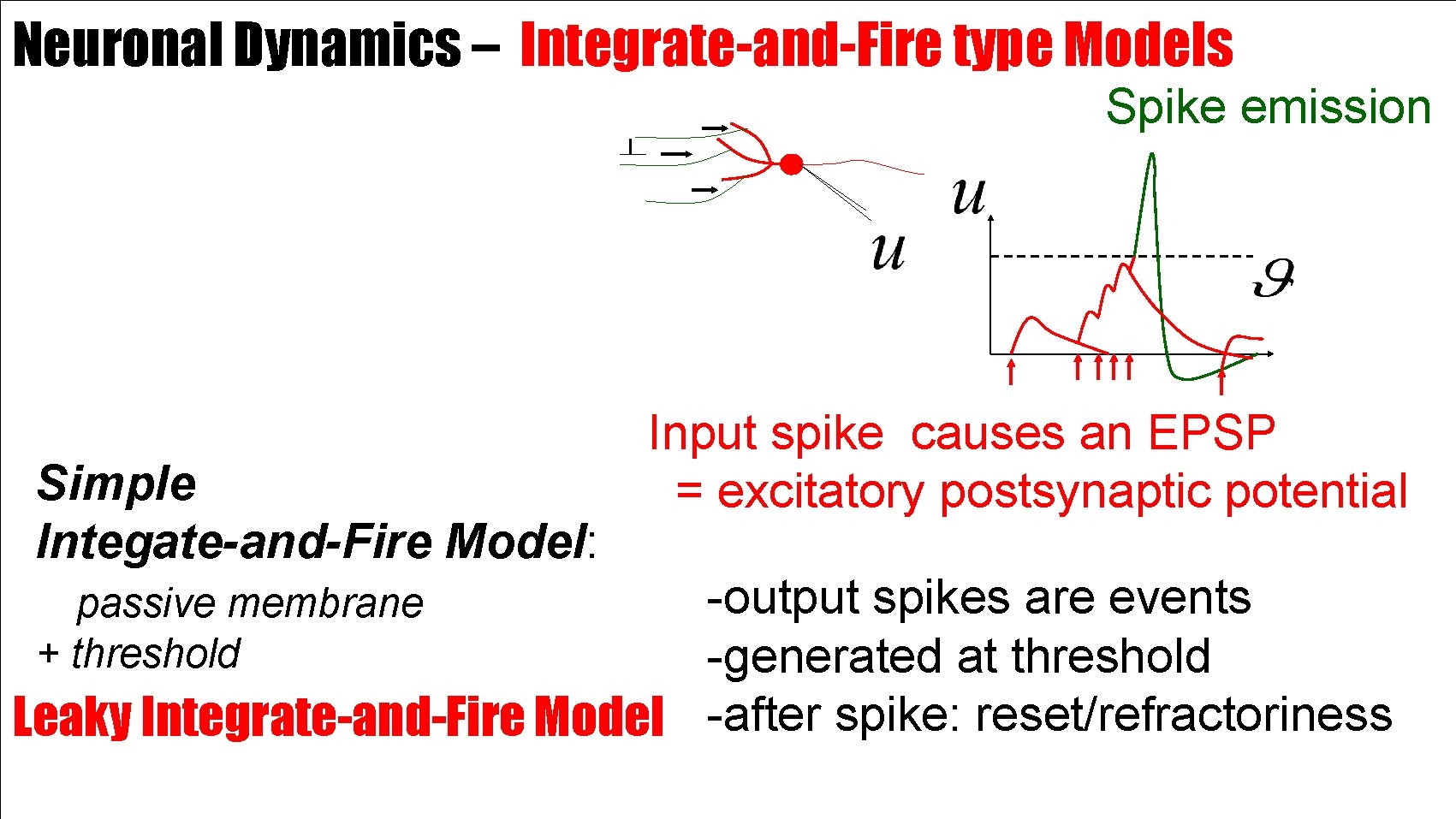
Neuronal Dynamics – Integrate-and-Fire type Models Spike emission Simple Integate-and-Fire Model: Input spike causes an EPSP = excitatory postsynaptic potential -output spikes are events -generated at threshold Leaky Integrate-and-Fire Model -after spike: reset/refractoriness passive membrane + threshold
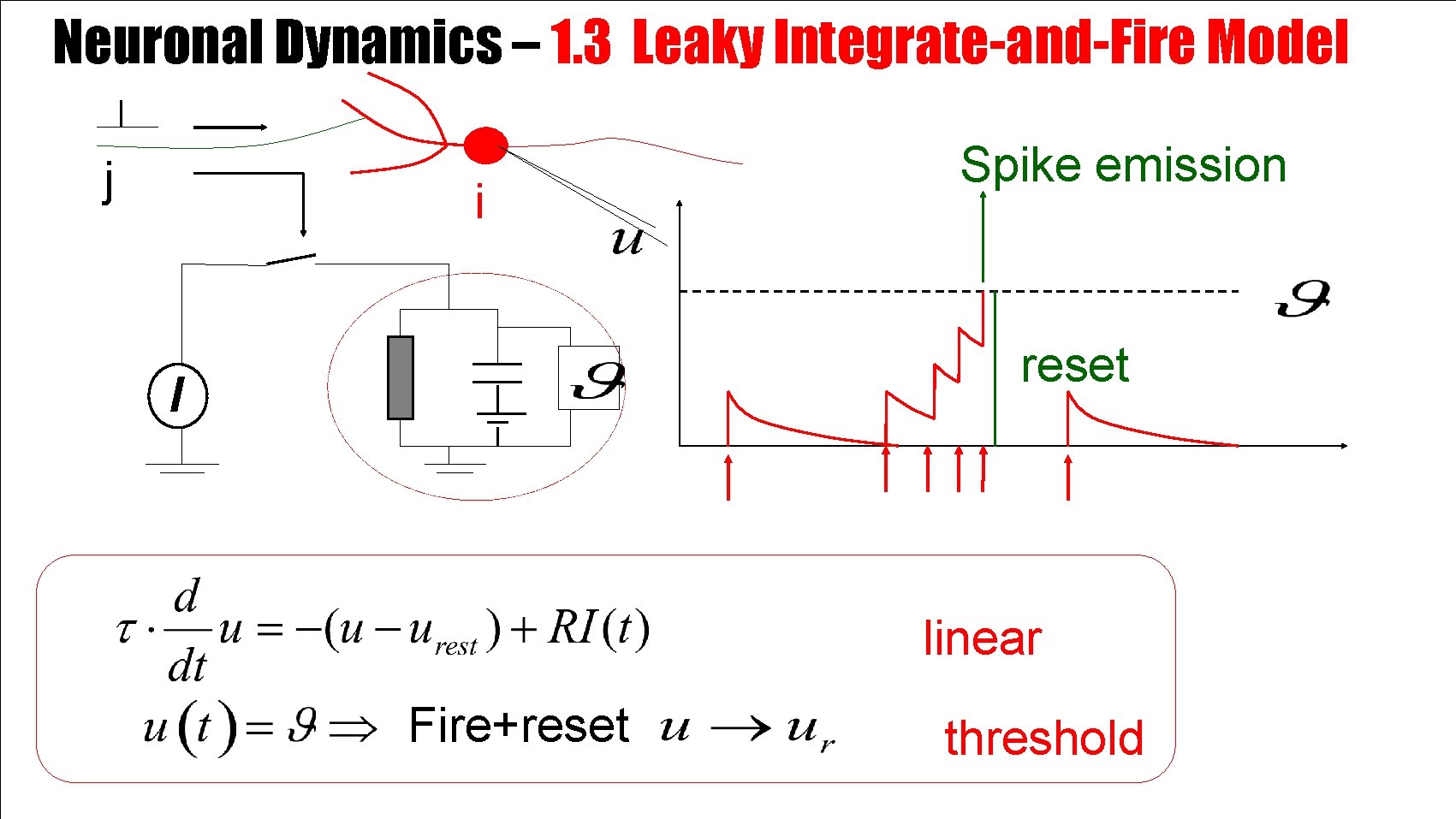
Neuronal Dynamics – 1. 3 Leaky Integrate-and-Fire Model j i Spike emission reset I linear Fire+reset threshold
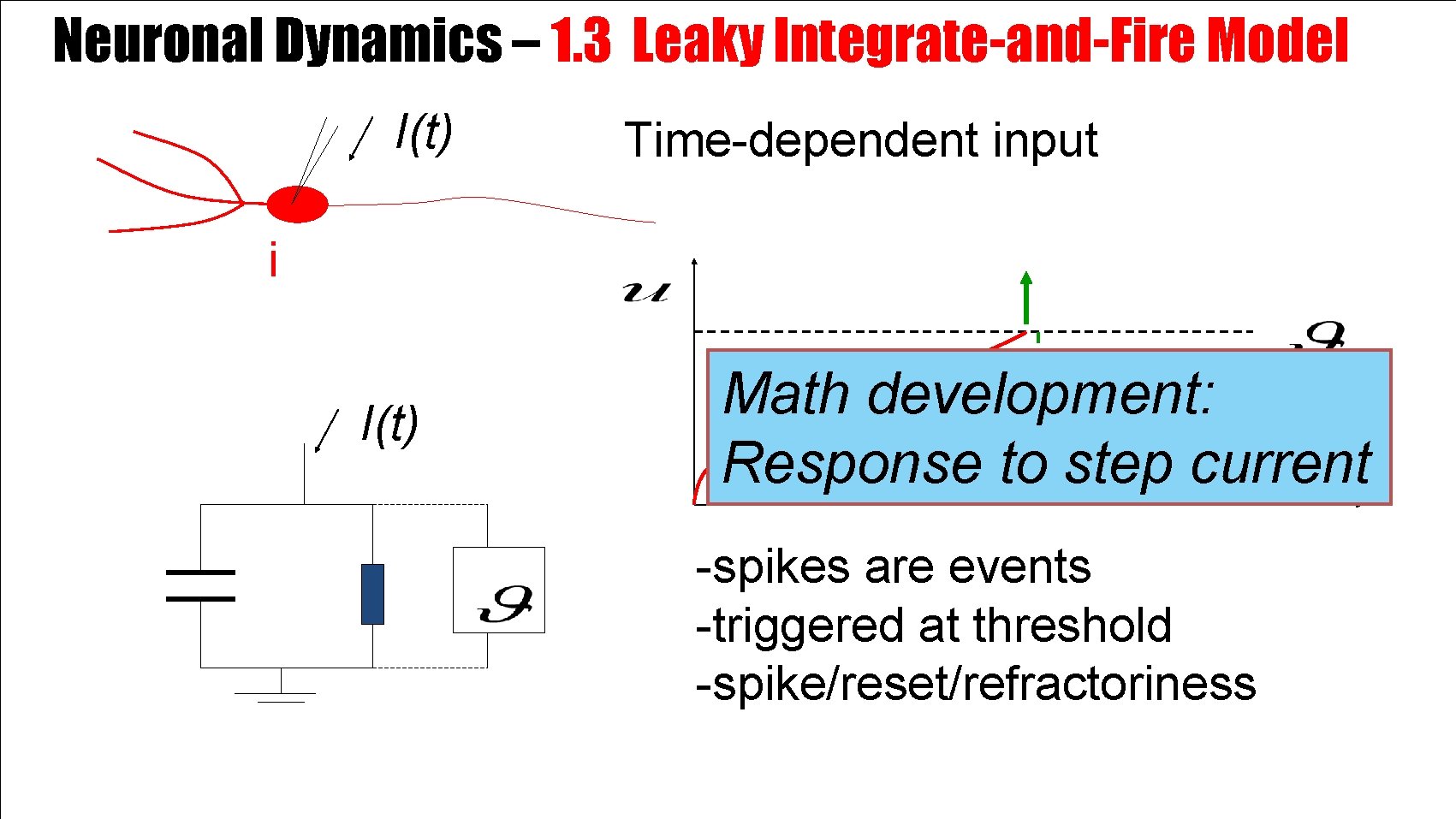
Neuronal Dynamics – 1. 3 Leaky Integrate-and-Fire Model I(t) Time-dependent input i I(t) Math development: Response to step current -spikes are events -triggered at threshold -spike/reset/refractoriness
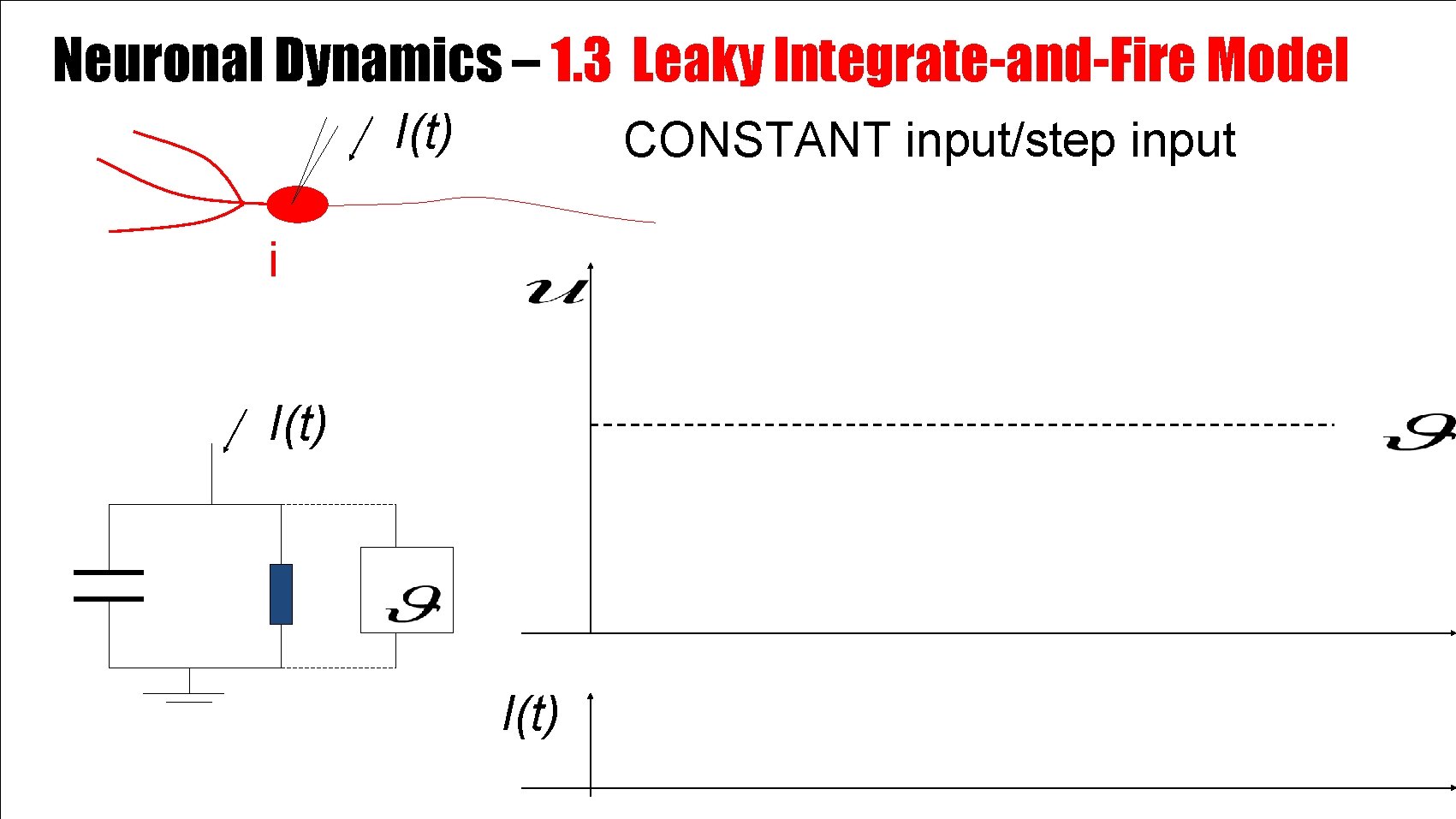
Neuronal Dynamics – 1. 3 Leaky Integrate-and-Fire Model I(t) CONSTANT input/step input i I(t)
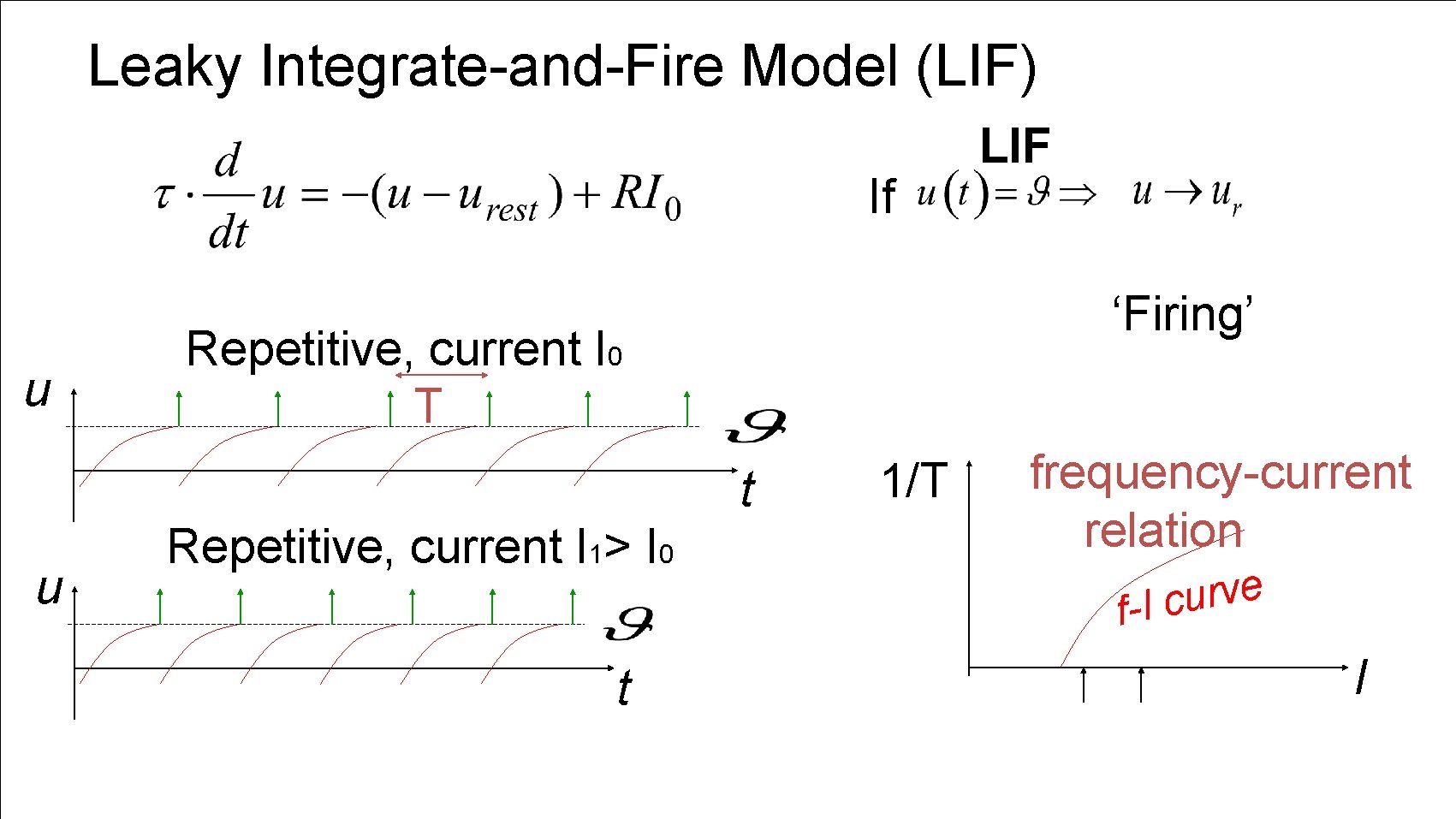
Leaky Integrate-and-Fire Model (LIF) If u ‘Firing’ Repetitive, current I 0 T t u Repetitive, current I 1> I 0 t LIF 1/T frequency-current relation e v r u f-I c I
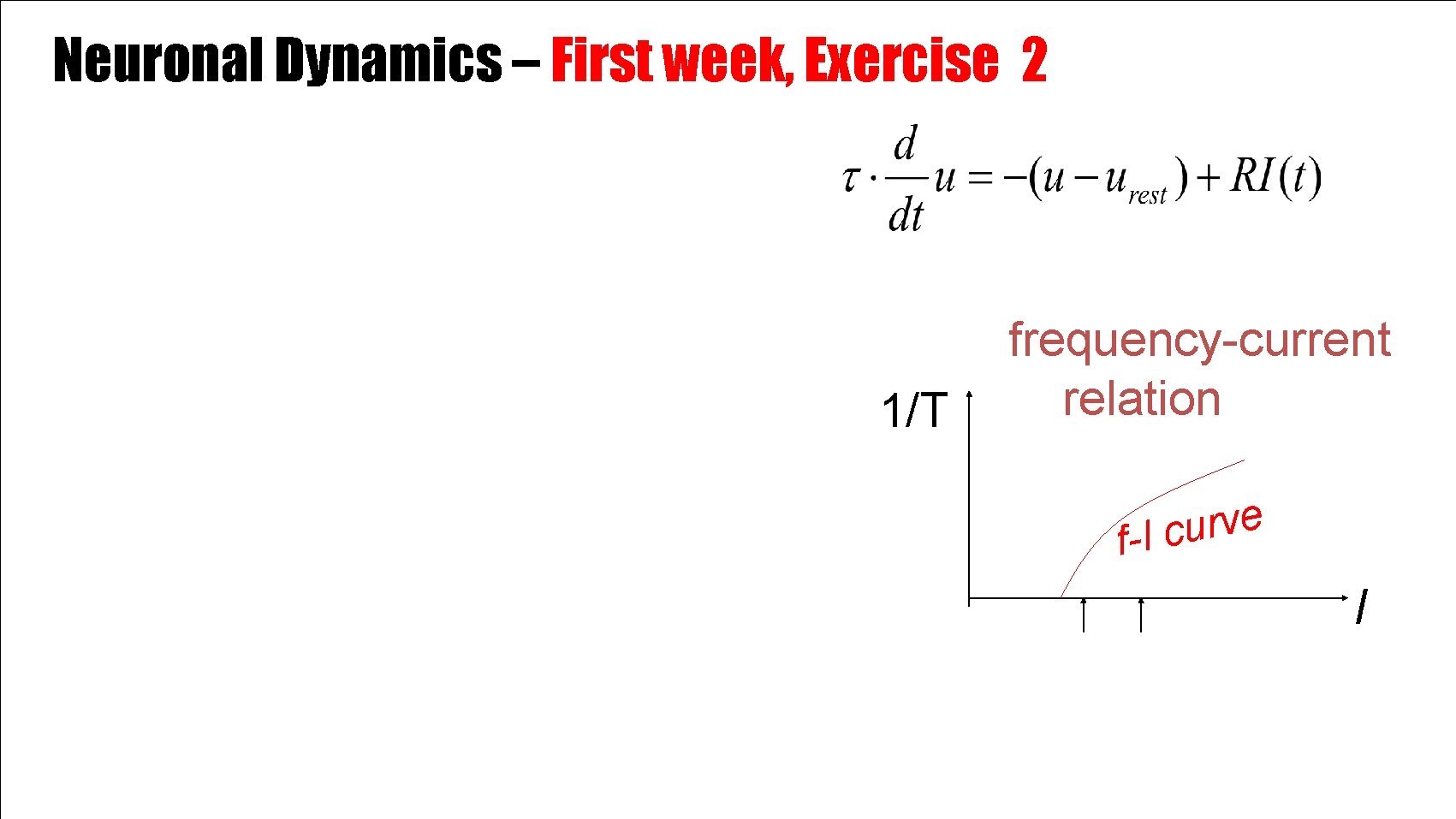
Neuronal Dynamics – First week, Exercise 2 1/T frequency-current relation e v r u f-I c I
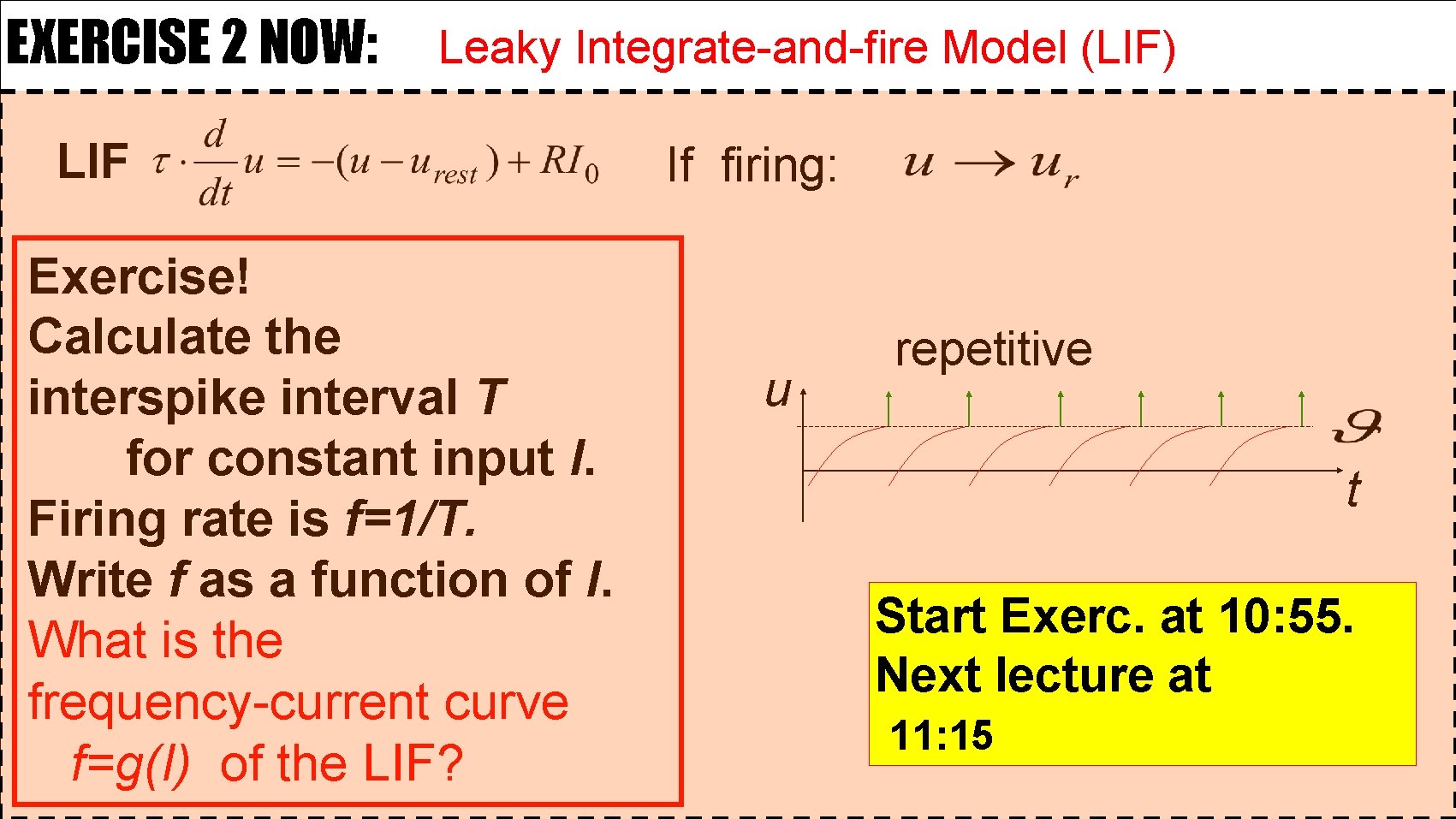
EXERCISE 2 NOW: Leaky Integrate-and-fire Model (LIF) LIF Exercise! Calculate the interspike interval T for constant input I. Firing rate is f=1/T. Write f as a function of I. What is the frequency-current curve f=g(I) of the LIF? If firing: u repetitive t Start Exerc. at 10: 55. Next lecture at 11: 15
Week 1 – part 4: Generalized Integrate-and 1. 1 Neurons and Synapses: Fire Model Overview 1. 2 The Passive Membrane Neuronal Dynamics: Computational Neuroscience of Single Neurons - Linear circuit - Dirac delta-function 1. 3 Leaky Integrate-and-Fire Model 1. 4 Generalized Integrate-and Week 1 – neurons and mathematics: -Fire a first simple neuron model Model 1. 5. Quality of Integrate-and. Wulfram Gerstner Fire EPFL, Lausanne, Switzerland Models
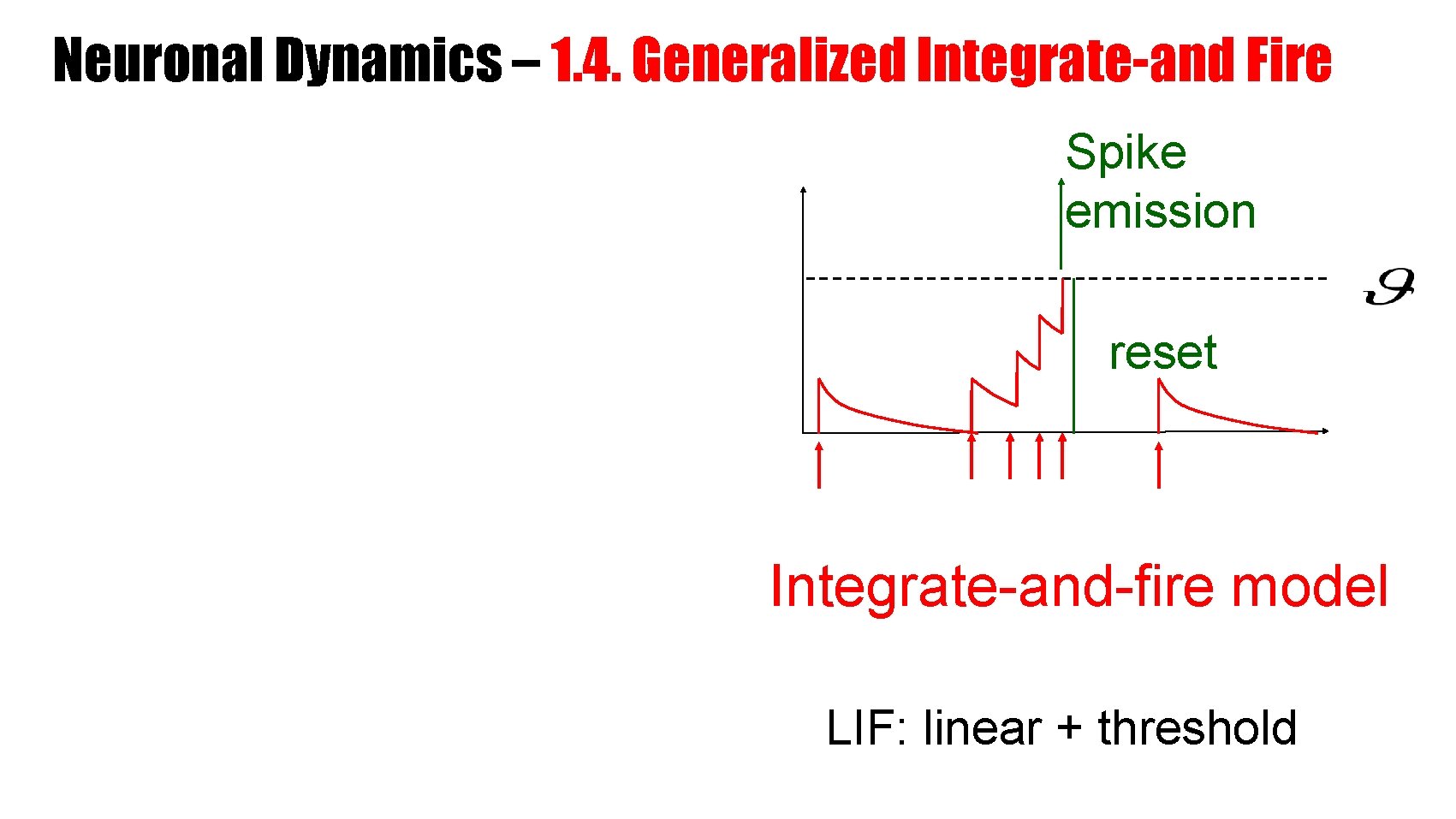
Neuronal Dynamics – 1. 4. Generalized Integrate-and Fire Spike emission reset Integrate-and-fire model LIF: linear + threshold
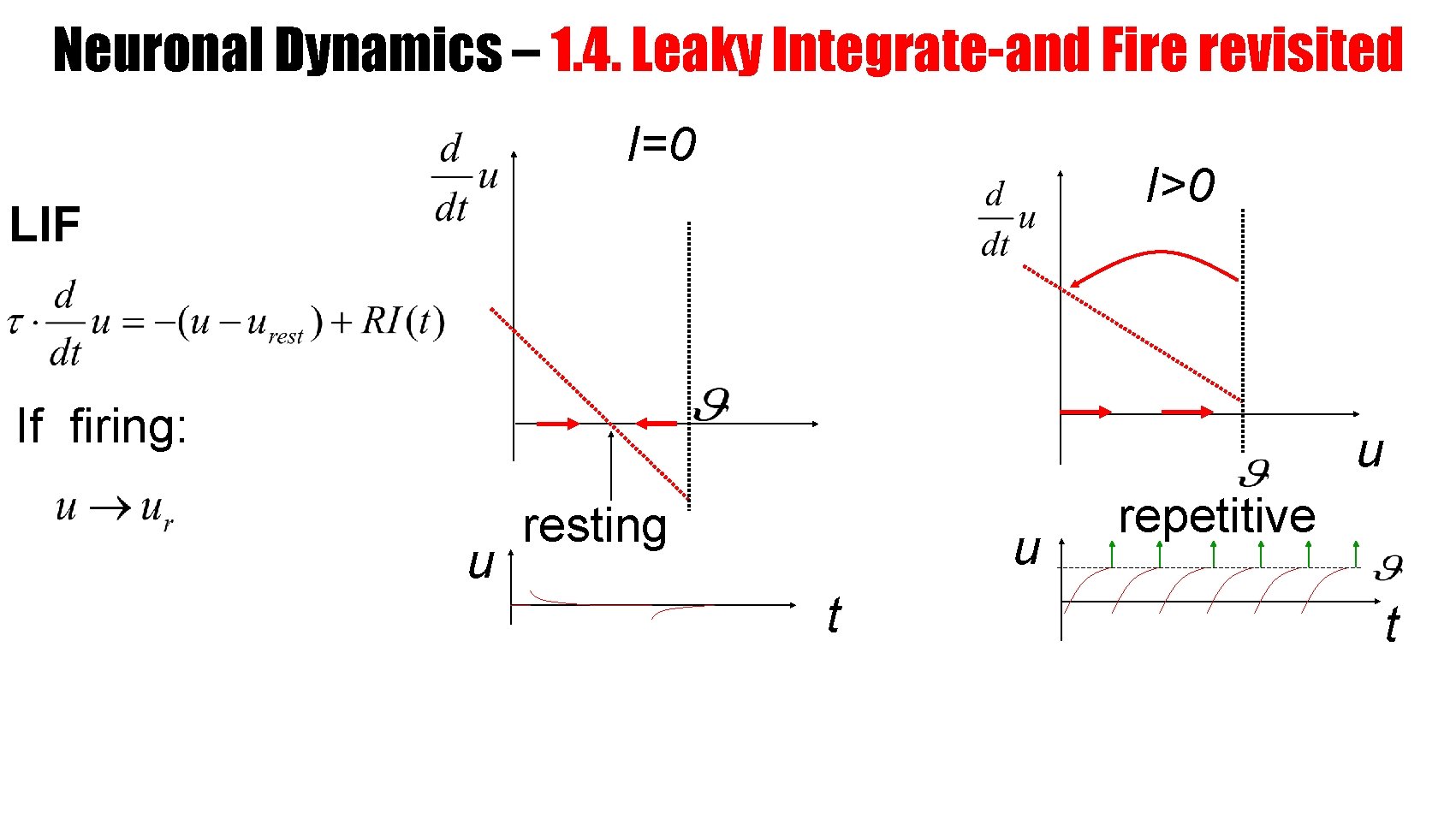
Neuronal Dynamics – 1. 4. Leaky Integrate-and Fire revisited I=0 I>0 LIF If firing: u u resting u t repetitive t
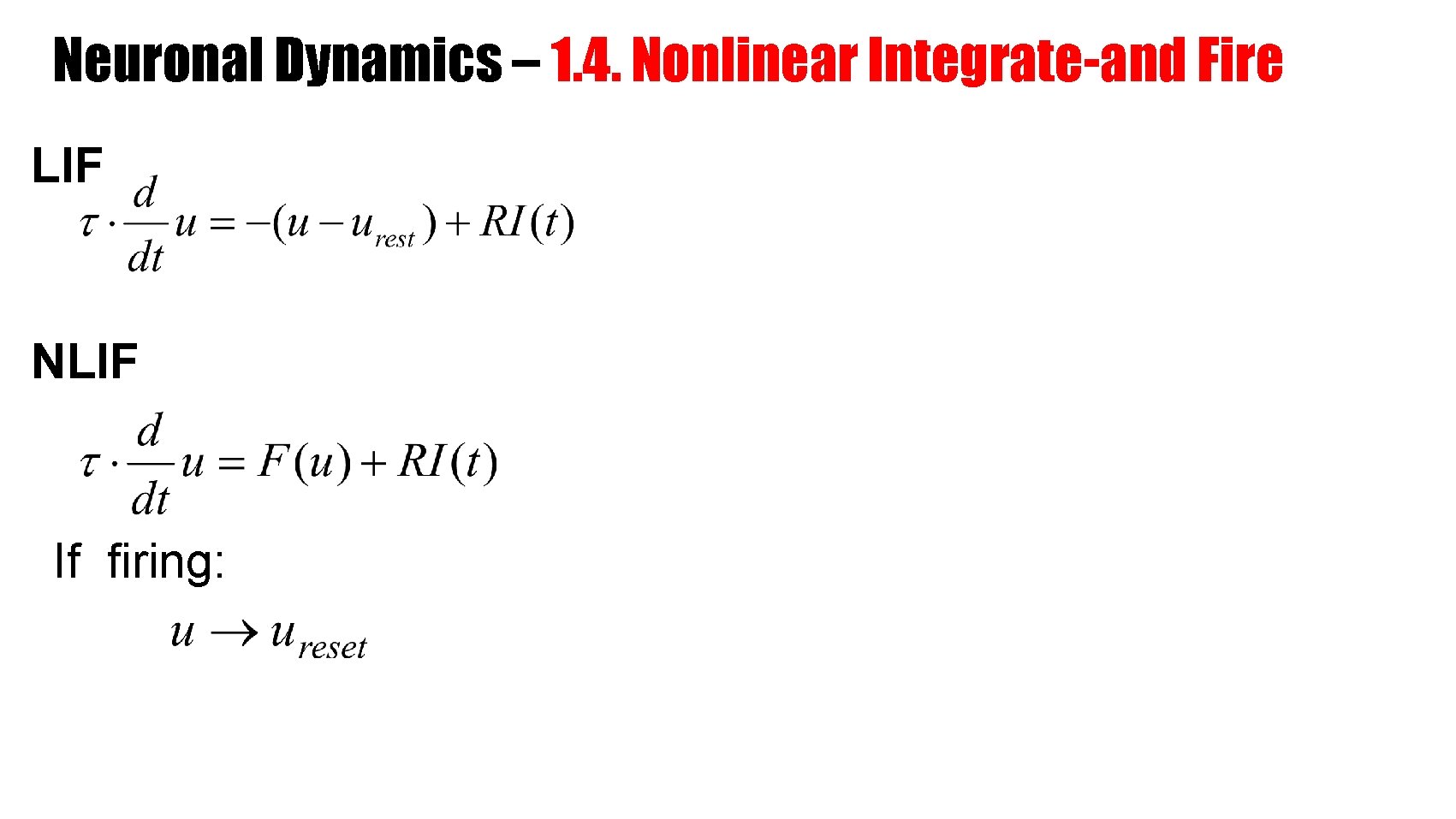
Neuronal Dynamics – 1. 4. Nonlinear Integrate-and Fire LIF NLIF If firing:
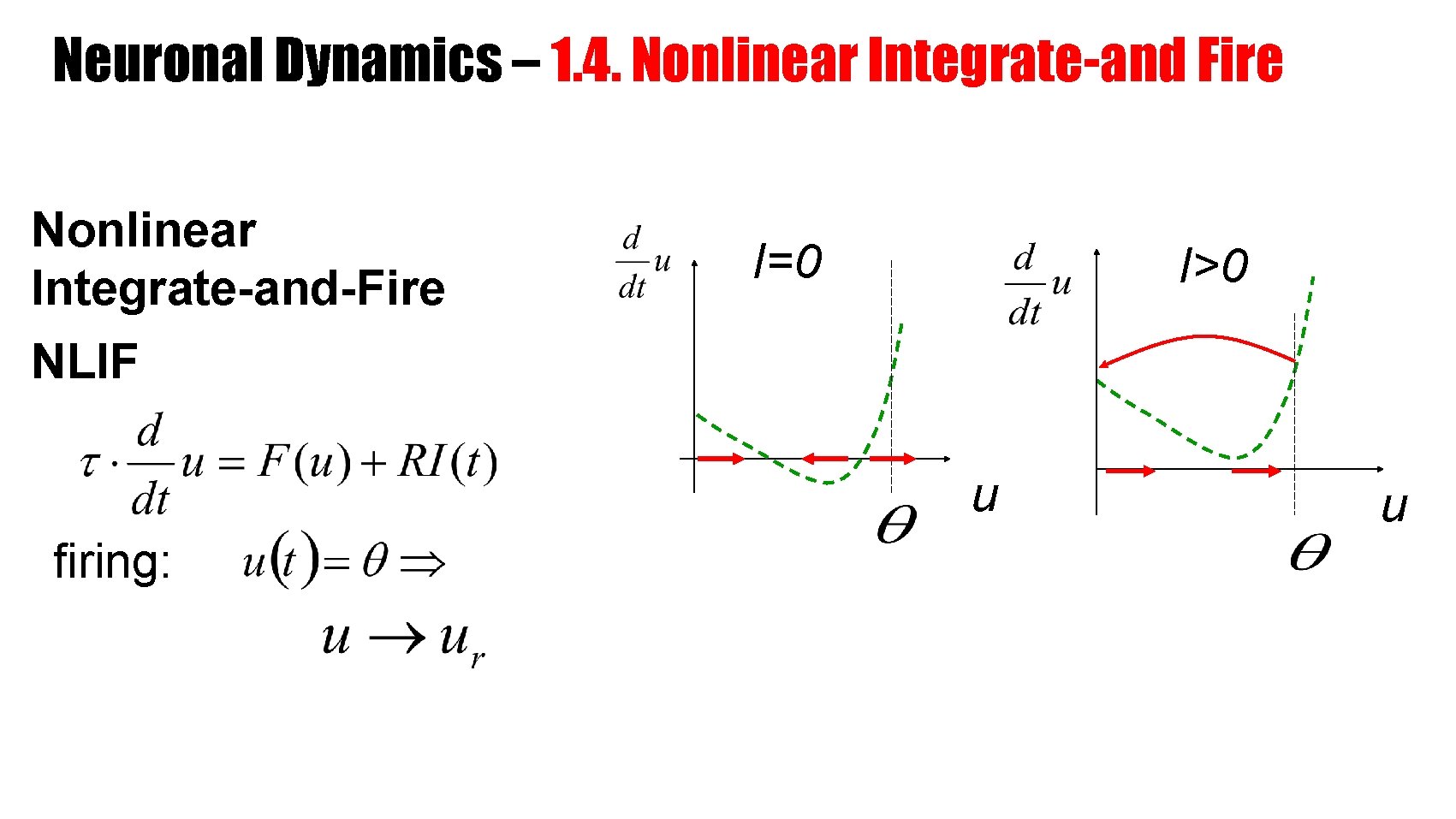
Neuronal Dynamics – 1. 4. Nonlinear Integrate-and Fire Nonlinear Integrate-and-Fire I=0 I>0 NLIF u firing: u
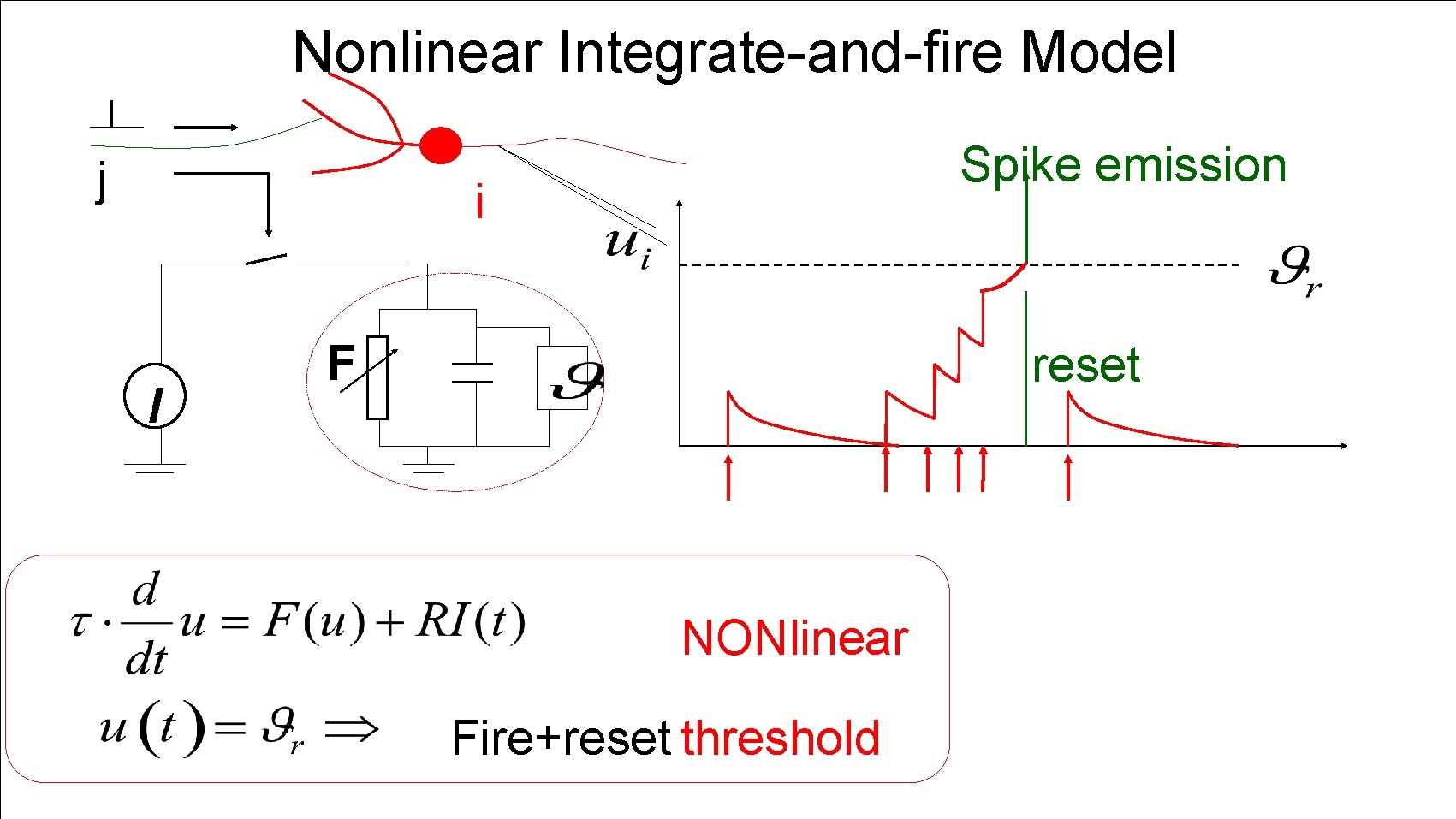
Nonlinear Integrate-and-fire Model j Spike emission i I F reset NONlinear Fire+reset threshold
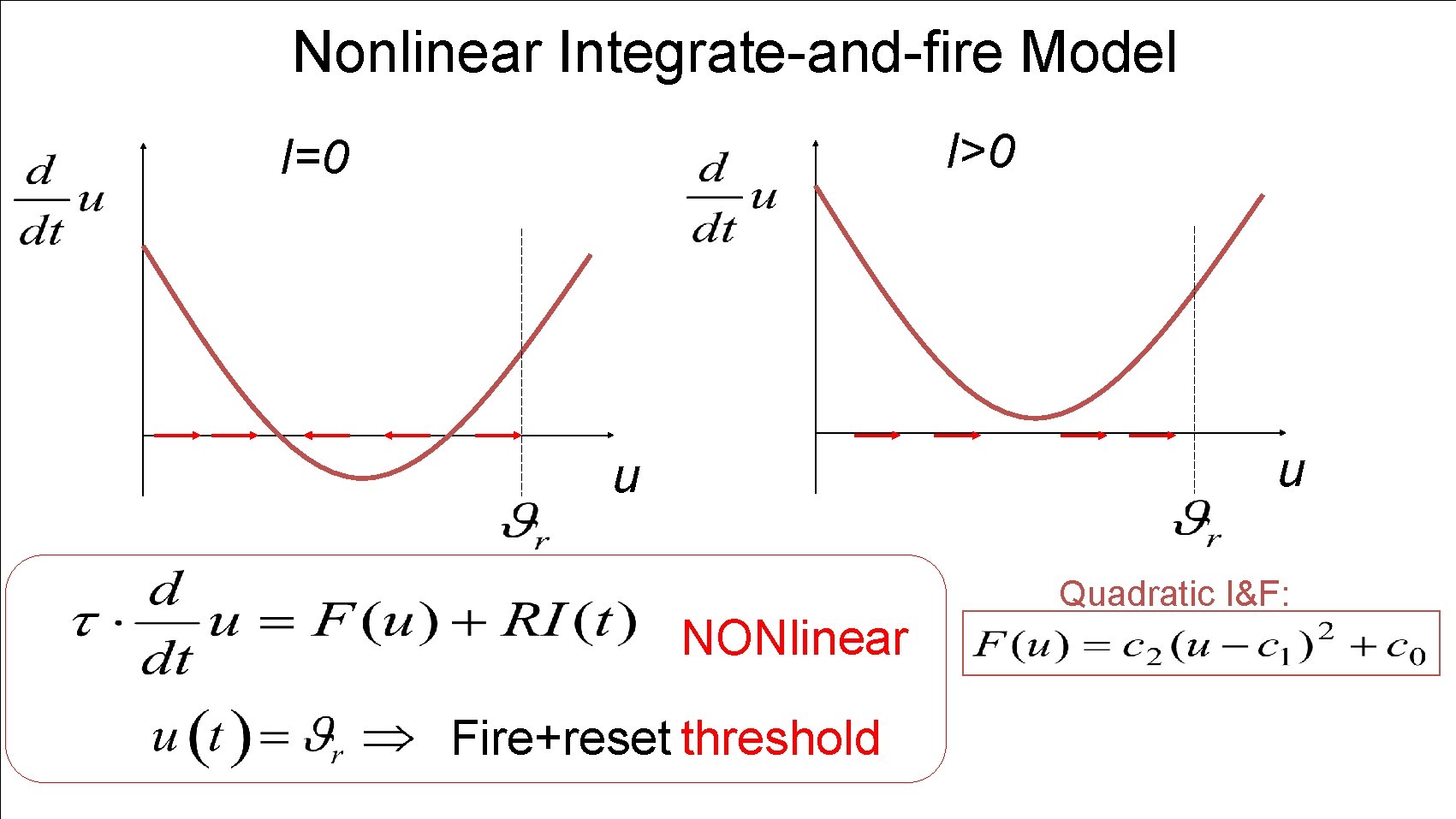
Nonlinear Integrate-and-fire Model I>0 I=0 u u NONlinear Fire+reset threshold Quadratic I&F:
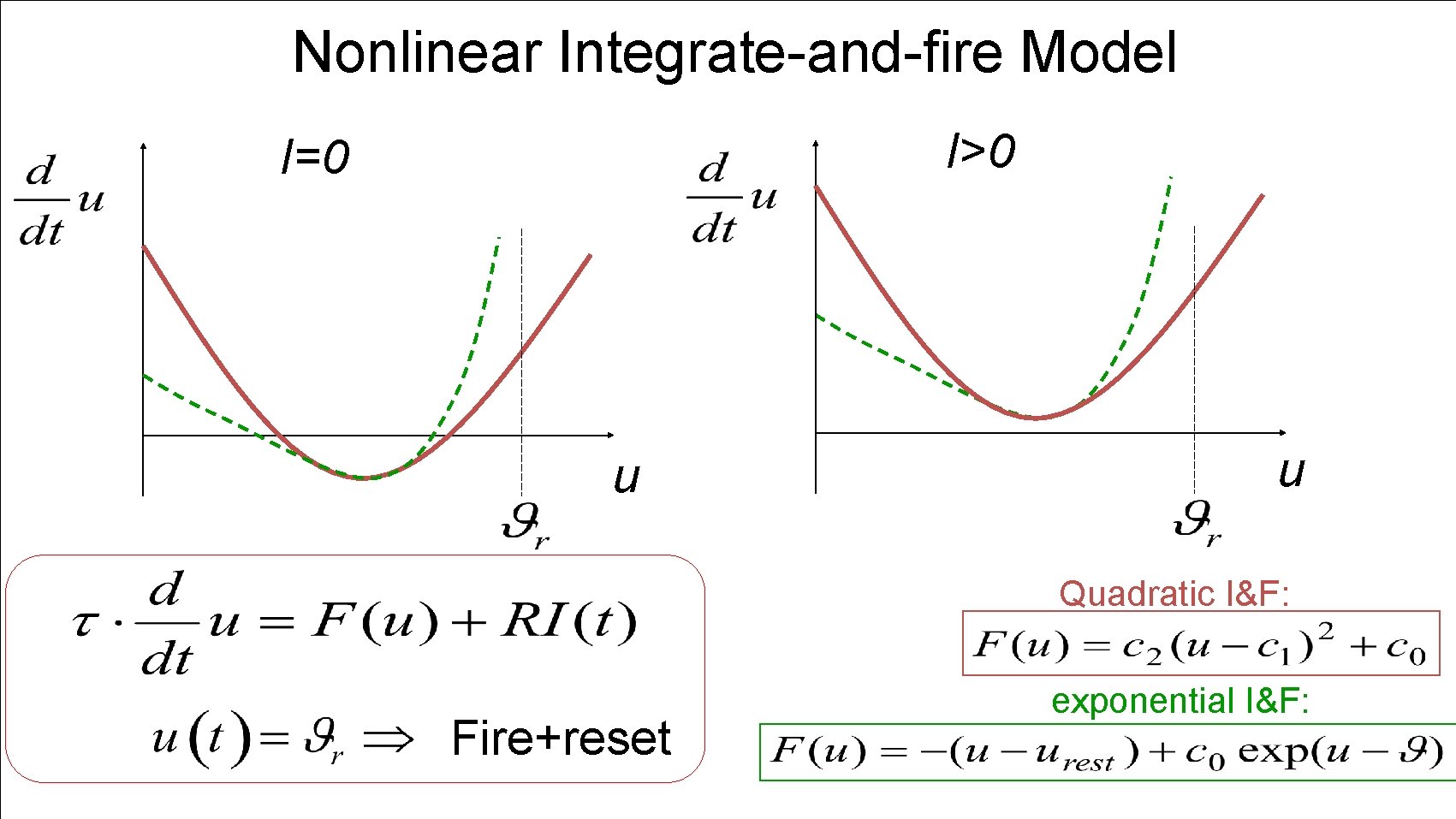
Nonlinear Integrate-and-fire Model I>0 I=0 u u Quadratic I&F: Fire+reset exponential I&F:
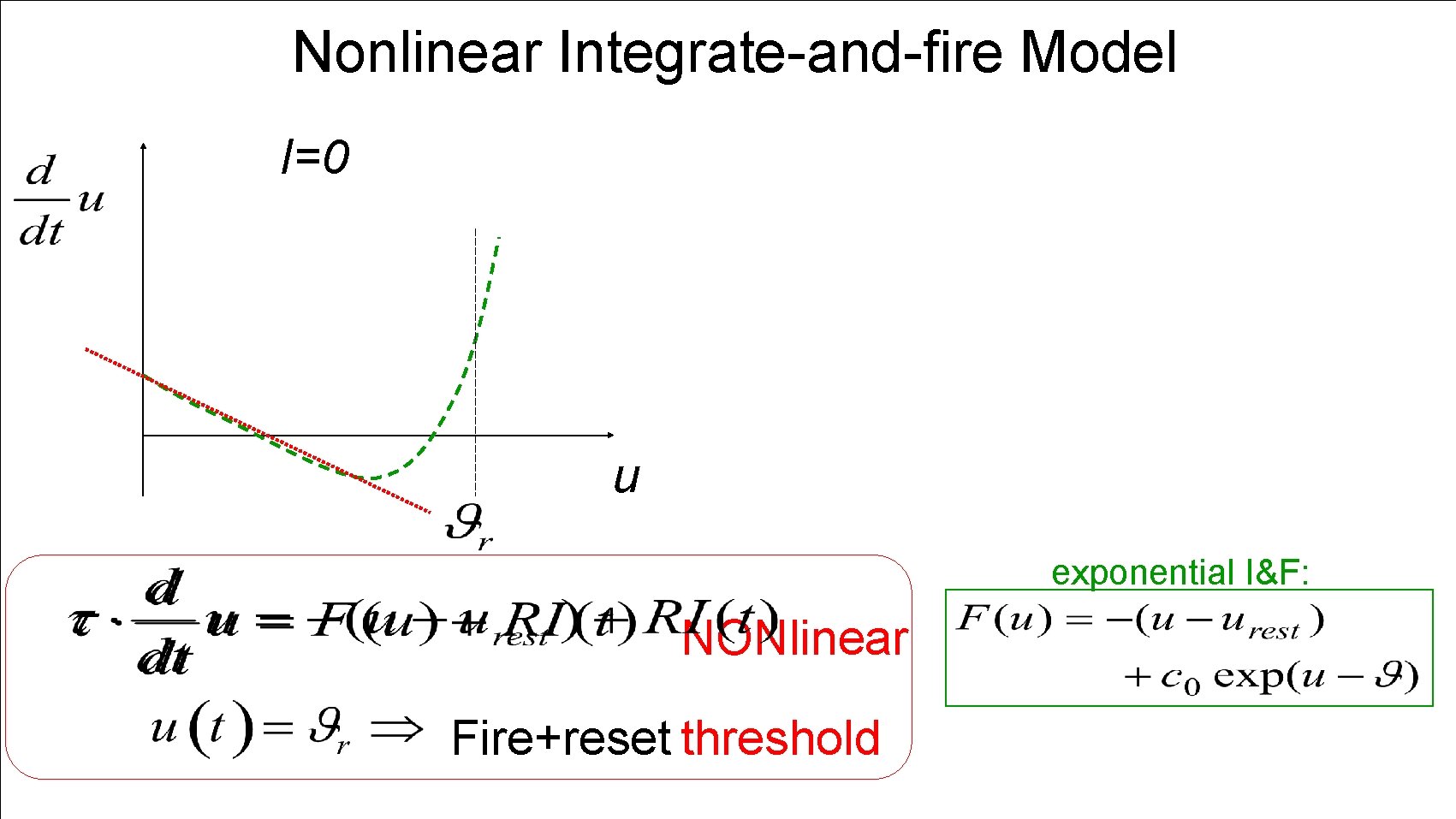
Nonlinear Integrate-and-fire Model I=0 u exponential I&F: NONlinear Fire+reset threshold
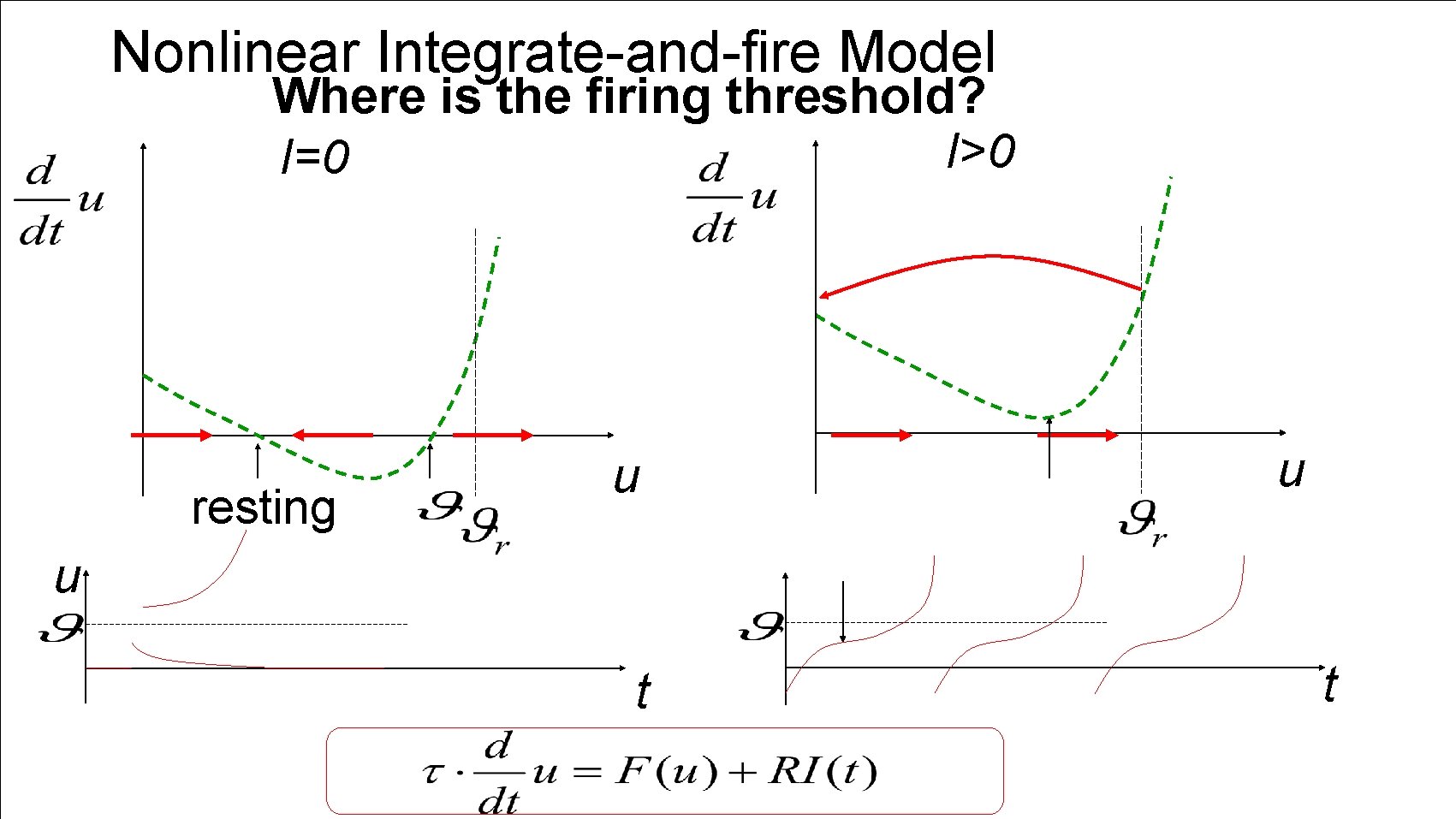
Nonlinear Integrate-and-fire Model Where is the firing threshold? I>0 I=0 resting u u u t t
1. 1 Neurons and Synapses: Week 1 – part 5: How good are Integrate-and-Fire Model? Overview 1. 2 The Passive Membrane Neuronal Dynamics: - Linear circuit - Dirac delta-function 1. 3 Leaky Integrate-and-Fire Computational Neuroscience Model of Single Neurons 1. 4 Generalized Integrate-and -Fire Week 1 – neurons and mathematics: Model a first simple neuron model Wulfram Gerstner EPFL, Lausanne, Switzerland - where is the firing threshold? 1. 5. Quality of Integrate-and. Fire Models - Neuron models and
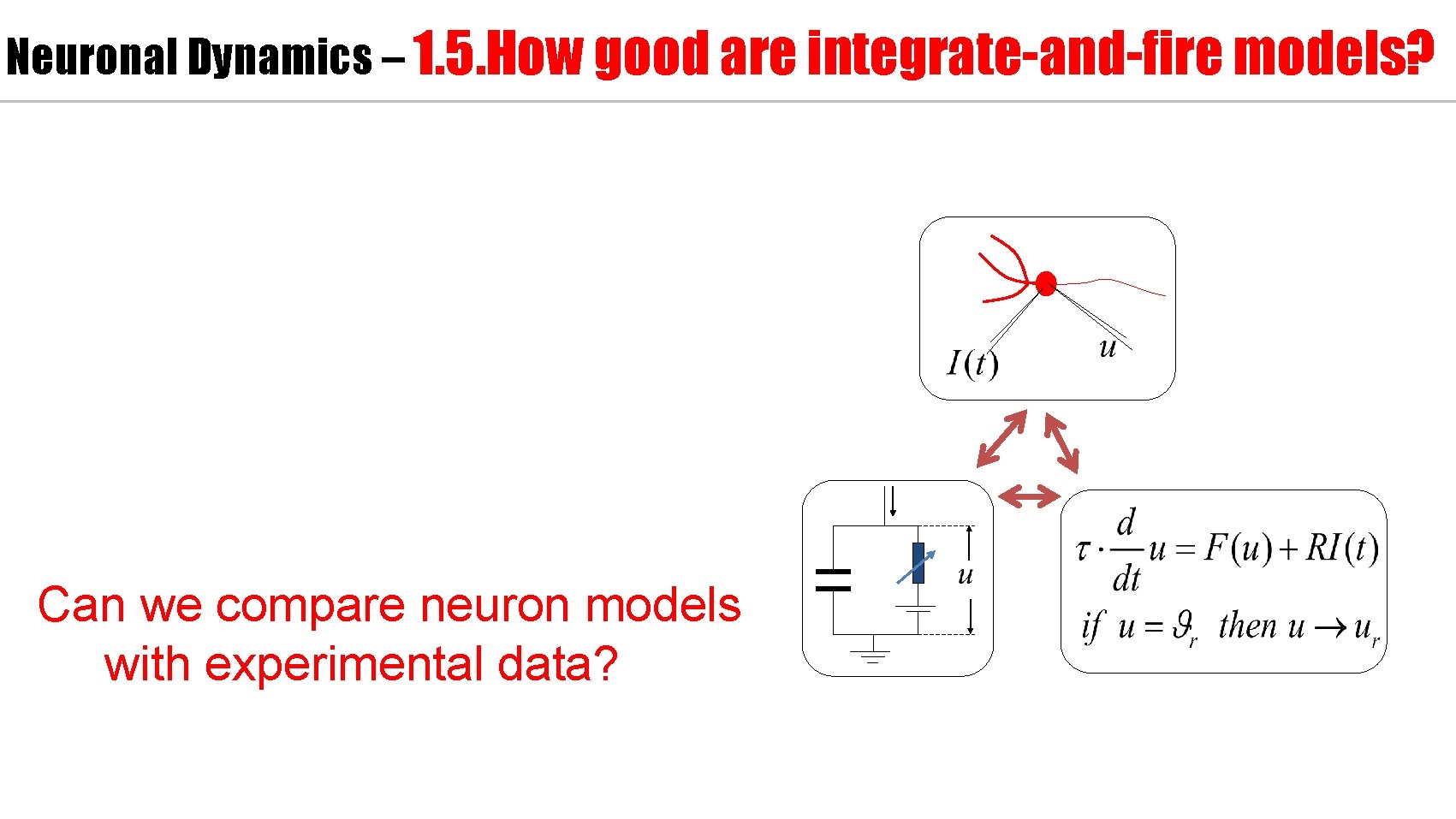
Neuronal Dynamics – 1. 5. How good are integrate-and-fire models? Can we compare neuron models with experimental data?
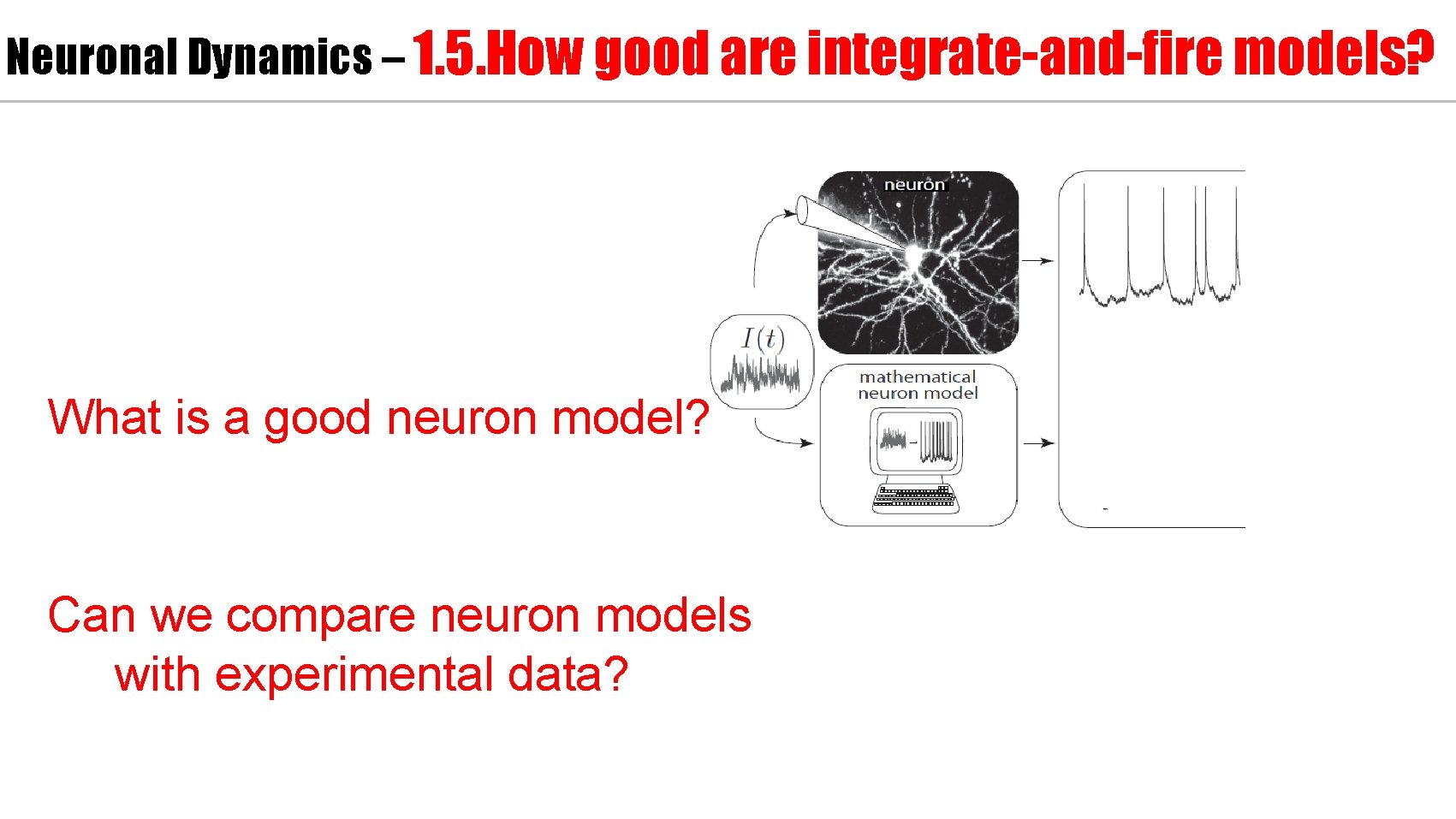
Neuronal Dynamics – 1. 5. How good are integrate-and-fire models? What is a good neuron model? Can we compare neuron models with experimental data?
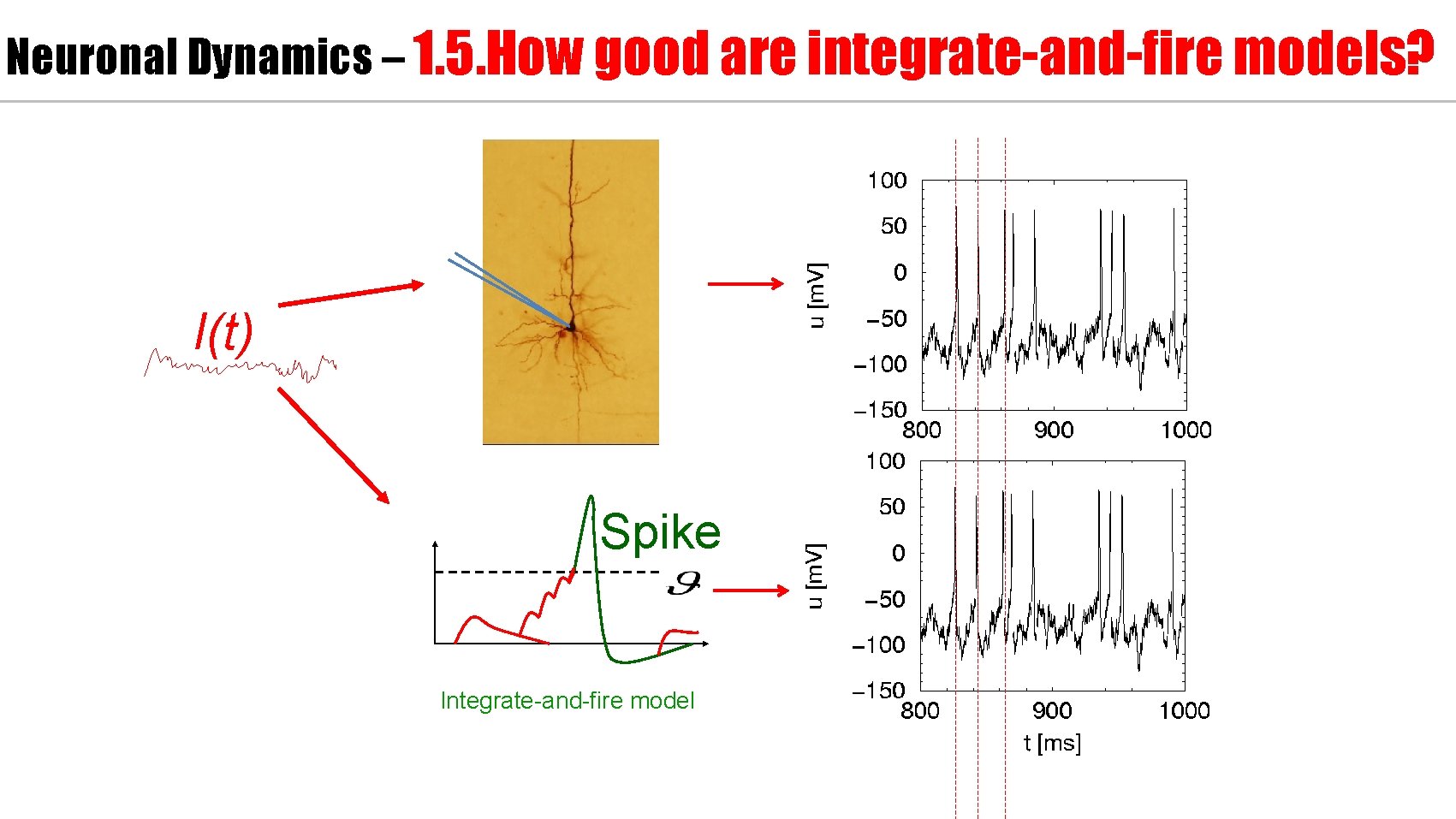
Neuronal Dynamics – 1. 5. How good are integrate-and-fire models? I(t) Spike Integrate-and-fire model
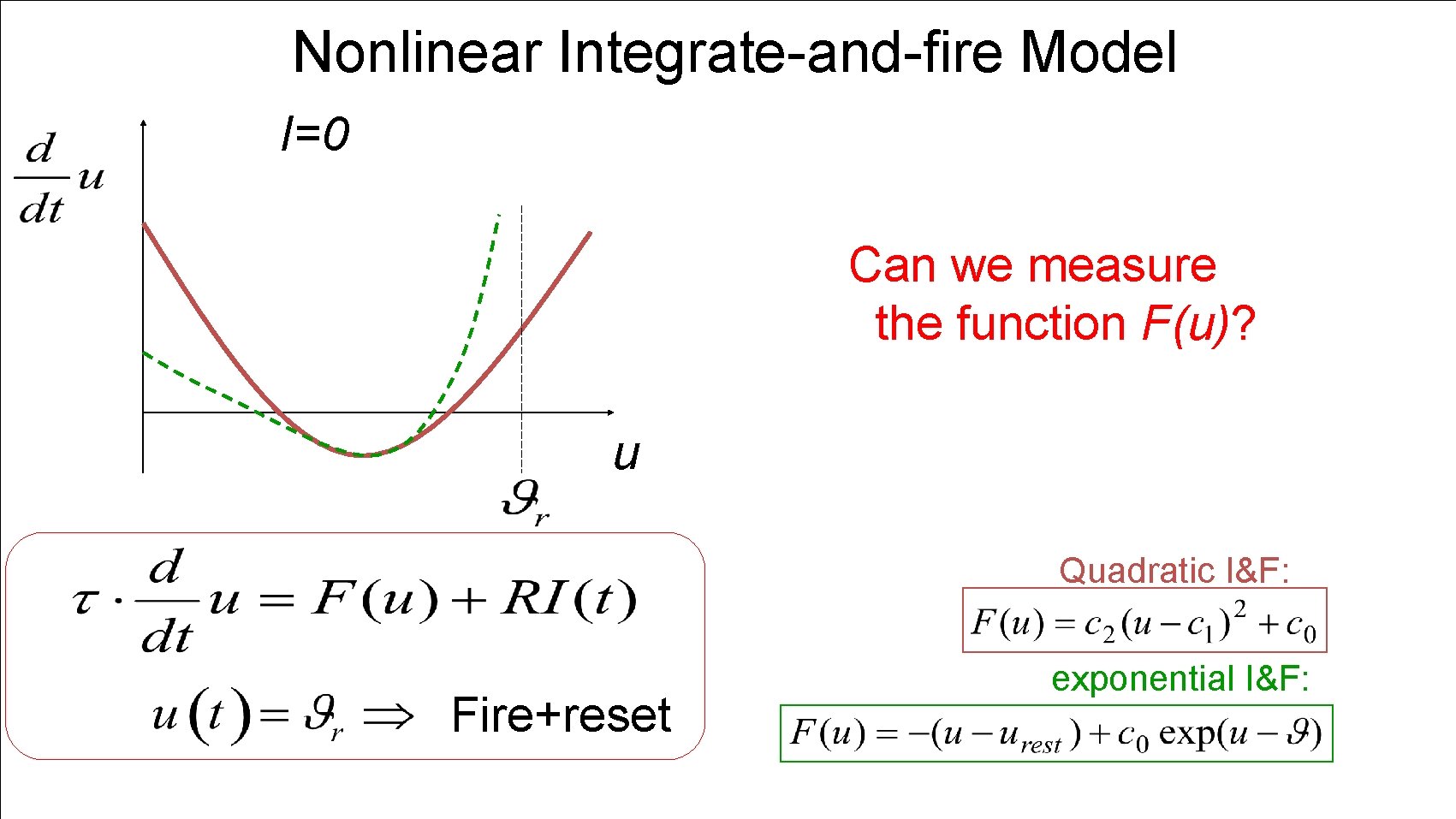
Nonlinear Integrate-and-fire Model I=0 Can we measure the function F(u)? u Quadratic I&F: Fire+reset exponential I&F:
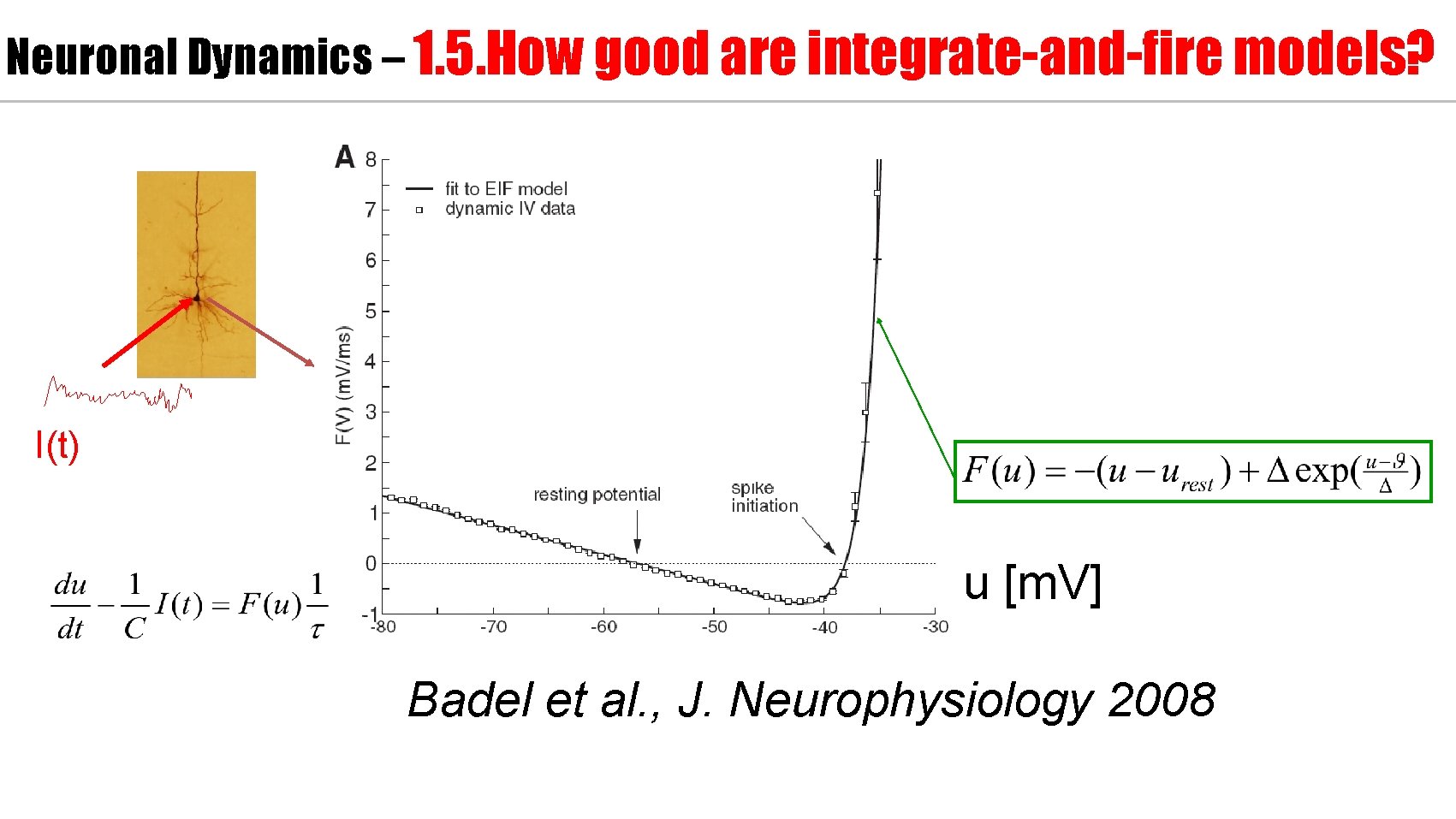
Neuronal Dynamics – 1. 5. How good are integrate-and-fire models? voltage I(t) u [m. V] Badel et al. , J. Neurophysiology 2008
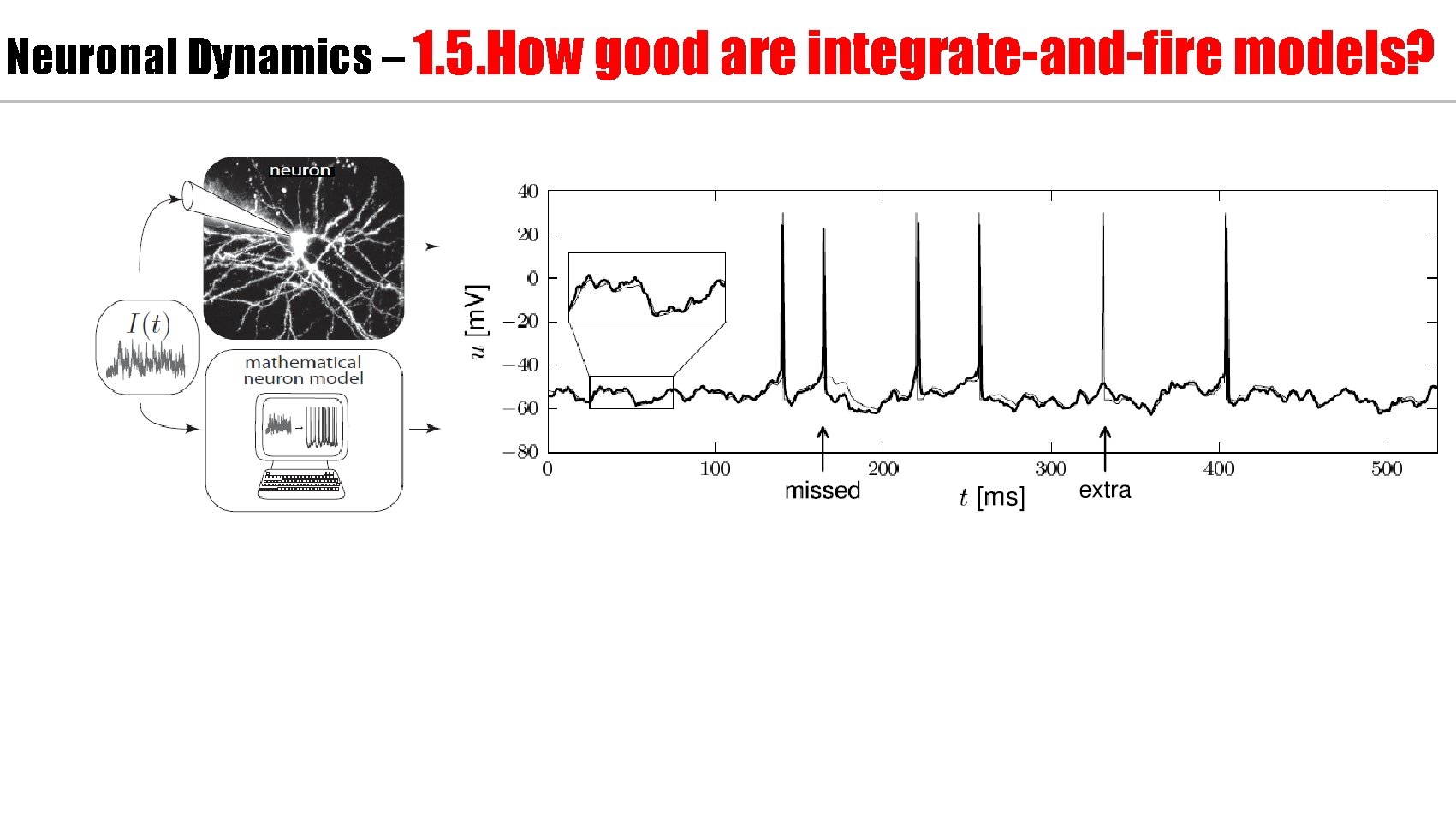
Neuronal Dynamics – 1. 5. How good are integrate-and-fire models?
Neuronal Dynamics – 1. 5. How good are integrate-and-fire models? Nonlinear integrate-and-fire models are good Mathematical description prediction Computer ecercises: Python Need to add - adaptation - noise - dendrites/synapses
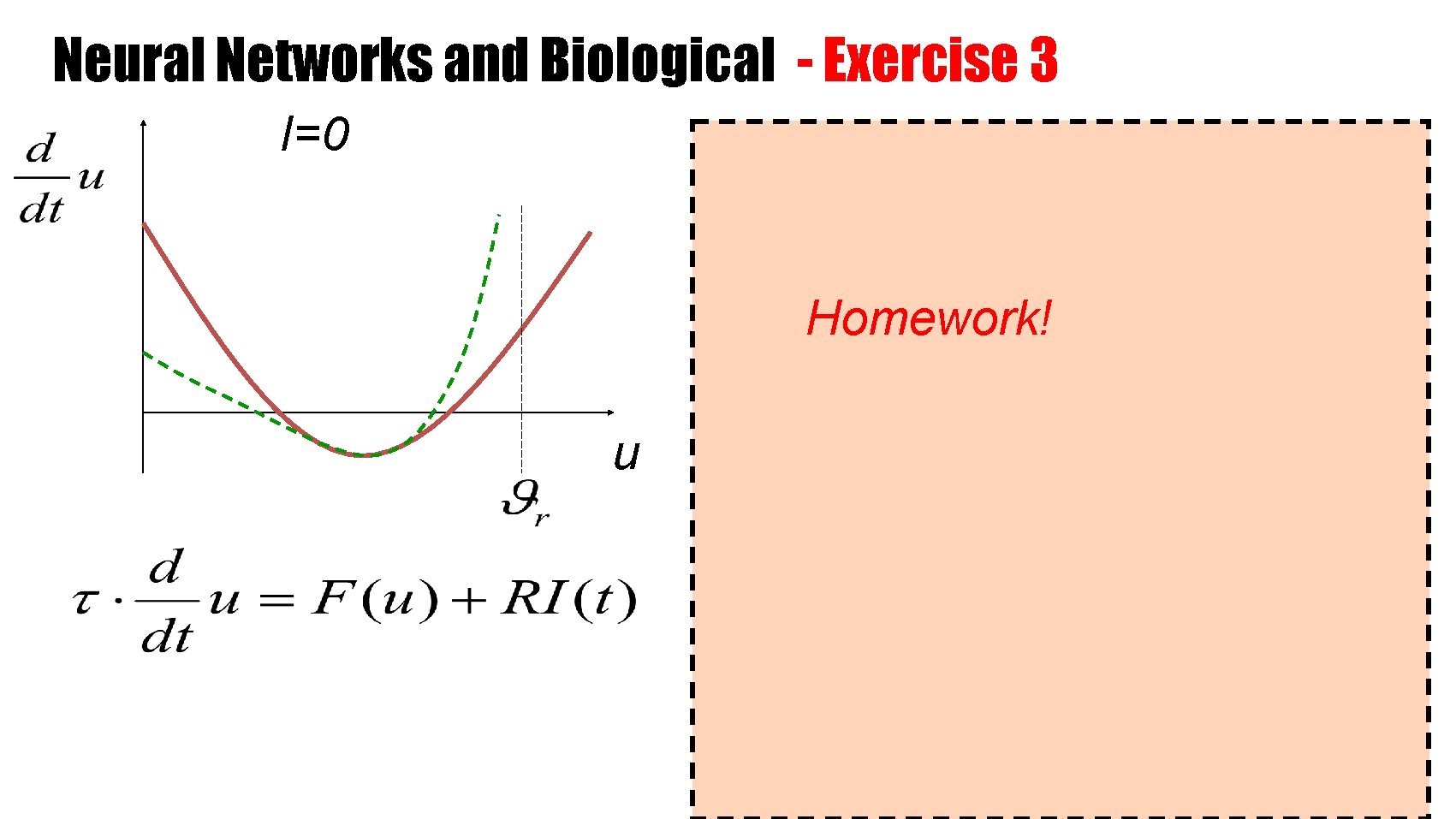
Neural Networks and Biological - Exercise 3 I=0 Homework! u
Neuronal Dynamics – References and Suggested Reading: W. Gerstner, W. M. Kistler, R. Naud and L. Paninski, Neuronal Dynamics: from single neurons to networks and models of cognition. Chapter 1: Introduction. Cambridge Univ. Press, 2014 Selected references to linear and nonlinear integrate-and-fire models - Lapicque, L. (1907). Recherches quantitatives sur l'excitation electrique des nerfs traitee comme une polarization. J. Physiol. Pathol. Gen. , 9: 620 -635. -Stein, R. B. (1965). A theoretical analysis of neuronal variability. Biophys. J. , 5: 173 -194. -Ermentrout, G. B. (1996). Type I membranes, phase resetting curves, and synchrony. Neural Computation, 8(5): 979 -1001. -Fourcaud-Trocme, N. , Hansel, D. , van Vreeswijk, C. , and Brunel, N. (2003). How spike generation mechanisms determine the neuronal response to fluctuating input. J. Neuroscience, 23: 11628 -11640. -Badel, L. , Lefort, S. , Berger, T. , Petersen, C. , Gerstner, W. , and Richardson, M. (2008). Biological Cybernetics, 99(4 -5): 361 -370. - Latham, P. E. , Richmond, B. , Nelson, P. , and Nirenberg, S. (2000). Intrinsic dynamics in neuronal networks. I. Theory. J. Neurophysiology, 83: 808 -827.
Neuronal Dynamics – THE END MATH DETOUR SLIDES
1. 1 Neurons and Synapses: Week 1 – part 2: Detour/Linear differential Overview equation 1. 2 The Passive Membrane Neuronal Dynamics: Computational Neuroscience of Single Neurons - Linear circuit - Dirac delta-function - Detour: solution of 1 -dim linear differential equation 1. 3 Leaky Integrate-and-Fire Model Week 1 – neurons and mathematics: 1. 4 Generalized Integrate-and a first simple neuron model -Fire Model Wulfram Gerstner 1. 5. Quality of Integrate-and. EPFL, Lausanne, Switzerland Fire Models
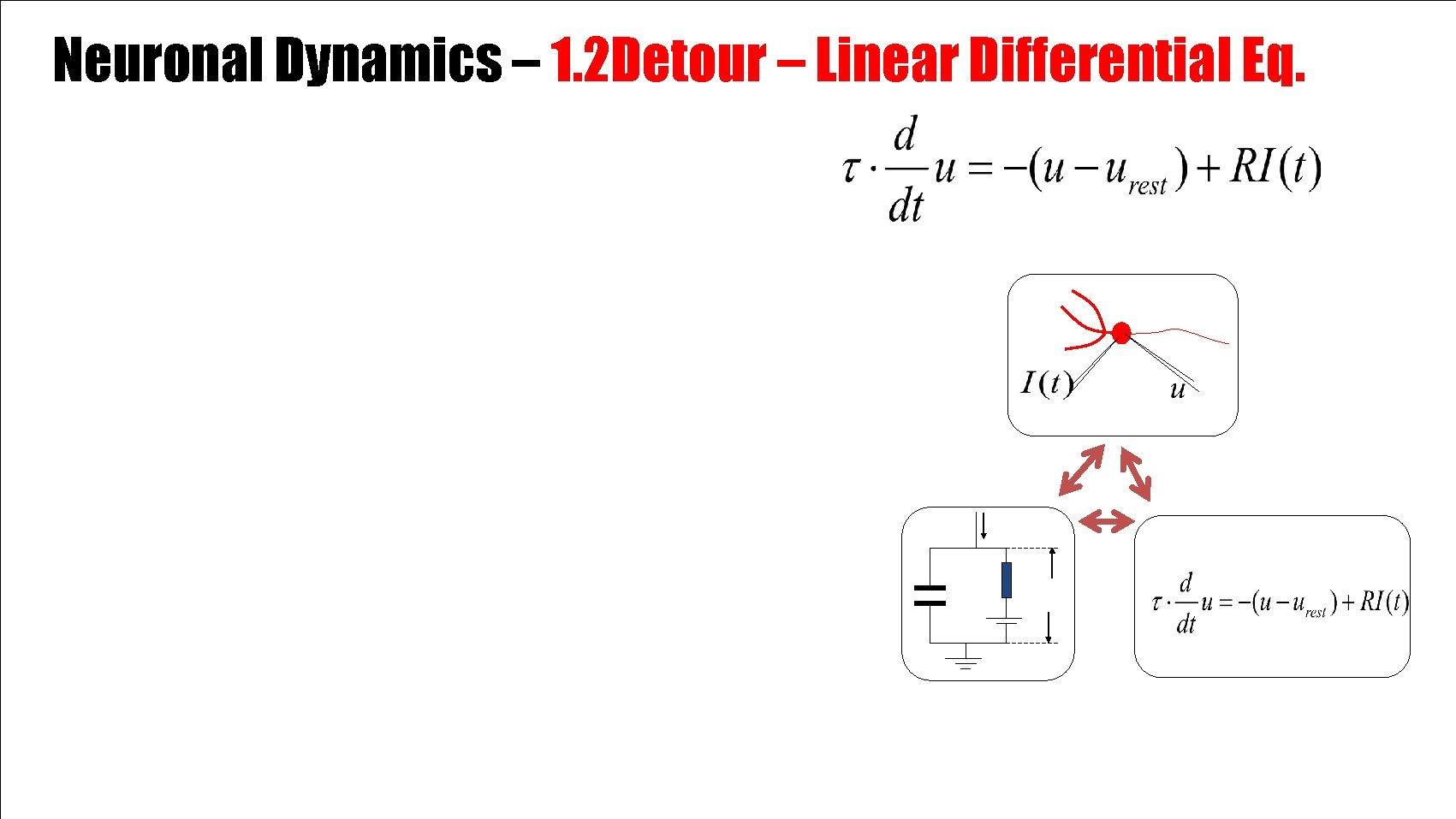
Neuronal Dynamics – 1. 2 Detour – Linear Differential Eq.
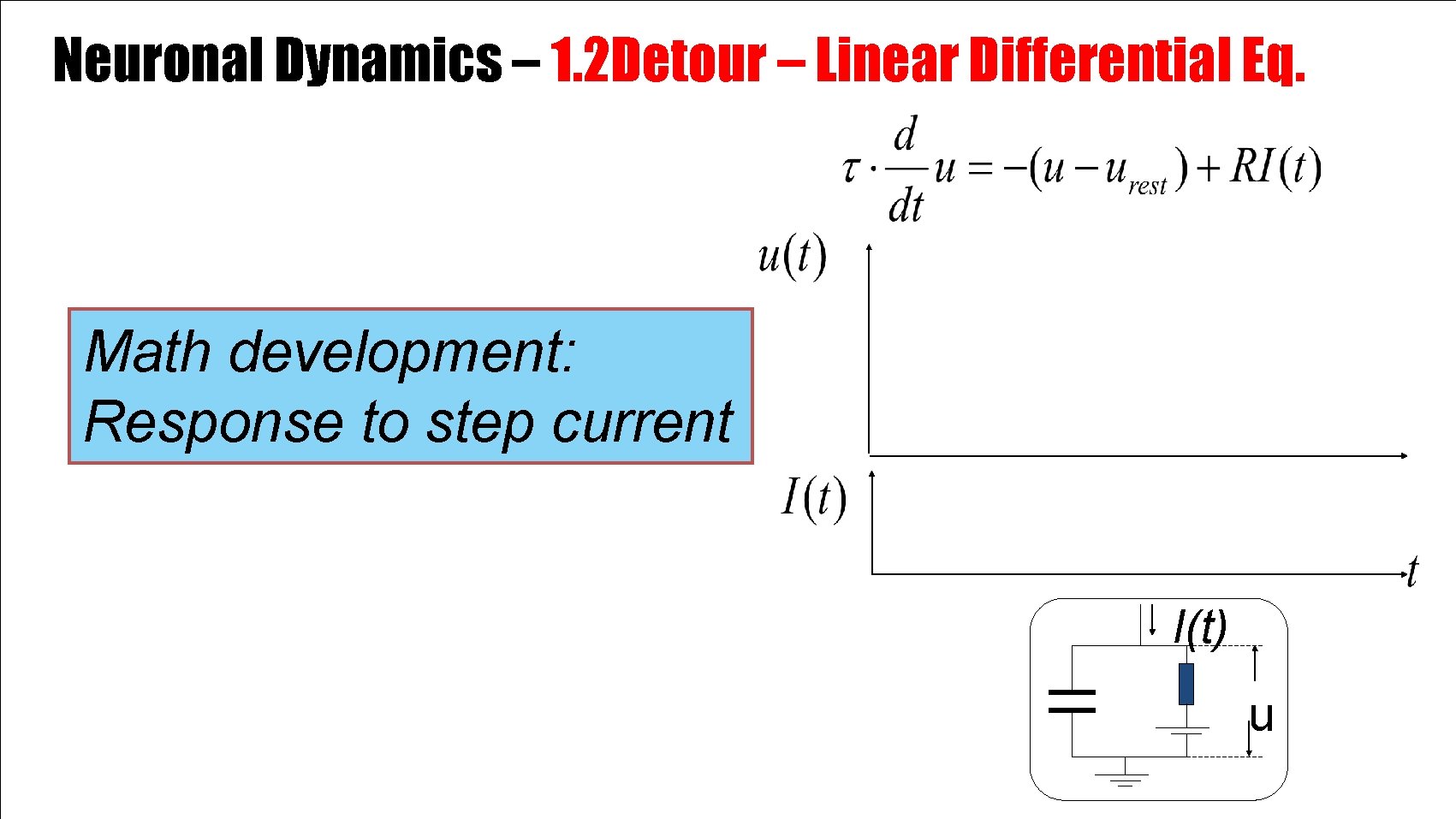
Neuronal Dynamics – 1. 2 Detour – Linear Differential Eq. Math development: Response to step current I(t) u
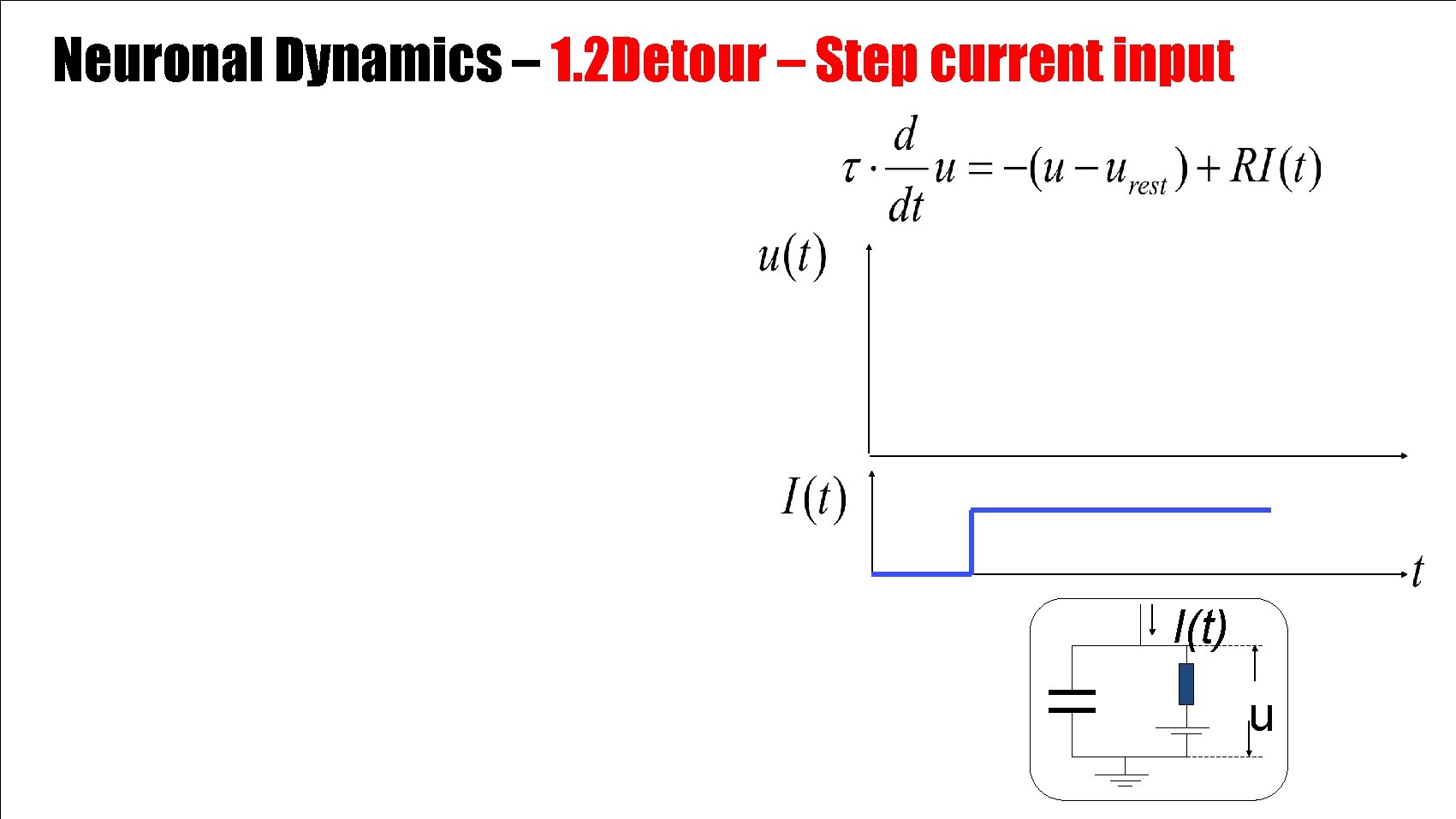
Neuronal Dynamics – 1. 2 Detour – Step current input I(t) u
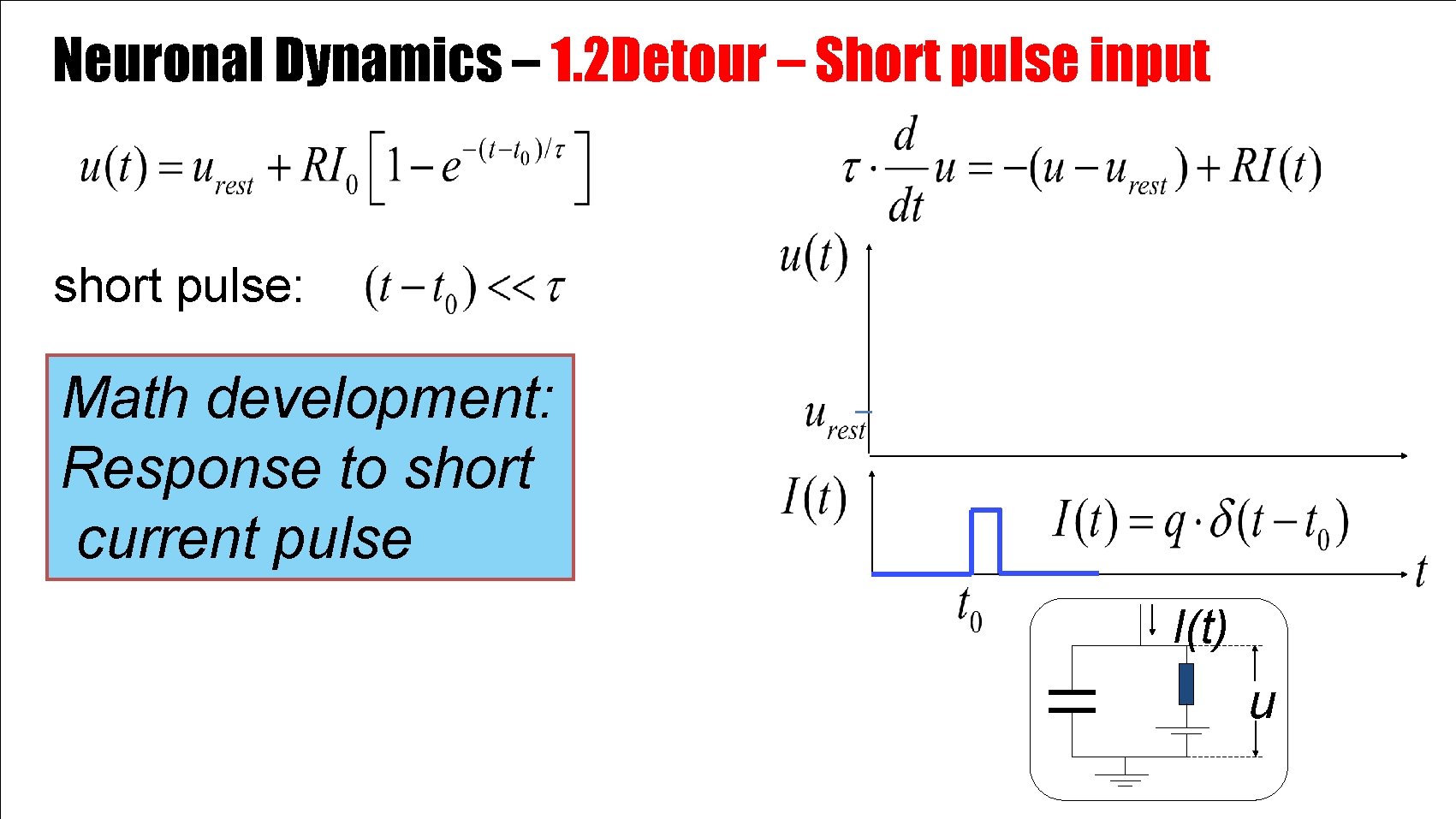
Neuronal Dynamics – 1. 2 Detour – Short pulse input short pulse: Math development: Response to short current pulse I(t) u
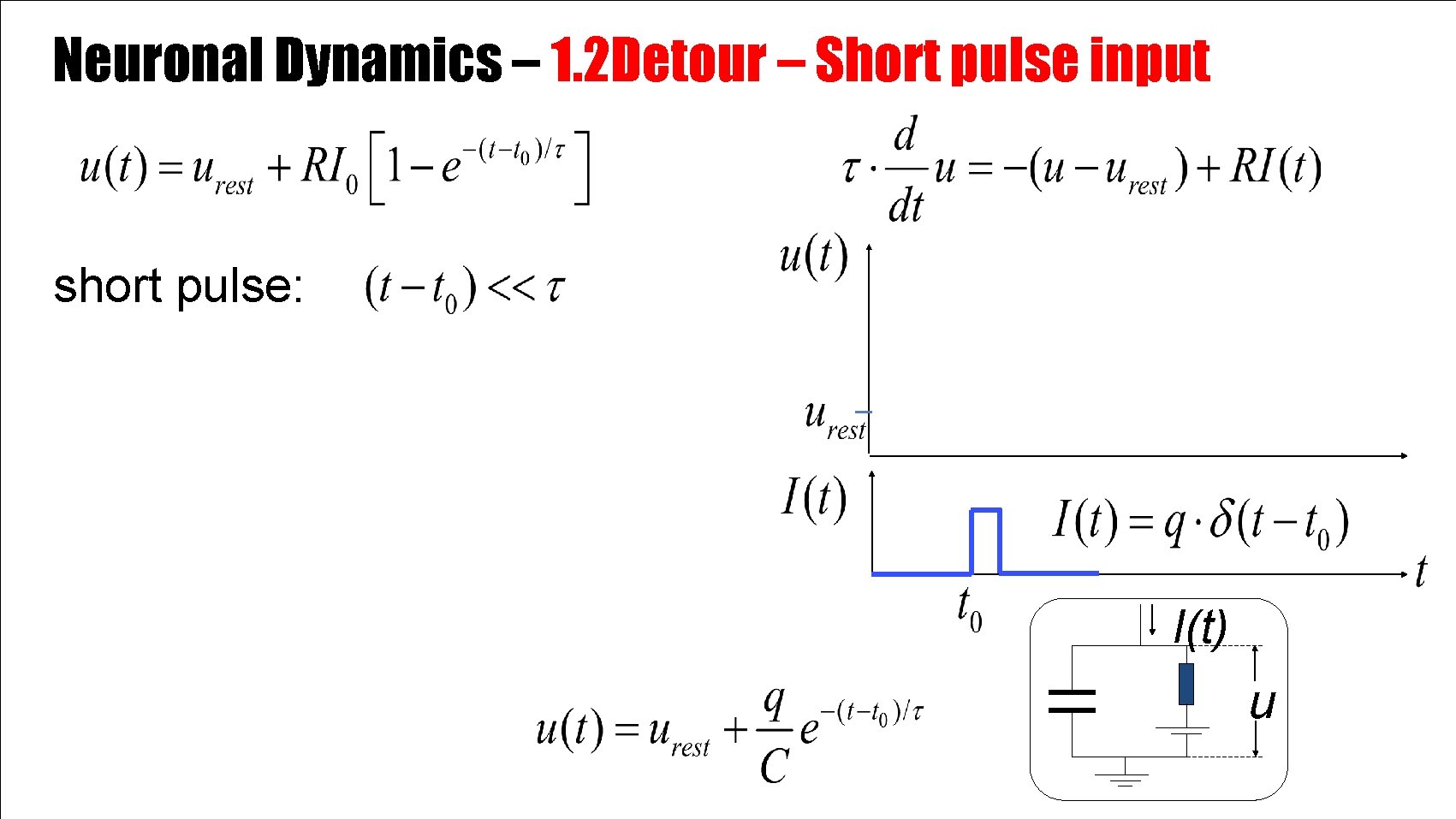
Neuronal Dynamics – 1. 2 Detour – Short pulse input short pulse: I(t) u
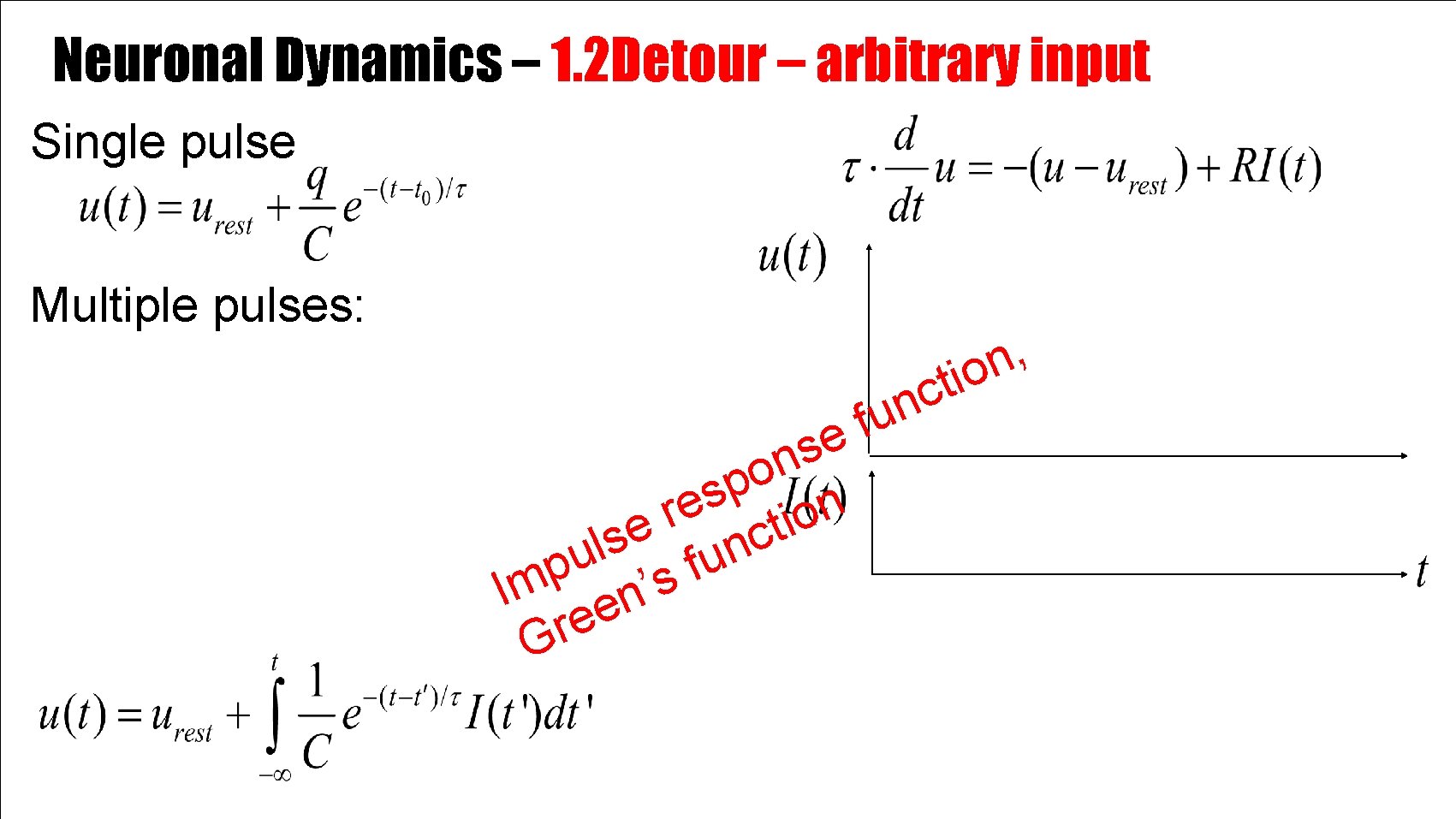
Neuronal Dynamics – 1. 2 Detour – arbitrary input Single pulse Multiple pulses: , n o i t c n u f e s n o p s n e r o i t e c s l n u u f p Im en’s e r G
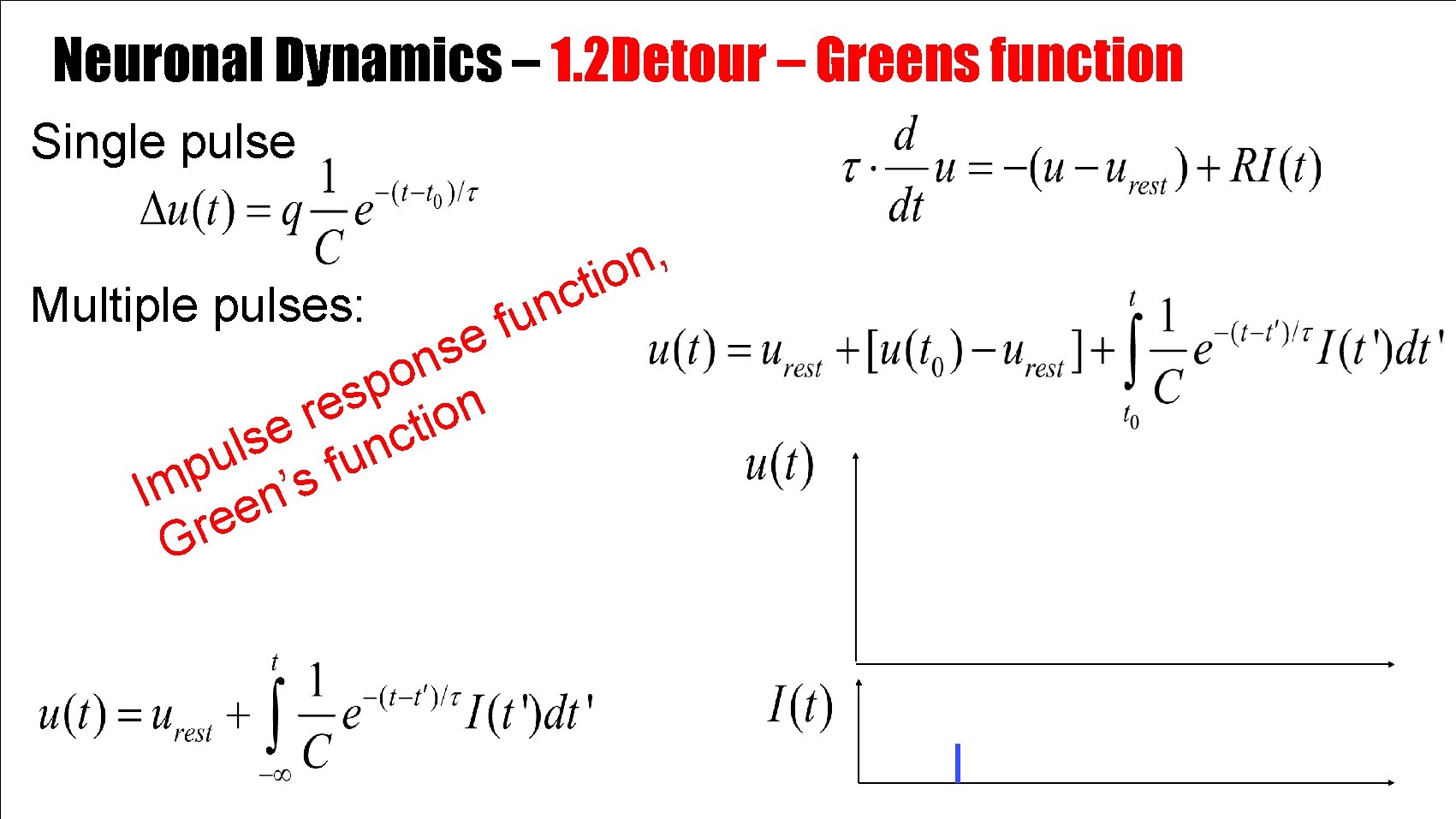
Neuronal Dynamics – 1. 2 Detour – Greens function Single pulse Multiple pulses: , n o i t c n u f e s n o p s n e r o i t e c s l n u u f p Im en’s e r G
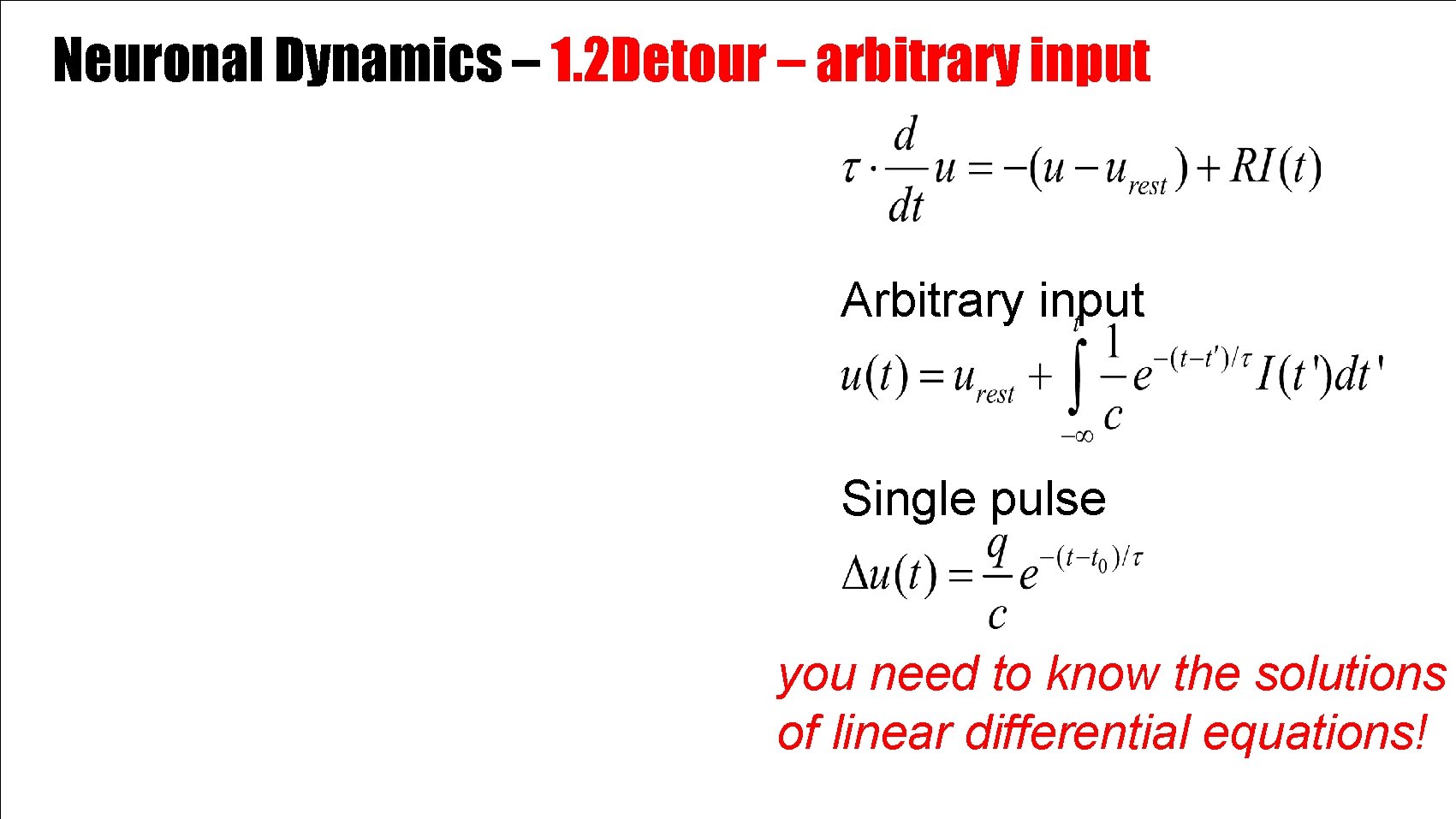
Neuronal Dynamics – 1. 2 Detour – arbitrary input Arbitrary input Single pulse you need to know the solutions of linear differential equations!
Neuronal Dynamics – Exercises 1. 2/Quiz 1. 2 If you don’t feel at ease yet, spend 10 minutes on these mathematical exercises
- Slides: 70