
BIOLOGICAL FACTORS AFFECTING LABORATORY RESULTS BY DR MEKA

BIOLOGICAL FACTORS AFFECTING LABORATORY RESULTS BY DR MEKA
Introduction Pathology – A branch of medical science primarily concerning the cause, origin and nature of disease. Involves examn of tissues, organs, body fluids and autopsies to study and diagnose disease Chemical Pathology Aka Clinical Pathology, Clinical chemistry, clinical biochemistry Chemical Pathology – study of chemical and biochemical mechanisms of the body in relation to disease, usually through the analysis of body fluids such as blood, urine Branch of Pathology generally concerned with analysis of body fluids for diagnostic and therapeutic purposes

Introduction…. . Specimen – any biological material obtained from a human body for a specific purpose Proper specimen procurement and handling is an integral part of obtaining a valid and timely laboratory test result A lot of factors have the potential to affect the collection, processing and analysis of patient samples thereby influencing the final outcome – the laboratory test result
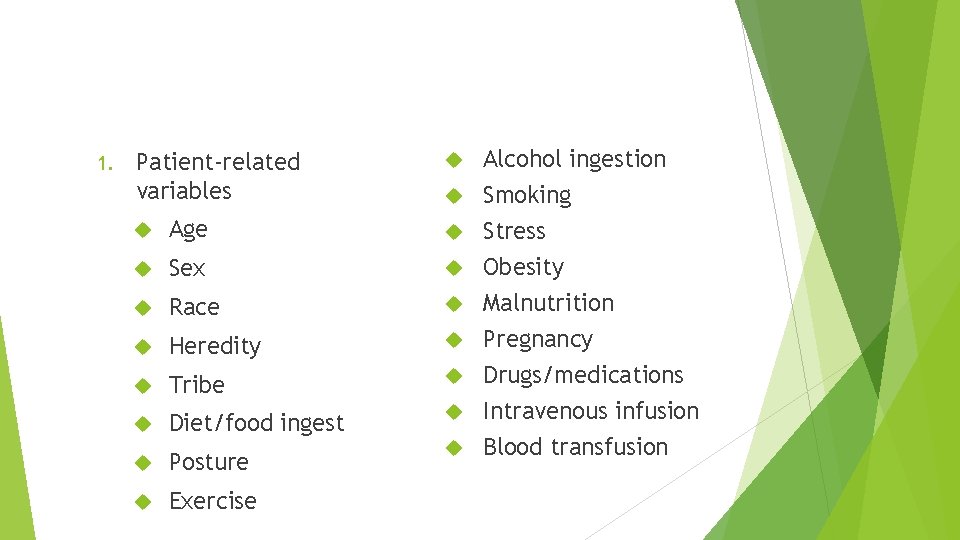
1. Patient-related variables Age Sex Race Heredity Tribe Diet/food ingest Posture Exercise Alcohol ingestion Smoking Stress Obesity Malnutrition Pregnancy Drugs/medications Intravenous infusion Blood transfusion
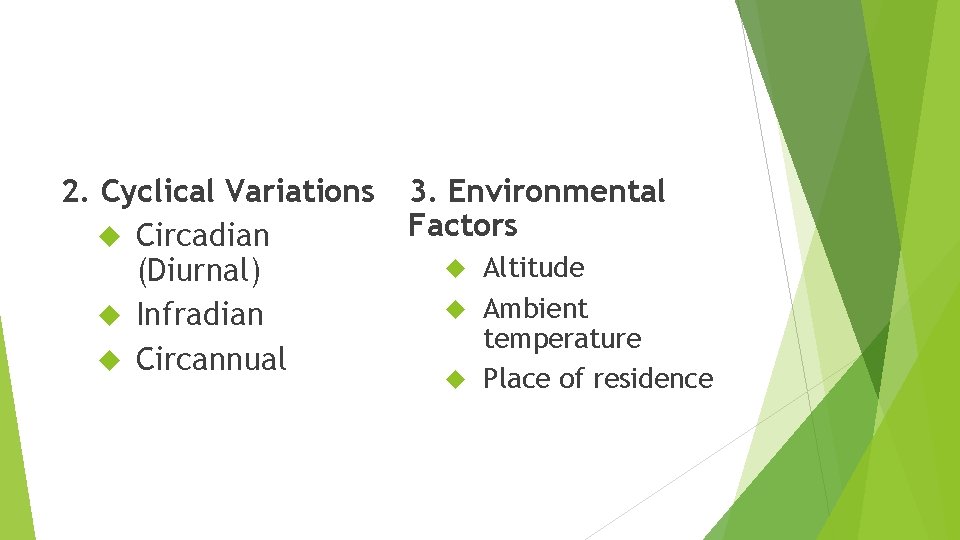
2. Cyclical Variations Circadian (Diurnal) Infradian Circannual 3. Environmental Factors Altitude Ambient temperature Place of residence
AGE Plasma concentration of some analytes tend to vary with age. Individuals are categorized according to age as: newborn, childhood and adolescence, adult, and elderly adult. Many changes in body fluid composition occur between infancy and puberty Most of these changes are gradual and rarely abrupt Adult concentrations are attained around the age of 10 Ø Serum ALP activity increases in infancy, decreases during childhood and rises during prepubertal and pubertal growth spurt. Need for age-specific reference intervals
SEX Few differences exist between laboratory data of young female and male individuals before puberty. Changes occur after puberty due to different concentrations of sex hormones and skeletal muscle mass. Sex-specific reference intervals.
RACE Serum total protein concentration is higher in blacks than in whites Serum albumin is less in blacks than in whites. Serum activity of CK and LD are higher in black men and women than their white counterparts
HEREDITY Genetic make-up of an individual can affect laboratory results Pharmacogenicity: increased activity of certain drug metabolizing enzymes tend to make the individuals less or more prone to drug toxicity.
DIET/FOOD INGESTION Diet and food ingestion affect composition of plasma. High protein diet is associated with increased plasma concentrations of urea, Uric Acid, and NH 3. Analytes with increased postprandial plasma concentrations: gastrin, glucagon, insulin, glucose, Triglycerides
POSTURE Associated with short-term changes and long-term changes (e. g. prolonged bed rest) Changes from lying to upright position ↑ plasma hydrostatic pressure leakage of H 2 O and electrolytes from IVF (plasma) compartment to ISF compartment decreased blood volume (about 10%) (decreased plasma) ↑ plasma total protein concentration (8 -10%) ↑ levels of protein-bound substances, lipoproteins, and cholesterol.
Posture…… Reverse occurs with change from upright to lying position. Prolonged bed rest fluid retention Increased plasma volume haemodilution decreased plasma total protein, albumin and protein-bound substances
EXERCISE Change in analytes concentrations depends on nature and extent of exercise as well as physical fitness of individual Exercise increased metabolic activity of skeletal muscles increased plasma pyruvate and lactate concentrations and decreased arterial p. H and PCO 2.
ALCOHOL INGESTION A single moderate dose has few effects on lab tests. Acute ingestion sharp reduction in plasma testosterone in men Chronic alcohol ingestion is associated with: increased activity of GGT, abnormal pituitary, adrenocortical and adrenomedullary functions.
SMOKING Effects mediated by nicotine which can affect several laboratory test results. Associated with: (a) increased glucose concentrations. (b) glucose tolerance is mildly impaired (c) Affects body’s immune response by decreased plasma concentrations of Ig. A, Ig. G and Ig. M. (d) ↓ Sperm count, ↑ abnormal forms, ↓ sperm motility
DRUGS/MEDICATIONS Consists of prescribed medications, recreational drugs, herbal preparations. Recreational drugs eg morphine, amphetamine, heroin, pain medications. Intramuscular injection lead to increased activity and plasma levels of CK and LDH. Morphine causes increased serum activity of: amylase, lipase, ALT, AST, ALP, bilirubin Herbal preparations may affect liver functions.
CYCLICAL VARIATIONS Alterations in analytes concentrations which occur repetitively in a predictable manner over a given period of time. Can be: circardian (diurnal), ultradian infradian, and circannual. Circadian (Diurnal) Variation Changes occur over the course of a single day (24 hours) May be due to: (i) posture (ii) activity (iii) food ingestion (iv) stress (v) daylight/darkness (vi) sleep/wakefulness. Analytes higher in the morning: ACTH, cortisol, glucose, insulin, catecholamines, iron, renin, aldosterone, glucose tolerance.
Infradian Variation Changes occur over a period of time longer than one day. Typical of menstrual cycle associated with changes in concentrations of ovarian hormones. Circannual variation Change in analytes levels are related to seasonal variations in diet or climatic change. Vitamin D concentration is higher in summer than in other seasons. Individual variability (outliers): There are individuals who are healthy but whose tests results, which are typical for them, do not always fall within the expected range of the overall population
ENVIRONMENTAL FACTORS ALTITUDE High altitude is associated with: increased Hb concentrations, haematocrit, RBC 23 DPG, and shift of O 2 -Hb dissociation curve to the right. Also causes increased serum concentrations of CRP, transferrin, and β 2 – globulins Associated decrease in plasma osmolality, renin, and aldosterone concentrations. Full adaptation to high altitude occurs in many weeks Adjustment to lower altitude takes less time.
Ambient Temperature Acute exposure to heat Expansion of plasma volume by influx of interstitial fluid into intravascular space and ↓ GFR, decreased plasma total protein concentration Extensive sweating hemoconcentration
PLACE OF RESIDENCE Geographical location of residence may affect body fluids composition. Areas with hard water have been associated with increased serum levels of TG, cholesterol and magnesium Areas of ore smelting may cause increased concentrations of trace elements. Carboxyhaemoglobin levels are higher in urbanized cities with heavier automobile traffic than rural areas. Increased blood lead (Pb) concentrations in places of heavy automobile traffic. Indoor workers tend to have lower 25 -(OH) vitamin D than outdoor workers.
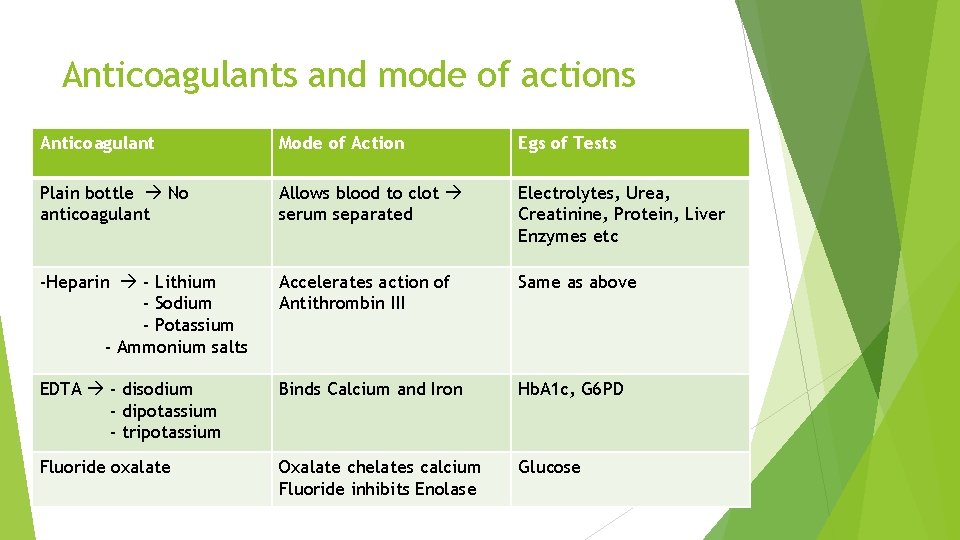
Anticoagulants and mode of actions Anticoagulant Mode of Action Egs of Tests Plain bottle No anticoagulant Allows blood to clot serum separated Electrolytes, Urea, Creatinine, Protein, Liver Enzymes etc -Heparin - Lithium - Sodium - Potassium - Ammonium salts Accelerates action of Antithrombin III Same as above EDTA - disodium - dipotassium - tripotassium Binds Calcium and Iron Hb. A 1 c, G 6 PD Fluoride oxalate Oxalate chelates calcium Fluoride inhibits Enolase Glucose
Factors that can cause errors Prolonged tourniquet application Incomplete drying of site after antiseptic application Ejection of blood via needle instead of through nozzle of syringe Sample hemolysis Use of wrong sample bottle Blood collection from arm containing IV infusion Inadequate patient preparation Wrong timing eg Mid-luteal progesterone
Post Collection REJECTION CRITERIA Improperly filled request forms Incorrectly labelled/unlabeled specimens Hemolyzed samples Stained request forms Inadequate Wrong Poor sample volumes timing eg Day 21 Progesterone patient preparation eg Fasting sample
Conclusion An abnormal result does not always mean presence of disease while normal does not exclude a disease process. THANK YOU
- Slides: 25