
Biological Effects of Ionizing Radiation Michael Hajek Radiation

Biological Effects of Ionizing Radiation Michael Hajek Radiation Safety and Monitoring Section Division of Radiation, Transport and Waste Safety Department of Nuclear Safety and Security IAEA International Atomic Energy Agency
Outline • Introduction and historical background • Targets for biological radiation damage • Deterministic and stochastic effects • ICRP system of radiological protection IAEA Biological Radiation Effects 2
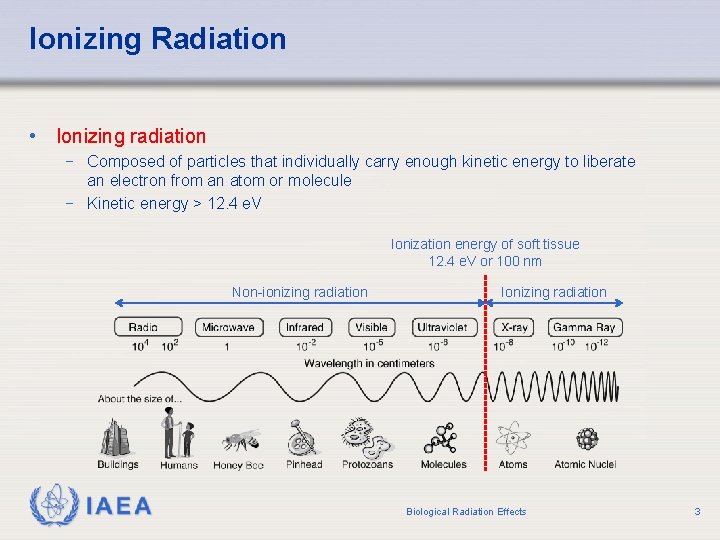
Ionizing Radiation • Ionizing radiation − Composed of particles that individually carry enough kinetic energy to liberate an electron from an atom or molecule − Kinetic energy > 12. 4 e. V Ionization energy of soft tissue 12. 4 e. V or 100 nm Non-ionizing radiation IAEA Ionizing radiation Biological Radiation Effects 3
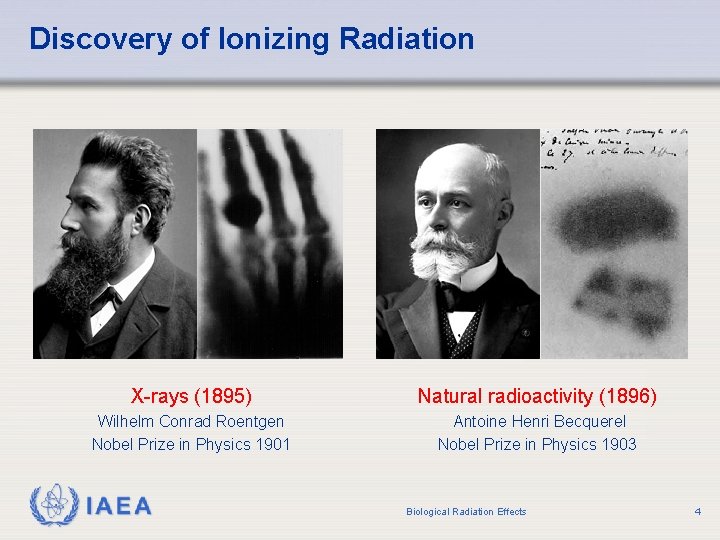
Discovery of Ionizing Radiation X-rays (1895) Natural radioactivity (1896) Wilhelm Conrad Roentgen Nobel Prize in Physics 1901 Antoine Henri Becquerel Nobel Prize in Physics 1903 IAEA Biological Radiation Effects 4
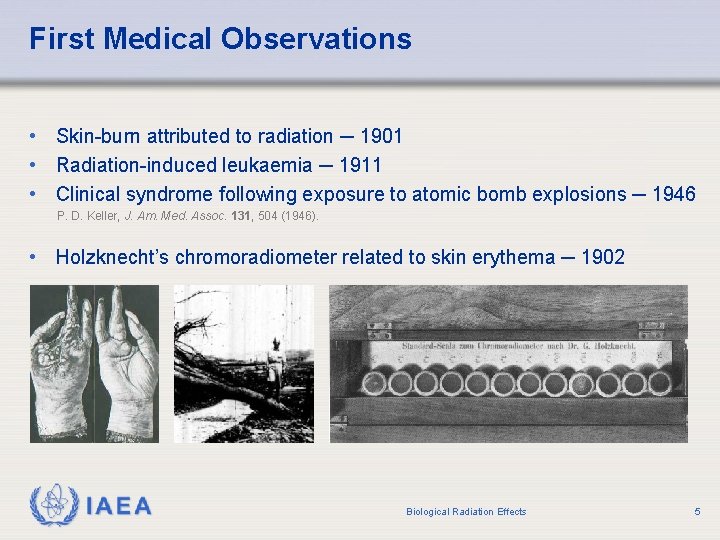
First Medical Observations • Skin-burn attributed to radiation ─ 1901 • Radiation-induced leukaemia ─ 1911 • Clinical syndrome following exposure to atomic bomb explosions ─ 1946 P. D. Keller, J. Am. Med. Assoc. 131, 504 (1946). • Holzknecht’s chromoradiometer related to skin erythema ─ 1902 IAEA Biological Radiation Effects 5
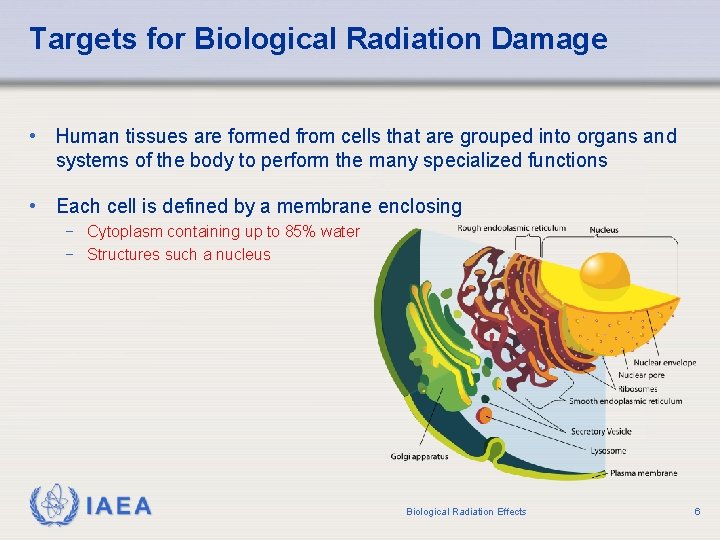
Targets for Biological Radiation Damage • Human tissues are formed from cells that are grouped into organs and systems of the body to perform the many specialized functions • Each cell is defined by a membrane enclosing − Cytoplasm containing up to 85% water − Structures such a nucleus IAEA Biological Radiation Effects 6
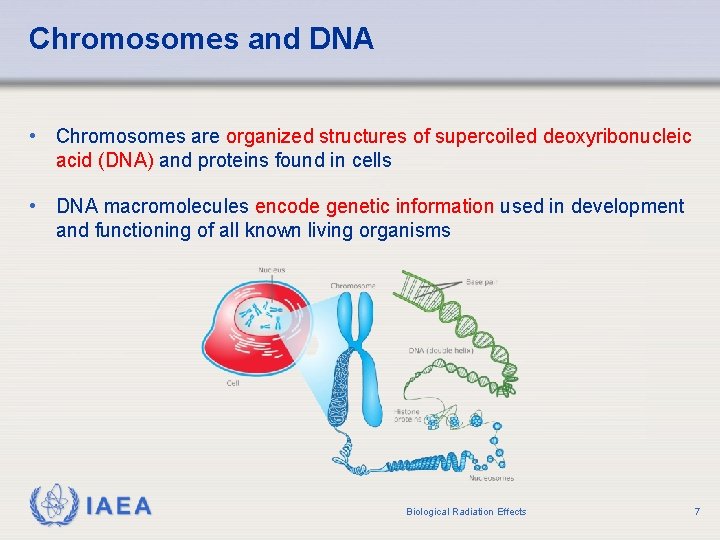
Chromosomes and DNA • Chromosomes are organized structures of supercoiled deoxyribonucleic acid (DNA) and proteins found in cells • DNA macromolecules encode genetic information used in development and functioning of all known living organisms IAEA Biological Radiation Effects 7
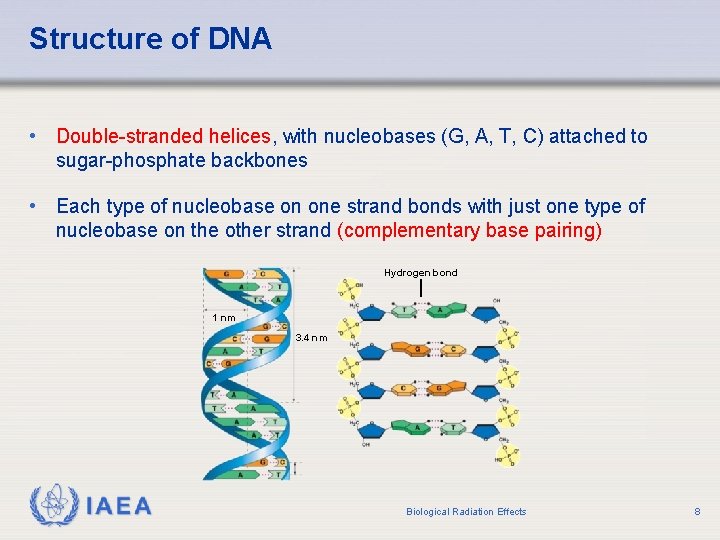
Structure of DNA • Double-stranded helices, with nucleobases (G, A, T, C) attached to sugar-phosphate backbones • Each type of nucleobase on one strand bonds with just one type of nucleobase on the other strand (complementary base pairing) Hydrogen bond 1 nm 3. 4 nm IAEA Biological Radiation Effects 8
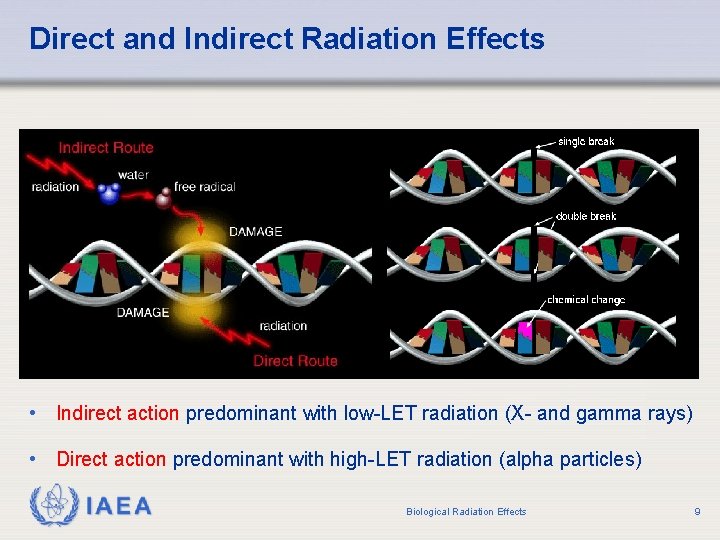
Direct and Indirect Radiation Effects • Indirect action predominant with low-LET radiation (X- and gamma rays) • Direct action predominant with high-LET radiation (alpha particles) IAEA Biological Radiation Effects 9
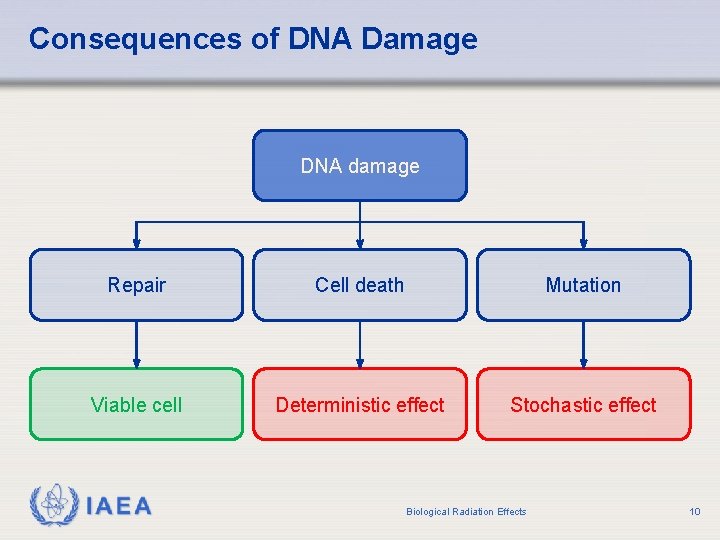
Consequences of DNA Damage DNA damage Repair Cell death Mutation Viable cell Deterministic effect Stochastic effect IAEA Biological Radiation Effects 10
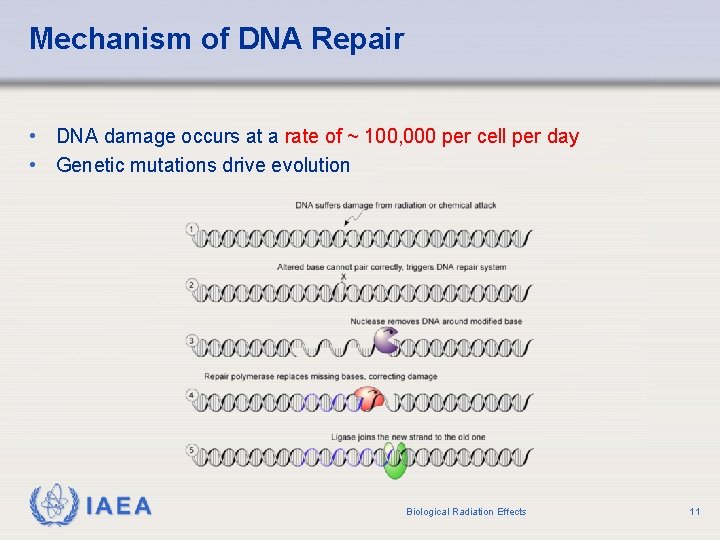
Mechanism of DNA Repair • DNA damage occurs at a rate of ~ 100, 000 per cell per day • Genetic mutations drive evolution IAEA Biological Radiation Effects 11

Deterministic Radiation Effects • Occur at high doses when enough cells in an organ or tissue are killed or prevented from functioning normally Threshold dose, above which effects are clinically observable Severity increases with dose Acute effects, non-malignant late effects Examples: Cataracts, erythema, acute radiation syndromes (ARS) SEVERITY − − 100% Threshold dose DOSE IAEA Biological Radiation Effects 12
Deterministic Radiation Effects • Data on deterministic radiation effects come from − Survivors of atomic bombs on Hiroshima and Nagasaki − Effects on early radiologists − Consequences of severe accidents with industrial radiation sources − Studies of side effects of radiotherapy IAEA Biological Radiation Effects 13
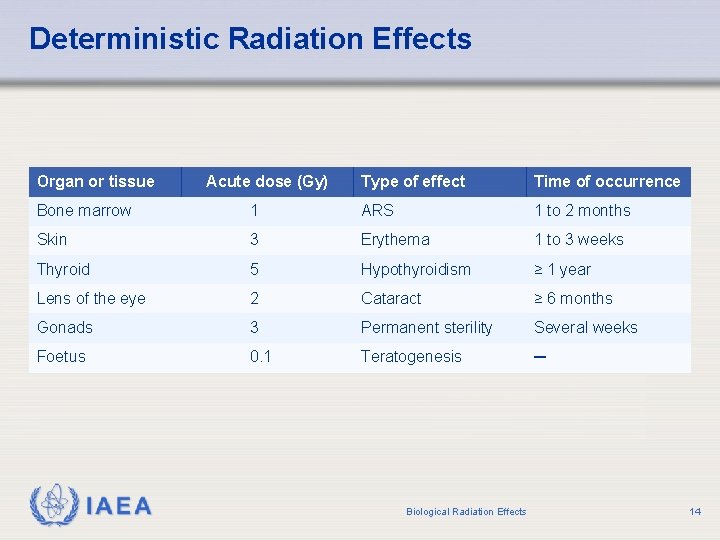
Deterministic Radiation Effects Organ or tissue Acute dose (Gy) Type of effect Time of occurrence Bone marrow 1 ARS 1 to 2 months Skin 3 Erythema 1 to 3 weeks Thyroid 5 Hypothyroidism ≥ 1 year Lens of the eye 2 Cataract ≥ 6 months Gonads 3 Permanent sterility Several weeks Foetus 0. 1 Teratogenesis ─ IAEA Biological Radiation Effects 14
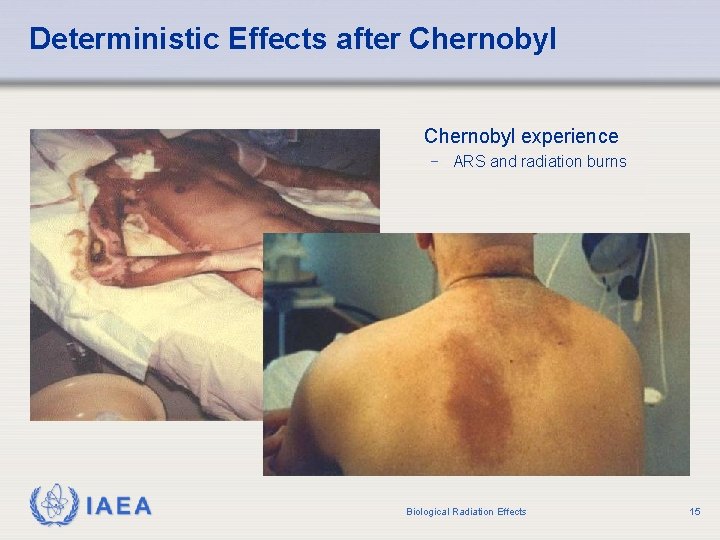
Deterministic Effects after Chernobyl experience − ARS and radiation burns IAEA Biological Radiation Effects 15
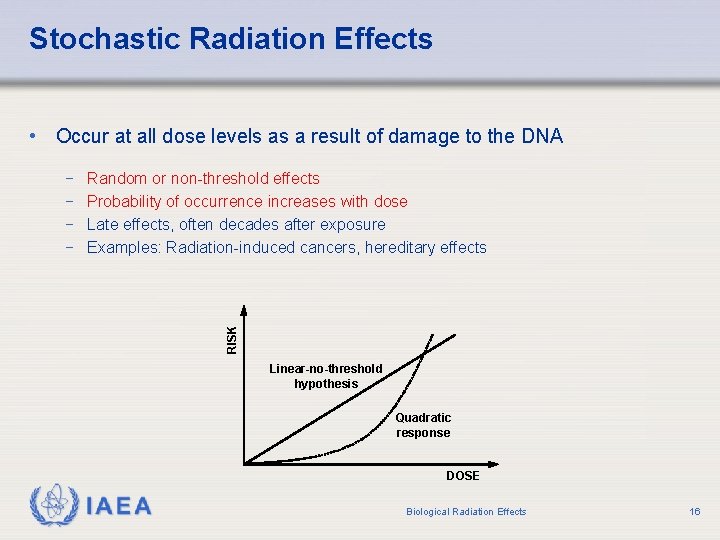
Stochastic Radiation Effects • Occur at all dose levels as a result of damage to the DNA Random or non-threshold effects Probability of occurrence increases with dose Late effects, often decades after exposure Examples: Radiation-induced cancers, hereditary effects RISK − − Linear-no-threshold hypothesis Quadratic response DOSE IAEA Biological Radiation Effects 16
Stochastic Radiation Effects • Principal sources of information on stochastic effects are − Epidemiological studies on atomic-bomb survivors − Patients exposed to radiation for medical treatment or diagnosis − Some groups of occupationally exposed workers (uranium miners, nuclear industry workers, radium-dial painters) IAEA Biological Radiation Effects 17
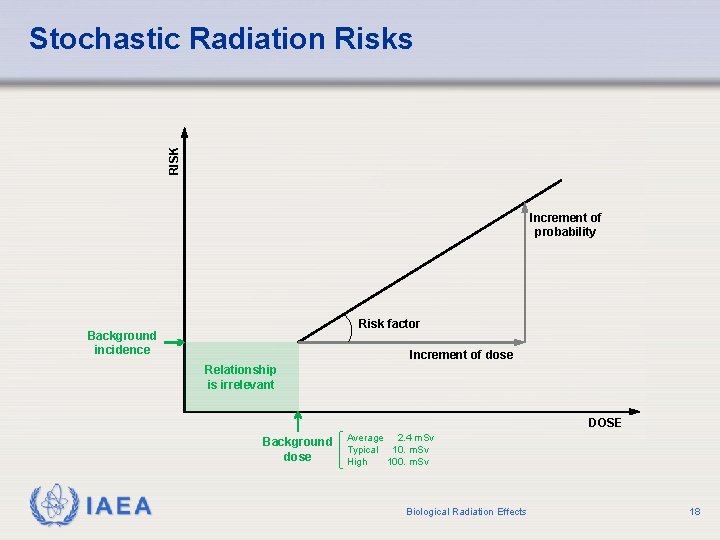
RISK Stochastic Radiation Risks Increment of probability Risk factor Background incidence Increment of dose Relationship is irrelevant DOSE Background dose IAEA Average 2. 4 m. Sv Typical 10. m. Sv High 100. m. Sv Biological Radiation Effects 18
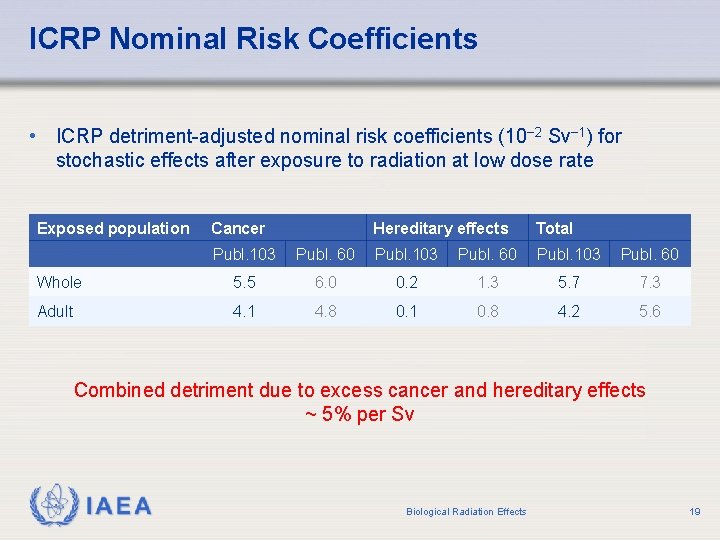
ICRP Nominal Risk Coefficients • ICRP detriment-adjusted nominal risk coefficients (10− 2 Sv− 1) for stochastic effects after exposure to radiation at low dose rate Exposed population Cancer Hereditary effects Total Publ. 103 Publ. 60 Whole 5. 5 6. 0 0. 2 1. 3 5. 7 7. 3 Adult 4. 1 4. 8 0. 1 0. 8 4. 2 5. 6 Combined detriment due to excess cancer and hereditary effects ~ 5% per Sv IAEA Biological Radiation Effects 19
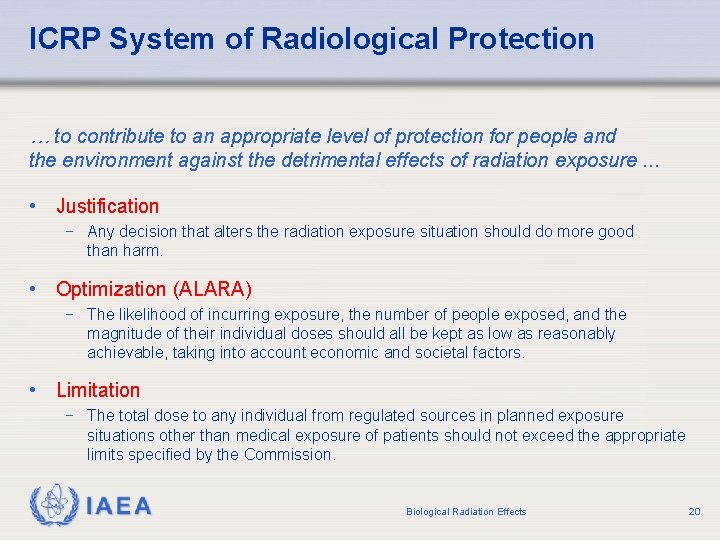
ICRP System of Radiological Protection … to contribute to an appropriate level of protection for people and the environment against the detrimental effects of radiation exposure. . . • Justification − Any decision that alters the radiation exposure situation should do more good than harm. • Optimization (ALARA) − The likelihood of incurring exposure, the number of people exposed, and the magnitude of their individual doses should all be kept as low as reasonably achievable, taking into account economic and societal factors. • Limitation − The total dose to any individual from regulated sources in planned exposure situations other than medical exposure of patients should not exceed the appropriate limits specified by the Commission. IAEA Biological Radiation Effects 20
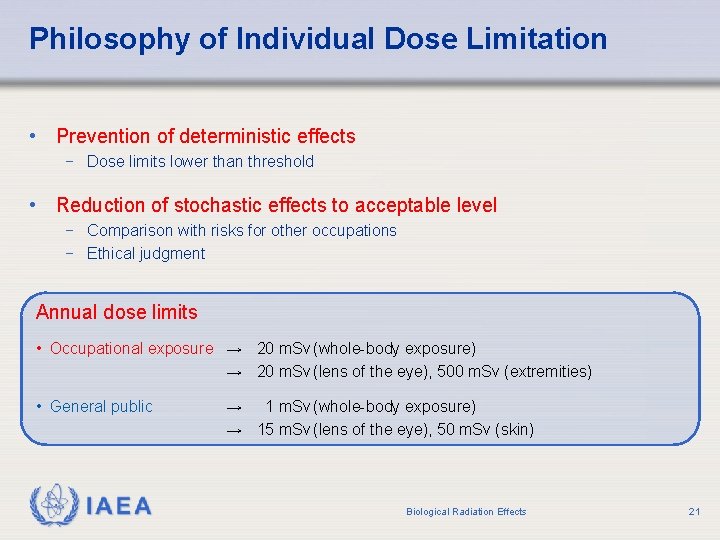
Philosophy of Individual Dose Limitation • Prevention of deterministic effects − Dose limits lower than threshold • Reduction of stochastic effects to acceptable level − Comparison with risks for other occupations − Ethical judgment Annual dose limits • Occupational exposure → 20 m. Sv (whole-body exposure) → 20 m. Sv (lens of the eye), 500 m. Sv (extremities) • General public IAEA → 1 m. Sv (whole-body exposure) → 15 m. Sv (lens of the eye), 50 m. Sv (skin) Biological Radiation Effects 21
Further Information • IAEA Safety Standards − No. GSR Part 3 (Interim) “Radiation Protection and Safety of Radiation Sources: International Basic Safety Standards” (2011) • IAEA Safety Standards Series − No. SF-1 “Fundamental Safety Principles” (2006) − No. RS-G-1. 1 “Occupational Radiation Protection” (1999) • Practical Radiation Technical Manuals − “Health Effects and Medical Surveillance” (2004) − “Personal Protective Equipment” (2004) IAEA Biological Radiation Effects 22
Thank you for your kind attention! IAEA Biological Radiation Effects 23
- Slides: 23