
Biological Effects of Ionising Radiation In a biological
Biological Effects of Ionising Radiation
In a biological system, ionisation of a molecule can lead to Direct or Indirect damage to the system.
Direct Damage 1 – cell may be undamaged 2 – cell may repair and work normally 3 – cell repaired but abnormal 4 – cell may die
Indirect Damage Ionising radiation causes cleavage of a covalent bond, fragmenting the molecule, each fragment retaining one of the paired electrons or by instigating chemical changes which produce free radicals. This damage to the system depends on the concentration of free radicals and this in turn depends on the number of ionisation events per unit mass.
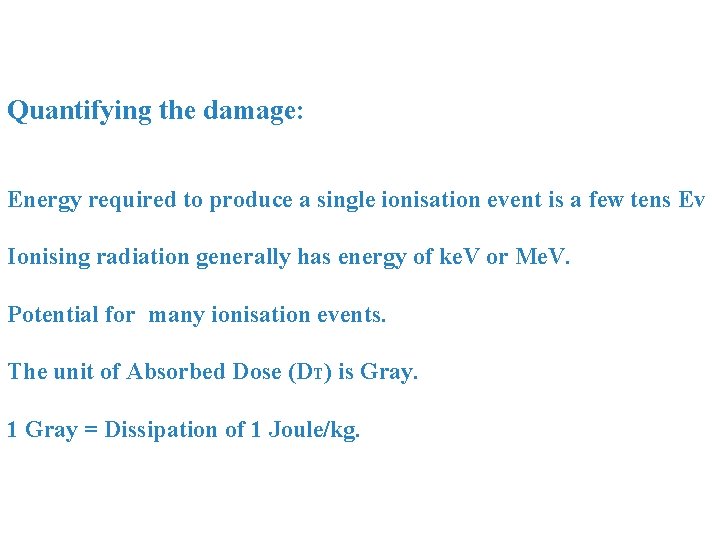
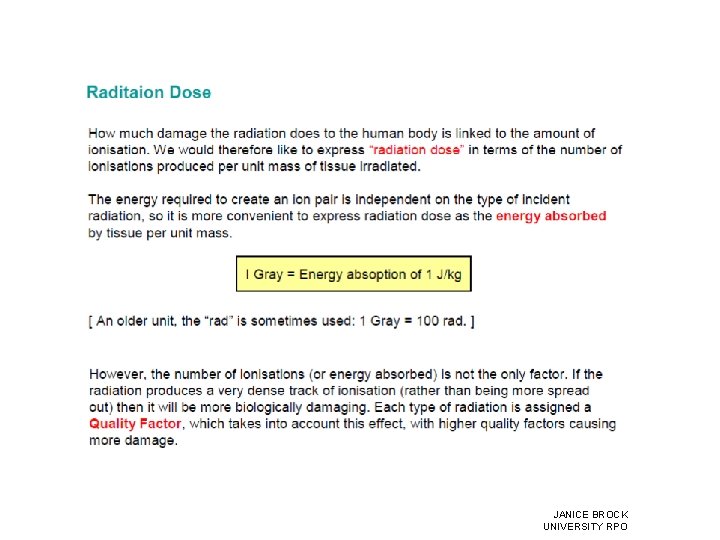
Quantifying the damage: Energy required to produce a single ionisation event is a few tens Ev Ionising radiation generally has energy of ke. V or Me. V. Potential for many ionisation events. The unit of Absorbed Dose (DT) is Gray. 1 Gray = Dissipation of 1 Joule/kg.

Equivalent Dose (HT ) and Radiation Weighting Factor (WR ) -particle 50 ionisations/cellular nucleus -particle 12, 500 ionisations/cellular nucleus
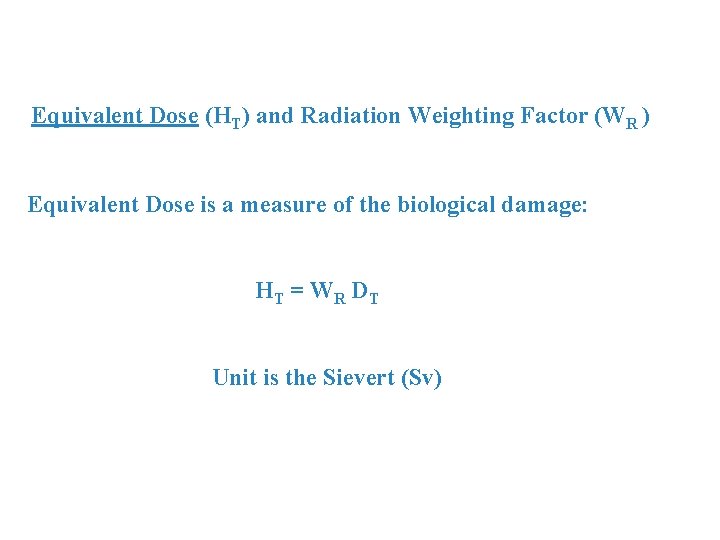
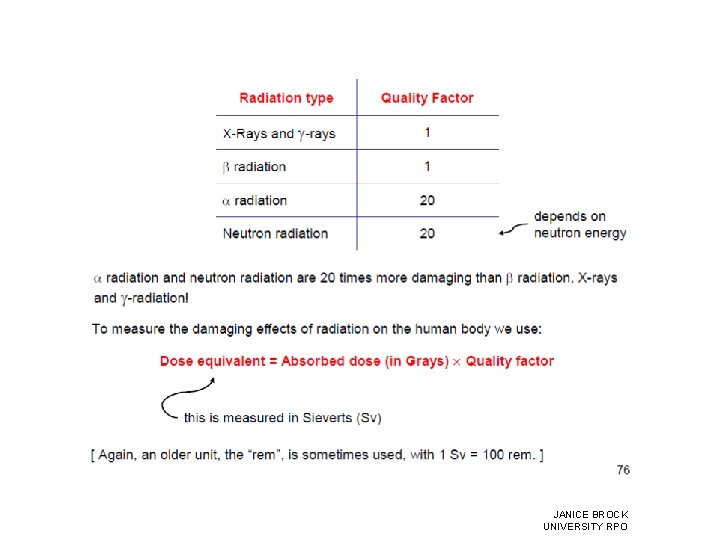
Equivalent Dose (HT) and Radiation Weighting Factor (WR ) Equivalent Dose is a measure of the biological damage: H T = W R DT Unit is the Sievert (Sv)
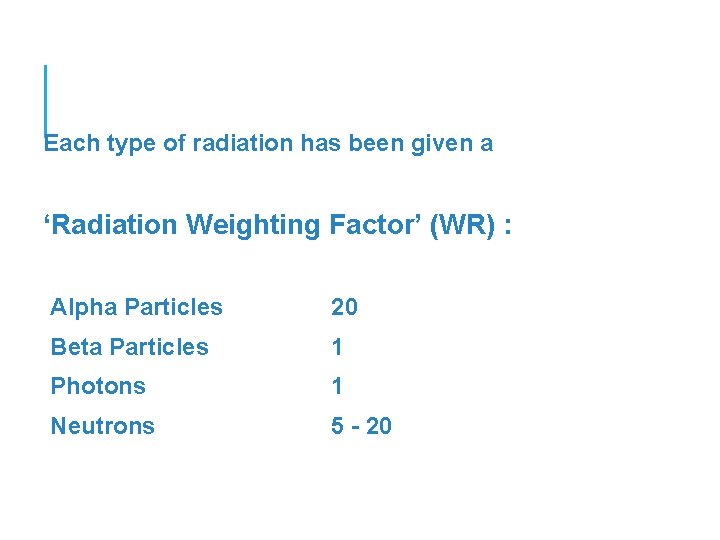
Each type of radiation has been given a ‘Radiation Weighting Factor’ (WR) : Alpha Particles 20 Beta Particles 1 Photons 1 Neutrons 5 - 20
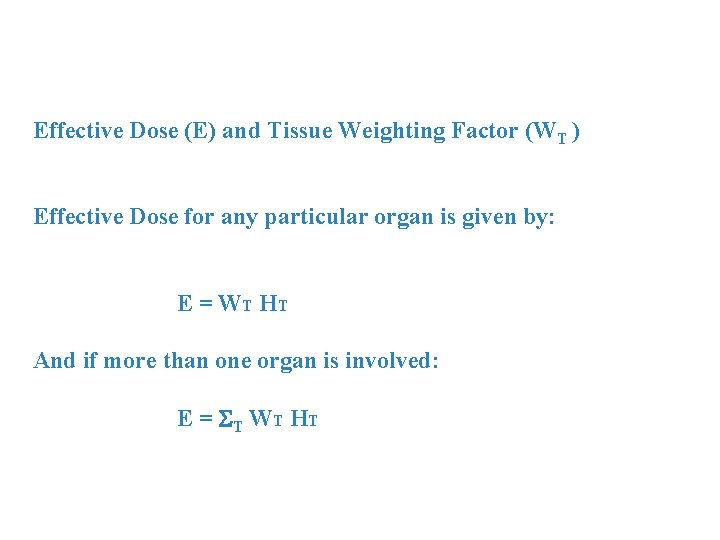
Effective Dose (E) and Tissue Weighting Factor (WT ) Effective Dose for any particular organ is given by: E = WT HT And if more than one organ is involved: E = T WT HT
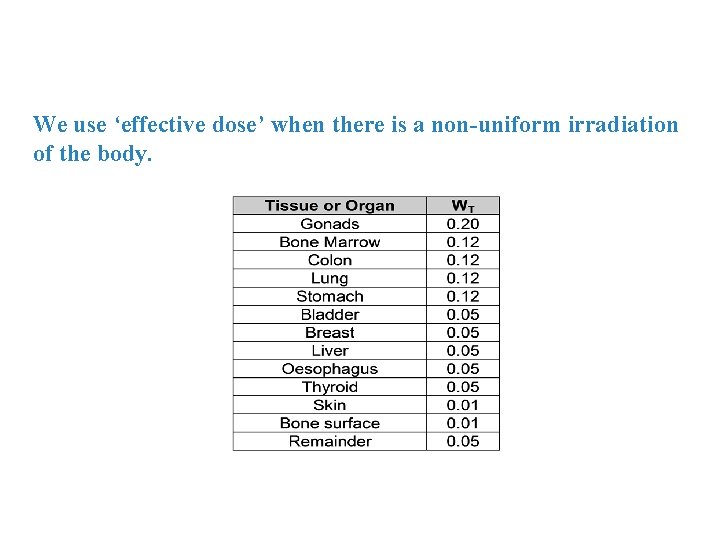
We use ‘effective dose’ when there is a non-uniform irradiation of the body.

The Effects on Health Deterministic and Stochastic Effects Deterministic Effects Radiation doses involved here are usually substantial and delivered over a short space of time and there is a threshold dose below which no clinical effect is observed. These type of effects are called Deterministic.
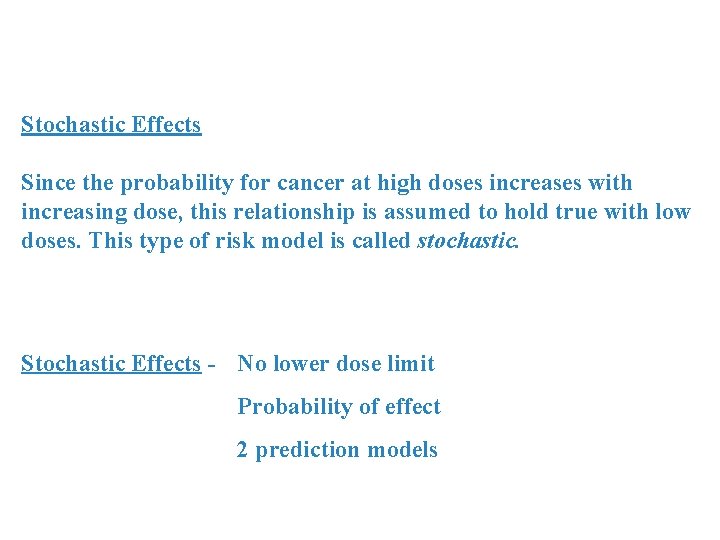
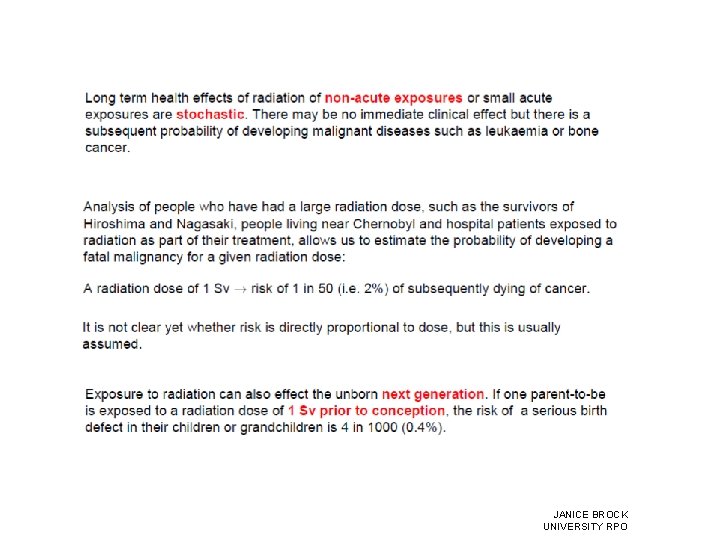
Stochastic Effects Since the probability for cancer at high doses increases with increasing dose, this relationship is assumed to hold true with low doses. This type of risk model is called stochastic. Stochastic Effects - No lower dose limit Probability of effect 2 prediction models
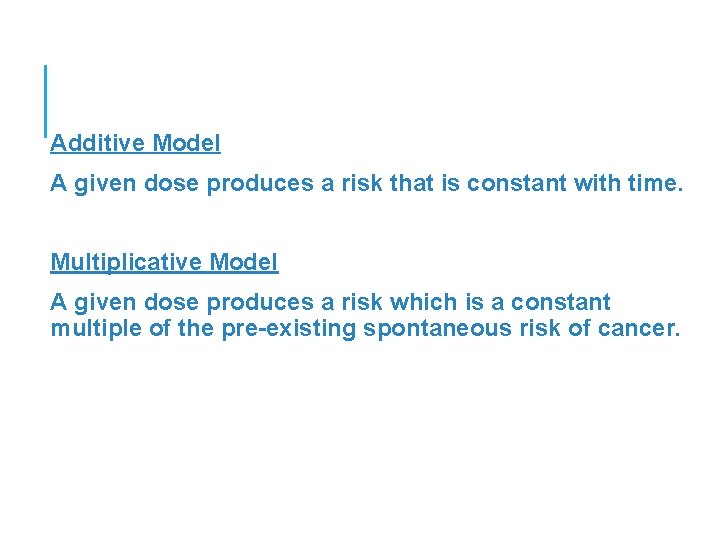
Additive Model A given dose produces a risk that is constant with time. Multiplicative Model A given dose produces a risk which is a constant multiple of the pre-existing spontaneous risk of cancer.
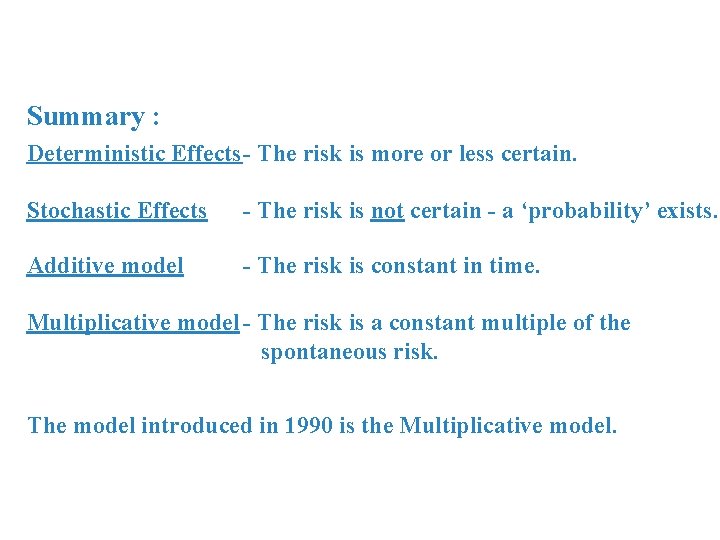
Summary : Deterministic Effects- The risk is more or less certain. Stochastic Effects - The risk is not certain - a ‘probability’ exists. Additive model - The risk is constant in time. Multiplicative model - The risk is a constant multiple of the spontaneous risk. The model introduced in 1990 is the Multiplicative model.
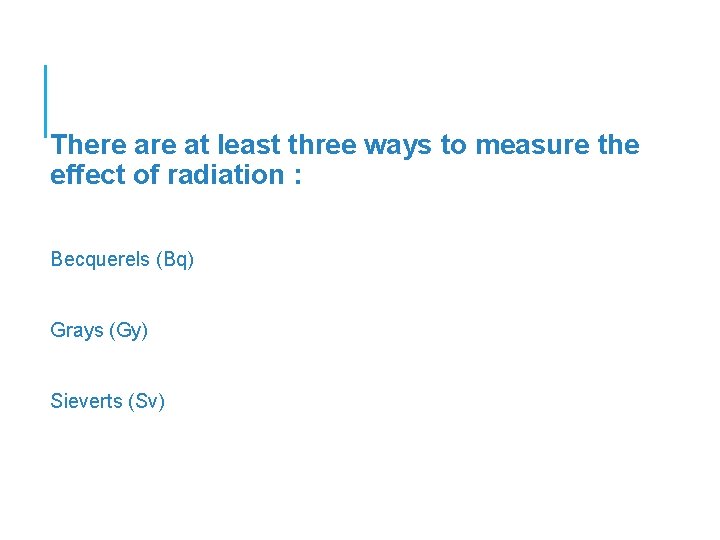
There at least three ways to measure the effect of radiation : Becquerels (Bq) Grays (Gy) Sieverts (Sv)
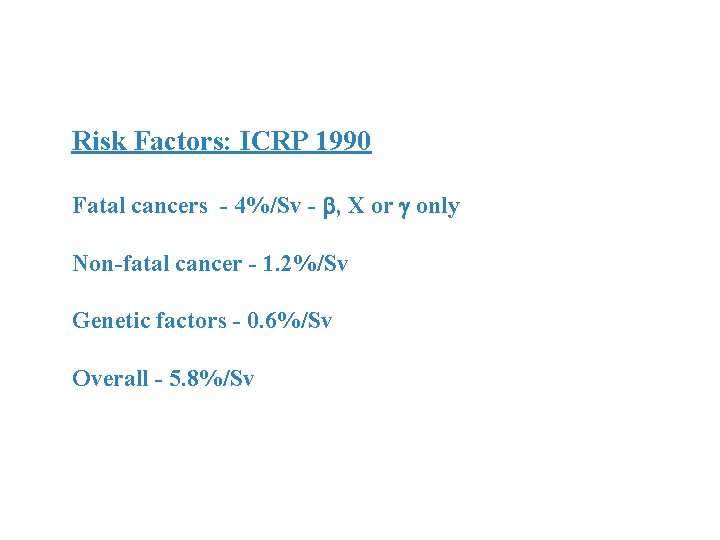
Risk Factors: ICRP 1990 Fatal cancers - 4%/Sv - , X or only Non-fatal cancer - 1. 2%/Sv Genetic factors - 0. 6%/Sv Overall - 5. 8%/Sv
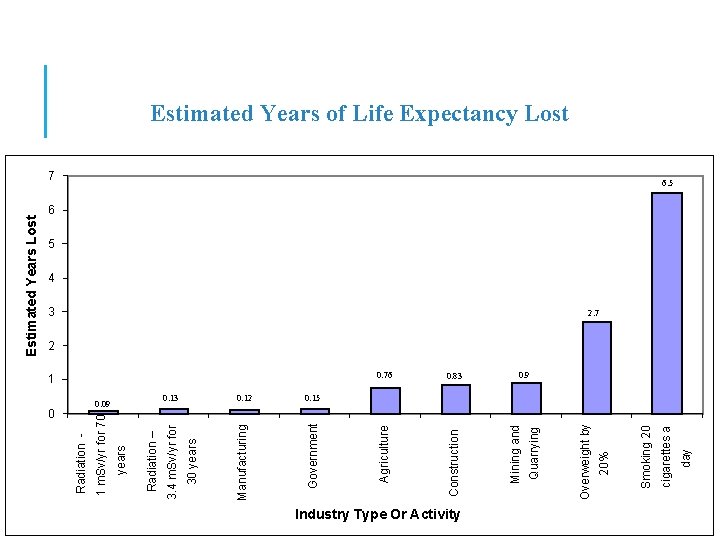
0 0. 12 0. 15 0. 83 Industry Type Or Activity JANICE BROCK UNIVERSITY RPO day 7 cigarettes a Smoking 20 20% 3 Overweight by Quarrying Mining and 0. 76 Construction 1 Agriculture Government 0. 13 Manufacturing 30 years 0. 09 3. 4 m. Sv/yr for Radiation – years 1 m. Sv/yr for 70 Radiation - Estimated Years Lost Estimated Years of Life Expectancy Lost 6. 5 6 5 4 2. 7 2 0. 9
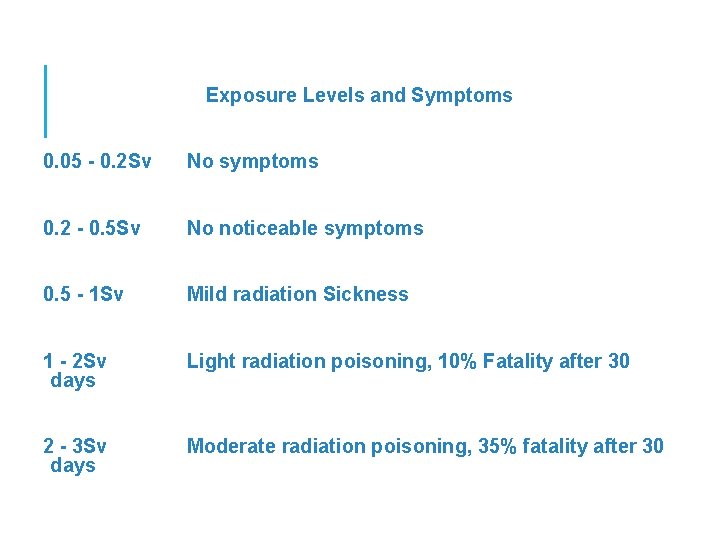
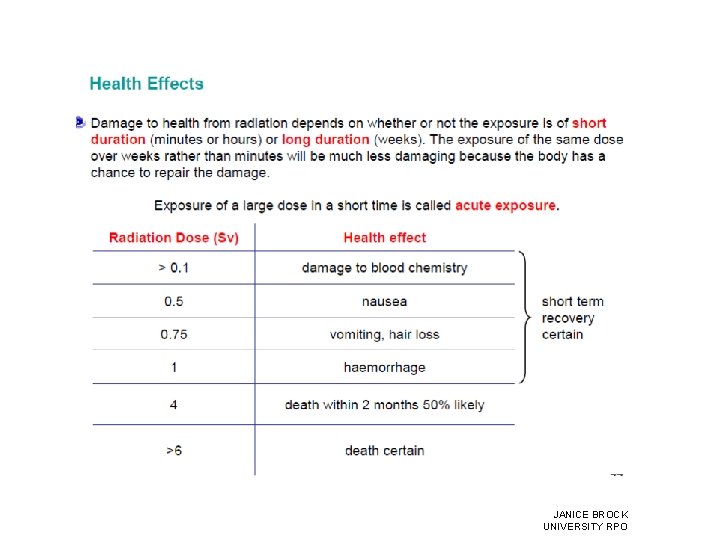
Exposure Levels and Symptoms 0. 05 - 0. 2 Sv No symptoms 0. 2 - 0. 5 Sv No noticeable symptoms 0. 5 - 1 Sv Mild radiation Sickness 1 - 2 Sv days Light radiation poisoning, 10% Fatality after 30 2 - 3 Sv days Moderate radiation poisoning, 35% fatality after 30
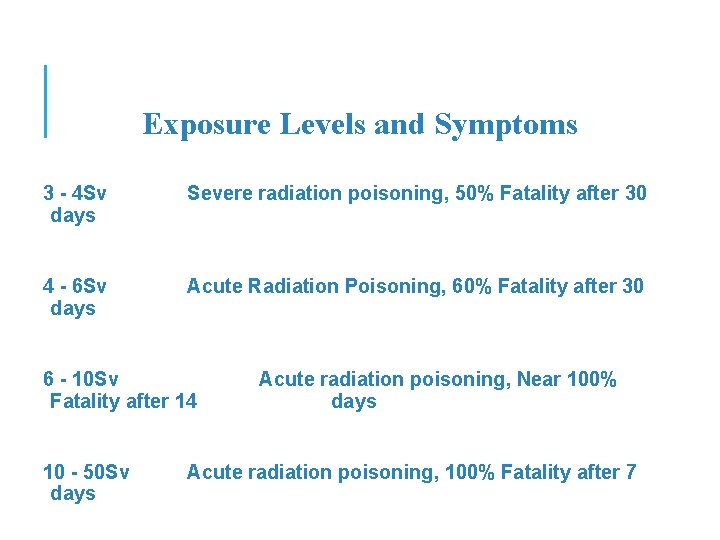
Exposure Levels and Symptoms 3 - 4 Sv days Severe radiation poisoning, 50% Fatality after 30 4 - 6 Sv days Acute Radiation Poisoning, 60% Fatality after 30 6 - 10 Sv Fatality after 14 10 - 50 Sv days Acute radiation poisoning, Near 100% days Acute radiation poisoning, 100% Fatality after 7
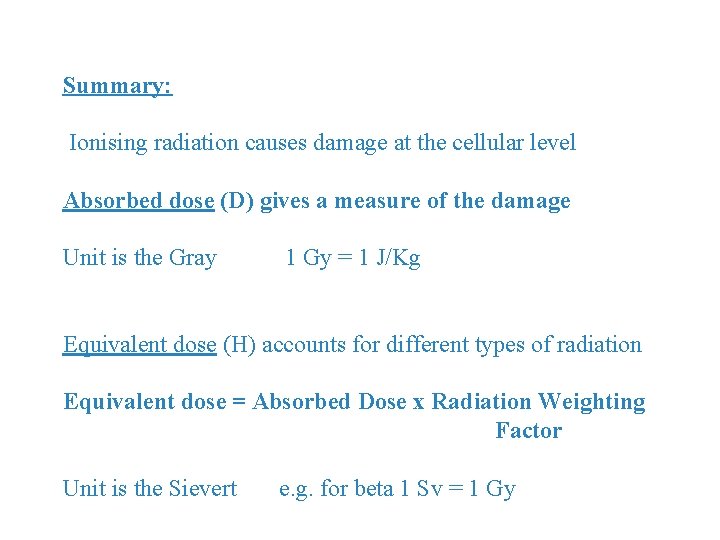
Summary: Ionising radiation causes damage at the cellular level Absorbed dose (D) gives a measure of the damage Unit is the Gray 1 Gy = 1 J/Kg Equivalent dose (H) accounts for different types of radiation Equivalent dose = Absorbed Dose x Radiation Weighting Factor Unit is the Sievert e. g. for beta 1 Sv = 1 Gy
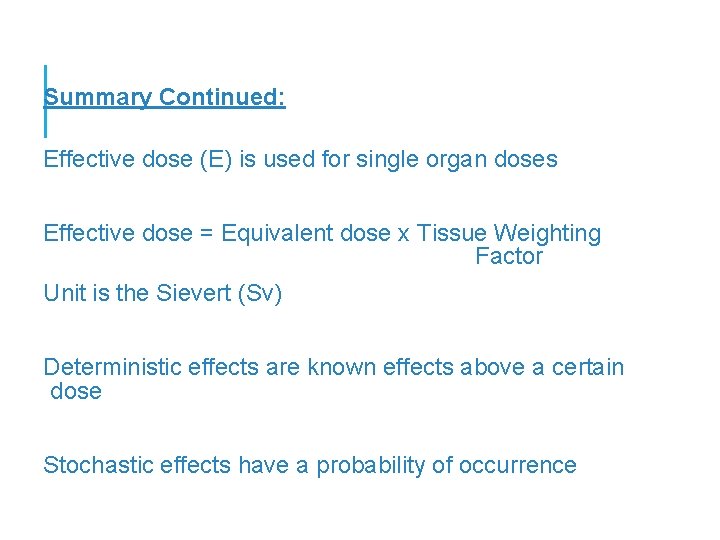
Summary Continued: Effective dose (E) is used for single organ doses Effective dose = Equivalent dose x Tissue Weighting Factor Unit is the Sievert (Sv) Deterministic effects are known effects above a certain dose Stochastic effects have a probability of occurrence
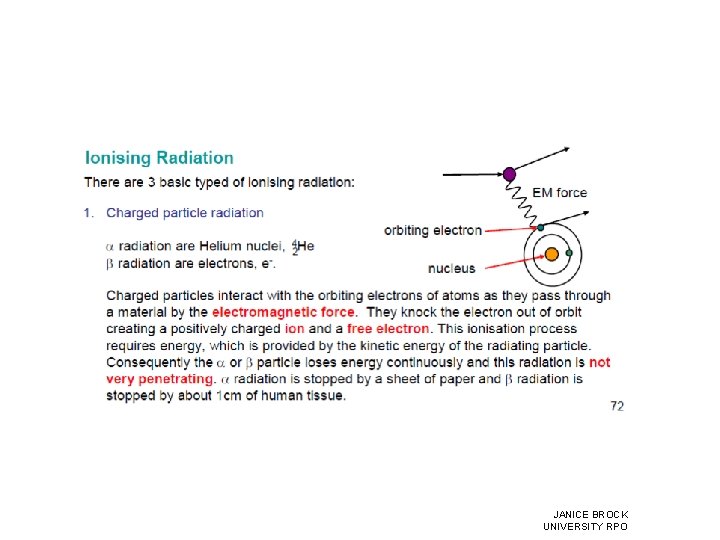
JANICE BROCK UNIVERSITY RPO
JANICE BROCK UNIVERSITY RPO
JANICE BROCK UNIVERSITY RPO
JANICE BROCK UNIVERSITY RPO
JANICE BROCK UNIVERSITY RPO
JANICE BROCK UNIVERSITY RPO
JANICE BROCK UNIVERSITY RPO
JANICE BROCK UNIVERSITY RPO



JANICE BROCK UNIVERSITY RPO
- Slides: 32