
Biological Control of Filth Flies for Livestock Operations
Biological Control of Filth Flies for Livestock Operations Erika Machtinger
Biological Control of Filth Flies for Livestock Operations • Brief discussion on filth fly problems in livestock operations • Review of house and stable flies • IPM • Biological Control • Parasitoids • Current Research

Biological Control of Filth Flies for Livestock Operations • Many, many different types of pests • Focus on two main types in livestock operations • House flies • Stable flies • Problem • Cause Disease • Annoyance • Loss of physical condition • Injury • Long dispersal flights
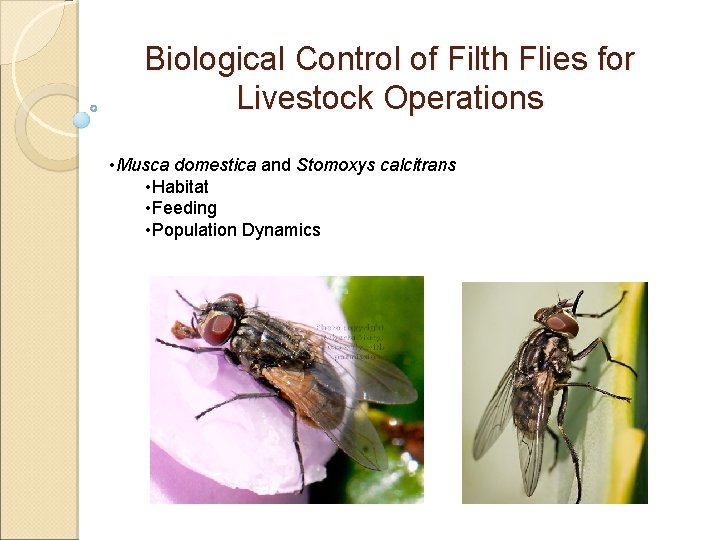
Biological Control of Filth Flies for Livestock Operations • Musca domestica and Stomoxys calcitrans • Habitat • Feeding • Population Dynamics
Biological Control of Filth Flies for Livestock Operations • Integrated Pest Management (IPM) program • Seeks to maximize the effectiveness, conserving beneficial insects and minimizing pesticide use • Pest identification and monitoring • Controlling filth flies • Traps • Insecticides • Cultural control • Biological control

Biological Control of Filth Flies for Livestock Operations • Three types of biological control • Conservation • Supplementing with food, habitat or other resources to maintain natural enemies • Classical Biological • Introduction of natural enemies to a new locale where they did not originate or do not occur naturally. • Augmentation • Supplemental release of natural enemies.
Biological Control of Filth Flies for Livestock Operations • Biological Control • Nature can help in the battle against flies by providing natural enemies • predatory beetles and mites, • parasitic wasps, and • fly pathogens
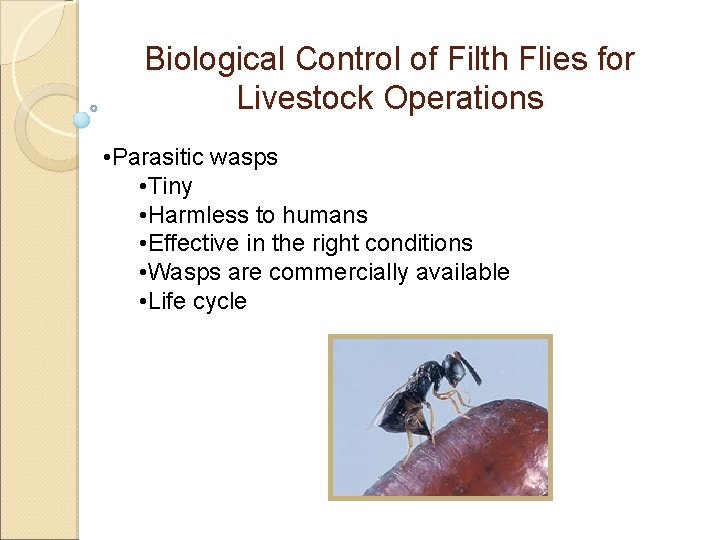
Biological Control of Filth Flies for Livestock Operations • Parasitic wasps • Tiny • Harmless to humans • Effective in the right conditions • Wasps are commercially available • Life cycle

Biological Control of Filth Flies for Livestock Operations • Filth Fly Research with IPM Florida • Other systems well known • Horses contribute substantially to the economy in Florida • Ranchettes are a fast growing sector of real estate • Horse owners do not act like small for-profit farm owners
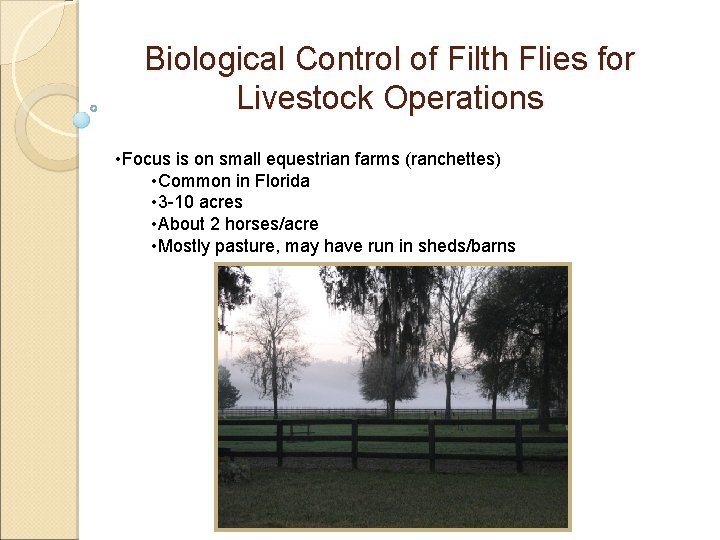
Biological Control of Filth Flies for Livestock Operations • Focus is on small equestrian farms (ranchettes) • Common in Florida • 3 -10 acres • About 2 horses/acre • Mostly pasture, may have run in sheds/barns
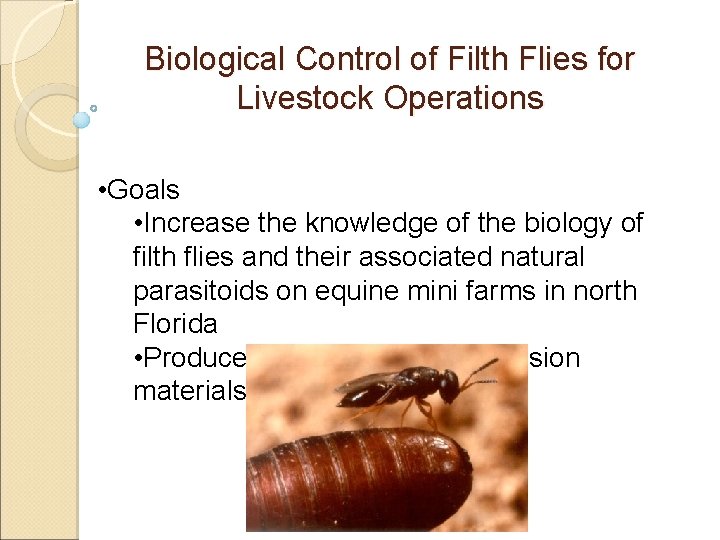
Biological Control of Filth Flies for Livestock Operations • Goals • Increase the knowledge of the biology of filth flies and their associated natural parasitoids on equine mini farms in north Florida • Produce educational and extension materials
Biological Control of Filth Flies for Livestock Operations • Objectives • Determine levels of filth fly breeding on equestrian mini farms. • Differentiate between migrant adult stable flies and those that result from breeding on-site. • Determine natural filth fly parasitoid species composition and percent parasitism. • Produce educational materials to increase awareness of control for filth flies on equine mini farms in north Florida.
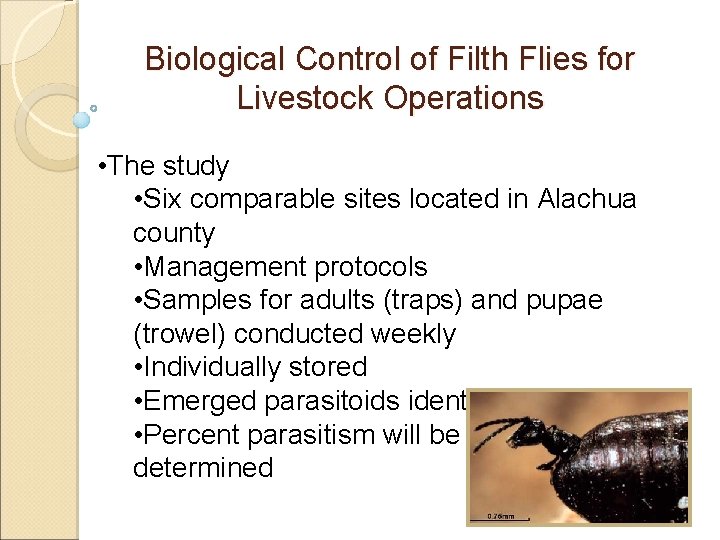
Biological Control of Filth Flies for Livestock Operations • The study • Six comparable sites located in Alachua county • Management protocols • Samples for adults (traps) and pupae (trowel) conducted weekly • Individually stored • Emerged parasitoids identified • Percent parasitism will be determined

Biological Control of Filth Flies for Livestock Operations • Control • What can we do with this information? • What methods would be most effective if breeding is occurring on site? • What if it is emigration? • What could cause a difference in breeding on site vs. emigration?
- Slides: 14