
Biological Classification is the method of grouping organisms
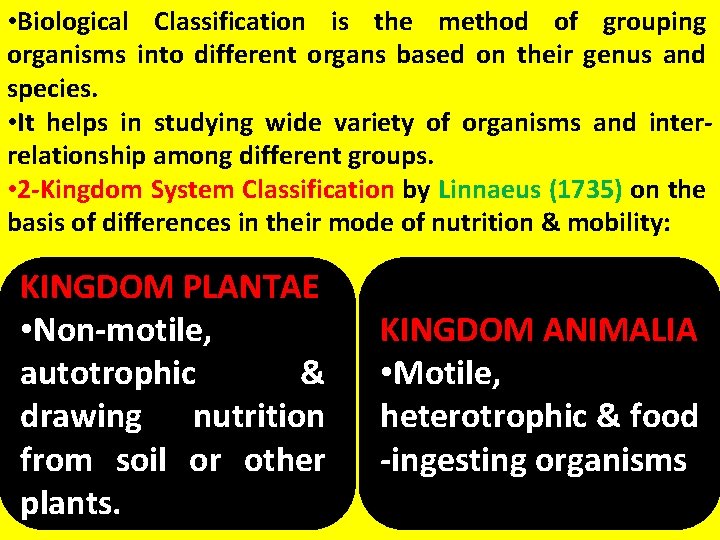
• Biological Classification is the method of grouping organisms into different organs based on their genus and species. • It helps in studying wide variety of organisms and interrelationship among different groups. • 2 -Kingdom System Classification by Linnaeus (1735) on the basis of differences in their mode of nutrition & mobility: KINGDOM PLANTAE • Non-motile, autotrophic & drawing nutrition from soil or other plants. KINGDOM ANIMALIA • Motile, heterotrophic & food -ingesting organisms

• 3 -Kingdom System Classification by Ernest Haeckel (1866) : 1. KINGDOM PLANTAE • Non-motile, green, autotrophs & phototrophs. Eg. , Bryophytes, Pteridophytes, Gymno. & Angio. 2. KINGDOM ANIMALIA • Motile, chemotrophs & heterotrophs • Includes all Invertebrates and Vertebrates 3. KINGDOM PROTISTA • Organisms neither plants nor animals, unicellular. Eg. , algae, bacteria & protozoans
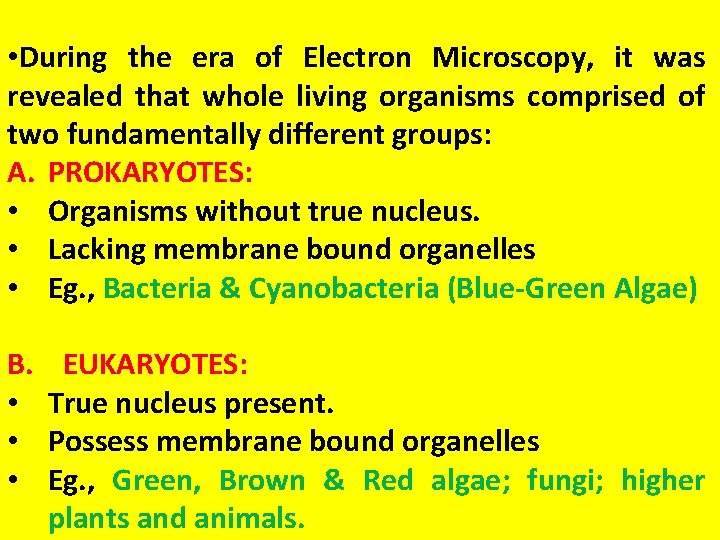
• During the era of Electron Microscopy, it was revealed that whole living organisms comprised of two fundamentally different groups: A. PROKARYOTES: • Organisms without true nucleus. • Lacking membrane bound organelles • Eg. , Bacteria & Cyanobacteria (Blue-Green Algae) B. • • • EUKARYOTES: True nucleus present. Possess membrane bound organelles Eg. , Green, Brown & Red algae; fungi; higher plants and animals.
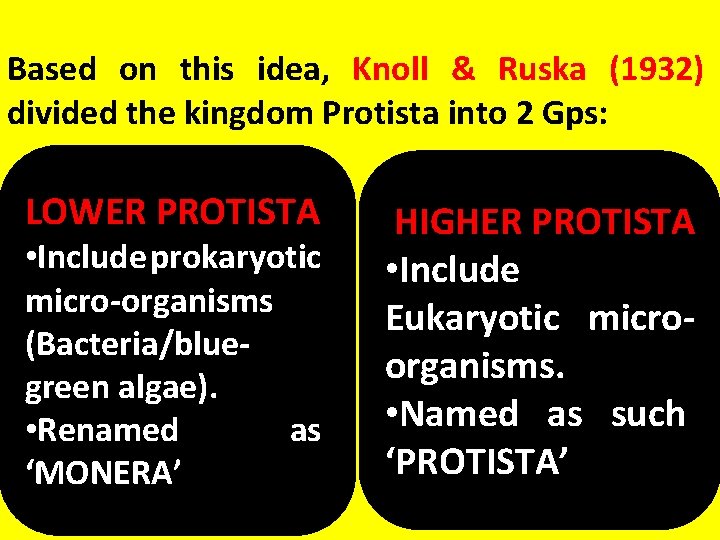
Based on this idea, Knoll & Ruska (1932) divided the kingdom Protista into 2 Gps: LOWER PROTISTA • Include prokaryotic micro-organisms (Bacteria/bluegreen algae). • Renamed as ‘MONERA’ HIGHER PROTISTA • Include Eukaryotic microorganisms. • Named as such ‘PROTISTA’

• 3 -Kingdom System Classification transformed into 4 kingdom classification by Copeland, 1938: 1. KINGDOM MONERA (Prokaryotic organisms) 2. KINGDOM PROTISTA (Eukaryotic organisms) 3. KINGDOM PLANTAE (Higher algae & green plants) 4. KINGDOM ANIMALIA (Animals)
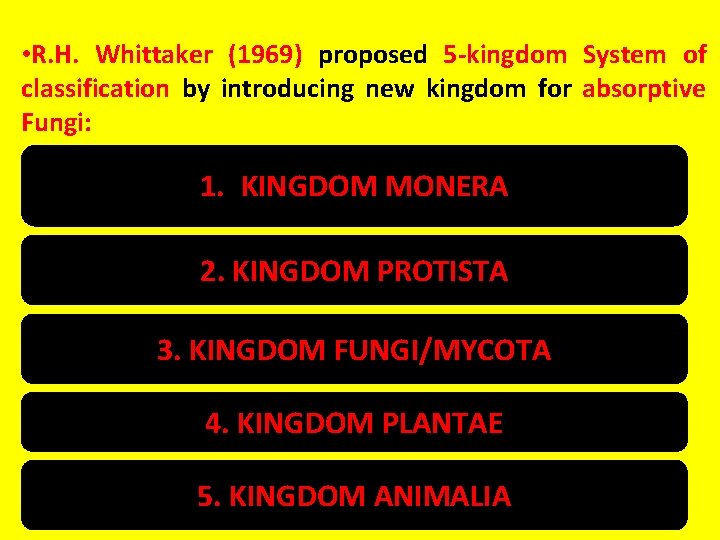
• R. H. Whittaker (1969) proposed 5 -kingdom System of classification by introducing new kingdom for absorptive Fungi: 1. KINGDOM MONERA 2. KINGDOM PROTISTA 3. KINGDOM FUNGI/MYCOTA 4. KINGDOM PLANTAE 5. KINGDOM ANIMALIA

• Introduced by Carl Woese et al. , (1977) and is a system for classifying biological organisms. • Woese initially used the term ‘KINGDOM’ to refer to the three Primary Phylogenetic Groupings and this nomenclature was widely used until the term DOMAIN was adopted in 1990.
• The three-domain system groups organisms primarily based on differences in ribosomal RNA (r. RNA) structure. • This system adds a level of classification (the DOMAINS) "above" the kingdoms present in the previously used five- or six-kingdom systems.
• Under this system, organisms are classified into 3 Domains: I. DOMAIN ARCHAE II. DOMAIN BACTERIA III. DOMAIN EUKARYA
DOMAIN ARCHAE (Archae have genes similar to both Bacteria and Eukaryotes) • Unicellular, prokaryotic organisms, and does not possess a membrane bound nucleus. • Lack Internal Cell Organelles and many are equal in size and similar in shape as bacteria. • Reproduce by Binary Fission, have one circular chromosome and use Flagella for locomotion (like bacteria). • Membrane Lipids present are predominantly Isoprenoid Glycerol Diethers or Diglycerol Tetraethers. • Cell wall lacks peptidoglycan. • Ribosomes contain an archaeal type of r. RNA where corresponding side bulge is made up of seven nucleotides and exhibit unique structure between positions 180 -197 or 405 and 498.
• Possess unique ancient evolutionary history for which they are considered some of the oldest species of organisms on Earth. • Traditionally classified as archaebacteria; often characterized by living in extreme environmental conditions such as hydrothermal vents, acidic springs and under Arctic Ice. • Some examples of archaeal organisms are methanogens which produce the gas methane, halophiles which live in very salty water, and thermoacidophiles which thrive in acidic high temperature water. • Archaea are divided into three main Phyla: 1. Crenarchaeota, 2. Euryarchaeota, and 3. Korarchaeota.
1. Crenarchaeota: It include many organisms that are hyperthermophiles (thrive in environments with great temperature extremes) and thermoacidophiles (thrive in extremely hot and acidic environments). 2. Euryarchaeota: Members of this phylum are methanogens. They produce methane as a byproduct of metabolism and require an oxygen-free environment. 3. Korarchaeota: Little is known about this phylum as few species have been found living in places such as hot springs, hydrothermal vents, and obsidian pools.
DOMAIN BACTERIA • Prokaryotic Cell Organisation. • Lipids present in Plasma Membrane are predominantly Diacyl Glycerol Diesters Lipids. • Cell wall contains Peptidoglycan. • Ribosomes present in these organisms contain bacterial type of r. RNA where between position 500 and 545 occurs a hairpin loop possessing a side bulge made up of six nucleotides. • Traditionally classified as bacteria. • Some organisms are pathogenic and capable of causing disease. • Some examples of bacteria include Cyanobacteria, Gramnegative bacteria and Gram-positive bacteria.
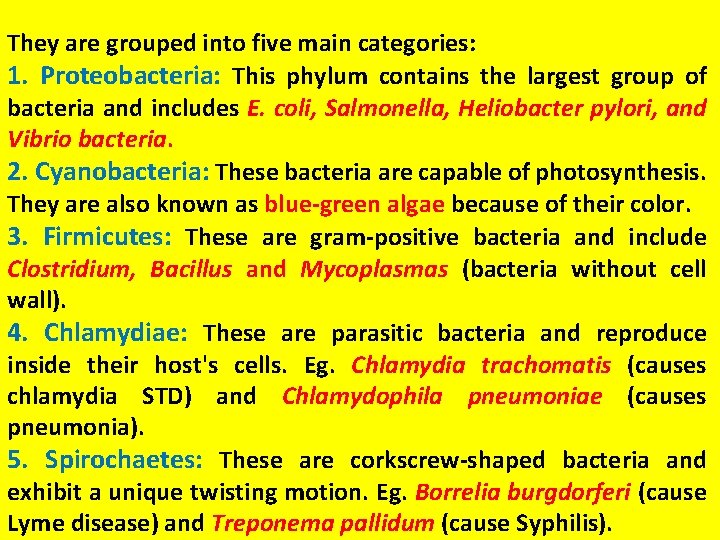
They are grouped into five main categories: 1. Proteobacteria: This phylum contains the largest group of bacteria and includes E. coli, Salmonella, Heliobacter pylori, and Vibrio bacteria. 2. Cyanobacteria: These bacteria are capable of photosynthesis. They are also known as blue-green algae because of their color. 3. Firmicutes: These are gram-positive bacteria and include Clostridium, Bacillus and Mycoplasmas (bacteria without cell wall). 4. Chlamydiae: These are parasitic bacteria and reproduce inside their host's cells. Eg. Chlamydia trachomatis (causes chlamydia STD) and Chlamydophila pneumoniae (causes pneumonia). 5. Spirochaetes: These are corkscrew-shaped bacteria and exhibit a unique twisting motion. Eg. Borrelia burgdorferi (cause Lyme disease) and Treponema pallidum (cause Syphilis).
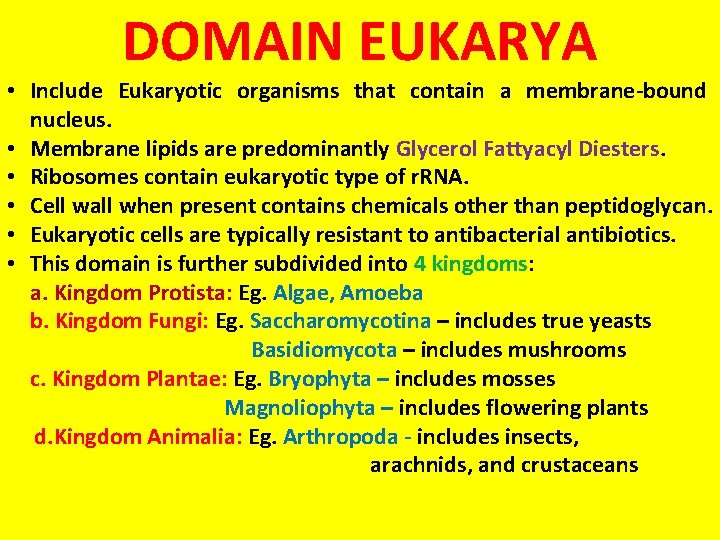
DOMAIN EUKARYA • Include Eukaryotic organisms that contain a membrane-bound nucleus. • Membrane lipids are predominantly Glycerol Fattyacyl Diesters. • Ribosomes contain eukaryotic type of r. RNA. • Cell wall when present contains chemicals other than peptidoglycan. • Eukaryotic cells are typically resistant to antibacterial antibiotics. • This domain is further subdivided into 4 kingdoms: a. Kingdom Protista: Eg. Algae, Amoeba b. Kingdom Fungi: Eg. Saccharomycotina – includes true yeasts Basidiomycota – includes mushrooms c. Kingdom Plantae: Eg. Bryophyta – includes mosses Magnoliophyta – includes flowering plants d. Kingdom Animalia: Eg. Arthropoda - includes insects, arachnids, and crustaceans
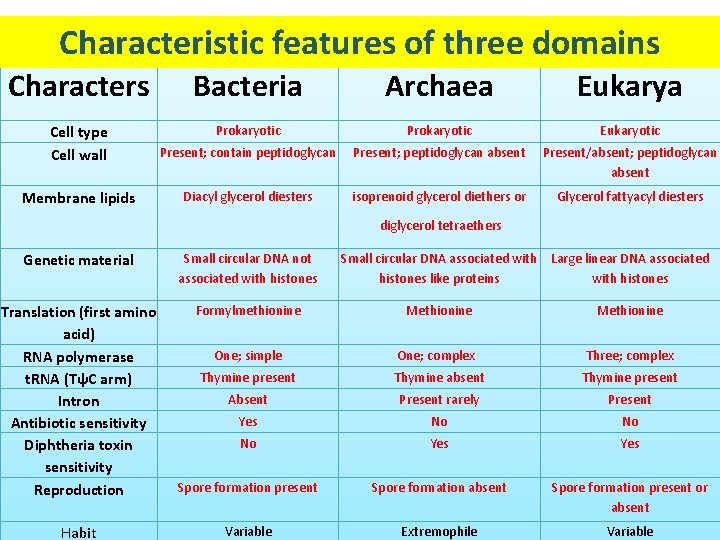
Characteristic features of three domains Characters Bacteria Archaea Eukarya Cell type Cell wall Prokaryotic Eukaryotic Present; contain peptidoglycan Present; peptidoglycan absent Present/absent; peptidoglycan absent Membrane lipids Diacyl glycerol diesters isoprenoid glycerol diethers or Glycerol fattyacyl diesters diglycerol tetraethers Genetic material Small circular DNA not associated with histones Small circular DNA associated with Large linear DNA associated histones like proteins with histones Translation (first amino acid) RNA polymerase t. RNA (TψC arm) Intron Antibiotic sensitivity Diphtheria toxin sensitivity Reproduction Formylmethionine Methionine One; simple One; complex Three; complex Thymine present Thymine absent Thymine present Absent Present rarely Present Yes No No No Yes Spore formation present Spore formation absent Spore formation present or absent Habit Variable Extremophile Variable

- Slides: 19