
BIOLOGICAL CLASSIFICATION Chapter 17 Section 1 Notes Taxonomy

BIOLOGICAL CLASSIFICATION Chapter 17 Section 1 Notes
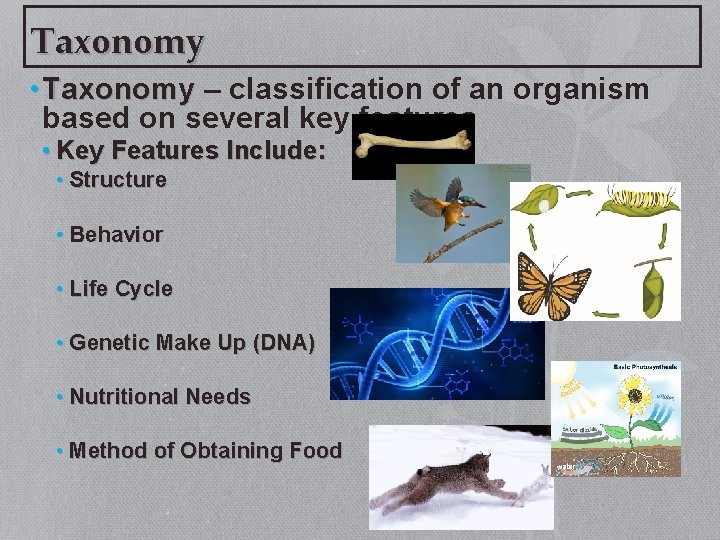
Taxonomy • Taxonomy – classification of an organism based on several key features • Key Features Include: • Structure • Behavior • Life Cycle • Genetic Make Up (DNA) • Nutritional Needs • Method of Obtaining Food
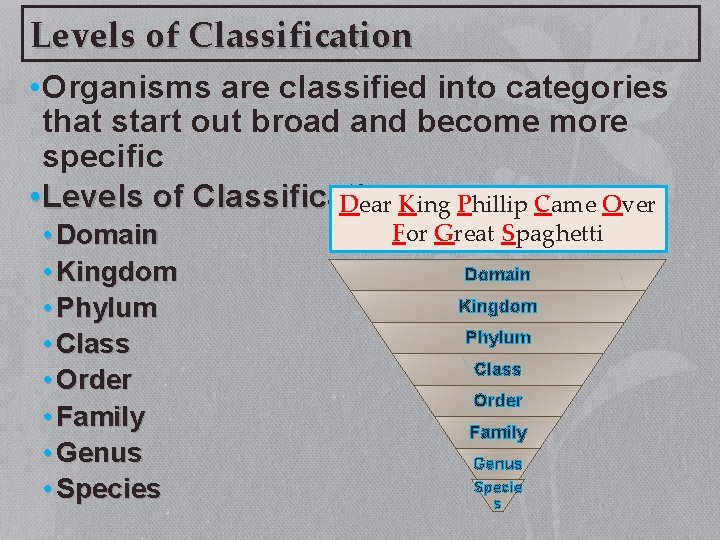
Levels of Classification • Organisms are classified into categories that start out broad and become more specific • Levels of Classification: Dear King Phillip Came Over • Domain • Kingdom • Phylum • Class • Order • Family • Genus • Species For Great Spaghetti Domain Kingdom Phylum Class Order Family Genus Specie s
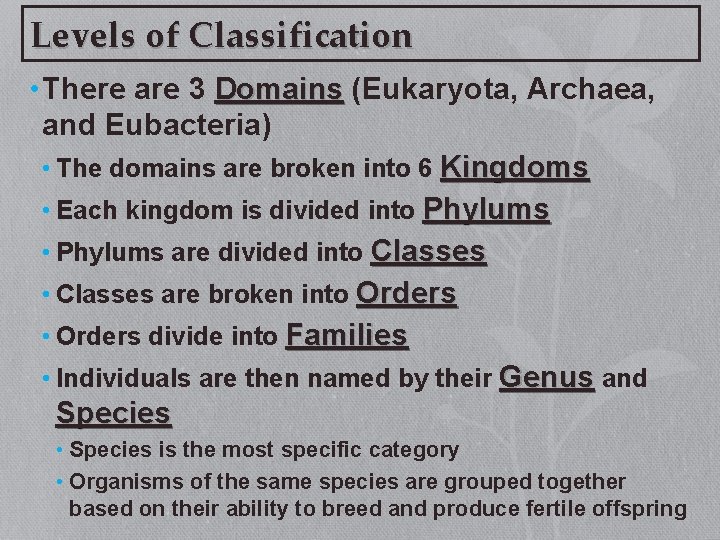
Levels of Classification • There are 3 Domains (Eukaryota, Archaea, and Eubacteria) • The domains are broken into 6 Kingdoms • Each kingdom is divided into Phylums • Phylums are divided into Classes • Classes are broken into Orders • Orders divide into Families • Individuals are then named by their Genus and Species • Species is the most specific category • Organisms of the same species are grouped together based on their ability to breed and produce fertile offspring
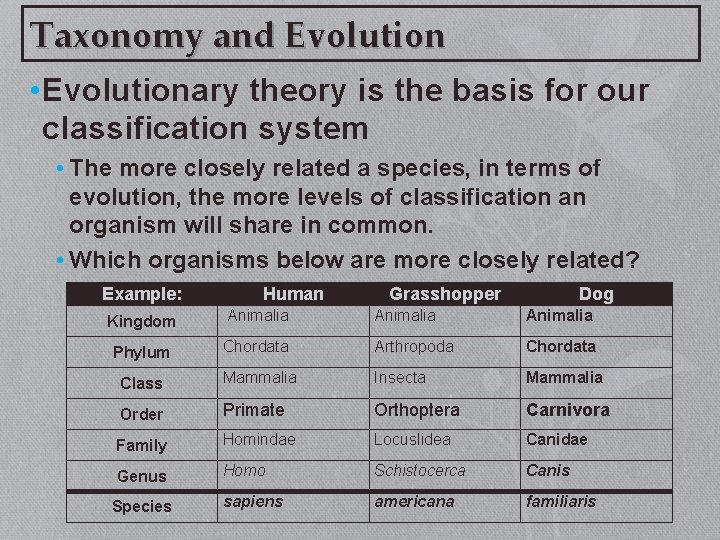
Taxonomy and Evolution • Evolutionary theory is the basis for our classification system • The more closely related a species, in terms of evolution, the more levels of classification an organism will share in common. • Which organisms below are more closely related? Example: Human Grasshopper Dog Kingdom Animalia Phylum Chordata Arthropoda Chordata Class Mammalia Insecta Mammalia Order Primate Orthoptera Carnivora Family Homindae Locuslidea Canidae Genus Homo Schistocerca Canis sapiens americana familiaris Species
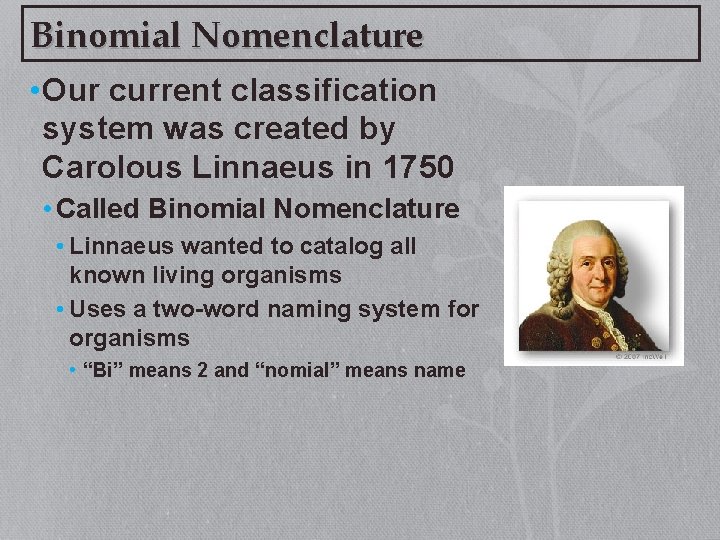
Binomial Nomenclature • Our current classification system was created by Carolous Linnaeus in 1750 • Called Binomial Nomenclature • Linnaeus wanted to catalog all known living organisms • Uses a two-word naming system for organisms • “Bi” means 2 and “nomial” means name
Rules of Binomial Nomenclature • Names are written in latin • Considered an organism’s scientific name • Includes two names • First word: Genus • Second word: Species • The entire scientific name is italicized or underlined • The genus name is capitlized • After the name has been used once it may be abbreviated with the genus as just the first letter • Example: Homo sapiens • Abbreviation: H. sapiens • Helps to avoid confusion of organisms if using common names which change based on location and native language
- Slides: 7